REVIEW 3 major objections 4 minor 19 references
Unleashing Uncertainty: Efficient Machine Unlearning for Generative AI
T0 review · 3 major / 4 minor · reviewed 2026-08-05 · deepseek-v4-flash
Pith's one-line read The paper claims that SAFEMax—an entropy-maximization fine-tuning scheme that makes a diffusion model emit pure Gaussian noise when conditioned on an impermissible class, with an exponential schedule focusing unlearning on early diffusion s
desk verdict SAFEMax is a simple and likely efficient unlearning trick for diffusion models, but the headline 100% unlearning accuracy is an artifact of the evaluation classifier and the theory is cosmetic; the core idea deserves a careful revision, not a desk reject. read the letter →
The pith
A machine-rendered reading of the paper's core claim, the machinery that carries it, and where it could break.
The reading
What carries the argument
The carrying mechanism is the SAFEMax forget loss, Lf = E[ψ(t) ||ϵ_T − ϵθ(xt, cf, t)||²], i.e., the standard DDPM reconstruction loss with the target noise replaced by ϵ_T and weighted by the exponentially decaying scheduler ψ(t)=exp(−λt/T). Here ϵ_T is the maximum-entropy latent reached at the end of the forward process, and the scheduler emphasizes the early timesteps, where the paper assumes class-specific information is concentrated. The information-theoretic backing is Fano's inequality, which converts the entropy increase into a lower bound on the probability that the reconstruction preserves the original class semantics.
What would settle it
Train SAFEMax while probing the latent states x_t at each timestep with a small classifier: if class information remains strong near the end of the diffusion chain, the exponential scheduler under-weights exactly the steps that need changing, so forget-class outputs should still contain class traces. A second check is to replace the evaluation classifier with one calibrated to treat pure Gaussian noise as 'no class'; if any class other than CIFAR-10 class 2 then shows unlearning accuracy below 100%, the perfect-unlearning result is at least partly an artifact of classifier bias.
Extended reading notes
Core claim
On the paper's own terms, the discovery is an effective unlearning recipe for DDPMs: keep the standard denoising objective, but for the forget class replace the ground-truth noise target with ϵ_T, the nearly pure Gaussian noise reached at the end of the forward diffusion, so the model is trained to generate maximum-entropy noise and effectively halt denoising when conditioned on that class, rather than generating a wrong image. The update is weighted by ψ(t)=exp(−λt/T), an exponentially decaying schedule that concentrates unlearning in the early timesteps where class-specific semantics are formed. The paper argues via Fano's inequality that raising the conditional entropy H(x | x̂) raises th
Load-bearing premise
The load-bearing premise is that class-specific information lives mainly in the early diffusion steps; if it persists into later steps, or if early steps also hold features the retained classes need, SAFEMax will either not fully forget the target class or will visibly degrade the others.
Editorial extensions
If this is right
- Unlearning for a diffusion model can be reduced to a single additional objective on the noise target, removing the need for Fisher Information Matrix, saliency masks, or multi-objective regularization that drive the overhead of existing baselines.
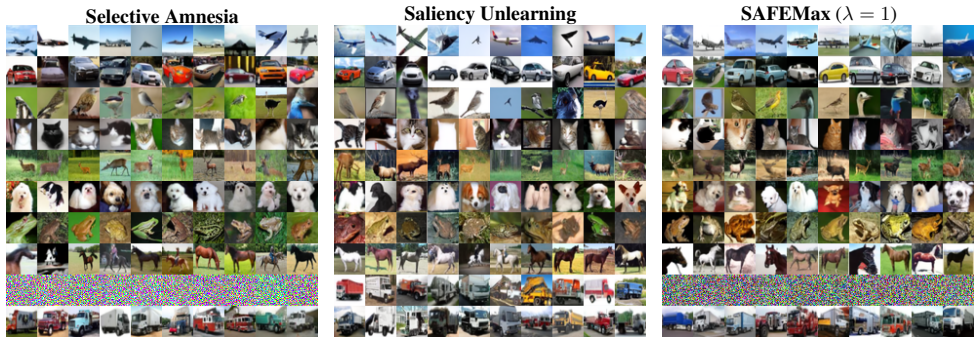
- On CIFAR-10, SAFEMax reaches 100% unlearning accuracy in nine of ten classes while achieving the best mean retention FID (16.74), suggesting that forgetting and retaining can be balanced without a major quality trade-off.
- Runtime drops to 5.83 minutes versus 11.81 for SalUn and 174.37 for Selective Amnesia, and peak GPU memory drops to 9.50 GB versus 23.23 and 17.29 GB, making class-level unlearning practical on more modest hardware.
- The scheduler ψ(t) acts as a single dial: increasing λ retains more information—even for the forget class—so practitioners can choose how aggressively to forget versus how much to preserve.
Reading between the lines
- The same entropy-maximization trick could transfer to text-to-image or Stable Diffusion unlearning by guiding the text-conditioned latent toward a high-entropy prior in the early denoising steps; the paper does not test this, but it follows naturally from treating the scheduler as a way to localize unlearning in time.
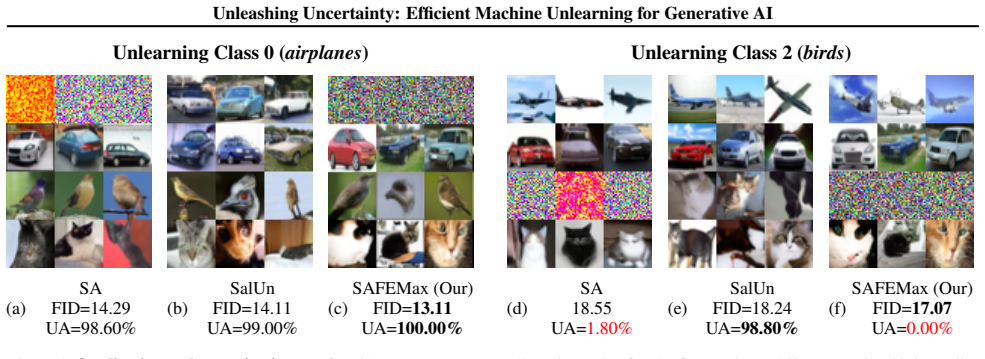
- The class-2 result shows that unlearning accuracy alone is misleading when the forget behavior is noise: a classifier that mistakes noise for the class reports 0% unlearning. A practical corollary is that generative unlearning evaluations should also measure how close forget-class outputs are to the model's true noise prior, not just classifier confusion.
- Because SAFEMax changes the model's output behavior rather than the information content of its weights, it provides functional unlearning, not certified deletion; applications requiring formal guarantees would need additional mechanisms.
- A cheap way to validate and tune the central assumption would be to measure class information in latent states across timesteps; if the distribution of class information shifts across datasets or class granularities, the optimal λ would shift with it.
Editorial analysis
A structured set of objections, weighed in public.
Referee Report
Summary. The paper proposes SAFEMax, an unlearning method for class-conditional DDPMs. It fine-tunes the model on the forget class using a weighted noise-prediction loss that emphasizes early diffusion steps, with the aim of making the model output high-entropy Gaussian noise instead of images for that class, while retained classes are fine-tuned normally. Experiments on CIFAR-10 report UA=100% for 9/10 forget classes, the best retention FID among the compared baselines, and substantially lower runtime and GPU memory than Selective Amnesia and Saliency Unlearning. An ablation studies the effect of the decay parameter λ.
Significance. If the empirical claims hold, SAFEMax is a simple and efficient alternative to FIM- or mask-based unlearning, with clear practical value for resource-constrained settings. The paper deserves credit for comparing against two established baselines, reporting efficiency metrics, and including an ablation of the scheduler. The evaluation is not circular in that it uses an external classifier and FID. However, the significance is limited by the single dataset/model and, more importantly, by the fragility of the unlearning metric: the headline UA numbers are produced by a single classifier on outputs that are close to pure noise, for which any classifier's labels are essentially arbitrary. The theoretical framing also needs clarification before the claimed information-theoretic grounding can be accepted.
major comments (3)
- [§3, Table 1] The headline unlearning claim rests on UA from a single ResNet34 classifier. The class-2 row demonstrates the problem: SAFEMax produces noise with essentially the same classifier entropy (H=1.156) as classes where UA=100%, yet UA=0% because the classifier labels the noise as birds. Pure Gaussian noise can be assigned to any class by a fixed decision boundary, so the difference between 100% and 0% reflects classifier bias, not a difference in forgetting. The authors' own caveat that UA can be misleading in isolation therefore applies to all rows, not only class 2. Please add classifier-independent evidence (e.g., distributional distance from the forget-class training data, multiple classifiers, or forget-class FID/IS) and treat UA as a secondary metric.
- [§2, Eq. (3)] The proposed loss is not derived from the stated entropy-maximization objective, and its definition is ambiguous. If ε_T is the final-step noise and is independent of x_t for t<T, the L2-optimal prediction is E[ε_T | x_t, c_f, t] = 0, meaning the model is trained to output zero noise, not to generate Gaussian noise. If ε_T is instead meant to be the same reparameterized noise as ε_t, then Eq. (3) is essentially the standard diffusion objective weighted by ψ(t), which would not halt denoising. The paper needs to specify the exact coupling between ε_T and x_t and show how optimizing Eq. (3) increases H(x | x̂). The Fano bound in Eq. (4) has a missing citation and does not by itself imply Eq. (3). In addition, the statement in §2 that 'x_T approximates the mean of the training data distribution' is false: q(x_T) is approximately N(0,I), independent of x0.
- [§2, Eq. (5) and §3, Fig. 3] The claim that class-specific information is concentrated in early diffusion steps is not directly tested; no probe of internal representations or per-timestep analysis is provided. The ablation shows that λ=0 already achieves UA=100% and that λ=1 gives only a 5.6% FID improvement on a single class. This is weak evidence for the scheduler's role in balancing forgetting and retention. Please report the ablation across all classes and include variance estimates, or substantially soften the mechanistic claim in the introduction and abstract.
minor comments (4)
- [References] There are missing citations marked '?' for Fano's inequality and CIFAR-10; these should be filled in.
- [§3, Efficiency] The FIM computation time for Selective Amnesia (1226.98 minutes) is mentioned in the text but not in Table 2, and the claimed 230× total speed-up does not match the stated arithmetic ((174.37+1226.98)/5.83 ≈ 240). Clarify exactly what is included in each runtime figure.
- [Table 1] The reported entropy H≈1.1 on a 10-class softmax is far below the maximum log2(10)≈3.32. Calling this 'maximum entropy' is misleading; consider reporting normalized entropy or the full softmax distribution.
- [§3, Experiments] Please report the number of generated samples used for UA and FID, whether multiple seeds were run, and any confidence intervals. This is important for reproducibility.
Circularity Check
No significant circularity; central claims are independently benchmarked; minor self-citation is motivational only.
full rationale
SAFEMax's unlearning objective (Eq. 3) directly trains the denoiser to output the terminal Gaussian noise for the forget class; the paper's empirical evaluation measures forgetting via an external ResNet34 classifier and retention via FID, so the headline numbers are not derived from the method's own assumptions. The information-theoretic discussion (Eq. 4) is a post-hoc interpretation of why outputting high-entropy noise should cause classifier uncertainty, not a derivation that presupposes the conclusion; it adds no independent predictive content but is not circular because the loss was not constructed from Fano's inequality. The only self-citation is to the authors' prior LoTUS paper as inspiration for entropy-based unlearning and loss scheduling; it is not load-bearing, as the scheduler's contribution is tested in an ablation and the method works without it. The anomalous Class 2 UA=0% is acknowledged as a classifier artifact and does not constitute a circular step, only a validity caveat. Hence score 2 for a minor, non-load-bearing self-citation.
Assumptions & free parameters
free parameters (1)
- λ (decay rate) =
1
assumptions (3)
- standard math Fano's inequality, as applied to semantic reconstruction error (Eq. 4), supports the entropy-maximization rationale for unlearning.
- standard math The forward diffusion process makes later latent states of different classes similar, with the final state x_T being pure Gaussian noise.
- domain assumption Class-specific information is prominent in early diffusion steps and is progressively obscured by Gaussian noise (Figure 1, Section 2).
Cite this review
Pith. "Pith review of Unleashing Uncertainty: Efficient Machine Unlearning for Generative AI." pith.science (2026). https://pith.science/paper/4ZBHHRLD
@misc{pith2026250820773,
  author       = {Pith},
  title        = {Pith review of: Unleashing Uncertainty: Efficient Machine Unlearning for Generative AI},
  year         = {2026},
  howpublished = {\url{https://pith.science/paper/4ZBHHRLD}},
  note         = {Machine review of arXiv:2508.20773}
}
read the original abstract
We introduce SAFEMax, a novel method for Machine Unlearning in diffusion models. Grounded in information-theoretic principles, SAFEMax maximizes the entropy in generated images, causing the model to generate Gaussian noise when conditioned on impermissible classes by ultimately halting its denoising process. Also, our method controls the balance between forgetting and retention by selectively focusing on the early diffusion steps, where class-specific information is prominent. Our results demonstrate the effectiveness of SAFEMax and highlight its substantial efficiency gains over state-of-the-art methods.
Figures


Figures from the paper (10 more)



Reference graph
Works this paper leans on
-
[1]
Fan, C., Liu, J., Zhang, Y., Wei, D., Wong, E., and Liu, S. Salun: Empowering machine unlearning via gradient-based weight saliency in both image classification and generation. In International Conference on Learning Representations, 2024
work page 2024
-
[2]
Fast machine unlearning without retraining through selective synaptic dampening
Foster, J., Schoepf, S., and Brintrup, A. Fast machine unlearning without retraining through selective synaptic dampening. In Proceedings of the AAAI conference on artificial intelligence, volume 38, pp.\ 12043--12051, 2024
work page 2024
-
[3]
Eternal sunshine of the spotless net: Selective forgetting in deep networks
Golatkar, A., Achille, A., and Soatto, S. Eternal sunshine of the spotless net: Selective forgetting in deep networks. In Proceedings of the IEEE/CVF conference on computer vision and pattern recognition, pp.\ 9304--9312, 2020
work page 2020
-
[4]
Graves, L., Nagisetty, V., and Ganesh, V. Amnesiac machine learning. In Proceedings of the AAAI Conference on Artificial Intelligence, volume 35, pp.\ 11516--11524, 2021
work page 2021
-
[5]
Heng, A. and Soh, H. Selective amnesia: A continual learning approach to forgetting in deep generative models. Advances in Neural Information Processing Systems, 36: 0 17170--17194, 2023
work page 2023
-
[6]
Denoising diffusion probabilistic models
Ho, J., Jain, A., and Abbeel, P. Denoising diffusion probabilistic models. Advances in neural information processing systems, 33: 0 6840--6851, 2020
2020
-
[7]
Model sparsity can simplify machine unlearning
Jia, J., Liu, J., Ram, P., Yao, Y., Liu, G., Liu, Y., Sharma, P., and Liu, S. Model sparsity can simplify machine unlearning. Advances in Neural Information Processing Systems, 36: 0 51584--51605, 2023
work page 2023
-
[8]
T., Li, Q., Jin, M., Song, D., and Jia, R
Ko, M., Li, H., Wang, Z., Patsenker, J., Wang, J. T., Li, Q., Jin, M., Song, D., and Jia, R. Boosting alignment for post-unlearning text-to-image generative models. Advances in Neural Information Processing Systems, 37: 0 85131--85154, 2024
work page 2024
Show all 19 references
-
[9]
Ablating concepts in text-to-image diffusion models
Kumari, N., Zhang, B., Wang, S.-Y., Shechtman, E., Zhang, R., and Zhu, J.-Y. Ablating concepts in text-to-image diffusion models. In Proceedings of the IEEE/CVF International Conference on Computer Vision (ICCV), pp.\ 22691--22702, October 2023
2023
-
[10]
Towards unbounded machine unlearning
Kurmanji, M., Triantafillou, P., Hayes, J., and Triantafillou, E. Towards unbounded machine unlearning. Advances in neural information processing systems, 36: 0 1957--1987, 2023
1957
-
[11]
Machine unlearning for image-to-image generative models
Li, G., Hsu, H., Chen, C.-F., and Marculescu, R. Machine unlearning for image-to-image generative models. In The Twelfth International Conference on Learning Representations, 2024
2024
-
[12]
Scissorhands: Exploiting the persistence of importance hypothesis for llm kv cache compression at test time
Liu, Z., Desai, A., Liao, F., Wang, W., Xie, V., Xu, Z., Kyrillidis, A., and Shrivastava, A. Scissorhands: Exploiting the persistence of importance hypothesis for llm kv cache compression at test time. Advances in Neural Information Processing Systems, 36: 0 52342--52364, 2023
2023
-
[13]
and Qiu, Q
Patel, G. and Qiu, Q. Learning to unlearn while retaining: Combating gradient conflicts in machine unlearning, 2025
2025
-
[14]
N., Semertzidis, T., Gavves, S., and Daras, P
Spartalis, C. N., Semertzidis, T., Gavves, S., and Daras, P. Lotus: Large-scale machine unlearning with a taste of uncertainty. In Proceedings of the IEEE/CVF conference on computer vision and pattern recognition, 2025
2025
-
[15]
Unrolling sgd: Understanding factors influencing machine unlearning
Thudi, A., Deza, G., Chandrasekaran, V., and Papernot, N. Unrolling sgd: Understanding factors influencing machine unlearning. In 2022 IEEE 7th European Symposium on Security and Privacy (EuroS&P), pp.\ 303--319. IEEE, 2022
2022
-
[16]
Triantafillou, E., Kairouz, P., Pedregosa, F., Hayes, J., Kurmanji, M., Zhao, K., Dumoulin, V., J \'u nior, J. C. J., Mitliagkas, I., Wan, J., et al. Are we making progress in unlearning? findings from the first neurips unlearning competition. CoRR, 2024
2024
-
[17]
and Harandi, M
Wu, J. and Harandi, M. Munba: Machine unlearning via nash bargaining. arXiv preprint arXiv:2411.15537, 2024
2024 arXiv
-
[18]
Diffusion tuning: Transferring diffusion models via chain of forgetting
Zhong, J., Guo, X., Dong, J., and Long, M. Diffusion tuning: Transferring diffusion models via chain of forgetting. In The Thirty-eighth Annual Conference on Neural Information Processing Systems, 2024
2024
-
[19]
write newline
" write newline "" before.all 'output.state := FUNCTION n.dashify 't := "" t empty not t #1 #1 substring "-" = t #1 #2 substring "--" = not "--" * t #2 global.max substring 't := t #1 #1 substring "-" = "-" * t #2 global.max substring 't := while if t #1 #1 substring * t #2 gl...
Reviewed August 5, 2026 · model on record in the stance chip above.
Discussion (0). Sign in to comment.