Confinement in the three-state Potts quantum spin chain in extreme ferromagnetic limit
Pith reviewed 2026-05-18 20:48 UTC · model grok-4.3
The pith
Perturbative expansion in the transverse field describes resonant excitations and post-quench dynamics in the three-state Potts quantum spin chain
A machine-rendered reading of the paper's core claim, the machinery that carries it, and where it could break.
Core claim
In the extreme ferromagnetic limit a perturbative expansion in the transverse magnetic field gives access to resonant excitations that form when unconfined kinks hybridize with two-kink bound states in the oblique quench regime. The same expansion supplies closed-form predictions for the post-quench time evolution of the magnetization, which match direct numerical simulations of the non-equilibrium dynamics.
What carries the argument
Perturbative expansion in the transverse magnetic field, used to extract the analytic structure of the two-kink scattering amplitude and the resulting resonances near stability thresholds.
If this is right
- Stable two-kink bound states transform into resonances near stability thresholds.
- Analytic expressions for the excitation spectrum become available throughout the oblique quench regime.
- Post-quench magnetization dynamics can be predicted analytically instead of only numerically.
- Confinement phenomenology in the Potts chain includes hybridization channels absent from the Ising chain.
Where Pith is reading between the lines
- The same perturbative treatment could be applied to clock models with more than three states to locate analogous resonance thresholds.
- The resonance description supplies a concrete starting point for studying how confinement affects thermalization after a quench in related one-dimensional quantum systems.
- Higher-order corrections in the transverse field could be computed to test the range of validity of the leading-order resonance predictions.
Load-bearing premise
The perturbative expansion in the transverse magnetic field remains valid and correctly captures the hybridization of unconfined kinks with two-kink bound states near stability thresholds.
What would settle it
A numerical diagonalization or time-evolution run at moderate transverse-field strength that produces excitation energies or magnetization traces differing from the perturbative formulas would falsify the claim.
Figures




read the original abstract
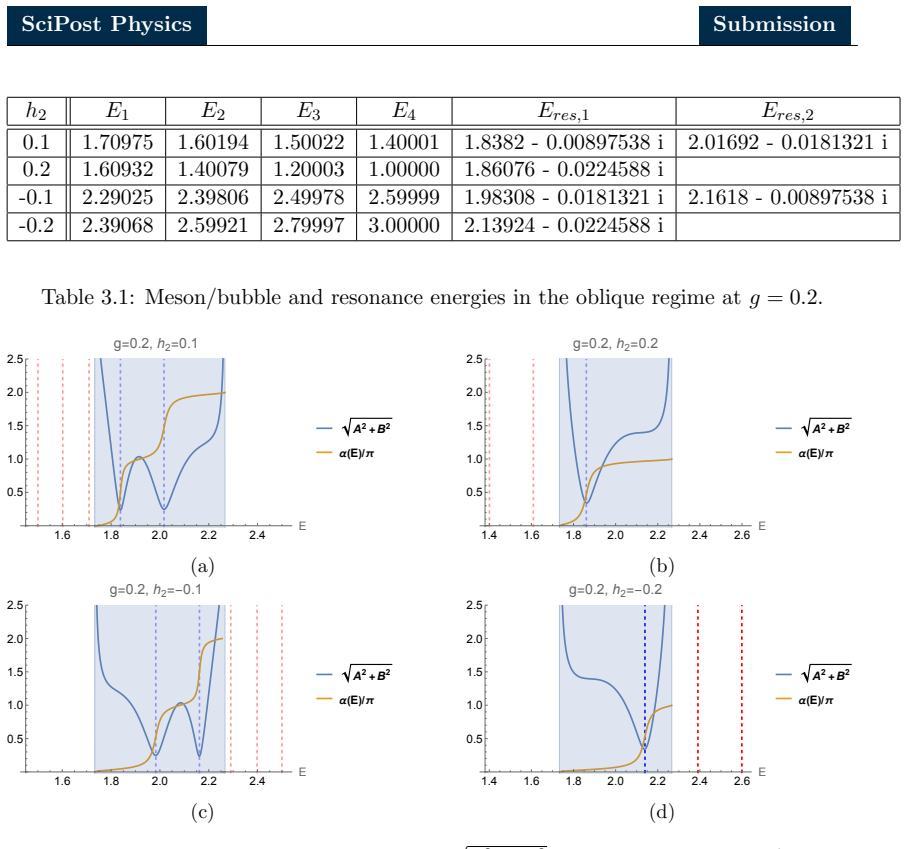
We investigate the dynamics of the three-state Potts quantum spin chain in the extreme ferromagnetic limit using a perturbative expansion in the transverse magnetic field. We demonstrate that a perturbative approach provides access to important features beyond the reach of previous studies, most notably the description of resonant excitations and the analytic prediction of post-quench time evolution. A central focus is the oblique quench regime - a feature unique to the Potts model with no Ising counterpart - in which unconfined kink excitations hybridise with the two-kink bound states. We provide a detailed examination of the analytic structure of the two-kink scattering amplitude, tracing the transformation of stable excitations into resonances near stability thresholds. Our analytical results for the excitation spectra and magnetisation dynamics show excellent agreement with numerical simulations of non-equilibrium dynamics.
Editorial analysis
A structured set of objections, weighed in public.
Referee Report
Summary. The paper investigates the dynamics of the three-state Potts quantum spin chain in the extreme ferromagnetic limit via a perturbative expansion in the transverse magnetic field h. It focuses on the oblique-quench regime unique to the Potts model, where unconfined kinks hybridize with two-kink bound states, and provides an analytic treatment of the two-kink scattering amplitude that tracks the transformation of stable excitations into resonances near stability thresholds. The work claims analytic predictions for excitation spectra and post-quench magnetization dynamics that show excellent agreement with numerical simulations of non-equilibrium evolution.
Significance. If the perturbative results hold, the manuscript offers a valuable analytic window into resonant excitations and time evolution in a regime inaccessible to prior Ising-based studies, with the explicit treatment of hybridization and resonance formation constituting a clear advance. The reported numerical agreement is a strength, though the absence of explicit convergence tests leaves the quantitative reliability near thresholds open to further verification.
major comments (1)
- [analytic structure of the two-kink scattering amplitude (near stability thresholds)] The central claim that the leading-order perturbative scattering amplitude quantitatively captures resonance positions and widths near kink stability thresholds (where the T-matrix denominator approaches zero) is load-bearing for the oblique-quench analysis. The manuscript does not report an explicit check of convergence with respect to higher orders in h or finite-size scaling in the critical oblique window; such a test is required to rule out non-perturbative shifts comparable to the leading correction itself.
minor comments (1)
- [Introduction and methods] Notation for the effective kink Hamiltonian and the definition of the oblique angle should be cross-referenced more explicitly to earlier sections to aid readers unfamiliar with Potts-model conventions.
Simulated Author's Rebuttal
We thank the referee for their careful reading of our manuscript and for the constructive comments. We address the major comment below and have revised the manuscript to strengthen the presentation of our perturbative results.
read point-by-point responses
-
Referee: The central claim that the leading-order perturbative scattering amplitude quantitatively captures resonance positions and widths near kink stability thresholds (where the T-matrix denominator approaches zero) is load-bearing for the oblique-quench analysis. The manuscript does not report an explicit check of convergence with respect to higher orders in h or finite-size scaling in the critical oblique window; such a test is required to rule out non-perturbative shifts comparable to the leading correction itself.
Authors: We agree that an explicit discussion of convergence would strengthen the quantitative claims near stability thresholds. In the revised manuscript we have added a new paragraph in the section on the two-kink scattering amplitude that estimates the size of higher-order corrections. Because the leading hybridization and resonance formation arise at O(h) while the next corrections enter at O(h^2), the relative shift remains parametrically small throughout the extreme ferromagnetic regime (h ≪ 1) considered in the work. We have also included a supplementary figure that demonstrates convergence of the resonance positions with system size for the lattice lengths used in the numerical benchmarks. These additions show that non-perturbative shifts do not alter the leading-order predictions at the level of accuracy reported. We therefore maintain that the analytic structure derived at leading order remains quantitatively reliable for the oblique-quench dynamics. revision: partial
Circularity Check
No significant circularity; derivation grounded in standard perturbation theory
full rationale
The paper applies a perturbative expansion in the transverse magnetic field to the three-state Potts quantum spin chain Hamiltonian in the extreme ferromagnetic limit. This yields analytic expressions for excitation spectra, resonant states, and post-quench dynamics that are then compared to independent numerical simulations. No load-bearing step reduces by construction to a fitted parameter or self-citation chain; the central results follow from the effective kink Hamiltonian and scattering amplitude derived order-by-order, with the oblique-quench hybridization emerging directly from the perturbative T-matrix without renaming or self-referential closure. The approach remains self-contained against external benchmarks.
Axiom & Free-Parameter Ledger
Lean theorems connected to this paper
-
IndisputableMonolith/Cost/FunctionalEquation.leanwashburn_uniqueness_aczel unclear?
unclearRelation between the paper passage and the cited Recognition theorem.
The difference equation (2.43) can be easily solved using the equality for the Bessel function of the first kind Jc(Z), Jc+1(Z) + Jc−1(Z) = 2c/Z Jc(Z). The appropriate solution reads: ψι(j) = (sign h1)j+1 Jj+c0(Z)
-
IndisputableMonolith/Foundation/DAlembert.leandAlembert_cosh_solution_aczel unclear?
unclearRelation between the paper passage and the cited Recognition theorem.
The scattering amplitude S(z, v2) = Bin(z−1,v2)/Bin(z,v2) of two unconfined kinks reads: S(z, v2) = − [z−1 J1−c0(z,v2)(4/3|v2|) + 4 sign v2 J−c0(z,v2)(4/3|v2|)] / [z J1−c0(z,v2)(4/3|v2|) + 4 sign v2 J−c0(z,v2)(4/3|v2|)]
What do these tags mean?
- matches
- The paper's claim is directly supported by a theorem in the formal canon.
- supports
- The theorem supports part of the paper's argument, but the paper may add assumptions or extra steps.
- extends
- The paper goes beyond the formal theorem; the theorem is a base layer rather than the whole result.
- uses
- The paper appears to rely on the theorem as machinery.
- contradicts
- The paper's claim conflicts with a theorem or certificate in the canon.
- unclear
- Pith found a possible connection, but the passage is too broad, indirect, or ambiguous to say the theorem truly supports the claim.
Reference graph
Works this paper leans on
-
[1]
K. G. Wilson, Confinement of quarks , Phys. Rev. D 10, 2445 (1974), doi:10.1103/PhysRevD.10.2445. 39 SciPost Physics Submission 1.6 1.8 2.0 2.2 2.4 -0.006 -0.004 -0.002 (a) 1.6 1.8 2.0 2.2 2.4 -0.006 -0.004 -0.002 (b) Figure B.2: Comparison of the analytically calculated a ReF (1) 2 (ω) with the numerically computed ReM2(ω) for the positive oblique quench...
-
[2]
Narison, QCD as a Theory of Hadrons , Cambridge University Press, Cambridge (2004)
S. Narison, QCD as a Theory of Hadrons , Cambridge University Press, Cambridge (2004)
work page 2004
-
[3]
B. M. McCoy and T. T. Wu, Two dimensional Ising field theory in a magnetic field: Breakup of the cut in the two-point function , Phys. Rev. D 18, 1259 (1978), doi:10.1103/PhysRevD.18.1259
-
[4]
Non-integrable Quantum Field Theories as Perturbations of Certain Integrable Models
G. Delfino, G. Mussardo and P. Simonetti, Non-integrable quantum field theo- ries as perturbations of certain integrable models , Nucl. Phys. B 473, 469 (1996), doi:10.1016/0550-3213(96)00265-9, hep-th/9603011
work page internal anchor Pith review Pith/arXiv arXiv doi:10.1016/0550-3213(96)00265-9 1996
-
[5]
Non-integrable aspects of the multi-frequency Sine-Gordon model
G. Delfino and G. Mussardo, Non-integrable aspects of the multi-frequency sine- Gordon model, Nucl. Phys. B 516, 675 (1998), doi:10.1016/S0550-3213(98)00063-7, hep-th/9709028
work page internal anchor Pith review Pith/arXiv arXiv doi:10.1016/s0550-3213(98)00063-7 1998
-
[6]
P. Fonseca and A. B. Zamolodchikov, Ising field theory in a magnetic field: Analytic properties of the free energy , J. Stat. Phys. 110, 527 (2003), doi:https://doi.org/10.1023/A:1022147532606
-
[7]
Ising Spectroscopy I: Mesons at T < T_c
P. Fonseca and A. B. Zamolodchikov, Ising spectroscopy I: Mesons at T < T c (2006), arXiv:hep-th/0612304
work page internal anchor Pith review Pith/arXiv arXiv 2006
-
[8]
S. B. Rutkevich, Energy Spectrum of Bound-Spinons in the Quantum Ising Spin- Chain Ferromagnet, J. Stat. Phys. 131, 917 (2008), doi:10.1007/s10955-008-9495-1, 0712.3189
work page internal anchor Pith review Pith/arXiv arXiv doi:10.1007/s10955-008-9495-1 2008
-
[10]
S. B. Rutkevich, Kink confinement in the antiferromagnetic XXZ spin-(1/2) chain in a weak staggered magnetic field , EPL (Europhys. Lett.) 121, 37001 (2018), doi:10.1209/0295-5075/121/37001, 1710.11605
work page internal anchor Pith review Pith/arXiv arXiv doi:10.1209/0295-5075/121/37001 2018
-
[11]
G. Lagnese, F. M. Surace, M. Kormos and P. Calabrese, Confinement in the spectrum of a Heisenberg–Ising spin ladder , J. Stat. Mech. Theor. Exp. 2020, 093106 (2020), doi:10.1088/1742-5468/abb368
-
[12]
F. B. Ramos, M. Lencs´ es, J. C. Xavier and R. G. Pereira, Confinement and bound states of bound states in a transverse-field two-leg Ising ladder , Phys. Rev. B 102, 014426 (2020), doi:10.1103/PhysRevB.102.014426, 2005.03145
-
[13]
M. Lencs´ es, G. Mussardo and G. Tak´ acs,Confinement in the tricritical Ising model , Phys. Lett. B 828, 137008 (2022), doi:10.1016/j.physletb.2022.137008
-
[14]
Rutkevich, Soliton confinement in the double sine-Gordon model , SciPost Phys
S. Rutkevich, Soliton confinement in the double sine-Gordon model , SciPost Phys. 16, 042 (2024), doi:10.21468/SciPostPhys.16.2.042, 2311.07303
-
[15]
Hamiltonian truncation approach to quenches in the Ising field theory
T. Rakovszky, M. Mesty´ an, M. Collura, M. Kormos and G. Tak´ acs, Hamiltonian truncation approach to quenches in the Ising field theory , Nucl. Phys. B 911, 805 (2016), doi:10.1016/j.nuclphysb.2016.08.024, 1607.01068
work page internal anchor Pith review Pith/arXiv arXiv doi:10.1016/j.nuclphysb.2016.08.024 2016
-
[16]
S. B. Rutkevich, Large-n Excitations in the Ferromagnetic Ising Field Theory in a Weak Magnetic Field: Mass Spectrum and Decay Widths, Phys. Rev. Lett. 95, 250601 (2005), doi:10.1103/PhysRevLett.95.250601, hep-th/0509149. 41 SciPost Physics Submission
work page internal anchor Pith review Pith/arXiv arXiv doi:10.1103/physrevlett.95.250601 2005
-
[17]
S. B. Rutkevich, Formfactor perturbation expansions and confinement in the Ising field theory , J. of Phys. A Math. Gen. 42, 304025 (2009), doi:10.1088/1751- 8113/42/30/304025, 0901.1571
work page internal anchor Pith review Pith/arXiv arXiv doi:10.1088/1751- 2009
-
[18]
M. Lencs´ es and G. Tak´ acs,Confinement in the q-state Potts model: an RG-TCSA study, J. High Energ. Phys. 2015, 146 (2015), doi:10.1007/JHEP09(2015)146, 1506. 06477
-
[19]
M. Kormos, M. Collura, G. Tak´ acs and P. Calabrese, Real-time confinement fol- lowing a quantum quench to a non-integrable model , Nat. Phys. 13, 246 (2017), doi:10.1038/nphys3934
-
[20]
O. Pomponio, M. A. Werner, G. Zar´ and and G. Tak´ acs,Bloch oscillations and the lack of the decay of the false vacuum in a one-dimensional quantum spin chain , SciPost Phys. 12, 061 (2022), doi:10.21468/SciPostPhys.12.2.061
-
[21]
A. Krasznai and G. Tak´ acs, Escaping fronts in local quenches of a confining spin chain, Scipost Phys. 16, 138 (2024), doi:10.21468/SciPostPhys.16.5.138, 2401.04193
-
[22]
L. Chim and A. Zamolodchikov, Integrable Field Theory of the q-State Potts Model with 0 < q < 4, Int. J. Mod. Phys. A 7, 5317 (1992), doi:10.1142/S0217751X9200243X
-
[23]
A. N. Kirillov and F. A. Smirnov, Local fields in scaling field theory associated with 3-state Potts model , ITF Kiev preprint ITF-88-73R (in Russian) (1988)
work page 1988
-
[24]
Confinement in the q-state Potts field theory
G. Delfino and P. Grinza, Confinement in the q-state Potts field theory , Nucl. Phys. B 791, 265 (2008), doi:10.1016/j.nuclphysb.2007.09.003, 0706.1020
work page internal anchor Pith review Pith/arXiv arXiv doi:10.1016/j.nuclphysb.2007.09.003 2008
-
[26]
O. Pomponio, A. Krasznai and G. Tak´ acs, Confinement and false vac- uum decay on the Potts quantum spin chain , SciPost Phys. 18, 082 (2025), doi:10.21468/SciPostPhys.18.3.082
-
[27]
´A. Rapp, G. Zar´ and, C. Honerkamp and W. Hofstetter, Color Superfluidity and “Baryon” Formation in Ultracold Fermions , Phys. Rev. Lett. 98, 160405 (2007), doi:10.1103/PhysRevLett.98.160405, cond-mat/0607138
work page internal anchor Pith review Pith/arXiv arXiv doi:10.1103/physrevlett.98.160405 2007
-
[28]
F. Liu, S. Whitsitt, P. Bienias, R. Lundgren and A. V. Gorshkov, Realizing and Probing Baryonic Excitations in Rydberg Atom Arrays arXiv:2007.07258 (2020), doi:10.48550/arXiv.2007.07258, 2007.07258
-
[29]
M. A. Werner, C. P. Moca, M. Kormos, ¨O. Legeza, B. D´ ora and G. Zar´ and, Spectroscopic evidence for engineered hadronic bound state formation in repul- sive fermionic SU(N ) Hubbard systems , Phys. Rev. Research 043020 (2023), doi:10.1103/PhysRevResearch.5.043020, 2207.00994
-
[30]
P. P. Mazza, G. Perfetto, A. Lerose, M. Collura and A. Gambassi, Suppression of transport in nondisordered quantum spin chains due to confined excitations , Phys. Rev. B 99, 180302 (2019), doi:10.1103/PhysRevB.99.180302, 1806.09674. 42 SciPost Physics Submission
work page internal anchor Pith review Pith/arXiv arXiv doi:10.1103/physrevb.99.180302 2019
-
[31]
A. Lerose, F. M. Surace, P. P. Mazza, G. Perfetto, M. Collura and A. Gambassi, Quasilocalized dynamics from confinement of quantum excitations , Phys. Rev. B 102, 041118 (2020), doi:10.1103/PhysRevB.102.041118, 1911.07877
-
[32]
Dynamical correlations and quantum phase transition in the quantum Potts model
´A. Rapp and G. Zar´ and, Dynamical correlations and quantum phase tran- sition in the quantum Potts model , Phys. Rev. B 74, 014433 (2006), doi:10.1103/PhysRevB.74.014433, cond-mat/0507390
work page internal anchor Pith review Pith/arXiv arXiv doi:10.1103/physrevb.74.014433 2006
-
[33]
S. B. Rutkevich, On the weak confinement of kinks in the one-dimensional quan- tum ferromagnet CoNb 2O6, J. Stat. Mech. Theor. Exp. 2010, 07015 (2010), doi:10.1088/1742-5468/2010/07/P07015, 1003.5654
work page internal anchor Pith review Pith/arXiv arXiv doi:10.1088/1742-5468/2010/07/p07015 2010
-
[34]
N. Ishimura and H. Shiba, Dynamical Correlation Functions of One-Dimensional Anisotropic Heisenberg Model with Spin 1/2. I: Ising-Like Antiferromagnets, Progress of Theoretical Physics 63, 743 (1980), doi:10.1143/PTP.63.743
-
[35]
A. K. Bera, B. Lake, F. H. L. Essler, L. Vanderstraeten, C. Hubig, U. Schollw¨ ock, A. T. M. N. Islam, A. Schneidewind and D. L. Quintero-Castro, Spinon confinement in a quasi-one-dimensional anisotropic Heisenberg magnet , Phys. Rev. B 96, 054423 (2017), doi:10.1103/PhysRevB.96.054423, 1705.01259
work page internal anchor Pith review Pith/arXiv arXiv doi:10.1103/physrevb.96.054423 2017
-
[36]
S. B. Rutkevich, Spinon confinement in the gapped antiferromagnetic XXZ spin- 1/2 chain , Phys. Rev. B 106, 134405 (2022), doi:10.1103/PhysRevB.106.134405, 2207.12215
-
[37]
S. B. Rutkevich, Confinement of spinons in the XXZ spin-1/2 chain in presence of a transverse magnetic field , Phys. Rev. B 109, 014411 (2024), doi:10.1103/PhysRevB.109.014411, 2307.08328
-
[38]
M. Jimbo and T. Miwa, Algebraic Analysis of Solvable Lattice Models , Conference Board of the Mathematical Sciences. American Mathematical Soc. (1995)
work page 1995
-
[39]
L. D. Landau and E. M. Lifshitz, Quantum Mechanics: Non-Relativistic Theory , Course of Theoretical Physics. Elsevier Science, ISBN 9780080503486 (1981)
work page 1981
-
[40]
D. J. Griffiths and D. F. Schroeter, Introduction to Quantum Mechanics, Cambridge University Press, ISBN 9781107189638 (2018)
work page 2018
-
[41]
J. R. Taylor, Scattering Theory: The Quantum Theory of Nonrelativistic Collisions , Dover Books on Engineering. Dover Publications, ISBN 9780486142074 (2012)
work page 2012
-
[42]
Quantum quenches with integrable pre-quench dynamics
G. Delfino, Quantum quenches with integrable pre-quench dynamics, J. Phys. A Math. Gen. 47, 402001 (2014), doi:10.1088/1751-8113/47/40/402001, 1405.6553
work page internal anchor Pith review Pith/arXiv arXiv doi:10.1088/1751-8113/47/40/402001 2014
-
[43]
G. Delfino and J. Viti, On the theory of quantum quenches in near-critical systems , J. of Phys. A Math. Gen. 50, 084004 (2017), doi:10.1088/1751-8121/aa5660, 1608. 07612
-
[44]
Quench dynamics of the Ising field theory in a magnetic field
K. H´ ods´ agi, M. Kormos and G. Tak´ acs,Quench dynamics of the Ising field theory in a magnetic field , SciPost Phys. 5, 027 (2018), doi:10.21468/SciPostPhys.5.3.027, 1803.01158
work page internal anchor Pith review Pith/arXiv arXiv doi:10.21468/scipostphys.5.3.027 2018
-
[45]
K. H´ ods´ agi, M. Kormos and G. Tak´ acs,Perturbative post-quench overlaps in quantum field theory, J. High Energ. Phys. 2019, 47 (2019), doi:10.1007/JHEP08(2019)047, 1905.05623. 43 SciPost Physics Submission
-
[46]
S. B. Rutkevich, Relaxation dynamics of a quantum chain of harmonic oscillators , Ukr. Phys. J. 25, 1135 (1980)
work page 1980
-
[47]
S. B. Rutkevich, Partial thermalization in the quantum chain of harmonic oscillators (2012), arXiv:1201.0578v2
work page internal anchor Pith review Pith/arXiv arXiv 2012
-
[49]
Quantum quench in the sine-Gordon model
B. Bertini, D. Schuricht and F. H. L. Essler, Quantum quench in the sine- Gordon model, J. Stat. Mech. Theor. Exp. 2014, 10035 (2014), doi:10.1088/1742- 5468/2014/10/P10035, 1405.4813
work page internal anchor Pith review Pith/arXiv arXiv doi:10.1088/1742- 2014
-
[50]
L. Piroli, B. Pozsgay and E. Vernier, What is an integrable quench? , Nucl. Phys. B 925, 362 (2017), doi:10.1016/j.nuclphysb.2017.10.012, 1709.04796
work page internal anchor Pith review Pith/arXiv arXiv doi:10.1016/j.nuclphysb.2017.10.012 2017
-
[51]
B. Pozsgay, L. Piroli and E. Vernier, Integrable Matrix Product States from boundary integrability, SciPost Phys. 6, 062 (2019), doi:10.21468/SciPostPhys.6.5.062, 1812. 11094
-
[52]
G. Lagnese, F. M. Surace, S. Morampudi and F. Wilczek, Detecting a Long-Lived False Vacuum with Quantum Quenches , Phys. Rev. Lett. 133, 240402 (2024), doi:10.1103/PhysRevLett.133.240402, 2308.08340
-
[53]
Quantum Quench in the Transverse Field Ising Chain
P. Calabrese, F. H. L. Essler and M. Fagotti, Quantum Quench in the Transverse-Field Ising Chain , Phys. Rev. Lett. 106, 227203 (2011), doi:10.1103/PhysRevLett.106.227203, 1104.0154
work page internal anchor Pith review Pith/arXiv arXiv doi:10.1103/physrevlett.106.227203 2011
-
[54]
Quantum Quench in the Transverse Field Ising chain I: Time evolution of order parameter correlators
P. Calabrese, F. H. L. Essler and M. Fagotti, Quantum quench in the transverse field Ising chain: I. Time evolution of order parameter correlators , J. Stat. Mech. Theor. Exp. 2012, 07016 (2012), doi:10.1088/1742-5468/2012/07/P07016, 1204.3911
work page internal anchor Pith review Pith/arXiv arXiv doi:10.1088/1742-5468/2012/07/p07016 2012
-
[55]
Quantum Quench in the Transverse Field Ising Chain II: Stationary State Properties
P. Calabrese, F. H. L. Essler and M. Fagotti, Quantum quenches in the transverse field Ising chain: II. Stationary state properties , J. Stat. Mech. Theor. Exp. 2012, 07022 (2012), doi:10.1088/1742-5468/2012/07/P07022, 1205.2211. 44
work page internal anchor Pith review Pith/arXiv arXiv doi:10.1088/1742-5468/2012/07/p07022 2012
discussion (0)
Sign in with ORCID, Apple, or X to comment. Anyone can read and Pith papers without signing in.