REVIEW 4 major objections 6 minor 227 references
The thesis claims that counterfactual reasoning—changing one meaningful attribute while holding all else fixed—is a single lens for explaining, auditing, and mitigating bias in both image classifiers and text-to-image models, and it builds
Reviewed by Pith at T0; open to challenge. T0 means a machine referee read the full paper against a public rubric. the ladder, T0–T4 →
Counterfactual-based methods for concept attribution in classifiers and for dynamic bias evaluation and mitigation in text-to-image models.
T0 review reviewed 2026-08-05 challenge →
load-bearing objection A competent compilation thesis whose dynamic bias-axis and intersectional tools are genuinely useful, but the VQA-backed quantitative backbone and the causal framing need more caution before the unified claims are fully secured. the 4 major comments →
Understanding and evaluating computer vision models through the lens of counterfactuals
The pith
A machine-rendered reading of the paper's core claim, the machinery that carries it, and where it could break.
The reading
Core claim
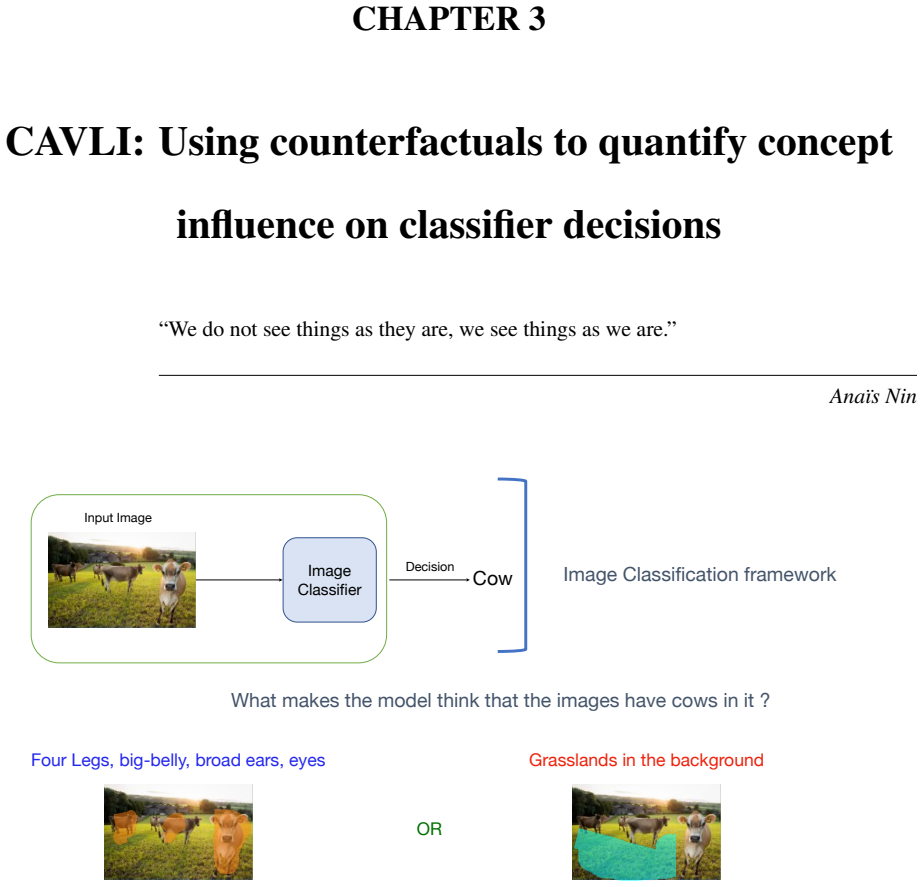
The paper's core discovery is that the simple counterfactual operation—take an image or prompt, change one semantically meaningful attribute or identity term, keep everything else fixed—can become a single experimental protocol covering the full life cycle of vision model bias. In discriminative models the protocol works at two scales: CAVLI masks random subsets of superpixels and measures overlap between concept-relevant and decision-relevant regions, producing a Concept Dependency Score that exposes spurious reliance (for example, cows classified by grasslands); ASAC instead perturbs pixels against a protected-attribute classifier and uses a difficulty-ranked curriculum of those adversaria
What carries the argument
The central machinery is the concept-level counterfactual: an alternate input that differs from the original in a small set of semantically meaningful, human-defined concepts while all other attributes are held fixed. Every contribution is an instantiation of this operation. CAVLI implements it by turning superpixels on and off and correlating the resulting concept sensitivities with decision sensitivities, producing the Concept Dependency Score. ASAC implements it adversarially: perturbations computed against a protected-attribute classifier create inputs whose protected attribute flips while visual content is preserved, and a curriculum orders them by how strongly they deceive the target c
Load-bearing premise
The load-bearing premise is that the text answers a vision-language model gives about generated images accurately describe what is actually visible; the thesis reports an 18% error rate in those answers, so if the vision-language reader misreads images, every downstream bias score and causal link built on those answers is distorted.
What would settle it
Take a fixed set of occupation prompts, generate the image sets once, then compute CAS/MAD with two different vision-language readers and with a human-annotated concept set for a subset. If the ordering of bias axes by MAD, or the sign of a BiasConnect cross-axis effect, changes across readers, the counterfactual pipeline is not the source of the measurement—the reader is.
If this is right
- A single evaluation protocol could replace disjoint fairness checklists: define bias axes dynamically per prompt, generate counterfactuals, measure concept shift, and aggregate scores across prompts.
- Vision classifiers can be debiased without external generative counterfactual images; ASAC's adversarial perturbations along protected attributes improve fairness gaps and often raise accuracy, avoiding stereotype artifacts that GAN-based counterfactuals introduce.
- Intersectional bias can be diagnosed as pairwise causal relationships rather than just subgroup accuracy gaps, so practitioners can anticipate side effects—such as ethnic diversification reducing gender diversity—before intervening.
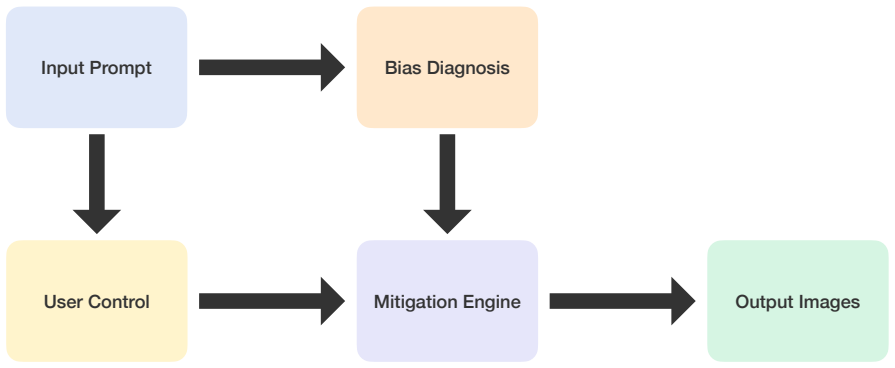
- Bias mitigation can become user-controllable and training-free: InterMit accepts user-defined priorities and target distributions and reports fewer mitigation steps than the ITI-GEN baseline with higher mitigation amount and visual quality.
- The same methodology transfers to any black-box text-to-image model, since TIBET and its successors only require prompts and generated images, not model internals.
Where Pith is reading between the lines
- I read the thesis as implying that the quantitative conclusions would need to survive a change of concept reader: if a second, independently calibrated VQA model gives different CAS/MAD rankings on the same image sets, then the measurement is partly a property of the reader rather than the generator.
- The pairwise causal graphs suggest a natural extension the author does not build: formulate mitigation as constrained optimization over the intersectional sensitivity matrix with user priorities, rather than the multi-step greedy heuristic InterMit uses. This could be tested by comparing InterMit's step selection against a differentiable solver on the same bias axes.
- The dynamic-axis idea could transfer to video or 3D generation, where 'holding everything fixed' is harder; a risk is that the LLM-proposed axes quietly become a new fixed checklist unless re-validated per prompt.
Editorial analysis
A structured set of objections, weighed in public.
Referee Report
Summary. The thesis argues that counterfactual reasoning provides a unifying methodology for interpretability, bias auditing, and bias mitigation in both vision classifiers and text-to-image (TTI) models. It develops and evaluates four main contributions: CAVLI (a hybrid TCAV/LIME concept-dependency score), ASAC (adversarial attribute-specific counterfactuals with curriculum fine-tuning), TIBET (dynamic bias-axis identification and CAS/MAD bias metrics), and BiasConnect/InterMit (pairwise dependency graphs and training-free mitigation with user-defined priorities). The evaluation spans ImageNet, CelebA, UTK, multiple backbones and TTI models, and includes user studies. The central claim is that counterfactuals are not just diagnostic tools but a principled methodology for fairness, causality, and explainability in vision systems.
Significance. If the technical concerns below are resolved, this would be a substantial contribution. The idea of prompt-dependent dynamic bias axes is a clear improvement over fixed-axis audits, and the thesis explicitly addresses intersectionality rather than treating bias dimensions independently. Strengths include the use of user studies to calibrate LLM/VQA-based measurements, multi-dataset and multi-backbone experiments, comparisons against prior methods (ITI-GEN, Ramaswamy et al.), and unusually honest limitation sections. The thesis also makes falsifiable predictions (e.g., CAS/MAD differences across prompts and models) and can be directly applied to existing black-box TTI systems. The main scientific risk is that the quantitative conclusions—especially those in Chapters 5–7—inherit an unquantified systematic error from the VQA concept extraction, and that the word 'causal' is used without identification assumptions.
major comments (4)
- [Section 5.5.3 / Section 5.3.3.1] The VQA concept extraction is the single point of failure for CAS, MAD, BiasConnect, and InterMit. The reported 18% VQA error rate and 13.11% MAD error are treated as if errors were independent and random. If MiniGPT-v2 has systematic biases (for example, the same gender/ethnicity associations as Stable Diffusion), then a low CAS can reflect the VQA model's stereotypes rather than the TTI model's behavior. The user studies validate perceived bias, not the correctness of the extracted concept histograms. The thesis needs a conditional error analysis: on what type of images, and for which bias axes, does the VQA model err? Without ground-truth concept annotations or a negative-control test, the main quantitative claims of Chapters 5–7 are not secure.
- [Section 6.5 / Section 6.6] The thesis calls BiasGraph 'causal graphs' and describes the approach as 'pairwise causal discovery', but no SCM is specified and no identification assumptions are stated (consistency, positivity, no unobserved confounding, no interference). The text in Section 2.4.2 itself lists hidden confounding as a central challenge, yet Chapter 6 does not apply any sensitivity analysis. The prompt-level intervention (e.g., changing 'gender' words) may affect multiple latent image-generation factors, and the resulting CAS associations need not identify a causal effect. Either state the assumptions under which the do-operator is justified for these text-to-image interventions, or rename the output as 'conditional association graphs' and add synthetic negative-control experiments where the true causal direction is known.
- [Section 3.3 / Algorithm 1] The validation of CAVLI is partly circular. CDS is defined in Algorithm 1 (step 9) as CDSi = gamma_i * CS^k_{C,l}(F, x_i), where CS is the TCAV conceptual sensitivity from Eq. (3.1). The chapter then claims that mean CDS 'resembles' TCAV scores and treats this as evidence that CDS captures concept dependence. Since TCAV sensitivity is a multiplicative factor of CDS, a positive correlation is expected by construction. An independent validation is needed: synthetic images with known concept dependencies, human agreement on the concept heatmaps, or an intervention-based test that removes the concept and measures the decision change.
- [Section 4.6.3 / Table 4.7 / Table 4.6] Hyperparameters appear to be selected after inspecting the same test-set metrics. Table 4.7 reports choosing noise magnitudes epsilon = {0.001, 0.01} from the ablation on the smile classifier, and Table 4.6 chooses curriculum direction (ascending vs descending difficulty) based on fairness/accuracy outcomes on the same evaluation. If these choices are not made on a separate validation set, the reported gains (e.g., DEO 0.050 vs baseline 0.088) may be partially due to selection bias. The thesis should either perform nested cross-validation or explicitly state which hyperparameters were chosen a priori and which were post-hoc.
minor comments (6)
- [Throughout] There are frequent typos and formatting artifacts: 'Adavantages' (Section 2.4), 'consitency' (Section 2.5.2.1), 'TCA V' / 'CA VLI' spacing, 'TIBET' vs 'TIBET' in figure captions. A careful copyedit is needed.
- [Eq. (5.1)–(5.3)] The 'Histogram Intersection-over-Union' is not the standard IoU. Please define it explicitly as sum(min(w_i, w_cf)) / sum(max(w_i, w_cf)), and clarify how zero-frequency concepts are treated in the vocabulary.
- [Section 5.3.1] The text says GPT-3, but the experiments use gpt-3.5-turbo. The model version and API date matter for reproducibility; please be precise.
- [Figure 5.4 / Appendix A.2] Figure 5.4 mentions 'MAD = 0.49' with no explanation of the normalization. Since the normalization is used in all later comparisons, it should be described in the main text, not only in Appendix A.2.
- [Chapter 6 / Chapter 7] The terms 'VLLMs' and 'VLMs', 'TTI' and 'T2I', and 'BiasConnect' vs 'BiasGraph' are used inconsistently. Please harmonize notation.
- [Reproducibility] No code release, data release, or detailed hyperparameter table is provided. Given the pipeline includes many LLM/VQA components, a reproducibility statement would strengthen the manuscript considerably.
Circularity Check
One partial self-referential validation in CAVLI; TIBET/BiasConnect/InterMit are otherwise externally validated.
specific steps
-
self definitional
[Section 3.3.1 (ImageNet evaluation) and Algorithm 1 (Section 3.2.4)]
"Calculate Concept Dependency Score: CDSi = γi · CSk C,l(F, xi). ... We propose a hypothesis that if there exists a correlation between the mean CDS scores and global concept methods like TCA V , it indicates that our metric is capable of accurately capturing the dependence between the model decisions and underlying concepts."
CDS is defined as the product of the spatial-overlap correlation γ and the TCAV conceptual sensitivity CS. The validation treats TCAV as an independent reference and takes correlation of mean CDS with TCAV as evidence that CDS captures concept dependence. But because CS is a factor in CDS, the two quantities are coupled by construction; even a CDS that added no concept information beyond TCAV's own sensitivity would correlate with TCAV. The correlation therefore cannot establish the validity of the new overlap term γ. The method still has independent content in γ, so this is a partial, not total, circularity.
full rationale
Aside from the CAVLI validation issue, the thesis is largely self-contained. CAVLI's CDS combines LIME-based perturbation with TCAV; the spatial overlap component is novel. TIBET's CAS/MAD metrics are measured from VQA concept frequencies, with external user studies and ITI-GEN ground-truth comparisons; MAD sensitivity to VQA errors is reported as a limitation, not hidden. BiasConnect is validated against post-mitigation ITI-GEN measurements, an external intervention. InterMit optimizes user-defined target distributions; evaluating against the same objectives is optimization, not circularity. Self-citations to prior papers by the author are normal for a thesis and are not load-bearing: the later chapters use the earlier methods as tools and validate them externally. Overall, one partial self-referential validation prevents a 0-2 score; there is no evidence that the central fairness/causality claims reduce by construction to their inputs.
Axiom & Free-Parameter Ledger
free parameters (6)
- noise magnitudes epsilon (FGSM/PGD) =
{0.001, 0.01} for ASACs; {0.03, 0.05} in ablation
- curriculum learning weight alpha =
0.5
- number of superpixels and random subsets in CAVLI =
r and n unspecified
- number of images per prompt in TIBET =
48
- VQA question templates =
hand-designed for common axes
- number of counterfactuals per axis =
K (variable)
axioms (5)
- domain assumption Uniform CAS distribution across counterfactuals implies low bias; skew implies bias
- domain assumption MiniGPT-v2 VQA provides sufficiently accurate concept extraction
- domain assumption GPT-3.5 can generate relevant bias axes and counterfactuals
- domain assumption Adversarial perturbations of the protected-attribute classifier preserve semantics and only change the protected attribute
- domain assumption Pairwise causal effects measured via prompt interventions are unconfounded and can be combined into a causal graph
Cite this review
Pith. "Pith review of Understanding and evaluating computer vision models through the lens of counterfactuals." pith.science (2026). https://pith.science/paper/H3XXXRHX
@misc{pith2026250820881,
  author       = {Pith},
  title        = {Pith review of: Understanding and evaluating computer vision models through the lens of counterfactuals},
  year         = {2026},
  howpublished = {\url{https://pith.science/paper/H3XXXRHX}},
  note         = {Machine review of arXiv:2508.20881}
}
read the original abstract
Counterfactual reasoning -- the practice of asking ``what if'' by varying inputs and observing changes in model behavior -- has become central to interpretable and fair AI. This thesis develops frameworks that use counterfactuals to explain, audit, and mitigate bias in vision classifiers and generative models. By systematically altering semantically meaningful attributes while holding others fixed, these methods uncover spurious correlations, probe causal dependencies, and help build more robust systems. The first part addresses vision classifiers. CAVLI integrates attribution (LIME) with concept-level analysis (TCAV) to quantify how strongly decisions rely on human-interpretable concepts. With localized heatmaps and a Concept Dependency Score, CAVLI shows when models depend on irrelevant cues like backgrounds. Extending this, ASAC introduces adversarial counterfactuals that perturb protected attributes while preserving semantics. Through curriculum learning, ASAC fine-tunes biased models for improved fairness and accuracy while avoiding stereotype-laden artifacts. The second part targets generative Text-to-Image (TTI) models. TIBET provides a scalable pipeline for evaluating prompt-sensitive biases by varying identity-related terms, enabling causal auditing of how race, gender, and age affect image generation. To capture interactions, BiasConnect builds causal graphs diagnosing intersectional biases. Finally, InterMit offers a modular, training-free algorithm that mitigates intersectional bias via causal sensitivity scores and user-defined fairness goals. Together, these contributions show counterfactuals as a unifying lens for interpretability, fairness, and causality in both discriminative and generative models, establishing principled, scalable methods for socially responsible bias evaluation and mitigation.
Figures






Reference graph
Works this paper leans on
-
[1]
Moss-Racusin, John F
Corinne A. Moss-Racusin, John F. Dovidio, Victoria L. Brescoll, Mark J. Graham, and Jo Handelsman. Science faculty’s subtle gender biases favor male students. Proceedings of the National Academy of Sciences, 109(41):16474–16479, 2012
2012
-
[2]
Counterfactuals
David Lewis. Counterfactuals. Harvard University Press, 1973
1973
-
[3]
High-resolution image synthesis with latent diffusion models
Robin Rombach, Andreas Blattmann, Dominik Lorenz, Patrick Esser, and Bj ¨orn Ommer. High-resolution image synthesis with latent diffusion models. InProceedings of the IEEE/CVF Conference on Computer Vision and Pattern Recognition, pages 10684–10695, 2022
2022
-
[4]
Towards accuracy-fairness paradox: Adversarial example-based data augmentation for visual debiasing
Yi Zhang and Jitao Sang. Towards accuracy-fairness paradox: Adversarial example-based data augmentation for visual debiasing. In Proceedings of the 28th ACM International Conference on Multimedia, pages 4346–4354, 2020
2020
-
[5]
Ramaswamy, Sunnie SY
Vikram V . Ramaswamy, Sunnie SY . Kim, and Olga Russakovsky. Fair attribute classification through latent space de-biasing. In Proceedings of the IEEE/CVF Conference on Computer Vision and Pattern Recognition, pages 9301–9310, 2021
2021
-
[6]
Image Counterfactual Sensitivity Analysis for Detecting Unintended Bias
Emily Denton, Ben Hutchinson, Margaret Mitchell, Timnit Gebru, and Andrew Zaldivar. Image counterfactual sensitivity analysis for detecting unintended bias. arXiv preprint arXiv:1906.06439, 2019
work page internal anchor Pith review Pith/arXiv arXiv 1906
-
[7]
Towards fairness in visual recognition: Effective strategies for bias mitigation
Zeyu Wang, Klint Qinami, Ioannis Christos Karakozis, Kyle Genova, Prem Nair, Kenji Hata, and Olga Russakovsky. Towards fairness in visual recognition: Effective strategies for bias mitigation. In Proceedings of the IEEE/CVF Conference on Computer Vision and Pattern Recognition, pages 8919–8928, 2020
2020
-
[8]
Balasubramanian, and Amit Sharma
Saloni Dash, Vineeth N. Balasubramanian, and Amit Sharma. Evaluating and mitigating bias in image classifiers: A causal perspective using counterfactuals. In Proceedings of the IEEE/CVF Winter Conference on Applications of Computer Vision, pages 915–924, 2022
2022
-
[9]
Towards causal bench- marking of biasin face analysis algorithms
Guha Balakrishnan, Yuanjun Xiong, Wei Xia, and Pietro Perona. Towards causal bench- marking of biasin face analysis algorithms. In Deep Learning-Based Face Analytics, pages 327–359. Springer, 2021
2021
-
[10]
Meaningfully debugging model mistakes using conceptual counterfactual explanations
Abubakar Abid, Mert Yuksekgonul, and James Zou. Meaningfully debugging model mistakes using conceptual counterfactual explanations. In Proceedings of the International Conference on Machine Learning, pages 66–88. PMLR, 2022. 150
2022
-
[11]
Causalm: Causal model explanation through counterfactual language models
Amir Feder, Nadav Oved, Uri Shalit, and Roi Reichart. Causalm: Causal model explanation through counterfactual language models. Computational Linguistics, 47(2):333–386, 2021
2021
-
[12]
Cavli-using image associations to produce local concept-based explanations
Pushkar Shukla, Sushil Bharati, and Matthew Turk. Cavli-using image associations to produce local concept-based explanations. In Proceedings of the IEEE/CVF Conference on Computer Vision and Pattern Recognition, pages 3749–3754, 2023
2023
-
[13]
Selvaraju, Michael Cogswell, Abhishek Das, Ramakrishna Vedantam, Devi Parikh, and Dhruv Batra
Ramprasaath R. Selvaraju, Michael Cogswell, Abhishek Das, Ramakrishna Vedantam, Devi Parikh, and Dhruv Batra. Grad-cam: Visual explanations from deep networks via gradient- based localization. In Proceedings of the IEEE/CVF International Conference on Computer Vision, pages 618–626, 2017
2017
-
[14]
Tibet: Identifying and evaluating biases in text-to-image generative models
Aditya Chinchure, Pushkar Shukla, Gaurav Bhatt, Kiri Salij, Kartik Hosanagar, Leonid Sigal, and Matthew Turk. Tibet: Identifying and evaluating biases in text-to-image generative models. Proceedings of the European Conference on Computer Vision, 2024
2024
-
[15]
Demarginalizing the intersection of race and sex: A black feminist critique of antidiscrimination doctrine, feminist theory, and antiracist politics
Kimberle Crenshaw. Demarginalizing the intersection of race and sex: A black feminist critique of antidiscrimination doctrine, feminist theory, and antiracist politics. In University of Chicago Legal Forum, pages 139–167. 1989
1989
-
[16]
Utilizing Adversarial Examples for Bias Mitigation and Accuracy Enhancement
Pushkar Shukla, Dhruv Srikanth, Lee Cohen, and Matthew Turk. Utilizing adversarial examples for bias mitigation and accuracy enhancement. arXiv preprint arXiv:2404.11819, 2024
work page internal anchor Pith review Pith/arXiv arXiv 2024
-
[17]
Balasubramanian, Leonid Sigal, and Matthew Turk
Pushkar Shukla, Aditya Chinchure, Emily Diana, Alexander Tolbert, Kartik Hosanagar, Vineeth N. Balasubramanian, Leonid Sigal, and Matthew Turk. Mitigate one, skew another? tackling intersectional biases in text-to-image models. arXiv preprint arXiv:2505.17280, 2025
Pith/arXiv arXiv 2025
-
[18]
Counterfactual visual explanations
Yash Goyal, Ziyan Wu, Jonas Ernst, Dhruv Batra, Devi Parikh, and Stefan Lee. Counterfactual visual explanations. In Proceedings of the International Conference on Machine Learning, 2019
2019
-
[19]
Counterfactual explanations without opening the black box: Automated decisions and the gdpr
Sandra Wachter, Brent Mittelstadt, and Chris Russell. Counterfactual explanations without opening the black box: Automated decisions and the gdpr. Harvard Journal of Law & Technology, 2017
2017
-
[20]
Estimating causal effects of treatments in randomized and nonrandomized studies
Donald B Rubin. Estimating causal effects of treatments in randomized and nonrandomized studies. Journal of Educational Psychology, 66(5):688–701, 1974
1974
-
[21]
Causality: Models, Reasoning and Inference
Judea Pearl. Causality: Models, Reasoning and Inference. Cambridge University Press, 2000
2000
-
[22]
Mothilal, Amit Sharma, and Chenhao Tan
Ramaravind K. Mothilal, Amit Sharma, and Chenhao Tan. Explaining machine learning classifiers through diverse counterfactual explanations. In Proceedings of the 2020 conference on Fairness, Accountability, and Transparency, pages 607–617, 2020
2020
-
[23]
Tongshuang Wu, Marco Tulio Ribeiro, Jeffrey Heer, and Daniel S. Weld. Polyjuice: Gen- erating counterfactuals for explaining, evaluating, and improving models. In Proceedings of the 59th Annual Meeting of the Association for Computational Linguistics and the 11th 151 International Joint Conference on Natural Language Processing (Volume 1: Long Papers), pa...
2021
-
[24]
Counterfactual fairness
Matt J Kusner, Joshua Loftus, Chris Russell, and Ricardo Silva. Counterfactual fairness. Advances in Neural Information Processing Systems, 30, 2017
2017
-
[25]
Counterfactual sensitivity and robustness
Timothy Christensen and Benjamin Connault. Counterfactual sensitivity and robustness. Econometrica, 91(1):263–298, 2023
2023
-
[26]
Divyansh Kaushik, Eduard Hovy, and Zachary C. Lipton. Learning the difference that makes a difference with counterfactually-augmented data. arXiv preprint arXiv:1909.12434, 2019
Pith/arXiv arXiv 1909
-
[27]
Counterfactuals
Jonathan Bennett and Kai von Fintel. Counterfactuals. https://plato.stanford. edu/entries/counterfactuals/, 2021. Stanford Encyclopedia of Philosophy, Accessed: 2025-06-12
2021
-
[28]
Argumentation and counterfactual reasoning in parmenides and melissus
Andr´e Laks. Argumentation and counterfactual reasoning in parmenides and melissus. Archai: Revista de Estudos sobre as Origens do Pensamento Ocidental , 9:45–56, 2012. URL https://www.scielo.br/j/archai/a/Cv7GBGFGwMZDTfQfmWK99Pr/ ?lang=en. Accessed: 2025-06-12
2012
-
[29]
Philosophy in Classical India: The Proper Work of Reason
Jonardon Ganeri. Philosophy in Classical India: The Proper Work of Reason . Oxford University Press, 2001
2001
-
[30]
The Character of Logic in India
Bimal Krishna Matilal and Kisor Kumar Chakrabarti. The Character of Logic in India. State University of New York Press, 1998
1998
-
[31]
Georges B.J. Dreyfus. Recognizing Reality: Dharmak ¯ırti’s Philosophy and Its Tibetan Interpretations. SUNY Press, 1997
1997
-
[32]
An Enquiry Concerning Human Understanding
David Hume. An Enquiry Concerning Human Understanding. A. Millar, 1748. Originally published 1748; many modern editions available
-
[33]
Essays on the Active Powers of the Human Mind
Thomas Reid. Essays on the Active Powers of the Human Mind. Bell & Bradfute, 1788
-
[34]
Critique of Pure Reason
Immanuel Kant. Critique of Pure Reason. Hartknoch, 1781. English translations by Norman Kemp Smith and others available
-
[35]
A System of Logic, Ratiocinative and Inductive
John Stuart Mill. A System of Logic, Ratiocinative and Inductive. Parker, 1843. See Book III for the Method of Difference
-
[36]
The Emotions and the Will
Alexander Bain. The Emotions and the Will. Longman, Green, Longman, and Roberts, 1859
-
[37]
Causality: Models, Reasoning, and Inference
Judea Pearl. Causality: Models, Reasoning, and Inference. Cambridge University Press, 2 edition, 2009
2009
-
[38]
Efficient search for diverse coherent explanations
Chris Russell. Efficient search for diverse coherent explanations. Proceedings of the 2020 FAT* Conference, 2019. 152
2020
-
[39]
Multi-objective counter- factual explanations
Susanne Dandl, Christoph Molnar, Martin Binder, and Bernd Bischl. Multi-objective counter- factual explanations. Machine Learning, 110(4):961–989, 2021
2021
-
[40]
Face: Feasible and actionable counterfactual explanations
Rafael Poyiadzi, Kacper Sokol, Raul Santos-Rodriguez, Tijl De Bie, and Peter Flach. Face: Feasible and actionable counterfactual explanations. Proceedings of the AAAI Conference on Artificial Intelligence, 34(03):1399–1407, 2020
2020
-
[41]
Model-agnostic counter- factual explanations for consequential decisions
Amir-Hossein Karimi, Gilles Barthe, Borja Balle, and Isabel Valera. Model-agnostic counter- factual explanations for consequential decisions. In International Conference on Artificial Intelligence and Statistics, pages 895–905. PMLR, 2020
2020
-
[42]
Focus: Flexible optimizable counterfactual explanations for tree ensembles
Ana-Marija Lucic, Hinda Haned, and Maarten de Rijke. Focus: Flexible optimizable counterfactual explanations for tree ensembles. In Proceedings of the 2022 Conference on Fairness, Accountability, and Transparency, 2022
2022
-
[43]
Hidden assumptions in counterfactual explanations and fairness
Solon Barocas, Moritz Hardt, and Arvind Narayanan. Hidden assumptions in counterfactual explanations and fairness. Communications of the ACM, 63(9):62–71, 2020
2020
-
[44]
Testing DNN Image Classifiers for Confusion & Bias Errors
Amit Sharma, Peter Henderson, Shubham Ghosh, Prateek Agarwal, and Matei Zaharia. Certifai: A common framework to provide explanations and recourse through counterfactuals. arXiv preprint arXiv:1905.07831, 2020
work page internal anchor Pith review Pith/arXiv arXiv 1905
-
[45]
Good counterfactuals and where to find them: A case-based technique for generating counterfactuals for explainable ai (xai)
Mark T Keane and Barry Smyth. Good counterfactuals and where to find them: A case-based technique for generating counterfactuals for explainable ai (xai). Proceedings of the AAAI Conference on Artificial Intelligence, 34(03):1364–1371, 2020
2020
-
[46]
Path-specific counterfactual fairness
Silvia Chiappa. Path-specific counterfactual fairness. In Proceedings of the AAAI conference on Artificial Intelligence, volume 33, pages 7801–7808, 2019
2019
-
[47]
Fairness through causal awareness: Learning causal latent representations for fair prediction
David Madras, Elliot Creager, Toniann Pitassi, and Richard Zemel. Fairness through causal awareness: Learning causal latent representations for fair prediction. Proceedings of the 35th Conference on Uncertainty in Artificial Intelligence, 2019
2019
-
[48]
Chi, and Alex Beutel
Sahaj Garg, Vincent Perot, Nicole Limtiaco, Ankur Taly, Ed H. Chi, and Alex Beutel. Counterfactual fairness in text classification through robustness. In Proceedings of the 2019 AAAI/ACM Conference on AI, Ethics, and Society, pages 219–226, 2019
2019
-
[49]
Conditional counterfactuals for fairness audits in nlp
Maarten Hall and Hanna Wallach. Conditional counterfactuals for fairness audits in nlp. Proceedings of the Conference on Empirical Methods in Natural Language Processing, 2020
2020
-
[50]
Fliptest: Fairness testing via statistical and semantic counterfactual generation
Emily Black, Alireza Farhadi, and Osbert Bastani. Fliptest: Fairness testing via statistical and semantic counterfactual generation. Proceedings of the 2021 ACM Conference on Fairness, Accountability, and Transparency, 2021
2021
-
[51]
Constructing and measuring visual counterfactuals for grounded bias analysis
Aparna Balagopalan, Vajira Thambawita, Sigurdur Olafsson, Jesse Hicks, Egil Arnesen, Thomas Goodwin, Eric Breck, and James Wexler. Constructing and measuring visual counterfactuals for grounded bias analysis. In CVPR Workshop on Responsible Vision, 2022. 153
2022
-
[52]
Nonparametric Multiple-Output Center-Outward Quantile Regression
Jieyu Zhao, Tianlu Wang, Daniel Khashabi, Sameer Singh, and Dan Roth. Evaluating bias and fairness in pretrained multimodal models. arXiv preprint arXiv:2204.11756, 2022
work page internal anchor Pith review Pith/arXiv arXiv 2022
-
[53]
A survey on bias and fairness in machine learning
Ninareh Mehrabi, Fred Morstatter, Nripsuta Saxena, Kristina Lerman, and Aram Galstyan. A survey on bias and fairness in machine learning. ACM Computing Surveys (CSUR), 54(6): 1–35, 2021
2021
-
[54]
Counterfactual fairness through semantic data augmentation
Tien Wu, Allison Woodruff, Jilin Chen, and Munmun De Choudhury. Counterfactual fairness through semantic data augmentation. In Proceedings of the AAAI Conference on Artificial Intelligence, 2021
2021
-
[55]
Actionable recourse in linear classification
Berk Ustun, Alexander Spangher, and Yang Liu. Actionable recourse in linear classification. In Proceedings of the Conference on Fairness, Accountability, and Transparency, pages 10–19, 2019
2019
-
[56]
Explaining and harnessing adver- sarial examples
Ian J Goodfellow, Jonathon Shlens, and Christian Szegedy. Explaining and harnessing adver- sarial examples. Proceedings of the International Conference on Learning Representations, 2015
2015
-
[57]
Benchmarking neural network robustness to common corruptions and perturbations
Dan Hendrycks and Thomas Dietterich. Benchmarking neural network robustness to common corruptions and perturbations. arXiv preprint arXiv:1903.12261, 2019
Pith/arXiv arXiv 1903
-
[58]
Persistent homology with non-contractible preimages
Robin Morris, Brandon Carter, and William Herlands. Reassessing the robustness of visual counterfactual explanations. arXiv preprint arXiv:2105.08130, 2021
work page internal anchor Pith review Pith/arXiv arXiv 2021
-
[59]
Counterfactual data augmen- tation for mitigating gender stereotypes in languages with rich morphology
Ran Zmigrod, Ryan Cotterell, Jacob Andreas, and Frank Keller. Counterfactual data augmen- tation for mitigating gender stereotypes in languages with rich morphology. In Proceedings of Association of Computational Linguists, 2019
2019
-
[60]
Aguirre, and Thomas Sch ¨on
Antˆonio H Ribeiro, Koen Tiels, Luis A. Aguirre, and Thomas Sch ¨on. Beyond exploding and vanishing gradients: analysing rnn training using attractors and smoothness. In International Conference on Artificial Intelligence and Statistics, pages 2370–2380. PMLR, 2020
2020
-
[61]
Estimating individual treatment effect: generalization bounds and algorithms
Uri Shalit, Fredrik D Johansson, and David Sontag. Estimating individual treatment effect: generalization bounds and algorithms. In Proceedings of the International conference on machine Learning, pages 3076–3085. PMLR, 2017
2017
-
[62]
Learning representations for counterfactual inference
Fredrik Johansson, Uri Shalit, and David Sontag. Learning representations for counterfactual inference. In Proceedings of the International conference on machine Learning , pages 3020–3029. PMLR, 2016
2016
-
[63]
Causal effect inference with deep latent-variable models
Christos Louizos, Uri Shalit, Joris M Mooij, David Sontag, Richard Zemel, and Max Welling. Causal effect inference with deep latent-variable models. Advances in Neural Information Processing Systems, 30, 2017
2017
-
[64]
Ganite: Estimation of individual- ized treatment effects using generative adversarial nets
Jinsung Yoon, James Jordon, and Mihaela Van Der Schaar. Ganite: Estimation of individual- ized treatment effects using generative adversarial nets. In Proceedings of the International Conference on Learning Representations, 2018. 154
2018
-
[65]
Learn: Controllable counterfactual genera- tion via latent disentanglement
Xinyi Lu, Piji Qi, and William Yang Wang. Learn: Controllable counterfactual genera- tion via latent disentanglement. Findings North American Chapter of the Association for Computational Linguistics, 2022
2022
-
[66]
Interpretations are useful: Penalizing explanations to align neural networks with prior knowledge
Laura Rieger, Chandresh Singh, W James Murdoch, and Bin Yu. Interpretations are useful: Penalizing explanations to align neural networks with prior knowledge. In Proceedings of the International Conference on Machine Learning, 2020
2020
-
[67]
REIN: A Comprehensive Benchmark Framework for Data Cleaning Methods in ML Pipelines
Zixuan Zhang, Lei Huang, Hongyu Zhang, and Yulan He. A survey on counterfactual data generation for text. arXiv preprint arXiv:2302.04702, 2023
work page internal anchor Pith review Pith/arXiv arXiv 2023
-
[68]
Explanation by progressive exaggeration
Sahil Singla and Soheil Feizi. Explanation by progressive exaggeration. In Proceedings of the International Conference on Machine Learning, 2019
2019
-
[69]
Explaining image classifiers using statistical fault localization
Chun-Hao Chang, Cedric Anders, Andreas Muller, and Been Kim. Explaining image classifiers using statistical fault localization. In Advances in Neural Information Processing Systems, 2019
2019
-
[70]
Gan dissection: Visualizing and understanding generative adversarial networks
David Bau, Jun-Yan Zhu, Hendrik Strobelt, Bolei Zhou, Josh Tenenbaum, Bill Freeman, and Antonio Torralba. Gan dissection: Visualizing and understanding generative adversarial networks. Proceedings of the International Conference on Learning Representations, 2019
2019
-
[71]
Explaining black-box classifiers using post-hoc explanations: A unified review
Kedar Dhamdhere, Mukund Sundararajan, and Qiqi Yan. Explaining black-box classifiers using post-hoc explanations: A unified review. arXiv preprint arXiv:1909.13584, 2019
Pith/arXiv arXiv 1909
-
[72]
On robustness of causal claims in text classification
Shyam Upadhyay, Kai-Wei Chang, and Dan Roth. On robustness of causal claims in text classification. In Proceedings of the Annual Meeting of the Association for Computational Linguistics, 2021
2021
-
[73]
Experience-Embedded Visual Foresight
Dibya Mahajan, S Karthik, and Abhishek Mishra. Preserving semantic relations for zero-shot learning. arXiv preprint arXiv:1911.05071, 2019
work page internal anchor Pith review Pith/arXiv arXiv 1911
-
[74]
Jon Gauthier, Tianyi Zhang, Bernd Bohnet, and Alexander M. Rush. Counterfactual data augmentation for robust nlp. In Proceedings of the Annual Meeting of the Association for Computational Linguistics, 2021
2021
-
[75]
Donghyun Kim, Siddhartha Dalmia, and Alan W. Black. Counterfactual reasoning in multimodal language models. In Proceedings of the Conference on Empirical Methods in Natural Language Processing, 2022
2022
-
[76]
Anchors: High-precision model- agnostic explanations
Marco Tulio Ribeiro, Sameer Singh, and Carlos Guestrin. Anchors: High-precision model- agnostic explanations. In AAAI Conference on Artificial Intelligence, 2018
2018
-
[77]
Grounding visual explanations
Lisa Anne Hendricks, Ronghang Hu, Trevor Darrell, and Zeynep Akata. Grounding visual explanations. In Proceedings of the European Conference on Computer Vision, 2018
2018
-
[78]
Algorithmic re- course: From counterfactual explanations to interventions
Amir-Hossein Karimi, Gilles Barthe, Bernhard Sch¨olkopf, and Isabel Valera. Algorithmic re- course: From counterfactual explanations to interventions. In Advances in Neural Information Processing Systems, 2020. 155
2020
-
[79]
Karthik, and Vivek Srikumar
Dibya Mahajan, Aditya Singh, S. Karthik, and Vivek Srikumar. Generating interpretable coun- terfactual explanations by structural interventions. Proceedings of International Conference on Machine Learning, 2023
2023
-
[80]
Friedler, John Moeller, Carlos Scheidegger, and Suresh Venkata- subramanian
Michael Feldman, Sorelle A. Friedler, John Moeller, Carlos Scheidegger, and Suresh Venkata- subramanian. Certifying and removing disparate impact. In Proceedings of the 21th ACM SIGKDD International Conference on Knowledge Discovery and Data Mining, 2015
2015
This paper was first reviewed by deepseek-v4-flash on August 5, 2026.
discussion (0)
Sign in with ORCID, Apple, or X to comment. Anyone can read and Pith papers without signing in.