REVIEW 3 major objections 5 minor 1 cited by
A wrapper that reformulates the user query before each tool call can beat ReAct, function calling, and self-reflection on τ-bench.
Reviewed by Pith at T0; open to challenge. T0 means a machine referee read the full paper against a public rubric. the ladder, T0–T4 →
IRMA reformulates tool-agent inputs with memory, domain constraints, and tool suggestions, and reports improved tau-bench pass^5 reliability over ReAct, function calling, and self-reflection.
T0 review reviewed 2026-08-05 challenge →
load-bearing objection IRMA is a plausible, cost-effective input-side method with a real effect on tau-bench; the abstract's headline numbers come from an undocumented filtered subset and an inconsistent averaging, so the margins are overstated as written. the 3 major comments →
How Can Input Reformulation Improve Tool Usage Accuracy in a Complex Dynamic Environment? A Study on $\tau$-bench
The pith
A machine-rendered reading of the paper's core claim, the machinery that carries it, and where it could break.
The reading
Core claim
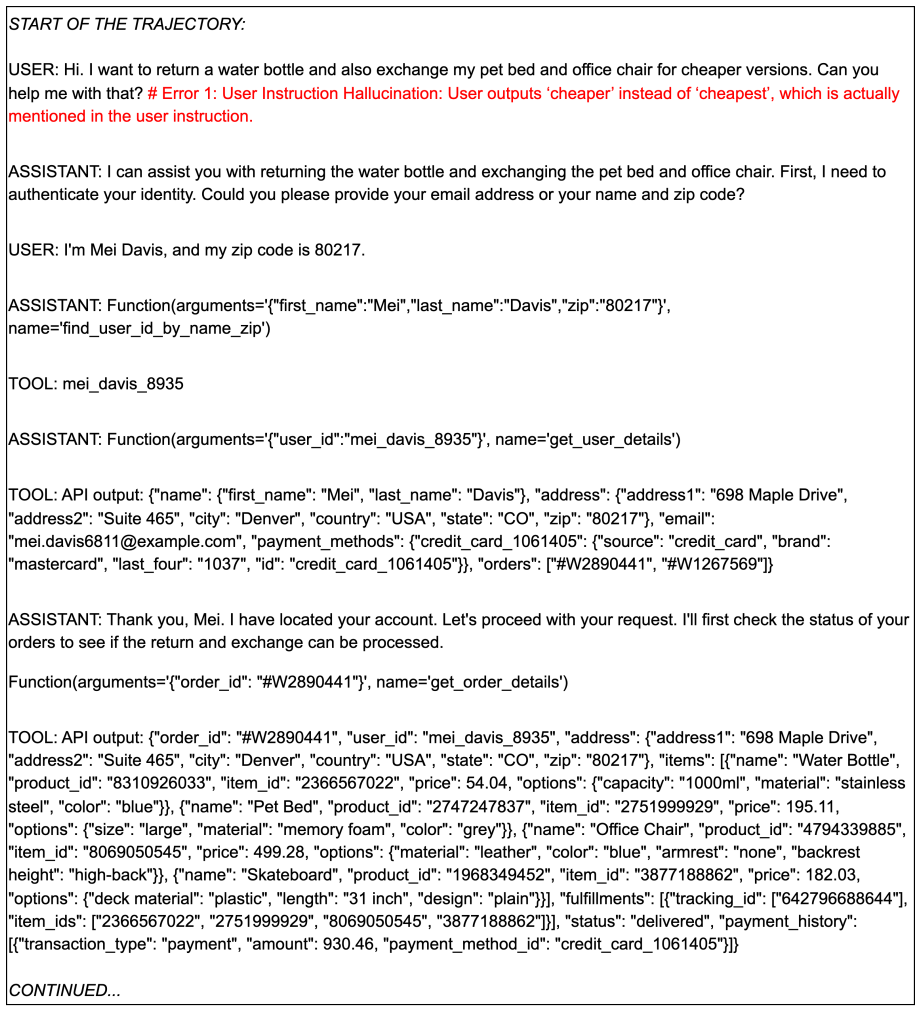
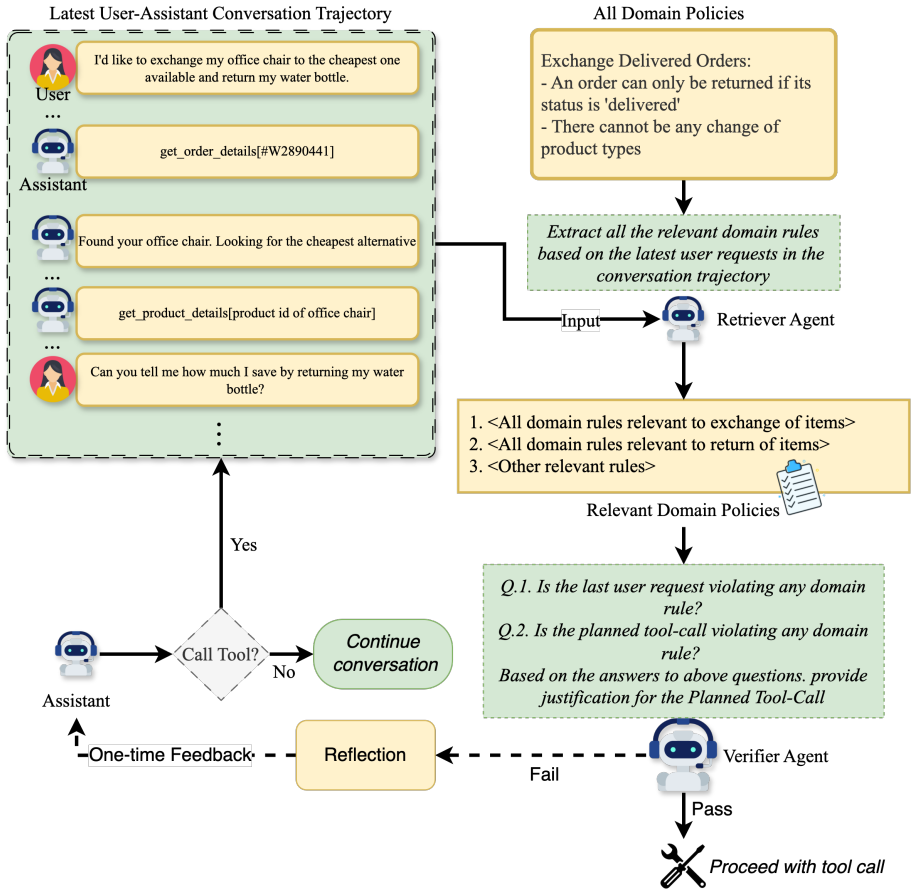
The paper's central claim comes in two parts. First, the dominant failure modes of function-calling agents in τ-bench are context-level breakdowns rather than missing tools: the simulated user drifts from its script, the assistant forgets the original request, the agent violates domain rules (for example, attempting an exchange when the order is not in 'delivered' status), and requests that amount to an exchange are misread as simple returns. Second, these failures can be reduced by changing the input rather than the model or a post-hoc correction loop. IRMA interposes three lightweight LLM agents between the user and the tool-calling assistant: a memorizer that preserves the original query
What carries the argument
IRMA (Input-Reformulation Multi-Agent) is a multi-agent prompt-reformulation wrapper. Each turn, three modules build a structured prompt for the tool-calling LLM: memorization (conversation history in <memory> tags), constraints (a generated checklist of relevant domain rules in <constraints> tags), and tool suggestion (a short ranked list of candidate tools in <tool_suggested> tags). The companion FACT (Follow-up Question ACTing) prompting strategy instructs the assistant to ask targeted follow-up questions before invoking a tool. Together these components compress and stabilise the information the assistant acts on: memory prevents instruction drift, constraints prevent policy violations,
Load-bearing premise
The reported gains are computed after dropping tasks the authors classify as having ground-truth or user-instruction errors, without a published list of excluded tasks or a reproducible rule for deciding; if that filtering is arbitrary or uneven, the headline margins shrink.
What would settle it
Run the five-trial pass^5 evaluation on all 165 τ-bench tasks with a pre-registered exclusion rule (or no exclusion) and report the IRMA-minus-ReAct and IRMA-minus-FC gaps with confidence intervals; the central claim fails if the gaps collapse or the ranking changes. A second check is to run IRMA with the <memory>, <constraints>, and <tool_suggested> tags emptied successively and observe whether pass^5 drops.
If this is right
- Tool-use reliability can be improved at the input stage, before any action, so agents do not need a verification or self-correction loop that adds inference cost.
- IRMA's ablations show the full memory-plus-constraints-plus-tool configuration is best, with memory and constraints supplying most of the gain and tool suggestion adding the rest.
- Because IRMA completes successful tasks in fewer turns than ReAct, Function Calling, and Self-Reflection, the approach carries a latency and cost advantage in conversational deployments.
- The paper's cause-oriented error taxonomy maps each failure class to a concrete input-side intervention, giving benchmark builders a checklist for designing more reliable tool-use evaluations.
- IRMA also lifts a smaller model, GPT-4o-mini, above the corresponding ReAct and Function Calling baselines on airline pass^k, suggesting the benefit is not simply a large-model reasoning effect.
Where Pith is reading between the lines
- A direct extension would be to run IRMA on a second multi-turn tool-use benchmark: if the gains come from context engineering itself, they should transfer; if they are specific to τ-bench's error distribution, they will shrink.
- A cheap test of the mechanism is to empty the <memory>, <constraints>, or <tool_suggested> tags one at a time at inference; if pass^k does not drop, the reformulation is not the active ingredient.
- Because the reported margins come from a post-hoc exclusion of ground-truth and user-instruction error tasks, the numbers are best read as upper-bound estimates until the exclusion rule is pre-registered and the full-task comparison is reported with confidence intervals.
- Since IRMA has no verification loop, its cost advantage over self-reflection should grow with trajectory length; in long customer-service sessions, token and latency savings may matter more than the pass^5 gap.
Editorial analysis
A structured set of objections, weighed in public.
Referee Report
Summary. The paper studies tool-calling agents in τ-bench, a multi-turn airline/retail benchmark. The authors first conduct a manual analysis of GPT-4o trajectory failures and propose a four-category error taxonomy (user-instruction hallucination, agent hallucination, domain-policy violation, contextual misinterpretation). They then introduce FACT (Follow-up Question Acting) and IRMA (Input-Reformulation Multi-Agent), a verification-loop-free framework that augments the assistant's input with a memory of the user query, a constraint checklist, and tool suggestions. Evaluation with GPT-4o and other backbones reports higher pass@1 and pass^5 than ReAct, Function Calling, and Self-Reflection, plus fewer turns in successful tasks. The abstract claims significant improvements of 16.1%, 12.7%, and 19.1% in overall pass^5, and the conclusion states an overall 43% pass^5 score.
Significance. If the results hold, the paper offers a useful input-side alternative to verification/reflection loops and a fine-grained error taxonomy that could inform future agent design. The framework is clearly described, and the ablations in Appendix G support the contribution of each IRMA module. The multi-backbone results and turn-efficiency analysis are also valuable. A notable strength is that the method is simple and does not require a verification loop, which is attractive for latency-sensitive deployments. However, the headline magnitudes are computed on an undocumented filtered task subset, the reported percentages are internally inconsistent, and no uncertainty quantification or significance tests are provided. With those gaps fixed, the empirical claims would be substantially stronger.
major comments (3)
- [§6.2, Appendix Tables 2–7] The abstract's headline pass^5 gains (16.1/12.7/19.1) and the conclusion's "43% pass^5" are computed on the GT/UI-error-excluded subset (Tables 4 and 7, 31 airline and 105 retail tasks, inferred from denominators), not on the full 165 tasks. The all-task tables yield weighted pass^5 gaps of roughly 13.9/10.9/16.4 points vs ReAct/FC/Self-Reflection, so the claimed margins depend on the exclusion. The paper does not list removed task IDs, give operational criteria for labeling GT/UI errors, report annotator agreement, or show that exclusions are method-independent. Moreover, "43%" is not a task-weighted overall: weighting the filtered airline 0.4516 and retail 0.4095 by 31 and 105 tasks gives about 41.9%. The paper must report the exclusion list, criteria, and both all-task and filtered results, and correct the headline numbers accordingly.
- [§6.2, Table 1] The running text's pass@1 gains (6.1%, 3.9%, 0.4%) do not match Table 1's overall pass@1 values: IRMA is 52.75 vs ReAct 45.7, Self-Reflection 47.9, and FC 51.4, giving differences of 7.05, 4.85, and 1.35 points. The relationship between Table 1 and the appendix pass@1 columns is also unclear. In addition, the paper uses "significantly outperforms" repeatedly but reports no confidence intervals, bootstrap estimates, or significance tests; for pass@1 the IRMA–FC gap is near 1 point, and even the larger pass^5 gaps need uncertainty estimates. These omissions are load-bearing because the abstract asserts significance.
- [§4 and §5] The error taxonomy was derived from manual inspection of trajectories on the same τ-bench tasks later used for evaluation, and the human-in-the-loop reformulation experiments (§5.2) informed the IRMA modules before the final evaluation. There is no disclosure of a development/test split, no statement of how many tasks were inspected before freezing prompts, and no external validation. This risks overfitting the framework to τ-bench's known failure patterns and undermines the broader claim about "complex dynamic environments." The authors should either provide a held-out task split, add a cross-benchmark evaluation, or clearly frame the claims as τ-bench-specific rather than general.
minor comments (5)
- [§6.2] The reliability paragraph says "The results in Figure 6 show that IRMA ... is much more reliable and consistent," but Figure 6 shows turn distributions; the pass^k plot is Figure 4. Please correct the cross-reference.
- [Abstract vs §6.2] The abstract reports a 12.7% pass^5 gain over Function Calling, while the text reports 12.6% for the same comparison; reconcile these numbers.
- [§6.2] The claim "Combining FACT with GPT-4o-FC led to a 12% performance drop" is asserted without a table, figure, or appendix reference. Please provide the supporting result.
- [Appendix B] Tables 3, 4, 6, and 7 do not state the number of tasks remaining after excluding GT and UI errors. Add N for each table so the pass^k denominators are transparent.
- [Conclusion] The "43% pass^5" figure should state that it is an unweighted average of the filtered airline and retail scores, not a task-weighted overall score.
Circularity Check
No circularity found: IRMA's pass^k gains are empirical evaluation outcomes, not quantities forced by construction or by self-citation.
full rationale
The paper is an empirical study, not a derivation chain. The error taxonomy in §4 is produced by manual inspection of GPT-4o trajectories on τ-bench, and the IRMA modules in §5.2 (memory, constraints, tool suggestion) target those observed failure modes. This is in-sample, benchmark-specific method development, but it is not circular: none of the reported pass^k values is defined in terms of the taxonomy or the modules, and no parameter is fitted to the test set. The pass^k formula in §6.1 is a standard unbiased estimator over independent success counts; the pass^5 numbers in Tables 2–7 are simple aggregates of those counts. The post-hoc removal of tasks labeled as having ground-truth or user-instruction errors (§6.2, Figure 5, Appendix Tables 4/7) is a reporting and validity concern—the exclusion list is not provided and no significance tests are given—but the qualitative result also holds on the unfiltered tasks, so the headline margin is not manufactured by an equation that reduces to its own input. The paper invokes no load-bearing self-citation: references to ReAct, τ-bench, and context engineering are external, and no 'uniqueness theorem' is used to rule out alternatives. Therefore, under the circularity rubric, there is no step that reduces to its inputs by construction, and the score is 0.
Axiom & Free-Parameter Ledger
free parameters (3)
- GT/UI error exclusion set =
unlisted subset of tau-bench (29 of 165 tasks)
- Constraint and tool-suggestion prompt templates =
not released
- FACT system prompt design =
partially shown in Figure 10
axioms (4)
- domain assumption tau-bench reward (hash-match plus mandatory natural-language outputs) is a valid measure of correct task completion
- ad hoc to paper The four-category error taxonomy from manual review covers the dominant failure modes
- ad hoc to paper Excluding tasks with GT and UI errors removes noise rather than cherry-picking favorable cases
- domain assumption The 5-trial pass^5 estimator provides a stable ordering of methods
invented entities (4)
-
Memory module (IRMA)
no independent evidence
-
Constraint agent (IRMA)
no independent evidence
-
Tool Selector agent (IRMA)
no independent evidence
-
FACT agent (Follow-up question acting)
no independent evidence
Cite this review
Pith. "Pith review of How Can Input Reformulation Improve Tool Usage Accuracy in a Complex Dynamic Environment? A Study on $\tau$-bench." pith.science (2026). https://pith.science/paper/36NPVMZX
@misc{pith2026250820931,
  author       = {Pith},
  title        = {Pith review of: How Can Input Reformulation Improve Tool Usage Accuracy in a Complex Dynamic Environment? A Study on $\tau$-bench},
  year         = {2026},
  howpublished = {\url{https://pith.science/paper/36NPVMZX}},
  note         = {Machine review of arXiv:2508.20931}
}
abstract
Recent advances in reasoning and planning capabilities of large language models (LLMs) have enabled their potential as autonomous agents capable of tool use in dynamic environments. However, in multi-turn conversational environments like $\tau$-bench, these agents often struggle with consistent reasoning, adherence to domain-specific policies, and extracting correct information over a long horizon of tool-calls and conversation. To capture and mitigate these failures, we conduct a comprehensive manual analysis of the common errors occurring in the conversation trajectories. We then experiment with reformulations of inputs to the tool-calling agent for improvement in agent decision making. Finally, we propose the Input-Reformulation Multi-Agent (IRMA) framework, which automatically reformulates user queries augmented with relevant domain rules and tool suggestions for the tool-calling agent to focus on. The results show that IRMA significantly outperforms ReAct, Function Calling, and Self-Reflection by 16.1%, 12.7%, and 19.1%, respectively, in overall pass^5 scores. These findings highlight the superior reliability and consistency of IRMA compared to other methods in dynamic environments.
Figures






Forward citations
Cited by 1 Pith paper
-
Self-Evolution for Multi-Turn Tool-Calling Agents via Divergence-Point Preference Learning
ToolGraph plus DPO on divergence-point preferences lifts weighted average reward on 375 tau2-bench tasks from 0.304 to 0.355.
Reference graph
Works this paper leans on
-
[3]
arXiv preprint arXiv:2409.03797
Nestful: A benchmark for eval- uating llms on nested sequences of api calls. arXiv preprint arXiv:2409.03797. Mert Cemri, Melissa Z Pan, Shuyi Yang, Lakshya A Agrawal, Bhavya Chopra, Rishabh Tiwari, Kurt Keutzer, Aditya Parameswaran, Dan Klein, Kannan Ramchandran, et al
-
[4]
Aili Chen, Xuyang Ge, Ziquan Fu, Yanghua Xiao, and Jiangjie Chen
Why do multi-agent llm systems fail? arXiv preprint arXiv:2503.13657. Aili Chen, Xuyang Ge, Ziquan Fu, Yanghua Xiao, and Jiangjie Chen. 2024a. Travelagent: An ai assis- tant for personalized travel planning. arXiv preprint arXiv:2409.08069. Guoxin Chen, Zhong Zhang, Xin Cong, Fangda Guo, Yesai Wu, Yankai Lin, Wenzheng Feng, and Yasheng Wang. 2024b. Learni...
-
[5]
Apt-1: Adaptive prompt tuning for llms. https://www.scaledcognition. com/blog/apt-1. Accessed: 2025-05-19. Jiazhan Feng, Shijue Huang, Xingwei Qu, Ge Zhang, Yujia Qin, Baoquan Zhong, Chengquan Jiang, Jinxin Chi, and Wanjun Zhong
work page 2025
-
[6]
arXiv preprint arXiv:2504.11536
Retool: Reinforce- ment learning for strategic tool use in llms. arXiv preprint arXiv:2504.11536. Aaron Grattafiori, Abhimanyu Dubey, Abhinav Jauhri, Abhinav Pandey, Abhishek Kadian, Ahmad Al- Dahle, Aiesha Letman, Akhil Mathur, Alan Schelten, Alex Vaughan, et al
-
[7]
arXiv preprint arXiv:2407.21783
The llama 3 herd of mod- els. arXiv preprint arXiv:2407.21783. Aaron Hurst, Adam Lerer, Adam P Goucher, Adam Perelman, Aditya Ramesh, Aidan Clark, AJ Os- trow, Akila Welihinda, Alan Hayes, Alec Radford, et al
-
[8]
arXiv preprint arXiv:2410.21276
Gpt-4o system card. arXiv preprint arXiv:2410.21276. Minghao Li, Yingxiu Zhao, Bowen Yu, Feifan Song, Hangyu Li, Haiyang Yu, Zhoujun Li, Fei Huang, and Yongbin Li
-
[10]
arXiv preprint arXiv:2307.03172
Lost in the middle: How lan- guage models use long contexts. arXiv preprint arXiv:2307.03172. Weiwen Liu, Xu Huang, Xingshan Zeng, Xinlong Hao, Shuai Yu, Dexun Li, Shuai Wang, Weinan Gan, Zhengying Liu, Yuanqing Yu, et al. 2024b. Toolace: Winning the points of llm function calling. arXiv preprint arXiv:2409.00920. Zuxin Liu, Thai Hoang, Jianguo Zhang, Min...
-
[11]
arXiv preprint arXiv:2408.04682
Toolsandbox: A stateful, conversational, interactive evaluation bench- mark for llm tool use capabilities. arXiv preprint arXiv:2408.04682. Lingrui Mei, Jiayu Yao, Yuyao Ge, Yiwei Wang, Bao- long Bi, Yujun Cai, Jiazhi Liu, Mingyu Li, Zhong-Zhi Li, Duzhen Zhang, et al
-
[12]
arXiv preprint arXiv:2507.13334
A survey of con- text engineering for large language models. arXiv preprint arXiv:2507.13334. Grégoire Mialon, Clémentine Fourrier, Thomas Wolf, Yann LeCun, and Thomas Scialom
-
[13]
arXiv preprint arXiv:2502.16111
Plan- gen: A multi-agent framework for generating plan- ning and reasoning trajectories for complex problem solving. arXiv preprint arXiv:2502.16111. Shishir G. Patil, Huanzhi Mao, Charlie Cheng-Jie Ji, Fanjia Yan, Vishnu Suresh, Ion Stoica, and Joseph E. Gonzalez
-
[14]
arXiv preprint arXiv:2504.03601
Apigen-mt: Agentic pipeline for multi-turn data gen- eration via simulated agent-human interplay. arXiv preprint arXiv:2504.03601. Yujia Qin, Shihao Liang, Yining Ye, Kunlun Zhu, Lan Yan, Yaxi Lu, Yankai Lin, Xin Cong, Xiangru Tang, Bill Qian, et al
-
[15]
arXiv preprint arXiv:2307.16789
Toolllm: Facilitating large language models to master 16000+ real-world apis. arXiv preprint arXiv:2307.16789. Qwen, :, An Yang, Baosong Yang, Beichen Zhang, Binyuan Hui, Bo Zheng, Bowen Yu, Chengyuan Li, Dayiheng Liu, Fei Huang, Haoran Wei, Huan Lin, Jian Yang, Jianhong Tu, Jianwei Zhang, Jianxin Yang, Jiaxi Yang, Jingren Zhou, Junyang Lin, Kai Dang, Kem...
-
[16]
Qwen2.5 technical report. Preprint, arXiv:2412.15115. Matthew Renze and Erhan Guven
-
[17]
arXiv preprint arXiv:2405.06682
Self-reflection in llm agents: Effects on problem-solving perfor- mance. arXiv preprint arXiv:2405.06682. Timo Schick, Jane Dwivedi-Yu, Roberto Dessì, Roberta Raileanu, Maria Lomeli, Eric Hambro, Luke Zettle- moyer, Nicola Cancedda, and Thomas Scialom
-
[18]
arXiv preprint arXiv:2504.02441
Cognitive memory in large language models. arXiv preprint arXiv:2504.02441. Zhengliang Shi, Shen Gao, Lingyong Yan, Yue Feng, Xiuyi Chen, Zhumin Chen, Dawei Yin, Suzan Ver- berne, and Zhaochun Ren
-
[19]
Tool learning in the wild: Empowering language models as automatic tool agents. Preprint, arXiv:2405.16533. Harmanpreet Singh, Nikhil Verma, Yixiao Wang, Man- asa Bharadwaj, Homa Fashandi, Kevin Ferreira, and Chul Lee
-
[20]
Personal large language model agents: A case study on tailored travel planning. In Proceedings of the 2024 Conference on Empirical Methods in Natural Language Processing: Industry Track, pages 486–514, Miami, Florida, US. Associa- tion for Computational Linguistics. Joykirat Singh, Raghav Magazine, Yash Pandya, and Akshay Nambi
work page 2024
-
[21]
arXiv preprint arXiv:2505.01441
Agentic reasoning and tool integration for llms via reinforcement learning. arXiv preprint arXiv:2505.01441. Jimin Sun, So Yeon Min, Yingshan Chang, and Yonatan Bisk
-
[22]
Tools Fail: Detecting Silent Errors in Faulty Tools
Tools fail: Detecting silent errors in faulty tools. arXiv preprint arXiv:2406.19228. Gemini Team, Petko Georgiev, Ving Ian Lei, Ryan Burnell, Libin Bai, Anmol Gulati, Garrett Tanzer, Damien Vincent, Zhufeng Pan, Shibo Wang, et al
work page internal anchor Pith review Pith/arXiv arXiv
-
[23]
arXiv preprint arXiv:2403.05530
Gemini 1.5: Unlocking multimodal under- standing across millions of tokens of context. arXiv preprint arXiv:2403.05530. Lei Wang, Chen Ma, Xueyang Feng, Zeyu Zhang, Hao Yang, Jingsen Zhang, Zhiyuan Chen, Jiakai Tang, Xu Chen, Yankai Lin, et al
-
[24]
arXiv preprint arXiv:2411.14033
Multi-llm-agent systems: Tech- niques and business perspectives. arXiv preprint arXiv:2411.14033. Shunyu Yao, Noah Shinn, Pedram Razavi, and Karthik Narasimhan
-
[25]
τ-bench: A benchmark for tool-agent-user interaction in real-world domains. Preprint, arXiv:2406.12045. Shunyu Yao, Jeffrey Zhao, Dian Yu, Nan Du, Izhak Shafran, Karthik Narasimhan, and Yuan Cao
-
[26]
arXiv preprint arXiv:2503.07826
Magnet: Multi-turn tool-use data synthesis and distillation via graph translation. arXiv preprint arXiv:2503.07826. Shaokun Zhang, Yi Dong, Jieyu Zhang, Jan Kautz, Bryan Catanzaro, Andrew Tao, Qingyun Wu, Zhiding Yu, and Guilin Liu
-
[27]
arXiv preprint arXiv:2505.00024
Nemotron-research-tool- n1: Exploring tool-using language models with rein- forced reasoning. arXiv preprint arXiv:2505.00024. Yuxiang Zhang, Jing Chen, Junjie Wang, Yaxin Liu, Cheng Yang, Chufan Shi, Xinyu Zhu, Zihao Lin, Hanwen Wan, Yujiu Yang, Tetsuya Sakai, Tian Feng, and Hayato Yamana
-
[28]
ToolBeHonest: A multi- level hallucination diagnostic benchmark for tool- augmented large language models. In Proceedings of the 2024 Conference on Empirical Methods in Natural Language Processing, pages 11388–11422, Miami, Florida, USA. Association for Computational Linguistics. Yuxiang Zheng, Dayuan Fu, Xiangkun Hu, Xiaojie Cai, Lyumanshan Ye, Pengrui L...
work page 2024
-
[29]
arXiv preprint arXiv:2504.03160
Deepresearcher: Scaling deep research via reinforce- ment learning in real-world environments. arXiv preprint arXiv:2504.03160. Huichi Zhou, Yihang Chen, Siyuan Guo, Xue Yan, Kin Hei Lee, Zihan Wang, Ka Yiu Lee, Guchun Zhang, Kun Shao, Linyi Yang, and Jun Wang
-
[30]
Memento: Fine-tuning llm agents without fine-tuning llms. Preprint, arXiv:2508.16153. A Task Definition in τ-bench Following Yao et al. (2024), each task inτ-bench is modelled as a partially observable Markov deci- sion process (POMDP) M = ⟨S, A, O, T , R, U ⟩. We briefly restate every component and specify how they instantiate in the retail and airline d...
Pith/arXiv arXiv 2024
-
[31]
Instruction space U : Each task provides a fixed natural-language instruction u ∈ Udescribing the user goal, persona and constraints. The user sim- ulator may disclose u incrementally; therefore the agent must act under partial observability. This causal decomposition lets us pinpoint failure modes such as wrong tool arguments (action-level), policy viola...
work page 2000
-
[2023]
arXiv preprint arXiv:2304.08244
Api-bank: A comprehensive benchmark for tool-augmented llms. arXiv preprint arXiv:2304.08244. Aixin Liu, Bei Feng, Bing Xue, Bingxuan Wang, Bochao Wu, Chengda Lu, Chenggang Zhao, Chengqi Deng, Chenyu Zhang, Chong Ruan, et al. 2024a. Deepseek-v3 technical report. arXiv preprint arXiv:2412.19437. Nelson F Liu, Kevin Lin, John Hewitt, Ashwin Paran- jape, Mic...
-
[2024]
arXiv preprint arXiv:2412.08905
Phi-4 technical report. arXiv preprint arXiv:2412.08905. Yashwanth Annepaka and Prasenjit Pakray
-
[2025]
Knowledge and Informa- tion Systems, 67:2967–3022
Large language models: a survey of their development, ca- pabilities, and applications. Knowledge and Informa- tion Systems, 67:2967–3022. Anthropic. 2024a. Claude 3.5 models and com- puter use. https://www.anthropic.com/news/ 3-5-models-and-computer-use . Accessed: 2025- 05-20. Anthropic. 2024b. Claude 3.5 sonnet. https://www. anthropic.com/news/claude-3...
work page 2025
This paper was first reviewed by deepseek-v4-flash on August 5, 2026.
discussion (0)
Sign in with ORCID, Apple, or X to comment. Anyone can read and Pith papers without signing in.