REVIEW 5 major objections 7 minor 2 cited by
DrivingGaussian++ claims a single composite 3D Gaussian representation can reconstruct dynamic surround-view driving scenes at state-of-the-art quality and edit them training-free in minutes.
Reviewed by Pith at T0; open to challenge. T0 means a machine referee read the full paper against a public rubric. the ladder, T0–T4 →
DrivingGaussian++ reconstructs dynamic surround-view driving scenes and performs training-free multi-task editing (weather, texture, object manipulation) using Gaussians, diffusion models, and LLM-generated trajectories.
T0 review reviewed 2026-08-05 challenge →
load-bearing objection Useful editing extension of the authors' prior DrivingGaussian, but the central multi-view consistency claim rests on an unvalidated depth back-projection and a metric that never measures consistency. the 5 major comments →
DrivingGaussian++: Towards Realistic Reconstruction and Editable Simulation for Surrounding Dynamic Driving Scenes
The pith
A machine-rendered reading of the paper's core claim, the machinery that carries it, and where it could break.
The reading
Core claim
The paper's central claim is that a composite explicit Gaussian scene, built by reconstructing the static background incrementally and each moving object as a node in a dynamic Gaussian graph, can be both state-of-the-art in reconstruction and a substrate for fast training-free multi-task editing. LiDAR points are used not merely as depth supervision but as the initialization of the Gaussians, which the authors argue recovers cleaner geometry and better multi-camera consistency. Editing is done at the level of the Gaussians themselves: textures are back-projected from 2D edits using rendered depth, weather is added as particle Gaussians with physical trajectories, and object insertion uses a
What carries the argument
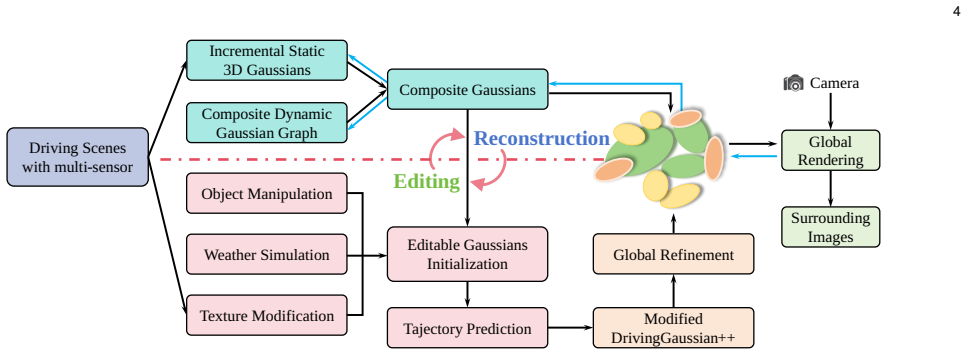
Composite Gaussian Splatting: the scene is split into Incremental Static 3D Gaussians, reconstructed bin-by-bin along the ego trajectory, and a Composite Dynamic Gaussian Graph, where each moving object stores its own Gaussians together with a transform, opacity, and temporal state. The LiDAR prior seeds the static Gaussians, and the global renderer uses the standard 3D Gaussian splatting rasterizer; editing operates directly on this explicit representation through inverse projection from rendered depth, so multi-view consistency is carried by geometry instead of per-frame 2D editing.
Load-bearing premise
The editing pipeline assumes the depth maps rendered by the reconstructed 3D Gaussian field are accurate enough to back-project edited 2D content into correctly placed 3D Gaussians; if rendered depth is biased at object boundaries or in distant regions, edited textures and snow cover will be geometrically misplaced across views.
What would settle it
Render a known planar surface (e.g., the road) from the reconstructed Gaussian model and compare the rendered depth against the LiDAR sweep at the same timestamp; a systematic depth bias at object boundaries or in distant regions would predict cross-view misalignment of edited content. A more direct test: edit one object from a single viewpoint, then render the edited scene from the opposite surround camera and measure the position shift of the edited texture against a manually composited reference; a visible shift or ghosting would falsify the depth-based inverse projection assumption.
If this is right
- Reconstruction and editing are decoupled: any pre-reconstructed 3D Gaussian scene can be edited without retraining, bringing editing cost down to minutes.
- The same framework handles texture modification, weather simulation, object removal and insertion, and dynamic trajectory prediction, replacing several task-specific editing pipelines.
- Using LiDAR as Gaussian initialization rather than only as depth supervision improves geometry and multi-view consistency; the ablation and monocular KITTI-360 results indicate the method is not strictly dependent on LiDAR.
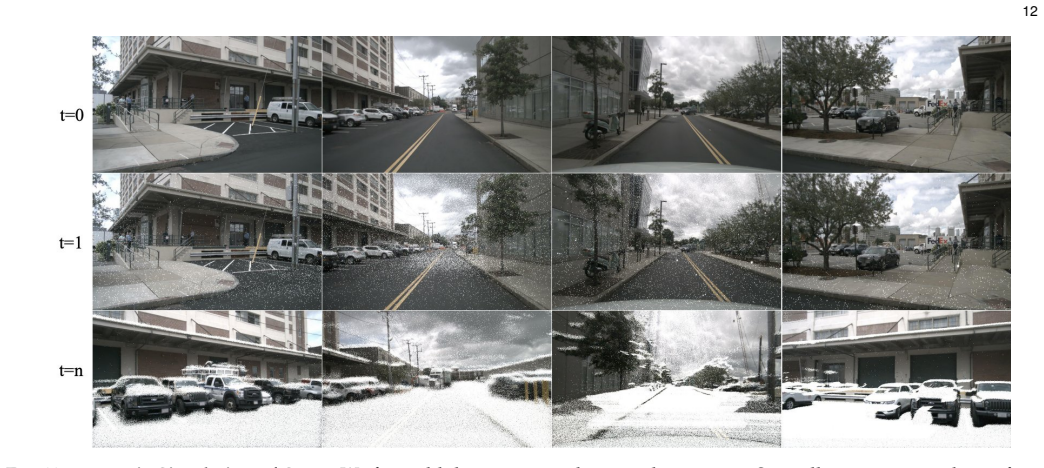
- Edited scenes can produce hard cases such as foggy conditions, cracks, and added objects that degrade object detectors, making the pipeline useful for robustness testing of perception systems.
- Higher CLIP-direction similarity than the compared baselines suggests edits align with text intent while remaining consistent across surrounding views.
Where Pith is reading between the lines
- An open test is whether the training-free editing generalizes when rendered depth is inaccurate: measuring back-projected edit alignment against LiDAR ground truth at object boundaries would directly probe the load-bearing depth assumption.
- Because editing works on explicit Gaussians, the same inverse-projection recipe could transfer to other explicit scene representations and other domains, provided a reliable depth prior exists.
- The LLM-based trajectory prediction is a black-box component; physical plausibility, collision avoidance, and interaction with existing traffic are not systematically evaluated, leaving a natural extension for dynamic insertion.
- Editing consistency is currently quantified on a small set of scenes with CLIP-direction similarity; longer sequences and human perceptual studies would be a stronger test of temporal consistency.
Editorial analysis
A structured set of objections, weighed in public.
Referee Report
Summary. This paper extends the CVPR 2024 DrivingGaussian framework to DrivingGaussian++. It reconstructs large-scale dynamic driving scenes using incremental static 3D Gaussians and a composite dynamic Gaussian graph, initialized with LiDAR points and supervised by TSSIM, robust, and LiDAR losses. On nuScenes and KITTI-360 it reports PSNR/SSIM/LPIPS improvements over EmerNeRF, 3DGS, SUDS, and other baselines. The new claimed contribution is a training-free multi-task editing layer: texture modification by 2D diffusion editing and depth back-projection, weather simulation via procedural particle Gaussians and snow coverage, and object insertion/deletion using a foreground asset bank; LLM (GPT-4o) predicts motion trajectories, and refinement uses inpainting and shadow synthesis. The paper reports large speedups and CLIP-direction scores for editing.
Significance. If the editing pipeline works as claimed, this would be a useful step toward practical dynamic-driving simulation, because it decouples reconstruction from editing and avoids per-task optimization. The reconstruction formulation has plausible components (LiDAR prior, incremental bins, dynamic Gaussian graph), and the reported reconstruction gains over EmerNeRF are substantial. Editing is demonstrated across several tasks with appealing qualitative examples and dramatic speedups. However, the paper's central new claim—consistent and realistic training-free editing—is not yet supported by the evaluation: there is no multi-view consistency metric, no depth-error validation of the back-projection step, no held-out frame evaluation, and the editing protocols are under-specified. Reconstruction numbers also need clarification as to whether they are training-frame or held-out results. With revisions adding targeted experiments, the contribution could become significant.
major comments (5)
- [Sec. 4.4.2 / Tables 2 and 4] The editing evaluation does not measure the property that is claimed. CLIP direction similarity compares text and image embeddings and cannot detect cross-view misplacement or geometric inconsistency of back-projected edits. For a 'consistent and realistic editing' claim, the paper needs a multi-view consistency metric (e.g., reprojection error of edited Gaussians, LPIPS/PSNR across overlapping edited cameras, or a user study) and per-task protocols (prompts, masks, number of scenes, seed). The single CLIP-dir number in Table 2 aggregates four tasks, making it impossible to interpret.
- [Sec. 3.3.1 / Eq. (14)] The depth-backprojection step is load-bearing for texture and snow editing. D_opt = Average_x(D_ori) assumes rendered 3DGS depth is unbiased and that horizontal flattening preserves edited-surface geometry. The paper itself notes depth discrepancies ('surface ... uneven and unrealistic') but does not validate Eq. (14). Please report depth error of D_ori and D_opt against LiDAR for edited regions, separated by surface type (road, vertical sign, vehicle), and show edited Gaussians rendered from novel viewpoints. Without this, the geometric-consistency claim for the novel editing layer is unsupported.
- [Sec. 4.2 / Table 1] The reconstruction evaluation does not state whether metrics are computed on held-out timestamps or views; 'report the average results of all camera frames in the scenes' suggests training frames were used. Since the abstract claims 'photorealistic surround-view synthesis,' held-out evaluation is needed. Also add variance over scene splits or seeds; margins over EmerNeRF are large but the editing comparison in Table 2 has no error bars.
- [Sec. 4.4.2 / Tables 2 and 4] The comparison protocol is under-specified. Prompts, masks, editing regions, scene identities, and LLM/diffusion settings are not given for any baseline or for Ours. Table 4(b) says 'LPIPS and FID' but reports only LPIPS. ClimateNeRF supports one task while Table 2 labels it as multi-task. A fair comparison needs per-task numbers and a clearly specified protocol for every method.
- [Sec. 3.3 / Eqs. (15), (19), (20)] The new editing pipeline has several free parameters and stochastic components that determine the results: particle range parameters zeta and epsilon, inpainting threshold d_thr, KNN pruning threshold, the GPT-4o prompt/temperature/seed, and the multi-camera fusion weight omega in Eq. (5). These are not specified, so the reported 8-minute editing time and qualitative outputs are not reproducible. Please report these settings or include a sensitivity analysis.
minor comments (7)
- [Throughout] Typos and wording issues: 'Cotrollable' in Sec. 2.2, 'matirx' after Eq. (5), 'denots' after Eq. (9), 'perforamnce' in Tables 1 and 3, 'T rajj' in Eqs. (16) and (20), and '1th' in Eq. (19).
- [Eq. (15)] The definition of s_{k,y} appears to be a typo: s_{k,y} = min(min(s_{k,x}, s_{k,x}), 0) + epsilon ignores s_{k,y} and likely should be min(s_{k,x}, s_{k,y}). Please correct.
- [Sec. 3.1.3 / Eq. (8)] The opacity adjustment formula uses cot(a_o) without defining the angle or deriving the expression. Please clarify the geometric meaning.
- [Table 4(b)] The text mentions 'LPIPS and FID' for object removal, but the table reports only LPIPS. Add FID or remove the claim.
- [Abstract] Two different project-page URLs appear in the abstract; please ensure they are consistent.
- [Sec. 4.2] The hardware description '8 RTX8000 with 384 GB memory' is ambiguous: is this 8 GPUs with 48 GB each, or a different configuration? Clarify for reproducibility.
- [Sec. 4.4.2] Define CLIP-direction similarity precisely: which CLIP model, which text prompts, and how direction is computed between source and edited images.
Circularity Check
Reconstruction is externally benchmarked and editing is training-free, but the CLIP-direction editing metric partially inherits the 2D diffusion editor's own prompt alignment, giving the headline editing comparison a mildly circular evaluative component.
specific steps
-
renaming known result
[Section 3.3.1 (Texture Modification) and Section 4.4.2 (Quantitative Results, Tables 2 and 4)]
"Next, we define the 2D mask of the target region and apply the diffusion model or image processing software to modify the image in a 2D space, producing the target image. Using the target image and the mask, we generate target Gaussians and assign appropriate attributes through inverse projection. ... We evaluate editing consistency using CLIP direction similarity metric for texture, weather editing and object insertion."
For texture and snow-coverage editing, the target Gaussians are constructed by inverse-projecting a 2D diffusion-edited target image. Re-rendering the composite scene from the same viewpoint used to create that target image largely reproduces the 2D diffusion editor's output. The reported editing metric, CLIP-direction similarity, then measures the 2D editor's own text-to-image alignment rather than the success of the 3D back-projection. Since Tables 2 and 4 use CLIP-dir as the headline quantitative evidence and no explicit multi-view consistency metric is reported, part of the claimed 3D editing advantage reduces to the pre-aligned 2D editing input.
full rationale
The core reconstruction claim is not circular: Table 1 and Table 3 benchmark against external methods (EmerNeRF, Mip-NeRF360, 3DGS, SUDS, etc.) on nuScenes and KITTI-360, and the LiDAR and SfM ablations are genuine comparisons of initialization strategies. The editing pipeline is training-free and does not fit parameters to the edited images, so there is no fitted-input-called-prediction pattern in the strict sense. The paper's own admitted limitation in Section 3.3.1, that rendered 3DGS depth may not match the true object surface and Eq. 14 is an unvalidated horizontal-depth equalization, is a correctness and robustness concern rather than a circularity. No load-bearing self-citation chain or imported uniqueness theorem appears: references to prior work, including the CVPR 2024 DrivingGaussian precursor, are not used to forbid alternatives or supply the main derivation. The only mild circularity is evaluative: for texture and snow editing, the target Gaussians are produced by inverse-projection of a 2D diffusion-edited image, and the CLIP-direction metric on the source viewpoint substantially reflects the 2D editor's own prompt alignment. This weakens but does not eliminate the editing evidence, since other viewpoints and the 3D particle weather effects provide independent content. Overall score 2: one minor evaluative circularity, with the central reconstruction and most of the editing mechanism remaining externally grounded.
Axiom & Free-Parameter Ledger
free parameters (5)
- Weather particle design parameters zeta and epsilon (Eq. 15) =
not reported
- Inpainting distance threshold d_thr (Eq. 21) =
not reported
- Loss weights for L_TSSIM, L_Robust, L_LiDAR (Eqs. 11-13) =
not reported
- LLM trajectory generation configuration (GPT-4o prompt, temperature, seed) =
not reported
- Multi-camera fusion weight omega (Eq. 5) =
not reported
axioms (5)
- domain assumption Accurate extrinsic calibration between the six cameras and the LiDAR sweeps
- domain assumption Dataset-provided 3D bounding boxes correctly identify and localize all dynamic objects
- domain assumption The 3DGS differentiable rasterizer, training schedule, and densification heuristics of [14] transfer to unbounded driving scenes
- domain assumption CLIP direction similarity is a valid proxy for editing quality and is comparable across heterogeneous tasks
- domain assumption Depth rendered by the reconstruction is accurate enough for inverse projection of edited 2D content
invented entities (2)
-
Procedural weather particle Gaussians (raindrops, snowflakes, fog)
no independent evidence
-
3D Gaussian foreground asset bank
no independent evidence
Cite this review
Pith. "Pith review of DrivingGaussian++: Towards Realistic Reconstruction and Editable Simulation for Surrounding Dynamic Driving Scenes." pith.science (2026). https://pith.science/paper/VBBTE4S3
@misc{pith2026250820965,
  author       = {Pith},
  title        = {Pith review of: DrivingGaussian++: Towards Realistic Reconstruction and Editable Simulation for Surrounding Dynamic Driving Scenes},
  year         = {2026},
  howpublished = {\url{https://pith.science/paper/VBBTE4S3}},
  note         = {Machine review of arXiv:2508.20965}
}
read the original abstract
We present DrivingGaussian++, an efficient and effective framework for realistic reconstructing and controllable editing of surrounding dynamic autonomous driving scenes. DrivingGaussian++ models the static background using incremental 3D Gaussians and reconstructs moving objects with a composite dynamic Gaussian graph, ensuring accurate positions and occlusions. By integrating a LiDAR prior, it achieves detailed and consistent scene reconstruction, outperforming existing methods in dynamic scene reconstruction and photorealistic surround-view synthesis. DrivingGaussian++ supports training-free controllable editing for dynamic driving scenes, including texture modification, weather simulation, and object manipulation, leveraging multi-view images and depth priors. By integrating large language models (LLMs) and controllable editing, our method can automatically generate dynamic object motion trajectories and enhance their realism during the optimization process. DrivingGaussian++ demonstrates consistent and realistic editing results and generates dynamic multi-view driving scenarios, while significantly enhancing scene diversity. More results and code can be found at the project site: https://xiong-creator.github.io/DrivingGaussian_plus.github.io
Figures






Forward citations
Cited by 2 Pith papers
-
LangDriveCTRL: Natural Language Controllable Driving Scene Editing with Multi-modal Agents
LangDriveCTRL decomposes driving videos into 3D scene graphs and uses an agentic pipeline with specialized multi-modal agents to perform language-controlled object and behavior edits, achieving nearly 2x higher instru...
-
Physics-Aware 3D Gaussian Editing for Driving Scene Generation
RoVES performs one-shot, optimization-free 3D Gaussian road geometry insertion coupled with 4-DOF vehicle dynamics for physics-aware pose correction in driving scenes.
Reference graph
Works this paper leans on
-
[1]
Instruct-nerf2nerf: Editing 3d scenes with instructions,
A. Haque, M. Tancik, A. A. Efros, A. Holynski, and A. Kanazawa, “Instruct-nerf2nerf: Editing 3d scenes with instructions,” in ICCV, 2023, pp. 19 740–19 750. 1, 2, 3, 13
work page 2023
-
[2]
Infusion: Inject and attention fusion for multi concept zero-shot text-based video editing,
A. Khandelwal, “Infusion: Inject and attention fusion for multi concept zero-shot text-based video editing,” in ICCV, 2023, pp. 3017–3026. 1, 4
work page 2023
-
[3]
Gaussctrl: multi-view consistent text-driven 3d gaus- sian splatting editing,
J. Wu, J.-W. Bian, X. Li, G. Wang, I. Reid, P . Torr, and V . A. Prisacariu, “Gaussctrl: multi-view consistent text-driven 3d gaus- sian splatting editing,” arXiv preprint arXiv:2403.08733 , 2024. 1, 3
Pith/arXiv arXiv 2024
-
[4]
Gaussianeditor: Swift and con- trollable 3d editing with gaussian splatting,
Y. Chen, Z. Chen, C. Zhang, F. Wang, X. Yang, Y. Wang, Z. Cai, L. Yang, H. Liu, and G. Lin, “Gaussianeditor: Swift and con- trollable 3d editing with gaussian splatting,” in CVPR, 2024, pp. 21 476–21 485. 1, 3
work page 2024
-
[5]
Vica-nerf: View-consistency-aware 3d editing of neural radiance fields,
J. Dong and Y.-X. Wang, “Vica-nerf: View-consistency-aware 3d editing of neural radiance fields,” NIPS, vol. 36, 2024. 1, 3
work page 2024
-
[6]
Climaten- erf: Extreme weather synthesis in neural radiance field,
Y. Li, Z.-H. Lin, D. Forsyth, J.-B. Huang, and S. Wang, “Climaten- erf: Extreme weather synthesis in neural radiance field,” in ICCV, 2023, pp. 3227–3238. 1, 2, 4, 13
work page 2023
-
[7]
Nerf: Representing scenes as neural radiance fields for view synthesis,
B. Mildenhall, P . P . Srinivasan, M. Tancik, J. T. Barron, R. Ra- mamoorthi, and R. Ng, “Nerf: Representing scenes as neural radiance fields for view synthesis,” Communications of the ACM , pp. 99–106, 2021. 2, 12
work page 2021
-
[8]
Block-nerf: Scalable large scene neural view synthesis,
M. Tancik, V . Casser, X. Yan, S. Pradhan, B. Mildenhall, P . P . Srinivasan, J. T. Barron, and H. Kretzschmar, “Block-nerf: Scalable large scene neural view synthesis,” in CVPR, 2022, pp. 8248–8258. 2
work page 2022
-
[9]
Mega-nerf: Scal- able construction of large-scale nerfs for virtual fly-throughs,
H. Turki, D. Ramanan, and M. Satyanarayanan, “Mega-nerf: Scal- able construction of large-scale nerfs for virtual fly-throughs,” in CVPR, 2022, pp. 12 922–12 931. 2
work page 2022
-
[10]
Neural fields meet explicit geometric representations for inverse rendering of urban scenes,
Z. Wang, T. Shen, J. Gao, S. Huang, J. Munkberg, J. Hasselgren, Z. Gojcic, W. Chen, and S. Fidler, “Neural fields meet explicit geometric representations for inverse rendering of urban scenes,” in CVPR, 2023, pp. 8370–8380. 2
work page 2023
-
[11]
M. Zhenxing and D. Xu, “Switch-nerf: Learning scene decomposi- tion with mixture of experts for large-scale neural radiance fields,” in The Eleventh International Conference on Learning Representations ,
-
[12]
Neural scene graphs for dynamic scenes,
J. Ost, F. Mannan, N. Thuerey, J. Knodt, and F. Heide, “Neural scene graphs for dynamic scenes,” in CVPR, 2021, pp. 2856–2865. 2, 3, 12
work page 2021
-
[13]
Towards Efficient Neural Scene Graphs by Learning Consistency Fields
Y. Song, C. Kong, S. Lee, N. Kwak, and J. Lee, “Towards efficient neural scene graphs by learning consistency fields,” arXiv preprint arXiv:2210.04127, 2022. 2, 3
work page internal anchor Pith review Pith/arXiv arXiv 2022
-
[14]
3D Gaus- sian splatting for real-time radiance field rendering,
B. Kerbl, G. Kopanas, T. Leimk ¨uhler, and G. Drettakis, “3D Gaus- sian splatting for real-time radiance field rendering,” TOG, vol. 42, no. 4, pp. 1–14, 2023. 2, 3, 6, 7, 9, 10, 11, 12, 14, 15
work page 2023
-
[15]
Instruct-gs2gs: Editing 3d gaussian splats with instructions (2024),
C. Vachha and A. Haque, “Instruct-gs2gs: Editing 3d gaussian splats with instructions (2024),” URL https://instruct-gs2gs.github.io,
work page 2024
-
[16]
Instant neural graphics primitives with a multiresolution hash encoding,
T. M ¨uller, A. Evans, C. Schied, and A. Keller, “Instant neural graphics primitives with a multiresolution hash encoding,” TOG, vol. 41, no. 4, pp. 1–15, 2022. 2, 10, 11
work page 2022
-
[17]
Plenoxels: Radiance fields without neural net- works,
S. Fridovich-Keil, A. Yu, M. Tancik, Q. Chen, B. Recht, and A. Kanazawa, “Plenoxels: Radiance fields without neural net- works,” in CVPR, 2022, pp. 5501–5510. 2
work page 2022
-
[18]
Fastnerf: High-fidelity neural rendering at 200fps,
S. J. Garbin, M. Kowalski, M. Johnson, J. Shotton, and J. Valentin, “Fastnerf: High-fidelity neural rendering at 200fps,” inICCV, 2021, pp. 14 346–14 355. 2
work page 2021
-
[19]
Barf: Bundle- adjusting neural radiance fields,
C.-H. Lin, W.-C. Ma, A. Torralba, and S. Lucey, “Barf: Bundle- adjusting neural radiance fields,” in ICCV, 2021, pp. 5741–5751. 2
work page 2021
-
[20]
Nerf–: Neural radiance fields without known camera parameters,
Z. Wang, S. Wu, W. Xie, M. Chen, and V . A. Prisacariu, “Nerf–: Neural radiance fields without known camera parameters,” arXiv preprint arXiv:2102.07064, 2021. 2
Pith/arXiv arXiv 2021
-
[21]
Nope- nerf: Optimising neural radiance field with no pose prior,
W. Bian, Z. Wang, K. Li, J.-W. Bian, and V . A. Prisacariu, “Nope- nerf: Optimising neural radiance field with no pose prior,” in CVPR, 2023, pp. 4160–4169. 2
work page 2023
-
[22]
Nerf for outdoor scene relighting,
V . Rudnev, M. Elgharib, W. Smith, L. Liu, V . Golyanik, and C. Theobalt, “Nerf for outdoor scene relighting,” in ECCV. Springer, 2022, pp. 615–631. 2
work page 2022
-
[23]
D- nerf: Neural radiance fields for dynamic scenes,
A. Pumarola, E. Corona, G. Pons-Moll, and F. Moreno-Noguer, “D- nerf: Neural radiance fields for dynamic scenes,” in CVPR, 2021, pp. 10 318–10 327. 2
work page 2021
-
[24]
Hdr- nerf: High dynamic range neural radiance fields,
X. Huang, Q. Zhang, Y. Feng, H. Li, X. Wang, and Q. Wang, “Hdr- nerf: High dynamic range neural radiance fields,” in CVPR, 2022, pp. 18 398–18 408. 2
work page 2022
-
[25]
Nerf in the wild: Neural radiance fields for unconstrained photo collections,
R. Martin-Brualla, N. Radwan, M. S. Sajjadi, J. T. Barron, A. Doso- vitskiy, and D. Duckworth, “Nerf in the wild: Neural radiance fields for unconstrained photo collections,” in CVPR, 2021, pp. 7210–7219. 2
work page 2021
-
[26]
Mip-nerf: A multiscale represen- tation for anti-aliasing neural radiance fields,
J. T. Barron, B. Mildenhall, M. Tancik, P . Hedman, R. Martin- Brualla, and P . P . Srinivasan, “Mip-nerf: A multiscale represen- tation for anti-aliasing neural radiance fields,” in ICCV, 2021, pp. 5855–5864. 2, 10, 11
work page 2021
-
[27]
Mip-nerf 360: Unbounded anti-aliased neural radiance fields,
J. T. Barron, B. Mildenhall, D. Verbin, P . P . Srinivasan, and P . Hed- man, “Mip-nerf 360: Unbounded anti-aliased neural radiance fields,” in CVPR, 2022, pp. 5470–5479. 2, 10, 11, 12
work page 2022
-
[28]
Grid-guided neural radiance fields for large urban scenes,
L. Xu, Y. Xiangli, S. Peng, X. Pan, N. Zhao, C. Theobalt, B. Dai, and D. Lin, “Grid-guided neural radiance fields for large urban scenes,” in CVPR, 2023, pp. 8296–8306. 2
work page 2023
-
[29]
Streetsurf: Extending multi-view implicit surface recon- struction to street views,
J. Guo, N. Deng, X. Li, Y. Bai, B. Shi, C. Wang, C. Ding, D. Wang, and Y. Li, “Streetsurf: Extending multi-view implicit surface recon- struction to street views,” arXiv preprint arXiv:2306.04988 , 2023. 2
Pith/arXiv arXiv 2023
-
[30]
Robust dynamic radiance fields,
Y.-L. Liu, C. Gao, A. Meuleman, H.-Y. Tseng, A. Saraf, C. Kim, Y.- Y. Chuang, J. Kopf, and J.-B. Huang, “Robust dynamic radiance fields,” in CVPR, 2023, pp. 13–23. 3
work page 2023
-
[31]
Progressively optimized local radiance fields for robust view synthesis,
A. Meuleman, Y.-L. Liu, C. Gao, J.-B. Huang, C. Kim, M. H. Kim, and J. Kopf, “Progressively optimized local radiance fields for robust view synthesis,” in CVPR, 2023, pp. 16 539–16 548. 3
work page 2023
-
[32]
MARS: An Instance-aware, Modular and Realistic Simulator for Autonomous Driving
Z. Wu, T. Liu, L. Luo, Z. Zhong, J. Chen, H. Xiao, C. Hou, H. Lou, Y. Chen, R. Yanget al., “Mars: An instance-aware, modular and realistic simulator for autonomous driving,” arXiv preprint arXiv:2307.15058, 2023. 3
work page internal anchor Pith review Pith/arXiv arXiv 2023
-
[33]
Unisim: A neural closed-loop sensor simulator,
Z. Yang, Y. Chen, J. Wang, S. Manivasagam, W.-C. Ma, A. J. Yang, and R. Urtasun, “Unisim: A neural closed-loop sensor simulator,” in CVPR, 2023, pp. 1389–1399. 3
work page 2023
-
[34]
S-nerf: Neural radiance fields for street views,
Z. Xie, J. Zhang, W. Li, F. Zhang, and L. Zhang, “S-nerf: Neural radiance fields for street views,” arXiv preprint arXiv:2303.00749 ,
-
[35]
Suds: Scalable urban dynamic scenes,
H. Turki, J. Y. Zhang, F. Ferroni, and D. Ramanan, “Suds: Scalable urban dynamic scenes,” in CVPR, 2023, pp. 12 375–12 385. 3, 10, 11, 12
work page 2023
-
[36]
Emernerf: Emergent spatial- temporal scene decomposition via self-supervision,
J. Yang, B. Ivanovic, O. Litany, X. Weng, S. W. Kim, B. Li, T. Che, D. Xu, S. Fidler, M. Pavone et al. , “Emernerf: Emergent spatial- temporal scene decomposition via self-supervision,” arXiv preprint arXiv:2311.02077, 2023. 3, 9, 10, 11, 12 17
Pith/arXiv arXiv 2023
-
[37]
De- formable 3d gaussians for high-fidelity monocular dynamic scene reconstruction,
Z. Yang, X. Gao, W. Zhou, S. Jiao, Y. Zhang, and X. Jin, “De- formable 3d gaussians for high-fidelity monocular dynamic scene reconstruction,” arXiv preprint arXiv:2309.13101 , 2023. 3
Pith/arXiv arXiv 2023
-
[38]
4d gaussian splatting for real-time dynamic scene rendering,
G. Wu, T. Yi, J. Fang, L. Xie, X. Zhang, W. Wei, W. Liu, Q. Tian, and X. Wang, “4d gaussian splatting for real-time dynamic scene rendering,” arXiv preprint arXiv:2310.08528 , 2023. 3
Pith/arXiv arXiv 2023
-
[39]
Dynamic 3d gaussians: Tracking by persistent dynamic view synthesis,
J. Luiten, G. Kopanas, B. Leibe, and D. Ramanan, “Dynamic 3d gaussians: Tracking by persistent dynamic view synthesis,” arXiv preprint arXiv:2308.09713, 2023. 3
Pith/arXiv arXiv 2023
-
[40]
Dreameditor: Text- driven 3d scene editing with neural fields,
J. Zhuang, C. Wang, L. Lin, L. Liu, and G. Li, “Dreameditor: Text- driven 3d scene editing with neural fields,” in SIGGRAPH Asia 2023 Conference Papers , 2023, pp. 1–10. 3
work page 2023
-
[41]
Hifa: High-fidelity text-to- 3d generation with advanced diffusion guidance,
J. Zhu, P . Zhuang, and S. Koyejo, “Hifa: High-fidelity text-to- 3d generation with advanced diffusion guidance,” arXiv preprint arXiv:2305.18766, 2023. 3
Pith/arXiv arXiv 2023
-
[42]
Structure-from-motion revis- ited,
J. L. Schonberger and J.-M. Frahm, “Structure-from-motion revis- ited,” in CVPR, 2016, pp. 4104–4113. 4, 14
work page 2016
-
[43]
R3d3: Dense 3d reconstruction of dynamic scenes from multiple cameras,
A. Schmied, T. Fischer, M. Danelljan, M. Pollefeys, and F. Yu, “R3d3: Dense 3d reconstruction of dynamic scenes from multiple cameras,” in ICCV, 2023, pp. 3216–3226. 5
work page 2023
-
[44]
MOISST: Multimodal Optimization of Implicit Scene for SpatioTemporal calibration
Q. Herau, N. Piasco, M. Bennehar, L. Rold ˜ao, D. Tsishkou, C. Migniot, P . Vasseur, and C. Demonceaux, “Moisst: Multi-modal optimization of implicit scene for spatiotemporal calibration,” arXiv preprint arXiv:2303.03056 , 2023. 5
work page internal anchor Pith review Pith/arXiv arXiv 2023
-
[45]
Grounded sam: Assembling open-world models for diverse visual tasks,
T. Ren, S. Liu, A. Zeng, J. Lin, K. Li, H. Cao, J. Chen, X. Huang, Y. Chen, F. Yan, Z. Zeng, H. Zhang, F. Li, J. Yang, H. Li, Q. Jiang, and L. Zhang, “Grounded sam: Assembling open-world models for diverse visual tasks,” arXiv preprint arXiv:2401.14159 , 2024. 6
Pith/arXiv arXiv 2024
-
[46]
S3im: Stochastic structural similarity and its unreason- able effectiveness for neural fields,
Z. Xie, X. Yang, Y. Yang, Q. Sun, Y. Jiang, H. Wang, Y. Cai, and M. Sun, “S3im: Stochastic structural similarity and its unreason- able effectiveness for neural fields,” in ICCV, 2023, pp. 18 024– 18 034. 7
work page 2023
-
[47]
Grounding dino: Marrying dino with grounded pre-training for open-set object detection,
S. Liu, Z. Zeng, T. Ren, F. Li, H. Zhang, J. Yang, C. Li, J. Yang, H. Su, J. Zhu et al. , “Grounding dino: Marrying dino with grounded pre-training for open-set object detection,” arXiv preprint arXiv:2303.05499, 2023. 7, 8
Pith/arXiv arXiv 2023
-
[48]
Depth anything: Unleashing the power of large-scale unlabeled data,
L. Yang, B. Kang, Z. Huang, X. Xu, J. Feng, and H. Zhao, “Depth anything: Unleashing the power of large-scale unlabeled data,” in CVPR, 2024, pp. 10 371–10 381. 9
work page 2024
-
[49]
Design of an image edge detection filter using the sobel operator,
N. Kanopoulos, N. Vasanthavada, and R. L. Baker, “Design of an image edge detection filter using the sobel operator,” IEEE Journal of solid-state circuits , vol. 23, no. 2, pp. 358–367, 1988. 9
work page 1988
-
[50]
Editable scene simulation for autonomous driving via collaborative llm-agents,
Y. Wei, Z. Wang, Y. Lu, C. Xu, C. Liu, H. Zhao, S. Chen, and Y. Wang, “Editable scene simulation for autonomous driving via collaborative llm-agents,” in CVPR, 2024, pp. 15 077–15 087. 9, 14
work page 2024
-
[51]
J. Achiam, S. Adler, S. Agarwal, L. Ahmad, I. Akkaya, F. L. Aleman, D. Almeida, J. Altenschmidt, S. Altman, S. Anadkat et al., “Gpt-4 technical report,” arXiv preprint arXiv:2303.08774 , 2023. 9, 10
Pith/arXiv arXiv 2023
-
[52]
Arshad- owgan: Shadow generative adversarial network for augmented reality in single light scenes,
D. Liu, C. Long, H. Zhang, H. Yu, X. Dong, and C. Xiao, “Arshad- owgan: Shadow generative adversarial network for augmented reality in single light scenes,” in CVPR, 2020, pp. 8139–8148. 10
work page 2020
-
[53]
K. Rematas, A. Liu, P . P . Srinivasan, J. T. Barron, A. Tagliasacchi, T. Funkhouser, and V . Ferrari, “Urban radiance fields,” in CVPR, 2022, pp. 12 932–12 942. 10, 11
work page 2022
-
[54]
nuscenes: A multimodal dataset for autonomous driving,
H. Caesar, V . Bankiti, A. H. Lang, S. Vora, V . E. Liong, Q. Xu, A. Krishnan, Y. Pan, G. Baldan, and O. Beijbom, “nuscenes: A multimodal dataset for autonomous driving,” in CVPR, 2020. 10
work page 2020
-
[55]
Kitti-360: A novel dataset and benchmarks for urban scene understanding in 2d and 3d,
Y. Liao, J. Xie, and A. Geiger, “Kitti-360: A novel dataset and benchmarks for urban scene understanding in 2d and 3d,” IEEE T ransactions on Pattern Analysis and Machine Intelligence , vol. 45, no. 3, pp. 3292–3310, 2022. 10
work page 2022
-
[56]
Point-nerf: Point-based neural radiance fields,
Q. Xu, Z. Xu, J. Philip, S. Bi, Z. Shu, K. Sunkavalli, and U. Neu- mann, “Point-nerf: Point-based neural radiance fields,” in CVPR, 2022, pp. 5438–5448. 12
work page 2022
-
[57]
Urban radiance field representation with deformable neural mesh primi- tives,
F. Lu, Y. Xu, G. Chen, H. Li, K.-Y. Lin, and C. Jiang, “Urban radiance field representation with deformable neural mesh primi- tives,” in ICCV, 2023, pp. 465–476. 12
work page 2023
-
[58]
Dreamgaussian4d: Generative 4d gaussian splatting,
J. Ren, L. Pan, J. Tang, C. Zhang, A. Cao, G. Zeng, and Z. Liu, “Dreamgaussian4d: Generative 4d gaussian splatting,” arXiv preprint arXiv:2312.17142 , 2023. 13, 14
Pith/arXiv arXiv 2023
-
[59]
Paint by example: Exemplar-based image editing with diffusion models,
B. Yang, S. Gu, B. Zhang, T. Zhang, X. Chen, X. Sun, D. Chen, and F. Wen, “Paint by example: Exemplar-based image editing with diffusion models,” in CVPR, 2023, pp. 18 381–18 391. 13, 14
work page 2023
-
[60]
Anydoor: Zero-shot object-level image customization,
X. Chen, L. Huang, Y. Liu, Y. Shen, D. Zhao, and H. Zhao, “Anydoor: Zero-shot object-level image customization,” in CVPR, 2024, pp. 6593–6602. 13, 14
work page 2024
-
[61]
High-resolution image synthesis with latent diffusion models,
R. Rombach, A. Blattmann, D. Lorenz, P . Esser, and B. Ommer, “High-resolution image synthesis with latent diffusion models,” in CVPR, 2022, pp. 10 684–10 695. 13, 14
work page 2022
-
[62]
Instructdiffusion: A generalist modeling interface for vision tasks,
Z. Geng, B. Yang, T. Hang, C. Li, S. Gu, T. Zhang, J. Bao, Z. Zhang, H. Li, H. Hu et al. , “Instructdiffusion: A generalist modeling interface for vision tasks,” in CVPR, 2024, pp. 12 709–12 720. 13, 14
work page 2024
-
[63]
Instructpix2pix: Learning to follow image editing instructions,
T. Brooks, A. Holynski, and A. A. Efros, “Instructpix2pix: Learning to follow image editing instructions,” in CVPR, 2023, pp. 18 392– 18 402. 13, 14
work page 2023
-
[64]
Towards under- standing cross and self-attention in stable diffusion for text-guided image editing,
B. Liu, C. Wang, T. Cao, K. Jia, and J. Huang, “Towards under- standing cross and self-attention in stable diffusion for text-guided image editing,” in CVPR, 2024, pp. 7817–7826. 13, 14
work page 2024
-
[65]
Ultraedit: Instruction-based fine-grained image editing at scale,
H. Zhao, X. Ma, L. Chen, S. Si, R. Wu, K. An, P . Yu, M. Zhang, Q. Li, and B. Chang, “Ultraedit: Instruction-based fine-grained image editing at scale,” arXiv preprint arXiv:2407.05282 , 2024. 14
Pith/arXiv arXiv 2024
-
[66]
Resolution-robust large mask inpainting with fourier convolutions,
R. Suvorov, E. Logacheva, A. Mashikhin, A. Remizova, A. Ashukha, A. Silvestrov, N. Kong, H. Goka, K. Park, and V . Lem- pitsky, “Resolution-robust large mask inpainting with fourier convolutions,” in Proceedings of the IEEE/CVF winter conference on applications of computer vision , 2022, pp. 2149–2159. 13
work page 2022
-
[67]
Spin-nerf: Multiview segmentation and perceptual inpainting with neural radiance fields,
A. Mirzaei, T. Aumentado-Armstrong, K. G. Derpanis, J. Kelly, M. A. Brubaker, I. Gilitschenski, and A. Levinshtein, “Spin-nerf: Multiview segmentation and perceptual inpainting with neural radiance fields,” in CVPR, 2023, pp. 20 669–20 679. 14
work page 2023
-
[68]
Splatter image: Ultra-fast single-view 3d reconstruction,
S. Szymanowicz, C. Rupprecht, and A. Vedaldi, “Splatter image: Ultra-fast single-view 3d reconstruction,” in CVPR, 2024, pp. 10 208–10 217. 14
work page 2024
-
[69]
Segment everything everywhere all at once,
X. Zou, J. Yang, H. Zhang, F. Li, L. Li, J. Gao, and Y. J. Lee, “Segment everything everywhere all at once,” arXiv preprint arXiv:2304.06718, 2023. 14
Pith/arXiv arXiv 2023
-
[70]
Dreamgaussian: Generative gaussian splatting for efficient 3d content creation,
J. Tang, J. Ren, H. Zhou, Z. Liu, and G. Zeng, “Dreamgaussian: Generative gaussian splatting for efficient 3d content creation,” arXiv preprint arXiv:2309.16653 , 2023. 14
Pith/arXiv arXiv 2023
This paper was first reviewed by deepseek-v4-flash on August 5, 2026.
discussion (0)
Sign in with ORCID, Apple, or X to comment. Anyone can read and Pith papers without signing in.