Bohr--Sommerfeld rules for systems
Pith reviewed 2026-05-18 20:09 UTC · model grok-4.3
The pith
Bohr-Sommerfeld quantization for self-adjoint 2x2 systems includes explicit geometric phase corrections that become quantized in certain cases.
A machine-rendered reading of the paper's core claim, the machinery that carries it, and where it could break.
Core claim
For a semiclassical self-adjoint 2x2 system whose principal symbol is a matrix-valued function with eigenvalues crossing inside a simple closed curve in phase space, the Bohr-Sommerfeld quantization condition takes an explicit form that includes geometric phase corrections, and these corrections become quantized under identifiable conditions on the system.
What carries the argument
The geometric phase correction term added to the integral form of the Bohr-Sommerfeld rule for matrix-valued principal symbols.
If this is right
- The quantization condition supplies explicit formulas for approximate eigenvalues that include the geometric phase contribution.
- The geometric phase takes quantized values when the 2x2 system satisfies certain symmetry conditions.
- The rule applies uniformly to any general self-adjoint 2x2 system generated by a simple closed curve in phase space.
- The formulas reduce to the ordinary scalar Bohr-Sommerfeld rule when there are no eigenvalue crossings.
Where Pith is reading between the lines
- The same phase-correction approach could be tested against numerical spectra of other 2x2 operators with known crossings to verify accuracy beyond the paper's examples.
- It may connect to quantization problems in which multiple crossings occur or in which the curve is not simple.
- The explicit form could be used to derive selection rules for transitions in physical systems modeled by such operators.
Load-bearing premise
The principal symbol is a self-adjoint 2x2 matrix-valued function whose eigenvalues cross inside the domain enclosed by the simple closed curve in phase space.
What would settle it
For a concrete example of a Dirac-type 2x2 operator, compute its eigenvalues numerically at small semiclassical parameter values and test whether they satisfy the derived quantization condition that includes the geometric phase term.
Figures



read the original abstract
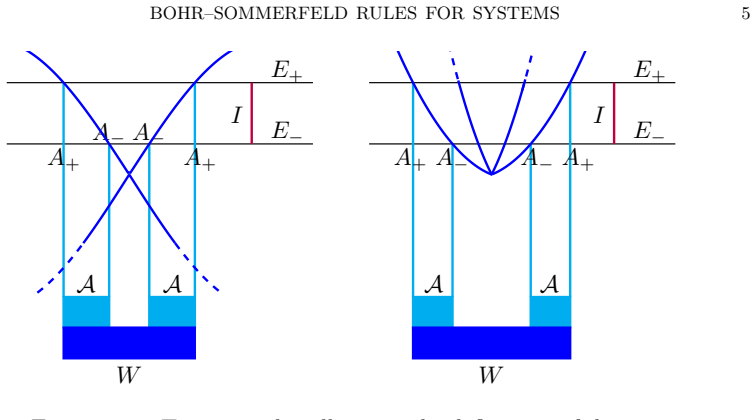
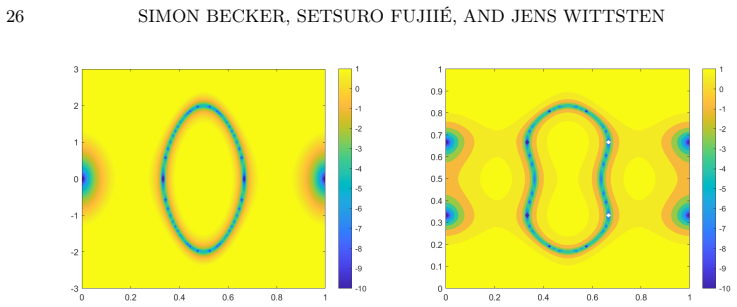
We present a complete, self-contained formulation of the Bohr--Sommerfeld quantization rule for a semiclassical self-adjoint $2 \times 2$ system on the real line, arising from a simple closed curve in phase space. We focus on the case where the principal symbol exhibits eigenvalue crossings within the domain enclosed by the curve -- a situation commonly encountered in Dirac-type operators. Building on earlier work on scalar Bohr--Sommerfeld rules and semiclassical treatments of the Harper operator near rational flux quanta, we derive concise expressions for general self-adjoint $2 \times 2$ systems. The resulting formulas give explicit geometric phase corrections and clarify when these phases take quantized values.
Editorial analysis
A structured set of objections, weighed in public.
Referee Report
Summary. The manuscript presents a complete, self-contained derivation of the Bohr-Sommerfeld quantization rule for semiclassical self-adjoint 2×2 systems on the real line associated with a simple closed curve in phase space. It focuses on eigenvalue crossings of the principal symbol inside the enclosed domain, reduces the problem to a scalar transport equation along the curve, and supplies explicit geometric (Berry) phase corrections together with a distinction between the quantized half-integer shift (crossing enclosed) and the non-quantized case (crossing outside).
Significance. If the derivation holds, the work supplies a useful explicit tool for semiclassical spectral analysis of Dirac-type and similar matrix operators. The paper's strengths include its parameter-free, self-contained construction that builds directly on published scalar Bohr-Sommerfeld and Harper-operator results, the reduction to a scalar transport equation with standard Maslov correction plus eigenvector-bundle Berry phase, and the correct monodromy matching that distinguishes the two crossing locations without internal inconsistency or ad-hoc parameters.
minor comments (2)
- A compact summary table or boxed display of the final quantization condition for the two cases (crossing inside versus outside the curve) would improve readability and make the distinction immediately accessible.
- Notation for the Berry phase and its relation to the eigenvector bundle is introduced gradually; a single consolidated definition early in the derivation section would reduce cross-referencing.
Simulated Author's Rebuttal
We thank the referee for the positive and accurate summary of our manuscript, as well as for the recommendation of minor revision. The report correctly identifies the self-contained derivation of the Bohr-Sommerfeld rule with geometric phase corrections for 2x2 semiclassical systems featuring eigenvalue crossings.
Circularity Check
Minor self-citation to prior scalar results; central derivation remains independent
full rationale
The paper explicitly builds on earlier published scalar Bohr-Sommerfeld rules and Harper-operator results but performs an independent reduction of the 2x2 self-adjoint system to a scalar transport equation along the closed curve, then inserts the standard Maslov index plus an explicitly computed geometric (Berry) phase from the eigenvector bundle. No load-bearing equation or quantization condition is obtained by fitting parameters to the target data or by redefining the output in terms of itself. The distinction between quantized and non-quantized phase contributions when crossings lie inside versus outside the curve is derived directly from the monodromy calculation and is externally falsifiable. This qualifies as a normal, non-circular use of prior independent work.
Axiom & Free-Parameter Ledger
axioms (2)
- domain assumption The operator is semiclassical and self-adjoint with a principal symbol that is a 2x2 matrix-valued function.
- domain assumption There exists a simple closed curve in phase space whose interior contains eigenvalue crossings of the principal symbol.
Lean theorems connected to this paper
-
IndisputableMonolith/Foundation/AlexanderDuality.leanalexander_duality_circle_linking unclear?
unclearRelation between the paper passage and the cited Recognition theorem.
Assumes principal symbol H0 = p0 I + ∥P∥ U with eigenvalue crossings inside D; reduces via perturbation and diagonalization to scalar Helffer-Robert BS rule
What do these tags mean?
- matches
- The paper's claim is directly supported by a theorem in the formal canon.
- supports
- The theorem supports part of the paper's argument, but the paper may add assumptions or extra steps.
- extends
- The paper goes beyond the formal theorem; the theorem is a base layer rather than the whole result.
- uses
- The paper appears to rely on the theorem as machinery.
- contradicts
- The paper's claim conflicts with a theorem or certificate in the canon.
- unclear
- Pith found a possible connection, but the passage is too broad, indirect, or ambiguous to say the theorem truly supports the claim.
Reference graph
Works this paper leans on
-
[1]
S. Becker and J. Wittsten,Semiclassical quantization conditions in strained moiré lat- tices. Commun. Math. Phys.405, 218 (2024)
work page 2024
- [2]
-
[3]
Colin de Verdière,Bohr-Sommerfeld rules to all orders,Ann
Y. Colin de Verdière,Bohr-Sommerfeld rules to all orders,Ann. Henri Poincaré (2005), 925–936
work page 2005
-
[4]
H. Cornean, B. Helffer, and R. Purice,Spectral analysis near a Dirac type crossing in a weak non-constant magnetic field, Trans. Amer. Math. Soc.374(10) (2021), 7041–7104
work page 2021
-
[5]
S. Fujiié and S. Kamvissis,Semiclassical WKB problem for the non-self-adjoint Dirac operator with analytic potential, Journal of Mathematical Physics61(1) (2020), 011510
work page 2020
-
[6]
S.Fujiié, C.Lasser, andL.Nédélec, Semiclassical resonances for a two-level Schrödinger operator with a conical intersection, Asymptotic Analysis65 (1-2) (2009), 17–58
work page 2009
-
[7]
S. Fujiié and J. Wittsten, Quantization conditions of eigenvalues for semiclassical Zakharov-Shabat systems on the circle, Discrete and continuous dynamical systems 38(8) (2018), 3851–3873
work page 2018
- [8]
-
[9]
B. Helffer and D. Robert,Calcul fonctionnel par la transformation de Mellin et opéra- teurs admissibles, J. Funct. Anal.53(3) (1983), 246–268
work page 1983
-
[10]
B. Helffer and D. Robert,Asymptotique des niveaux d’énergie pour des hamiltoniens a un degre de liberté, Duke Math. J.49(4) (1982), 853–868
work page 1982
-
[11]
B. Helffer and D. Robert,Puits de potentiel généralisés et asymptotique semi-classique, Annales de l’IHP Physique théorique41(3) (1984), 291–331
work page 1984
-
[12]
B. Helffer and J. Sjöstrand,Analyse semi-classique pour l’équation de Harper: (avec application à l’equation de Schrödinger avec champ magnétique).No. 34. Société Math- ématique de France, 1988
work page 1988
-
[13]
B. Helffer and J. Sjöstrand,Analyse semi-classique pour l’équation de Harper. II: com- portement semi-classique près d’un rationnel.Mémoires de la Société Mathématique de France 40 (1990), 1–139
work page 1990
-
[14]
K. Hirota, Real eigenvalues of a non-self-adjoint perturbation of the self-adjoint Zakharov-Shabat operator, Journal of Mathematical Physics58 (2017), 102108
work page 2017
-
[15]
K. Hirota and J. Wittsten,Complex eigenvalue splitting for the Dirac operator, Com- munications in Mathematical Physics383(3) (2021), 1527–1558
work page 2021
-
[16]
M. Hitrik and M. Zworski, Overdamped QNM for Schwarzschild black holes, arXiv preprint, 2025, arXiv:2406.15924
-
[17]
Sjöstrand,Microlocal analysis for the periodic Schrödinger equation and related ques- tions
J. Sjöstrand,Microlocal analysis for the periodic Schrödinger equation and related ques- tions. InMicrolocal Analysis and Applications: Lectures given at the 2nd Session of the Centro Internazionale Matematico Estivo (CIME) held at Montecatini Terme, Italy, July 3-11, 1989.Springer, 1991, p. 237–332
work page 1989
-
[18]
Taylor,Reflection of singularities of solutions to systems of differential equations
M. Taylor,Reflection of singularities of solutions to systems of differential equations. Comm. Pure Appl. Math.28, 457-478 (1975)
work page 1975
-
[19]
Thaller,The Dirac equation, Springer, 2013
B. Thaller,The Dirac equation, Springer, 2013
work page 2013
-
[20]
A. Timmel and E.J. Mele,Dirac-Harper Theory for One-Dimensional moiré Superlat- tices, Phys. Rev. Lett. 125, 166803. 30 SIMON BECKER, SETSURO FUJIIÉ, AND JENS WITTSTEN
-
[21]
Yoshida,Bohr–Sommerfeld quantization condition for self-adjoint Dirac operators
N. Yoshida,Bohr–Sommerfeld quantization condition for self-adjoint Dirac operators. Rev. Math. Phys.36 (2024), 2450024. (Simon Becker) ETH Zurich, Institute for Mathematical Research, Rämis- trasse 101, 8092 Zurich, Switzerland Email address: simon.becker@math.ethz.ch (Setsuro Fujiie) Department of Mathematical Sciences, Ritsumeikan Univer- sity, Kusatsu,...
work page 2024
discussion (0)
Sign in with ORCID, Apple, or X to comment. Anyone can read and Pith papers without signing in.