REVIEW 3 major objections 6 minor 1 cited by
The paper claims that self-consistency hallucination detection can be made roughly 2–3x cheaper by caching and reusing shared prefixes across sampled answers, with detection accuracy essentially unchanged.
Reviewed by Pith at T0; open to challenge. T0 means a machine referee read the full paper against a public rubric. the ladder, T0–T4 →
A decoding pipeline reuses cached tokens and anneals sampling temperature to accelerate self-consistency hallucination detection by up to 3x without meaningful AUROC loss.
T0 review reviewed 2026-08-05 challenge →
load-bearing objection Real speedups, but the 'no AUROC sacrifice' claim rests on an untested invariance that the paper's own SQuAD result contradicts. the 3 major comments →
Decoding Memories: An Efficient Pipeline for Self-Consistency Hallucination Detection
The pith
A machine-rendered reading of the paper's core claim, the machinery that carries it, and where it could break.
The reading
Core claim
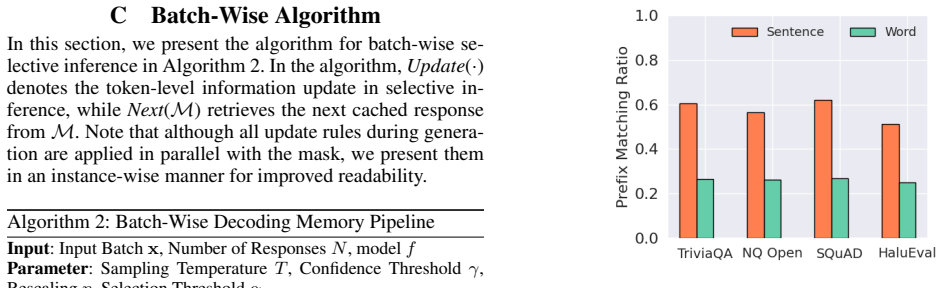
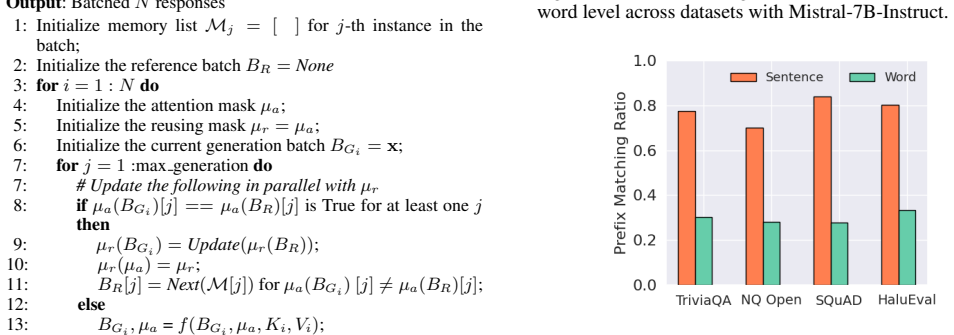
The paper's central claim is that self-consistency hallucination detection can be accelerated by treating repeated tokens as cached memory. The authors report two observations: across TriviaQA, NQ-Open, SQuAD, and HaluEval, multiple generations for the same prompt share a prefix in more than 70% of response pairs, and variation in non-exact-answer tokens does not change the semantic accuracy of response groups. From this they build DMP: a memory of past responses with their logits, KV caches, and hidden states; when a new generation matches a stored prefix, the pipeline reuses the cached logits instead of running a forward pass. Annealed decoding then lowers the effective sampling temperatur
What carries the argument
The central object is the Decoding Memory Pipeline (DMP), a cached-response reuse mechanism. Each stored response carries its token sequence, logits, KV cache tensors, and hidden states. Selective inference compares the current prefix against these cached responses: on a match, it reuses the cached logit and KV tensors, skipping the model forward pass; on a mismatch, it runs the model normally. Annealed decoding identifies non-exact-answer tokens—those whose embeddings are similar to the prompt embedding—and rescales their logits, effectively lowering their sampling temperature so templates become deterministic. Hard decoding additionally reuses cached tokens when the model's confidence exce
Load-bearing premise
The pipeline's speedup without quality loss depends on the premise that non-answer words can be made deterministic without changing what the response means for hallucination scoring; the paper's own SQuAD result shows this premise does not hold on every domain.
What would settle it
On a new QA dataset, run both standard sampling and DMP with annealed decoding on the same prompts and compare the actual consistency scores—Semantic Entropy or LN-Entropy—rather than grouped accuracy. If the score distributions diverge substantially, or if AUROC drops more than the roughly 2.9% single-trial bound reported here, the non-answer-token assumption fails in that domain.
If this is right
- Self-consistency hallucination detection can run at roughly half to one-third of its usual generation cost on common QA benchmarks, with mean detection AUROC changing less than 0.5%.
- The speedup transfers across models and across self-consistency baselines because DMP is orthogonal to how consistency is scored: it wraps generation, not the detection metric.
- Reuse ratio acts as a hardware-independent predictor of speedup: when about two-thirds of tokens are skipped, wall-clock time falls by roughly the same factor.
- DMP layers on top of KV caching and batch inference, so it can combine with existing inference-acceleration techniques rather than replace them.
- The same redundancy argument applies to other multi-response uses such as uncertainty quantification and best-of-n alignment, where multiple generations are also compared for consistency.
Where Pith is reading between the lines
- The paper does not directly test how annealing changes the actual consistency scores—it tests only grouped accuracy after template clustering. A natural extension is to compare LN-Entropy and Semantic Entropy distributions between standard and DMP-annealed responses; if those scores shift materially while grouped accuracy stays flat, observation 2 needs qualification.
- Because annealed decoding makes response templates deterministic, the cached prefix becomes a reliable draft. Pairing DMP with speculative or prompt-lookup decoding could compound the speedup beyond the reported reuse ratios, though the paper leaves this untested.
- The SQuAD result—where annealed decoding was dropped in favor of hard decoding—implies the non-answer-token assumption has boundaries. A self-tuning version of DMP that detects when annealing degrades detection quality and falls back to hard decoding would be a direct follow-up.
- The reported memory increase is modest at 722 MB for a batch of ten on a 7B model, but caching full responses, KV tensors, and hidden states may become expensive for long generations; quantized or compressed response memories are an obvious practical extension.
Editorial analysis
A structured set of objections, weighed in public.
Referee Report
Summary. The paper studies redundancy in multi-response self-consistency hallucination detection and proposes the Decoding Memory Pipeline (DMP). The authors report two observations: (1) responses to the same prompt share long prefixes, and (2) non-exact-answer tokens contribute little to semantic content. DMP combines selective inference, which reuses cached logits/KV states when a prefix matches a previously generated response, with annealed decoding, which rescales the logits of low-importance tokens to make sampling more deterministic and thereby increase reuse, and a hard-decoding rule for high-confidence tokens. Experiments on TriviaQA, NQ-Open, SQuAD, HaluEval, and SciQ with LLaMA-2-7B/13B-Chat, Mistral-7B-Instruct, and Falcon-7B-Instruct across five consistency baselines report wall-clock speedups of 1.9–2.8x and mean AUROC differences around 0.5% from baseline. The paper claims an up-to-3x speedup without sacrificing AUROC.
Significance. If the central claim holds, DMP is a practically useful, model- and metric-agnostic wrapper for self-consistency hallucination detection: it directly attacks the main cost of repeated generation, is compatible with KV caching and batching, and quantifies its memory overhead (Appendix F, +722 MB). The redundancy analysis and component ablation are useful contributions. However, the decisive claim that annealed decoding preserves detection quality is supported only indirectly, and the reported numbers contain an internal contradiction plus an unreported exception on SQuAD. The contribution is therefore a promising engineering result whose main conclusion still needs stronger evidence and honest qualification.
major comments (3)
- [§4.1, §4.3, Appendix B.2] Observation 2 is the load-bearing premise for annealed decoding, but it is tested only by grouping responses by template with GPT-3.5 and comparing group accuracy (Figure 2d). That test does not measure how annealing changes the consistency metrics used for detection (LN-Entropy, Eq. 4; Semantic Entropy, Eq. 21). Annealed decoding (Eq. 11) changes the token probabilities that feed those metrics. Moreover, Appendix B.2 states that annealed decoding on SQuAD performed 'significantly worse' and was dropped; the SQuAD rows in Table 1 therefore use a different configuration. The headline 'DMP achieves up to 3x without sacrificing AUROC' is not supported for a single pipeline; it is a dataset-specific composition.
- [§5.2, Table 1] The text states 'the AUROC reduction is at most 2.9% across all trials.' This is directly contradicted by Table 1: for Mistral-7B-Instruct on SQuAD, SelfCheckGPT baseline AUROC is 65.1 and DMP is 60.1, a 5.0-point drop. No confidence intervals, bootstrap estimates, or multiple-seed results are reported anywhere, so even the mean differences of about 0.5% cannot be distinguished from sampling noise. The 'without sacrificing AUROC' claim needs either corrected reporting and significance testing, or a qualified statement that discloses the SQuAD/SelfCheckGPT exception.
- [Eq. (11), Eq. (4), Eq. (21)] It is unclear which token probabilities are used to compute the self-consistency scores after DMP. Equation (11) updates the cached logits s(m)_i = η s(m)_i for non-exact-answer tokens, and these modified logits are used to sample or reuse tokens. If the same modified logits are used to compute LN-Entropy or Semantic Entropy, then the scores are not the same objects as the baseline scores, and the AUROC comparison is confounded. If the original logits are retained for scoring, the paper should say so and describe the additional storage. This must be clarified and, if necessary, re-validated.
minor comments (6)
- [Algorithm 1, Appendix C] The pseudocode is hard to follow and appears to contain errors: Algorithm 1 line 7 'Hard Decoding with cache' is not formally specified, and line 9 assigns f(x, Ki, Vi) to yi[j+len(x)] without defining the full update. Appendix C's mask updates have similar ambiguities. A clean description or proof of output equivalence would help.
- [§4.3, §5.1] The default importance-selection threshold is stated as α=0.9 in §5.1, but the ablation in Figure 5 recommends α=1.2 as maintaining high AUROC with a favorable trade-off. Please clarify the discrepancy or justify the default choice.
- [Abstract, §5.2] The abstract and text say 'up to 3x speedup,' while the largest measured wall-clock speedup in Table 1 is 2.8x. Clarify whether 3x refers to the theoretical reuse-ratio speedup (1/(1−0.668)) or to actual runtime, and align the wording.
- [Appendix B.1] The formulas for p_sentence and p_word are typeset incorrectly: Equation (23)–(27) have misplaced line breaks and an ambiguous denominator in p_word. Please rewrite these definitions cleanly.
- [Appendix E, Table 4] The text refers to 'Table E', but the actual table is numbered Table 4. Update the cross-reference.
- [References, Appendix D.2] Falcon-7B-Instruct is attributed to Penedo et al. 2023, but the cited RefinedWeb paper does not introduce Falcon-7B-Instruct. Use the correct Falcon model reference.
Circularity Check
No significant circularity: the speedup is a direct effect of the method and AUROC is measured externally; the only self-citation is non-load-bearing.
full rationale
Selective inference (Sec. 4.2) reuses cached logits only on exact prefix matches, so the generated distribution is identical to standard generation in the absence of annealing; the time saving is a direct measure of skipped forward passes, not a prediction derived from the method's parameters. Observation 2 is tested by an external GPT-3.5 template-grouping experiment (Fig. 2d), not by the consistency metrics themselves, so it is an empirical (if indirect) premise rather than a definitional equivalence. Annealed decoding (Eq. 11) modifies logits of selected tokens and the paper then measures AUROC against GPT-4o-labeled correctness, an external benchmark; the reported AUROC is therefore not forced by the construction of alpha, eta, or gamma. The reuse ratio is explicitly defined as the percentage of skipped forward passes, so reporting it as theoretical speedup is a definitional identity rather than a circular validation. Concerns that alpha, eta, and gamma are tuned on the same test datasets via ablations (Sec. 5.3) are a selection-bias/rigor issue, not a reduction of the result to its inputs. The self-citation to Gao et al. (2025) appears only in the efficient-LLM related-work list and is not load-bearing. The paper itself states the memory-cost limitation (Sec. 6) and the SQuAD annealed-decoding failure (App. B.2); these bound the universality claim but do not create circularity.
Axiom & Free-Parameter Ledger
free parameters (5)
- alpha (importance selection threshold) =
0.9 in main experiments; ablation suggests 1.2
- eta (annealing speed) =
1.4
- gamma (hard decoding confidence threshold) =
0.8
- sampling temperature T =
0.8
- short-answer token threshold =
<10 tokens
axioms (3)
- standard math LLM generation is autoregressive and the logit for a token depends only on the prefix; equal prefixes yield equal logits.
- domain assumption Non-exact-answer tokens (e.g., function words, template variations) contribute minimally to semantic content and to hallucination detection.
- domain assumption Altering the sampling distribution via annealing and hard decoding does not materially change hallucination detection AUROC.
Cite this review
Pith. "Pith review of Decoding Memories: An Efficient Pipeline for Self-Consistency Hallucination Detection." pith.science (2026). https://pith.science/paper/W3SR3RHL
@misc{pith2026250821228,
  author       = {Pith},
  title        = {Pith review of: Decoding Memories: An Efficient Pipeline for Self-Consistency Hallucination Detection},
  year         = {2026},
  howpublished = {\url{https://pith.science/paper/W3SR3RHL}},
  note         = {Machine review of arXiv:2508.21228}
}
read the original abstract
Large language models (LLMs) have demonstrated impressive performance in both research and real-world applications, but they still struggle with hallucination. Existing hallucination detection methods often perform poorly on sentence-level generation or rely heavily on domain-specific knowledge. While self-consistency approaches help address these limitations, they incur high computational costs due to repeated generation. In this paper, we conduct the first study on identifying redundancy in self-consistency methods, manifested as shared prefix tokens across generations, and observe that non-exact-answer tokens contribute minimally to the semantic content. Based on these insights, we propose a novel Decoding Memory Pipeline (DMP) that accelerates generation through selective inference and annealed decoding. Being orthogonal to the model, dataset, decoding strategy, and self-consistency baseline, our DMP consistently improves the efficiency of multi-response generation and holds promise for extension to alignment and reasoning tasks. Extensive experiments show that our method achieves up to a 3x speedup without sacrificing AUROC performance.
Figures




Forward citations
Cited by 1 Pith paper
-
Efficient Test-Time Inference via Deterministic Exploration of Truncated Decoding Trees
Distinct Leaf Enumeration (DLE) replaces stochastic self-consistency sampling with deterministic traversal of a truncated decoding tree to enumerate distinct leaves, increasing coverage and reducing redundant computat...
Reference graph
Works this paper leans on
-
[1]
, " * write output.state after.block = add.period write newline
ENTRY address archivePrefix author booktitle chapter edition editor eid eprint howpublished institution isbn journal key month note number organization pages publisher school series title type volume year label extra.label sort.label short.list INTEGERS output.state before.all mid.sentence after.sentence after.block FUNCTION init.state.consts #0 'before.a...
-
[2]
write newline
" write newline "" before.all 'output.state := FUNCTION n.dashify 't := "" t empty not t #1 #1 substring "-" = t #1 #2 substring "--" = not "--" * t #2 global.max substring 't := t #1 #1 substring "-" = "-" * t #2 global.max substring 't := while if t #1 #1 substring * t #2 global.max substring 't := if while FUNCTION word.in bbl.in capitalize " " * FUNCT...
-
[3]
AI@Meta. 2024. Llama 3 Model Card
work page 2024
-
[4]
Amini, A.; Vieira, T.; Ash, E.; and Cotterell, R. 2024. Variational best-of-n alignment. arXiv preprint arXiv:2407.06057
Pith/arXiv arXiv 2024
-
[5]
Asai, A.; and Hajishirzi, H. 2020. Logic-guided data augmentation and regularization for consistent question answering. arXiv preprint arXiv:2004.10157
Pith/arXiv arXiv 2020
-
[6]
Athaluri, S. A.; Manthena, S. V.; Kesapragada, V. K. M.; Yarlagadda, V.; Dave, T.; and Duddumpudi, R. T. S. 2023. Exploring the boundaries of reality: investigating the phenomenon of artificial intelligence hallucination in scientific writing through ChatGPT references. Cureus, 15(4)
work page 2023
-
[7]
Azaria, A.; and Mitchell, T. 2023. The internal state of an LLM knows when it's lying. arXiv preprint arXiv:2304.13734
Pith/arXiv arXiv 2023
-
[8]
Chai, M.; Herron, E.; Cervantes, E.; and Ghosal, T. 2024. Exploring scientific hypothesis generation with mamba. In Proceedings of the 1st Workshop on NLP for Science (NLP4Science), 197--207
work page 2024
-
[9]
Chen, C.; Liu, K.; Chen, Z.; Gu, Y.; Wu, Y.; Tao, M.; Fu, Z.; and Ye, J. 2024. INSIDE: LLMs' internal states retain the power of hallucination detection. arXiv preprint arXiv:2402.03744
Pith/arXiv arXiv 2024
-
[10]
Devlin, J.; Chang, M.-W.; Lee, K.; and Toutanova, K. 2019. Bert: Pre-training of deep bidirectional transformers for language understanding. In Proceedings of the 2019 conference of the North American chapter of the association for computational linguistics: human language technologies, volume 1 (long and short papers), 4171--4186
2019
-
[11]
Farquhar, S.; Kossen, J.; Kuhn, L.; and Gal, Y. 2024. Detecting hallucinations in large language models using semantic entropy. Nature, 630(8017): 625--630
2024
- [12]
-
[13]
B.; Dhariwal, P.; Gray, S.; et al
Henighan, T.; Kaplan, J.; Katz, M.; Chen, M.; Hesse, C.; Jackson, J.; Jun, H.; Brown, T. B.; Dhariwal, P.; Gray, S.; et al. 2020. Scaling laws for autoregressive generative modeling. arXiv preprint arXiv:2010.14701
Pith/arXiv arXiv 2020
-
[14]
Hooper, C.; Kim, S.; Mohammadzadeh, H.; Mahoney, M. W.; Shao, Y. S.; Keutzer, K.; and Gholami, A. 2024. Kvquant: Towards 10 million context length llm inference with kv cache quantization. Advances in Neural Information Processing Systems, 37: 1270--1303
work page 2024
-
[15]
P.; Perelman, A.; Ramesh, A.; Clark, A.; Ostrow, A.; Welihinda, A.; Hayes, A.; Radford, A.; et al
Hurst, A.; Lerer, A.; Goucher, A. P.; Perelman, A.; Ramesh, A.; Clark, A.; Ostrow, A.; Welihinda, A.; Hayes, A.; Radford, A.; et al. 2024. Gpt-4o system card. arXiv preprint arXiv:2410.21276
Pith/arXiv arXiv 2024
-
[16]
Ji, Z.; Lee, N.; Frieske, R.; Yu, T.; Su, D.; Xu, Y.; Ishii, E.; Bang, Y. J.; Madotto, A.; and Fung, P. 2023. Survey of hallucination in natural language generation. ACM computing surveys, 55(12): 1--38
work page 2023
-
[17]
Jiang, D.; Liu, Y.; Liu, S.; Zhao, J.; Zhang, H.; Gao, Z.; Zhang, X.; Li, J.; and Xiong, H. 2023. From clip to dino: Visual encoders shout in multi-modal large language models. arXiv preprint arXiv:2310.08825
Pith/arXiv arXiv 2023
-
[18]
Joshi, M.; Choi, E.; Weld, D. S.; and Zettlemoyer, L. 2017. Triviaqa: A large scale distantly supervised challenge dataset for reading comprehension. arXiv preprint arXiv:1705.03551
Pith/arXiv arXiv 2017
-
[19]
Kuhn, L.; Gal, Y.; and Farquhar, S. 2023. Semantic uncertainty: Linguistic invariances for uncertainty estimation in natural language generation. arXiv preprint arXiv:2302.09664
Pith/arXiv arXiv 2023
-
[20]
Kwiatkowski, T.; Palomaki, J.; Redfield, O.; Collins, M.; Parikh, A.; Alberti, C.; Epstein, D.; Polosukhin, I.; Devlin, J.; Lee, K.; et al. 2019. Natural questions: a benchmark for question answering research. Transactions of the Association for Computational Linguistics, 7: 453--466
2019
-
[21]
Li, J.; Cheng, X.; Zhao, W. X.; Nie, J.-Y.; and Wen, J.-R. 2023. Halueval: A large-scale hallucination evaluation benchmark for large language models. arXiv preprint arXiv:2305.11747
Pith/arXiv arXiv 2023
-
[22]
Li, Q.; Geng, J.; Chen, Z.; Zhu, D.; Wang, Y.; Ma, C.; Lyu, C.; and Karray, F. 2025. HD-NDEs: Neural Differential Equations for Hallucination Detection in LLMs. arXiv preprint arXiv:2506.00088
work page internal anchor Pith review Pith/arXiv arXiv 2025
-
[23]
Lin, J.; Tang, J.; Tang, H.; Yang, S.; Chen, W.-M.; Wang, W.-C.; Xiao, G.; Dang, X.; Gan, C.; and Han, S. 2024. Awq: Activation-aware weight quantization for on-device llm compression and acceleration. Proceedings of machine learning and systems, 6: 87--100
work page 2024
-
[24]
Lin, Z.; Liu, J. Z.; and Shang, J. 2022. Towards collaborative neural-symbolic graph semantic parsing via uncertainty. Findings of the Association for Computational Linguistics: ACL 2022
work page 2022
-
[25]
Liu, A.; Liu, J.; Pan, Z.; He, Y.; Haffari, G.; and Zhuang, B. 2024. Minicache: Kv cache compression in depth dimension for large language models. Advances in Neural Information Processing Systems, 37: 139997--140031
work page 2024
-
[26]
Liu, W.; Wang, X.; Owens, J.; and Li, Y. 2020. Energy-based out-of-distribution detection. Advances in neural information processing systems, 33: 21464--21475
work page 2020
-
[27]
Ma, X.; Fang, G.; and Wang, X. 2023. Llm-pruner: On the structural pruning of large language models. Advances in neural information processing systems, 36: 21702--21720
work page 2023
-
[28]
Malinin, A.; and Gales, M. 2020. Uncertainty estimation in autoregressive structured prediction. arXiv preprint arXiv:2002.07650
Pith/arXiv arXiv 2020
-
[29]
Manakul, P.; Liusie, A.; and Gales, M. J. 2023. Selfcheckgpt: Zero-resource black-box hallucination detection for generative large language models. arXiv preprint arXiv:2303.08896
Pith/arXiv arXiv 2023
-
[30]
OpenAI, R. 2023. Gpt-4 technical report. arxiv 2303.08774. View in Article, 2(5): 1
Pith/arXiv arXiv 2023
-
[31]
Orgad, H.; Toker, M.; Gekhman, Z.; Reichart, R.; Szpektor, I.; Kotek, H.; and Belinkov, Y. 2024. Llms know more than they show: On the intrinsic representation of llm hallucinations. arXiv preprint arXiv:2410.02707
Pith/arXiv arXiv 2024
-
[32]
Pal, A.; Umapathi, L. K.; and Sankarasubbu, M. 2023. Med-halt: Medical domain hallucination test for large language models. arXiv preprint arXiv:2307.15343
Pith/arXiv arXiv 2023
-
[33]
Fact-Checking Complex Claims with Program-Guided Reasoning
Pan, L.; Wu, X.; Lu, X.; Luu, A. T.; Wang, W. Y.; Kan, M.-Y.; and Nakov, P. 2023. Fact-checking complex claims with program-guided reasoning. arXiv preprint arXiv:2305.12744
work page internal anchor Pith review Pith/arXiv arXiv 2023
-
[34]
Park, S.; Du, X.; Yeh, M.-H.; Wang, H.; and Li, Y. 2025. Steer LLM Latents for Hallucination Detection. arXiv preprint arXiv:2503.01917
Pith/arXiv arXiv 2025
-
[35]
Penedo, G.; Malartic, Q.; Hesslow, D.; Cojocaru, R.; Cappelli, A.; Alobeidli, H.; Pannier, B.; Almazrouei, E.; and Launay, J. 2023. The RefinedWeb dataset for Falcon LLM: outperforming curated corpora with web data, and web data only. arXiv preprint arXiv:2306.01116
Pith/arXiv arXiv 2023
-
[36]
Rajpurkar, P.; Zhang, J.; Lopyrev, K.; and Liang, P. 2016. Squad: 100,000+ questions for machine comprehension of text. arXiv preprint arXiv:1606.05250
Pith/arXiv arXiv 2016
-
[37]
Rawte, V.; Sheth, A.; and Das, A. 2023. A survey of hallucination in large foundation models. arXiv preprint arXiv:2309.05922
Pith/arXiv arXiv 2023
-
[38]
Ren, J.; Luo, J.; Zhao, Y.; Krishna, K.; Saleh, M.; Lakshminarayanan, B.; and Liu, P. J. 2022. Out-of-distribution detection and selective generation for conditional language models. arXiv preprint arXiv:2209.15558
Pith/arXiv arXiv 2022
-
[39]
Su, W.; Wang, C.; Ai, Q.; Hu, Y.; Wu, Z.; Zhou, Y.; and Liu, Y. 2024. Unsupervised real-time hallucination detection based on the internal states of large language models. arXiv preprint arXiv:2403.06448
Pith/arXiv arXiv 2024
-
[40]
Touvron, H.; Martin, L.; Stone, K.; Albert, P.; Almahairi, A.; Babaei, Y.; Bashlykov, N.; Batra, S.; Bhargava, P.; Bhosale, S.; et al. 2023. Llama 2: Open foundation and fine-tuned chat models. arXiv preprint arXiv:2307.09288
Pith/arXiv arXiv 2023
-
[41]
N.; Kaiser, .; and Polosukhin, I
Vaswani, A.; Shazeer, N.; Parmar, N.; Uszkoreit, J.; Jones, L.; Gomez, A. N.; Kaiser, .; and Polosukhin, I. 2017. Attention is all you need. Advances in neural information processing systems, 30
2017
-
[42]
Wan, Z.; Wang, X.; Liu, C.; Alam, S.; Zheng, Y.; Liu, J.; Qu, Z.; Yan, S.; Zhu, Y.; Zhang, Q.; et al. 2023. Efficient large language models: A survey. arXiv preprint arXiv:2312.03863
Pith/arXiv arXiv 2023
-
[43]
Welbl, J.; Liu, N. F.; and Gardner, M. 2017. Crowdsourcing multiple choice science questions. arXiv preprint arXiv:1707.06209
Pith/arXiv arXiv 2017
-
[44]
Xiong, M.; Hu, Z.; Lu, X.; Li, Y.; Fu, J.; He, J.; and Hooi, B. 2023. Can llms express their uncertainty? an empirical evaluation of confidence elicitation in llms. arXiv preprint arXiv:2306.13063
Pith/arXiv arXiv 2023
-
[45]
Xu, X.; Li, M.; Tao, C.; Shen, T.; Cheng, R.; Li, J.; Xu, C.; Tao, D.; and Zhou, T. 2024. A survey on knowledge distillation of large language models. arXiv preprint arXiv:2402.13116
Pith/arXiv arXiv 2024
-
[46]
Xue, F.; Fu, Y.; Zhou, W.; Zheng, Z.; and You, Y. 2023. To repeat or not to repeat: Insights from scaling llm under token-crisis. Advances in Neural Information Processing Systems, 36: 59304--59322
work page 2023
-
[47]
Zuo, Y.; Zhang, K.; Sheng, L.; Qu, S.; Cui, G.; Zhu, X.; Li, H.; Zhang, Y.; Long, X.; Hua, E.; et al. 2025. Ttrl: Test-time reinforcement learning. arXiv preprint arXiv:2504.16084
Pith/arXiv arXiv 2025
-
[48]
@esa (Ref
\@ifxundefined[1] #1\@undefined \@firstoftwo \@secondoftwo \@ifnum[1] #1 \@firstoftwo \@secondoftwo \@ifx[1] #1 \@firstoftwo \@secondoftwo [2] @ #1 \@temptokena #2 #1 @ \@temptokena \@ifclassloaded agu2001 natbib The agu2001 class already includes natbib coding, so you should not add it explicitly Type <Return> for now, but then later remove the command n...
-
[49]
\@lbibitem[] @bibitem@first@sw\@secondoftwo \@lbibitem[#1]#2 \@extra@b@citeb \@ifundefined br@#2\@extra@b@citeb \@namedef br@#2 \@nameuse br@#2\@extra@b@citeb \@ifundefined b@#2\@extra@b@citeb @num @parse #2 @tmp #1 NAT@b@open@#2 NAT@b@shut@#2 \@ifnum @merge>\@ne @bibitem@first@sw \@firstoftwo \@ifundefined NAT@b*@#2 \@firstoftwo @num @NAT@ctr \@secondoft...
-
[50]
@open @close @open @close and [1] URL: #1 \@ifundefined chapter * \@mkboth \@ifxundefined @sectionbib * \@mkboth * \@mkboth\@gobbletwo \@ifclassloaded amsart * \@ifclassloaded amsbook * \@ifxundefined @heading @heading NAT@ctr thebibliography [1] @ \@biblabel @NAT@ctr \@bibsetup #1 @NAT@ctr @ @openbib .11em \@plus.33em \@minus.07em 4000 4000 `\.\@m @bibit...
arXiv 1932
This paper was first reviewed by deepseek-v4-flash on August 5, 2026.
discussion (0)
Sign in with ORCID, Apple, or X to comment. Anyone can read and Pith papers without signing in.