REVIEW 4 major objections 5 minor 30 references
Stage-Diff: Stage-wise Long-Term Time Series Generation Based on Diffusion Models
T0 review · 4 major / 5 minor · reviewed 2026-08-05 · deepseek-v4-flash
Pith's one-line read A staged diffusion model generates long time series by passing trend summaries between stages.
desk verdict A coherent staged-diffusion architecture for long time series, but the central trend-only transfer mechanism is not directly tested and the experiments are too thin to support the headline claim. read the letter →
The pith
A machine-rendered reading of the paper's core claim, the machinery that carries it, and where it could break.
The reading
What carries the argument
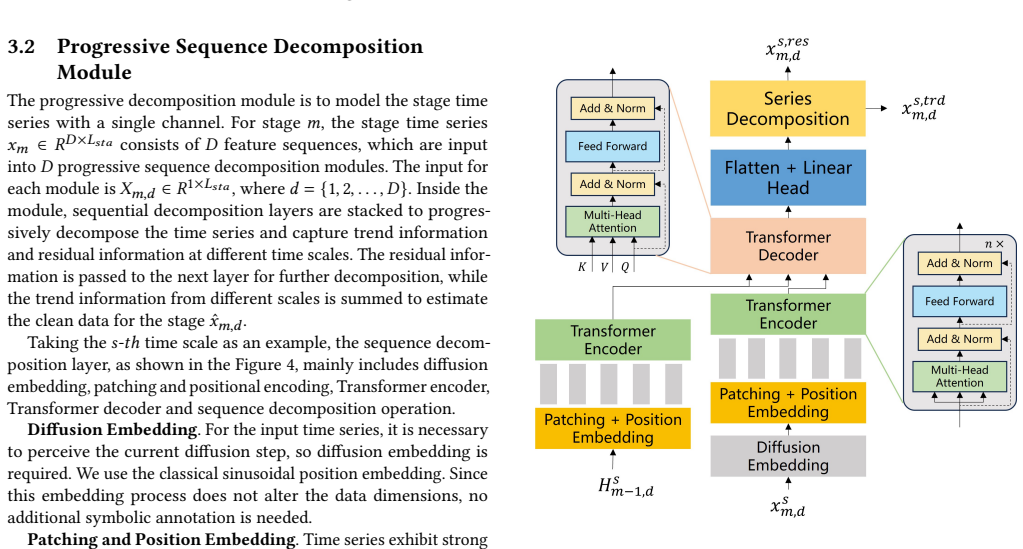
Progressive sequence decomposition with inter-stage multi-channel fusion. At stage m, each of the D channels runs through stacked decomposition layers; each layer patches the series, encodes with a Transformer, decodes conditioned on historical hidden state, then splits the output into an averaged trend and a residual that feeds the next layer. The trends from all scales are summed to form the channel's clean estimate. Across stages, the trends from all D channels at each scale are concatenated and passed through a temporal convolution with a D × L_conv kernel, producing fused historical embeddings that seed the next stage's decoder. This convolution is the only place channels interact, and
What would settle it
Take a synthetic two-channel series constructed so that the only cross-channel coupling lives in the high-frequency residual (e.g., a shared volatility cluster), while the trends are independent. Train Stage-Diff and a variant that also forwards residual information. If the variant reconstructs the coupling and Stage-Diff does not, the trend-only transfer is the bottleneck.
Extended reading notes
Core claim
The central claim is that the tension between long-term temporal dependencies and gradual distribution drift is resolvable by construction, not by a larger model: if generation happens stage by stage, with each stage's multi-scale trend summaries fused across channels and handed to the next stage, the model can hold the long-range context it needs while each stage freely learns its own local distribution. The paper additionally claims that interleaving channel-independent decomposition (within a stage) with multi-channel fusion (between stages) captures both intra-sequence and inter-sequence dependencies, and that this design keeps performance stable as sequence length increases, where singl
Load-bearing premise
Cutting a long series into fixed stages and passing only averaged trend summaries through a convolution is sufficient to preserve the inter-stage dependencies that matter for generation quality.
Editorial extensions
If this is right
- If stage-wise transfer works, long-series generation no longer needs to attend over the entire sequence; memory is compressed in trend summaries, so cost scales linearly with the number of stages.
- The method offers a template for generating non-stationary series: decompose temporally, model each local distribution, and pass compact summaries forward.
- Baseline comparisons suggest diffusion-based generators are more stable than GAN- and VAE-based generators as sequence length grows.
- Ablations indicate channel-independent modeling contributes more than multi-channel fusion, and stage-wise generation matters most at the longest tested lengths.
Reading between the lines
- The trend-summary bottleneck is an information bottleneck: one could measure how much information about the future stage is retained by the trend summaries versus the full stage, and a variant that also transfers residual information might beat Stage-Diff on series where cross-stage dependencies live in high-frequency components.
- The staged design suggests a natural autoregressive extension: generate stage by stage, which would enable conditional generation or controllable trajectory synthesis such as 'continue this series for another 256 steps.'
- A nonlinear fusion mechanism (e.g., cross-attention over channels rather than convolution) might capture richer inter-sequence dependencies; this is a testable variant of the multi-channel fusion module.
- The claimed stability at longer lengths could come from bounded error accumulation in the summary transfer; increasing the number of stages at fixed total length is a direct test of how gracefully quality degrades.
Editorial analysis
A structured set of objections, weighed in public.
Referee Report
Summary. The paper proposes Stage-Diff, a diffusion-based generative model for long multivariate time series. The full sequence is split into M stages; each stage is generated with per-channel Transformer-based encoders and decoders under a progressive sequence decomposition that separates the signal into multiscale trend and residual components. Only the trend components are passed to the next stage through a multi-channel convolution, which is meant to preserve long-term dependencies while stage-wise generation accommodates distribution shifts. Experiments on ETTH, Stock, Exchange, and Weather compare discriminative and predictive scores against Diffusion-TS, TimeVAE, PSA-GAN, and TimeGAN, and include ablation studies of the channel-independent, channel-fusion, and stage-wise components.
Significance. If the claims hold, the staged design with trend-only inter-stage information transfer is a plausible contribution to long time-series generation, and the combination of channel-independent modeling within stages with multi-channel fusion across stages is a sensible way to balance intra- and inter-sequence dependencies. The paper uses standard diffusion and attention machinery, and the architecture description is internally coherent. I do not see a circularity problem: the evaluation is on held-out real data with external baseline scores. However, the current evidence is not yet sufficient. The central mechanism—preservation of long-term dependencies and modeling of distribution shift—is not directly measured; the reported aggregate discriminative/predictive metrics do not isolate cross-stage information. The experimental support also lacks error bars, statistical tests, and hyperparameter reporting, and several Table 1 and Table 2 entries contradict the claimed uniform superiority. The idea is worth further investigation, but the manuscript needs substantial revision before the state-of-the-art claim is justified.
major comments (4)
- [§3.2–3.3, Eqs. (10)–(12)] The central claim that Stage-Diff 'preserves long-term sequence dependencies' is not directly tested. Only the multiscale trend components x^{s,trd}_{m,d} are transferred between stages via the convolution in Eq. (12); the residuals x^{s,res}_{m,d} are discarded. The evaluation in Table 1 reports aggregate discriminative and predictive scores over whole sequences, which do not isolate whether information across stage boundaries is preserved. A GRU discriminator can separate real from synthetic data based on local statistics, and the predictive score does not force long-horizon accuracy. I request targeted diagnostics: lagged autocorrelation and cross-correlation functions across stage boundaries, or a forecasting task with horizon comparable to the stage length. If distribution-shift modeling is claimed, the paper should also compare per-stage distributions (e.g., segment-wise MMD) betwe
- [§4.2, Table 1] The statement that Stage-Diff 'achieves optimal or suboptimal performance across different datasets with varying sequence lengths' is not supported for length 24. TimeVAE beats Stage-Diff on ETTH (discriminative 0.014 vs 0.084; predictive 0.094 vs 0.132), Stock (0.015 vs 0.093), Exchange (0.014 vs 0.104), and Weather (0.003 vs 0.221). Stage-Diff's advantage is concentrated at lengths 128 and 256. Moreover, no error bars, number of seeds, or statistical significance tests are reported, so the differences may be within noise. Please report mean ± std across independent seeds (at least 5) and/or statistical tests, and rephrase the claim by sequence length and dataset.
- [§4.2, Table 2] The ablation study does not support the conclusion that 'the complete Stage-Diff model consistently achieves the best results.' Several cells contradict this: w/o Stage is better than Stage-Diff on ETTH length 24 (discriminative 0.071 vs 0.084; length 64 0.087 vs 0.093), Stock length 24 (predictive 0.013 vs 0.037), and several other rows. The text acknowledges that stage-wise generation can hurt short sequences, but the final conclusion remains too strong. Please either revise the claim to specify the regime in which staging helps or provide a statistical analysis showing that these exceptions are not significant.
- [§3.1–3.3 and §4.1] The method and experimental configuration are under-specified. The diffusion loss L_x is defined for a generic denoiser, but the paper does not state how the per-stage estimates \hat{x}_{m,d} are used in the objective, how the inter-stage fusion in Eq. (12) is trained, what H^s_{m-1,d} is for the first stage, or whether L_sta is fixed while M varies across the four tested lengths. The hyperparameters introduced in Section 3 (M, L_sta, L_patch, L_win, S, L_conv, diffusion steps, noise schedule) are not reported in Section 4.1, and no code is provided. Without these details, the reported scores cannot be reproduced or compared.
minor comments (5)
- [§3, §3.2, Table 1] Typos and inconsistent names: 'satges' in §3; 'TTo' at the start of the 'Series Decomposition' paragraph in §3.2; 'Diff-TS' vs 'Diffusion-TS' and 'TimeVAE' vs 'TimeV AE' in Table 1.
- [§3.2, Eq. (7)] Notation conflict: D denotes the feature dimension of the time series and also the Transformer latent dimension in Eq. (7); d_k and d are not clearly distinguished.
- [§1, Figure 1] Figure 1 shows commercial-vehicle data that is not among the four experimental datasets; please state clearly whether it is illustrative only.
- [§4.2, Figure 5] The phrase 'completely aligns' in the t-SNE discussion is too strong for a visual inspection; 'overlaps substantially' would be more accurate.
- [Front matter] The CCS Concepts block (Security and privacy → Data anonymization and sanitization) does not match the paper's content.
Circularity Check
No significant circularity: Stage-Diff's central claims are tested against held-out real-world data using standard discriminative and predictive metrics, not by construction or by self-citation.
full rationale
The paper's derivation chain is self-contained in the relevant sense: the proposed staged generation, progressive sequence decomposition, and multi-channel fusion modules are defined directly from Equations (7)-(12) and are evaluated on four external real-world datasets (ETTH, Stock, Exchange, Weather) with the TimeGAN-based discriminative and predictive scores. No fitted parameter is renamed as a prediction; the discriminative score compares real and synthetic data with a GRU classifier, and the predictive score trains a predictor on synthetic data and evaluates on real data. These are independent, held-out evaluations rather than reductions of the target claim. The cited works (Diffusion-TS, TimeVAE, PSA-GAN, TimeGAN) are baselines, not load-bearing justifications for the method's validity. The paper does not invoke a uniqueness theorem from the authors' prior work, and no ansatz is smuggled in via self-citation. The ablation study (Table 2) is also an honest comparison of design components rather than a circular argument. The concern that trend-only inter-stage transfer may not fully preserve long-term dependencies is a substantive modeling assumption and a possible correctness risk, but it is not circular reasoning: the paper does not define 'preserves long-term dependencies' as the same operation that generates the trend summaries, and the claim is not equivalent to its inputs by construction. Therefore the appropriate circularity score is 0.
Assumptions & free parameters
free parameters (6)
- stage count M and stage length L_sta
- patch length L_patch and stride L_win
- number of decomposition scales S
- convolution kernel size L_conv
- diffusion steps and noise schedule
- training hyperparameters
assumptions (5)
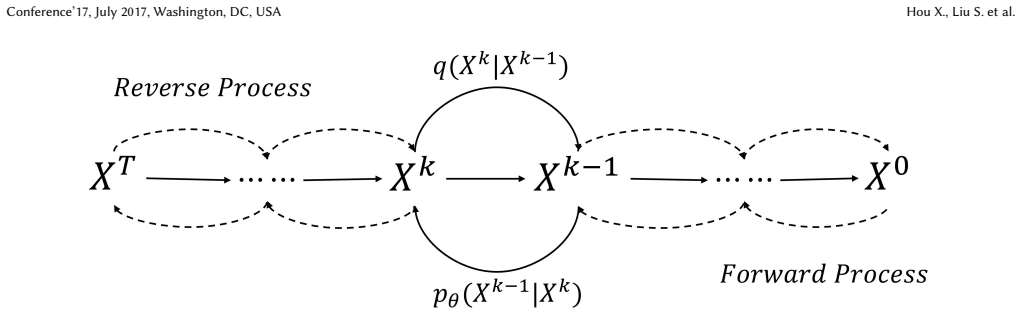
- standard math Standard diffusion forward and reverse process equations (1)-(6) are valid.
- standard math Multi-head attention as defined in equations (8)-(9) captures temporal dependencies.
- domain assumption Average pooling decomposition extracts meaningful trend components at each scale.
- domain assumption Distribution shift can be modeled by block-wise generation with trend-only inter-stage transfer.
- domain assumption Discriminative and predictive scores from TimeGAN measure generation quality faithfully.
Cite this review
Pith. "Pith review of Stage-Diff: Stage-wise Long-Term Time Series Generation Based on Diffusion Models." pith.science (2026). https://pith.science/paper/3MS6FRO4
@misc{pith2026250821330,
  author       = {Pith},
  title        = {Pith review of: Stage-Diff: Stage-wise Long-Term Time Series Generation Based on Diffusion Models},
  year         = {2026},
  howpublished = {\url{https://pith.science/paper/3MS6FRO4}},
  note         = {Machine review of arXiv:2508.21330}
}
read the original abstract
Generative models have been successfully used in the field of time series generation. However, when dealing with long-term time series, which span over extended periods and exhibit more complex long-term temporal patterns, the task of generation becomes significantly more challenging. Long-term time series exhibit long-range temporal dependencies, but their data distribution also undergoes gradual changes over time. Finding a balance between these long-term dependencies and the drift in data distribution is a key challenge. On the other hand, long-term time series contain more complex interrelationships between different feature sequences, making the task of effectively capturing both intra-sequence and inter-sequence dependencies another important challenge. To address these issues, we propose Stage-Diff, a staged generative model for long-term time series based on diffusion models. First, through stage-wise sequence generation and inter-stage information transfer, the model preserves long-term sequence dependencies while enabling the modeling of data distribution shifts. Second, within each stage, progressive sequence decomposition is applied to perform channel-independent modeling at different time scales, while inter-stage information transfer utilizes multi-channel fusion modeling. This approach combines the robustness of channel-independent modeling with the information fusion advantages of multi-channel modeling, effectively balancing the intra-sequence and inter-sequence dependencies of long-term time series. Extensive experiments on multiple real-world datasets validate the effectiveness of Stage-Diff in long-term time series generation tasks.
Figures


Figures from the paper (2 more)

Reference graph
Works this paper leans on
-
[1]
Generating Synthetic but Plausible Healthcare Record Datasets
Laura Aviñó, Matteo Ruffini, and Ricard Gavaldà. Generating synthetic but plausible healthcare record datasets. arXiv preprint arXiv:1807.01514, 2018
work page Pith review arXiv 2018
-
[2]
Eoin Brophy, Zhengwei Wang, Qi She, and Tomás Ward. Generative adversarial networks in time series: A systematic literature review.ACM Computing Surveys, Conference’17, July 2017, Washington, DC, USA Hou X., Liu S. et al. 55(10):1–31, 2023
work page 2017
-
[3]
On the constrained time-series generation problem
Andrea Coletta, Sriram Gopalakrishnan, Daniel Borrajo, and Svitlana Vyetrenko. On the constrained time-series generation problem. Advances in Neural Infor- mation Processing Systems, 36, 2024
work page 2024
-
[4]
Timevae: A variational auto-encoder for multivariate time series generation
Abhyuday Desai, Cynthia Freeman, Zuhui Wang, and Ian Beaver. Timevae: A variational auto-encoder for multivariate time series generation. arXiv preprint arXiv:2111.08095, 2021
arXiv 2021
-
[5]
Diffit: Diffusion vision transformers for image generation
Ali Hatamizadeh, Jiaming Song, Guilin Liu, Jan Kautz, and Arash Vahdat. Diffit: Diffusion vision transformers for image generation. In European Conference on Computer Vision, pages 37–55. Springer, 2025
work page 2025
-
[6]
Psa-gan: Progressive self attention gans for synthetic time series
Paul Jeha, Michael Bohlke-Schneider, Pedro Mercado, Shubham Kapoor, Ra- jbir Singh Nirwan, Valentin Flunkert, Jan Gasthaus, and Tim Januschowski. Psa-gan: Progressive self attention gans for synthetic time series. In The Tenth International Conference on Learning Representations , 2022
work page 2022
-
[7]
Gt-gan: General purpose time series synthesis with generative adversarial networks
Jinsung Jeon, Jeonghak Kim, Haryong Song, Seunghyeon Cho, and Noseong Park. Gt-gan: General purpose time series synthesis with generative adversarial networks. Advances in Neural Information Processing Systems , 35:36999–37010, 2022
work page 2022
-
[8]
Dif- fwave: A versatile diffusion model for audio synthesis
Zhifeng Kong, Wei Ping, Jiaji Huang, Kexin Zhao, and Bryan Catanzaro. Dif- fwave: A versatile diffusion model for audio synthesis. In International Confer- ence on Learning Representations , 2020
work page 2020
Show all 30 references
-
[9]
Modeling long-and short-term temporal patterns with deep neural networks
Guokun Lai, Wei-Cheng Chang, Yiming Yang, and Hanxiao Liu. Modeling long-and short-term temporal patterns with deep neural networks. In The 41st international ACM SIGIR conference on research & development in information retrieval, pages 95–104, 2018
2018
-
[10]
Causal recurrent variational autoencoder for medical time series generation
Hongming Li, Shujian Yu, and Jose Principe. Causal recurrent variational autoencoder for medical time series generation. In Proceedings of the AAAI conference on artificial intelligence , volume 37, pages 8562–8570, 2023
2023
-
[11]
Generative time series forecasting with diffusion, denoise, and disentanglement
Yan Li, Xinjiang Lu, Yaqing Wang, and Dejing Dou. Generative time series forecasting with diffusion, denoise, and disentanglement. Advances in Neural Information Processing Systems, 35:23009–23022, 2022
2022
-
[12]
itransformer: Inverted transformers are effective for time series forecasting
Yong Liu, Tengge Hu, Haoran Zhang, Haixu Wu, Shiyu Wang, Lintao Ma, and Mingsheng Long. itransformer: Inverted transformers are effective for time series forecasting. In The Twelfth International Conference on Learning Representations, 2024
2024
-
[13]
C-rnn-gan: Continuous recurrent neural networks with adversar- ial training
Olof Mogren. C-rnn-gan: Continuous recurrent neural networks with adversar- ial training. arXiv preprint arXiv:1611.09904, 2016
2016 arXiv
-
[14]
A time series is worth 64 words: Long-term forecasting with transformers
Yuqi Nie, Nam H Nguyen, Phanwadee Sinthong, and Jayant Kalagnanam. A time series is worth 64 words: Long-term forecasting with transformers. In The Eleventh International Conference on Learning Representations , 2023
2023
-
[15]
Scalable diffusion models with transformers
William Peebles and Saining Xie. Scalable diffusion models with transformers. In Proceedings of the IEEE/CVF International Conference on Computer Vision , pages 4195–4205, 2023
2023
-
[16]
Scale- former: Iterative multi-scale refining transformers for time series forecasting
Mohammad Amin Shabani, Amir H Abdi, Lili Meng, and Tristan Sylvain. Scale- former: Iterative multi-scale refining transformers for time series forecasting. In The Eleventh International Conference on Learning Representations , 2023
2023
-
[17]
Deep unsupervised learning using nonequilibrium thermodynamics
Jascha Sohl-Dickstein, Eric Weiss, Niru Maheswaranathan, and Surya Gan- guli. Deep unsupervised learning using nonequilibrium thermodynamics. In International conference on machine learning , pages 2256–2265. PMLR, 2015
2015
-
[18]
Csdi: Conditional score-based diffusion models for probabilistic time series imputation
Yusuke Tashiro, Jiaming Song, Yang Song, and Stefano Ermon. Csdi: Conditional score-based diffusion models for probabilistic time series imputation. Advances in Neural Information Processing Systems , 34:24804–24816, 2021
2021
-
[19]
Visualizing data using t-sne
Laurens Van der Maaten and Geoffrey Hinton. Visualizing data using t-sne. Journal of machine learning research , 9(11), 2008
2008
-
[20]
Aec-gan: adversarial error correction gans for auto-regressive long time-series generation
Lei Wang, Liang Zeng, and Jian Li. Aec-gan: adversarial error correction gans for auto-regressive long time-series generation. In Proceedings of the AAAI Conference on Artificial Intelligence, volume 37, pages 10140–10148, 2023
2023
-
[21]
Attention is all you need
A Waswani, N Shazeer, N Parmar, J Uszkoreit, L Jones, A Gomez, L Kaiser, and I Polosukhin. Attention is all you need. In NIPS, 2017
2017
-
[22]
Autoformer: Decom- position transformers with auto-correlation for long-term series forecasting
Haixu Wu, Jiehui Xu, Jianmin Wang, and Mingsheng Long. Autoformer: Decom- position transformers with auto-correlation for long-term series forecasting. Advances in neural information processing systems , 34:22419–22430, 2021
2021
-
[23]
Time-series generative adversarial networks
Jinsung Yoon, Daniel Jarrett, and Mihaela Van der Schaar. Time-series generative adversarial networks. Advances in neural information processing systems , 32, 2019
2019
-
[24]
Diffusion-ts: Interpretable diffusion for general time series generation
Xinyu Yuan and Yan Qiao. Diffusion-ts: Interpretable diffusion for general time series generation. In The Twelfth International Conference on Learning Representations, 2024
2024
-
[25]
Are transformers effective for time series forecasting? In Proceedings of the AAAI conference on artificial intelligence, volume 37, pages 11121–11128, 2023
Ailing Zeng, Muxi Chen, Lei Zhang, and Qiang Xu. Are transformers effective for time series forecasting? In Proceedings of the AAAI conference on artificial intelligence, volume 37, pages 11121–11128, 2023
2023
-
[26]
A transformer-based framework for multivariate time series representation learning
George Zerveas, Srideepika Jayaraman, Dhaval Patel, Anuradha Bhamidipaty, and Carsten Eickhoff. A transformer-based framework for multivariate time series representation learning. InProceedings of the 27th ACM SIGKDD conference on knowledge discovery & data mining , pages 2114...
2021
-
[27]
Privbayes: Private data release via bayesian networks
Jun Zhang, Graham Cormode, Cecilia M Procopiuc, Divesh Srivastava, and Xiaokui Xiao. Privbayes: Private data release via bayesian networks. ACM Transactions on Database Systems (TODS) , 42(4):1–41, 2017
2017
-
[28]
Crossformer: Transformer utilizing cross- dimension dependency for multivariate time series forecasting
Yunhao Zhang and Junchi Yan. Crossformer: Transformer utilizing cross- dimension dependency for multivariate time series forecasting. In The eleventh international conference on learning representations , 2023
2023
-
[29]
Sageformer: Series-aware framework for long-term multivariate time series forecasting
Zhenwei Zhang, Linghang Meng, and Yuantao Gu. Sageformer: Series-aware framework for long-term multivariate time series forecasting. IEEE Internet of Things Journal, 2024
2024
-
[30]
Informer: Beyond efficient transformer for long sequence time-series forecasting
Haoyi Zhou, Shanghang Zhang, Jieqi Peng, Shuai Zhang, Jianxin Li, Hui Xiong, and Wancai Zhang. Informer: Beyond efficient transformer for long sequence time-series forecasting. In Proceedings of the AAAI conference on artificial intelligence, volume 35, pages 11106–11115, 2021
2021
Reviewed August 5, 2026 · model on record in the stance chip above.
Discussion (0). Sign in to comment.