REVIEW 3 major objections 5 minor 293 references
Robust 3D understanding is essential for embodied agents; inductive biases are learnable; text bridges perception to reasoning.
Reviewed by Pith at T0; open to challenge. T0 means a machine referee read the full paper against a public rubric. the ladder, T0–T4 →
The thesis demonstrates that combining implicit 3D scene representations with LLM-based reasoning, using text as an interface, yields strong performance on robotic perception and spatial language tasks.
T0 review reviewed 2026-08-05 challenge →
load-bearing objection A solid PhD thesis compiling six strong papers, but the headline 'practical path to embodied spatial intelligence' is a research agenda, not a demonstrated result. the 3 major comments →
Embodied Spatial Intelligence: from Implicit Scene Modeling to Spatial Reasoning
The pith
A machine-rendered reading of the paper's core claim, the machinery that carries it, and where it could break.
The reading
Core claim
Robust 3D understanding is essential for embodied agents; many of the inductive biases needed for that understanding are learnable at scale; and a practical path toward embodied spatial intelligence lies in strategically integrating high-quality 3D structure with large-scale 2D foundation models, using text as a unifying medium. The thesis supports this with six results: sub-pixel self-calibration from raw video, a generalist depth network that transfers zero-shot, NeRF registration and blending, a benchmark showing LLM mapping gaps, 3D referring-expression resolution via transcribed scenes, and dual-LLM state-maintained planning.
What carries the argument
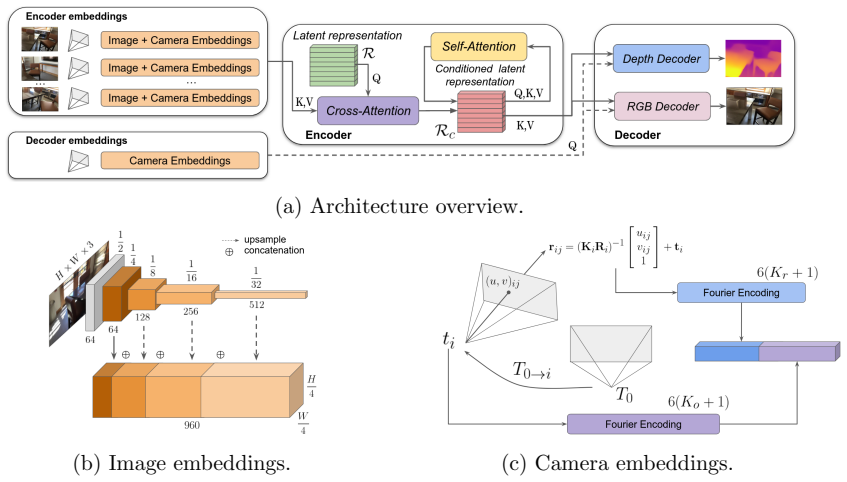
The thesis decomposes the action-perception mapping into V (perception from observations to a 3D representation) and F (from that representation to actions). It relies on implicit scene representations—continuous depth fields, neural radiance fields, and modular NeRF sub-maps—and on unified camera models with closed-form differentiable projection. For reasoning, it uses text as the unifying medium: detected objects are transcribed into structured descriptions, an LLM iterates with a Python interpreter for spatial calculations, and a second LLM maintains a concise state summary for long-horizon planning.
Load-bearing premise
The load-bearing premise is that transcribing 3D scenes into text preserves enough geometric information for language-guided spatial tasks; the thesis itself concedes this transcription is lossy and may discard metric distances, occlusions, or fine orientations.
What would settle it
Take Transcrib3D to referring expressions that require exact metric distances or occlusion ordering, such as 'the cup at least 30 centimeters from the wall, behind the tall bottle,' and see if accuracy drops to chance while humans succeed; if so, the claim that transcribed text retains the geometry needed for spatial reasoning is falsified.
If this is right
- Robots can recover from camera calibration drift on the fly using raw video and a self-supervised depth-and-pose objective.
- Generalist transformer architectures with 3D data augmentation can replace hand-engineered geometric modules for depth estimation and still transfer across domains.
- Large-scale environments can be represented as independently trained NeRFs, enabling distributed and privacy-preserving map building.
- Language models show systematic gaps in mapping and navigation; providing explicit map information improves their downstream performance.
- Transcribing 3D scenes into text with iterative code execution gives state-of-the-art 3D referring-expression resolution.
- Maintaining an explicit world state via a second LLM improves long-horizon language-guided task execution.
Where Pith is reading between the lines
- If 3D inductive biases are genuinely learnable at scale, specialized modules like cost volumes and epipolar losses may become optional; a direct test is to scale a generalist transformer on more diverse 3D data and see if the gap closes.
- The text-as-unifying-medium strategy has a measurable ceiling: construct referring expressions that require metric precision, occlusion reasoning, or fine orientation; if accuracy drops to chance, the claim that transcribed text retains geometry is falsified.
- The dual-LLM state-maintenance idea likely extends to belief maintenance in partially observable environments, storing uncertainty and hypotheses rather than just past actions.
- The MANGO result suggests that explicit memory or map modules, not just larger models, may be the missing piece for spatial reasoning in language models.
Editorial analysis
A structured set of objections, weighed in public.
Referee Report
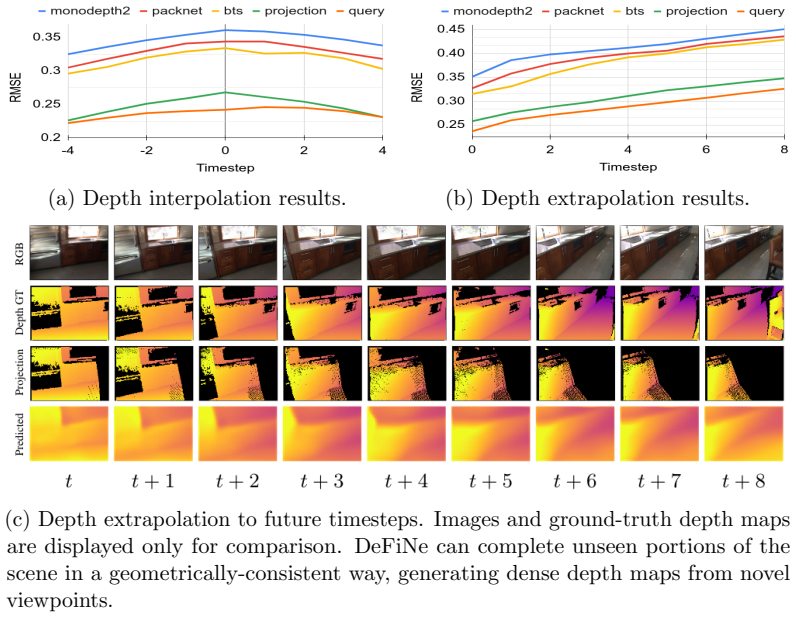
Summary. The manuscript is a PhD thesis that defines Embodied Spatial Intelligence and decomposes the robot control mapping as M = F ∘ V (Eq. 1.2). Chapter 2 develops implicit 3D scene representations: self-supervised camera self-calibration, the DeFiNe depth-field network, and NeRFuser for NeRF registration and blending. Chapter 3 develops LLM-based spatial reasoning: the MANGO text-navigation benchmark, Transcrib3D for 3D referring-expression resolution via scene transcription, and Statler for state-maintaining long-horizon planning. The thesis-level claims in Section 1.3 are that (a) robust 3D understanding is essential, (b) many inductive biases are learnable at scale, and (c) a practical path lies in integrating high-quality 3D structure with large-scale 2D foundation models. Each chapter is a previously published work evaluated on external benchmarks, with ablations for key design choices.
Significance. If the thesis-level synthesis were established, this would be a useful integrative statement of a research program: the per-chapter contributions are individually strong, with concrete benchmark results, ablations (Table 2.7, Figures 2.20–2.22), and public code for NeRFuser and Transcrib3D, as well as a hosted benchmark for MANGO. The works have already received peer review in their original venues. However, the manuscript's own central claim is not demonstrated: the scene-representation and reasoning components are never composed. The thesis is honest about the lossy nature of 3D-to-text transcription, but it does not analyze the consequences of that loss. The result is a credible research agenda rather than a validated architectural thesis.
major comments (3)
- [Section 1.3, Chapters 2–3] The thesis-level claim (c) is never tested end-to-end. Chapter 2 modules are evaluated on self-calibration, depth estimation, and NeRF registration/blending benchmarks; Chapter 3 modules are evaluated on text-based navigation, 3D referring-expression, and pick-and-place benchmarks. No experiment feeds a Chapter 2 representation into a Chapter 3 reasoner. In particular, Transcrib3D (§3.2) consumes Mask3D detections and an LLM code interpreter, not DeFiNe or NeRFuser, and Statler (§3.3) uses an LLM state summary without Chapter 2 representations. Thus 'a practical path... strategically integrating high-quality 3D structure with large-scale 2D foundation models' is an assertion, not a demonstrated result. Either add a concrete integration experiment or explicitly recast (c) as a research agenda.
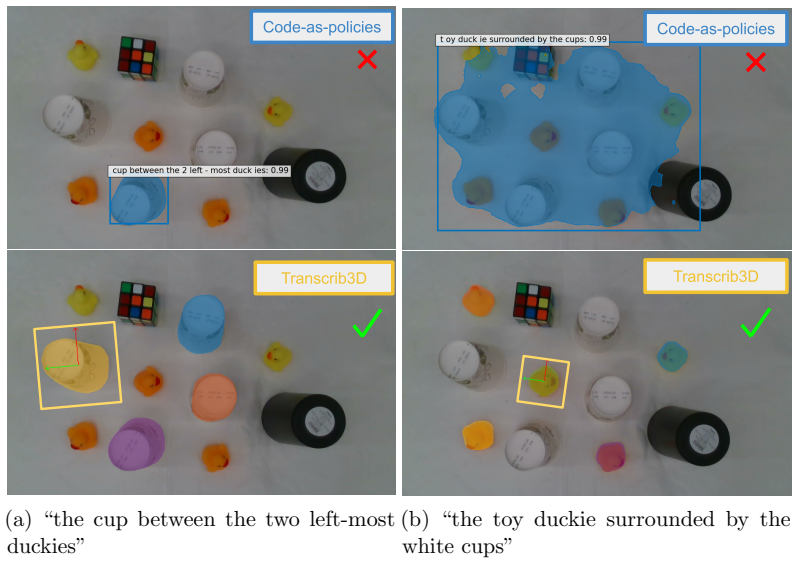
- [Chapter 3 introduction (p. 64)] The author acknowledges that 'transcribing 3D scenes into language is a form of lossy compression, potentially discarding geometric details crucial for certain tasks.' This caveat directly affects the Transcrib3D mechanism, which uses text as the unifying medium for 3D referring expression resolution and downstream pick-and-place (§3.2.5). The manuscript does not quantify which geometric details are lost or when they matter for the benchmark results in Table 3.2. A concrete fidelity analysis is needed: compare transcript-based reasoning against a variant with structured numeric 3D data, and characterize failure cases as semantic vs. geometric. Without this, the 'practical path' claim is vulnerable exactly where the author identifies the risk.
- [Section 3.1] MANGO is presented as evidence about LLMs' navigation and mapping abilities, and the thesis uses this to motivate the broader embodied-spatial-intelligence claim. However, the benchmark is text-only and the mazes are 2D projections of text-game graphs (Figure 3.1), not 3D environments. The results therefore support a narrower claim about textual graph navigation than about 3D spatial reasoning. The thesis should explicitly delimit MANGO's scope so that the per-chapter claims are not read as supporting the 3D-specific central claim more than they do.
minor comments (5)
- [Eq. (2.4b)] The definition of r² reads 'm2_x + m2_x'; presumably this should be m_x² + m_y².
- [§3.1.4.1] The sentence 'we used the same walkthrough prefixes and questions as GPT-3.5 for a fair comparison' is repeated verbatim in consecutive paragraphs.
- [Figure 3.6 caption] Typo: 'necessary to to follow' should be 'necessary to follow'.
- [Figure 3.16 caption] Typo: 'However, the the baseline Code-as-Policies' should read 'However, the baseline Code-as-Policies'.
- [Prompt 3.5] Typo: 'Dome Roomm' should be 'Dome Room'.
Circularity Check
No circularity found: each chapter's results are measured against external benchmarks or held-out data, and the untested central synthesis is a missing-support issue, not a circular derivation.
full rationale
I walked the claimed derivation chain chapter by chapter. Section 2.1 learns camera intrinsics by minimizing a photometric view-synthesis loss and then evaluates the resulting parameters against AprilTag/Basalt calibration and LiDAR-based depth (EuRoC, KITTI); the evaluation targets are external to the training objective, so the sub-pixel reprojection claim is not a fitted input renamed as a prediction. Section 2.2 (DeFiNe) is trained on ScanNet RGB-D and evaluated on held-out ScanNet, 7-Scenes, and virtual-camera projections; the novel-view ground truth is generated from sensor depth and available point clouds, not from DeFiNe's own output, so the zero-shot transfer and query-vs-projection comparisons are genuine generalization tests. Section 2.3 (NeRFuser) registers and blends pretrained NeRFs and checks against ground-truth RGB-D-fused point clouds and held-out imagery; the registration and blending metrics are not constructed from the method's own predictions. The LLM chapters (MANGO, Transcrib3D, Statler) are evaluated on external benchmarks (Jericho games, ReferIt3D, ScanRefer) and simulator/real-robot rollouts, and the LLM responses are not used to define the ground-truth labels. The thesis is compiled from the author's own prior papers, so self-citation is pervasive, but no load-bearing argument reduces to a self-citation chain: the cited works are independently benchmarked, and the strongest external supports (e.g., VGGT for learnable inductive biases) are not the author's own. The main weaknesses are evidentiary, not circular: Section 1.3's claim that a practical path lies in integrating 3D structure with 2D foundation models is never tested as an end-to-end composed system, and the Section 3 preface explicitly concedes that 'transcribing 3D scenes into language is a form of lossy compression, potentially discarding geometric details crucial for certain tasks.' These are limitations of support and correctness risk, not cases where an equation or prediction reduces by construction to its own input. Accordingly, no circular step is identified.
Axiom & Free-Parameter Ledger
free parameters (5)
- DeFiNe loss weights lambda_s, lambda_v =
tuned (ablated in Table 2.7)
- DeFiNe augmentation noise scales sigma_v, sigma_t, sigma_r =
e.g., sigma_v=0.25m used in Figure 2.11b
- NeRFuser blending rate gamma =
10 (Mission Bay)
- NeRFuser proximity threshold tau =
1.2
- NeRFuser distant accumulation distance d =
0.3
axioms (5)
- domain assumption The Unified Camera Model family (UCM/EUCM/DS) can represent the cameras considered (perspective, fisheye, catadioptric).
- domain assumption Input NeRFs are trained from poses that have been preprocessed in a standardized way (centered, rotated, up-aligned, scaled to [-1,1]).
- domain assumption LLMs can reason reliably over text transcripts of 3D scenes when given code execution tools and principles.
- domain assumption Mask3D object detector provides sufficient recall of objects relevant to referring expressions.
- standard math Standard backpropagation and Transformer architectures are taken as given.
Cite this review
Pith. "Pith review of Embodied Spatial Intelligence: from Implicit Scene Modeling to Spatial Reasoning." pith.science (2026). https://pith.science/paper/63KKXPH5
@misc{pith2026250900465,
  author       = {Pith},
  title        = {Pith review of: Embodied Spatial Intelligence: from Implicit Scene Modeling to Spatial Reasoning},
  year         = {2026},
  howpublished = {\url{https://pith.science/paper/63KKXPH5}},
  note         = {Machine review of arXiv:2509.00465}
}
read the original abstract
This thesis introduces "Embodied Spatial Intelligence" to address the challenge of creating robots that can perceive and act in the real world based on natural language instructions. To bridge the gap between Large Language Models (LLMs) and physical embodiment, we present contributions on two fronts: scene representation and spatial reasoning. For perception, we develop robust, scalable, and accurate scene representations using implicit neural models, with contributions in self-supervised camera calibration, high-fidelity depth field generation, and large-scale reconstruction. For spatial reasoning, we enhance the spatial capabilities of LLMs by introducing a novel navigation benchmark, a method for grounding language in 3D, and a state-feedback mechanism to improve long-horizon decision-making. This work lays a foundation for robots that can robustly perceive their surroundings and intelligently act upon complex, language-based commands.
Figures










Reference graph
Works this paper leans on
-
[1]
The double sphere camera model,
V. Usenko, N. Demmel, and D. Cremers, “The double sphere camera model,” in Proceedings of the International Conference on 3D Vision (3DV) , 2018, pp. 552–560
2018
-
[2]
Visual- inertial mapping with non-linear factor recovery,
V. Usenko, N. Demmel, D. Schubert, J. Stueckler, and D. Cremers, “Visual- inertial mapping with non-linear factor recovery,” IEEE Robotics and Automa- tion Letters, vol. 5, no. 2, pp. 422–429, 2020
2020
-
[3]
The EuRoC micro aerial vehicle datasets,
M. Burri, J. Nikolic, P. Gohl, T. Schneider, J. Rehder, S. Omari, M. W. Achtelik, and R. Siegwart, “The EuRoC micro aerial vehicle datasets,” International Journal of Robotics Research, vol. 35, no. 10, pp. 1157–1163, 2016
2016
-
[4]
Depth from videos in the wild: Unsupervised monocular depth learning from unknown cameras,
A. Gordon, H. Li, R. Jonschkowski, and A. Angelova, “Depth from videos in the wild: Unsupervised monocular depth learning from unknown cameras,” in Proceedings of the IEEE/CVF Conference on Computer Vision and Pattern Recognition (CVPR), 2019
2019
-
[5]
PointGroup: Dual-set point grouping for 3D instance segmentation,
L. Jiang, H. Zhao, S. Shi, S. Liu, C.-W. Fu, and J. Jia, “PointGroup: Dual-set point grouping for 3D instance segmentation,” in Proc. IEEE/CVF Conf. on Computer Vision and Pattern Recognition (CVPR) , 2020
2020
-
[6]
Mask3D: Mask transformer for 3D semantic instance segmentation,
J. Schult, F. Engelmann, A. Hermans, O. Litany, S. Tang, and B. Leibe, “Mask3D: Mask transformer for 3D semantic instance segmentation,” in Proc. IEEE Int’l Conf. on Robotics and Automation (ICRA) , 2023
2023
-
[7]
What’s “up
A. Kamath, J. Hessel, and K.-W. Chang, “What’s “up” with vision-language models? investigating their struggle with spatial reasoning,” in Proceedings of the 2023 Conference on Empirical Methods in Natural Language Processing (EMNLP), 2023
2023
-
[8]
Spa- tialvlm: Endowing vision-language models with spatial reasoning capabilities,
B. Chen, Z. Xu, S. Kirmani, B. Ichter, D. Sadigh, L. Guibas, and F. Xia, “Spa- tialvlm: Endowing vision-language models with spatial reasoning capabilities,” 115 in Proceedings of the IEEE/CVF Conference on Computer Vision and Pattern Recognition (CVPR), 2024
2024
-
[9]
Spatialrgpt: Grounded spatial reasoning for vision-language models,
X. Cheng, X. Wang, R. Zhao, X. Wang, L. Zhang, and S. Z. Li, “Spatialrgpt: Grounded spatial reasoning for vision-language models,” in Advances in Neural Information Processing Systems (NeurIPS) , 2024
2024
-
[10]
PointNet++: Deep hierarchical feature learning on point sets in a metric space,
C. Qi, L. Yi, H. Su, and L. J. Guibas, “PointNet++: Deep hierarchical feature learning on point sets in a metric space,” in Advances in Neural Information Processing Systems (NeurIPS), 2017
2017
-
[11]
KinectFusion: Real-time dense surface mapping and tracking,
R. A. Newcombe, S. Izadi, O. Hilliges, D. Molyneaux, D. Kim, A. J. Davison, P. Kohi, J. Shotton, S. Hodges, and A. Fitzgibbon, “KinectFusion: Real-time dense surface mapping and tracking,” in Proceedings of the IEEE International Symposium on Mixed and Augmented Reality (ISMAR) , 2011
2011
-
[12]
Octomap: An efficient probabilistic 3d mapping framework based on octrees,
A. Hornung, K. M. Wurm, M. Bennewitz, C. Stachniss, and W. Burgard, “Octomap: An efficient probabilistic 3d mapping framework based on octrees,” Autonomous Robots, vol. 34, no. 3, pp. 189–206, 2013
2013
-
[13]
Dtam: Dense track- ing and mapping in real-time,
R. A. Newcombe, S. J. Lovegrove, and A. J. Davison, “Dtam: Dense track- ing and mapping in real-time,” in 2011 IEEE International Conference on Computer Vision (ICCV) . IEEE, 2011, pp. 2320–2327
2011
-
[14]
PWC-Net: CNNs for optical flow using pyramid, warping, and cost volume,
D. Sun, X. Yang, M. Liu, and J. Kautz, “PWC-Net: CNNs for optical flow using pyramid, warping, and cost volume,” in 2018 IEEE/CVF Conference on Computer Vision and Pattern Recognition (CVPR) . IEEE, 2018, pp. 8934–8943
2018
-
[15]
Digging into self- supervised monocular depth prediction,
C. Godard, O. Mac Aodha, M. Firman, and G. J. Brostow, “Digging into self- supervised monocular depth prediction,” in Proceedings of the International Conference on Computer Vision (ICCV) , 2019
2019
-
[16]
Depth field networks for generalizable multi-view scene representation,
V. Guizilini, I. Vasiljevic, J. Fang, R. Ambru, G. Shakhnarovich, M. R. Walter, and A. Gaidon, “Depth field networks for generalizable multi-view scene representation,” in European Conference on Computer Vision. Springer, 2022, pp. 245–262
2022
-
[17]
Input- level inductive biases for 3D reconstruction,
W. Yifan, C. Doersch, R. Arandjelovi´ c, J. Carreira, and A. Zisserman, “Input- level inductive biases for 3D reconstruction,” arXiv preprint arXiv:2112.03243 , 2021. 116
Pith/arXiv arXiv 2021
-
[18]
Delira: Self-supervised depth, light, and radiance fields,
V. Guizilini, I. Vasiljevic, J. Fang, R. Ambrus, S. Zakharov, V. Sitzmann, and A. Gaidon, “Delira: Self-supervised depth, light, and radiance fields,” in Proceedings of the IEEE/CVF International Conference on Computer Vision , 2023, pp. 17 935–17 945
2023
-
[19]
Vggt: Visual geometry grounded transformer,
J. Wang, M. Chen, N. Karaev, A. Vedaldi, C. Rupprecht, and D. Novotny, “Vggt: Visual geometry grounded transformer,” in Proceedings of the Computer Vision and Pattern Recognition Conference , 2025, pp. 5294–5306
2025
-
[20]
NeRF: Representing scenes as neural radiance fields for view synthesis,
B. Mildenhall, P. P. Srinivasan, M. Tancik, J. T. Barron, R. Ramamoorthi, and R. Ng, “NeRF: Representing scenes as neural radiance fields for view synthesis,” in Proceedings of the European Conference on Computer Vision (ECCV), 2020
2020
-
[21]
Nerfuser: Large-scale scene repre- sentation by nerf fusion,
J. Fang, S. Lin, I. Vasiljevic, V. Guizilini, R. Ambrus, A. Gaidon, G. Shakhnarovich, and M. R. Walter, “Nerfuser: Large-scale scene repre- sentation by nerf fusion,” 2023
2023
-
[22]
Di-nerf: Distributed nerf for collabora- tive learning with relative pose refinement,
M. Asadi, K. Zareinia, and S. Saeedi, “Di-nerf: Distributed nerf for collabora- tive learning with relative pose refinement,” IEEE Robotics and Automation Letters, 2024
2024
-
[23]
Transcrib3d: 3d referring expression resolution through large language models,
J. Fang, X. Tan, S. Lin, I. Vasiljevic, V. Guizilini, H. Mei, R. Ambrus, G. Shakhnarovich, and M. R. Walter, “Transcrib3d: 3d referring expression resolution through large language models,” arXiv preprint arXiv:2404.19221 , 2024
Pith/arXiv arXiv 2024
-
[24]
Perceiving layout and knowing distances: The integration, relative potency, and contextual use of different information about depth,
J. E. Cutting and P. M. Vishton, “Perceiving layout and knowing distances: The integration, relative potency, and contextual use of different information about depth,” in Perception of space and motion . Elsevier, 1995, pp. 69–117
1995
-
[25]
Mango: A benchmark for evaluating mapping and navigation abilities of large language models,
P. Ding, J. Fang, P. Li, K. Wang, X. Zhou, M. Yu, J. Li, M. R. Walter, and H. Mei, “Mango: A benchmark for evaluating mapping and navigation abilities of large language models,” arXiv preprint arXiv:2403.19913 , 2024
Pith/arXiv arXiv 2024
-
[26]
Do as I can, 117 not as I say: Grounding language in robotic affordances,
b. Ichter, A. Brohan, Y. Chebotar, C. Finn, K. Hausman, A. Herzog, D. Ho, J. Ibarz, A. Irpan, E. Jang, R. Julian, D. Kalashnikov, S. Levine, Y. Lu, C. Parada, K. Rao, P. Sermanet, A. T. Toshev, V. Vanhoucke, F. Xia, T. Xiao, P. Xu, M. Yan, N. Brown, M. Ahn, O. Cortes, N. Sievers, C. Tan, S. Xu, D. Reyes, J. Rettinghouse, J. Quiambao, P. Pastor, L. Luu, K....
2023
-
[28]
Self-supervised camera self-calibration from video,
J. Fang, I. Vasiljevic, V. Guizilini, R. Ambrus, G. Shakhnarovich, A. Gaidon, and M. R. Walter, “Self-supervised camera self-calibration from video,” in 2022 International Conference on Robotics and Automation (ICRA) , 2022, pp. 8468–8475
2022
-
[29]
Structure-from-motion revisited,
J. L. Sch¨ onberger and J.-M. Frahm, “Structure-from-motion revisited,” in Proceedings of the IEEE/CVF Conference on Computer Vision and Pattern Recognition (CVPR), 2016, pp. 4104–4113
2016
-
[30]
Pixelwise view selection for unstructured multi-view stereo,
J. L. Sch¨ onberger, E. Zheng, M. Pollefeys, and J.-M. Frahm, “Pixelwise view selection for unstructured multi-view stereo,” in Proceedings of the European Conference on Computer Vision (ECCV) , 2016, pp. 501–518
2016
-
[31]
Orb-slam: a versatile and accurate monocular slam system,
R. Mur-Artal, J. M. M. Montiel, and J. D. Tardos, “Orb-slam: a versatile and accurate monocular slam system,” IEEE transactions on robotics , vol. 31, no. 5, pp. 1147–1163, 2015
2015
-
[32]
NeRF: Representing scenes as neural radiance fields for view synthesis,
B. Mildenhall, P. P. Srinivasan, M. Tancik, J. T. Barron, R. Ramamoorthi, and R. Ng, “NeRF: Representing scenes as neural radiance fields for view synthesis,” in Proceedings of the European Conference on Computer Vision (ECCV), 2020, pp. 405–421
2020
-
[33]
Implicit neural representations with periodic activation functions,
V. Sitzmann, J. Martel, A. Bergman, D. Lindell, and G. Wetzstein, “Implicit neural representations with periodic activation functions,” Advances in neural information processing systems, vol. 33, pp. 7462–7473, 2020
2020
-
[34]
A flexible new technique for camera calibration,
Z. Zhang, “A flexible new technique for camera calibration,”IEEE Transactions on Pattern Analysis and Machine Intelligence , vol. 22, no. 11, pp. 1330–1334, 2000
2000
-
[35]
A flexible technique for accurate omnidirectional camera calibration and structure from motion,
D. Scaramuzza, A. Martinelli, and R. Siegwart, “A flexible technique for accurate omnidirectional camera calibration and structure from motion,” in Proceedings of the IEEE International Conference on Computer Vision Systems (ICVS), 2006, pp. 45–45. 118
2006
-
[36]
A generic camera model and calibration method for conventional, wide-angle, and fish-eye lenses,
J. Kannala and S. S. Brandt, “A generic camera model and calibration method for conventional, wide-angle, and fish-eye lenses,” IEEE Transactions on Pattern Analysis and Machine Intelligence , vol. 28, no. 8, pp. 1335–1340, 2006
2006
-
[37]
A general imaging model and a method for finding its parameters,
M. D. Grossberg and S. K. Nayar, “A general imaging model and a method for finding its parameters,” in Proceedings of the International Conference on Computer Vision (ICCV) , vol. 2, 2001, pp. 108–115
2001
-
[38]
Using vanishing points for camera calibration,
B. Caprile and V. Torre, “Using vanishing points for camera calibration,” International Journal on Computer Vision , vol. 4, no. 2, pp. 127–139, 1990
1990
-
[39]
A stratified approach to metric self-calibration,
M. Pollefeys and L. Van Gool, “A stratified approach to metric self-calibration,” in Proceedings of the IEEE/CVF Conference on Computer Vision and Pattern Recognition (CVPR), 1997, pp. 407–412
1997
-
[40]
Camera calibration from vanishing points in image of architectural scenes,
R. Cipolla, T. Drummond, and D. P. Robertson, “Camera calibration from vanishing points in image of architectural scenes,” in Proceedings of the British Machine Vision Conference (BMVC) , 1999, pp. 382–391
1999
-
[41]
DeepCalib: A deep learning approach for automatic intrinsic calibration of wide field-of-view cameras,
O. Bogdan, V. Eckstein, F. Rameau, and J.-C. Bazin, “DeepCalib: A deep learning approach for automatic intrinsic calibration of wide field-of-view cameras,” in Proceedings of the ACM SIGGRAPH European Conference on Visual Media Production, 2018
2018
-
[42]
Unsupervised CNN for single view depth estimation: Geometry to the rescue,
R. Garg, V. K. Bg, G. Carneiro, and I. Reid, “Unsupervised CNN for single view depth estimation: Geometry to the rescue,” in Proceedings of the European Conference on Computer Vision (ECCV) , 2016, pp. 740–756
2016
-
[43]
Unsupervised learning of depth and ego-motion from video,
T. Zhou, M. Brown, N. Snavely, and D. G. Lowe, “Unsupervised learning of depth and ego-motion from video,” inProceedings of the IEEE/CVF Conference on Computer Vision and Pattern Recognition (CVPR) , 2017, pp. 1851–1858
2017
-
[44]
Neural ray surfaces for self-supervised learning of depth and ego-motion,
I. Vasiljevic, V. Guizilini, R. Ambrus, S. Pillai, W. Burgard, G. Shakhnarovich, and A. Gaidon, “Neural ray surfaces for self-supervised learning of depth and ego-motion,” in Proceedings of the International Conference on 3D Vision (3DV), 2020
2020
-
[45]
Hartley and A
R. Hartley and A. Zisserman, Multiple view geometry in computer vision . Cambridge university press, 2003
2003
-
[46]
Bradski and A
G. Bradski and A. Kaehler, “OpenCV,” Dr. Dobb’s Journal of Software Tools , vol. 3, 2000. 119
2000
-
[47]
Extending kalibr: Calibrating the extrinsics of multiple IMUs and of individual axes,
J. Rehder, J. Nikolic, T. Schneider, T. Hinzmann, and R. Siegwart, “Extending kalibr: Calibrating the extrinsics of multiple IMUs and of individual axes,” in Proceedings of the IEEE International Conference on Robotics and Automation (ICRA), 2016, pp. 4304–4311
2016
-
[48]
A perception-driven autonomous urban vehicle,
J. Leonard, J. How, S. Teller, M. Berger, S. Campbell, G. Fiore, L. Fletcher, E. Frazzoli, A. Huang, S. Karaman, O. Koch, Y. Kuwata, D. Moore, E. Olson, S. Peters, J. Teo, R. Truax, M. Walter, D. Barrett, A. Epstein, K. Maheloni, K. Moyer, T. Jones, R. Buckley, M. Antone, R. Galejs, S. Krishnamurthy, and J. Williams, “A perception-driven autonomous urban ...
2008
-
[49]
Autonomous driving in urban environments: Boss and the Urban Challenge,
C. Urmson, J. Anhalt, D. Bagnell, C. Baker, R. Bittner, M. Clark, J. Dolan, D. Duggins, T. Galatali, C. Geyer et al. , “Autonomous driving in urban environments: Boss and the Urban Challenge,” Journal of Field Robotics , vol. 25, no. 8, pp. 425–466, 2008
2008
-
[50]
Lens distortion for close-range photogrammetry,
J. G. Fryer and D. C. Brown, “Lens distortion for close-range photogrammetry,” Photogrammetric Engineering and Remote Sensing , vol. 52, pp. 51–58, 1986
1986
-
[51]
A unifying theory for central panoramic systems and practical implications,
C. Geyer and K. Daniilidis, “A unifying theory for central panoramic systems and practical implications,” in Proceedings of the European Conference on Computer Vision (ECCV) , 2000, pp. 445–461
2000
-
[52]
An enhanced unified camera model,
B. Khomutenko, G. Garcia, and P. Martinet, “An enhanced unified camera model,” IEEE Robotics and Automation Letters , vol. 1, no. 1, pp. 137–144, 2015
2015
-
[53]
DeepFo- cal: A method for direct focal length estimation,
S. Workman, C. Greenwell, M. Zhai, R. Baltenberger, and N. Jacobs, “DeepFo- cal: A method for direct focal length estimation,” in Proceedings of the IEEE International Conference on Image Processing (ICIP) , 2015, pp. 1369–1373
2015
-
[54]
S. Workman, M. Zhai, and N. Jacobs, “Horizon lines in the wild,” arXiv preprint arXiv:1604.02129, 2016
Pith/arXiv arXiv 2016
-
[55]
Radial lens distortion correction using convolutional neural networks trained with synthesized images,
J. Rong, S. Huang, Z. Shang, and X. Ying, “Radial lens distortion correction using convolutional neural networks trained with synthesized images,” in Proceedings of the Asian Conference on Computer Vision , 2016, pp. 35–49
2016
-
[56]
FishEyeRectNet: A multi-context collaborative deep network for fisheye image rectification,
X. Yin, X. Wang, J. Yu, M. Zhang, P. Fua, and D. Tao, “FishEyeRectNet: A multi-context collaborative deep network for fisheye image rectification,” in Proceedings of the European Conference on Computer Vision (ECCV) , 2018, pp. 469–484. 120
2018
-
[57]
Deep single image camera calibration with radial distortion,
M. Lopez, R. Mari, P. Gargallo, Y. Kuang, J. Gonzalez-Jimenez, and G. Haro, “Deep single image camera calibration with radial distortion,” in Proceedings of the IEEE/CVF Conference on Computer Vision and Pattern Recognition (CVPR), 2019, pp. 11 817–11 825
2019
-
[58]
A perceptual measure for deep single image camera calibration,
Y. Hold-Geoffroy, K. Sunkavalli, J. Eisenmann, M. Fisher, E. Gambaretto, S. Hadap, and J.-F. Lalonde, “A perceptual measure for deep single image camera calibration,” in Proceedings of the IEEE/CVF Conference on Computer Vision and Pattern Recognition (CVPR) , 2018
2018
-
[59]
Single view metrology in the wild,
R. Zhu, X. Yang, Y. Hold-Geoffroy, F. Perazzi, J. Eisenmann, K. Sunkavalli, and M. Chandraker, “Single view metrology in the wild,” in Proceedings of the European Conference on Computer Vision (ECCV) , 2020, pp. 316–333
2020
-
[60]
DeepPTZ: Deep self-calibration for PTZ cameras,
C. Zhang, F. Rameau, J. Kim, D. M. Argaw, J.-C. Bazin, and I. S. Kweon, “DeepPTZ: Deep self-calibration for PTZ cameras,” in Proceedings of the IEEE/CVF Winter Conference on Applications of Computer Vision , 2020, pp. 1041–1049
2020
-
[61]
Learning perspective undistortion of portraits,
Y. Zhao, Z. Huang, T. Li, W. Chen, C. LeGendre, X. Ren, A. Shapiro, and H. Li, “Learning perspective undistortion of portraits,” in Proceedings of the International Conference on Computer Vision (ICCV) , 2019, pp. 7849–7859
2019
-
[62]
Learning to recover 3D scene shape from a single image,
W. Yin, J. Zhang, O. Wang, S. Niklaus, L. Mai, S. Chen, and C. Shen, “Learning to recover 3D scene shape from a single image,” in Proceedings of the IEEE/CVF Conference on Computer Vision and Pattern Recognition (CVPR) , 2021, pp. 204–213
2021
-
[63]
Progressively complementary network for fisheye image rectification using appearance flow,
S. Yang, C. Lin, K. Liao, C. Zhang, and Y. Zhao, “Progressively complementary network for fisheye image rectification using appearance flow,” in Proceedings of the IEEE/CVF Conference on Computer Vision and Pattern Recognition (CVPR), 2021, pp. 6348–6357
2021
-
[64]
A deep ordinal distortion estimation approach for distortion rectification,
K. Liao, C. Lin, and Y. Zhao, “A deep ordinal distortion estimation approach for distortion rectification,” IEEE Transactions on Image Processing , vol. 30, pp. 3362–3375, 2021
2021
-
[65]
Deep geometry-aware camera self- calibration from video,
A. Hagemann, M. Knorr, and C. Stiller, “Deep geometry-aware camera self- calibration from video,” in Proceedings of the IEEE/CVF International Con- ference on Computer Vision , 2023, pp. 3438–3448
2023
-
[66]
Robust self-supervised extrinsic self-calibration,
T. Kanai, I. Vasiljevic, V. Guizilini, A. Gaidon, and R. Ambrus, “Robust self-supervised extrinsic self-calibration,” in 2023 IEEE/RSJ International 121 Conference on Intelligent Robots and Systems (IROS) . IEEE, 2023, pp. 1932–1939
2023
-
[67]
Digging into self- supervised monocular depth estimation,
C. Godard, O. Mac Aodha, M. Firman, and G. J. Brostow, “Digging into self- supervised monocular depth estimation,” in Proceedings of the International Conference on Computer Vision (ICCV) , 2019, pp. 3828–3838
2019
-
[68]
3D packing for self-supervised monocular depth estimation,
V. Guizilini, R. Ambrus, S. Pillai, A. Raventos, and A. Gaidon, “3D packing for self-supervised monocular depth estimation,” in Proceedings of the IEEE/CVF Conference on Computer Vision and Pattern Recognition (CVPR) , 2020
2020
-
[69]
SuperDepth: Self-supervised, super- resolved monocular depth estimation,
S. Pillai, R. Ambrus, and A. Gaidon, “SuperDepth: Self-supervised, super- resolved monocular depth estimation,” in Proceedings of the IEEE International Conference on Robotics and Automation (ICRA) , 2019
2019
-
[70]
Are we ready for autonomous driv- ing? The KITTI vision benchmark suite,
A. Geiger, P. Lenz, and R. Urtasun, “Are we ready for autonomous driv- ing? The KITTI vision benchmark suite,” in Proceedings of the IEEE/CVF Conference on Computer Vision and Pattern Recognition (CVPR) , 2012, pp. 3354–3361
2012
-
[71]
nuScenes: A multimodal dataset for au- tonomous driving,
H. Caesar, V. Bankiti, A. H. Lang, S. Vora, V. E. Liong, Q. Xu, A. Krishnan, Y. Pan, G. Baldan, and O. Beijbom, “nuScenes: A multimodal dataset for au- tonomous driving,” in Proceedings of the IEEE/CVF Conference on Computer Vision and Pattern Recognition (CVPR) , 2020, pp. 11 621–11 631
2020
-
[72]
Depth map prediction from a single image using a multi-scale deep network,
D. Eigen, C. Puhrsch, and R. Fergus, “Depth map prediction from a single image using a multi-scale deep network,” arXiv preprint arXiv:1406.2283, 2014
Pith/arXiv arXiv 2014
-
[73]
Calibrating and centering quasi- central catadioptric cameras,
M. Sch¨ onbein, T. Strauß, and A. Geiger, “Calibrating and centering quasi- central catadioptric cameras,” in Proceedings of the IEEE International Con- ference on Robotics and Automation (ICRA) , 2014, pp. 4443–4450
2014
-
[74]
Automatic differentiation in PyTorch,
A. Paszke, S. Gross, S. Chintala, G. Chanan, E. Yang, Z. DeVito, Z. Lin, A. Desmaison, L. Antiga, and A. Lerer, “Automatic differentiation in PyTorch,” in Advances in Neural Information Processing Systems (NeurIPS) , 2017
2017
-
[75]
AprilTag: A robust and flexible visual fiducial system,
E. Olson, “AprilTag: A robust and flexible visual fiducial system,” in Pro- ceedings of the IEEE International Conference on Robotics and Automation (ICRA), 2011, pp. 3400–3407
2011
-
[76]
End-to-end learning of geometry and context for deep stereo 122 regression,
A. Kendall, H. Martirosyan, S. Dasgupta, P. Henry, R. Kennedy, A. Bachrach, and A. Bry, “End-to-end learning of geometry and context for deep stereo 122 regression,” in Proceedings of the International Conference on Computer Vision (ICCV), 2017, pp. 66–75
2017
-
[77]
RAFT-Stereo: Multilevel recurrent field transforms for stereo matching,
L. Lipson, Z. Teed, and J. Deng, “RAFT-Stereo: Multilevel recurrent field transforms for stereo matching,” in Proceedings of the International Conference on 3D Vision (3DV) , 2021, pp. 218–227
2021
-
[78]
RAFT: Recurrent all-pairs field transforms for optical flow,
Z. Teed and J. Deng, “RAFT: Recurrent all-pairs field transforms for optical flow,” in Proceedings of the European Conference on Computer Vision (ECCV), 2020
2020
-
[79]
DeepV2D: Video to depth with differentiable structure from motion,
——, “DeepV2D: Video to depth with differentiable structure from motion,” in Proceedings of the International Conference on Learning Representations (ICLR), 2020
2020
-
[80]
Neural fields in visual computing and beyond,
Y. Xie, T. Takikawa, S. Saito, O. Litany, S. Yan, N. Khan, F. Tombari, J. Tompkin, V. Sitzmann, and S. Sridhar, “Neural fields in visual computing and beyond,” arXiv preprint arXiv:2111.11426 , 2021
Pith/arXiv arXiv 2021
-
[81]
pixelNeRF: Neural radiance fields from one or few images,
A. Yu, V. Ye, M. Tancik, and A. Kanazawa, “pixelNeRF: Neural radiance fields from one or few images,” in Proceedings of the IEEE/CVF Conference on Computer Vision and Pattern Recognition (CVPR) , 2021
2021
This paper was first reviewed by deepseek-v4-flash on August 5, 2026.
discussion (0)
Sign in with ORCID, Apple, or X to comment. Anyone can read and Pith papers without signing in.