REVIEW 3 major objections 6 minor 2 cited by
BALM-TSF claims that balancing text and time series modalities with a two-step scaling-plus-contrastive alignment lets a 0.97M-parameter forecaster beat much larger LLM-based forecasters on six benchmarks.
Reviewed by Pith at T0; open to challenge. T0 means a machine referee read the full paper against a public rubric. the ladder, T0–T4 →
T0 review · deepseek-v4-flash
2026-08-05 13:23 UTC pith:TXEXS6LC
load-bearing objection BALM-TSF is a solid, reproducible LLM-forecasting paper, but the SOTA claim overreaches and the missing no-LLM control leaves its central mechanism unproven. the 3 major comments →
BALM-TSF: Balanced Multimodal Alignment for LLM-Based Time Series Forecasting
The pith
A machine-rendered reading of the paper's core claim, the machinery that carries it, and where it could break.
Core claim
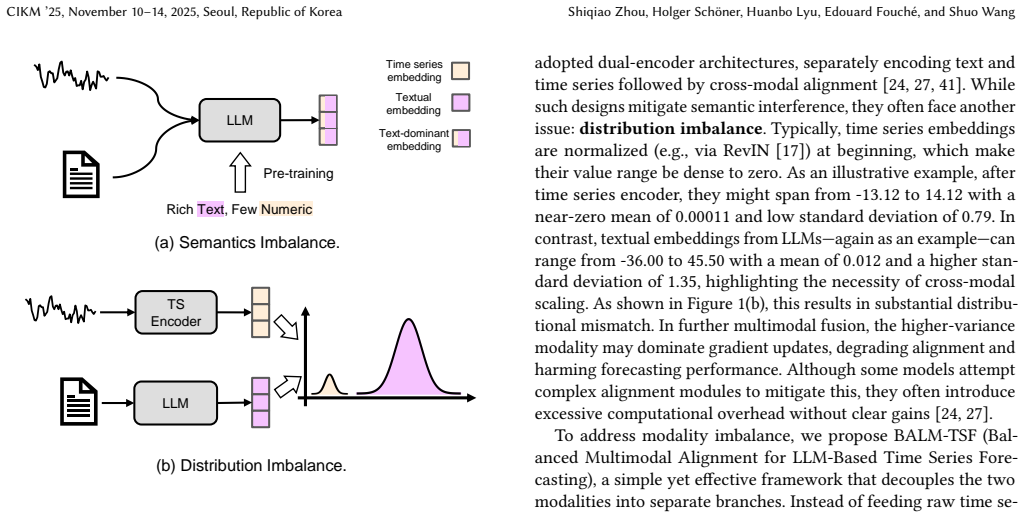
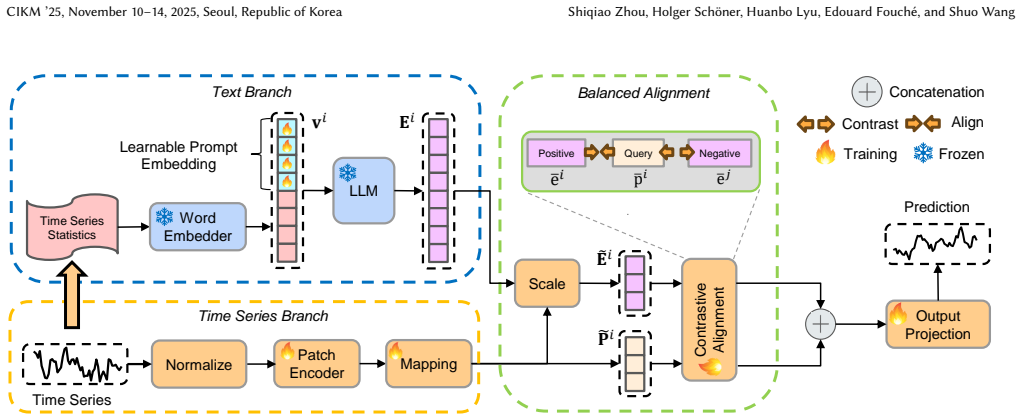
The central claim is that modality imbalance—not model capacity—is the key bottleneck in LLM-based time series forecasting. BALM-TSF shows that by (1) avoiding raw series tokens in the LLM and using compact statistical prompts enriched with a learnable prompt, (2) adaptively truncating textual embeddings based on prediction horizon, (3) rescaling them to match time series embedding variance, and (4) pulling matching text–series pairs together with InfoNCE while pushing others apart, the two modalities can be integrated without one dominating. The result is state-of-the-art or near-state-of-the-art MSE/MAE across ETT, Exchange, and Weather benchmarks in both long-term and few-shot (10% traini
What carries the argument
The central object is the balanced multimodal alignment module: a two-step procedure that first adaptively truncates textual embeddings to N_E = min(N_P, floor(N_P·H/L)) tokens based on forecast horizon, then rescales them by the standard-deviation ratio α = STD_time/STD_text, and finally applies an InfoNCE contrastive loss between the averaged, ℓ2-normalized text and time series embeddings. This machinery enforces both distributional consistency (matching variance) and semantic alignment (pulling corresponding text–series pairs together), so the concatenated representation feeding the forecast head is balanced rather than text-dominated.
Load-bearing premise
The method's gains rest on the assumption that the tail end of a prompt holds the most useful statistical information, an assumption the paper tests only on ETTh data.
What would settle it
Run BALM-TSF with the adaptive truncation reversed (keep the first N_E tokens) or with N_E drawn randomly across horizons; if MSE does not degrade on ETTh or degrades less on other datasets, the horizon-aware tail-retention premise is not load-bearing. Also, hold out a dataset whose statistical prompt order is permuted so statistics appear at the beginning; if gains vanish, the tail-retention assumption is confirmed as the cause.
If this is right
- If correct, LLM-based forecasters can be made much lighter: training 0.97M parameters instead of 53M yields better accuracy, so parameter-efficient forecaster design is a viable alternative to scaling.
- The horizon-aware truncation implies that the optimal textual context is a function of forecast length: short horizons want minimal text, long horizons benefit from richer statistical summaries.
- Contrastive alignment plus scaling is sufficient to bridge text and time series distributions, suggesting simpler alternatives to cross-attention or complex fusion modules.
- Benchmark results imply that descriptive statistics prompts carry enough information for the LLM to add value, without feeding raw values.
- Few-shot gains (10.7% MSE reduction vs GPT4TS) suggest balance helps most when data is scarce.
Where Pith is reading between the lines
- The truncation rule assumes tail tokens are most informative; a natural extension would test whether the same retained-token count rule transfers to prompts where key statistics are front-loaded, or to datasets with different tokenizations.
- Because the scaling factor is computed per-sample from standard deviations, the method could be extended to align higher moments (skew, kurtosis) or to use a learned affine map instead of a scalar, which may further reduce distributional gap.
- The contrastive objective uses only paired time series/statistics; extending to supervised contrastive with forecast target similarity or to harder negatives from same-series different-horizon pairs might improve few-shot stability.
- The claim that textual modality is auxiliary suggests an adaptive gating mechanism could weight text contributions per dataset or per channel, potentially recovering gains on Weather where univariate statistics were insufficient.
Editorial analysis
A structured set of objections, weighed in public.
Referee Report
Summary. The paper introduces BALM-TSF, a dual-branch LLM-based time series forecasting framework. One branch encodes normalized, patched time series via a PatchTST-style encoder; the other feeds descriptive statistics (min, max, median, trend, top-5 lags) plus a learnable prompt through a frozen GPT-2. To balance the modalities, the textual embeddings are truncated according to the prediction horizon, rescaled to the time series embedding scale, and aligned with a contrastive loss. The aligned representations are concatenated and projected to the forecast. Experiments on six standard benchmarks compare against four LLM-based and four non-LLM baselines in long-term and few-shot settings, with ablations and parameter-sensitivity analyses. The claimed contributions are a diagnosis of modality imbalance, a lightweight alignment mechanism, and state-of-the-art accuracy with only 0.97M trainable parameters.
Significance. If the claimed results hold under a properly qualified comparison, the paper makes a useful practical contribution: a very lightweight (0.97M trainable parameters) LLM-based forecaster that can match or beat much larger models on several ETT/Exchange settings. The method is simple and the Section 3 equations are internally consistent. The paper also has positive reproducibility features: code is released, standard benchmarks are used, and the ablations show that each component individually matters. The main significance is therefore conditional on two issues: (i) the 'state-of-the-art' claim is contradicted by the paper's own tables on Weather and on some few-shot comparisons; (ii) the ablations never remove or replace the frozen LLM text branch, so it is not established that LLM semantic knowledge, rather than the dual-branch statistical-prompt architecture plus alignment, drives the gains.
major comments (3)
- [Abstract and Section 4.2, Table 1] The abstract claims BALM-TSF 'achieves state-of-the-art performance in both long-term and few-shot forecasting,' but Table 1 shows this is not true on Weather: BALM-TSF's average MSE/MAE are 0.243/0.281, worse than GPT4TS (0.228/0.266), Time-LLM (0.230/0.269), and PatchTST (0.232/0.273). Likewise, in the few-shot Table 2, ETTh1 average MSE 0.683 is much worse than DLinear's 0.530, and on ETTh2 DLinear also wins (0.412 vs 0.460). The claim should be qualified to 'state-of-the-art among LLM-based methods on ETT/Exchange' or 'competitive overall'; as written, the central contribution is overstated by the paper's own numbers.
- [Section 4.4, Ablation Study] Every ablation variant — 'w/o scale + alignment', 'w/o alignment', 'w/o scale', 'w/o learnable prompt' — retains the frozen GPT-2 text branch with the statistical prompt. Therefore the experiments never isolate whether the gains come from LLM-based multimodal semantic knowledge or simply from the dual-branch design with a statistical-prompt encoder and the scaling/contrastive recipe. Since the statistical prompt is derived from the same input series and GPT-2 is frozen, a non-LLM encoder (or a no-text control) trained with the same scaling and contrastive objective could plausibly reproduce the results. This is load-bearing because the paper's stated novelty is 'balanced multimodal alignment' for the textual modality, not just a dual-branch architecture. Please add a control that removes the text branch or replaces the frozen LLM with a lightweight non-LLM text encoder, and report the re
- [Section 3.4.1, Eq. (7)] The adaptive truncation rule N_E = min(N_P, floor(N_P*H/L)) is derived from the premise that, due to masked self-attention, final tokens capture richer context, and that longer horizons benefit from more text. However, the only empirical support is Figure 6, which is measured on ETTh1/ETTh2 and tests exactly the values 12, 24, 42, 64 generated by the formula for H=96,192,336,720 plus one extra value (72). This does not validate the formula on other datasets or against alternative truncation strategies (e.g., fixed length, first tokens, learned attention pooling). Since the scaling and contrastive alignment operate on the truncated text representation, an out-of-sample validation or an ablation on the truncation rule is needed to establish that the method's gains are not an artifact of fitting Eq. (7) to the ETTh datasets.
minor comments (6)
- [Section 4.2 / Table 1] The sentence 'BALM-TSF achieves the lowest or second-lowest error on all ETT and Exchange dataset–horizon combinations' is accurate only for ETT/Exchange, not for Weather; please make this explicit earlier to avoid the impression that the aggregate 'state-of-the-art' phrase covers all six benchmarks.
- [Section 4.5, Figure 7 caption/text] The text mentions 'the horizon of 512 benefits from increasing value', but the experiments use horizons 96, 192, 336, 720. This appears to be a typo; please correct.
- [Figure 6] The y-axis label reads 'T extual Embedding Length'; there is an extra space. Also, the figure would benefit from marking the N_E values selected by Eq. (7) for each horizon, so the reader can directly see the relation to the truncation rule.
- [Section 4.6, Table 3] TimeCMA is labeled 'LLM in model? no', yet Section 2.1 and Table 1 describe TimeCMA as an LLM-based dual-branch model using a frozen LLM for embeddings. Please clarify the distinction between 'using an LLM in the pipeline' and 'having trainable LLM components' to avoid confusion.
- [Section 4.6, Table 3] The efficiency table omits GPT4TS, UniTime, and non-LLM baselines. Since the claim is about lightweight efficiency relative to LLM-based methods, adding GPT4TS and reporting training time (not just inference speed) would strengthen the comparison.
- [Section 4.1.3 / Section 4.5] The alignment weight lambda is set to 1, but Figure 7 shows horizon-dependent sensitivity. A sentence explaining how the single global lambda=1 was chosen (e.g., validation-set selection across all horizons) would preempt concerns about cherry-picking.
Circularity Check
No significant circularity: BALM-TSF's central forecasts are evaluated against external benchmarks, and its alignment components are standard operations rather than target-equivalent constructions.
full rationale
The paper's derivation chain is not circular. The main claims (long-term and few-shot MSE/MAE reductions vs. Time-LLM and GPT4TS) are supported by experiments on standard benchmark datasets (ETT, Exchange, Weather) against independent baselines. The scaling factor alpha = STD_time/STD_text is a per-instance normalization of text embeddings to the time-series embedding scale; it is computed from input embeddings, not from the forecast target, and its effect is isolated in an ablation. The contrastive alignment loss is a standard InfoNCE objective between same-instance text and time representations; it shapes the representation space but does not encode future values. The statistical prompt is a deterministic summary of the input series, so the text branch does not inject exogenous information, but this is a design/completeness limitation rather than a circular derivation: the forecast target is not used to construct the prompt. The adaptive truncation rule N_E = min(N_P, floor(N_P*H/L)) is a heuristic supported by a sensitivity study (Figure 6); the study is on the same datasets, but it is an empirical justification of a hyperparameter schedule, not an equation that reduces the predicted output to the fitted parameter. There are no load-bearing self-citations; references to Time-LLM, PatchTST, RevIN, and InfoNCE are to independent prior work. The absence of a no-LLM/text-free control is a legitimate experimental gap regarding attribution of the gains to the frozen LLM, but it is not a definitional equivalence and does not constitute circularity under the specified criteria.
Axiom & Free-Parameter Ledger
free parameters (2)
- alignment loss weight lambda =
1
- learnable prompt token count =
not reported
axioms (5)
- domain assumption The statistical prompt (min, max, median, trend, top-5 lags) carries forecasting-relevant complementary information
- domain assumption Due to masked self-attention, the final tokens of the prompt embedding capture richer context than earlier tokens
- domain assumption Scaling the textual embeddings by the ratio of standard deviations is sufficient to align the value ranges of the two modalities
- standard math Contrastive InfoNCE with one positive sample per instance is a valid objective for aligning text and time series embeddings
- domain assumption RevIN normalization and PatchTST-style patching are effective time series encoding choices
Cite this review
Pith. "Pith review of BALM-TSF: Balanced Multimodal Alignment for LLM-Based Time Series Forecasting." pith.science (2026). https://pith.science/paper/TXEXS6LC
@misc{pith2026250900622,
  author       = {Pith},
  title        = {Pith review of: BALM-TSF: Balanced Multimodal Alignment for LLM-Based Time Series Forecasting},
  year         = {2026},
  howpublished = {\url{https://pith.science/paper/TXEXS6LC}},
  note         = {Machine review of arXiv:2509.00622}
}
read the original abstract
Time series forecasting is a long-standing and highly challenging research topic. Recently, driven by the rise of large language models (LLMs), research has increasingly shifted from purely time series methods toward harnessing textual modalities to enhance forecasting performance. However, the vast discrepancy between text and temporal data often leads current multimodal architectures to over-emphasise one modality while neglecting the other, resulting in information loss that harms forecasting performance. To address this modality imbalance, we introduce BALM-TSF (Balanced Multimodal Alignment for LLM-Based Time Series Forecasting), a lightweight time series forecasting framework that maintains balance between the two modalities. Specifically, raw time series are processed by the time series encoder, while descriptive statistics of raw time series are fed to an LLM with learnable prompt, producing compact textual embeddings. To ensure balanced cross-modal context alignment of time series and textual embeddings, a simple yet effective scaling strategy combined with a contrastive objective then maps these textual embeddings into the latent space of the time series embeddings. Finally, the aligned textual semantic embeddings and time series embeddings are together integrated for forecasting. Extensive experiments on standard benchmarks show that, with minimal trainable parameters, BALM-TSF achieves state-of-the-art performance in both long-term and few-shot forecasting, confirming its ability to harness complementary information from text and time series. Code is available at https://github.com/ShiqiaoZhou/BALM-TSF.
Figures


Forward citations
Cited by 2 Pith papers
-
Rethinking Multimodal Fusion for Time Series: Text Modalities Need Constrained Fusion
Naive text+time-series fusion frequently degrades forecasting, while a low-rank controlled adapter (CFA) consistently improves over unimodal baselines across 14 backbones, 4 text encoders, and 9 datasets.
-
Rethinking Multimodal Fusion for Time Series: Text Modalities Need Constrained Fusion
Uncontrolled text–time-series fusion underperforms unimodal baselines; constrained fusion and a low-rank Controlled Fusion Adapter recover gains without changing the TS backbone.
Reference graph
Works this paper leans on
-
[1]
Josh Achiam, Steven Adler, Sandhini Agarwal, Lama Ahmad, Ilge Akkaya, Floren- cia Leoni Aleman, Diogo Almeida, Janko Altenschmidt, Sam Altman, Shyamal Anadkat, et al. 2023. Gpt-4 technical report. arXiv preprint arXiv:2303.08774 (2023)
Pith/arXiv arXiv 2023
-
[2]
George EP Box, Gwilym M Jenkins, Gregory C Reinsel, and Greta M Ljung. 2015. Time series analysis: forecasting and control . John Wiley & Sons
work page 2015
-
[3]
Tom Brown, Benjamin Mann, Nick Ryder, Melanie Subbiah, Jared D Kaplan, Prafulla Dhariwal, Arvind Neelakantan, Pranav Shyam, Girish Sastry, Amanda Askell, et al. 2020. Language models are few-shot learners. Advances in neural information processing systems 33 (2020), 1877–1901
2020
-
[4]
Defu Cao, Furong Jia, Sercan O Arik, Tomas Pfister, Yixiang Zheng, Wen Ye, and Yan Liu. 2023. Tempo: Prompt-based generative pre-trained transformer for time series forecasting. arXiv preprint arXiv:2310.04948 (2023)
Pith/arXiv arXiv 2023
-
[5]
Mohammad Azhar Mat Daut, Mohammad Yusri Hassan, Hayati Abdullah, Hasimah Abdul Rahman, Md Pauzi Abdullah, and Faridah Hussin. 2017. Building electrical energy consumption forecasting analysis using conventional and artifi- cial intelligence methods: A review. Renewable and Sustainable Energy Reviews 70 (2017), 1108–1118
work page 2017
-
[6]
Ning Ding, Yujia Qin, Guang Yang, Fuchao Wei, Zonghan Yang, Yusheng Su, Shengding Hu, Yulin Chen, Chi-Min Chan, Weize Chen, et al. 2023. Parameter- efficient fine-tuning of large-scale pre-trained language models. Nature Machine Intelligence 5, 3 (2023), 220–235
work page 2023
-
[7]
Xiao Ding, Yue Zhang, Ting Liu, and Junwen Duan. 2015. Deep learning for event-driven stock prediction.. In Ijcai, Vol. 15. 2327–2333
work page 2015
-
[8]
Manqing Dong, Hao Huang, and Longbing Cao. 2024. Can LLMs Serve As Time Series Anomaly Detectors? arXiv preprint arXiv:2408.03475 (2024)
Pith/arXiv arXiv 2024
-
[9]
Adi Haviv, Ori Ram, Ofir Press, Peter Izsak, and Omer Levy. 2022. Transformer language models without positional encodings still learn positional information. arXiv preprint arXiv:2203.16634 (2022)
Pith/arXiv arXiv 2022
-
[10]
Sepp Hochreiter and Jürgen Schmidhuber. 1997. Long short-term memory.Neural computation 9, 8 (1997), 1735–1780
1997
-
[11]
Yuxiao Hu, Qian Li, Dongxiao Zhang, Jinyue Yan, and Yuntian Chen. 2025. Context-Alignment: Activating and Enhancing LLM Capabilities in Time Se- ries. arXiv preprint arXiv:2501.03747 (2025)
arXiv 2025
-
[12]
Lei Huang, Weijiang Yu, Weitao Ma, Weihong Zhong, Zhangyin Feng, Haotian Wang, Qianglong Chen, Weihua Peng, Xiaocheng Feng, Bing Qin, et al. 2025. A survey on hallucination in large language models: Principles, taxonomy, chal- lenges, and open questions. ACM Transactions on Information Systems 43, 2 (2025), 1–55
2025
-
[13]
Chao Jia, Yinfei Yang, Ye Xia, Yi-Ting Chen, Zarana Parekh, Hieu Pham, Quoc Le, Yun-Hsuan Sung, Zhen Li, and Tom Duerig. 2021. Scaling up visual and vision- language representation learning with noisy text supervision. In International conference on machine learning . PMLR, 4904–4916
2021
-
[14]
Furong Jia, Kevin Wang, Yixiang Zheng, Defu Cao, and Yan Liu. 2024. Gpt4mts: Prompt-based large language model for multimodal time-series forecasting. In Proceedings of the AAAI Conference on Artificial Intelligence, Vol. 38. 23343–23351
2024
-
[15]
Ming Jin, Shiyu Wang, Lintao Ma, Zhixuan Chu, James Y Zhang, Xiaoming Shi, Pin-Yu Chen, Yuxuan Liang, Yuan-Fang Li, Shirui Pan, et al . 2023. Time-llm: Time series forecasting by reprogramming large language models. arXiv preprint arXiv:2310.01728 (2023)
Pith/arXiv arXiv 2023
-
[16]
Ming Jin, Yifan Zhang, Wei Chen, Kexin Zhang, Yuxuan Liang, Bin Yang, Jindong Wang, Shirui Pan, and Qingsong Wen. 2024. Position: What can large language models tell us about time series analysis. In Forty-first International Conference on Machine Learning
2024
-
[17]
Taesung Kim, Jinhee Kim, Yunwon Tae, Cheonbok Park, Jang-Ho Choi, and Jaegul Choo. 2021. Reversible Instance Normalization for Accurate Time-Series Forecasting against Distribution Shift. In International Conference on Learning Representations. https://openreview.net/forum?id=cGDAkQo1C0p
work page 2021
-
[18]
Guokun Lai, Wei-Cheng Chang, Yiming Yang, and Hanxiao Liu. 2018. Modeling long-and short-term temporal patterns with deep neural networks. In The 41st international ACM SIGIR conference on research & development in information retrieval. 95–104
work page 2018
-
[19]
Brian Lester, Rami Al-Rfou, and Noah Constant. 2021. The power of scale for parameter-efficient prompt tuning. arXiv preprint arXiv:2104.08691 (2021)
Pith/arXiv arXiv 2021
-
[20]
Aitor Lewkowycz, Anders Andreassen, David Dohan, Ethan Dyer, Henryk Michalewski, Vinay Ramasesh, Ambrose Slone, Cem Anil, Imanol Schlag, Theo Gutman-Solo, et al. 2022. Solving quantitative reasoning problems with language models. Advances in Neural Information Processing Systems 35 (2022), 3843–3857
work page 2022
-
[21]
Qing Li, Jinghua Tan, Jun Wang, and Hsinchun Chen. 2020. A multimodal event- driven LSTM model for stock prediction using online news. IEEE Transactions on Knowledge and Data Engineering 33, 10 (2020), 3323–3337
work page 2020
-
[22]
Zhenghao Lin, Zhibin Gou, Yeyun Gong, Xiao Liu, Ruochen Xu, Chen Lin, Yujiu Yang, Jian Jiao, Nan Duan, Weizhu Chen, et al. 2024. Not all tokens are what you need for pretraining. Advances in Neural Information Processing Systems 37 (2024), 29029–29063
work page 2024
-
[23]
Aixin Liu, Bei Feng, Bing Xue, Bingxuan Wang, Bochao Wu, Chengda Lu, Cheng- gang Zhao, Chengqi Deng, Chenyu Zhang, Chong Ruan, et al. 2024. Deepseek-v3 technical report. arXiv preprint arXiv:2412.19437 (2024)
Pith/arXiv arXiv 2024
-
[24]
Chenxi Liu, Qianxiong Xu, Hao Miao, Sun Yang, Lingzheng Zhang, Cheng Long, Ziyue Li, and Rui Zhao. 2024. Timecma: Towards llm-empowered time series forecasting via cross-modality alignment. arXiv preprint arXiv:2406.01638 (2024)
Pith/arXiv arXiv 2024
-
[25]
Haoxin Liu, Shangqing Xu, Zhiyuan Zhao, Lingkai Kong, Harshavardhan Prab- hakar Kamarthi, Aditya Sasanur, Megha Sharma, Jiaming Cui, Qingsong Wen, Chao Zhang, et al. 2024. Time-mmd: Multi-domain multimodal dataset for time series analysis. Advances in Neural Information Processing Systems 37 (2024), 77888–77933
2024
-
[26]
Haoxin Liu, Zhiyuan Zhao, Jindong Wang, Harshavardhan Kamarthi, and B Aditya Prakash. 2024. Lstprompt: Large language models as zero-shot time series forecasters by long-short-term prompting. arXiv preprint arXiv:2402.16132 (2024)
Pith/arXiv arXiv 2024
-
[27]
Peiyuan Liu, Hang Guo, Tao Dai, Naiqi Li, Jigang Bao, Xudong Ren, Yong Jiang, and Shu-Tao Xia. 2025. Calf: Aligning llms for time series forecasting via cross- modal fine-tuning. In Proceedings of the AAAI Conference on Artificial Intelligence , Vol. 39. 18915–18923
work page 2025
-
[28]
Xu Liu, Junfeng Hu, Yuan Li, Shizhe Diao, Yuxuan Liang, Bryan Hooi, and Roger Zimmermann. 2024. Unitime: A language-empowered unified model for cross- domain time series forecasting. In Proceedings of the ACM Web Conference 2024 . 4095–4106
work page 2024
-
[29]
Yong Liu, Tengge Hu, Haoran Zhang, Haixu Wu, Shiyu Wang, Lintao Ma, and Mingsheng Long. 2023. itransformer: Inverted transformers are effective for time series forecasting. arXiv preprint arXiv:2310.06625 (2023)
Pith/arXiv arXiv 2023
-
[30]
Nguyen, Phanwadee Sinthong, and Jayant Kalagnanam
Yuqi Nie, Nam H. Nguyen, Phanwadee Sinthong, and Jayant Kalagnanam. 2023. A Time Series is Worth 64 Words: Long-term Forecasting with Transformers. In International Conference on Learning Representations
2023
-
[31]
Aaron van den Oord, Yazhe Li, and Oriol Vinyals. 2018. Representation learning with contrastive predictive coding. arXiv preprint arXiv:1807.03748 (2018)
Pith/arXiv arXiv 2018
-
[32]
Alec Radford, Jong Wook Kim, Chris Hallacy, Aditya Ramesh, Gabriel Goh, Sandhini Agarwal, Girish Sastry, Amanda Askell, Pamela Mishkin, Jack Clark, et al. 2021. Learning transferable visual models from natural language supervision. In International conference on machine learning . PmLR, 8748–8763
2021
-
[33]
Alec Radford, Jeffrey Wu, Rewon Child, David Luan, Dario Amodei, Ilya Sutskever, et al. 2019. Language models are unsupervised multitask learners. OpenAI blog 1, 8 (2019), 9
2019
-
[34]
Eli Schwartz, Leshem Choshen, Joseph Shtok, Sivan Doveh, Leonid Karlinsky, and Assaf Arbelle. 2024. NumeroLogic: Number Encoding for Enhanced LLMs’ Numerical Reasoning. arXiv preprint arXiv:2404.00459 (2024)
Pith/arXiv arXiv 2024
-
[35]
Mahya Seyedan and Fereshteh Mafakheri. 2020. Predictive big data analytics for supply chain demand forecasting: methods, applications, and research opportu- nities. Journal of Big Data 7, 1 (2020), 53
work page 2020
-
[36]
Aaditya K Singh and DJ Strouse. 2024. Tokenization counts: the impact of tokenization on arithmetic in frontier llms. arXiv preprint arXiv:2402.14903 (2024)
Pith/arXiv arXiv 2024
-
[37]
Dimitris Spathis and Fahim Kawsar. 2024. The first step is the hardest: Pitfalls of representing and tokenizing temporal data for large language models. Journal of the American Medical Informatics Association 31, 9 (2024), 2151–2158
work page 2024
-
[38]
Chenxi Sun, Hongyan Li, Yaliang Li, and Shenda Hong. 2023. Test: Text proto- type aligned embedding to activate llm’s ability for time series. arXiv preprint arXiv:2308.08241 (2023)
Pith/arXiv arXiv 2023
-
[39]
Mingtian Tan, Mike Merrill, Vinayak Gupta, Tim Althoff, and Tom Hartvigsen
-
[40]
Hugo Touvron, Thibaut Lavril, Gautier Izacard, Xavier Martinet, Marie-Anne Lachaux, Timothée Lacroix, Baptiste Rozière, Naman Goyal, Eric Hambro, Faisal Azhar, et al. 2023. Llama: Open and efficient foundation language models. arXiv preprint arXiv:2302.13971 (2023)
Pith/arXiv arXiv 2023
-
[41]
Pengfei Wang, Huanran Zheng, Qi’ao Xu, Silong Dai, Yiqiao Wang, Wenjing Yue, Wei Zhu, Tianwen Qian, and Xiaoling Wang. 2025. TS-HTFA: Advancing Time Series Forecasting via Hierarchical Text-Free Alignment with Large Language Models. arXiv:2409.14978 [cs.AI] https://arxiv.org/abs/2409.14978
Pith/arXiv arXiv 2025
-
[42]
Yuxuan Wang, Haixu Wu, Jiaxiang Dong, Guo Qin, Haoran Zhang, Yong Liu, Yunzhong Qiu, Jianmin Wang, and Mingsheng Long. 2024. Timexer: Empowering transformers for time series forecasting with exogenous variables. arXiv preprint arXiv:2402.19072 (2024)
Pith/arXiv arXiv 2024
-
[43]
Andrew Robert Williams, Arjun Ashok, Étienne Marcotte, Valentina Zantedeschi, Jithendaraa Subramanian, Roland Riachi, James Requeima, Alexandre Lacoste, Irina Rish, Nicolas Chapados, et al . 2024. Context is key: A benchmark for BALM-TSF: Balanced Multimodal Alignment for LLM-Based Time Series Forecasting CIKM ’25, November 10–14, 2025, Seoul, Republic of...
Pith/arXiv arXiv 2024
-
[44]
Haixu Wu, Tengge Hu, Yong Liu, Hang Zhou, Jianmin Wang, and Mingsheng Long. 2023. TimesNet: Temporal 2D-Variation Modeling for General Time Series Analysis. In International Conference on Learning Representations
2023
-
[45]
Haixu Wu, Jiehui Xu, Jianmin Wang, and Mingsheng Long. 2021. Autoformer: De- composition transformers with auto-correlation for long-term series forecasting. Advances in neural information processing systems 34 (2021), 22419–22430
2021
-
[46]
Haotong Yang, Yi Hu, Shijia Kang, Zhouchen Lin, and Muhan Zhang. 2024. Number Cookbook: Number Understanding of Language Models and How to Improve It. arXiv preprint arXiv:2411.03766 (2024)
Pith/arXiv arXiv 2024
-
[47]
Ailing Zeng, Muxi Chen, Lei Zhang, and Qiang Xu. 2022. Are Transformers Effective for Time Series Forecasting? arXiv preprint arXiv:2205.13504 (2022)
Pith/arXiv arXiv 2022
-
[48]
Haoyi Zhou, Shanghang Zhang, Jieqi Peng, Shuai Zhang, Jianxin Li, Hui Xiong, and Wancai Zhang. 2021. Informer: Beyond efficient transformer for long se- quence time-series forecasting. In Proceedings of the AAAI conference on artificial intelligence, Vol. 35. 11106–11115
work page 2021
-
[49]
Tian Zhou, Peisong Niu, Liang Sun, Rong Jin, et al . 2023. One fits all: Power general time series analysis by pretrained lm. Advances in neural information processing systems 36 (2023), 43322–43355
2023
-
[2024]
Are language models actually useful for time series forecasting? Advances in Neural Information Processing Systems 37 (2024), 60162–60191
2024
discussion (0)
Sign in with ORCID, Apple, or X to comment. Anyone can read and Pith papers without signing in.