REVIEW 4 major objections 7 minor 46 references
Naive text fusion often hurts time-series forecasting; constraining the text signal through a low-rank bottleneck consistently fixes it.
Reviewed by Pith at T0; open to challenge. T0 means a machine referee read the full paper against a public rubric. the ladder, T0–T4 →
T0 review · deepseek-v4-flash
2026-08-02 17:40 UTC pith:ZZOBFJPX
load-bearing objection Broad, honest empirical study showing naive text fusion often hurts TS forecasting and low-rank constrained fusion helps; the missing error bars keep the headline gains from being statistically established. the 4 major comments →
Rethinking Multimodal Fusion for Time Series: Text Modalities Need Constrained Fusion
The pith
A machine-rendered reading of the paper's core claim, the machinery that carries it, and where it could break.
Core claim
The paper's central claim is that in multimodal time-series forecasting, the time series must remain the primary modality and any auxiliary text signal must be injected in a constrained manner; unconstrained injection is actively harmful. Concretely, the authors demonstrate that across a large experimental grid, naive additive and concatenative fusion at any layer often underperforms the unimodal baseline, sometimes diverging to errors more than ten times larger. In contrast, four constrained strategies—a learned gate, feature-wise linear modulation (FiLM), orthogonal projection, and their proposed CFA—consistently outperform naive fusion, and CFA additionally beats the unimodal baseline on
What carries the argument
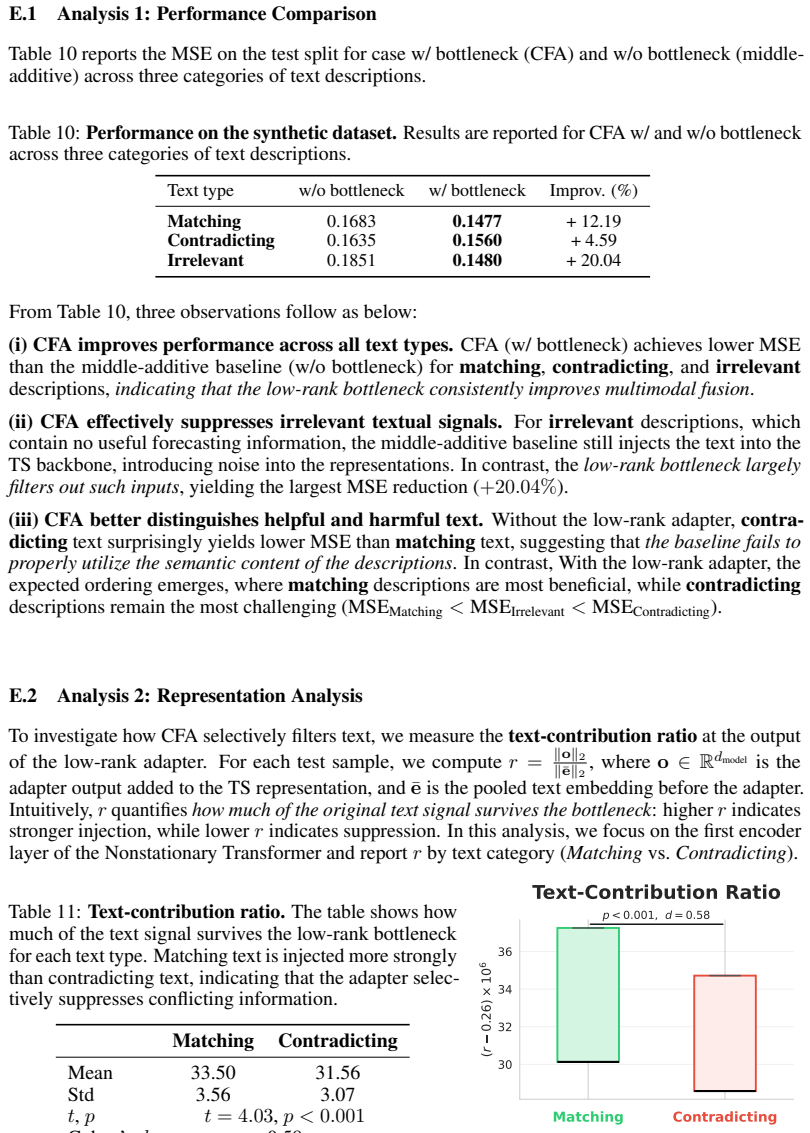
The Controlled Fusion Adapter (CFA) is the central object: a LoRA-style low-rank bottleneck that compresses the text embedding into a low-dimensional subspace and then expands it back for residual addition to the time-series embedding. The mechanism is the rank restriction itself—since the down- and up-projections both have rank at most D/r, the composed text transformation lives in a subspace of dimension at most D/r, which bounds the capacity of the text signal to alter temporal representations. This low-rank constraint does the filtering work: in the paper's synthetic study it suppresses contradicting and irrelevant text (largest MSE improvement, +20.04%, occurs for irrelevant text) while
Load-bearing premise
The empirical superiority of constrained fusion over the unimodal baseline rests on a comparison protocol where each configuration is tuned over ten learning rates and only the best result is reported, without repeated-seed error bars; if that gap shrinks or reverses under fixed hyperparameters or across seeds, the 'consistent improvement' claim weakens.
What would settle it
A direct replication with fixed learning rates (or a small set) and multiple random seeds per configuration, reporting mean and variance of normalized MSE, would settle the claim: if CFA's advantage over the unimodal baseline falls within noise—especially on settings where naive fusion does not diverge—the paper's central conclusion would be materially weakened. A second falsifier: construct a dataset where text is deliberately highly informative (e.g., a single text token encodes the future trend) and show that a naive additive or concatenative fusion makes no trade-off; the claim predicts th
If this is right
- Practitioners integrating text into time-series models should avoid simple additive or concatenative fusion, which the paper shows frequently underperforms the unimodal baseline.
- A plug-in low-rank residual adapter can be added to any existing time-series backbone without retraining it from scratch, since only the adapter and a text projection are trained while the text encoder stays frozen.
- Constrained fusion is robust to irrelevant text: when text is mismatched to the series, CFA degrades the least relative to the unimodal model.
- The approach is efficient, adding under one percent parameter and FLOP overhead compared with the unimodal model, unlike some constrained alternatives such as gating that increase FLOPs by roughly 31%.
- Because CFA generalizes across 14 backbones and 4 text encoders, the benefit is not tied to a specific architecture or language model.
Where Pith is reading between the lines
- Editorial: the low-rank bottleneck can be viewed as an inductive bias that forces the text pathway to compete for a limited number of 'directions' in the temporal representation space; the paper's filtering story is plausible but the evidence is correlational, so an alternative explanation—that the bottleneck merely regularizes the fusion layer—is not ruled out.
- Editorial: if the rank restriction is truly the operative mechanism, then varying the bottleneck rank and measuring performance versus text informativeness across datasets would give a direct test; the sensitivity analysis in the paper shows stability across ranks r=2..32, which is consistent with the filtering story but does not isolate it.
- Editorial: the same constrained-fusion principle should transfer to other auxiliary modalities such as vision or tabular context, and the paper flags this as future work; a testable prediction is that naive vision fusion will also underperform unimodal baselines on the same datasets.
- Editorial: the reported averaged win-rates aggregate configurations that include divergence-level failures of naive fusion; a reader should check whether constrained fusion still beats unimodal on the subset of settings where naive fusion does not diverge.
Editorial analysis
A structured set of objections, weighed in public.
Referee Report
Summary. The paper studies multimodal time-series forecasting with auxiliary text. It reports that naive fusion (additive or concatenative injection of text embeddings into a TS backbone) often degrades performance relative to a unimodal baseline, and that this can be remedied by 'constrained fusion.' The authors propose Controlled Fusion Adapter (CFA), a low-rank residual adapter that projects text through a bottleneck before adding it to TS representations. They evaluate 10 fusion strategies over an unusually broad grid (14 TS models × 4 text models × 9 datasets × 4 horizons), report averaged normalized MSE and win-rates, and include a synthetic toy experiment plus several analyses (representation similarity, temporal attribution, efficiency, effective rank) to support the proposed mechanism. The central claim is that CFA consistently outperforms both naive fusion methods and the unimodal baseline, and that constrained fusion in general is more robust than naive fusion.
Significance. If the central claim holds, the paper offers a practical and simple design rule: when injecting text into a time-series forecaster, use a low-rank residual bottleneck rather than direct addition or concatenation. The breadth of the empirical grid—over 2K settings and 10 fusion strategies—is a real strength, as is the release of code and the honest flagging of divergence cases in the full tables. The toy experiment with matching/contradicting/irrelevant text is a useful controlled check. However, the lack of repeated-seed variance and the loosely specified normalization make the headline 'consistent' claim statistically unquantified, and the 'theoretical perspective' in Appendix G is essentially a restatement of the low-rank construction rather than an explanation of why irrelevant text is filtered.
major comments (4)
- [Section 4; Table 4; Figure 3; Table 18] The evaluation protocol reports only the best result over 10 learning rates per setting, with no repeated seeds or variance statistics (Section 4: 'Each setting is evaluated over 10 learning rates, reporting the best result'). This is load-bearing because the headline 'consistent improvement' is an aggregate over many settings, and the paper's own per-horizon tables show small or reversed differences (e.g., Table 18, Nonstationary Transformer, Agriculture H=6: CFA 0.053 vs unimodal 0.051). Selection noise of this magnitude is larger than many reported gaps. Please provide repeated-seed results (mean±std over at least 3–5 seeds) for a representative subset or the full grid, and/or a paired bootstrap over settings, so the win-rates and average normalized MSE have confidence intervals. Without this, the 'consistent' claim is not statistically supported.
- [Appendix G; Section 3.3] The 'theoretical perspective' in Appendix G states that rank(W_up W_down) ≤ D/r, which is true by construction. The conclusion that 'the injected textual signal lies in a subspace of dimension at most D/r' and therefore 'suppresses irrelevant information' is an empirical claim, not a theorem. The toy experiment (Appendix E) is a demonstration, not a proof. As written, the theoretical argument is circular with the design of the adapter. Please either remove the 'theoretical perspective' label, or provide a formal analysis (e.g., with explicit assumptions about signal vs noise directions) that shows how the low-rank projection selectively attenuates irrelevant components.
- [Figure 3; Section 4.2] The aggregated comparisons use 'normalized MSE,' but the normalization procedure is never defined in the main text. This matters because dataset scales differ enormously (e.g., Security MSE ≈ 106, Agriculture ≈ 0.08 in Table 4). If 'normalization' is per-dataset division by some reference, the average can be dominated by a few high-scale datasets. Please specify the normalization formula explicitly, and report per-dataset and per-backbone win-rates or medians, so the 0.256 vs 0.349 overall gap can be interpreted correctly.
- [Section 5 [2]; Appendix E] The toy experiment used to support the low-rank filtering mechanism is a single synthetic dataset (N=1000) with a single TS backbone (Nonstationary Transformer), a single split, and no repeated-seed variance. The text-contribution ratio in Appendix E.2 is reported after an unexplained constant shift ((r−0.25745)×10^6), making the numbers difficult to interpret. To make the mechanistic claim convincing, the toy experiment should be run with at least a few seeds and ideally with one or two additional backbones, with error bars on both the MSE comparisons and the contribution ratios.
minor comments (7)
- [Figure 1 caption] The caption says 'Average over 2K settings,' but the experiment grid includes 9×14×4×4 = 2016 settings, which is indeed ~2K. Please clarify whether this is per fusion method or total.
- [Table 4] The footnote defining 'Div.*' appears at the bottom of the table but is not referenced in the caption or header. Consider adding a sentence in the caption explaining the divergence criterion.
- [Equation (2)] The cosine similarity formula in Section 5 [3] is mis-formatted: the inner product and norms are not typeset correctly. Also, the layer index L is overloaded with the lookback length L; use a different symbol for the layer count.
- [Section 4.2 [4]] In the text, 'Table 3d' should refer to Figure 3d. Also, Figure 5a in Section 5 [2] is labeled 'Table 5a' in the text; please correct the cross-references.
- [Appendix D, Table 9] The hyperparameter table uses inconsistent notation: d_model is listed as 512 for Transformer-based models, but the text describes DLinear as operating on C_in directly. Clarify the relationship between d_model and the channel dimension in the fusion equations.
- [Abstract and Introduction] The abstract claims 'over 20K experiments,' while Section 4 states '2K settings × 10 fusion methods.' This is consistent, but the wording '20K experiments' could be clearer—each setting is a hyperparameter configuration, not a repeated-seed trial.
- [Appendix I, Table 15] Typo: 'Algriculture' should be 'Agriculture' in both Table 15 and Table 16.
Circularity Check
No significant circularity: the central claims are held-out empirical benchmarks; Appendix G restates the low-rank adapter definition but is not load-bearing.
full rationale
The paper's central claims—that naive fusion often underperforms the unimodal baseline, that constrained fusion consistently beats naive fusion, and that CFA is best—are established by direct held-out test-set comparisons across many datasets, backbones, text encoders, and horizons. The baseline numbers (e.g., unimodal normalized MSE 0.349 vs CFA 0.256; win rates in Table 4) are measured, not derived from the definition of CFA. CFA's advantage is not a fitted parameter renamed as a prediction: its low-rank bottleneck is a fixed architectural choice, and its benefit is tested against actual unimodal and alternative fusion models. The toy experiment (Appendix E) is a controlled synthetic check comparing CFA with and without the bottleneck under matching, contradicting, and irrelevant text; the reported improvements are empirical outcomes, not consequences of a definition. Appendix G does contain a 'theoretical perspective' that essentially restates the mathematical fact rank(W_up W_down) ≤ D/r from the dimensions of the adapter and then interprets this as suppressing irrelevant information. That inference is more of a design rationale than a derivation, but it is not load-bearing: the empirical sections do not rely on Appendix G for their conclusions, and the paper's Limitations section explicitly concedes that 'our analysis remains largely empirical.' The dataset and tooling citations (e.g., Time-MMD) are external and not self-citations, and no uniqueness theorem or prior result by the same authors is invoked to force the choice of CFA. The best-of-10-learning-rate protocol without repeated-seed error bars is a legitimate statistical-rigor concern about selection noise, but it is a benchmarking methodology issue, not circularity: the predicted quantities are not defined in terms of the fitted hyperparameters. Overall, the derivation chain is self-contained with respect to circularity; any weakness lies in empirical robustness rather than in definitional equivalence.
Axiom & Free-Parameter Ledger
free parameters (2)
- Bottleneck reduction ratio r (CFA) =
r=8 (r=4 best in several cases, Appendix I)
- Fusion injection position (first/middle/last) =
Per-setting best position aggregated; CFA applied at every encoder layer (middle)
axioms (4)
- domain assumption The Time-MMD multimodal datasets and their text pairing are a valid benchmark for multimodal TS forecasting (Section 4, Appendix B).
- domain assumption Selection of the best of 10 learning rates is a valid way to compare fusion methods (Section 4.1, Table 8).
- ad hoc to paper A low-rank projection suppresses irrelevant information while preserving useful information (Appendix G, Appendix E).
- domain assumption Frozen text encoders (BERT, GPT-2, Llama-3, Doc2Vec) provide usable text embeddings for the paired text (Section 4.1, Appendix A).
invented entities (1)
-
Controlled Fusion Adapter (CFA)
independent evidence
read the original abstract
Recent advances in multimodal learning have motivated the integration of auxiliary modalities such as text or vision into time series (TS) forecasting. However, most existing methods provide limited gains, often improving performance only in specific datasets or relying on architecture-specific designs that limit generalization. In this paper, we show that multimodal models with naive fusion strategies (e.g., simple addition or concatenation) often underperform unimodal TS models, which we attribute to the uncontrolled integration of auxiliary modalities which may introduce irrelevant information. Motivated by this observation, we explore various constrained fusion methods designed to control such integration and find that they consistently outperform naive fusion methods. Furthermore, we propose Controlled Fusion Adapter (CFA), a simple plug-in method that enables controlled cross-modal interactions without modifying the TS backbone, integrating only relevant textual information aligned with TS dynamics. CFA employs low rank adapters to filter irrelevant textual information before fusing it into temporal representations. We conduct over 20K experiments across various datasets and TS/text models, demonstrating the effectiveness of the constrained fusion methods. Code is available at: https://github.com/seunghan96/cfa.
Figures



Reference graph
Works this paper leans on
-
[1]
Multivariate time series dataset for space weather data analytics.Scientific data, 7(1):227, 2020
Rafal A Angryk, Petrus C Martens, Berkay Aydin, Dustin Kempton, Sushant S Mahajan, Sunitha Basodi, Azim Ahmadzadeh, Xumin Cai, Soukaina Filali Boubrahimi, Shah Muhammad Hamdi, et al. Multivariate time series dataset for space weather data analytics.Scientific data, 7(1):227, 2020
2020
-
[2]
Context matters: Leveraging contextual features for time series forecasting
Sameep Chattopadhyay, Pulkit Paliwal, Sai Shankar Narasimhan, Shubhankar Agarwal, and Sandeep P Chinchali. Context matters: Leveraging contextual features for time series forecasting. arXiv preprint arXiv:2410.12672, 2024
Pith/arXiv arXiv 2024
-
[3]
Tsmixer: An all-mlp architecture for time series forecasting.TMLR, 2023
Si-An Chen, Chun-Liang Li, Nate Yoder, Sercan O Arik, and Tomas Pfister. Tsmixer: An all-mlp architecture for time series forecasting.TMLR, 2023
2023
-
[4]
Abdul Monaf Chowdhury, Rabeya Akter, and Safaeid Hossain Arib. T3time: Tri-modal time series forecasting via adaptive multi-head alignment and residual fusion.arXiv preprint arXiv:2508.04251, 2025
Pith/arXiv arXiv 2025
-
[5]
Towards spatio- temporal aware traffic time series forecasting
Razvan-Gabriel Cirstea, Bin Yang, Chenjuan Guo, Tung Kieu, and Shirui Pan. Towards spatio- temporal aware traffic time series forecasting. In2022 IEEE 38th International Conference on Data Engineering (ICDE), pages 2900–2913. IEEE, 2022
2022
-
[6]
A. Das, W. Kong, A. B. Leach, S. Mathur, R. Sen, and R. Yu. Long-term forecasting with tide: Time-series dense encoder.arXiv Preprint arXiv:2304.08424, 2023
Pith/arXiv arXiv 2023
-
[7]
Bert: Pre-training of deep bidirectional transformers for language understanding
Jacob Devlin, Ming-Wei Chang, Kenton Lee, and Kristina Toutanova. Bert: Pre-training of deep bidirectional transformers for language understanding. InNAACL, 2018
2018
-
[8]
Attention based multi-modal new product sales time-series forecasting
Vijay Ekambaram, Kushagra Manglik, Sumanta Mukherjee, Surya Shravan Kumar Sajja, Satyam Dwivedi, and Vikas Raykar. Attention based multi-modal new product sales time-series forecasting. InProceedings of the 26th ACM SIGKDD international conference on knowledge discovery & data mining, pages 3110–3118, 2020
2020
-
[9]
Lora: Low-rank adaptation of large language models.ICLR, 1(2):3, 2022
Edward J Hu, Yelong Shen, Phillip Wallis, Zeyuan Allen-Zhu, Yuanzhi Li, Shean Wang, Liang Wang, Weizhu Chen, et al. Lora: Low-rank adaptation of large language models.ICLR, 1(2):3, 2022
2022
-
[10]
Gpt4mts: Prompt-based large language model for multimodal time-series forecasting
Furong Jia, Kevin Wang, Yixiang Zheng, Defu Cao, and Yan Liu. Gpt4mts: Prompt-based large language model for multimodal time-series forecasting. InAAAI, 2024
2024
-
[11]
Multi-modal time series analysis: A tutorial and survey
Yushan Jiang, Kanghui Ning, Zijie Pan, Xuyang Shen, Jingchao Ni, Wenchao Yu, Anderson Schneider, Haifeng Chen, Yuriy Nevmyvaka, and Dongjin Song. Multi-modal time series analysis: A tutorial and survey. InProceedings of the 31st ACM SIGKDD Conference on Knowledge Discovery and Data Mining V . 2, pages 6043–6053, 2025
2025
-
[12]
Time-llm: Time series forecasting by reprogramming large language models
Ming Jin, Shiyu Wang, Lintao Ma, Zhixuan Chu, James Y Zhang, Xiaoming Shi, Pin-Yu Chen, Yuxuan Liang, Yuan-Fang Li, Shirui Pan, et al. Time-llm: Time series forecasting by reprogramming large language models. InICLR, 2024
2024
-
[13]
Multi-modal forecaster: Jointly predicting time series and textual data
Kai Kim, Howard Tsai, Rajat Sen, Abhimanyu Das, Zihao Zhou, Abhishek Tanpure, Mathew Luo, and Rose Yu. Multi-modal forecaster: Jointly predicting time series and textual data. arXiv:2411.06735, 2024. Preprint
Pith/arXiv arXiv 2024
-
[14]
Adam: A method for stochastic optimization.arXiv preprint arXiv:1412.6980, 2014
Diederik P Kingma and Jimmy Ba. Adam: A method for stochastic optimization.arXiv preprint arXiv:1412.6980, 2014
Pith/arXiv arXiv 2014
-
[15]
Reformer: The efficient transformer
Nikita Kitaev, Łukasz Kaiser, and Anselm Levskaya. Reformer: The efficient transformer. arXiv preprint arXiv:2001.04451, 2020
Pith/arXiv arXiv 2001
-
[16]
Le and Tomas Mikolov
Quoc V . Le and Tomas Mikolov. Distributed representations of sentences and documents. In ICML, 2014. 10
2014
-
[17]
Zihao Li, Xiao Lin, Zhining Liu, Jiaru Zou, Ziwei Wu, Lecheng Zheng, Dongqi Fu, Yada Zhu, Hendrik Hamann, Hanghang Tong, et al. Language in the flow of time: Time-series-paired texts weaved into a unified temporal narrative.arXiv preprint arXiv:2502.08942, 2025
arXiv 2025
-
[18]
Jiafeng Lin, Yuxuan Wang, Huakun Luo, Zhongyi Pei, and Jianmin Wang. Timi: Empower time series transformers with multimodal mixture of experts.arXiv preprint arXiv:2602.21693, 2026
arXiv 2026
-
[19]
Chanjuan Liu, Shengzhi Wang, and Enqiang Zhu. Pa-rnet: Perturbation-aware reasoning network for multimodal time series forecasting.arXiv preprint arXiv:2508.04750, 2025
Pith/arXiv arXiv 2025
-
[20]
Timecma: Towards llm-empowered time series forecasting via cross-modality alignment.AAAI, pages arXiv–2406, 2025
Chenxi Liu, Qianxiong Xu, Hao Miao, Sun Yang, Lingzheng Zhang, Cheng Long, Ziyue Li, and Rui Zhao. Timecma: Towards llm-empowered time series forecasting via cross-modality alignment.AAAI, pages arXiv–2406, 2025
2025
-
[21]
Time-mmd: Multi-domain multimodal dataset for time series analysis.Advances in Neural Information Processing Systems, 37:77888–77933, 2024
Haoxin Liu, Shangqing Xu, Zhiyuan Zhao, Lingkai Kong, Harshavardhan Prabhakar Kamarthi, Aditya Sasanur, Megha Sharma, Jiaming Cui, Qingsong Wen, Chao Zhang, et al. Time-mmd: Multi-domain multimodal dataset for time series analysis.Advances in Neural Information Processing Systems, 37:77888–77933, 2024
2024
-
[22]
Liu et al
Y . Liu et al. Non-stationary transformers for time series forecasting. InAdvances in Neural Information Processing Systems (NeurIPS), 2022
2022
-
[23]
itransformer: Inverted transformers are effective for time series forecasting
Yong Liu, Tengge Hu, Haoran Zhang, Haixu Wu, Shiyu Wang, Lintao Ma, and Mingsheng Long. itransformer: Inverted transformers are effective for time series forecasting. InICLR, 2024
2024
-
[24]
Koopa: Learning non-stationary time series dynamics with koopman predictors.Advances in neural information processing systems, 36:12271–12290, 2023
Yong Liu, Chenyu Li, Jianmin Wang, and Mingsheng Long. Koopa: Learning non-stationary time series dynamics with koopman predictors.Advances in neural information processing systems, 36:12271–12290, 2023
2023
-
[25]
Spectral text fusion: A frequency-aware approach to multimodal time-series forecasting
Huu Hiep Nguyen, Minh Hoang Nguyen, Dung Nguyen, and Hung Le. Spectral text fusion: A frequency-aware approach to multimodal time-series forecasting. arXiv:2602.01588, 2026. Preprint
Pith/arXiv arXiv 2026
-
[26]
Y . Nie, N. H. Nguyen, P. Sinthong, and J. Kalagnanam. Patchtst: A patch-based time series transformer with channel independence.arXiv Preprint arXiv:2211.14730, 2023
Pith/arXiv arXiv 2023
-
[27]
Unicast: A unified multimodal prompting framework for time series forecasting
Sehyuk Park, Soyeon Caren Han, and Eduard Hovy. Unicast: A unified multimodal prompting framework for time series forecasting. arXiv:2508.11954, 2025. Preprint
arXiv 2025
-
[28]
Film: Visual reasoning with a general conditioning layer
Ethan Perez, Florian Strub, Harm De Vries, Vincent Dumoulin, and Aaron Courville. Film: Visual reasoning with a general conditioning layer. InAAAI, 2018
2018
-
[29]
Language models are unsupervised multitask learners.OpenAI, 2019
Alec Radford, Jeff Wu, Rewon Child, David Luan, Dario Amodei, and Ilya Sutskever. Language models are unsupervised multitask learners.OpenAI, 2019. Technical report
2019
-
[30]
Stock price prediction using deep learning and frequency decomposition.Expert Systems with Applications, 169:114332, 2021
Hadi Rezaei, Hamidreza Faaljou, and Gholamreza Mansourfar. Stock price prediction using deep learning and frequency decomposition.Expert Systems with Applications, 169:114332, 2021
2021
-
[31]
Multimodal conditioned diffusive time series forecasting
Chen Su, Yuanhe Tian, and Yan Song. Multimodal conditioned diffusive time series forecasting. arXiv preprint arXiv:2504.19669, 2025
Pith/arXiv arXiv 2025
-
[32]
Llama: Open and efficient foundation language models.arXiv preprint arXiv:2302.13971, 2023
Hugo Touvron, Thibaut Lavril, Gautier Izacard, Xavier Martinet, Marie-Anne Lachaux, Timo- thée Lacroix, Baptiste Rozière, Naman Goyal, Eric Hambro, Faisal Azhar, et al. Llama: Open and efficient foundation language models.arXiv preprint arXiv:2302.13971, 2023
Pith/arXiv arXiv 2023
-
[33]
Attention is all you need
Ashish Vaswani, Noam Shazeer, Niki Parmar, Jakob Uszkoreit, Llion Jones, Aidan N Gomez, Łukasz Kaiser, and Illia Polosukhin. Attention is all you need. InNeurIPS, 2017
2017
-
[34]
Chattime: A unified multimodal time series foundation model bridging numerical and textual data
Chengsen Wang, Qi Qi, Jingyu Wang, Haifeng Sun, Zirui Zhuang, Jinming Wu, Lei Zhang, and Jianxin Liao. Chattime: A unified multimodal time series foundation model bridging numerical and textual data. InAAAI, 2025. 11
2025
-
[35]
Timexer: Empowering transformers for time series forecasting with exogenous variables.Advances in Neural Information Processing Systems, 37:469–498, 2024
Yuxuan Wang, Haixu Wu, Jiaxiang Dong, Guo Qin, Haoran Zhang, Yong Liu, Yunzhong Qiu, Jianmin Wang, and Mingsheng Long. Timexer: Empowering transformers for time series forecasting with exogenous variables.Advances in Neural Information Processing Systems, 37:469–498, 2024
2024
-
[36]
Autoformer: Decomposition transformers with auto-correlation for long-term series forecasting
Haixu Wu, Jiehui Xu, Jianmin Wang, and Mingsheng Long. Autoformer: Decomposition transformers with auto-correlation for long-term series forecasting. InNeurIPS, 2021
2021
-
[37]
Promptcast: A new prompt-based learning paradigm for time series forecasting.IEEE Transactions on Knowledge and Data Engineering, 36(11):6851–6864, 2023
Hao Xue and Flora D Salim. Promptcast: A new prompt-based learning paradigm for time series forecasting.IEEE Transactions on Knowledge and Data Engineering, 36(11):6851–6864, 2023
2023
-
[38]
Context-aware probabilistic modeling with llm for multimodal time series forecasting
Yueyang Yao, Jiajun Li, Xingyuan Dai, MengMeng Zhang, Xiaoyan Gong, Fei-Yue Wang, and Yisheng Lv. Context-aware probabilistic modeling with llm for multimodal time series forecasting. arXiv:2505.10774, 2025. Preprint
Pith/arXiv arXiv 2025
-
[39]
Frequency-domain mlps are more effective learners in time series forecasting.Advances in Neural Information Processing Systems, 36:76656–76679, 2023
Kun Yi, Qi Zhang, Wei Fan, Shoujin Wang, Pengyang Wang, Hui He, Ning An, Defu Lian, Longbing Cao, and Zhendong Niu. Frequency-domain mlps are more effective learners in time series forecasting.Advances in Neural Information Processing Systems, 36:76656–76679, 2023
2023
-
[40]
A. Zeng, S. Chen, L. Zhang, and Q. Xu. DLinear: Efficient linear models for time series forecasting.arXiv preprint arXiv:2205.13504, 2022
Pith/arXiv arXiv 2022
-
[41]
Crossformer: Transformer utilizing cross-dimension dependency for multivariate time series forecasting
Yunhao Zhang and Junchi Yan. Crossformer: Transformer utilizing cross-dimension dependency for multivariate time series forecasting. InICLR, 2023
2023
-
[42]
Time- vlm: Exploring multimodal vision-language models for augmented time series forecasting
Siru Zhong, Weilin Ruan, Ming Jin, Huan Li, Qingsong Wen, and Yuxuan Liang. Time- vlm: Exploring multimodal vision-language models for augmented time series forecasting. In Proceedings of the 42nd International Conference on Machine Learning (ICML), volume 267 ofPMLR, pages 78478–78497, 2025
2025
-
[43]
Informer: Beyond efficient transformer for long sequence time-series forecasting
Haoyi Zhou, Shanghang Zhang, Jieqi Peng, Shuai Zhang, Jianxin Li, Hui Xiong, and Wancai Zhang. Informer: Beyond efficient transformer for long sequence time-series forecasting. In AAAI, 2021
2021
-
[44]
Balm-tsf: Balanced multimodal alignment for llm-based time series forecasting
Shiqiao Zhou, Holger Schöner, Huanbo Lyu, Edouard Fouché, and Shuo Wang. Balm-tsf: Balanced multimodal alignment for llm-based time series forecasting. arXiv:2509.00622, 2025. Preprint
Pith/arXiv arXiv 2025
-
[45]
T. Zhou, Z. Ma, Q. Wen, X. Wang, L. Sun, and R. Jin. Film: Frequency improved legendre mem- ory model for long-term time series forecasting.Advances in Neural Information Processing Systems, 2022
2022
-
[46]
Tian Zhou, Ziqing Ma, Qingsong Wen, Xue Wang, Liang Sun, and Rong Jin. Fedformer: Frequency enhanced decomposed transformer for long-term series forecasting. InICML, 2022. 12 A Details of Models We use the mmtslib package provided by Time-MMD [ 21]. We adopt 14 TS models and 4 text models implemented in the library.TS Models.We use 14 TS models from three...
arXiv 2022
discussion (0)
Sign in with ORCID, Apple, or X to comment. Anyone can read and Pith papers without signing in.