REVIEW 3 major objections 4 minor 20 references
Analysis of Error Sources in LLM-based Hypothesis Search for Few-Shot Rule Induction
T0 review · 3 major / 4 minor · reviewed 2026-08-05 · deepseek-v4-flash
Pith's one-line read The paper claims that an LLM pipeline that first states a rule in natural language and then implements it as code reaches human-comparable few-shot rule induction, while direct code generation lags behind, and that hypothesis quality is the
desk verdict Useful module-level error analysis and an execution-based comparison that likely holds up, but the 'human-comparable' claim rests on a single-example metric the authors themselves show is inflated. read the letter →
The pith
A machine-rendered reading of the paper's core claim, the machinery that carries it, and where it could break.
The reading
What carries the argument
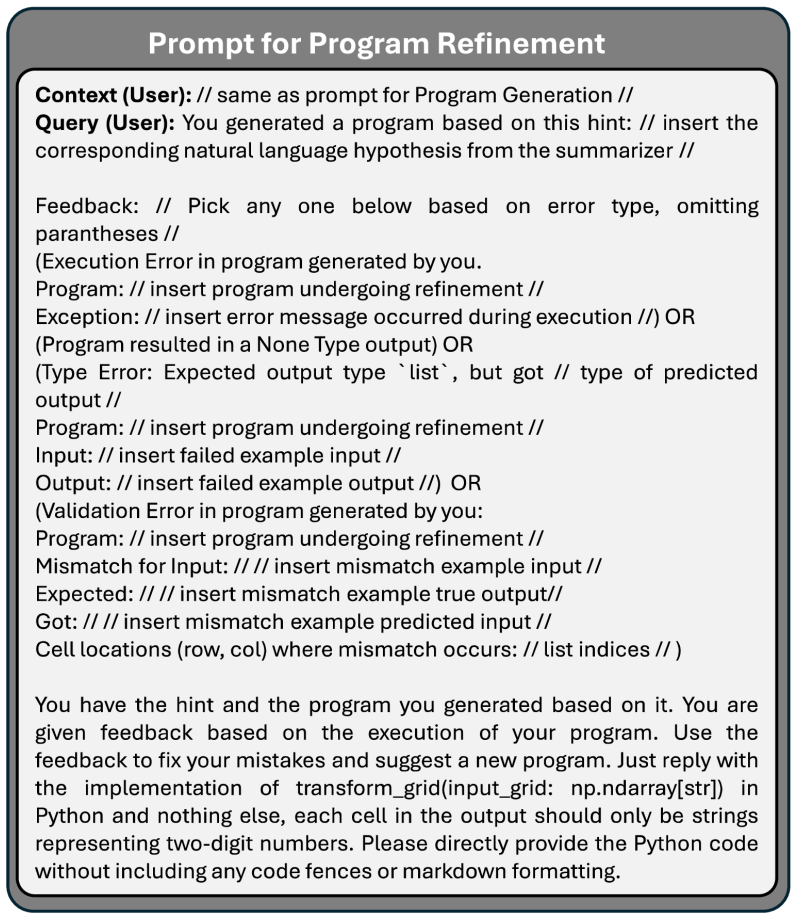
The central mechanism is the three-stage hypothesis search pipeline: a Hypothesis Generator produces 64 natural-language guesses at the rule, a Summarizer condenses them into 8 candidate rules, and a Program Implementor writes and refines Python programs for each candidate, using execution against the given examples as the filter. The natural-language hypothesis is the inductive bias that narrows the program search space; the module-level error analysis shows that this bias is most valuable when the generator is right, and that generation quality is the main lever on end-to-end performance.
What would settle it
Re-run the pipeline but score each final program on several held-out lists per function (or directly against the ground-truth rule) instead of one example. If the hypothesis-search acquisition curve falls below the human curve under this scoring, the human-comparable conclusion is an artifact of the single-example protocol.
Extended reading notes
Core claim
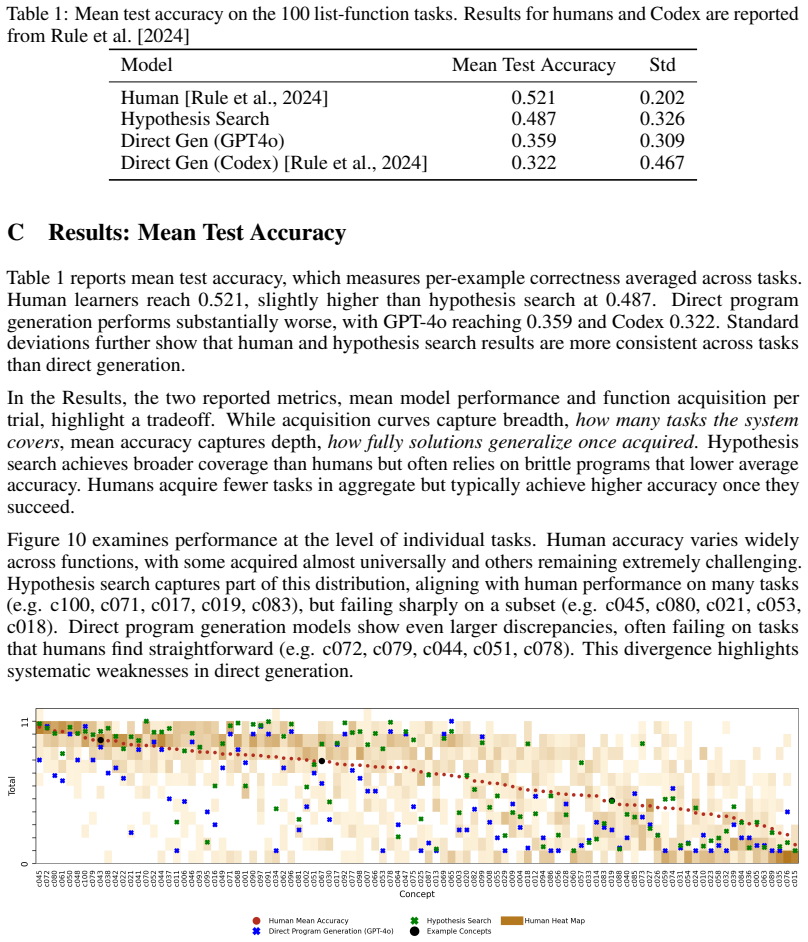
On the paper's own terms, the central discovery is that an LLM pipeline which first names the rule in natural language, compresses those names, and then searches the space of Python programs consistent with them solves 48.7% of held-out list-function tasks, compared with 52.1% for human learners and 35.9% for direct GPT-4o code generation. The paper attributes this advantage to the inductive bias that natural-language hypotheses impose on program search, and its module-level error analysis identifies hypothesis generation as the pivotal stage: correct generator output makes downstream test success roughly 17 times more likely, while the summarizer discards about 26% of correct hypotheses and
Load-bearing premise
The human-comparable claim depends on treating one correct held-out answer as evidence the rule was learned; the paper itself reports that 45.4% of programs passing that test do not implement the ground-truth rule, so acquisition scores can reflect overfitting.
Editorial extensions
If this is right
- If hypothesis search's advantage holds, few-shot rule induction by LLMs is better modeled as constrained search over programs than as end-to-end code synthesis.
- Improving the hypothesis generator is the highest-leverage intervention; the paper estimates generator success makes test success roughly 17 times more likely.
- Fixing the summarizer's 26% discard rate would recover a 12.1% absolute loss in trial-level success without touching program synthesis.
- Because failed trials consume roughly twice the refinement budget of successful ones, efficiency gains will come from upstream hypothesis quality, not from more refinement compute.
Reading between the lines
- The single-example scoring protocol means the 48.7% figure likely overstates genuine rule induction; using the ground-truth rule as the test would probably lower hypothesis search more than it lowers human performance, since 45.4% of passing programs are wrong-rule overfits.
- A direct-generation baseline with the same 257-call refinement budget would clarify whether the advantage comes from hypotheses or from search compute; the paper does not run this control.
- The same three-stage pipeline could be ported to grid-based ARC tasks; the paper's motivation suggests positive transfer, but the added perceptual complexity may weaken the natural-language bias.
Editorial analysis
A structured set of objections, weighed in public.
Referee Report
Summary. The paper adapts the LLM-based hypothesis-search pipeline of Wang et al. (2023) to the 100 list-function induction tasks of Rule et al. (2024), and compares it with direct program generation and with human performance. Across 11 trials and 5 runs, hypothesis search reaches mean test accuracy 0.487, versus 0.359 for direct GPT-4o generation and 0.521 for humans. The authors then decompose the pipeline with an LLM-based Evaluator, reporting module accuracies for the Hypothesis Generator, Summarizer, and Program Implementor, and conclude that the Generator is the main bottleneck. The paper claims human-comparable performance for hypothesis search and argues that natural-language hypotheses provide a useful inductive bias for program synthesis.
Significance. If the claims were fully supported, the paper would be a valuable case study showing that language-mediated hypothesis search improves few-shot program induction over end-to-end code generation, and it would provide a principled error-source analysis. The main comparative result (hypothesis search vs. direct GPT-4o) is grounded in program execution on held-out examples from an external benchmark, and the 100-task, 11-trial, 5-run design is substantial. However, the headline 'human-comparable' claim is not statistically established and is weakened by the paper's own single-example evaluation and LLM-based self-evaluation. The paper is a solid contribution to the evaluation of LLM-based program induction, but the central claim needs to be re-scoped or additionally supported.
major comments (3)
- [Section 2.2 and Supplementary D] The central claim of human-comparable performance rests on an acquisition metric in which a task is acquired when the final program solves the single held-out test example. Supplementary D reports that 45.4% of programs passing that test fail against the ground-truth rule as judged by the LLM evaluator. Thus a large fraction of hypothesis-search 'acquisitions' may be overfits rather than genuine rule inductions. The paper itself acknowledges that 'acquisition curves may overstate success when measured on a single example,' yet the abstract and Section 3 still advance the human-comparable claim. Moreover, human data come from Rule et al.'s same single-example protocol, but there is no evidence that human successes have the same overfitting rate; Supplementary C even notes that hypothesis search 'relies on brittle programs.' The authors should either report a corrected generalization metri
- [Section 4 and Supplementary E] The module-level error analysis uses a GPT-4o Evaluator to judge GPT-4o-generated hypotheses against ground-truth descriptions. This is a self-evaluation setup: the same model family produces the hypotheses and decides their correctness. Consequently, the reported Generator accuracy (46.4%), Summarizer accuracy (34.5%), the '26% of correct hypotheses discarded' statistic, and the bottleneck conclusion are all potentially biased in a direction that cannot be assessed from the paper. The paper acknowledges this limitation in Supplementary E, but the main text presents these numbers as objective module diagnostics. The authors should validate the Evaluator against human judgments on a sample, or at least use a second independent model and measure agreement, before drawing strong conclusions about which module is the bottleneck.
- [Table 1, Figure 3, and Supplementary D] No inferential statistics are provided for the key comparisons. Table 1 reports Hypothesis Search 0.487 (std 0.326) vs. Human 0.521 (std 0.202) vs. Direct GPT-4o 0.359 (std 0.309); with roughly 100 tasks, the 0.034 difference from humans is well within sampling noise, and the 0.128 difference from direct GPT-4o, while large, is not accompanied by a confidence interval or paired test. The acquisition curves in Figure 3a also lack error bars. Supplementary D uses the phrase 'significantly better' without any statistical test. The authors should report per-task paired differences, bootstrap confidence intervals, or a mixed-effects model, and should either support or retract the 'human-comparable' wording.
minor comments (4)
- [Section 3 vs. Supplementary D] The computational cost analysis is inconsistent: Section 3 states up to 8×8×3 = 192 Program Implementor calls and a total of 257 calls per task, while Supplementary D reports 'up to 256 program refinements (8 hypotheses × 8 candidates × 4 versions each).' Clarify whether the initial candidate generation is counted as a refinement and reconcile the totals.
- [Supplementary B] The Codex baseline is taken directly from Rule et al. (2024), where Codex was evaluated under a different program representation (functional language over abstract primitives), while all other models in this paper generate Python programs. This makes the Codex comparison not fully apples-to-apples. State this caveat, or re-run Codex in the same Python protocol.
- [Figure 9 caption] The caption says 'Generator and Simulator modules'; this should be 'Generator and Summarizer modules.'
- [Section 3, first paragraph] The acquisition metric is loosely defined: 'the number of tasks successfully solved at least once in a given trial.' Clarify whether this is averaged over the five runs or counts a task as acquired if solved in any run, and define the relationship between these acquisition counts and the mean test accuracy in Table 1.
Circularity Check
No significant circularity: central comparison is grounded in an external benchmark; only a minor pipeline tautology in the error analysis.
-
self definitional
[Section 4, Error Analysis of the Hypothesis Search Pipeline (module dependency paragraph)]
"First, the pipeline depends on the Generator: there are no trials in which the Summarizer succeeds while the Generator fails, confirming that Generator accuracy is foundational."
This 'finding' is a logical consequence of the pipeline definition: the Summarizer receives only the Generator's output, so a correct summarized hypothesis can exist only if at least one Generator hypothesis was correct. The observation is therefore true by construction and cannot independently 'confirm' the Generator's foundational role. However, it is a minor, non-load-bearing statement in the error analysis; the paper's central comparison between hypothesis search, humans, and direct program generation rests on an external benchmark (Rule et al. 2024) and is not affected by this tautology.
full rationale
The paper's central claim—that hypothesis search performs comparably to humans and beats direct program generation—is evaluated against the 100 list functions and human data from Rule et al. (2024), an external benchmark. The reported accuracies are obtained by executing generated programs on held-out test examples, not by fitting parameters or by deriving the outcome from the method's own assumptions. No fitted input is renamed as a prediction, and no load-bearing self-citation chain is used; the Wang et al. (2023) framework is adopted as an implementation, not as an argument for correctness. The error analysis does use a GPT-4o evaluator to score GPT-4o-generated hypotheses, which is a legitimate methodological limitation (acknowledged in Section E) but not a circular reduction: ground-truth descriptions come from Rule et al., and the evaluator's judgments are not defined in terms of the generator's outputs. The single-example test protocol, and the paper's own finding that 45.4% of passing programs fail the ground-truth rule, is a validity threat to the 'human-comparable' claim, but it is an overfitting/measurement concern, not a circularity of derivation. The only by-construction element identified is the trivial Summarizer-depends-on-Generator relation in Section 4, which is stated as a 'finding' but is entailed by the pipeline architecture; it is minor and does not bear on the main external comparison. Overall, no significant circularity is present.
Assumptions & free parameters
free parameters (4)
- Number of generator queries per trial (64) =
64
- Number of summarized hypotheses per trial (8) =
8
- Program refinement rounds (3) =
3
- Tied-program evaluation modification =
test all tied programs and average
assumptions (6)
- domain assumption The natural-language rule descriptions from Rule et al. are unique, correct targets for evaluating hypotheses.
- ad hoc to paper A GPT-4o Evaluator's binary correct/incorrect judgment is a faithful proxy for hypothesis correctness.
- domain assumption Executing candidate Python programs against the given input-output examples is a valid test of solution correctness.
- domain assumption Success on a single held-out test example is an adequate measure of rule acquisition.
- domain assumption Hypotheses sampled from GPT-4o at temperature 1.0 are independent samples from a useful hypothesis prior.
- domain assumption Human and Codex results from Rule et al. are directly comparable to the authors' GPT-4o runs.
Cite this review
Pith. "Pith review of Analysis of Error Sources in LLM-based Hypothesis Search for Few-Shot Rule Induction." pith.science (2026). https://pith.science/paper/ZYLLZWVS
@misc{pith2026250901016,
  author       = {Pith},
  title        = {Pith review of: Analysis of Error Sources in LLM-based Hypothesis Search for Few-Shot Rule Induction},
  year         = {2026},
  howpublished = {\url{https://pith.science/paper/ZYLLZWVS}},
  note         = {Machine review of arXiv:2509.01016}
}
read the original abstract
Inductive reasoning enables humans to infer abstract rules from limited examples and apply them to novel situations. In this work, we compare an LLM-based hypothesis search framework with direct program generation approaches on few-shot rule induction tasks. Our findings show that hypothesis search achieves performance comparable to humans, while direct program generation falls notably behind. An error analysis reveals key bottlenecks in hypothesis generation and suggests directions for advancing program induction methods. Overall, this paper underscores the potential of LLM-based hypothesis search for modeling inductive reasoning and the challenges in building more efficient systems.
Figures


Figures from the paper (7 more)




Reference graph
Works this paper leans on
-
[1]
Program synthesis with large language models
Jacob Austin, Augustus Odena, Maxwell Nye, Maarten Bosma, Henryk Michalewski, David Dohan, Ellen Jiang, Carrie Cai, Michael Terry, Quoc Le, et al. Program synthesis with large language models. arXiv preprint arXiv:2108.07732,
-
[5]
On the measure of intelligence
François Chollet. On the measure of intelligence. arXiv preprint arXiv:1911.01547,
arXiv 1911
-
[8]
Fast and flexible: Human program induction in abstract reasoning tasks
Aysja Johnson, Wai Keen V ong, Brenden M Lake, and Todd M Gureckis. Fast and flexible: Human program induction in abstract reasoning tasks. arXiv preprint arXiv:2103.05823,
-
[9]
Neural-Guided Deductive Search for Real-Time Program Synthesis from Examples
Ashwin Kalyan, Abhishek Mohta, Oleksandr Polozov, Dhruv Batra, Prateek Jain, and Sumit Gulwani. Neural-guided deductive search for real-time program synthesis from examples. arXiv preprint arXiv:1804.01186,
-
[12]
Neuro-symbolic program synthesis
Emilio Parisotto, Abdel-rahman Mohamed, Rishabh Singh, Lihong Li, Dengyong Zhou, and Pushmeet Kohli. Neuro-symbolic program synthesis. arXiv preprint arXiv:1611.01855,
-
[14]
Synchromesh: Reliable code generation from pre-trained language models
Gabriel Poesia, Oleksandr Polozov, Vu Le, Ashish Tiwari, Gustavo Soares, Christopher Meek, and Sumit Gulwani. Synchromesh: Reliable code generation from pre-trained language models. arXiv preprint arXiv:2201.11227,
-
[15]
Multi-agent collaboration: Harnessing the power of intelligent llm agents
Yashar Talebirad and Amirhossein Nadiri. Multi-agent collaboration: Harnessing the power of intelligent llm agents. arXiv preprint arXiv:2306.03314,
-
[17]
Yudong Xu, Wenhao Li, Pashootan Vaezipoor, Scott Sanner, and Elias B Khalil. Llms and the abstrac- tion and reasoning corpus: Successes, failures, and the importance of object-based representations. arXiv preprint arXiv:2305.18354,
Show all 20 references
-
[18]
In Hypothesis Search, we follow the configuration of Wang et al. [2023], using GPT-4o for all three modules: the Hypothesis Generator (temperature 1.0, top-p 1.0), the Hypothesis Summarizer (temperature 1.0, top-p 0.0), and the Program Implementor (temperature 0.7, top-p 0.0)....
2023
-
[20]
Human learners reach 0.521, slightly higher than hypothesis search at 0.487
Model Mean Test Accuracy Std Human [Rule et al., 2024] 0.521 0.202 Hypothesis Search 0.487 0.326 Direct Gen (GPT4o) 0.359 0.309 Direct Gen (Codex) [Rule et al., 2024] 0.322 0.467 C Results: Mean Test Accuracy Table 1 reports mean test accuracy, which measures per-example corre...
2024
-
[1000]
[2024], where Codex was evaluated under Direct Program Generation
For comparison, we also report human performance and Codex results from Rule et al. [2024], where Codex was evaluated under Direct Program Generation. While Rule et al
2024
-
[1868]
Doing experiments and revising rules with natural language and probabilistic reasoning
Wasu Top Piriyakulkij, Cassidy Langenfeld, Tuan Anh Le, and Kevin Ellis. Doing experiments and revising rules with natural language and probabilistic reasoning. arXiv preprint arXiv:2402.06025,
-
[2011]
Symbolic regression with a learned concept library
Arya Grayeli, Atharva Sehgal, Omar Costilla-Reyes, Miles Cranmer, and Swarat Chaudhuri. Symbolic regression with a learned concept library. arXiv preprint arXiv:2409.09359,
-
[2015]
Large language models are not abstract reasoners
Gaël Gendron, Qiming Bao, Michael Witbrock, and Gillian Dobbie. Large language models are not abstract reasoners. arXiv preprint arXiv:2305.19555, 2,
-
[2018]
Hypothesis search: Inductive reasoning with language models
Ruocheng Wang, Eric Zelikman, Gabriel Poesia, Yewen Pu, Nick Haber, and Noah D Goodman. Hypothesis search: Inductive reasoning with language models. arXiv preprint arXiv:2309.05660,
-
[2019]
Large language models as general pattern machines
Suvir Mirchandani, Fei Xia, Pete Florence, Brian Ichter, Danny Driess, Montserrat Gonzalez Arenas, Kanishka Rao, Dorsa Sadigh, and Andy Zeng. Large language models as general pattern machines. arXiv preprint arXiv:2307.04721,
-
[2020]
Sparks of artificial general intelligence: Early experiments with gpt-4
Sébastien Bubeck, Varun Chandrasekaran, Ronen Eldan, Johannes Gehrke, Eric Horvitz, Ece Kamar, Peter Lee, Yin Tat Lee, Yuanzhi Li, Scott Lundberg, et al. Sparks of artificial general intelligence: Early experiments with gpt-4. arXiv preprint arXiv:2303.12712,
-
[2021]
Language models are few-shot learners
Tom B Brown. Language models are few-shot learners. arXiv preprint arXiv:2005.14165,
2005 arXiv
-
[2023]
Evaluating large language models trained on code
Mark Chen, Jerry Tworek, Heewoo Jun, Qiming Yuan, Henrique Ponde De Oliveira Pinto, Jared Kaplan, Harri Edwards, Yuri Burda, Nicholas Joseph, Greg Brockman, et al. Evaluating large language models trained on code. arXiv preprint arXiv:2107.03374,
-
[2024]
The neuro- symbolic concept learner: Interpreting scenes, words, and sentences from natural supervision
5 Jiayuan Mao, Chuang Gan, Pushmeet Kohli, Joshua B Tenenbaum, and Jiajun Wu. The neuro- symbolic concept learner: Interpreting scenes, words, and sentences from natural supervision. arXiv preprint arXiv:1904.12584,
1904 arXiv
Reviewed August 5, 2026 · model on record in the stance chip above.
Discussion (0). Sign in to comment.