Learning residue level protein dynamics with multiscale Gaussians
Pith reviewed 2026-05-18 20:32 UTC · model grok-4.3
The pith
DynaProt predicts protein residue flexibility and dynamic couplings from static structures using multiscale Gaussians.
A machine-rendered reading of the paper's core claim, the machinery that carries it, and where it could break.
Core claim
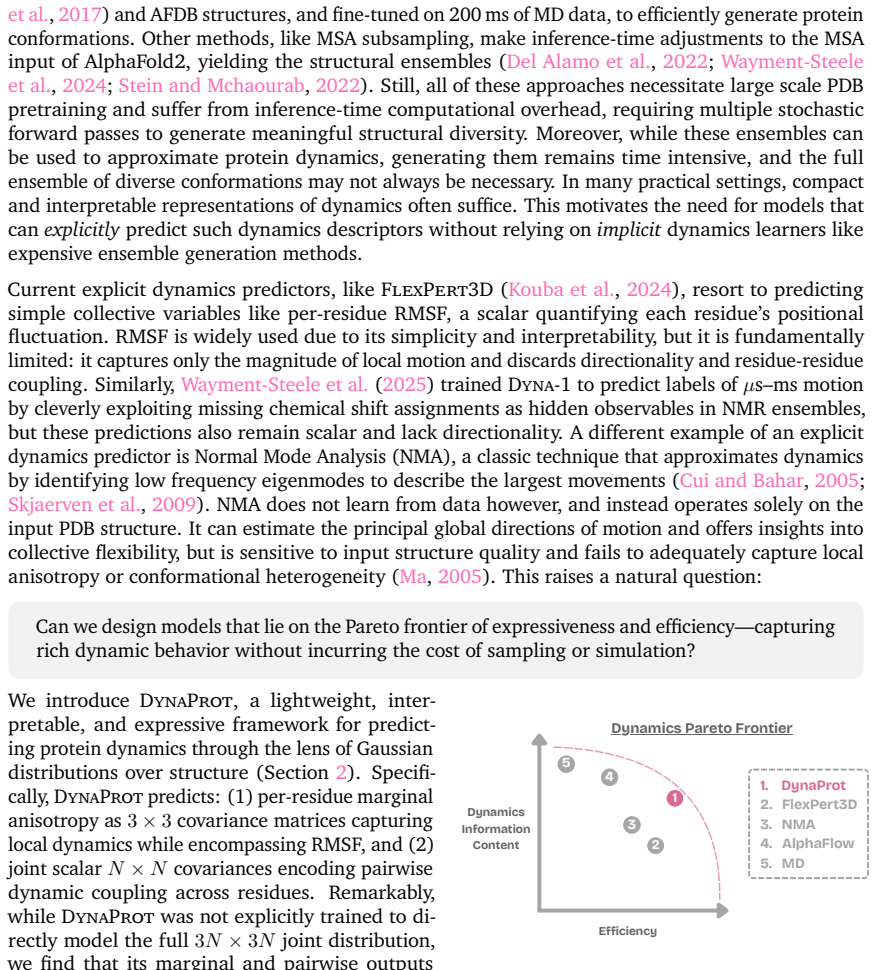
By framing protein dynamics through multivariate Gaussians, DynaProt estimates per-residue 3x3 covariance matrices for local flexibility and joint scalar covariances for pairwise dynamic coupling, allowing high-accuracy RMSF prediction and reasonable full covariance reconstruction from static structures alone.
What carries the argument
Multiscale Gaussians that separate marginal anisotropy for individual residues from scalar covariances encoding inter-residue dynamic couplings.
If this is right
- High accuracy in residue-level flexibility prediction without running simulations.
- Reasonable reconstruction of the full covariance matrix enables fast ensemble generation.
- Uses orders of magnitude fewer parameters than previous methods.
- Applicable directly to static structures for scalable analysis.
Where Pith is reading between the lines
- Could be combined with structure prediction models to generate dynamic ensembles for many proteins quickly.
- May allow studying dynamics in contexts where simulations are infeasible due to size or time.
- Potential to identify flexible regions important for function or binding more efficiently.
Load-bearing premise
That a Gaussian model trained on molecular dynamics data generalizes to predict biologically relevant dynamics for diverse new proteins.
What would settle it
Running molecular dynamics simulations on a test set of proteins and comparing the predicted RMSF values and reconstructed covariances to the simulation results.
Figures


read the original abstract
Many methods have been developed to predict static protein structures, however understanding the dynamics of protein structure is essential for elucidating biological function. While molecular dynamics (MD) simulations remain the in silico gold standard, its high computational cost limits scalability. We present DynaProt, a lightweight, SE(3)-invariant framework that predicts rich descriptors of protein dynamics directly from static structures. By casting the problem through the lens of multivariate Gaussians, DynaProt estimates dynamics at two complementary scales: (1) per-residue marginal anisotropy as $3 \times 3$ covariance matrices capturing local flexibility, and (2) joint scalar covariances encoding pairwise dynamic coupling across residues. From these dynamics outputs, DynaProt achieves high accuracy in predicting residue-level flexibility (RMSF) and, remarkably, enables reasonable reconstruction of the full covariance matrix for fast ensemble generation. Notably, it does so using orders of magnitude fewer parameters than prior methods. Our results highlight the potential of direct protein dynamics prediction as a scalable alternative to existing methods.
Editorial analysis
A structured set of objections, weighed in public.
Referee Report
Summary. The manuscript introduces DynaProt, a lightweight SE(3)-invariant model that predicts protein dynamics directly from static structures by estimating per-residue 3×3 covariance matrices for local flexibility (anisotropy) and scalar pairwise covariances for inter-residue dynamic coupling. These outputs are assembled into a full covariance matrix to enable fast ensemble generation. The central claims are high accuracy on residue-level RMSF prediction and reasonable reconstruction of the full covariance, achieved with orders of magnitude fewer parameters than prior methods.
Significance. If the quantitative claims are substantiated, the work offers a scalable, low-parameter alternative to MD for generating protein ensembles and could accelerate dynamics-aware applications in structural biology. The multiscale Gaussian formulation and explicit SE(3) invariance are strengths that distinguish it from purely scalar flexibility predictors. The low parameter count is explicitly credited as a practical advantage.
major comments (3)
- [Abstract and §4] Abstract and §4 (Results): the claim of 'reasonable reconstruction of the full covariance matrix' for ensemble generation lacks reported quantitative metrics (Frobenius norm, eigenvalue spectrum match, or ensemble RMSD to held-out MD trajectories). Without these, it is impossible to evaluate whether the assembled 3N×3N matrix supports the headline claim beyond RMSF accuracy.
- [Methods (§3.2)] Methods (§3.2, covariance assembly): the per-residue 3×3 matrices and independently learned scalar pairwise terms are combined into a block matrix; no description is given of how positive-semidefiniteness is enforced (e.g., via Schur-complement constraints, projection, or regularization during training). This is load-bearing for the ensemble-generation claim and must be clarified with explicit checks or failure cases.
- [§4 and §5] §4 and §5: validation details (train/test splits, protein diversity, error bars, ablation of the scalar pairwise term) are not reported for the covariance reconstruction task. This weakens the generalization statement that the model captures 'biologically relevant dynamics across diverse proteins'.
minor comments (2)
- [Methods] Notation: the transition from per-residue 3×3 matrices to the full covariance should be given an explicit equation number for clarity.
- [Figures] Figure captions: add quantitative summary statistics (e.g., mean RMSF correlation) directly in the caption for quick reference.
Simulated Author's Rebuttal
We thank the referee for their thoughtful and constructive comments on our manuscript. We address each of the major comments point by point below. We have revised the manuscript to incorporate additional details and metrics as suggested.
read point-by-point responses
-
Referee: [Abstract and §4] Abstract and §4 (Results): the claim of 'reasonable reconstruction of the full covariance matrix' for ensemble generation lacks reported quantitative metrics (Frobenius norm, eigenvalue spectrum match, or ensemble RMSD to held-out MD trajectories). Without these, it is impossible to evaluate whether the assembled 3N×3N matrix supports the headline claim beyond RMSF accuracy.
Authors: We agree that quantitative metrics beyond RMSF would provide stronger support for the covariance reconstruction claim. In the revised version, we will report the Frobenius norm of the difference between predicted and MD-derived covariance matrices, compare eigenvalue spectra, and compute ensemble RMSDs for generated structures against held-out MD trajectories. These will be added to §4. revision: yes
-
Referee: [Methods (§3.2)] Methods (§3.2, covariance assembly): the per-residue 3×3 matrices and independently learned scalar pairwise terms are combined into a block matrix; no description is given of how positive-semidefiniteness is enforced (e.g., via Schur-complement constraints, projection, or regularization during training). This is load-bearing for the ensemble-generation claim and must be clarified with explicit checks or failure cases.
Authors: This is a valid point. The assembly process uses the fact that the per-residue 3x3 covariances are PSD by construction (as they are predicted as covariance matrices), and the scalar pairwise terms are incorporated in a way that maintains overall PSD through the multivariate Gaussian formulation and training regularization. However, we will expand §3.2 to explicitly describe the assembly procedure, how PSD is preserved, and include checks such as minimum eigenvalue distributions to confirm no violations occur in practice. revision: yes
-
Referee: [§4 and §5] §4 and §5: validation details (train/test splits, protein diversity, error bars, ablation of the scalar pairwise term) are not reported for the covariance reconstruction task. This weakens the generalization statement that the model captures 'biologically relevant dynamics across diverse proteins'.
Authors: We appreciate this feedback. While the main results in §4 focus on RMSF, the covariance task uses the same train/test splits and protein set as described in the methods. To address this, we will add in the revised §4 and §5: explicit mention of the splits for covariance evaluation, statistics on protein diversity (e.g., fold classes), error bars from cross-validation, and results from an ablation study where the scalar pairwise covariance term is removed to quantify its impact on full matrix reconstruction. revision: yes
Circularity Check
No significant circularity: predictions learned from external MD data
full rationale
The paper frames DynaProt as a supervised learning model trained on molecular dynamics trajectories to output per-residue 3x3 covariance matrices and scalar inter-residue covariances from static structures. These outputs are not defined in terms of each other or the target RMSF values inside the same equations; the full covariance reconstruction is described as a post-hoc assembly enabled by the learned descriptors rather than a quantity forced by construction or by fitting a subset and renaming it. No self-citation load-bearing steps, uniqueness theorems imported from the authors' prior work, or ansatzes smuggled via citation appear in the derivation. The model is presented as generalizing from external data, so the claimed predictions retain independent content and the chain is self-contained.
Axiom & Free-Parameter Ledger
axioms (1)
- domain assumption Protein dynamics can be adequately represented by multivariate Gaussian distributions at per-residue and pairwise scales.
Lean theorems connected to this paper
-
IndisputableMonolith/Cost/FunctionalEquation.leanwashburn_uniqueness_aczel unclear?
unclearRelation between the paper passage and the cited Recognition theorem.
we leverage the fact that any SPD matrix can be uniquely defined by its Cholesky factorization... LLogFrob = ∥ log(Σpred) − log(Σtrue)∥2F
-
IndisputableMonolith/Foundation/AbsoluteFloorClosure.leanabsolute_floor_iff_bare_distinguishability unclear?
unclearRelation between the paper passage and the cited Recognition theorem.
Σjoint = Lmarginal (eC ⊗ I3) L⊤marginal (Proposition 3.1 SPD Closure)
What do these tags mean?
- matches
- The paper's claim is directly supported by a theorem in the formal canon.
- supports
- The theorem supports part of the paper's argument, but the paper may add assumptions or extra steps.
- extends
- The paper goes beyond the formal theorem; the theorem is a base layer rather than the whole result.
- uses
- The paper appears to rely on the theorem as machinery.
- contradicts
- The paper's claim conflicts with a theorem or certificate in the canon.
- unclear
- Pith found a possible connection, but the passage is too broad, indirect, or ambiguous to say the theorem truly supports the claim.
Forward citations
Cited by 1 Pith paper
-
Motion-Enabled Tomography via Gaussian Mixture Models
A parametric GMM model for motion-enabled tomography that decouples reconstruction into sub-problems and tests on 2D simulations of intersecting trajectories.
Reference graph
Works this paper leans on
-
[1]
Accurate structure prediction of biomolecular interactions with alphafold 3
Josh Abramson, Jonas Adler, Jack Dunger, Richard Evans, Tim Green, Alexander Pritzel, Olaf Ronneberger, Lindsay Willmore, Andrew J Ballard, Joshua Bambrick, et al. Accurate structure prediction of biomolecular interactions with alphafold 3. Nature, 630 0 (8016): 0 493--500, 2024
work page 2024
-
[2]
On the Bures--Wasserstein distance between positive definite matrices
Rajendra Bhatia, Tanvi Jain, and Yongdo Lim. On the Bures--Wasserstein distance between positive definite matrices . Expositiones Mathematicae , 37 0 (2): 0 165--191, 2019
work page 2019
-
[3]
Protein data bank (pdb): the single global macromolecular structure archive
Stephen K Burley, Helen M Berman, Gerard J Kleywegt, John L Markley, Haruki Nakamura, and Sameer Velankar. Protein data bank (pdb): the single global macromolecular structure archive. Protein crystallography: methods and protocols, pages 627--641, 2017
work page 2017
-
[4]
Insights from molecular dynamics simulations for computational protein design
Matthew Carter Childers and Valerie Daggett. Insights from molecular dynamics simulations for computational protein design. Molecular systems design & engineering, 2 0 (1): 0 9--33, 2017
work page 2017
-
[5]
Exploring cryptic pockets formation in targets of pharmaceutical interest with swish
Federico Comitani and Francesco Luigi Gervasio. Exploring cryptic pockets formation in targets of pharmaceutical interest with swish. Journal of chemical theory and computation, 14 0 (6): 0 3321--3331, 2018
work page 2018
-
[6]
Normal mode analysis: theory and applications to biological and chemical systems
Qiang Cui and Ivet Bahar. Normal mode analysis: theory and applications to biological and chemical systems. CRC press, 2005
work page 2005
-
[7]
Sampling alternative conformational states of transporters and receptors with alphafold2
Diego Del Alamo, Davide Sala, Hassane S Mchaourab, and Jens Meiler. Sampling alternative conformational states of transporters and receptors with alphafold2. Elife, 11: 0 e75751, 2022
work page 2022
-
[8]
Deep sparse rectifier neural networks
Xavier Glorot, Antoine Bordes, and Yoshua Bengio. Deep sparse rectifier neural networks . In Proceedings of the fourteenth international conference on artificial intelligence and statistics , pages 315--323. JMLR Workshop and Conference Proceedings, 2011
work page 2011
-
[9]
Deep learning--guided design of dynamic proteins
Amy B Guo, Deniz Akpinaroglu, Christina A Stephens, Michael Grabe, Colin A Smith, Mark JS Kelly, and Tanja Kortemme. Deep learning--guided design of dynamic proteins. Science, 388 0 (6749): 0 eadr7094, 2025
work page 2025
-
[10]
Molecular dynamics simulation for all
Scott A Hollingsworth and Ron O Dror. Molecular dynamics simulation for all. Neuron, 99 0 (6): 0 1129--1143, 2018
work page 2018
-
[11]
Cryptic pocket formation underlies allosteric modulator selectivity at muscarinic gpcrs
Scott A Hollingsworth, Brendan Kelly, Celine Valant, Jordan Arthur Michaelis, Olivia Mastromihalis, Geoff Thompson, AJ Venkatakrishnan, Samuel Hertig, Peter J Scammells, Patrick M Sexton, et al. Cryptic pocket formation underlies allosteric modulator selectivity at muscarinic gpcrs. Nature Communications, 10 0 (1): 0 3289, 2019
work page 2019
-
[12]
Seqdance: A protein language model for representing protein dynamic properties
Chao Hou and Yufeng Shen. Seqdance: A protein language model for representing protein dynamic properties. bioRxiv, 2024
work page 2024
-
[13]
Zhiwu Huang, Ruiping Wang, Shiguang Shan, Xianqiu Li, and Xilin Chen. Log-euclidean metric learning on symmetric positive definite manifold with application to image set classification . In International conference on machine learning , pages 720--729. PMLR, 2015
work page 2015
-
[14]
Harold Jeffreys. The theory of probability. OuP Oxford, 1998
work page 1998
-
[15]
Alphafold meets flow matching for generating protein ensembles, 2024
Bowen Jing, Bonnie Berger, and Tommi Jaakkola. AlphaFold meets flow matching for generating protein ensembles . arXiv preprint arXiv:2402.04845, 2024
-
[16]
Highly accurate protein structure prediction with AlphaFold
John Jumper, Richard Evans, Alexander Pritzel, Tim Green, Michael Figurnov, Olaf Ronneberger, Kathryn Tunyasuvunakool, Russ Bates, Augustin Z \' dek, Anna Potapenko, et al. Highly accurate protein structure prediction with AlphaFold . Nature , 596 0 (7873): 0 583--589, 2021
work page 2021
-
[17]
Learning to engineer protein flexibility
Petr Kouba, Joan Planas-Iglesias, Jiri Damborsky, Jiri Sedlar, Stanislav Mazurenko, and Josef Sivic. Learning to engineer protein flexibility. arXiv preprint arXiv:2412.18275, 2024
-
[18]
On information and sufficiency
Solomon Kullback and Richard A Leibler. On information and sufficiency. The annals of mathematical statistics, 22 0 (1): 0 79--86, 1951
work page 1951
-
[19]
Scalable emulation of protein equilibrium ensembles with generative deep learning
Sarah Lewis, Tim Hempel, Jos \'e Jim \'e nez-Luna, Michael Gastegger, Yu Xie, Andrew YK Foong, Victor Garc \' a Satorras, Osama Abdin, Bastiaan S Veeling, Iryna Zaporozhets, et al. Scalable emulation of protein equilibrium ensembles with generative deep learning. bioRxiv, pages 2024--12, 2024
work page 2024
-
[20]
Seamoon: Prediction of molecular motions based on language models
Valentin Lombard, Dan Timsit, Sergei Grudinin, and Elodie Laine. Seamoon: Prediction of molecular motions based on language models. bioRxiv, pages 2024--09, 2024
work page 2024
-
[21]
Structure language models for protein conformation generation
Jiarui Lu, Xiaoyin Chen, Stephen Zhewen Lu, Chence Shi, Hongyu Guo, Yoshua Bengio, and Jian Tang. Structure language models for protein conformation generation. arXiv preprint arXiv:2410.18403, 2024
-
[22]
Usefulness and limitations of normal mode analysis in modeling dynamics of biomolecular complexes
Jianpeng Ma. Usefulness and limitations of normal mode analysis in modeling dynamics of biomolecular complexes. Structure, 13 0 (3): 0 373--380, 2005
work page 2005
-
[23]
JA McCammon. Protein dynamics. Reports on Progress in Physics, 47 0 (1): 0 1, 1984
work page 1984
-
[24]
Lotthammer, Felipe Oviedo, Juan Lavista Ferres, and Gregory R
Artur Meller, Michael Ward, Jonathan Borowsky, Meghana Kshirsagar, Jeffrey M. Lotthammer, Felipe Oviedo, Juan Lavista Ferres, and Gregory R. Bowman. Predicting locations of cryptic pockets from single protein structures using the PocketMiner graph neural network. 14 0 (1): 0 1177. ISSN 2041-1723. doi:10.1038/s41467-023-36699-3. URL https://doi.org/10.1038...
-
[25]
Minyue Mou, Weicheng Yang, Guangyi Huang, Xiaoyan Yang, Xiao Zhang, Wasala Mudiyanselage Wishwajith Wickramabahu Kandegama, Charles R Ashby Jr, Gefei Hao, and Yangyang Gao. The discovery of cryptic pockets increases the druggability of “undruggable” proteins. Medicinal Research Reviews, 2025
work page 2025
-
[26]
Fast procedure for reconstruction of full-atom protein models from reduced representations
Piotr Rotkiewicz and Jeffrey Skolnick. Fast procedure for reconstruction of full-atom protein models from reduced representations. Journal of computational chemistry, 29 0 (9): 0 1460--1465, 2008
work page 2008
-
[27]
Atomic-level characterization of the structural dynamics of proteins
David E Shaw, Paul Maragakis, Kresten Lindorff-Larsen, Stefano Piana, Ron O Dror, Michael P Eastwood, Joseph A Bank, John M Jumper, John K Salmon, Yibing Shan, et al. Atomic-level characterization of the structural dynamics of proteins. Science, 330 0 (6002): 0 341--346, 2010
work page 2010
-
[28]
Normal mode analysis for proteins
Lars Skjaerven, Siv M Hollup, and Nathalie Reuter. Normal mode analysis for proteins. Journal of Molecular Structure: THEOCHEM, 898 0 (1-3): 0 42--48, 2009
work page 2009
-
[29]
Speach\_af: Sampling protein ensembles and conformational heterogeneity with alphafold2
Richard A Stein and Hassane S Mchaourab. Speach\_af: Sampling protein ensembles and conformational heterogeneity with alphafold2. PLOS Computational Biology, 18 0 (8): 0 e1010483, 2022
work page 2022
-
[30]
ATLAS: protein flexibility description from atomistic molecular dynamics simulations
Yann Vander Meersche, Gabriel Cretin, Aria Gheeraert, Jean-Christophe Gelly, and Tatiana Galochkina. ATLAS: protein flexibility description from atomistic molecular dynamics simulations . Nucleic Acids Research, 52 0 (D1): 0 D384--D392, 2024
work page 2024
-
[31]
Riemannian Metric Learning for Symmetric Positive Definite Matrices
Raviteja Vemulapalli and David W Jacobs. Riemannian metric learning for symmetric positive definite matrices . arXiv preprint arXiv:1501.02393, 2015
work page internal anchor Pith review Pith/arXiv arXiv 2015
-
[32]
Protein conformation generation via force-guided se (3) diffusion models
Yan Wang, Lihao Wang, Yuning Shen, Yiqun Wang, Huizhuo Yuan, Yue Wu, and Quanquan Gu. Protein conformation generation via force-guided se (3) diffusion models. arXiv preprint arXiv:2403.14088, 2024
-
[33]
Predicting multiple conformations via sequence clustering and alphafold2
Hannah K Wayment-Steele, Adedolapo Ojoawo, Renee Otten, Julia M Apitz, Warintra Pitsawong, Marc H \"o mberger, Sergey Ovchinnikov, Lucy Colwell, and Dorothee Kern. Predicting multiple conformations via sequence clustering and alphafold2. Nature, 625 0 (7996): 0 832--839, 2024
work page 2024
-
[34]
Learning millisecond protein dynamics from what is missing in nmr spectra
Hannah K Wayment-Steele, Gina El Nesr, Ramith Hettiarachchi, Hasindu Kariyawasam, Sergey Ovchinnikov, and Dorothee Kern. Learning millisecond protein dynamics from what is missing in nmr spectra. bioRxiv, pages 2025--03, 2025
work page 2025
-
[35]
Propagating conformational changes over long (and short) distances in proteins
Edward W Yu and Daniel E Koshland Jr. Propagating conformational changes over long (and short) distances in proteins. Proceedings of the National Academy of Sciences, 98 0 (17): 0 9517--9520, 2001
work page 2001
-
[36]
G protein-coupled receptors (gpcrs): advances in structures, mechanisms and drug discovery
Mingyang Zhang, Ting Chen, Xun Lu, Xiaobing Lan, Ziqiang Chen, and Shaoyong Lu. G protein-coupled receptors (gpcrs): advances in structures, mechanisms and drug discovery. Signal Transduction and Targeted Therapy, 9 0 (1): 0 88, 2024
work page 2024
-
[37]
Prody 2.0: increased scale and scope after 10 years of protein dynamics modelling with python
She Zhang, James M Krieger, Yan Zhang, Cihan Kaya, Burak Kaynak, Karolina Mikulska-Ruminska, Pemra Doruker, Hongchun Li, and Ivet Bahar. Prody 2.0: increased scale and scope after 10 years of protein dynamics modelling with python. Bioinformatics, 37 0 (20): 0 3657--3659, 2021
work page 2021
-
[38]
Activation and friction in enzymatic loop opening and closing dynamics
Kirill Zinovjev, Paul Gu \'e non, Carlos A Ramos-Guzm \'a n, J Javier Ruiz-Pern \' a, Damien Laage, and I \ n aki Tu \ n \'o n. Activation and friction in enzymatic loop opening and closing dynamics. Nature Communications, 15 0 (1): 0 2490, 2024
work page 2024
discussion (0)
Sign in with ORCID, Apple, or X to comment. Anyone can read and Pith papers without signing in.