REVIEW 4 major objections 6 minor 37 references
As exemplars accumulate, chain-of-thought reasoning shifts from pretrained priors to in-context signals, so enough wrong examples can flip even an 8B model's answers.
Reviewed by Pith at T0; open to challenge. T0 means a machine referee read the full paper against a public rubric. the ladder, T0–T4 →
The paper finds that as exemplar count increases, LLMs shift from pretrained priors to in-context signals, and long chain-of-thought prompts induce longer reasoning chains that often improve accuracy.
T0 review reviewed 2026-08-05 challenge →
load-bearing objection A useful empirical paper whose central RQ2 label-flipping claim is under-evidenced; deserves a referee but needs per-label output analysis. the 4 major comments →
Rethinking the Chain-of-Thought: The Roles of In-Context Learning and Pre-trained Priors
The pith
A machine-rendered reading of the paper's core claim, the machinery that carries it, and where it could break.
The reading
Core claim
The paper's central discovery is a mechanism with a dial: the number of exemplars controls whether CoT reasoning follows pretrained priors or in-context signals. In controlled experiments, task-agnostic CoT prompts leave semantic reasoning intact while changing lexical form, and accuracy tracks the number of reasoning verbs with an optimum, indicating the model copies structure while relying on prior knowledge for content. Then, replacing answers with wrong answers in increasing numbers of exemplars shows little effect at 4–5 shots but progressive accuracy collapse at 40 shots; in the closed-domain binary Coin Flip task, an 8B model systematically flips labels. False rationales likewise degr
What carries the argument
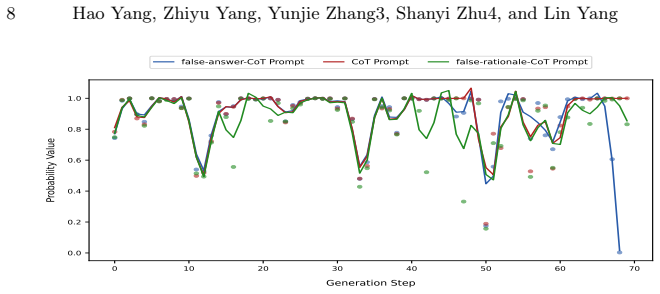
The exemplar-count dial plus a lexical decomposition of rationales. Starting with a small number of CoT exemplars and incrementally adding corrupted ones turns the strength of in-context learning into a controllable scalar. A complementary lexical analysis splits model-generated rationales into structure words, feature words, verbs, and location/person entities to separate imitation of form from reliance on semantic priors; confidence is tracked through per-token generation probabilities.
Load-bearing premise
The load-bearing premise is that the accuracy collapse under many false-answer exemplars means the model actually learns to output the flipped labels, rather than merely copying final answers or getting confused; the paper's own limitation section adds that greedy decoding often produced endless repetitions, a separate risk for the slow-thinking result.
What would settle it
Record the actual final-answer tokens the model emits under 40 false-answer CoT exemplars on Coin Flip. If the model's output distribution still concentrates on correct labels, or collapses onto copied exemplar answers regardless of the input, then the claimed systematic input-label mapping and label flipping are not real, and the ICL-overrides-priors conclusion would need revision.
If this is right
- Few noisy exemplars are harmless, but at scale they can outweigh what the model knows, so prompt hygiene matters increasingly with prompt length.
- Contrary to earlier claims that only very large models can learn flipped labels in context, CoT prompting lets an 8B model flip answers on a closed-domain binary task.
- Misleading rationales make a model less confident as well as less accurate, so unreliable prompts are detectable in generation probabilities.
- Long-CoT prompts distilled from stronger reasoners can transfer slow-thinking behavior to smaller models and improve accuracy, up to an optimal length.
- Reasoning length is not 'more is better': beyond an optimum, longer chains hurt, and the optimum grows with model size and task difficulty.
Where Pith is reading between the lines
- The abrupt shift from priors-dominated to ICL-dominated behavior as exemplars accumulate suggests a phase-transition-like dynamic; a natural test is to fit accuracy as a function of exemplar count and look for a critical count that changes with model size.
- If the mechanism is general, closed-domain tasks with small label spaces (multiple choice, yes/no, classification) are the most vulnerable to prompt poisoning, while open-ended generation is more robust.
- The slow-thinking transfer result could support self-improvement loops: a model's own long outputs, once filtered for quality, could be reused as prompts or training data, provided the decoding repetition problem is solved.
- The optimal-length finding implies adaptive control of reasoning length per question—stop early on easy items, extend on hard ones—could capture most gains at lower inference cost.
Editorial analysis
A structured set of objections, weighed in public.
Referee Report
Summary. The paper studies Chain-of-Thought (CoT) prompting through the dual lens of in-context learning (ICL) and pretrained priors. It reports three experiments: (i) a lexical-level analysis of model-generated rationales comparing zero-shot CoT, manual CoT, and task-agnostic CoT; (ii) a noisy-exemplar scaling study that increments false-answer and false-rationale exemplars, claiming that sufficient exemplars shift the model from pretrained priors to ICL and that 8B models can flip labels in closed-domain tasks; and (iii) a prompt-engineering study that uses long CoT prompts distilled from R1/QwQ models to induce slow thinking. The paper claims three findings: models learn lexical and deeper reasoning structures while relying on pretrained priors; exemplar scaling shifts decision-making toward ICL while misleading prompts introduce instability; and long CoT prompting improves downstream performance.
Significance. If the label-flipping and prior-shift claims held, the paper would contribute to the debate on the nature of ICL and would challenge prior results (Wei et al., 2023) about model-size thresholds for learning flipped labels. The RQ3 results also have practical value for prompt design. The paper has notable strengths: it spans multiple model families and sizes (Gemma2-9B/27B, LLaMA3.1-8B, Qwen2.5-32B), the false-exemplar perturbation design is simple and clearly described, and the authors include a limitation section acknowledging dataset, noise-level, and decoding issues. However, the central mechanistic interpretation is not tightly supported by the reported measures, and several quantitative details are missing.
major comments (4)
- [Section 3.2 (Fig. 4)] The central inference of RQ2 is that 'the model tends to learn an input-label mapping that leads to systematic label flipping' and that this refutes Wei et al.'s claim that smaller models cannot learn flipped labels. The evidence is an aggregate accuracy decline in Coin Flip. A decline from high to near-chance accuracy is equally compatible with copying the (possibly balanced) false answers, with a global response bias, or with general confusion from contradictory evidence; only a decline to ~0% (or per-label flip rates close to 100%) would establish systematic flipping. The paper reports no exact Coin Flip accuracies, confusion matrices, or error bars. Please add output-level analysis (accuracy by true label, flip rate, and answer distribution at 4-shot and 40-shot) before the 'ICL overrides pretrained priors' claim is accepted.
- [Section 3.2 (Fig. 5)] The confidence analysis is one case study: a single trace of per-step probabilities for three prompts. The claim that CoT prompts maintain stable probabilities while false prompts fluctuate is not substantiated without aggregation over a sample of questions. Please provide mean and variance/autocorrelation statistics across the test set, or at least across multiple examples, with prompt type as the independent variable. As presented, Fig. 5 is anecdotal and cannot carry the 'misleading prompts introduce instability' takeaway.
- [Section 3.1 (Figs. 2 and 3)] The paper states that 'a positive correlation' exists between average verb count and accuracy, and that an 'optimal count' is evident, but no correlation coefficients, fitted curves, or confidence intervals are reported. The scatterplots combine multiple prompt types and model sizes in one panel, making within-task relationships difficult to assess. Please quantify these lexical-level claims (e.g., Spearman correlation per model/task, or a regression controlling for model size and task difficulty) and state the criteria for an 'optimal' verb count.
- [Table 1 (Section 3.3)] The 'improving performance' claim is based on point estimates without variance or significance tests. Some entries contradict the broad claim, e.g., LLaMA3.1-8B-Instruct on GSM8K with QwQ-32B-Long-CoT (0.7695 to 0.6202) and LLaMA3.1-8B-Instruct on DATE with DS-Qwen32B-Long-CoT (0.6504 to 0.6449). The 'Avg. tokens total' is reported but not analyzed as a continuous variable; the optimal-length conclusion would benefit from a systematic length-versus-performance analysis over a range of token budgets rather than selected model/task pairings.
minor comments (6)
- [Section 3.2] Typo: 'Our findings challenge previousous claims' should read 'previous claims'.
- [Table 1 caption] 'A vg. tokens total' should be 'Avg. tokens total'.
- [Fig. 3] The legend uses 'LLaMA3-8B' while the text uses 'LLaMA3.1-8B'; make consistent.
- [Introduction] The formalization of CoT prompting is incomplete: 'Input: X = {(q_i, r_i, a_i)}N_{i=1}, q' lacks clear set notation and the target question q is not incorporated into the conditioning set. Please rewrite the equation cleanly.
- [Section 3.2] The 'token generation probability at each time step' is used as confidence, but it is not specified whether this is the softmax probability over the full vocabulary, top-k logits, or a normalized logit transformation. Clarify how the 'Probability Value' in Fig. 5 is computed.
- [Section 6 (Limitations)] The authors acknowledge that greedy decoding 'often resulted in endless repetitions' for long CoT prompts, but the frequency of such repetitions is not reported. This could bias the RQ3 accuracy numbers; please state how many generations (per condition) were truncated or excluded.
Circularity Check
No significant circularity: the study reports empirical observations; its claims do not reduce to fitted parameters, self-citations, or definitional equivalences.
full rationale
This is an empirical study rather than a derivation, so the standard circularity patterns do not apply. RQ1 (Section 3.1) defines lexical categories (structure words, feature words, verbs, loc&per) and counts them in model-generated rationales; the conclusion that models 'rely on pretrained priors' is an interpretive claim about those counts, not a result that is equivalent to the counting procedure by construction. RQ2 (Section 3.2) constructs false-answer and false-rationale exemplars by explicit editing operations (inverting yes/no, swapping operators, shifting dates, replacing answers), then measures accuracy as a function of exemplar count. The observed accuracy decline is not a fitted parameter renamed as a prediction; the 'systematic label flipping' explanation is inferred from aggregate accuracy in a closed-domain task, but it is not built into the accuracy metric itself. Underdetermination of the mechanism by aggregate accuracy is an evidentiary limitation, not circularity. RQ3 (Section 3.3) is motivated by RQ1/RQ2 but independently tests whether long CoT prompts distilled from RLMs improve accuracy; the measured improvements on GSM8K, MATH-500, Date, and Last Letter are external outcomes, not consequences of the prompt construction. The paper uses standard prompts from Wei et al. [30] and Kojima et al. [9], and cites prior work for context and contrast, but no load-bearing claim depends solely on a self-citation by the present authors. There is no imported uniqueness theorem, no ansatz smuggled in via citation, and no renaming of a known result as a new framework. Accordingly, the circularity score is 0.
Axiom & Free-Parameter Ledger
free parameters (1)
- Exemplar count range for scaling experiments =
up to 40
axioms (5)
- domain assumption NLTK verb extraction identifies reasoning-relevant actions in model-generated rationales.
- domain assumption The selected benchmarks (GSM8K, MATH-500, Date, Coin Flip, Last Letter) measure reasoning ability.
- domain assumption Greedy decoding outputs are representative of model behavior under these prompts.
- ad hoc to paper Task-agnostic CoT prompts isolate the contribution of in-context exemplars versus pretrained priors.
- domain assumption Distilled long CoT prompts from DeepSeek-R1 and QwQ are valid exemplars for teaching slow thinking.
Cite this review
Pith. "Pith review of Rethinking the Chain-of-Thought: The Roles of In-Context Learning and Pre-trained Priors." pith.science (2026). https://pith.science/paper/5P3F4GPY
@misc{pith2026250901236,
  author       = {Pith},
  title        = {Pith review of: Rethinking the Chain-of-Thought: The Roles of In-Context Learning and Pre-trained Priors},
  year         = {2026},
  howpublished = {\url{https://pith.science/paper/5P3F4GPY}},
  note         = {Machine review of arXiv:2509.01236}
}
read the original abstract
Chain-of-Thought reasoning has emerged as a pivotal methodology for enhancing model inference capabilities. Despite growing interest in Chain-of-Thought reasoning, its underlying mechanisms remain unclear. This paper explores the working mechanisms of Chain-of-Thought reasoning from the perspective of the dual relationship between in-context learning and pretrained priors. We first conduct a fine-grained lexical-level analysis of rationales to examine the model's reasoning behavior. Then, by incrementally introducing noisy exemplars, we examine how the model balances pretrained priors against erroneous in-context information. Finally, we investigate whether prompt engineering can induce slow thinking in large language models. Our extensive experiments reveal three key findings: (1) The model not only quickly learns the reasoning structure at the lexical level but also grasps deeper logical reasoning patterns, yet it heavily relies on pretrained priors. (2) Providing sufficient exemplars shifts the model's decision-making from pretrained priors to in-context signals, while misleading prompts introduce instability. (3) Long Chain-of-Thought prompting can induce the model to generate longer reasoning chains, thereby improving its performance on downstream tasks.
Figures



Reference graph
Works this paper leans on
-
[1]
Transactions on Machine Learning Research (2023)
BigBench: Beyond the imitation game: Quantifying and extrapolating the capabil- ities of language models. Transactions on Machine Learning Research (2023)
work page 2023
-
[2]
In: Advances in Neural Information Processing Systems
Brown, T., Mann, B., Ryder, N., et al.: Language models are few-shot learners. In: Advances in Neural Information Processing Systems. vol. 33, pp. 1877–1901. Curran Associates, Inc. (2020)
work page 1901
-
[3]
Transactions on Machine Learning Research (2023)
Chen, W., Ma, X., et al.: Program of thoughts prompting: Disentangling com- putation from reasoning for numerical reasoning tasks. Transactions on Machine Learning Research (2023)
work page 2023
-
[4]
Chia, Y.K., Chen, G., et al.: Contrastive chain-of-thought prompting (2023)
work page 2023
-
[5]
Cobbe, K., Kosaraju, V., et al.: Training verifiers to solve math word problems. arXiv preprint arXiv:2110.14168 (2021) 12 Hao Yang, Zhiyu Yang, Yunjie Zhang3, Shanyi Zhu4, and Lin Yang
Pith/arXiv arXiv 2021
-
[6]
Psychological review101(3), 371 (1994)
Graesser, A.C., Singer, M., Trabasso, T.: Constructing inferences during narrative text comprehension. Psychological review101(3), 371 (1994)
work page 1994
-
[7]
language 56(2), 251–299 (1980)
Hopper, P.J., Thompson, S.A.: Transitivity in grammar and discourse. language 56(2), 251–299 (1980)
work page 1980
-
[8]
In: Findings of the Association for Computational Linguistics: ACL 2024
Jin, M., Yu, Q., et al.: The impact of reasoning step length on large language models. In: Findings of the Association for Computational Linguistics: ACL 2024. pp. 1830–1842. Association for Computational Linguistics (2024)
work page 2024
-
[9]
In: Advances in Neural Information Processing Systems
Kojima, T., Gu, S.S., Reid, M., Matsuo, Y., Iwasawa, Y.: Large language models are zero-shot reasoners. In: Advances in Neural Information Processing Systems. vol. 35, pp. 22199–22213. Curran Associates, Inc. (2022)
work page 2022
-
[10]
In: International Conference on Learning Repre- sentations (ICLR) (2024)
Kossen, J., Gal, Y., Rainforth, T.: In-context learning learns label relationships but is not conventional learning. In: International Conference on Learning Repre- sentations (ICLR) (2024)
work page 2024
-
[11]
Lee, A., Che, E., Peng, T.: How well do llms compress their own chain-of-thought? a token complexity approach (2025),https://arxiv.org/abs/2503.01141
Pith/arXiv arXiv 2025
-
[12]
Li, D., Cao, S., et al.: Llms can easily learn to reason from demonstrations struc- ture, not content, is what matters! arXiv preprint arXiv:2502.07374 (2025)
Pith/arXiv arXiv 2025
-
[13]
arXiv preprint arXiv:2305.20050 (2023)
Lightman, H., Kosaraju, V., , et al.: Let’s verify step by step. arXiv preprint arXiv:2305.20050 (2023)
Pith/arXiv arXiv 2023
-
[14]
In: Forty-first Inter- national Conference on Machine Learning (2024)
Lin, Z., Lee, K.: Dual operating modes of in-context learning. In: Forty-first Inter- national Conference on Machine Learning (2024)
work page 2024
-
[15]
Madaan, A., Yazdanbakhsh, A.: Text and patterns: For effective chain of thought, it takes two to tango (2022),https://arxiv.org/abs/2209.07686
Pith/arXiv arXiv 2022
-
[16]
In: Findings of the Association for Computational Linguistics: EMNLP 2023
Madaan, A., et al.: What makes chain-of-thought prompting effective? a coun- terfactual study. In: Findings of the Association for Computational Linguistics: EMNLP 2023. pp. 1448–1535. Association for Computational Linguistics (2023)
work page 2023
-
[17]
In: The Twelfth International Conference on Learning Representations (2024)
Merrill, W., Sabharwal, A.: The expressive power of transformers with chain of thought. In: The Twelfth International Conference on Learning Representations (2024)
work page 2024
-
[18]
Min, S., et al.: Rethinking the role of demonstrations: What makes in-context learning work? In: Proceedings of the 2022 Conference on Empirical Methods in Natural Language Processing. pp. 11048–11064. Association for Computational Linguistics (2022)
work page 2022
-
[19]
OpenAI: Gpt-4 technical report (2024),https://arxiv.org/abs/2303.08774
Pith/arXiv arXiv 2024
-
[20]
In: Findings of the Association for Computational Linguistics: ACL 2023
Pan, J., et al.: What in-context learning “learns” in-context: Disentangling task recognition and task learning. In: Findings of the Association for Computational Linguistics: ACL 2023. pp. 8298–8319. Association for Computational Linguistics (2023)
work page 2023
-
[21]
In: The Eleventh International Conference on Learn- ing Representations (2023)
Saparov, A., He, H.: Language models are greedy reasoners: A systematic formal analysis of chain-of-thought. In: The Eleventh International Conference on Learn- ing Representations (2023)
work page 2023
-
[22]
arXiv preprint arXiv:2307.10573 (2023)
Schaeffer, R., Pistunova, K., et al.: Invalid logic, equivalent gains: The bizarreness of reasoning in language model prompting. arXiv preprint arXiv:2307.10573 (2023)
Pith/arXiv arXiv 2023
-
[23]
Si, C., Friedman, D., et al.: Measuring inductive biases of in-context learning with underspecified demonstrations. In: Proceedings of the 61st Annual Meeting of the Association for Computational Linguistics (Volume 1: Long Papers). pp. 11289– 11310. Association for Computational Linguistics (2023)
work page 2023
-
[24]
Talmy, L.: Toward a cognitive semantics: Concept structuring systems, vol. 1. MIT press (2000)
work page 2000
-
[25]
Team, G.: Gemma 2: Improving open language models at a practical size (2024), https://arxiv.org/abs/2408.00118 Title Suppressed Due to Excessive Length 13
Pith/arXiv arXiv 2024
-
[26]
Team,L.:Thellama3herdofmodels(2024), https://arxiv.org/abs/2407.21783
Pith/arXiv arXiv 2024
-
[27]
arXiv preprint arXiv:2412.15115 (2024)
Team, Q.: Qwen2.5 technical report. arXiv preprint arXiv:2412.15115 (2024)
Pith/arXiv arXiv 2024
-
[28]
Wang, B., Min, S., et al.: Towards understanding chain-of-thought prompting: An empirical study of what matters. In: Proceedings of the 61st Annual Meeting of the Association for Computational Linguistics (Volume 1: Long Papers). pp. 2717–
-
[29]
In: The Thirty-eighthAnnualConferenceonNeuralInformationProcessingSystems(2024)
Wang, X., Zhou, D.: Chain-of-thought reasoning without prompting. In: The Thirty-eighthAnnualConferenceonNeuralInformationProcessingSystems(2024)
work page 2024
-
[30]
In: Advances in Neural Information Processing Systems
Wei, J., Wang, X., Schuurmans, et al.: Chain-of-thought prompting elicits rea- soning in large language models. In: Advances in Neural Information Processing Systems. vol. 35, pp. 24824–24837. Curran Associates, Inc. (2022)
work page 2022
-
[31]
arXiv preprint arXiv:2303.03846 (2023)
Wei, J., Wei, J., et al.: Larger language models do in-context learning differently. arXiv preprint arXiv:2303.03846 (2023)
Pith/arXiv arXiv 2023
-
[32]
Wu, Y., Wang, Y., Du, T., Jegelka, S., Wang, Y.: When more is less: Understanding chain-of-thought length in llms (2025),https://arxiv.org/abs/2502.07266
Pith/arXiv arXiv 2025
-
[33]
Yang, W., Ma, S., Lin, Y., Wei, F.: Towards thinking-optimal scaling of test-time compute for llm reasoning (2025),https://arxiv.org/abs/2502.18080
arXiv 2025
-
[34]
In:FindingsoftheAssociationforComputationalLinguistics:ACL2023.pp.4469–
Ye,X.,Iyer,S.,etal.:Complementaryexplanationsforeffectivein-contextlearning. In:FindingsoftheAssociationforComputationalLinguistics:ACL2023.pp.4469–
-
[35]
Yoo, K.M., Kim, J., et al.: Ground-truth labels matter: A deeper look into input- label demonstrations. In: Proceedings of the 2022 Conference on Empirical Meth- odsinNaturalLanguageProcessing.pp.2422–2437.AssociationforComputational Linguistics (2022)
work page 2022
-
[36]
In: The Eleventh International Conference on Learning Representations (2023)
Zhou, D., Schärli, N., et al.: Least-to-most prompting enables complex reasoning in large language models. In: The Eleventh International Conference on Learning Representations (2023)
work page 2023
-
[4484]
Association for Computational Linguistics (2023)
work page 2023
This paper was first reviewed by deepseek-v4-flash on August 5, 2026.
discussion (0)
Sign in with ORCID, Apple, or X to comment. Anyone can read and Pith papers without signing in.