REVIEW 5 major objections 4 minor 57 references
The paper claims that supervising the average attention map with token-level causal labels makes LLMs robust when spurious correlations are broken.
Reviewed by Pith at T0; open to challenge. T0 means a machine referee read the full paper against a public rubric. the ladder, T0–T4 →
A training method that injects token-level causal labels into attention improves out-of-distribution accuracy on a synthetic benchmark and slightly on math/reasoning tasks.
T0 review reviewed 2026-08-05 challenge →
load-bearing objection Plausible, modest extension of attention supervision; the STG benchmark is worth keeping, but single-seed, validation-tuned numbers and unvalidated Aadj supervision make the headline gains hard to trust. the 5 major comments →
CAT: Causal Attention Tuning For Injecting Fine-grained Causal Knowledge into Large Language Models
The pith
A machine-rendered reading of the paper's core claim, the machinery that carries it, and where it could break.
The reading
Core claim
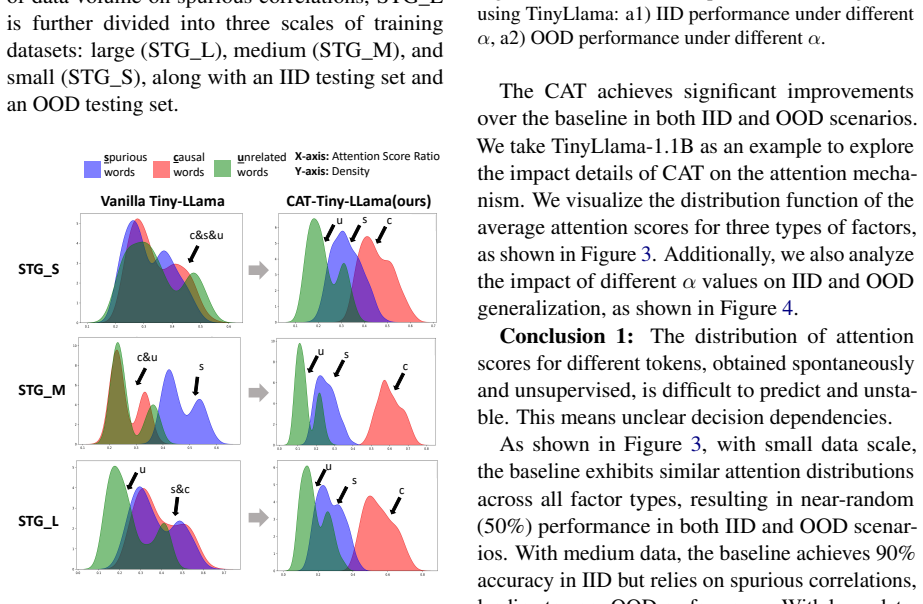
CAT claims that fine-grained, token-level causal knowledge can be injected into pretrained transformers through the attention map rather than through data augmentation or loss reweighting. An assistant LLM prompted with a few handwritten examples outputs, for each question, a JSON dictionary of the form 'this token is caused by those earlier tokens'; after tokenization this becomes a Boolean adjacency matrix Aadj. Training then adds Lattn = Σ_i max(0, α − C_i/N_i), where C_i is the row-average attention paid to tokens marked causal and N_i is the row-average attention paid to the rest. The paper reports that this reshapes the model's decision dependency so that OOD performance jumps—for inst
What carries the argument
The Re-Attention mechanism: after averaging attention maps over all layers and heads into one matrix AM, the loss compares, for each row i, average attention C_i on tokens marked causal in Aadj with average attention N_i on all other tokens, and penalizes whenever C_i/N_i < α. The adjacency matrix is shifted up one position so that it aligns with next-token prediction, since token i's output predicts token i+1. The mechanism's work is to convert coarse human-prior causal judgments into a differentiable training constraint that redirects attention without changing model architecture.
Load-bearing premise
Everything rests on the Boolean adjacency matrix Aadj being a correct, complete map of which tokens cause the answer; the paper's own Limitations section admits that human priors can make the assistant LLM inject biases, and no quantitative check of annotation quality is reported.
What would settle it
Take the STG setup and corrupt the supervision: shuffle the adjacency matrix, or invert it so it marks spurious tokens as causal. If OOD accuracy stays high, the gain is not caused by attending to true causal tokens. Alternatively, annotate the same questions with an oracle matrix derived from the known data-generating causal graph; if CAT with the oracle does not beat CAT with the assistant-LLM matrix, the causal annotation pipeline is not the source of the improvement.
If this is right
- If CAT works as claimed, LLM fine-tuning can be made robust to spurious correlations without new architectures or extra inference-time reasoning.
- On the STG benchmark, larger α within a range improves both IID and OOD accuracy, suggesting attention to causal tokens is a tunable, monotone lever up to a point.
- The method transfers across base models (TinyLlama, Qwen2.5, Llama-3.1), full fine-tuning and LoRA, and from GSM8K-trained models to OOD math datasets, so the improvement is not tied to one training recipe.
- Cheap assistant LLMs such as ChatGLM-4-air give most of the benefit of expensive ones like GPT-4o at much lower annotation cost, so the pipeline is practical at scale.
Where Pith is reading between the lines
- Beyond the paper's tests: on STG, CAT could be compared with an oracle adjacency matrix built from the known data-generating causal graph; if oracle supervision does not beat assistant-LLM supervision, the bottleneck is annotation quality rather than the attention loss.
- An implicit testable extension: after training, rows containing causal tokens should show C_i/N_i near α on held-out prompts; inspecting this ratio would show whether the loss genuinely transfers or merely memorizes training labels.
- Because the loss constrains only the average attention map, it may interact differently with models using sparse or differential attention; extending CAT to those architectures would reveal whether averaging is essential or a convenience.
- The paper's own ethical note implies an adversarial version: a maliciously built Aadj could rewire a model to ignore protected attributes; a red-team study could quantify how easily such injection succeeds.
Editorial analysis
A structured set of objections, weighed in public.
Referee Report
Summary. The paper proposes Causal Attention Tuning (CAT), a fine-tuning method that injects token-level causal knowledge into LLMs. In the first stage, human-written examples prompt an assistant LLM (ChatGLM-4-air) to produce dictionary-form causal relations between tokens, which are converted into a Boolean adjacency matrix A_adj. In the second stage, a Re-Attention loss L_attn constrains the average multi-layer, multi-head attention map so that, for each row, the average attention on tokens marked as causal is at least α times the average attention on non-causal tokens. The method is evaluated on a new synthetic Spurious Token Game (STG) benchmark and on five math/reasoning datasets, with reported average improvements of 5.76% and 1.56% over vanilla fine-tuning. The most striking results are on STG OOD settings, e.g., Llama-3.1-8B on STG_M improving from 64.5% to 90.5% and Qwen on STG_H from 25.4% to 55.9%.
Significance. If the results hold, CAT would be a practical, low-cost way to make LLM fine-tuning more robust to spurious correlations by directly shaping attention with human/LLM causal priors. The STG benchmark is a useful controlled testbed, and the paper provides a public code repository, implementation details, and attention visualizations that help the reader see the mechanism at work. These are genuine strengths. However, the central claim that the gains come from injected causal knowledge is currently supported only by an unvalidated annotation pipeline and by single-seed experiments in which the key hyperparameter α is selected per model/task on a validation set. The evidence as presented does not yet rule out the possibility that the improvements are due to a tuned attention regularizer rather than to faithful causal supervision.
major comments (5)
- [§4.1, Step 2; Limitations] The load-bearing component is A_adj, built from assistant-LLM annotations with no quantitative validation. The paper reports no human agreement study, no error analysis, and no comparison against annotations with known ground truth. The Limitations section itself concedes that even professional human priors 'may cause an LLM assistant to inject biases that do not exist in the training data.' Since L_attn (Eq. 8) directly enforces attention ratios against A_adj, any systematic annotation error is a false supervision signal and the downstream OOD gains cannot be attributed to causal knowledge. Moreover, the paper does not specify whether A_adj for STG is obtained from the known data-generation graph or from the assistant-LLM pipeline; this distinction is important for interpreting the benchmark. I ask the authors to (i) quantify annotation quality on a sample, and (ii) include a control co
- [Appendix F; Tables 1 and 2] The α threshold is selected per model/task on the validation set, and the paper reports test results for the best-performing model on the validation set. Because α directly controls the strength of the causal constraint, this protocol conflates the method's benefit with hyperparameter tuning. For TinyLlama full-parameter on STG_E, α is set to 0.6 even though the stated search range is 0.05–0.35. The paper should report results for a fixed α across models/tasks, show the full α sweep with the selection rule, or provide a pre-registered validation-based selection procedure. Sensitivity tables such as Figure 4 are helpful but are not a substitute for reporting the selection protocol in the main tables.
- [Appendix F; Tables 1 and 2] All experiments use a single random seed (42), and no error bars or significance tests are reported. Several individual deltas are small or negative (e.g., TinyLlama LoRA GSM8K −0.23 and MAWPS† −0.49; Qwen LoRA ASDiv† −1.94), while the headline downstream average gain is 1.56%. Without multiple seeds and a paired-error analysis, these differences are not statistically meaningful. I request 3–5 seeds with mean ± std, or at least significance tests for the aggregate claims.
- [§2.1 and §5.1] The paper cites DAS (Wu et al., 2024b), an attention-supervision debiasing method based on backdoor adjustment, but does not compare CAT against DAS or against other debiasing baselines such as counterfactual data augmentation or invariant loss. Because CAT is also an attention-supervision method, omitting these baselines leaves the core claim 'CAT outperforms existing debiasing approaches' unsupported. Please add these comparisons on both STG and downstream tasks.
- [§4.2, Eq. (8)] The definition of L_attn is incomplete in degenerate cases. If a row contains only causal tokens, N_i is zero and C_i/N_i is undefined; if a row contains no causal tokens, C_i is zero. The text says the loss is applied 'for rows i where causal words appear,' but it does not specify the behavior for rows with all-causal or all-noncausal distributions. Please provide a formal definition with a safe fallback (e.g., skip degenerate rows or define a margin loss), since this is necessary for exact reproduction of the method.
minor comments (4)
- [§4.2, Eq. (8)] The summation in L_attn runs from i = 0 to n, but attention rows are indexed 1..n; the indexing and the shifted adjacency alignment should be stated precisely.
- [§5.2.3] The ablation wording is confusing: 'we set the coefficient γ of L_attn as 1 (w/o γ)' seems to say the ablation removes γ by setting it to 1, but 'w/o γ' normally means γ is removed. Please clarify whether the w/o γ condition uses γ = 1 or γ = 0.
- [§5.2.3 and Table 3] There is a typo 'Mehod' in the table header, and the α grid in the text reads '0.05, 0.1, 015, 0.2, 0.25, 0.3' — '015' should be '0.15'.
- [Figure 4] The subfigure labels (a1), (a2), (b1), (b2) with '(default)' repeated are not self-explanatory; please add a legend or caption explaining which α values and settings correspond to each panel.
Circularity Check
No significant circularity: CAT's attention supervision is externally generated and the reported gains are empirical outcomes, not consequences of the loss by construction.
full rationale
The derivation chain is: human priors + assistant LLM → token-level adjacency matrix Aadj (Sec. 4.1) → Re-Attention loss Lattn (Sec. 4.2) → fine-tuned model → STG/downstream evaluations (Sec. 5). None of these links reduces to its own input. Aadj is produced by an external assistant LLM from handwritten examples and the task's Q/A; it is not fitted to the test sets or to the reported accuracies. Lattn constrains a ratio of average attention scores, but the final next-token predictions and accuracies are not set by Lattn; they are measured outcomes. On STG, the causal structure used to synthesize the data also informs the supervision, but the OOD test removes spurious correlations and the model must still map attended causal tokens to the correct label—a nontrivial empirical result (e.g., Llama-3.1-8B STG_M OOD 64.5→90.5). The α/γ hyperparameters are tuned on validation splits, which is standard practice and does not make the test numbers fitted by construction. Self-citations (Han et al. 2024, Wu et al. 2024a/b) are related-work references and are not load-bearing; no uniqueness theorem or ansatz is imported from them. The Limitations passage admitting possible assistant-LLM bias in Aadj is a correctness/validity caveat, not evidence that the claimed predictions are equivalent to the supervision. Therefore no circular step is present.
Axiom & Free-Parameter Ledger
free parameters (2)
- alpha (attention ratio threshold) =
grid-searched 0.05 to 0.35, with 0.6 for TinyLlama full STG_E; per-model values 0.15 to 0.3 on downstream tasks
- gamma (attention loss weight) =
e^{-epoch}
axioms (4)
- domain assumption Assistant-LLM-generated token-level causal annotations are accurate and complete.
- domain assumption The average attention map across all layers and heads is a meaningful target for causal supervision.
- domain assumption Requiring C_i/N_i >= alpha improves causal focus and OOD generalization.
- domain assumption Token-level causal relations can be represented as a binary adjacency matrix and aligned with the attention objective.
Cite this review
Pith. "Pith review of CAT: Causal Attention Tuning For Injecting Fine-grained Causal Knowledge into Large Language Models." pith.science (2026). https://pith.science/paper/CXS4ADK7
@misc{pith2026250901535,
  author       = {Pith},
  title        = {Pith review of: CAT: Causal Attention Tuning For Injecting Fine-grained Causal Knowledge into Large Language Models},
  year         = {2026},
  howpublished = {\url{https://pith.science/paper/CXS4ADK7}},
  note         = {Machine review of arXiv:2509.01535}
}
read the original abstract
Large Language Models (LLMs) have achieved remarkable success across various domains. However, a fundamental question remains: Can LLMs effectively utilize causal knowledge for prediction and generation? Through empirical studies, we find that LLMs trained directly on large-scale data often capture spurious correlations rather than true causal relationships, leading to suboptimal performance, especially in out-of-distribution (OOD) scenarios. To address this challenge, we propose Causal Attention Tuning (CAT), a novel approach that injects fine-grained causal knowledge into the attention mechanism. We propose an automated pipeline that leverages human priors to automatically generate token-level causal signals and introduce the Re-Attention mechanism to guide training, helping the model focus on causal structures while mitigating noise and biases in attention scores. Experimental results on our proposed Spurious Token Game (STG) benchmark and multiple downstream tasks demonstrate that our approach effectively leverages causal knowledge for prediction and remains robust in OOD scenarios. The CAT achieves an average improvement of 5.76% on the STG dataset and 1.56% on downstream tasks. Notably, the OOD performance of the Llama-3.1-8B model on STG_M increased from 64.5% to 90.5%, and Qwen's OOD performance on the STG_H dataset improved from 25.4% to 55.9%. Implementation details can be found at https://github.com/Kairong-Han/CAT.
Figures




Reference graph
Works this paper leans on
-
[1]
Josh Achiam, Steven Adler, Sandhini Agarwal, Lama Ahmad, Ilge Akkaya, Florencia Leoni Aleman, Diogo Almeida, Janko Altenschmidt, Sam Altman, Shyamal Anadkat, et al. 2023. Gpt-4 technical report. arXiv preprint arXiv:2303.08774
Pith/arXiv arXiv 2023
-
[2]
Guangsheng Bao, Hongbo Zhang, Linyi Yang, Cunxiang Wang, and Yue Zhang. 2024. Llms with chain-of-thought are non-causal reasoners. arXiv preprint arXiv:2402.16048
work page internal anchor Pith review Pith/arXiv arXiv 2024
-
[3]
Peter Clark, Isaac Cowhey, Oren Etzioni, Tushar Khot, Ashish Sabharwal, Carissa Schoenick, and Oyvind Tafjord. 2018. Think you have solved question answering? try arc, the ai2 reasoning challenge. arXiv preprint arXiv:1803.05457
Pith/arXiv arXiv 2018
-
[4]
Karl Cobbe, Vineet Kosaraju, Mohammad Bavarian, Mark Chen, Heewoo Jun, Lukasz Kaiser, Matthias Plappert, Jerry Tworek, Jacob Hilton, Reiichiro Nakano, Christopher Hesse, and John Schulman. 2021. Training verifiers to solve math word problems. arXiv preprint arXiv:2110.14168
Pith/arXiv arXiv 2021
-
[5]
Sunhao Dai, Chen Xu, Shicheng Xu, Liang Pang, Zhenhua Dong, and Jun Xu. 2024. Bias and unfairness in information retrieval systems: New challenges in the llm era. In Proceedings of the 30th ACM SIGKDD Conference on Knowledge Discovery and Data Mining, pages 6437--6447
2024
-
[6]
Jacob Devlin. 2018. Bert: Pre-training of deep bidirectional transformers for language understanding. arXiv preprint arXiv:1810.04805
Pith/arXiv arXiv 2018
-
[7]
Xinpeng Dong, Min Zhang, Didi Zhu, Ye Jun Jian, Zhang Keli, Aimin Zhou, Fei Wu, and Kun Kuang. 2025. Erict: Enhancing robustness by identifying concept tokens in zero-shot vision language models. In Forty-second International Conference on Machine Learning
work page 2025
-
[8]
Tao Feng, Lizhen Qu, Zhuang Li, Haolan Zhan, Yuncheng Hua, and Reza Haf. 2024. https://doi.org/10.18653/v1/2024.acl-long.144 IMO : Greedy layer-wise sparse representation learning for out-of-distribution text classification with pre-trained models . In Proceedings of the 62nd Annual Meeting of the Association for Computational Linguistics (Volume 1: Long ...
-
[9]
Isabel O Gallegos, Ryan A Rossi, Joe Barrow, Md Mehrab Tanjim, Sungchul Kim, Franck Dernoncourt, Tong Yu, Ruiyi Zhang, and Nesreen K Ahmed. 2024. Bias and fairness in large language models: A survey. Computational Linguistics, pages 1--79
2024
-
[10]
Team GLM, Aohan Zeng, Bin Xu, Bowen Wang, Chenhui Zhang, Da Yin, Dan Zhang, Diego Rojas, Guanyu Feng, Hanlin Zhao, et al. 2024. Chatglm: A family of large language models from glm-130b to glm-4 all tools. arXiv preprint arXiv:2406.12793
Pith/arXiv arXiv 2024
-
[11]
Xiangming Gu, Tianyu Pang, Chao Du, Qian Liu, Fengzhuo Zhang, Cunxiao Du, Ye Wang, and Min Lin. 2024. When attention sink emerges in language models: An empirical view. arXiv preprint arXiv:2410.10781
Pith/arXiv arXiv 2024
-
[12]
Meng-Hao Guo, Tian-Xing Xu, Jiang-Jiang Liu, Zheng-Ning Liu, Peng-Tao Jiang, Tai-Jiang Mu, Song-Hai Zhang, Ralph R Martin, Ming-Ming Cheng, and Shi-Min Hu. 2022. Attention mechanisms in computer vision: A survey. Computational visual media, 8(3):331--368
work page 2022
-
[13]
Muhammad Usman Hadi, Rizwan Qureshi, Abbas Shah, Muhammad Irfan, Anas Zafar, Muhammad Bilal Shaikh, Naveed Akhtar, Jia Wu, Seyedali Mirjalili, et al. 2023. A survey on large language models: Applications, challenges, limitations, and practical usage. Authorea Preprints
work page 2023
-
[14]
Kairong Han, Kun Kuang, Ziyu Zhao, Junjian Ye, and Fei Wu. 2024. Causal agent based on large language model. arXiv preprint arXiv:2408.06849
arXiv 2024
-
[15]
Edward J Hu, Yelong Shen, Phillip Wallis, Zeyuan Allen-Zhu, Yuanzhi Li, Shean Wang, Lu Wang, and Weizhu Chen. 2021. Lora: Low-rank adaptation of large language models. arXiv preprint arXiv:2106.09685
Pith/arXiv arXiv 2021
-
[16]
Zijing Hu, Fengda Zhang, Long Chen, Kun Kuang, Jiahui Li, Kaifeng Gao, Jun Xiao, Xin Wang, and Wenwu Zhu. 2025 a . Towards better alignment: Training diffusion models with reinforcement learning against sparse rewards. In Proceedings of the IEEE/CVF Conference on Computer Vision and Pattern Recognition (CVPR), pages 23604--23614
work page 2025
-
[17]
Zijing Hu, Fengda Zhang, and Kun Kuang. 2025 b . https://arxiv.org/abs/2505.22002 D-fusion: Direct preference optimization for aligning diffusion models with visually consistent samples . Preprint, arXiv:2505.22002
Pith/arXiv arXiv 2025
-
[18]
Jie Huang and Kevin Chen-Chuan Chang. 2022. Towards reasoning in large language models: A survey. arXiv preprint arXiv:2212.10403
Pith/arXiv arXiv 2022
-
[19]
David Jenny, Yann Billeter, Bernhard Sch \"o lkopf, and Zhijing Jin. 2024. Exploring the jungle of bias: Political bias attribution in language models via dependency analysis. In Proceedings of the Third Workshop on NLP for Positive Impact, pages 152--178
work page 2024
-
[20]
Zhijing Jin, Yuen Chen, Felix Leeb, Luigi Gresele, Ojasv Kamal, LYU Zhiheng, Kevin Blin, Fernando Gonzalez Adauto, Max Kleiman-Weiner, Mrinmaya Sachan, et al. 2023. Cladder: Assessing causal reasoning in language models. In Thirty-seventh conference on neural information processing systems
2023
-
[21]
Goro Kobayashi, Tatsuki Kuribayashi, Sho Yokoi, and Kentaro Inui. 2020. https://doi.org/10.18653/v1/2020.emnlp-main.574 Attention is not only a weight: Analyzing transformers with vector norms . In Proceedings of the 2020 Conference on Empirical Methods in Natural Language Processing (EMNLP), pages 7057--7075, Online. Association for Computational Linguistics
-
[22]
Rik Koncel-Kedziorski, Subhro Roy, Aida Amini, Nate Kushman, and Hannaneh Hajishirzi. 2016. https://doi.org/10.18653/v1/N16-1136 MAWPS : A math word problem repository . In Proceedings of the 2016 Conference of the North A merican Chapter of the Association for Computational Linguistics: Human Language Technologies , pages 1152--1157, San Diego, Californi...
-
[23]
Jiachun Li, Pengfei Cao, Yubo Chen, Kang Liu, and Jun Zhao. 2024. Towards faithful chain-of-thought: Large language models are bridging reasoners. arXiv preprint arXiv:2405.18915
Pith/arXiv arXiv 2024
-
[24]
Ari M Lipsky and Sander Greenland. 2022. Causal directed acyclic graphs. JAMA, 327(11):1083--1084
work page 2022
-
[25]
Jiashuo Liu, Zheyan Shen, Yue He, Xingxuan Zhang, Renzhe Xu, Han Yu, and Peng Cui. 2021. Towards out-of-distribution generalization: A survey. arXiv preprint arXiv:2108.13624
Pith/arXiv arXiv 2021
-
[26]
Shayne Longpre, Kartik Perisetla, Anthony Chen, Nikhil Ramesh, Chris DuBois, and Sameer Singh. 2021. Entity-based knowledge conflicts in question answering. arXiv preprint arXiv:2109.05052
Pith/arXiv arXiv 2021
-
[27]
Nicholas Meade, Elinor Poole-Dayan, and Siva Reddy. 2021. An empirical survey of the effectiveness of debiasing techniques for pre-trained language models. arXiv preprint arXiv:2110.08527
Pith/arXiv arXiv 2021
-
[28]
Shen-yun Miao, Chao-Chun Liang, and Keh-Yih Su. 2020. A diverse corpus for evaluating and developing english math word problem solvers. In Proceedings of the 58th Annual Meeting of the Association for Computational Linguistics, pages 975--984
2020
-
[29]
Zhaoyang Niu, Guoqiang Zhong, and Hui Yu. 2021. A review on the attention mechanism of deep learning. Neurocomputing, 452:48--62
work page 2021
-
[30]
Arkil Patel, Satwik Bhattamishra, and Navin Goyal. 2021. https://doi.org/10.18653/v1/2021.naacl-main.168 Are NLP models really able to solve simple math word problems? In Proceedings of the 2021 Conference of the North American Chapter of the Association for Computational Linguistics: Human Language Technologies, pages 2080--2094, Online. Association for ...
-
[31]
Judea Pearl. 2010. Causal inference. Causality: objectives and assessment, pages 39--58
work page 2010
-
[32]
Mingjie Sun, Xinlei Chen, J Zico Kolter, and Zhuang Liu. 2024. Massive activations in large language models. arXiv preprint arXiv:2402.17762
Pith/arXiv arXiv 2024
-
[33]
Qwen Team. 2024. https://qwenlm.github.io/blog/qwen2.5/ Qwen2.5: A party of foundation models
2024
-
[34]
Krishnaiyan Thulasiraman and Madisetti NS Swamy. 2011. Graphs: theory and algorithms. John Wiley & Sons
work page 2011
-
[35]
Yunze Tong, Junkun Yuan, Min Zhang, Didi Zhu, Keli Zhang, Fei Wu, and Kun Kuang. 2023. Quantitatively measuring and contrastively exploring heterogeneity for domain generalization. In Proceedings of the 29th ACM SIGKDD Conference on Knowledge Discovery and Data Mining
work page 2023
-
[36]
Yunze Tong, Fengda Zhang, Zihao Tang, Kaifeng Gao, Kai Huang, Pengfei Lyu, Jun Xiao, and Kun Kuang. 2025. Latent score-based reweighting for robust classification on imbalanced tabular data. In Proceedings of the 42nd International Conference on Machine Learning
work page 2025
-
[37]
Hugo Touvron, Louis Martin, Kevin Stone, Peter Albert, Amjad Almahairi, Yasmine Babaei, Nikolay Bashlykov, Soumya Batra, Prajjwal Bhargava, Shruti Bhosale, et al. 2023. Llama 2: Open foundation and fine-tuned chat models. arXiv preprint arXiv:2307.09288
Pith/arXiv arXiv 2023
-
[38]
A Vaswani. 2017. Attention is all you need. Advances in Neural Information Processing Systems
2017
-
[39]
Fei Wang, Wenjie Mo, Yiwei Wang, Wenxuan Zhou, and Muhao Chen. 2023. https://doi.org/10.18653/v1/2023.findings-emnlp.1013 A causal view of entity bias in (large) language models . In Findings of the Association for Computational Linguistics: EMNLP 2023, pages 15173--15184, Singapore. Association for Computational Linguistics
-
[40]
Lei Wang, Chen Ma, Xueyang Feng, Zeyu Zhang, Hao Yang, Jingsen Zhang, Zhiyuan Chen, Jiakai Tang, Xu Chen, Yankai Lin, et al. 2024 a . A survey on large language model based autonomous agents. Frontiers of Computer Science, 18(6):186345
work page 2024
-
[41]
Xiyao Wang, Yuhang Zhou, Xiaoyu Liu, Hongjin Lu, Yuancheng Xu, Feihong He, Jaehong Yoon, Taixi Lu, Gedas Bertasius, Mohit Bansal, et al. 2024 b . Mementos: A comprehensive benchmark for multimodal large language model reasoning over image sequences. arXiv preprint arXiv:2401.10529
Pith/arXiv arXiv 2024
-
[42]
Kellie Webster, Xuezhi Wang, Ian Tenney, Alex Beutel, Emily Pitler, Ellie Pavlick, Jilin Chen, Ed Chi, and Slav Petrov. 2020. Measuring and reducing gendered correlations in pre-trained models. arXiv preprint arXiv:2010.06032
Pith/arXiv arXiv 2020
-
[43]
Anpeng Wu, Kun Kuang, Minqin Zhu, Yingrong Wang, Yujia Zheng, Kairong Han, Baohong Li, Guangyi Chen, Fei Wu, and Kun Zhang. 2024 a . Causality for large language models. arXiv preprint arXiv:2410.15319
Pith/arXiv arXiv 2024
-
[44]
Yiquan Wu, Yifei Liu, Ziyu Zhao, Weiming Lu, Yating Zhang, Changlong Sun, Fei Wu, and Kun Kuang. 2024 b . https://doi.org/10.1609/aaai.v38i17.29897 De-biased attention supervision for text classification with causality . Proceedings of the AAAI Conference on Artificial Intelligence, 38(17):19279--19287
-
[45]
Guangxuan Xiao, Yuandong Tian, Beidi Chen, Song Han, and Mike Lewis. 2023. Efficient streaming language models with attention sinks. arXiv preprint arXiv:2309.17453
Pith/arXiv arXiv 2023
-
[46]
An Yang, Baosong Yang, Binyuan Hui, Bo Zheng, Bowen Yu, Chang Zhou, Chengpeng Li, Chengyuan Li, Dayiheng Liu, Fei Huang, Guanting Dong, Haoran Wei, Huan Lin, Jialong Tang, Jialin Wang, Jian Yang, Jianhong Tu, Jianwei Zhang, Jianxin Ma, Jin Xu, Jingren Zhou, Jinze Bai, Jinzheng He, Junyang Lin, Kai Dang, Keming Lu, Keqin Chen, Kexin Yang, Mei Li, Mingfeng ...
Pith/arXiv arXiv 2024
-
[47]
Tianzhu Ye, Li Dong, Yuqing Xia, Yutao Sun, Yi Zhu, Gao Huang, and Furu Wei. 2024 a . Differential transformer. arXiv preprint arXiv:2410.05258
Pith/arXiv arXiv 2024
-
[48]
Wenqian Ye, Guangtao Zheng, Xu Cao, Yunsheng Ma, and Aidong Zhang. 2024 b . Spurious correlations in machine learning: A survey. arXiv preprint arXiv:2402.12715
arXiv 2024
-
[49]
Zhongzhi Yu, Zheng Wang, Yonggan Fu, Huihong Shi, Khalid Shaikh, and Yingyan (Celine) Lin. 2024. Unveiling and harnessing hidden attention sinks: enhancing large language models without training through attention calibration. In Proceedings of the 41st International Conference on Machine Learning, ICML'24. JMLR.org
work page 2024
-
[50]
Congzhi Zhang, Linhai Zhang, Jialong Wu, Deyu Zhou, and Yulan He. 2024 a . Causal prompting: Debiasing large language model prompting based on front-door adjustment. arXiv preprint arXiv:2403.02738
Pith/arXiv arXiv 2024
-
[51]
Peiyuan Zhang, Guangtao Zeng, Tianduo Wang, and Wei Lu. 2024 b . Tinyllama: An open-source small language model. arXiv preprint arXiv:2401.02385
Pith/arXiv arXiv 2024
-
[52]
Wayne Xin Zhao, Kun Zhou, Junyi Li, Tianyi Tang, Xiaolei Wang, Yupeng Hou, Yingqian Min, Beichen Zhang, Junjie Zhang, Zican Dong, et al. 2023. A survey of large language models. arXiv preprint arXiv:2303.18223
Pith/arXiv arXiv 2023
-
[53]
Ce Zhou, Qian Li, Chen Li, Jun Yu, Yixin Liu, Guangjing Wang, Kai Zhang, Cheng Ji, Qiben Yan, Lifang He, et al. 2024. A comprehensive survey on pretrained foundation models: A history from bert to chatgpt. International Journal of Machine Learning and Cybernetics, pages 1--65
work page 2024
-
[54]
Fan Zhou, Yuzhou Mao, Liu Yu, Yi Yang, and Ting Zhong. 2023 a . Causal-debias: Unifying debiasing in pretrained language models and fine-tuning via causal invariant learning. In Proceedings of the 61st Annual Meeting of the Association for Computational Linguistics (Volume 1: Long Papers), pages 4227--4241
work page 2023
-
[55]
Yuhang Zhou, Paiheng Xu, Xiaoyu Liu, Bang An, Wei Ai, and Furong Huang. 2023 b . Explore spurious correlations at the concept level in language models for text classification. arXiv preprint arXiv:2311.08648
Pith/arXiv arXiv 2023
-
[56]
online" 'onlinestring :=
ENTRY address archivePrefix author booktitle chapter edition editor eid eprint eprinttype howpublished institution journal key month note number organization pages publisher school series title type volume year doi pubmed url lastchecked label extra.label sort.label short.list INTEGERS output.state before.all mid.sentence after.sentence after.block STRING...
-
[57]
write newline
" write newline "" before.all 'output.state := FUNCTION n.dashify 't := "" t empty not t #1 #1 substring "-" = t #1 #2 substring "--" = not "--" * t #2 global.max substring 't := t #1 #1 substring "-" = "-" * t #2 global.max substring 't := while if t #1 #1 substring * t #2 global.max substring 't := if while FUNCTION word.in bbl.in capitalize " " * FUNCT...
This paper was first reviewed by deepseek-v4-flash on August 5, 2026.
discussion (0)
Sign in with ORCID, Apple, or X to comment. Anyone can read and Pith papers without signing in.