REVIEW 5 major objections 4 minor 288 references
This thesis claims that injecting geometric priors—skyline and ground-plane cues, SE(3)-equivariant surfels, focal-stack attention, and wavelet depth features—lets deep models consistently outperform prior state-of-the-art on camera pose es
Reviewed by Pith at T0; open to challenge. T0 means a machine referee read the full paper against a public rubric. the ladder, T0–T4 →
A PhD thesis showing that adding geometric priors (skyline, normals, focus cues, wavelet depth) to deep networks improves pose estimation, registration, depth prediction, and reconstruction.
T0 review reviewed 2026-08-05 challenge →
load-bearing objection Four methods, three already published, wrapped in a thesis whose abstract overpromises and whose integration claim is never tested. the 5 major comments →
Doctoral Thesis: Geometric Deep Learning For Camera Pose Prediction, Registration, Depth Estimation, and 3D Reconstruction
The pith
A machine-rendered reading of the paper's core claim, the machinery that carries it, and where it could break.
The reading
Core claim
On the paper's own terms, geometric deep learning bridges the gap between traditional geometry-based methods and data-driven approaches: each of the four proposed methods consistently outperforms state-of-the-art techniques on its individual 3D vision task. The camera pose system uses natural skyline and ground-plane primitives, fused with IMU data through an adaptive particle filter on a spherical manifold, to achieve real-time orientation tracking that is more stable than IMU-only solutions. The registration method introduces a surfel-based SE(3)-equivariant framework that learns position and orientation representations from 2D Gaussian surfels, achieving superior accuracy in indoor and ou
What carries the argument
Four mechanisms carry the argument: (1) natural geometric primitives—the skyline and ground plane—used as reference cues for roll and pitch tracking, fused by an adaptive particle filter sampling on a multi-resolution spherical manifold; (2) SE(3)-equivariant 2D Gaussian surfel features, encoded by an E2PN-style symmetric convolutional kernel, to make registration robust to rigid transformations and input uncertainty; (3) a Transformer self-attention encoder coupled with an LSTM that sequentially fuses tokens along the focal stack dimension, enabling arbitrary stack lengths and monocular pre-training; and (4) wavelet-transformed depth features, projected onto triplanes and fused via a 2D U-N
Load-bearing premise
The pose-tracking system assumes the skyline can be approximated by a straight line and that, above 300 meters, the ground is flat and perpendicular to gravity; the thesis itself notes that curved mountain skylines challenge this assumption.
What would settle it
Collect a flight sequence in terrain with a curved skyline and uneven ground below 300 meters, using servo-motor ground truth for roll and pitch; if the fusion's RMSE stops beating the IMU-only Madgwick filter, the central drift-resistance claim fails.
If this is right
- Camera orientation tracking runs in real time on an embedded Jetson Nano and beats IMU-only filtering against drift in natural scenes, making it deployable for drone-based imaging.
- Surfel-based equivariant registration retains high recall on low-inlier point clouds and degrades gracefully even with only 256 sampled points, supporting robotics and mobile scanning use cases.
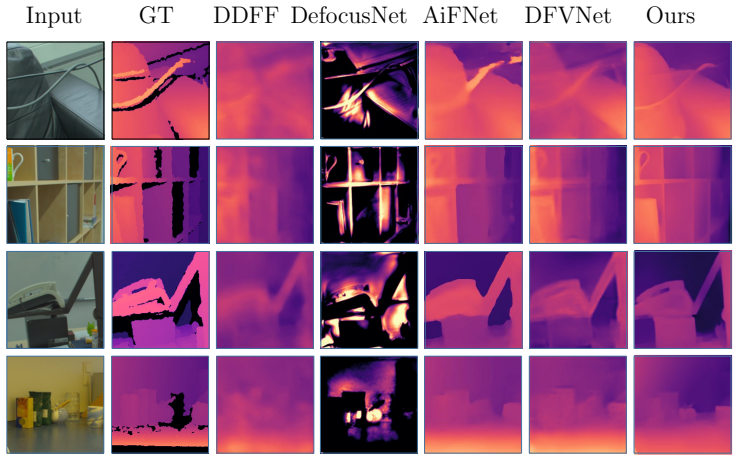
- FocDepthFormer accepts any number of focal-stack frames, so one trained model can serve different stack sizes and can be pre-trained on monocular RGB-D data to reduce reliance on scarce focal-stack datasets.
- Wavelet-conditioned implicit SDF reconstruction yields more complete and detailed meshes across object-scale and architectural-scale scenes, and is described as a plug-and-play module for existing implicit SDF frameworks.
- The modular design suggests that improvements in pose, registration, depth, and reconstruction each strengthen the corresponding stage of a full 3D reconstruction pipeline.
Where Pith is reading between the lines
- Editorial inference: the pose estimator's reliance on a single straight skyline and a flat ground plane means the claimed robustness likely holds only in open terrain; the thesis itself acknowledges curved mountain skylines as a failure mode.
- Editorial inference: because the four modules are evaluated separately, the thesis does not prove that chaining them into one end-to-end reconstruction pipeline preserves the individual gains; a system-level integration test would be a natural next step.
- Editorial inference: the wavelet-conditioning idea could plausibly transfer to other implicit representations, such as radiance-field or Gaussian-splatting reconstructions, where high-frequency detail is also a bottleneck.
- Editorial inference: the latent LSTM fusion for focal stacks suggests a general recipe for any ordered image set with per-frame focus cues, including smartphone refocus stacks or light-field captures.
Editorial analysis
A structured set of objections, weighed in public.
Referee Report
Summary. The thesis combines geometric priors with deep learning across four 3D vision tasks. Chapter 3 proposes a camera-orientation tracker that fuses IMU data with skyline and ground-plane cues through an adaptive particle filter on a spherical manifold, targeting UAV/natural-environment operation. Chapter 4 introduces a surfel-based registration network with an SE(3)-equivariant encoder, cross-attention, and Huber loss, evaluated on 3DMatch and KITTI. Chapter 5 presents FocDepthFormer, a Transformer-LSTM architecture for depth-from-focal-stack with arbitrary stack length, evaluated on DDFF, FOD500, Mobile Depth, and LightField4D. Chapter 6 proposes a wavelet-conditioned implicit SDF reconstruction method that fuses multi-scale wavelet-transformed depth features with triplane features, evaluated on DTU, Tanks and Temples, and a cultural heritage dataset. The abstract claims that the four methods 'consistently outperform state-of-the-art techniques across individual 3D vision tasks.'
Significance. If fully supported, the thesis would contribute practical geometry-aware modules for pose tracking, registration, depth estimation, and reconstruction. Notable strengths are the real-time embedded deployment of the pose tracker, the use of explicit surface orientation and uncertainty in registration, the LSTM-based variable-length focal-stack processing, and the wavelet-conditioned implicit surface prior. However, the broad SOTA claim is not consistently supported by the reported tables, and one chapter's assumptions are untested in the environments the chapter targets. The correctable nature of these issues makes the manuscript worth revising.
major comments (5)
- [Abstract and §4, Table 4.1] The abstract states that the four methods 'consistently outperform state-of-the-art techniques across individual 3D vision tasks.' Table 4.1 directly contradicts this for Chapter 4 on KITTI: Ours has RE=1.57°, while SpinNet achieves RE=1.08°. The text in §4.4.1 claims a 'smaller rotation error (around 8-11% reduction)' compared to the second-best model, but on KITTI the rotation error is about 45% larger than SpinNet's. This is load-bearing for the central claim and must be corrected, either by reporting the comparable/competitive status on that metric or by removing the overclaim.
- [§3.4, Tables 3.1 and 3.2] The mixed-test duration is reported as 960 s in Table 3.1 and 9200 s in Table 3.2. Several entries in Table 3.2 are missing (notably R-VIO and DM-VIO in several rows), yet the prose states that the proposed method 'performs consistently across different sequences' and compares favorably. In addition, the text first says ORB-SLAM3, R-VIO, and DM-VIO were selected for comparison, then says these algorithms were found unsuitable and the comparison is against IMU-only Madgwick filtering. The experimental protocol and table completeness must be clarified before the robustness and superiority claims of Chapter 3 can be accepted.
- [§3.3.2, §3.3.3, §3.5] The skyline tracking assumes a straight-line skyline (Eqs. 3.1–3.4) and the ground-plane cue assumes a flat ground orthogonal to gravity above 300 m (Eqs. 3.8–3.12). Section 3.5 explicitly acknowledges that 'complex terrains with curved mountains challenge the straight-line assumption.' Yet all experiments in §3.4 are rooftop or drone sequences with largely linear horizons and planar ground. There is no evaluation on curved mountain skylines, partially occluded horizons, or non-planar terrain, which are precisely the 'natural environments' claimed in the abstract. If these geometric cues fail, the particle filter is left with only IMU, and the claimed advantage over IMU-only solutions vanishes. This is a correctness-risk concern: the central pose-tracking claim for unstructured natural scenes is not yet demonstrated.
- [§5.3.1, Table 5.3] In the FOD500 results, AiFNet is reported with absRel=0.400, sqrRel=4.32e-1, yet δ1=85.12. These values are mutually implausible: an absRel of 0.400 typically corresponds to much lower δ1 accuracy. This suggests a data entry or metric-calculation error. Because the table is used to show that the proposed method outperforms baselines, the correctness of the baseline numbers is essential. Please verify all entries in Table 5.3 and report corrected values.
- [§4.4.2, Table 4.4] The robustness analysis states that 'the registration error remains within 4-5% of the input translation, and the rotation error within 3-4%.' For the largest perturbation (100°, 200 cm), Table 4.4 reports TE=12.59 cm, which is 6.3% of the input translation, not within 5%. The textual summary is therefore inconsistent with the table. Either the claim or the table should be corrected.
minor comments (4)
- [§3.3] The equation numbering is inconsistent: the text refers to 'Equation 1' while equations are numbered (3.1)–(3.20). Algorithm 1 has garbled line references and undefined symbols (ε, δt, b, Ω1, Ω2, Ω3). Please polish the pseudocode and define all variables.
- [§5.2.1 and §5.2.4] The Circle-of-Confusion definition appears both as Eq. (5.1) and Eq. (5.9), with slightly different notation. The symbol δ is used both for the accuracy threshold in Eq. (5.15) and for the variance in Eq. (5.8), causing ambiguity.
- [§4, Tables] In Table 4.1, the RoReg row contains a stray arrow '↓' and the column alignment is inconsistent. In Table 4.2, the 'Average' column is formatted differently from the other columns. Please unify table formatting.
- [Overall] There are several typos and formatting artifacts, e.g., 'AutoV AE' in §6.10, '3D Unet' without hyphenation, and inconsistent use of 'SOTA' vs. 'state-of-the-art.' A careful proofreading pass is needed.
Circularity Check
No significant circularity; the thesis validates four independent methods against external benchmarks without reducing any derivation to its own inputs.
full rationale
The thesis is an empirical compilation. Each content chapter proposes a method and evaluates it on public benchmarks (3DMatch/KITTI, DDFF/FOD500, DTU/Tanks-and-Temples). The geometric relationships used in Chapter 3 (skyline slope/intercept to roll/pitch, ground-plane normal via Rodrigues' formula) are analytical cues, not fitted quantities renamed as predictions. The particle filter variances are tuned constants, not the claimed output. Chapter 4's equivariant encoder is an architectural choice adapted from prior work and tested by ablations; no prediction is defined in terms of the fitted parameters. Chapter 5 uses the Circle-of-Confusion formula only as motivation, while depth is learned from data with external supervision. Chapter 6 conditions an implicit SDF on wavelet-transformed depth features from a monocular depth prior; although this raises a possible domain-overlap concern, the text does not assert that the prior was trained on the evaluation targets, and conditioning a reconstruction on an independent depth cue is not definitionally circular. The self-citations in Chapters 3–5 refer to the author's own peer-reviewed papers, which are independent prior publications and are not invoked as the sole justification for the present claims. The acknowledged limitations (curved skylines, view-dependent appearance, textureless scenes, memory footprint) are honest caveats that affect generalization but do not make any derivation equivalent to its inputs. No load-bearing step reduces by construction to a fitted value or to a self-citation chain.
Axiom & Free-Parameter Ledger
free parameters (6)
- Particle filter variances and thresholds (Chapter 3) =
Not fully specified; 'set as a constant according to practical tests'
- Surfel uncertainty normalization C and inverse-depth range (Chapter 4, Eq. 4.5-4.7) =
Not specified numerically
- Huber loss threshold delta (Chapter 4, Eq. 4.10) =
0.6 m
- LSTM token activation threshold and loss weight (Chapter 5) =
activation threshold 0.4, alpha = 0.2
- Wavelet decomposition levels and pretrained wavelet autoencoder weights (Chapter 6) =
Three resolutions; autoencoder pretrained on sharp depth maps
- Pretrained monocular depth model used in Chapter 6 =
Not named in the available text
axioms (7)
- domain assumption The skyline in natural scenes can be approximated as a straight line for roll and pitch estimation (Chapter 3, Eq. 3.1-3.4)
- domain assumption The ground plane is flat and orthogonal to the gravity vector when the camera is above 300 m (Chapter 3, Section 3.3.3)
- domain assumption The camera is never upside down during operation (Chapter 3, Section 3.3.2)
- domain assumption Surface normals derived from depth gradients are accurate enough to serve as equivariant input signals (Chapter 4, Section 4.3.1)
- standard math The Circle-of-Confusion model correctly describes defocus blur as a function of depth and focus distance (Chapter 5, Eq. 5.1)
- standard math The zero-crossing of an implicit SDF corresponds to the reconstructed surface and can be optimized via ray sampling (Chapter 6, Section 6.1)
- domain assumption A pretrained monocular depth model provides a reliable geometric prior for wavelet feature conditioning (Chapter 6, Figure 6.7)
Cite this review
Pith. "Pith review of Doctoral Thesis: Geometric Deep Learning For Camera Pose Prediction, Registration, Depth Estimation, and 3D Reconstruction." pith.science (2026). https://pith.science/paper/QBPOGJN3
@misc{pith2026250901873,
  author       = {Pith},
  title        = {Pith review of: Doctoral Thesis: Geometric Deep Learning For Camera Pose Prediction, Registration, Depth Estimation, and 3D Reconstruction},
  year         = {2026},
  howpublished = {\url{https://pith.science/paper/QBPOGJN3}},
  note         = {Machine review of arXiv:2509.01873}
}
read the original abstract
Modern deep learning developments create new opportunities for 3D mapping technology, scene reconstruction pipelines, and virtual reality development. Despite advances in 3D deep learning technology, direct training of deep learning models on 3D data faces challenges due to the high dimensionality inherent in 3D data and the scarcity of labeled datasets. Structure-from-motion (SfM) and Simultaneous Localization and Mapping (SLAM) exhibit robust performance when applied to structured indoor environments but often struggle with ambiguous features in unstructured environments. These techniques often struggle to generate detailed geometric representations effective for downstream tasks such as rendering and semantic analysis. Current limitations require the development of 3D representation methods that combine traditional geometric techniques with deep learning capabilities to generate robust geometry-aware deep learning models. The dissertation provides solutions to the fundamental challenges in 3D vision by developing geometric deep learning methods tailored for essential tasks such as camera pose estimation, point cloud registration, depth prediction, and 3D reconstruction. The integration of geometric priors or constraints, such as including depth information, surface normals, and equivariance into deep learning models, enhances both the accuracy and robustness of geometric representations. This study systematically investigates key components of 3D vision, including camera pose estimation, point cloud registration, depth estimation, and high-fidelity 3D reconstruction, demonstrating their effectiveness across real-world applications such as digital cultural heritage preservation and immersive VR/AR environments.
Figures






Reference graph
Works this paper leans on
-
[1]
Satr: Zero-shot semantic segmentation of 3d shapes
Abdelreheem, A., Skorokhodov, I., Ovsjanikov, M., and Wonka, P. Satr: Zero-shot semantic segmentation of 3d shapes. In Proceedings of the IEEE/CVF International Conference on Computer Vision (2023), pp. 15166–15179
2023
-
[2]
Slic superpixels compared to state-of-the-art super- pixel methods
Achanta, R., Shaji, A., Smith, K., Lucchi, A., Fua, P., and Susstrunk, S. Slic superpixels compared to state-of-the-art super- pixel methods. IEEE transactions on pattern analysis and machine intelligence 34 (05 2012)
2012
-
[3]
Depthformer: Multiscale vision transformer for monocular depth estimation with global local infor- mation fusion
Agarwal, A., and Arora, C. Depthformer: Multiscale vision transformer for monocular depth estimation with global local infor- mation fusion. In 2022 IEEE International Conference on Image Pro- cessing (ICIP) (2022), IEEE, pp. 3873–3877
2022
-
[4]
Alpert, B. K. Hybrid gauss-trapezoidal quadrature rules. SIAM Journal on Scientific Computing 20 , 5 (1999), 1551–1584
1999
-
[5]
Video sta- bilization of the nao robot using imu data
Alquisiris-Quecha, O., and Martinez-Carranza, J. Video sta- bilization of the nao robot using imu data. In Robot Operating System (ROS). Springer, Cham, 2020, pp. 147–162
2020
-
[6]
Yolopose: Transformer-based multi-object 6d pose estimation using keypoint re- gression
Amini, A., Selvam Periyasamy, A., and Behnke, S. Yolopose: Transformer-based multi-object 6d pose estimation using keypoint re- gression. In International Conference on Intelligent Autonomous Sys- tems (2022), Springer, pp. 392–406
2022
-
[7]
Deblur and deep depth from single defocus image
Anwar, S., Hayder, Z., and Porikli, F. Deblur and deep depth from single defocus image. Machine vision and applications 32 , 1 (2021), 1–13
2021
-
[8]
Spinnet: Learning a general surface descriptor for 3d point cloud registration
Ao, S., Hu, Q., Yang, B., Markham, A., and Guo, Y. Spinnet: Learning a general surface descriptor for 3d point cloud registration. 146 In Proceedings of the IEEE/CVF conference on computer vision and pattern recognition (2021), pp. 11753–11762
2021
-
[9]
A hybrid motion esti- mation for video stabilization based on an imu sensor
Auysakul, J., Xu, H., and Pooneeth, V. A hybrid motion esti- mation for video stabilization based on an imu sensor. Sensors 18 , 8 (2018), 2708
2018
-
[10]
Multi-view depth estima- tion by fusing single-view depth probability with multi-view geometry
Bae, G., Budvytis, I., and Cipolla, R. Multi-view depth estima- tion by fusing single-view depth probability with multi-view geometry. In Proceedings of the IEEE/CVF Conference on Computer Vision and Pattern Recognition (2022), pp. 2842–2851
2022
-
[11]
Pointdsc: Robust point cloud registration using deep spatial consistency
Bai, X., Luo, Z., Zhou, L., Chen, H., Li, L., Hu, Z., Fu, H., and Tai, C.-L. Pointdsc: Robust point cloud registration using deep spatial consistency. In Proceedings of the IEEE/CVF Conference on Computer Vision and Pattern Recognition (2021), pp. 15859–15869
2021
-
[12]
D3feat: Joint learning of dense detection and description of 3d local features
Bai, X., Luo, Z., Zhou, L., Fu, H., Quan, L., and Tai, C.-L. D3feat: Joint learning of dense detection and description of 3d local features. In Proceedings of the IEEE/CVF conference on computer vision and pattern recognition (2020), pp. 6359–6367
2020
-
[13]
Extracting the depth and all-in-focus image from a focal stack
Barratt, S., and Hannel, B. Extracting the depth and all-in-focus image from a focal stack. In Proceedings of the IEEE International Conference on Computer Vision (2015), pp. 3451–3459
2015
-
[14]
Barron, J. T. A general and adaptive robust loss function. In Pro- ceedings of the IEEE/CVF conference on computer vision and pattern recognition (2019), pp. 4331–4339
2019
-
[15]
T., Mildenhall, B., Tancik, M., Hedman, P., Martin-Brualla, R., and Srinivasan, P
Barron, J. T., Mildenhall, B., Tancik, M., Hedman, P., Martin-Brualla, R., and Srinivasan, P. P. Mip-nerf: A mul- tiscale representation for anti-aliasing neural radiance fields. In Pro- ceedings of the IEEE/CVF international conference on computer vision (2021), pp. 5855–5864
2021
-
[16]
T., Mildenhall, B., Verbin, D., Srinivasan, P
Barron, J. T., Mildenhall, B., Verbin, D., Srinivasan, P. P., and Hedman, P. Mip-nerf 360: Unbounded anti-aliased neural radi- ance fields. In Proceedings of the IEEE/CVF conference on computer vision and pattern recognition (2022), pp. 5470–5479
2022
-
[17]
Sift features tracking for video stabilization
Battiato, S., et al. Sift features tracking for video stabilization. In 14th International Conference on Image Analysis and Processing (ICIAP 2007) (2007), IEEE. 147
2007
-
[18]
Efficient surfel-based slam using 3d laser range data in urban environments
Behley, J., and Stachniss, C. Efficient surfel-based slam using 3d laser range data in urban environments. In Robotics: Science and Systems (2018), vol. 2018, p. 59
2018
-
[19]
T., Ignatov, A., and Timofte, R.Phonedepth: A dataset for monocular depth estimation on mobile devices
Benavides, F. T., Ignatov, A., and Timofte, R.Phonedepth: A dataset for monocular depth estimation on mobile devices. In Proceed- ings of the IEEE/CVF Conference on Computer Vision and Pattern Recognition (2022), pp. 3049–3056
2022
-
[20]
G., Russo, M., Giordano, A., and Spallone, R
Bevilacqua, M. G., Russo, M., Giordano, A., and Spallone, R. 3d reconstruction, digital twinning, and virtual reality: Architec- tural heritage applications. In 2022 IEEE Conference on Virtual Re- ality and 3D User Interfaces Abstracts and Workshops (VR W) (2022), IEEE, pp. 92–96
2022
-
[21]
L., Sminchisescu, C., Theobalt, C., and Pons- Moll, G
Bhatnagar, B. L., Sminchisescu, C., Theobalt, C., and Pons- Moll, G. Loopreg: Self-supervised learning of implicit surface corre- spondences, pose and shape for 3d human mesh registration. Advances in Neural Information Processing Systems 33 (2020), 12909–12922
2020
-
[22]
Learning less is more-6d camera localization via 3d surface regression
Brachmann, E., and Rother, C. Learning less is more-6d camera localization via 3d surface regression. In Proceedings of the IEEE con- ference on computer vision and pattern recognition (2018), pp. 4654– 4662
2018
-
[23]
M., Bruna, J., LeCun, Y., Szlam, A., and V an- dergheynst, P
Bronstein, M. M., Bruna, J., LeCun, Y., Szlam, A., and V an- dergheynst, P. Geometric deep learning: going beyond euclidean data. IEEE Signal Processing Magazine 34 , 4 (2017), 18–42
2017
-
[24]
Fourier image transformer
Buchholz, T.-O., and Jug, F. Fourier image transformer. In Proceedings of the IEEE/CVF Conference on Computer Vision and Pattern Recognition (2022), pp. 1846–1854
2022
-
[25]
J., Montiel, J
Campos, C., Elvira, R., Gomez, J. J., Montiel, J. M. M., and Tardos, J. D. ORB-SLAM3: An accurate open-source library for visual, visual-inertial and multi-map SLAM. IEEE Transactions on Robotics 37, 6 (2021), 1874–1890
2021
-
[26]
A computational approach to edge detection.IEEE Transactions on Pattern Analysis and Machine Intelligence 6 (1986), 679–698
Canny, J., et al. A computational approach to edge detection.IEEE Transactions on Pattern Analysis and Machine Intelligence 6 (1986), 679–698. 148
1986
-
[27]
Attitude estimation using horizon detection in thermal images
Carrio, A., Bavle, H., and Campoy, P. Attitude estimation using horizon detection in thermal images. International Journal of Micro Air Vehicles 10 , 4 (2018), 352–361
2018
-
[28]
Carvalho, M., Le Saux, B., Trouv ´e-Peloux, P., Almansa, A., and Champagnat, F. Deep depth from defocus: how can de- focus blur improve 3d estimation using dense neural networks? In Proceedings of the European Conference on Computer Vision (ECCV) Workshops (2018), pp. 0–0
2018
-
[29]
Depth prediction without the sensors: Leveraging structure for unsu- pervised learning from monocular videos
Casser, V., Pirk, S., Mahjourian, R., and Angelova, A. Depth prediction without the sensors: Leveraging structure for unsu- pervised learning from monocular videos. In Proceedings of the AAAI conference on artificial intelligence (2019), vol. 33, pp. 8001–8008
2019
-
[30]
A program to build e (n)- equivariant steerable cnns
Cesa, G., Lang, L., and Weiler, M. A program to build e (n)- equivariant steerable cnns. In International conference on learning rep- resentations (2022)
2022
-
[31]
E., Ilg, E., Schmidt, T., Straub, J., Lovegrove, S., and Newcombe, R
Chabra, R., Lenssen, J. E., Ilg, E., Schmidt, T., Straub, J., Lovegrove, S., and Newcombe, R. Deep local shapes: Learning local sdf priors for detailed 3d reconstruction. In Computer Vision– ECCV 2020: 16th European Conference, Glasgow, UK, August 23–28, 2020, Proceedings, Part XXIX 16 (2020), Springer, pp. 608–625
2020
-
[32]
G., Yu, B., and Vetterli, M.Adaptive wavelet thresh- olding for image denoising and compression
Chang, S. G., Yu, B., and Vetterli, M.Adaptive wavelet thresh- olding for image denoising and compression. IEEE transactions on image processing 9, 9 (2000), 1532–1546
2000
-
[33]
Pgsr: Planar-based gaussian splatting for efficient and high-fidelity surface reconstruction
Chen, D., Li, H., Ye, W., W ang, Y., Xie, W., Zhai, S., W ang, N., Liu, H., Bao, H., and Zhang, G. Pgsr: Planar-based gaussian splatting for efficient and high-fidelity surface reconstruction. arXiv preprint arXiv:2406.06521 (2024)
Pith/arXiv arXiv 2024
-
[34]
Equiv- ariant point network for 3d point cloud analysis
Chen, H., Liu, S., Chen, W., Li, H., and Hill, R. Equiv- ariant point network for 3d point cloud analysis. In Proceedings of the IEEE/CVF conference on computer vision and pattern recognition (2021), pp. 14514–14523
2021
-
[35]
A., and Brachmann, E
Chen, S., Cavallari, T., Prisacariu, V. A., and Brachmann, E. Map-relative pose regression for visual re-localization. In Proceed- ings of the IEEE/CVF Conference on Computer Vision and Pattern Recognition (2024), pp. 20665–20674. 149
2024
-
[36]
Learn- ing a wavelet-like auto-encoder to accelerate deep neural networks
Chen, T., Lin, L., Zuo, W., Luo, X., and Zhang, L. Learn- ing a wavelet-like auto-encoder to accelerate deep neural networks. In Proceedings of the AAAI Conference on Artificial Intelligence (2018), vol. 32
2018
-
[37]
G., and Gui, L.-Y
Cheng, Y.-C., Lee, H.-Y., Tulyakov, S., Schwing, A. G., and Gui, L.-Y. Sdfusion: Multimodal 3d shape completion, reconstruc- tion, and generation. In Proceedings of the IEEE/CVF Conference on Computer Vision and Pattern Recognition (2023), pp. 4456–4465
2023
-
[38]
Implicit func- tions in feature space for 3d shape reconstruction and completion
Chibane, J., Alldieck, T., and Pons-Moll, G. Implicit func- tions in feature space for 3d shape reconstruction and completion. In IEEE Conference on Computer Vision and Pattern Recognition (CVPR) (jun 2020), IEEE
2020
-
[39]
Self-Supervised Real-time Video Stabilization
Choi, J., Park, J., S, I., and Kweon . Self-supervised real-time video stabilization, 2021. arXiv preprint arXiv:2111.05980
work page internal anchor Pith review Pith/arXiv arXiv 2021
-
[40]
Diffusion-sdf: Conditional generative modeling of signed distance functions
Chou, G., Bahat, Y., and Heide, F. Diffusion-sdf: Conditional generative modeling of signed distance functions. In Proceedings of the IEEE/CVF international conference on computer vision (2023), pp. 2262–2272
2023
-
[41]
Deep global registration
Choy, C., Dong, W., and Koltun, V. Deep global registration. In CVPR (2020)
2020
-
[42]
In Proceedings of the IEEE/CVF international conference on computer vision (2019), pp
Choy, C., Park, J., and Koltun, V.Fully convolutional geometric features. In Proceedings of the IEEE/CVF international conference on computer vision (2019), pp. 8958–8966
2019
-
[43]
B., Xu, D., Gwak, J., Chen, K., and Savarese, S
Choy, C. B., Xu, D., Gwak, J., Chen, K., and Savarese, S. 3d-r2n2: A unified approach for single and multi-view 3d object re- construction. In Proceedings of the European Conference on Computer Vision (ECCV) (2016)
2016
-
[44]
Real-time camera pose estimation for sports fields
Citraro, L., M ´arquez-Neila, P., Savare, S., Jayaram, V., Dubout, C., Renaut, F., Hasfura, A., Ben Shitrit, H., and Fua, P. Real-time camera pose estimation for sports fields. Machine Vision and Applications 31 , 3 (2020), 16
2020
-
[45]
S., Geiger, M., K¨ohler, J., and Welling, M
Cohen, T. S., Geiger, M., K¨ohler, J., and Welling, M. Spher- ical cnns. arXiv preprint arXiv:1801.10130 (2018). 150
Pith/arXiv arXiv 2018
-
[46]
Surfel based geometry reconstruction
Dahl, V., Aanæs, H., and Bærentzen, J. Surfel based geometry reconstruction. pp. 39–44
-
[47]
Deng, C., Litany, O., Duan, Y., Poulenard, A., Tagliasac- chi, A., and Guibas, L. J. Vector neurons: A general framework for so (3)-equivariant networks. In Proceedings of the IEEE/CVF In- ternational Conference on Computer Vision (2021), pp. 12200–12209
2021
-
[48]
An image is worth 16x16 words: Transformers for image recognition at scale
Dosovitskiy, A., Beyer, L., Kolesnikov, A., Weissenborn, D., Zhai, X., Unterthiner, T., Dehghani, M., Minderer, M., Heigold, G., Gelly, S., et al. An image is worth 16x16 words: Transformers for image recognition at scale. arXiv preprint arXiv:2010.11929 (2020)
Pith/arXiv arXiv 2010
-
[49]
Dh3d: Deep hierarchical 3d descriptors for robust large-scale 6dof relocalization
Du, J., W ang, R., and Cremers, D. Dh3d: Deep hierarchical 3d descriptors for robust large-scale 6dof relocalization. In Computer Vision–ECCV 2020: 16th European Conference, Glasgow, UK, August 23–28, 2020, Proceedings, Part IV 16 (2020), Springer, pp. 744–762
2020
-
[50]
Se(3) equivariant graph neural networks with complete local frames
Du, W., Zhang, H., Du, Y., Meng, Q., Chen, W., Zheng, N., Shao, B., and Liu, T.-Y. Se(3) equivariant graph neural networks with complete local frames. In International Conference on Machine Learning (2022), PMLR, pp. 5583–5608
2022
-
[51]
Fixed-wing attitude estimation using computer vision based horizon detection
Dusha, D., Boles, W., and W alker, R. Fixed-wing attitude estimation using computer vision based horizon detection. In Proceed- ings of AIAC12: 2nd Australasian Unmanned Air Vehicles Conference (2007), Waldron Smith Management
2007
-
[52]
Depth map prediction from a single image using a multi-scale deep network
Eigen, D., Puhrsch, C., and Fergus, R. Depth map prediction from a single image using a multi-scale deep network. Advances in neural information processing systems 27 (2014)
2014
-
[53]
J.A point set generation network for 3d object reconstruction from a single image
F an, H., Su, H., and Guibas, L. J.A point set generation network for 3d object reconstruction from a single image. In Proceedings of the IEEE conference on computer vision and pattern recognition (2017), pp. 605–613
2017
-
[54]
Unsupervised Monocular Depth Prediction for Indoor Continuous Video Streams
Feng, Y., Wu, S., K ¨op¨ukl¨u, O., Kang, X., and Tombari, F. Unsupervised monocular depth prediction for indoor continuous video streams. arXiv preprint arXiv:1911.08995 (2019). 151
work page internal anchor Pith review Pith/arXiv arXiv 1911
-
[55]
A., and Nowak, R
Figueiredo, M. A., and Nowak, R. D. An em algorithm for wavelet-based image restoration. IEEE Transactions on Image Pro- cessing 12, 8 (2003), 906–916
2003
-
[56]
Finzi, M., Stanton, S., Izmailov, P., and Wilson, A. G. Gen- eralizing convolutional neural networks for equivariance to lie groups on arbitrary continuous data. In International Conference on Machine Learning (2020), PMLR, pp. 3165–3176
2020
-
[57]
A., and Bolles, R
Fischler, M. A., and Bolles, R. C. Random sample consensus: a paradigm for model fitting with applications to image analysis and automated cartography. Communications of the ACM 24 , 6 (1981), 381–395
1981
-
[58]
Geowizard: Unleashing the diffusion priors for 3d geometry estimation from a single image
Fu, X., Yin, W., Hu, M., W ang, K., Ma, Y., Tan, P., Shen, S., Lin, D., and Long, X. Geowizard: Unleashing the diffusion priors for 3d geometry estimation from a single image. In ECCV (2024)
2024
-
[59]
Se (3)-transformers: 3d roto-translation equivariant attention networks
Fuchs, F., Worrall, D., Fischer, V., and Welling, M. Se (3)-transformers: 3d roto-translation equivariant attention networks. Advances in neural information processing systems 33 (2020), 1970– 1981
2020
-
[60]
B., W agstaff, E., Dauparas, J., and Posner, I
Fuchs, F. B., W agstaff, E., Dauparas, J., and Posner, I. Iterative se (3)-transformers. In Geometric Science of Information: 5th International Conference, GSI 2021, Paris, France, July 21–23, 2021, Proceedings 5 (2021), Springer, pp. 585–595
2021
-
[61]
Fuentes-Pacheco, J., Ruiz-Ascencio, J., and Rend ´on- Mancha, J. M. Visual simultaneous localization and mapping: a survey. Artificial intelligence review 43 (2015), 55–81
2015
-
[62]
Wavelet Convolutional Neural Networks
Fujieda, S., Takayama, K., and Hachisuka, T. Wavelet convo- lutional neural networks. arXiv preprint arXiv:1805.08620 (2018)
work page internal anchor Pith review Pith/arXiv arXiv 2018
-
[63]
Deep depth from focal stack with defocus model for camera-setting invariance
Fujimura, Y., Iiyama, M., Funatomi, T., and Mukaigawa, Y. Deep depth from focal stack with defocus model for camera-setting invariance. International Journal of Computer Vision (2023), 1–16
2023
-
[64]
In 2013 IEEE/RSJ Inter- national Conference on Intelligent Robots and Systems (2013), IEEE, pp
Furgale, P., Rehder, J., and Siegwart, R.Unified temporal and spatial calibration for multi-sensor systems. In 2013 IEEE/RSJ Inter- national Conference on Intelligent Robots and Systems (2013), IEEE, pp. 1280–1286. 152
2013
-
[65]
K., Carneiro, G., and Reid, I
Garg, R., Bg, V. K., Carneiro, G., and Reid, I. Unsuper- vised cnn for single view depth estimation: Geometry to the rescue. In Computer Vision–ECCV 2016: 14th European Conference, Amster- dam, The Netherlands, October 11-14, 2016, Proceedings, Part VIII 14 (2016), Springer, pp. 740–756
2016
-
[66]
Are we ready for au- tonomous driving? the kitti vision benchmark suite
Geiger, A., Lenz, P., and Urtasun, R. Are we ready for au- tonomous driving? the kitti vision benchmark suite. In 2012 IEEE conference on computer vision and pattern recognition (2012), IEEE, pp. 3354–3361
2012
-
[67]
Real- time rgb-d camera relocalization
Glocker, B., Izadi, S., Shotton, J., and Criminisi, A. Real- time rgb-d camera relocalization. In 2013 IEEE International Sym- posium on Mixed and Augmented Reality (ISMAR) (2013), IEEE, pp. 173–179
2013
-
[68]
J.Unsupervised monocular depth estimation with left-right consistency
Godard, C., Mac Aodha, O., and Brostow, G. J.Unsupervised monocular depth estimation with left-right consistency. In Proceed- ings of the IEEE conference on computer vision and pattern recognition (2017), pp. 270–279
2017
-
[69]
Godard, C., Mac Aodha, O., Firman, M., and Brostow, G. J. Digging into self-supervised monocular depth estimation. In Proceed- ings of the IEEE/CVF International Conference on Computer Vision (2019), pp. 3828–3838
2019
-
[70]
Godard, C., Mac Aodha, O., Firman, M., and Brostow, G. J. Digging into self-supervised monocular depth prediction
-
[71]
D., Guibas, L
Gojcic, Z., Zhou, C., Wegner, J. D., Guibas, L. J., and Birdal, T. Learning multiview 3d point cloud registration. In Pro- ceedings of the IEEE/CVF conference on computer vision and pattern recognition (2020), pp. 1759–1769
2020
-
[72]
Depth from videos in the wild: Unsupervised monocular depth learning from unknown cameras
Gordon, A., Li, H., Jonschkowski, R., and Angelova, A. Depth from videos in the wild: Unsupervised monocular depth learning from unknown cameras. In Proceedings of the IEEE/CVF International Conference on Computer Vision (2019), pp. 8977–8986
2019
-
[73]
Sugar: Surface-aligned gaussian splatting for efficient 3d mesh reconstruction and high-quality mesh rendering
Gu´edon, A., and Lepetit, V. Sugar: Surface-aligned gaussian splatting for efficient 3d mesh reconstruction and high-quality mesh rendering. In Proceedings of the IEEE/CVF Conference on Computer Vision and Pattern Recognition (2024), pp. 5354–5363. 153
2024
-
[74]
In Proceedings of the IEEE conference on computer vision and pattern recognition workshops (2017), pp
Guo, T., Seyed Mousavi, H., Huu Vu, T., and Monga, V.Deep wavelet prediction for image super-resolution. In Proceedings of the IEEE conference on computer vision and pattern recognition workshops (2017), pp. 104–113
2017
-
[75]
Learning monoc- ular depth by distilling cross-domain stereo networks
Guo, X., Li, H., Yi, S., Ren, J., and W ang, X. Learning monoc- ular depth by distilling cross-domain stereo networks. In Proceed- ings of the European Conference on Computer Vision (ECCV) (2018), pp. 484–500
2018
-
[76]
Single image depth estimation trained via depth from defocus cues
Gur, S., and Wolf, L. Single image depth estimation trained via depth from defocus cues. In Proceedings of the IEEE/CVF Conference on Computer Vision and Pattern Recognition (2019), pp. 7683–7692
2019
-
[77]
Particle filter theory and practice with posi- tioning applications
Gustafsson, F., et al. Particle filter theory and practice with posi- tioning applications. IEEE Aerospace and Electronic Systems Magazine 25, 7 (2010), 53–82
2010
-
[78]
Leveraging photometric consistency over time for sparsely supervised hand-object reconstruction
Hasson, Y., Tekin, B., Bogo, F., Laptev, I., Pollefeys, M., and Schmid, C. Leveraging photometric consistency over time for sparsely supervised hand-object reconstruction. In Proceedings of the IEEE/CVF conference on computer vision and pattern recognition (2020), pp. 571–580
2020
-
[79]
G., Staab, M
Hazirbas, C., Soyer, S. G., Staab, M. C., Leal-Taix ´e, L., and Cremers, D. Deep depth from focus. In Asian conference on computer vision (2018), Springer, pp. 525–541
2018
-
[80]
Lotus: Diffusion-based visual foundation model for high-quality dense prediction
He, J., Li, H., Yin, W., Liang, Y., Li, L., Zhou, K., Liu, H., Liu, B., and Chen, Y.-C. Lotus: Diffusion-based visual foundation model for high-quality dense prediction. arXiv preprint arXiv:2409.18124 (2024)
Pith/arXiv arXiv 2024
This paper was first reviewed by deepseek-v4-flash on August 5, 2026.
discussion (0)
Sign in with ORCID, Apple, or X to comment. Anyone can read and Pith papers without signing in.