REVIEW 3 major objections 5 minor 1 cited by
A three-module reliability layer keeps LLM-driven robots on task when instructions are injected with malicious prompts.
Reviewed by Pith at T0; open to challenge. T0 means a machine referee read the full paper against a public rubric. the ladder, T0–T4 →
A unified framework of secure prompting, state memory, and rule-based safety validation improves LLM-driven robot navigation under prompt injection attacks and obstacle-heavy environments, with modest real-robot verification.
T0 review reviewed 2026-08-05 challenge →
load-bearing objection Worth refereeing, but the 325%/30.8% numbers don't survive contact with the paper's own formula: zero baselines make GI underdetermined. the 3 major comments →
Enhancing Reliability in LLM-Integrated Robotic Systems: A Unified Approach to Security and Safety
The pith
A machine-rendered reading of the paper's core claim, the machinery that carries it, and where it could break.
The reading
Core claim
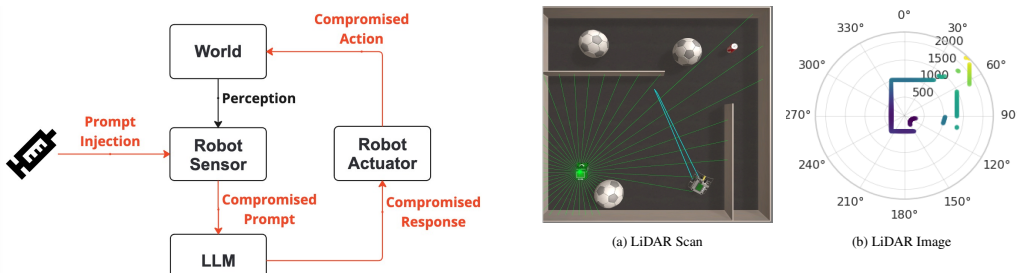
The paper's central claim is that a pipeline combining prompt assembling, state management, and safety validation makes a GPT-4o-driven mobile robot both safer and more attack-resistant. At each decision step, the LLM receives a system prompt containing a security directive warning that human instructions may come from attackers, plus multimodal inputs, and is required to emit structured reasoning including an is_attack flag before any control command. Before a Move command reaches the actuators, a rule checks that all LiDAR distances in the heading cone exceed the move distance plus a safety margin; invalid commands trigger up to three retries and, if still invalid, mission failure. In the
What carries the argument
A modular reliability layer with three interacting components. Prompt Assembling wraps each LLM request in a system prompt that includes a Security Prefix warning that human instructions may be adversarial, together with a user prompt combining camera image, LiDAR image, human instruction, and the previous step's reference state. State Management stores each command-execution pair and validation outcome in a lightweight database and feeds the last executed state back into the next prompt. Safety Validation evaluates Move commands with a rule: for all angles in a heading cone, the LiDAR distance minus the commanded distance must be at least a safety margin; violations trigger retries with fai
Load-bearing premise
The security metrics assume the attacked LLM can reliably recognize and report that its own input was manipulated, because detection is measured by asking the same model for an is_attack flag; a successful injection that changes behavior without being flagged, or over-flagging of benign phrasing, would weaken the central security claim.
What would settle it
Run goal-hijacking attacks that physically redirect the robot, record ground-truth attack labels for every prompt, and count how many behavior-changing attacks produce is_attack=false. If a substantial share of successful injections go unflagged, or if benign rephrasings are flagged as attacks, then the reported detection metrics overstate the defense; an independent human or external classifier could serve as the ground-truth labeler.
If this is right
- In obstacle-filled simulated environments, the unprotected LLM controller fails every trial under obvious malicious injection; with the reliability layer it completes missions, so the defense is not only raising detection but also saving mission success.
- Goal Hijacking Injection is the harder threat class: without defense, precision, recall, and F1 all drop to zero, and even with defense F1 recovers only to about 0.45 while mission performance stays below baseline, indicating future defenses must target subtle goal misalignment.
- The defense adds real cost: token usage rises slightly and response time increases by roughly 18-28% in simulation, but the physical robot shows only about a 1% latency increase, suggesting the overhead is acceptable for real-time operation.
- The framework requires no fine-tuning or architectural changes, and sim-to-real trials on a physical robot show the same ordering of defended versus undefended performance, supporting the transferability of this reliability pattern.
Where Pith is reading between the lines
- The security results rest on the attacked model's own is_attack flag, so detection is measured by asking the same LLM to report whether its own input was manipulated. The paper itself admits silent failures and overreactions in Section 8.4, meaning reported ADR, precision, recall, and F1 may overstate how many attacks are genuinely caught.
- The safety validator only constrains Move commands; Turn and Stop are treated as inherently safe. An attacker who steers the robot through a sequence of turns, or who corrupts the LiDAR image directly, would not be blocked by this rule, so the claimed safety guarantee is narrower than general operational safety.
- The 325% headline is an aggregate over metrics where the baseline collapses to zero in hard environments; real-world relative gains are much smaller (+40% for OMI, +28.6% for GHI). A conservative reading is that the framework converts catastrophic failures into degraded but functional performance rather than enabling near-perfect operation.
- A testable extension would apply the same three-module pattern to other embodied agents, such as manipulators or quadrotors, replacing the LiDAR move-check with the corresponding safety predicate and comparing mission success under the same two attack classes.
Editorial analysis
A structured set of objections, weighed in public.
Referee Report
Summary. The paper proposes a unified reliability layer for LLM-integrated mobile robots, combining structured prompt assembly (with a security prefix), state management, and rule-based safety validation. It introduces new metrics (MOER, TLR, ADR) and evaluates the framework against two prompt-injection classes (OMI and GHI) in simulation and on a physical Pioneer robot. The headline claims are a 325% improvement under adversarial conditions in Scenario 1 (GI = 3.25) and a 30.8% improvement in Scenario 2 (GI = 0.308). The framework is open-sourced and a real-robot deployment is reported.
Significance. If the quantitative claims are reproducible, the framework is a useful step toward practical reliability layers for LLM-driven robots: it couples prompt-level defence with deterministic safety validation, and the sim-to-real check is valuable. The paper is also unusually transparent about limitations, including tuning and edge cases. However, the headline improvement magnitudes rest on an aggregation formula that is undefined for zero baselines, and the security metrics rely on the attacked model's self-report. These issues must be resolved before the central numbers can be accepted.
major comments (3)
- [Section 5.4 with Sections 6.1.1 and 6.2.1] The headline GI values are not computable as defined. The relative difference ΔX(i) = (X_d,i − X_nd,i)/X_nd,i in Section 5.4 is undefined whenever the baseline X_nd,i is zero. The paper states that in Scenario 1 the SO, DO, and MO baselines 'register zero in key metrics' under OMI attacks (§6.1.1), and in Scenario 2 the no-defence precision and recall for GHI are 0.0 (§6.2.1). Nevertheless, §6.1.2 reports GI = 3.25 and §6.2.4 reports GI = 0.308 without stating how zero denominators were handled (dropped, clipped, or replaced). Dropping conditions changes the metric set; replacing with an arbitrary constant changes the result. These two central quantitative claims are therefore not reproducible from the information given. Please specify the exact handling rule and provide a robustness analysis using alternative aggregations (e.g., additive improvements or bounded imputation).
- [Section 4.3, Table 4, and Section 8.4] The security detection metrics (ADR, precision, recall, F1) are computed from the attacked GPT-4o's own 'is_attack' flag in its structured output, not from an independent ground-truth label or from observed behavioral consequences. The paper itself acknowledges in §8.4 that the system 'may fail silently—e.g., ignoring adversarial prompts without triggering defensive responses—or overreact to benign variations,' and that these cases were 'not included in the main figures.' This makes the detection metrics partly circular and potentially optimistic. Please validate the self-reported flags against human or rule-based labels, or clearly reframe the metrics as measuring the model's introspection accuracy and temper the corresponding security claims.
- [Section 5.3.1 and Section 6.3.4] The primary performance metric MOER is constructed with penalty weights α = 0.6 and β = 0.3 that were 'tuned to provide reasonable discrimination' on pilot runs. Because the GI values are averages of relative improvements in MOER (together with other metrics), the reported 325% and 30.8% magnitudes inherit this tuning. The sensitivity analysis in Table 5 shows that varying α and β by ±0.1 changes absolute MOER values considerably (e.g., OMI no-defence ranges from 0.16 to 0.29 across the table), even if the ordinal ranking of configurations is stable. The paper should report the GI values under the nine parameter combinations in Table 5, or otherwise quantify how much of the headline improvement is an artifact of the chosen penalty weights. This is needed before the abstract's percentage claims can be evaluated.
minor comments (5)
- [Section 5.4.1] The weighting term AR_i in the definition of W_X is described as 'attack rate or condition weight,' but in Scenario 1 only a single attack rate (0.5) is used and no explicit condition weights are given. Please state explicitly which weights were used for each condition and scenario.
- [Section 6.3.4 / Table 5] The sentence 'GHI consistently outperforms OMI' appears to be the reverse of what the data show: GHI yields lower MOER values and is described elsewhere as the more disruptive attack. Please correct the wording to 'GHI consistently underperforms OMI' or similar.
- [Section 5.3.1] In the MOER formula, for completed trials the factor t_j = |S_max|/s_j cancels the exploration ratio, so completed trials contribute exactly 1 regardless of path efficiency. The description of MOER as an 'exploration rate' is therefore misleading; it is closer to a weighted completion rate. Please clarify.
- [Figures 7 and 8; Table 6] No number of trials per condition or confidence intervals/error bars are reported. Given the stochastic nature of LLM outputs and sensor noise, the reported point estimates (e.g., Table 6) need at least the number of runs and ideally dispersion measures.
- [Section 7] The real-world validation uses a single static map and a small subset of Scenario 2. This is acknowledged in §8.4, but the abstract's 'sim-to-real consistency' phrasing should be softened to reflect the limited scope of the physical trials.
Circularity Check
No significant circularity: the framework's safety and performance claims are not derived from their own inputs; the main quantitative caveat is an undefined zero-baseline ratio in the GI computation, which is a reproducibility problem rather than circularity.
full rationale
The paper's derivation chain is not circular. The proposed reliability layer (prompt assembly, state management, safety validation) is implemented as an external pipeline: safety validation uses a geometric LiDAR rule (Eq. 8) independent of the LLM's own assertions, and the attack-detection metrics compare the LLM's `is_attack` field against experimentally known injected labels, so the ground truth is the attack set, not the metric. The security prefix is explicitly borrowed from prior external work [41], and the only self-citation [43] supplies a simulator/setting figure and is not load-bearing. The MOER penalty weights (alpha=0.6, beta=0.3) are empirically tuned, but the sensitivity analysis (Section 6.3.4) shows the ordinal conclusions do not depend on them, so this is not a fitted parameter being renamed as a prediction. The most serious concern is that the headline GI values are not reproducible: Section 5.4 defines Delta X(i) = (X_d - X_nd)/X_nd, but Sections 6.1.1 and 6.2.1 report baseline values of zero for key metrics (SO/DO/MO under OMI; GHI precision/recall/F1), making the ratio undefined; Section 6.1.2/6.2.4 report GI=3.25 and 0.308 without stating the imputation rule. This undermines the quantitative headline and should be corrected, but it is an identification/statistical-reporting flaw, not a claim whose output is equivalent to its input by construction.
Axiom & Free-Parameter Ledger
free parameters (4)
- MOER penalty weights alpha, beta =
alpha=0.6, beta=0.3
- retry threshold N =
3
- timeout tau =
100 s
- safety validation range r and margin dist =
not reported
axioms (5)
- domain assumption The attacked LLM can reliably self-report whether its input is an attack when given a security prefix and structured output format.
- domain assumption Only Move commands pose collision risk; Turn and Stop are inherently safe.
- domain assumption LiDAR distance measurements faithfully represent obstacles for the validation rule.
- domain assumption A zero-shot structured-prompt LLM without the three defenses is a representative baseline.
- ad hoc to paper MOER with pilot-tuned penalties is a valid proxy for mission robustness.
Cite this review
Pith. "Pith review of Enhancing Reliability in LLM-Integrated Robotic Systems: A Unified Approach to Security and Safety." pith.science (2026). https://pith.science/paper/6HEXSP3D
@misc{pith2026250902163,
  author       = {Pith},
  title        = {Pith review of: Enhancing Reliability in LLM-Integrated Robotic Systems: A Unified Approach to Security and Safety},
  year         = {2026},
  howpublished = {\url{https://pith.science/paper/6HEXSP3D}},
  note         = {Machine review of arXiv:2509.02163}
}
read the original abstract
Integrating large language models (LLMs) into robotic systems has revolutionised embodied artificial intelligence, enabling advanced decision-making and adaptability. However, ensuring reliability, encompassing both security against adversarial attacks and safety in complex environments, remains a critical challenge. To address this, we propose a unified framework that mitigates prompt injection attacks while enforcing operational safety through robust validation mechanisms. Our approach combines prompt assembling, state management, and safety validation, evaluated using both performance and security metrics. Experiments show a 30.8% improvement under injection attacks and up to a 325% improvement in complex environment settings under adversarial conditions compared to baseline scenarios. This work bridges the gap between safety and security in LLM-based robotic systems, offering actionable insights for deploying reliable LLM-integrated mobile robots in real-world settings. The framework is open-sourced with simulation and physical deployment demos at https://llmeyesim.vercel.app/
Figures



Forward citations
Cited by 1 Pith paper
-
Software Engineering for Self-Adaptive Robotics: A Research Agenda
This paper proposes a research agenda for software engineering of self-adaptive robotic systems along lifecycle stages and enabling technologies, identifying challenges and a roadmap to 2030.
Reference graph
Works this paper leans on
-
[1]
Do As I Can, Not As I Say: Grounding Language in Robotic A ffordances
Ahn, M., Brohan, A., Brown, N., Chebotar, Y ., Cortes, O., David, B., Finn, C., Fu, C., Gopalakrishnan, K., Hausman, K., et al., 2022. Do As I Can, Not As I Say: Grounding Language in Robotic A ffordances. arXiv preprint arXiv:2204.01691
Pith/arXiv arXiv 2022
-
[2]
Alzubaidi, L., Bai, J., Al-Sabaawi, A., Santamaría, J., Albahri, A.S., Al- Dabbagh, B.S.N., Fadhel, M.A., Manoufali, M., Zhang, J., Al-Timemy, A.H., et al., 2023. A Survey on Deep Learning Tools Dealing with Data Scarcity: Definitions, Challenges, Solutions, Tips, and Applications. Journal of Big Data 10, 46
work page 2023
-
[3]
Remembr: Building and reasoning over long-horizon spatio-temporal memory for robot navigation
Anwar, A., Welsh, J., Biswas, J., Pouya, S., Chang, Y ., 2024. Remembr: Building and reasoning over long-horizon spatio-temporal memory for robot navigation. arXiv preprint arXiv:2409.13682
Pith/arXiv arXiv 2024
-
[4]
LLM-Driven Robots Risk Enacting Discrimination, Violence, and Unlawful Actions
Azeem, R., Hundt, A., Mansouri, M., Brandão, M., 2024. LLM-Driven Robots Risk Enacting Discrimination, Violence, and Unlawful Actions. arXiv preprint arXiv:2406.08824
arXiv 2024
-
[5]
A Survey on Prompting Techniques in LLMs
Bhandari, P., 2024. A Survey on Prompting Techniques in LLMs. arXiv preprint arXiv:2312.03740
Pith/arXiv arXiv 2024
-
[6]
Cyber Security of Robots: a Comprehensive Survey
Botta, A., Rotbei, S., Zinno, S., Ventre, G., 2023. Cyber Security of Robots: a Comprehensive Survey. Intelligent Systems with Applications , 200237
work page 2023
-
[7]
Mobile Robot Programming: Adventures in Python and C
Bräunl, T., 2023. Mobile Robot Programming: Adventures in Python and C. Springer International Publishing
work page 2023
-
[8]
Safe Learning in Robotics: From Learning-Based Control to Safe Reinforcement Learning
Brunke, L., Gree ff, M., Hall, A.W., Yuan, Z., Zhou, S., Panerati, J., Schoellig, A.P., 2022. Safe Learning in Robotics: From Learning-Based Control to Safe Reinforcement Learning. Annual Review of Control, Robotics, and Autonomous Systems 5, 411–444
work page 2022
-
[9]
Ding, Y ., Fan, W., Ning, L., Wang, S., Li, H., Yin, D., Chua, T.S., Li, Q.,
-
[10]
PaLM-E: An Embodied Multimodal Language Model
Driess, D., Xia, F., Sajjadi, M.S.M., Lynch, C., Chowdhery, A., Ichter, B., Wahid, A., Tompson, J., Vuong, Q., Yu, T., Huang, W., Chebotar, Y ., Sermanet, P., Duckworth, D., Levine, S., Vanhoucke, V ., Hausman, K., Toussaint, M., Greff, K., Zeng, A., Mordatch, I., Florence, P., 2023. PaLM-E: An Embodied Multimodal Language Model. arXiv preprint arXiv:2303.03378
Pith/arXiv arXiv 2023
-
[11]
A Survey of Embodied AI: from Simulators to Research Tasks
Duan, J., Yu, S., Tan, H.L., Zhu, H., Tan, C., 2022. A Survey of Embodied AI: from Simulators to Research Tasks. IEEE Transactions on Emerging Topics in Computational Intelligence 6, 230–244
work page 2022
-
[12]
Foundation Models in Robotics: Applications, Challenges, and the Future
Firoozi, R., Tucker, J., Tian, S., Majumdar, A., Sun, J., Liu, W., Zhu, Y ., Song, S., Kapoor, A., Hausman, K., et al., 2025. Foundation Models in Robotics: Applications, Challenges, and the Future. The International Journal of Robotics Research 44, 701–739
work page 2025
-
[13]
Safe LLM-Controlled Robots with Formal Guarantees via Reachability Anal- ysis
Hafez, A., Naderi Akhormeh, A., Hegazy, A., Alanwar, A., 2025. Safe LLM-Controlled Robots with Formal Guarantees via Reachability Anal- ysis. arXiv preprint arXiv:2503.03911
Pith/arXiv arXiv 2025
-
[14]
Toward General-Purpose Robots via Foundation Models: A Survey and Meta-Analysis
Hu, Y ., Xie, Q., Jain, V ., Francis, J., Patrikar, J., Keetha, N., Kim, S., Xie, Y ., Zhang, T., Fang, H.S., et al., 2023. Toward General-Purpose Robots via Foundation Models: A Survey and Meta-Analysis. arXiv preprint arXiv:2312.08782
Pith/arXiv arXiv 2023
-
[15]
Huang, W., Abbeel, P., Pathak, D., Mordatch, I., 2022. Language Mod- els as Zero-Shot Planners: Extracting Actionable Knowledge for Embod- ied Agents, in: International Conference on Machine Learning (ICML), PMLR. pp. 8948–8970. URL: https://proceedings.mlr.press/ v162/huang22a.html
work page 2022
-
[16]
Huang, W., Xia, F., Xiao, T., Chan, H., Liang, J., Florence, P., Zeng, A., Tompson, J., Mordatch, I., Chebotar, Y ., et al., 2023. Inner Monologue: Embodied Reasoning through Planning with Language Models, in: Con- ference on Robot Learning, PMLR. pp. 1769–1782
work page 2023
-
[17]
Hundt, A., Agnew, W., Zeng, V ., Kacianka, S., Gombolay, M., 2022. Robots Enact Malignant Stereotypes, in: ACM Conference on Fairness, Accountability, and Transparency (FAccT), pp. 743–756
work page 2022
-
[18]
MInference 1.0: Acceler- ating Pre-filling for Long-Context LLMs via Dynamic Sparse Attention
Jiang, H., Li, Y ., Zhang, C., Wu, Q., Luo, X., Ahn, S., Han, Z., Abdi, A.H., Li, D., Lin, C.Y ., Yang, Y ., Qiu, L., 2024. MInference 1.0: Acceler- ating Pre-filling for Long-Context LLMs via Dynamic Sparse Attention. arXiv preprint arXiv:2407.02490
Pith/arXiv arXiv 2024
-
[19]
Text-Based Prompt Injection Attack using Mathematical Functions in Modern Large Language Models
Kwon, H., Pak, W., 2024. Text-Based Prompt Injection Attack using Mathematical Functions in Modern Large Language Models. Electronics 13, 5008
work page 2024
-
[20]
Aligning Cyber Space with Physi- cal World: A Comprehensive Survey on Embodied AI
Liu, Y ., Chen, W., Bai, Y ., Luo, J., Song, X., Jiang, K., Li, Z., Zhao, G., Lin, J., Li, G., et al., 2024a. Aligning Cyber Space with Physi- cal World: A Comprehensive Survey on Embodied AI. arXiv preprint arXiv:2407.06886
-
[21]
Formalizing and Benchmarking Prompt Injection Attacks and Defenses
Liu, Y ., Jia, Y ., Geng, R., Jia, J., Gong, N.Z., 2024b. Formalizing and Benchmarking Prompt Injection Attacks and Defenses
-
[22]
OpenAI, 2024. OpenAI Vision Guide. URL: https://platform. openai.com/docs/guides/vision. accessed: 2024-07-28
work page 2024
-
[23]
Guardian: A Multi- Tiered Defence Architecture for Thwarting Prompt Injection Attacks on LLMs
Rai, P., Sood, S., Madisetti, V .K., Bahga, A., 2024. Guardian: A Multi- Tiered Defence Architecture for Thwarting Prompt Injection Attacks on LLMs. Journal of Software Engineering and Applications 17, 43–68
work page 2024
-
[24]
Ravichandran, Z., Robey, A., Kumar, V ., Pappas, G.J., Hassani, H., 2025. Safety Guardrails for LLM-Enabled Robots, in: RSS 2025 Workshop on Reliable Robotics: Safety and Security in the Face of Generative AI, pp. 9493–9500
work page 2025
-
[25]
Rizwan, M., 2024. Programming for reliability and safety in robotics: The role of domain-specific languages: Domain specific programming for safe and reliable robots. Licentiate thesis 2024
work page 2024
-
[26]
Jailbreaking LLM-Controlled Robots
Robey, A., Ravichandran, Z., Kumar, V ., Hassani, H., Pappas, G.J., 2024. Jailbreaking LLM-Controlled Robots. arXiv preprint arXiv:2410.13691
Pith/arXiv arXiv 2024
-
[27]
Shah, D., Osi ´nski, B., Ichter, B., Levine, S., 2023. LM-Nav: Robotic Navigation with Large Pre-Trained Models of Language, Vision, and Action, in: Proceedings of the 6th Conference on Robot Learning (CoRL), pp. 492–504. URL: https://proceedings.mlr.press/ v205/shah23b.html
work page 2023
-
[28]
Shahriar, S., Lund, B.D., Mannuru, N.R., Arshad, M.A., Hayawi, K., Bevara, R.V .K., Mannuru, A., Batool, L., 2024. Putting GPT-4o to the Sword: A Comprehensive Evaluation of Language, Vision, Speech, and Multimodal Proficiency. Applied Sciences 14, 7782
work page 2024
-
[29]
Sharma, R.K., Gupta, V ., Grossman, D., 2024. Defending Language Models Against Image-Based Prompt Attacks via User-Provided Spec- ifications, in: 2024 IEEE Security and Privacy Workshops (SPW), IEEE. pp. 112–131
work page 2024
-
[30]
Shentu, Y ., Wu, P., Rajeswaran, A., Abbeel, P., 2024. From LLMs to Actions: Latent Codes as Bridges in Hierarchical Robot Control, in: 2024 IEEE/RSJ International Conference on Intelligent Robots and Systems (IROS), IEEE. pp. 8539–8546
work page 2024
-
[31]
Shi, F., Chen, X., Misra, K., Scales, N., Dohan, D., Chi, E.H., Schärli, N., Zhou, D., 2023. Large Language Models Can Be Easily Distracted by Irrelevant Context, in: International Conference on Machine Learning, PMLR. pp. 31210–31227
work page 2023
-
[32]
Exploring the Adversarial Vulnerabilities of Vision- Language-Action Models in Robotics
Wang, T., Liu, D., Liang, J.C., Yang, W., Wang, Q., Han, C., Luo, J., Tang, R., 2024a. Exploring the Adversarial Vulnerabilities of Vision- Language-Action Models in Robotics. arXiv preprint arXiv:2411.13587
-
[33]
Wang, W., Obi, I., Min, B.C., 2024b. SRLM: Human-in-Loop Interactive Social Robot Navigation with Large Language Model and Deep Rein- forcement Learning. arXiv preprint arXiv:2403.15648
-
[34]
Corelocker: Neuron-Level Usage Control, in: 2024 IEEE Symposium on Security and Privacy (SP), IEEE
Wang, Z., Ma, Z., Feng, X., Sun, R., Wang, H., Xue, M., Bai, G., 2024c. Corelocker: Neuron-Level Usage Control, in: 2024 IEEE Symposium on Security and Privacy (SP), IEEE. pp. 2497–2514
work page 2024
-
[35]
KARMA: Augmenting Embodied AI Agents with Long- and Short-Term Memory Systems
Wang, Z., Yu, B., Zhao, J., Sun, W., Hou, S., Liang, S., Hu, X., Han, Y ., Gan, Y ., 2024d. KARMA: Augmenting Embodied AI Agents with Long- and Short-Term Memory Systems. arXiv preprint arXiv:2409.14908
-
[36]
Chain-of-Thought Prompting Elicits Reasoning in Large Language Models
Wei, J., Wang, X., Schuurmans, D., Bosma, M., Xia, F., Chi, E., Le, Q.V ., Zhou, D., et al., 2022. Chain-of-Thought Prompting Elicits Reasoning in Large Language Models. Advances in neural information processing systems 35, 24824–24837
work page 2022
-
[37]
Wen, C., Liang, J., Yuan, S., Huang, H., Fang, Y ., 2024. How Secure Are Large Language Models (LLMs) for Navigation in Urban Environments? arXiv preprint arXiv:2402.09546
Pith/arXiv arXiv 2024
-
[38]
Autogen: Enabling Next-Gen LLM Applications via Multi-Agent Conversation Framework
Wu, Q., Bansal, G., Zhang, J., Wu, Y ., Zhang, S., Zhu, E., Li, B., Jiang, L., Zhang, X., Wang, C., 2023. Autogen: Enabling Next-Gen LLM Applications via Multi-Agent Conversation Framework. arXiv preprint arXiv:2308.08155
Pith/arXiv arXiv 2023
-
[39]
Wu, X., Xian, R., Guan, T., Liang, J., Chakraborty, S., Liu, F., Sadler, B., Manocha, D., Bedi, A.S., 2024. On the Safety Concerns of Deploy- ing LLMs/VLMs in Robotics: Highlighting the Risks and Vulnerabilities. arXiv preprint arXiv:2402.10340
Pith/arXiv arXiv 2024
-
[40]
Leveraging Error- Assisted Fine-Tuning Large Language Models for Manufacturing Excel- lence
Xia, L., Li, C., Zhang, C., Liu, S., Zheng, P., 2024. Leveraging Error- Assisted Fine-Tuning Large Language Models for Manufacturing Excel- lence. Robotics and Computer-Integrated Manufacturing 88, 102728
work page 2024
-
[41]
Defensive Prompt Patch: 17 a Robust and Interpretable Defense of LLMs Against Jailbreak Attacks
Xiong, C., Qi, X., Chen, P.Y ., Ho, T.Y ., 2024. Defensive Prompt Patch: 17 a Robust and Interpretable Defense of LLMs Against Jailbreak Attacks. arXiv preprint arXiv:2405.20099
Pith/arXiv arXiv 2024
-
[42]
LiDAR-LLM: Exploring the Potential of Large Language Models for 3D LiDAR Understanding
Yang, S., Liu, J., Zhang, R., Pan, M., Guo, Z., Li, X., Chen, Z., Gao, P., Guo, Y ., Zhang, S., 2023. LiDAR-LLM: Exploring the Potential of Large Language Models for 3D LiDAR Understanding. arXiv preprint arXiv:2312.14074
Pith/arXiv arXiv 2023
-
[43]
Zhang, W., Kong, X., Dewitt, C., Braunl, T., Hong, J.B., 2024. A Study on Prompt Injection Attack Against LLM-Integrated Mobile Robotic Sys- tems, in: 2024 IEEE 35th International Symposium on Software Reliabil- ity Engineering Workshops (ISSREW), IEEE. pp. 361–368
work page 2024
-
[44]
Zhen, H., Qiu, X., Chen, P., Yang, J., Yan, X., Du, Y ., Hong, Y ., Gan, C.,
-
[46]
arXiv preprint arXiv:2403.09631
3D-VLA: A 3D Vision-Language-Action Generative World Model. arXiv preprint arXiv:2403.09631 . Wenxiao Zhang is a Ph.D. student at the University of Western Australia, researching the application and security of large lan- guage model-based agents in cyber-physical systems. He holds a Master’s degree in Software Engineering from the University of Western A...
Pith/arXiv arXiv 2021
-
[2024]
arXiv preprint arXiv:2405.06211
A Survey on RAG Meets LLMs: Towards Retrieval-Augmented Large Language Models. arXiv preprint arXiv:2405.06211
This paper was first reviewed by deepseek-v4-flash on August 5, 2026.
discussion (0)
Sign in with ORCID, Apple, or X to comment. Anyone can read and Pith papers without signing in.