REVIEW 3 major objections 4 minor 1 cited by
Magnetic Double-Wells: Absence of Tunneling
T0 review · 3 major / 4 minor · reviewed 2026-08-05 · deepseek-v4-flash
Pith's one-line read A magnetic double well can have exactly zero tunneling, not just exponentially little.
desk verdict A genuinely new construction for exact zero tunneling in a magnetic double-well, but the proof has a sign error in a central symmetry lemma; the main claim probably survives, but the current write-up is not correct as it stands. read the letter →
The pith
A machine-rendered reading of the paper's core claim, the machinery that carries it, and where it could break.
The reading
What carries the argument
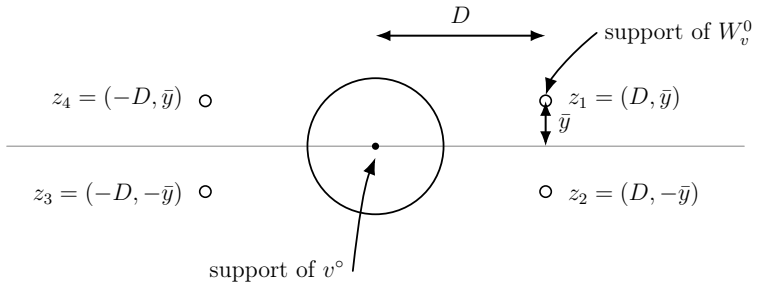
The engine of the proof is the magnetic hopping coefficient ρ0(λ)=⟨φ^L, (Hλ−eλ)φ^R⟩, which inversion symmetry makes real-valued, and the relation S0(λ) ≈ −2ρ0(λ), Δ0(λ)=|S0(λ)|. The single-well potential is a radial 'planet' λ²v◦ decorated with four 'sophons': tiny translated copies τ W^0(x−ζν) centered at (±D, ±ȳ). Zak's magnetic translation operator attaches oscillating phase factors exp(iλ d∧x) to atomic states, and the dominant planet–sophon interaction carries the phase λ d∧ζν = ±λD^{3/2}ȳ/2, producing the cosine in the expansion. The parameters δ=exp(−MλD^{3/2}) and τ=exp(−λ/4(2D^{5/2}−3D²)) are chosen so that planet–sophon interactions dominate planet–planet and sophon–sophon terms. A
What would settle it
Compute the spectrum of Hλ for the constructed potential with ȳ placed at a zero of cos(λD^{3/2}ȳ/2), e.g. ȳ = π/(λD^{3/2}). If the two lowest eigenvalues are not exactly degenerate—if E1−E0 remains positive with magnitude comparable to the predicted FACρ exp(−λ/4(D³−D²))—or if the even and odd ground states fail to cross, the central claim fails. Alternatively, scan ȳ and check whether the signed splitting S0 changes sign at all.
Extended reading notes
Core claim
The paper's central result is Theorem 1.1. Fix a smooth radial single-well potential v◦ satisfying hypotheses (V1)–(V5); fix d1 large. Then for all sufficiently large λ there is a family Fλ of smooth, compactly supported, non-positive single-well potentials, each within exp(−Cλ) of λ²v◦ in L∞ and differing from it only on a set of total measure exp(−Cλ), with these properties: some member has zero double-well eigenvalue splitting Δ0(λ)=0, hence no low-energy tunneling; some member has zero magnetic hopping coefficient ρ0(λ)=0; and by deforming within Fλ the signed splitting S0(λ)=E_odd−E_even changes sign, so the ground state switches parity, degenerating in between. The proof works by expan
Load-bearing premise
The whole argument rests on an energy estimate ensuring that the two lowest levels of the double well are exactly the even and odd ground states with a fixed gap to the rest of the spectrum; the sophon perturbations have to stay inside that estimate's regime, and the proof of that estimate is only sketched here.
Editorial extensions
If this is right
- For the constructed potential, the low-energy tunneling time 1/Δ0 becomes infinite: a state localized in one well stays there.
- At the degeneracy point the ground-state eigenspace is two-dimensional, spanned by one even and one odd state; moving through it flips the parity of the ground state.
- The vanishing is non-generic: within the same family, changing ȳ reopens a gap, so exact cancellation occurs at isolated parameter values.
- In a periodic array of such magnetic double wells, suppressed nearest-neighbor hopping points toward nearly flat magnetic bands near the atomic energy, as the authors note in their outlook.
- The construction shows that exponentially small, spatially placed potential perturbations—not large barriers—can completely eliminate magnetic tunneling.
Reading between the lines
- If the construction is robust, the same sophon-placement mechanism could cancel hopping in higher-dimensional or lattice settings, possibly with fewer than four bumps when reflection symmetry is not required.
- A direct numerical check is available: fix D, M, and λ, scan ȳ, and look for Δ0(λ) to dip to numerical zero at ȳ = (n+1/2)π/(λD^{3/2}); the corresponding tunneling time should diverge.
- The exact zero condition λD^{3/2}ȳ/2 = (n+1/2)π gives a clean relation between geometric placement, magnetic field strength, and energy degeneracy—potentially useful as a calibration or switching effect.
- The authors' expected result that zeros are non-generic in λ while the phenomenon is open in potential space suggests that exact vanishing is fragile but stably reachable by fine-tuning position, a feature that could matter for engineered quantum devices.
Editorial analysis
A structured set of objections, weighed in public.
Referee Report
Summary. The paper constructs a magnetic double-well Schrödinger Hamiltonian on R^2, in a strong constant magnetic field, whose two lowest eigenvalues are exactly degenerate, so that tunneling between the wells vanishes. The single-well potential is a radially symmetric 'planet' λ²v◦ perturbed by four very small, very localized 'sophon' potentials. The key object is the hopping coefficient ρ(λ), which is expanded into planet-planet, planet-sophon, and sophon-sophon interaction terms. The authors show that the dominant planet-sophon contribution is proportional to cos((λ/2)D^{3/2}ȳ) times an exponentially small positive factor, so by varying the vertical offset ȳ one can make ρ vanish or change sign. A linear-combination-of-atomic-orbitals (LCAO) reduction then identifies the eigenvalue splitting Δ(λ) with |−2ρ(λ)+error|, yielding the main theorem: a family of potentials with exactly zero tunneling, including a parity flip of the ground state at the degeneracy point.
Significance. If the proof is correct, this is a striking result: exact cancellation of tunneling in a magnetic double well, with no analogue in the non-magnetic case. The paper gives a concrete, parameter-dependent construction and a precise asymptotic formula for the hopping coefficient, with all exponential error terms controlled. The mechanism—using exponentially small symmetry-breaking perturbations to seed magnetic phase oscillations—is original and likely to influence later work on flat bands and tight-binding reductions. The claims are falsifiable through the explicit cosine formula and the predicted degeneracy at specific values of ȳ. The main limitation is that the proof relies on several prior results, and one load-bearing identity in the derivation of the cosine formula is stated with the wrong phase; this issue appears fixable but must be addressed before the central claim is established.
major comments (3)
- [§2.6.2, Eq. (2.30c), Prop. 2.13] The proof of Proposition 2.13 starts by writing Ω(ν,0) with the phase e^{+iλ/2 x∧y}, but the definition (2.30c) has e^{-iλ/2 x∧y}. With the definition, substitution x=−ỹ, y=−x̃ gives Ω(ν,0) = conjugate of Ω(0,ν), not Ω(0,ν). The asserted equality is used in §3.1.2 (the line 'We note that Ω◦(ν,0)=Ω◦(0,ν)' and Proposition 3.7) to produce the real cosine in (3.44). Moreover, if Ω(ν,0)=Ω(0,ν) as stated, then Ω(0,1)+Ω(0,2) is not automatically real because the factors Rν in Proposition 3.4 are real and may differ, and no proof of R1=R2 is given. Replacing the equality by the conjugate relation, together with a proof that Ω(0,2)=conj(Ω(0,1)), can still lead to the cosine formula, so the gap is probably repairable; as written, however, the derivation of the sign-changing cosine is not established.
- [§2.8, Prop. 2.16] The identification {E0,λ,E1,λ} = {Eeven,λ,Eodd,λ} is essential: it converts a zero of the hopping coefficient into a zero eigenvalue splitting, Δ=|S|. The proof is only a sketch and invokes an energy estimate from [FSW25a, Theorem 6.3] without stating the result or checking its hypotheses for the present λ-dependent potentials with exponentially small, distant sophons. Since this is the bridge between ρ and the actual spectrum of Hλ, the manuscript should either state a precise version of the cited estimate and verify its applicability, or give a complete proof. This is not a mere presentation issue; it is load-bearing for Theorems 2.21 and 1.1.
- [§3.1.3] The transition from the approximate hopping −ρ◦ to the full −ρ is dispatched in a short paragraph: 'The results of Appendix C imply ... terms in Ω(μ,ν)−Ω◦(μ,ν) all have at least one additional factor of τ ... bounded in a manner similar to (3.20).' Given that the parameter choices for τ and δ are delicate and are what makes the planet-sophon terms dominate, this step needs a more explicit estimate. In particular, the error should be tracked through all terms of (2.29), including the phase factors and the overlap integrals, so the asserted Proposition 2.14 can be checked without rederiving the argument.
minor comments (4)
- [§2.9, Eq. (2.41)] Typo: 'λmiin' should be 'λmin'.
- [§2.6.2, Prop. 2.13 proof] The phase in the first displayed equation of the proof appears to be a typo; with the definition (2.30c) it should read e^{−iλ/2 x∧y}. Please correct and adjust the surrounding text accordingly.
- [References] The citation [3BP] in Section 2.3 appears to be a work of fiction rather than a mathematical reference; consider replacing it with a standard perturbative/effective-Hamiltonian reference or removing the informal shorthand.
- [Theorem 1.1 statement] The statement says 'Let d1>0 be given and sufficiently large', but in the construction d1 is set to D^{3/2}/2 with D itself a large parameter chosen later. Please rephrase to avoid the impression that arbitrary large d1 are covered.
Circularity Check
No significant circularity: zero-tunneling conclusion emerges from the construction, not from an input or self-citation chain.
full rationale
The derivation chain is explicit: the potential vλ is constructed as λ²v◦ plus exponentially small 'sophon' perturbations; the hopping coefficient ρ is expanded via the resolvent kernel into planet/sophon interaction terms (2.28)-(2.30); Proposition 2.14 gives the oscillatory formula ρ = -[cos(λD^{3/2}ȳ/2)+ERR]·FAC·exp(-λ(D³-D²)/4); Proposition 2.20 connects the signed splitting to -2ρ; then the sign change and zero of ρ are obtained by varying the free parameter ȳ. The cosine phase is computed from the magnetic phases of the localized states, not inserted as an ansatz, and no parameter is fitted to the target Δ=0. The choice of τ and δ enforces dominance of the planet-sophon terms but does not force the sign of ρ. The paper does rely on the authors' own prior results — [FSW22] for the radial-well tunneling bounds and [FSW25a, Thm 6.3] for the spectral-gap/energy estimate used in Proposition 2.16 — but these are independent theorems with stated assumptions that do not include the vanishing-tunneling conclusion, so they are legitimate external support rather than circular self-citation. The 'sketch' label on Prop 2.16 and the possible phase/sign inconsistency in the proof of Prop 2.13 are mathematical correctness concerns, not reductions of the conclusion to its inputs. No equation is defined in terms of the target result, and no fitted quantity is renamed as a prediction.
Assumptions & free parameters
free parameters (4)
- ybar =
ybar*_n(lambda) = (n+1/2)pi / (lambda/2 D^{3/2}), n chosen so 0 < ybar < 1
- D =
sufficiently large (D >= Dmin)
- M =
sufficiently large
- lambda_min =
sufficiently large depending on v0, D, M
assumptions (3)
- domain assumption Radial ground state and uniform spectral gap for the radial single-well Hamiltonian h0_lambda (Assumptions (V1)-(V5), Section 2.1)
- standard math [FSW22, Theorem 1.7] lower bound on the radial magnetic hopping coefficient rho0,lambda(Y)
- standard math [FSW25a, Theorem 6.3] energy estimate for low-lying double-well magnetic spectra
Cite this review
Pith. "Pith review of Magnetic Double-Wells: Absence of Tunneling." pith.science (2026). https://pith.science/paper/CZ4BGWFJ
@misc{pith2026250902857,
  author       = {Pith},
  title        = {Pith review of: Magnetic Double-Wells: Absence of Tunneling},
  year         = {2026},
  howpublished = {\url{https://pith.science/paper/CZ4BGWFJ}},
  note         = {Machine review of arXiv:2509.02857}
}
read the original abstract
We present a magnetic double-well Hamiltonian where the tunneling between the two wells vanishes, as recently announced.
Figures

Forward citations
Cited by 1 Pith paper
-
Magnetic Double-Wells: Lower Bounds on Tunneling
For generic coupling λ in a strongly magnetic double well, the tunneling splitting and hopping coefficient are bounded below by exp(-λ^{1+ε}) outside a zero-density exceptional set.
Reference graph
Works this paper leans on
-
[2]
arXiv:2506.12650 [math-ph]. [FSW25b] Fefferman,C.L.,Shapiro,J.,andWeinstein,M.I.:Quantumtunnelingandits absence in deep wells and strong magnetic fields Proceedings of the National Academy of Sciences.122 (8), e2420062122 (2025) [HS84] Helffer, B. and Sjostrand, J.: Multiple wells in the semi-classical limit I Com- munications in Partial Differential Equa...
work page Pith review arXiv 2025
-
[157]
Providence, RI: American Mathematical Society, 2014.doi: 10.1090/ gsm/157
Graduate Studies in Mathe- matics. Providence, RI: American Mathematical Society, 2014.doi: 10.1090/ gsm/157. [Zak64] Zak, J.: Magnetic Translation Group Phys. Rev. 134, A1602–A1606 (1964) 40
work page 2014
-
[2014]
[Mat94] Matsumoto,H.:SemiclassicalasymptoticsofeigenvaluedistributionsforSchrödinger operators with magnetic fields Communications in Partial Differential Equa- tions. 19 (5-6), 719–759 (1994) [Mor24] Morin, L.: Tunneling effect between radial electric wells in a homogeneous magnetic field Letters in Mathematical Physics.114 (1), 29 (2024) [SW22] Shapiro,...
work page 1994
-
[2025]
The Flea on the Magnetic Elephant
arXiv: 2505.12846 [math-ph]. [FSW22] Fefferman, C., Shapiro, J., and Weinstein, M. I.: Lower Bound on Quantum Tunneling for Strong Magnetic Fields SIAM Journal on Mathematical Anal- ysis. 54 (1), 1105–1130 (2022) [FLW18] Fefferman,C.L.,Lee-Thorp,J.P.,andWeinstein,M.I.:HoneycombSchrödinger Operators in the Strong Binding Regime Communications on Pure and A...
work page Pith review arXiv 2022
Reviewed August 5, 2026 · model on record in the stance chip above.
Discussion (0). Sign in to comment.