Entanglement Complexity in Many-body Systems from Positivity Scaling Laws
Pith reviewed 2026-05-18 20:04 UTC · model grok-4.3
The pith
If a quantum system is solvable with level-p positivity independent of its size, its entanglement complexity scales polynomially with p.
A machine-rendered reading of the paper's core claim, the machinery that carries it, and where it could break.
Core claim
We prove a general complexity bound: if a quantum system is solvable with level-p positivity independent of its size, then its entanglement complexity scales polynomially with order p. This theorem connects structural constraints on RDMs with computational tractability and provides a rigorous framework for certifying when many-body methods including RDM methods can efficiently simulate correlated quantum matter and materials.
What carries the argument
p-particle positivity conditions, which form a hierarchy of N-representability constraints for an RDM to correspond to a valid N-particle quantum system and become exact when the Hamiltonian is a convex combination of positive semidefinite p-particle operators.
Load-bearing premise
The positivity conditions form a hierarchy of N-representability constraints for an RDM to correspond to a valid N-particle quantum system, becoming exact when the Hamiltonian can be expressed as a convex combination of positive semidefinite p-particle operators.
What would settle it
A counterexample would be a family of quantum systems that remain exactly solvable by size-independent level-p positivity yet display superpolynomial scaling of entanglement complexity with p.
Figures

read the original abstract
Area laws describe how entanglement entropy scales and thus provide important necessary conditions for efficient quantum many-body simulation, but they do not, by themselves, yield a direct measure of computational complexity. Here we introduce a complementary framework based on $p$-particle positivity conditions from reduced density matrix (RDM) theory. These conditions form a hierarchy of $N$-representability constraints for an RDM to correspond to a valid $N$-particle quantum system, becoming exact when the Hamiltonian can be expressed as a convex combination of positive semidefinite $p$-particle operators. We prove a general complexity bound: if a quantum system is solvable with level-$p$ positivity independent of its size, then its entanglement complexity scales polynomially with order $p$. This theorem connects structural constraints on RDMs with computational tractability and provides a rigorous framework for certifying when many-body methods including RDM methods can efficiently simulate correlated quantum matter and materials.
Editorial analysis
A structured set of objections, weighed in public.
Referee Report
Summary. The manuscript introduces a framework based on p-particle positivity conditions from reduced density matrix (RDM) theory. These form a hierarchy of N-representability constraints that become exact when the Hamiltonian is a convex combination of positive semidefinite p-particle operators. The central claim is a conditional theorem: if a quantum system is solvable with level-p positivity independent of its size, then its entanglement complexity scales polynomially with order p. This is positioned as connecting structural RDM constraints with computational tractability for many-body simulation methods.
Significance. If the theorem holds with the stated assumptions, the result supplies a rigorous, positivity-based criterion for when RDM methods and related approaches can efficiently simulate correlated quantum matter, complementing area-law analyses by directly addressing complexity scaling rather than entropy bounds alone. The conditional nature of the bound (tied to size-independent solvability) makes it a potentially useful diagnostic tool for certifying tractability.
major comments (1)
- The abstract states the general complexity bound but provides no derivation steps, explicit assumptions, or error analysis for the implication from the positivity hierarchy to polynomial scaling of entanglement complexity. The full manuscript must supply the key steps showing how level-p positivity (independent of size) produces the polynomial bound, including any intermediate reductions or definitions of entanglement complexity used in the argument.
Simulated Author's Rebuttal
We thank the referee for their careful reading of the manuscript and for the positive assessment of its potential significance. We address the major comment below and have revised the manuscript to improve the explicitness of the derivation.
read point-by-point responses
-
Referee: The abstract states the general complexity bound but provides no derivation steps, explicit assumptions, or error analysis for the implication from the positivity hierarchy to polynomial scaling of entanglement complexity. The full manuscript must supply the key steps showing how level-p positivity (independent of size) produces the polynomial bound, including any intermediate reductions or definitions of entanglement complexity used in the argument.
Authors: We agree that greater explicitness benefits the reader. The full manuscript already contains the proof in Section III, but we have now expanded it with a new subsection (III.B) that walks through the argument step by step. We first define entanglement complexity as the minimal scaling of the variational parameter count (or equivalent bond dimension) required to represent states consistent with the given positivity constraints. Lemma 1 shows that size-independent level-p positivity reduces the effective search space to a polynomial (in p) number of independent RDM elements. Lemma 2 then bounds the computational cost of solving the resulting semidefinite program, yielding the overall polynomial scaling. The assumptions (Hamiltonian as convex combination of p-particle PSD operators, size-independent solvability) are now stated at the beginning of the section. Because the bound is deterministic under these conditions, no separate error analysis appears; we have added a short remark clarifying this point. These changes are marked in the revised manuscript. revision: yes
Circularity Check
No significant circularity; derivation is a self-contained conditional theorem
full rationale
The paper states a conditional complexity bound: solvability via size-independent level-p positivity implies polynomial scaling of entanglement complexity with p. This is framed directly from the standard N-representability hierarchy of RDM positivity conditions and the exactness criterion (Hamiltonian as convex combination of PSD p-particle operators). No load-bearing step reduces by construction to a fitted parameter, self-definition, or unverified self-citation chain; the theorem connects structural RDM constraints to tractability without renaming known results or smuggling ansatzes. The derivation remains independent of the present paper's own fitted values or prior author-specific uniqueness theorems.
Axiom & Free-Parameter Ledger
axioms (1)
- domain assumption p-particle positivity conditions form a hierarchy of N-representability constraints for an RDM to correspond to a valid N-particle quantum system
Lean theorems connected to this paper
-
IndisputableMonolith/Cost/FunctionalEquation.leanwashburn_uniqueness_aczel unclear?
unclearRelation between the paper passage and the cited Recognition theorem.
We prove a general complexity bound: if a quantum system is solvable with level-p positivity independent of its size, then its entanglement complexity scales polynomially with order p.
-
IndisputableMonolith/Foundation/BranchSelection.leanbranch_selection unclear?
unclearRelation between the paper passage and the cited Recognition theorem.
the Hamiltonian can be expressed as a convex combination of positive semidefinite p-particle operators
What do these tags mean?
- matches
- The paper's claim is directly supported by a theorem in the formal canon.
- supports
- The theorem supports part of the paper's argument, but the paper may add assumptions or extra steps.
- extends
- The paper goes beyond the formal theorem; the theorem is a base layer rather than the whole result.
- uses
- The paper appears to rely on the theorem as machinery.
- contradicts
- The paper's claim conflicts with a theorem or certificate in the canon.
- unclear
- Pith found a possible connection, but the passage is too broad, indirect, or ambiguous to say the theorem truly supports the claim.
Reference graph
Works this paper leans on
-
[1]
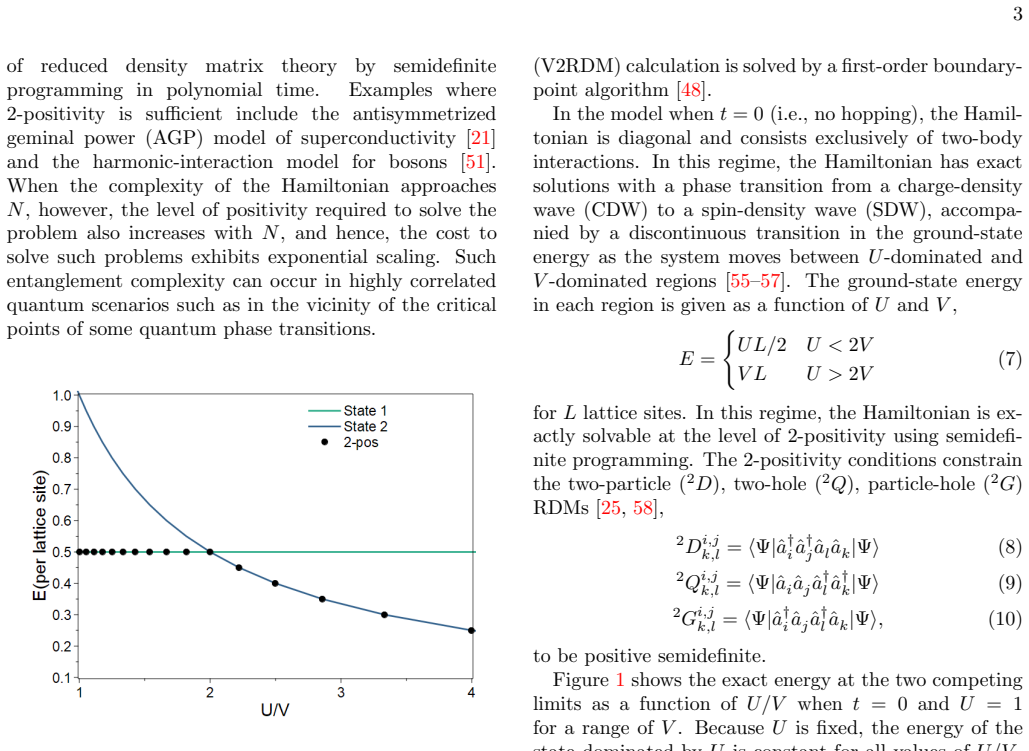
driven states are shown as solid lines. The ground state energy calculated with V2RDM with 2-positivity conditions (2-pos) is exact for this model and is shown as black points along the curves. Results: We illustrate the theorem by solving the ex- tended Hubbard model [52–54], given by, ˆH = −t X <i,j> ˆa† i ˆaj + h.c + U X i ˆa† i↑ˆai↑ˆa† i↓ˆai↓ + V X <i...
-
[2]
R. Horodecki, P. Horodecki, M. Horodecki, and K. Horodecki, Quantum entanglement, Rev. Mod. Phys. 81, 865 (2009)
work page 2009
- [3]
- [4]
-
[5]
Kais, Entanglement, electron correlation, and density matrices, Adv
S. Kais, Entanglement, electron correlation, and density matrices, Adv. Chem. Phys. 134, 493 (2007)
work page 2007
-
[6]
A. Kitaev and J. Preskill, Topological entanglement en- tropy, Phys. Rev. Lett. 96, 110404 (2006)
work page 2006
-
[7]
M. Levin and X.-G. Wen, Detecting topological order in a ground state wave function, Phys. Rev. Lett. 96, 110405 (2006)
work page 2006
-
[8]
L. Bombelli, R. K. Koul, J. Lee, and R. D. Sorkin, Quan- tum source of entropy for black holes, Phys. Rev. D 34, 373 (1986)
work page 1986
-
[9]
Srednicki, Entropy and area, Phys
M. Srednicki, Entropy and area, Phys. Rev. Lett. 71, 666 (1993)
work page 1993
-
[10]
M. B. Hastings, Lieb-Schultz-Mattis in higher dimen- sions, Phys. Rev. B 69, 104431 (2004)
work page 2004
-
[11]
M. B. Plenio, J. Eisert, J. Dreißig, and M. Cramer, En- tropy, entanglement, and area: Analytical results for harmonic lattice systems, Phys. Rev. Lett. 94, 060503 (2005)
work page 2005
-
[12]
M. B. Hastings, Entropy and entanglement in quantum ground states, Phys. Rev. B 76, 035114 (2007)
work page 2007
-
[13]
Schollw¨ ock, The density-matrix renormalization group, Rev
U. Schollw¨ ock, The density-matrix renormalization group, Rev. Mod. Phys. 77, 259 (2005)
work page 2005
-
[14]
M. B. Hastings, An area law for one-dimensional quan- tum systems, J. Stat. Mech. Theory Exp. 2007, P08024 (2007)
work page 2007
- [15]
-
[16]
S. R. White, Density matrix formulation for quantum renormalization groups, Phys. Rev. Lett.69, 2863 (1992)
work page 1992
-
[17]
F. Verstraete and J. I. Cirac, Matrix product states rep- resent ground states faithfully, Phys. Rev. B 73, 094423 (2006)
work page 2006
-
[18]
D. A. Mazziotti, Structure of fermionic density matrices: Complete N-representability conditions, Phys. Rev. Lett. 108, 263002 (2012)
work page 2012
-
[19]
D. A. Mazziotti, Quantum many-body theory from a solution of the N-representability problem, Phys. Rev. Lett. 130, 153001 (2023)
work page 2023
-
[20]
A. J. Coleman, Structure of fermion density matrices, Rev. Mod. Phys. 35, 668 (1963)
work page 1963
-
[21]
Kummer, N-representability problem for reduced den- sity matrices, J
H. Kummer, N-representability problem for reduced den- sity matrices, J. Math. Phys. 8, 2063 (1967)
work page 2063
-
[22]
A. J. Coleman and V. I. Yukalov, Reduced Density Ma- trices: Coulson ’s Challenge , Vol. 72 (Springer Science & Business Media, 2000)
work page 2000
-
[23]
D. A. Mazziotti and R. M. Erdahl, Uncertainty rela- tions and reduced density matrices: Mapping many-body quantum mechanics onto four particles, Phys. Rev. A63, 042113 (2001)
work page 2001
-
[24]
J. B. Lasserre, Global Optimization with Polynomials and the Problem of Moments, SIAM J. Optim. 11, 796 (2001)
work page 2001
-
[25]
D. A. Mazziotti, Realization of quantum chemistry with- out wave functions through first-order semidefinite pro- gramming, Phys. Rev. Lett. 93, 213001 (2004)
work page 2004
-
[26]
D. A. Mazziotti, Reduced-density-matrix Mechanics: With Application to Many-electron Atoms and Molecule , Vol. 134 (Adv. Chem. Phys., Wiley, New York, 2007)
work page 2007
- [27]
-
[28]
Z. Zhao, B. J. Braams, M. Fukuda, M. L. Overton, and J. K. Percus, The reduced density matrix method for electronic structure calculations and the role of three- index representability conditions, J. Chem. Phys. 120, 2095 (2004)
work page 2095
-
[29]
N. Shenvi and A. F. Izmaylov, Active-space N- representability constraints for variational two-particle reduced density matrix calculations, Phys. Rev. Lett. 105, 213003 (2010)
work page 2010
-
[30]
B. Verstichel, H. v. Aggelen, W. Poelmans, and D. V. Neck, Variational Two-Particle Density Matrix Calcula- tion for the Hubbard Model Below Half Filling Using Spin-Adapted Lifting Conditions, Phys. Rev. Lett. 108, 213001 (2011), 1110.5732
work page internal anchor Pith review Pith/arXiv arXiv 2011
- [31]
-
[32]
A. E. DePrince III, Variational determination of the two-electron reduced density matrix: A tutorial review, WIREs Comput. Mol. Sci. 14, e1702 (2024)
work page 2024
-
[33]
M. Piris, Global Natural Orbital Functional: Towards the Complete Description of the Electron Correlation, Phys. Rev. Lett. 127, 233001 (2021), 2112.02119
-
[34]
C. Schilling and S. Pittalis, Ensemble Reduced Density Matrix Functional Theory for Excited States and Hi- erarchical Generalization of Pauli’s Exclusion Principle, Phys. Rev. Lett. 127, 023001 (2021), 2106.02560
-
[35]
X. Han, S. A. Hartnoll, and J. Kruthoff, Bootstrapping matrix quantum mechanics, Phys. Rev. Lett.125, 041601 (2020)
work page 2020
-
[36]
Q. Gao, R. A. Lanzetta, P. Ledwith, J. Wang, and E. Khalaf, Bootstrapping the quantum hall problem, Phys. Rev. X 15, 031034 (2025)
work page 2025
-
[37]
M. G. Scheer, Hamiltonian Bootstrap, arXiv 10.48550/arxiv.2410.00810 (2024), 2410.00810
-
[38]
D. A. Mazziotti, Variational reduced-density-matrix method using three-particle N-representability condi- tions with application to many-electron molecules, Phys. Rev. A 74, 032501 (2006)
work page 2006
-
[39]
J. Xie, S. Ewing, J.-N. Boyn, A. S. Filatov, B. Cheng, T. Ma, G. L. Grocke, N. Zhao, R. Itani, X. Sun, H. Cho, Z. Chen, K. W. Chapman, S. N. Patel, D. V. Talapin, J. Park, D. A. Mazziotti, and J. S. Anderson, Intrinsic glassy-metallic transport in an amorphous coordination polymer, Nature 611, 479 (2022)
work page 2022
-
[40]
A. O. Schouten, J. E. Klevens, L. M. Sager-Smith, J. Xie, J. S. Anderson, and D. A. Mazziotti, Potential for exciton condensation in a highly conductive amorphous polymer, Phys. Rev. Mater. 7, 045001 (2023)
work page 2023
-
[41]
L. I. Payne Torres, A. O. Schouten, and D. A. Mazz- 6 iotti, Molecular origins of exciton condensation in van der Waals heterostructure bilayers, Chem. Sci. 15, 20371 (2024)
work page 2024
-
[42]
A. O. Schouten, S. Ewing, and D. A. Mazziotti, Boot- strapping the Electronic Structure of Quantum Materi- als, arXiv 10.48550/arxiv.2504.02861 (2025), 2504.02861
-
[43]
S. Ferrara, A. Grillo, and R. Gatto, Tensor representa- tions of conformal algebra and conformally covariant op- erator product expansion, Ann. Physics 76, 161 (1973)
work page 1973
-
[44]
A. M. Polyakov, Nonhamiltonian approach to conformal quantum field theory, Zh. Eksp. Teor. Fiz 66, 23 (1974)
work page 1974
- [45]
- [46]
-
[47]
D. A. Mazziotti, Enhanced Constraints for Accurate Lower Bounds on Many-Electron Quantum Energies from Variational Two-Electron Reduced Density Matrix Theory, Phys. Rev. Lett. 117, 153001 (2016)
work page 2016
-
[48]
The Electronic Ground State Energy Problem: a New Reduced Density Matrix Approach
E. Canc` es, G. Stoltz, and M. Lewin, The electronic ground-state energy problem: A new reduced density matrix approach, J. Chem. Phys. 125, 064101 (2006), quant-ph/0602042
work page internal anchor Pith review Pith/arXiv arXiv 2006
-
[49]
D. A. Mazziotti, Large-scale semidefinite programming for many-electron quantum mechanics, Phys. Rev. Lett. 106, 083001 (2011)
work page 2011
- [50]
-
[51]
L. Vandenberghe and S. Boyd, Semidefinite Program- ming, SIAM Review 38, 49 (1996)
work page 1996
-
[52]
G. Gidofalvi and D. A. Mazziotti, Boson correlation en- ergies via variational minimization with the two-particle reduced density matrix: Exact N-representability condi- tions for harmonic interactions, Phys. Rev. A 69, 042511 (2004)
work page 2004
-
[53]
Y. Zhang and J. Callaway, Extended Hubbard model in two dimensions, Phys. Rev. B 39, 9397 (1989)
work page 1989
-
[54]
M. Qin, T. Sch¨ afer, S. Andergassen, P. Corboz, and E. Gull, The Hubbard model: A computational perspec- tive, Annu. Rev. Condens. Matter Phys. 13, 275 (2022)
work page 2022
-
[55]
D. P. Arovas, E. Berg, S. A. Kivelson, and S. Raghu, The Hubbard model, Annu. Rev. Condens. Matter Phys. 13, 239 (2022)
work page 2022
-
[56]
J. E. Hirsch, Charge-density-wave to spin-density-wave transition in the extended Hubbard model, Phys. Rev. Lett. 53, 2327 (1984)
work page 1984
-
[57]
P. G. J. van Dongen, Exact mean-field theory of the ex- tended simplified Hubbard model, Phys. Rev. B 45, 2267 (1992)
work page 1992
-
[58]
E. Jeckelmann, Ground-state phase diagram of a half- filled one-dimensional extended Hubbard model, Phys. Rev. Lett. 89, 236401 (2002)
work page 2002
-
[59]
C. Garrod and J. K. Percus, Reduction of the N -Particle Variational Problem, J. Math. Phys. 5, 1756 (1964)
work page 1964
-
[60]
R. M. Erdahl, Representability, Int. J. Quantum Chem. 13, 697 (1978)
work page 1978
-
[61]
C. A. Schwerdtfeger and D. A. Mazziotti, Convex-set description of quantum phase transitions in the trans- verse Ising model using reduced-density-matrix theory, J. Chem. Phys. 130, 224102 (2009)
work page 2009
discussion (0)
Sign in with ORCID, Apple, or X to comment. Anyone can read and Pith papers without signing in.