REVIEW 5 major objections 5 minor 34 references
This paper claims optimized traditional OCR, not large vision-language models, is the best choice for multilingual edge deployment.
Reviewed by Pith at T0; open to challenge. T0 means a machine referee read the full paper against a public rubric. the ladder, T0–T4 →
T0 review · deepseek-v4-flash
2026-08-05 10:47 UTC pith:NV4WGRQN
load-bearing objection Useful efficiency data, but the accuracy ranking is unverifiable without the private dataset and a validated judge. the 5 major comments →
E-ARMOR: Edge case Assessment and Review of Multilingual Optical Character Recognition
The pith
A machine-rendered reading of the paper's core claim, the machinery that carries it, and where it could break.
Core claim
The paper's core claim is that Sprinklr-Edge-OCR, a proprietary optimized version of PaddleOCR using detection, recognition, and TensorRT acceleration, achieves the best composite performance among seven systems for multilingual edge OCR. On the authors' private 54-language image set, it reports the highest F1 score (0.4570), the highest semantic similarity score (7.2 out of 9), and the highest composite score (92.6 out of 100), while using 0.17 seconds per image on a T4 GPU and costing $0.006 per 1,000 images. Among LVLMs, Qwen-VL has the highest precision (0.5426) and GOT OCR has the lowest character error rate, but no LVLM matches the overall accuracy-efficiency balance. The authors also
What carries the argument
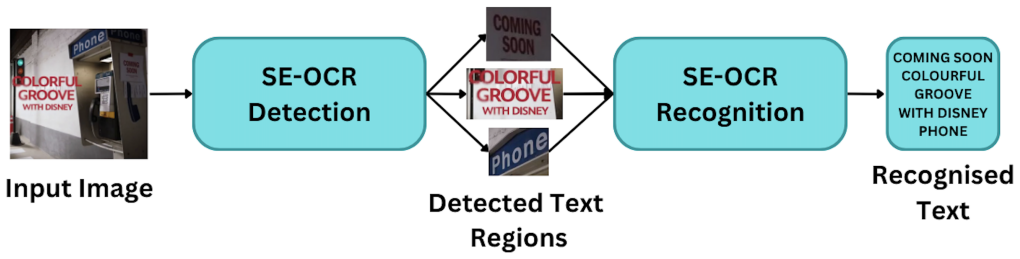
The central object is Sprinklr-Edge-OCR, a two-stage text detection and recognition pipeline derived from PaddleOCR, trimmed to essential OCR modules and accelerated with TensorRT for low latency and memory use. It carries the argument by being the optimized system the paper pits against five LVLMs and another traditional engine. The second load-bearing mechanism is the evaluation design: a private, doubly hand-annotated 54-language image dataset, a fixed prompt given to every model, and a Qwen3-8B large language model that acts as a judge, assigning a 0-9 similarity score comparing each prediction with ground truth.
Load-bearing premise
The rankings rest on a private, doubly hand-annotated dataset and a single LLM judge whose size, sampling, and scoring behavior are not reported; if the dataset skews toward easy or English-heavy images, or the judge favors fluent answers over exact text, the headline results could flip.
What would settle it
Run all seven models on a public, language-balanced OCR benchmark with exact ground truth and compute F1 by direct word matching instead of LLM-judge similarity; if Sprinklr-Edge-OCR no longer tops the ranking, the paper's central claim fails. A second check: repeat the CPU-only test on a Raspberry Pi-class device to see whether the 4.36 s versus 69.38 s gap and sub-1 GiB memory claim reproduce outside the authors' hardware.
If this is right
- For edge deployments such as kiosks, document scanners, and phones, optimized traditional OCR pipelines remain the default choice; LVLMs are not yet competitive under realistic latency, memory, and cost budgets.
- The reported speed and cost gap implies that high-volume OCR workloads can run on CPU-only hardware at about $0.006 per 1,000 images, opening applications that would be uneconomical with LVLM-based OCR.
- Lightweight, quantized, task-specific pipelines can match or exceed much larger multimodal models on text-extraction metrics, so model scale alone is not the deciding factor in OCR accuracy.
- Public benchmarks like OCRBench v2 can validate lightweight OCR systems without requiring cloud-grade GPUs, giving practitioners a low-cost way to compare options before deployment.
Where Pith is reading between the lines
- The paper leaves implicit that its dataset is heavily English-dominated (over 80% of samples), so the '54 languages' claim does not mean balanced multilingual evidence; the ranking may not hold for low-resource or non-Latin scripts with far fewer samples.
- The LLM judge (Qwen3-8B) may favor fluent, language-model-like outputs over exact string fidelity; replacing it with normalized edit-distance metrics could change the similarity and composite rankings.
- A hybrid strategy is a natural extension the paper does not explore: route easy images to the cheap traditional pipeline and send hard or ambiguous cases to an LVLM, amortizing cost while recovering recall.
- Because the dataset, annotation protocol, and judge prompts are proprietary, an independent replication on a public multilingual corpus would be needed to verify that the 35x speed and cost advantages generalize.
Editorial analysis
A structured set of objections, weighed in public.
Referee Report
Summary. E-ARMOR reports a comparative benchmark of seven OCR systems—five LVLMs (InternVL, Qwen2-VL-2B-OCR, GOT-OCR-2.0, LLaMA-3.2-11B, MiniCPM-V-2.6) and two traditional engines (proprietary Sprinklr-Edge-OCR, Surya)—on a proprietary, doubly hand-annotated dataset of images in 54 languages. The authors introduce Sprinklr-Edge-OCR, a PaddleOCR-based pipeline with TensorRT acceleration and proprietary optimizations. On accuracy metrics, Sprinklr-Edge-OCR is reported to achieve the highest F1 (0.4570) and similarity score (7.2); Qwen achieves the highest precision (0.5426) and GOT the lowest CER (0.6459). Sprinklr also reports the lowest latency (0.17 s/image), memory (1970 MiB), and cost ($0.006/1000 images), and in CPU-only tests beats Qwen-VL by 15.9× in latency and 12.1× in RAM. The paper concludes that optimized traditional OCR remains the most practical choice for edge deployment.
Significance. The question is timely and the scope is broad. The paper is one of few to jointly report accuracy, semantic similarity, latency, memory, GPU utilization, and cost for both LVLMs and classical OCR, and it explicitly evaluates CPU-only deployment. The authors also attempt an external sanity check on OCRBench v2. If the measurements were independently reproducible, the main conclusion (optimized traditional OCR can beat large multimodal models on F1 at a tiny fraction of the compute) would be practically valuable. However, the paper currently does not provide enough evidence to support that conclusion: the private dataset is not described with sufficient statistics, the LLM-based similarity judge is uncalibrated, the composite ranking is built from arbitrarily normalized metrics, and the cost calculation appears to contain an error. The strengths are the breadth of metrics and the explicit edge-deployment framing; the weakness is that every headline number depends on choices and data that are not independently checkable.
major comments (5)
- [§II (Dataset, Figures 1–2)] The paper never states the number of images, per-language sample sizes, sampling procedure, or annotation instructions/agreement. 'Doubly hand annotated' is asserted without a protocol or inter-annotator agreement. Since Figure 1 shows >80% English and Figure 2 shows most images have <10 words, the reported F1 scores (e.g., Sprinklr 0.4570 vs MiniCPM 0.3804) may be driven by the English/mostly-short-text majority; no language-stratified results are given. Without these numbers, the central accuracy ranking cannot be assessed or reproduced.
- [§II-C (Similarity Score, LLM Judge)] The Qwen3-8B judge is used as the semantic-similarity metric, but no human agreement, per-language calibration, or sensitivity analysis is reported. The rubric says the judge should focus on 'presence of exact ground truth words' while the text also claims it captures 'spelling variations, translation errors'; these are inconsistent. Because the judge is itself a Qwen-family model and one of the evaluated systems is also a Qwen model, independent calibration is especially important. As written, the 0–9 scores are an arbitrary input to the ranking.
- [§III (Composite score paragraph)] The composite score is an unweighted average of min-max-normalized metrics, but no equation is given, no sensitivity to normalization is reported, and the weights are arbitrary. The paper's 'best overall' language is partly based on this composite (Sprinklr 92.6 vs GOT 72.1). The ranking by composite may change under different normalization choices (e.g., using raw F1 only, Qwen/GOT/Sprinklr are much closer). Please provide the exact formula and a sensitivity analysis.
- [§III, Table II (Cost per 1,000 images)] The reported cost per 1,000 images appears to be obtained by dividing the elapsed cost by 'Number of Threads' without any throughput measurement. For Sprinklr-Edge-OCR, using the stated $0.526/hr and 0.17 s/image gives 1000×0.17/3600×0.526 = $0.0248, not $0.006. The correct cost depends on whether the benchmark ran 4 images concurrently; this is not reported. The same pattern holds for the 2-thread models (GOT and Surya). The cost advantage (claimed '<0.01×') is inflated by this unexplained division. Please report total wall-clock time for the batch and calculate cost from that.
- [§III-A and §V (CPU-only analysis and language coverage)] The CPU-only experiment compares only Sprinklr-Edge-OCR against Qwen-VL, yet the conclusion generalizes to 'traditional OCR systems' vs 'LVLMs'. No CPU results for Surya or other LVLMs are reported. Also, the Discussion states Sprinklr supports 5 languages, while the benchmark claims 54 languages; if the engine was evaluated outside its declared language support, the F1 and similarity results are not comparable. Please clarify the language coverage actually exercised and narrow the conclusion or add models.
minor comments (5)
- [Throughout] Table references are inconsistent: the model overview is Table I but the text says 'Table 1'; the results table is Table II but the text says 'Table 2'. Please standardize numbering.
- [Abstract] The abstract says '35 faster' and 'less than 0.01 of the cost'; the multiplication symbols are missing (should be '35×' and '0.01×').
- [Figure 3 / naming] The pipeline figure and text use 'SE-OCR' while the rest of the paper uses 'Sprinklr-Edge-OCR'. Please use one consistent name.
- [§III (OCRBench v2)] The 'average score of 55.4/100' on OCRBench v2 is reported without a per-dataset breakdown, a comparison table with the cited models, or the number of samples. This external validation is not verifiable as written.
- [References] The 'LLM-as-judge' claim cites the authors' own prior work (ref [31]). Consider also citing independent human-agreement studies, or better, report human agreement on a held-out set.
Circularity Check
No significant circularity: the benchmark is a measurement exercise; the central ranking does not reduce to its inputs.
full rationale
The paper's central claim—that Sprinklr-Edge-OCR achieves the best F1, similarity, speed, and cost among the tested systems—is the outcome of running seven systems on a private dataset and measuring outputs against human ground truth. No metric is defined in terms of the ranking it is said to establish. The composite score is explicitly described as a normalized average of the component metrics, so it is a summary of the measurements, not an independent derivation. The Similarity Score is produced by an external LLM judge (Qwen3-8B) using a pre-specified 0-9 rubric; the judge is not fitted to the benchmark and its outputs are not fed back into any model, so there is no fitted-input-called-prediction step. The one self-citation ([31], Harbola and Purwar) supports the general LLM-as-judge premise, but the paper also cites independent external work ([20], Zheng et al.) for the same premise, making the self-citation non-load-bearing. Additionally, the paper provides an external validation result on OCRBench v2, which independently supports Sprinklr-Edge-OCR's accuracy. The principal weaknesses of the paper are validity and verifiability concerns—the private dataset is undisclosed, judge calibration and human agreement are not reported, and some cost/latency numbers appear internally inconsistent—but these are correctness risks, not circular reasoning. No equation in the paper is equivalent to its conclusion by construction, and no load-bearing result is imported solely from the authors' prior work.
Axiom & Free-Parameter Ledger
free parameters (3)
- Composite score normalization =
None (equal weights on normalized metrics)
- LLM judge score thresholds =
0-9 scales with bands for 9, 7-8, 4-6, 1-3, 0
- Cost parallelism factor =
Number of threads per model (1, 2, or 4)
axioms (3)
- ad hoc to paper The proprietary dataset is representative of real-world multilingual edge OCR
- ad hoc to paper Qwen3-8B as judge reliably measures word-level presence across 54 languages without bias
- domain assumption Cloud GPU instance cost is an appropriate proxy for edge deployment cost
invented entities (1)
-
Sprinklr-Edge-OCR architecture with proprietary enhancements
no independent evidence
Cite this review
Pith. "Pith review of E-ARMOR: Edge case Assessment and Review of Multilingual Optical Character Recognition." pith.science (2026). https://pith.science/paper/NV4WGRQN
@misc{pith2026250903615,
  author       = {Pith},
  title        = {Pith review of: E-ARMOR: Edge case Assessment and Review of Multilingual Optical Character Recognition},
  year         = {2026},
  howpublished = {\url{https://pith.science/paper/NV4WGRQN}},
  note         = {Machine review of arXiv:2509.03615}
}
read the original abstract
Optical Character Recognition (OCR) in multilingual, noisy, and diverse real-world images remains a significant challenge for optical character recognition systems. With the rise of Large Vision-Language Models (LVLMs), there is growing interest in their ability to generalize and reason beyond fixed OCR pipelines. In this work, we introduce Sprinklr-Edge-OCR, a novel OCR system built specifically optimized for edge deployment in resource-constrained environments. We present a large-scale comparative evaluation of five state-of-the-art LVLMs (InternVL, Qwen, GOT OCR, LLaMA, MiniCPM) and two traditional OCR systems (Sprinklr-Edge-OCR, SuryaOCR) on a proprietary, doubly hand annotated dataset of multilingual (54 languages) images. Our benchmark covers a broad range of metrics including accuracy, semantic consistency, language coverage, computational efficiency (latency, memory, GPU usage), and deployment cost. To better reflect real-world applicability, we also conducted edge case deployment analysis, evaluating model performance on CPU only environments. Among the results, Qwen achieved the highest precision (0.54), while Sprinklr-Edge-OCR delivered the best overall F1 score (0.46) and outperformed others in efficiency, processing images 35 faster (0.17 seconds per image on average) and at less than 0.01 of the cost (0.006 USD per 1,000 images) compared to LVLM. Our findings demonstrate that the most optimal OCR systems for edge deployment are the traditional ones even in the era of LLMs due to their low compute requirements, low latency, and very high affordability.
Figures




Reference graph
Works this paper leans on
-
[1]
Bai, J., Bai, S., Yang, S., Wang, S., Tan, S., Wang, P., Lin, J., Zhou, C., & Zhou, J. (2023). Qwen-VL: A Versatile Vision-Language Model for Fig. 9. Example outputs for a publicly available challenging image, time taken and similarity score of various models along with ground truth Understanding, Localization, Text Reading, and Beyond. arXiv preprint arX...
Pith/arXiv arXiv 2023
-
[2]
Bautista, D., & Atienza, R. (2022). Scene text recognition with permuted autoregressive sequence models. In European Conference on Computer Vision (pp. 593–610). Springer
work page 2022
-
[3]
Deng, J., Dong, W., Socher, R., Li, L.-J., Li, K., & Fei-Fei, L. (2009). Imagenet: A large-scale hierarchical image database. In 2009 IEEE Conference on Computer Vision and Pattern Recognition (pp. 248–255). IEEE
work page 2009
-
[4]
Dosovitskiy, A., et al. (2021). An image is worth 16x16 words: Trans- formers for image recognition at scale. International Conference on Learning Representations
work page 2021
-
[5]
Du, Y ., et al. (2022). PP-OCRv3: More Robust and Accurate Scene Text Recognizer. arXiv preprint arXiv:2206.03001
Pith/arXiv arXiv 2022
-
[6]
Fang, S., Xie, H., Wang, Y ., Mao, Z., & Zhang, Y . (2021). Read like humans: Autonomous, bidirectional and iterative language modeling for scene text recognition. In CVPR (pp. 7098–7107)
work page 2021
-
[7]
Fu, L., et al. (2025). OCRBench v2: An Improved Benchmark for Evaluating Large Multimodal Models on Visual Text Localization and Reasoning. arXiv preprint arXiv:2501.00321
Pith/arXiv arXiv 2025
-
[8]
Kim, G., et al. (2021). OCR-free document understanding transformer. arXiv preprint arXiv:2111.15664
Pith/arXiv arXiv 2021
-
[9]
Kuang, Z., et al. (2021). MMOCR: A Comprehensive Toolbox for Text Detection, Recognition and Understanding. In arXiv preprint arXiv:2108.06543
work page internal anchor Pith review Pith/arXiv arXiv 2021
-
[10]
Li, M., et al. (2023). TrOCR: Transformer-based Opti- cal Character Recognition with Pre-trained Models. In https://doi.org/10.1609/aaai.v37i11.26538
-
[11]
Liao, H., et al. (2023). DocTr: Document Transformer for Structured In- formation Extraction in Documents. In arXiv preprint arXiv:2110.12942
work page internal anchor Pith review Pith/arXiv arXiv 2023
-
[12]
Paruchuri, V ., & Datalab Team. (2025). Surya: A lightweight docu- ment OCR and analysis toolkit. GitHub repository: https://github.com/ datalab-to/surya
work page 2025
-
[13]
Qwen Team. (2025). Qwen3 Technical Report. arXiv preprint arXiv:2505.09388
Pith/arXiv arXiv 2025
-
[14]
Smith, R. (2007). An overview of the Tesseract OCR engine. In ICDAR doi: 10.1109/ICDAR.2007.4376991
arXiv 2007
-
[15]
Touvron, H., et al. (2023). LLaMA: Open and efficient foundation language models. arXiv preprint arXiv:2302.13971
Pith/arXiv arXiv 2023
-
[16]
Wei, H., et al. (2024). General OCR Theory: Towards OCR-2.0 via a Unified End-to-end Model. arXiv preprint arXiv:2409.01704
Pith/arXiv arXiv 2024
-
[17]
Xie, E., et al. (2021). SegFormer: Simple and efficient design for seman- tic segmentation with transformers. In arXiv preprint arXiv:2105.15203
Pith/arXiv arXiv 2021
-
[18]
Yao, Y ., et al. (2024). MiniCPM-V: A GPT-4V Level MLLM on Your Phone. arXiv preprint arXiv:2408.01800
Pith/arXiv arXiv 2024
-
[19]
Zhai, X., et al. (2023). Sigmoid loss for language image pre-training. In arXiv preprint arXiv:2303.15343
Pith/arXiv arXiv 2023
-
[20]
Zheng, L., et al. (2023). Judging LLM-as-a-judge with MT-Bench and Chatbot Arena. arXiv preprint arXiv:2306.05685
Pith/arXiv arXiv 2023
-
[21]
Zhu, J., et al. (2025). InternVL3: Exploring Advanced Training and Test-Time Recipes for Open-Source Multimodal Models. arXiv preprint arXiv:2504.10479
Pith/arXiv arXiv 2025
-
[22]
GitHub repository: https://github.com/jpuigcerver/PyLaia
PyLaila: A Lightweight Multilingual OCR Library. GitHub repository: https://github.com/jpuigcerver/PyLaia
-
[23]
Kiessling, B. (2019). Kraken: An Universal Text Recognizer for the Humanities. In DH2019: Digital Humanities Conference. GitHub repos- itory: https://github.com/mittagessen/kraken
work page 2019
-
[24]
InstructOCR: Instruction-Tuned Multilingual Scene Text Recognition. GitHub repository: https://github.com/AlibabaResearch/ AdvancedLiterateMachinery/tree/main/InstructOCR
-
[25]
Huang, M., Li, H., Liu, Y ., Bai, X., & Jin, L. (2024). Bridging the Gap Between End-to-End and Two-Step Text Spotting. arXiv preprint arXiv:2404.04624
work page internal anchor Pith review Pith/arXiv arXiv 2024
-
[26]
Nassar, A., Marafioti, A., Omenetti, M., Lysak, M., Livathinos, N., Auer, C., Morin, L., Teixeira de Lima, R., Kim, Y ., Gurbuz, A.S., Dolfi, M., Farr´e, M. and Staar, P.W.J. (2025). SmolDocling: An ultra-compact vision-language model for end-to-end multi-modal document conver- sion. arXiv preprint arXiv:2503.11576
Pith/arXiv arXiv 2025
-
[27]
Zhibo Yang, Jun Tang, Zhaohai Li, Pengfei Wang, Jianqiang Wan, Humen Zhong, Xuejing Liu, Mingkun Yang, Peng Wang, Shuai Bai, LianWen Jin, and Junyang Lin. CC-OCR: A Comprehensive and Chal- lenging OCR Benchmark for Evaluating Large Multimodal Models in Literacy. arXiv preprint arXiv:2412.02210, December 2024. :contentRe- ference[oaicite:2]index=2
Pith/arXiv arXiv 2024
-
[28]
Benchmarking Vision-Language Models on Optical Char- acter Recognition in Dynamic Video Environments
Sankalp Nagaonkar, Augustya Sharma, Ashish Choithani, and Ashutosh Trivedi. Benchmarking Vision-Language Models on Optical Char- acter Recognition in Dynamic Video Environments. arXiv preprint arXiv:2502.06445, February 2025. :contentReference[oaicite:4]index=4
Pith/arXiv arXiv 2025
-
[29]
WACV Workshop on VisionDocs (2025), January 2025
Suraj Singh, A Comparative Analysis of OCR Models on Diverse Datasets: Insights and Efficiency. WACV Workshop on VisionDocs (2025), January 2025. :contentReference[oaicite:5]index=5
work page 2025
-
[30]
Bhawna Piryani, Jamshid Mozafari, Abdelrahman Abdallah, Antoine Doucet, and Adam Jatowt. MultiOCR-QA: Dataset for Evaluating Robustness of LLMs in Question Answering on Multilingual OCR Texts. arXiv preprint arXiv:2502.16781 , February 2025. :contentRef- erence[oaicite:6]index=6
arXiv 2025
-
[31]
Chitranshu Harbola and Anupam Purwar. KnowsLM: A framework for evaluation of small language models for knowledge augmentation and humanised conversations. arXiv preprint arXiv:2504.04569, April 2025. :contentReference[oaicite:1]index=1
work page internal anchor Pith review Pith/arXiv arXiv 2025
-
[32]
Song Han, Huizi Mao, and William J. Dally. Deep Compression: Compressing Deep Neural Networks with Pruning, Trained Quantization and Huffman Coding. arXiv preprint arXiv:1510.00149 , October 2015
Pith/arXiv arXiv 2015
-
[33]
Performance Eval- uation of INT8 Quantized Inference on Mobile GPUs
Seungmin Kim, Gwangjin Park, and Youngwoo Yi. Performance Eval- uation of INT8 Quantized Inference on Mobile GPUs. IEEE Access , 2021
work page 2021
-
[34]
B. Gautam and A. Purwar, Evaluating the Efficacy of Open-Source LLMs in Enterprise-Specific RAG Systems: A Comparative Study of Performance and Scalability, arXiv preprint arXiv:2406.11424, 2024
Pith/arXiv arXiv 2024
discussion (0)
Sign in with ORCID, Apple, or X to comment. Anyone can read and Pith papers without signing in.