REVIEW 3 major objections 5 minor 3 cited by
LuxDiT, a video diffusion transformer fine-tuned on synthetic renders and adapted with LoRA on real HDR panoramas, generates HDR environment maps from a single image or video and cuts sun-direction error on sunny outdoor scenes by roughly 4
Reviewed by Pith at T0; open to challenge. T0 means a machine referee read the full paper against a public rubric. the ladder, T0–T4 →
A video diffusion transformer fine-tuned on synthetic and real data predicts HDR environment maps from images/videos, cutting peak light-direction error by roughly 45% on sunny outdoor scenes versus DiffusionLight.
T0 review reviewed 2026-08-05 challenge →
load-bearing objection A genuinely new mechanism for HDR lighting estimation that mostly delivers on its claims, but the paper's own LoRA-scale supplement, a Table 7 copy-paste error, and an abstract broader than the Laval Indoor numbers all say: referee it carefully, don't desk-reject it. the 3 major comments →
LuxDiT: Lighting Estimation with Video Diffusion Transformer
The pith
A machine-rendered reading of the paper's core claim, the machinery that carries it, and where it could break.
The reading
Core claim
The paper's central claim is that a video diffusion transformer, conditioned on visual input through token-level attention rather than channel concatenation, can directly synthesize HDR environment maps whose direction, intensity, and temporal stability beat existing approaches. The HDR target is represented as two complementary tone-mapped latent streams, Reinhard and log, decoded and fused by a lightweight MLP. Stage I training on randomized synthetic scenes supplies physically grounded shading cues; Stage II applies LoRA on real HDR panoramas to align predicted lighting with the input scene's semantics. The reported result is a roughly 45% reduction in mean peak angular error on Laval Out
What carries the argument
Three components carry the argument: (1) a dual-tonemapped HDR representation, where the same panorama is encoded as a Reinhard-mapped LDR image and a log-intensity LDR image, allowing a latent diffusion model trained on LDR data to generate HDR content; (2) token-based conditioning, in which input video latents are flattened into tokens and processed jointly with denoising tokens under separate adaptive layer normalization, enabling global reasoning over non-local shading cues; and (3) a two-stage training scheme: synthetic supervised pretraining for physically grounded priors, followed by LoRA adaptation on real HDR panoramas for semantic alignment.
Load-bearing premise
The load-bearing premise is that physically grounded shading cues rendered in synthetic object scenes transfer to real-world photographs, and that the LoRA fine-tune on roughly 2,386 real HDR panoramas corrects semantic mismatches without eroding those cues; the paper itself shows that higher LoRA weights degrade lighting accuracy on synthetic foreground objects.
What would settle it
Render HDR panoramas of real outdoor scenes whose sun position is known from GPS and time, mask out any visible sky, and run LuxDiT versus DiffusionLight: if mean peak angular error does not stay near the 23.7-degree level, or at least substantially below 44.4 degrees, across varied weather, season, and geography, the synthetic-to-real transfer claim is weakened. A second check is to run LuxDiT on a held-out set of synthetic foreground objects with ground-truth HDR and confirm whether LoRA scale 1.0 reproduces the degradation shown in the supplement's Table 13.
If this is right
- A single feed-forward generative pass replaces expensive test-time ensembles such as DiffusionLight's multi-exposure chrome-ball inpainting.
- Video-conditioned inference is more temporally stable than frame-by-frame estimation, reducing flicker in relighting and virtual object insertion.
- Large-scale synthetic rendering is the key to out-of-domain generalization: removing it degrades performance on Laval Indoor, as shown in the paper's ablation.
- LoRA adaptation on real panoramas improves semantic alignment, lowering angular error on Poly Haven while preserving the pretrained model's lighting priors.
- Accurate peak sun direction enables plausible shadow casting; in the paper's user study, LuxDiT was preferred over StyleLight and DiffusionLight in about 60% of object-insertion comparisons.
Where Pith is reading between the lines
- A testable extension is to treat the LoRA weight as a calibrated slider: the paper's supplement shows higher LoRA scale improves real-scene accuracy but degrades synthetic foreground objects, suggesting users could trade semantic alignment against physics-based accuracy per application.
- The dual-tonemapped latent formulation is a reusable trick for other inverse-rendering tasks that need HDR outputs from VAEs trained only on LDR content, such as albedo or material estimation.
- Video-level diffusion could serve as a temporal prior for optimization-based inverse rendering, supplying a consistent lighting initialization that reduces flicker and speeds convergence.
Editorial analysis
A structured set of objections, weighed in public.
Referee Report
Summary. The paper introduces LuxDiT, a video diffusion transformer (built on CogVideoX) that estimates HDR environment maps from a single LDR image or video. The method encodes two tone-mapped HDR representations (Reinhard and log) with a pretrained VAE, concatenates their latents, and denoises them jointly while conditioning on input tokens through separate adaptive layer normalization and a directional embedding. Training is two-stage: first on roughly 190,000 synthetic scenes rendered from Objaverse objects and MatSynth materials, then LoRA fine-tuning on 2,386 real HDR panoramas and LDR panoramic videos. Evaluations on Laval Indoor/Outdoor and Poly Haven report competitive or better metrics than DiffusionLight and other baselines, a roughly 46% reduction in mean peak angular error on Laval Outdoor sunny scenes, improved temporal consistency on video benchmarks, and competitive virtual-object-insertion results. The supplement includes additional ablations, including a LoRA-scale study on synthetic foreground objects.
Significance. If correct, LuxDiT is a practically significant contribution: a single feed-forward generative model can estimate full HDR environment maps with high-frequency detail and temporal coherence, avoiding DiffusionLight's test-time multi-exposure ensembling. The two-stage recipe (physics-based synthetic pretraining followed by lightweight LoRA semantic alignment) is a sensible, reusable design. Strengths include the dual-tonemapping HDR representation with learned fusion, the token-based conditioning for non-aligned outputs, the large-scale synthetic data generation, and the transparent evaluation on standard benchmarks. The paper also includes an unusually honest supplement that reports a LoRA failure mode on synthetic foreground objects. However, the central generalization claim is not fully established because the optimal LoRA scale appears content-dependent, and one key ablation table contains a clear reporting error.
major comments (3)
- [Table 7] The channel-concatenation row reports identical angular errors (7.09, 10.04, 11.07) for both Laval Indoor and Poly Haven. Since the other rows and Table 1 show different error distributions for these datasets, identical values are implausible and indicate a copy/reporting error. This row is the primary quantitative evidence for the claim that token conditioning is necessary, so as printed the ablation cannot be used to support that claim. Please correct the table with the actual per-dataset numbers, or explicitly state which dataset was used for that variant.
- [Section 5.5 / Supp. Table 13] The LoRA interpolation scale is a free parameter, and the main results all use scale 1.0. Table 4 shows that scale 1.0 is best on Poly Haven, but Supp. Table 13 shows the opposite on synthetic foreground objects: diffuse angular error degrades from 1.59 to 3.94, matte from 2.07 to 5.89, and mirror from 3.41 to 7.40 as the scale goes from 0.0 to 1.0. The paper does not report a LoRA-scale sweep on a held-out real object-centric benchmark, so it is not established that scale 1.0 generalizes beyond panorama-crop-like inputs. Because the introduction and abstract claim generalization to 'real-world scenes' and 'casually captured images', this is load-bearing. Please add a sweep on a real object-centric set (e.g., Objects-with-Lighting) or clearly scope the claims to panorama-crop-like imagery and state the domain for which scale 1.0 is intended.
- [Table 1 / Abstract] The abstract states that the method is 'outperforming existing state-of-the-art techniques', but the table-level support is mixed. On Laval Indoor, DiffusionLight has lower angular error on diffuse and matte spheres (2.500 vs 2.555 and 3.421 vs 3.526), though Ours wins on mirror and on si-RMSE/n-RMSE. On Laval Outdoor, DiffusionLight has lower diffuse angular error (1.936 vs 2.018). The strongest and consistent gains are on Poly Haven and on si-RMSE/n-RMSE. Please qualify the claim (e.g., 'competitive or better on standard metrics, with consistent gains in RMSE and directional accuracy') and, if feasible, report significance or confidence intervals for the headline differences.
minor comments (5)
- [Table 3 caption] Typography: 'Angular error (AE) on is used to evaluate WEB360 LDR videos' should read 'Angular error (AE) is used...'.
- [Section 5.5 / Table 4 caption] The caption of Table 4 does not specify the dataset. The text says the sweep is on Poly Haven; please state in the caption that this is the held-out Poly Haven set and clarify whether any of those HDRIs overlap with the Stage II LoRA training set.
- [Supp. Figure 13 vs Table 4] The LoRA-scale values shown in Supp. Figure 13 (0.1, 0.2, 0.4, 0.6, 0.7, 0.8) do not match the values used in Table 4 (0.25, 0.5, 0.75). Please make the visual exploration consistent with the quantitative ablation.
- [Section 5.3 / Supp. B.2] The text says 114 WEB360 videos are held out for evaluation, but Table 3 uses 'randomly select 12 LDR panoramic videos' from WEB360. Please clarify whether the 12 sampled videos are a subset of the 114 held-out videos and how they were selected.
- [Section 5.1 / Baselines] It is unclear which baseline numbers were recomputed by the authors under the same protocol and which were copied from prior papers. For reproducibility, please mark copied numbers and, where feasible, run all baselines under the same three-sphere pipeline.
Circularity Check
No central circularity: main benchmarks are external and held out; one disclosed train/test overlap in the supplementary NeRF-object experiment is peripheral.
specific steps
-
other
[Supplement C.3, 'Lighting Estimation from Foreground Objects', paragraph under Fig. 11]
"While these HDR environment maps are included in our training set, the NeRF scenes differ significantly from our synthetic renderings (see Fig. 8), indicating that our model leverages shading cues and learned priors rather than direct memorization."
The targets of this supplemental evaluation are ground-truth HDR environment maps that the paper states are in its training set. A model trained on those maps can reproduce a training target without inferring it from the rendered object views, so the qualitative 'predictions' for the NeRF synthetic objects are not out-of-sample evidence. The paper's counterargument—that the NeRF scenes differ from its own synthetic renderings—only changes the input distribution, not the identity of the output target; the exact HDR map remains a training sample. This is a disclosed train/test overlap, making the experiment partially circular, though it is confined to a peripheral demonstration and does not support the paper's central held-out benchmark claims.
full rationale
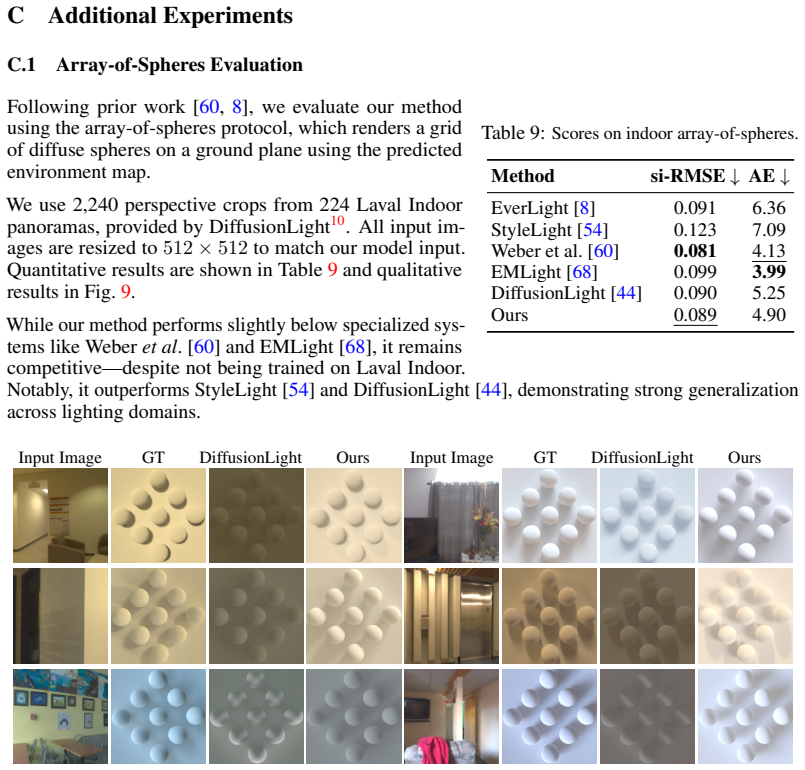
The core derivation chain is not circular. LuxDiT is trained on a large synthetic dataset plus 2,386 collected HDR panoramas and then evaluated on Laval Indoor, the 116-scene Laval Outdoor sunny subset, a held-out set of 181 Poly Haven HDRIs, held-out WEB360 videos, Cube++, and the Objects-with-Lighting dataset. The standard metrics (si-RMSE, angular error, n-RMSE, PAE) are external to the training loss, and the main reported improvements are computed against external baselines (DiffusionLight, StyleLight, NLFE, Hold-Geoffroy et al.). The self-citations (DiffusionRenderer, NLFE, DiPIR, inverse-rendering papers) appear as baselines, data-generation inspiration, or a downstream benchmark; none supplies a load-bearing uniqueness theorem or an unverified premise that forces the main result. The only in-sample evaluation is the supplement's NeRF synthetic-object experiment, where the paper explicitly says the target HDR maps are in the training set; that qualitative demonstration should be discounted as evidence, but it does not affect the principal claims. The LoRA-scale selection via Poly Haven ablation (Table 4) and the sunny-subset choice for Table 2 are methodological concerns (validation-set selection, benchmark subsetting), not circular reductions: the reported environment maps are still generated by the model rather than algebraically derived from the scale or the subset. Supp. Table 13's degradation at LoRA scale 1.0 on synthetic foreground objects is an acknowledged limitation/generalization trade-off, not a tautology. The reporting anomaly in Table 7 (identical channel-concat values) further lowers confidence in some experimental details, but again is not a circularity. Overall, the central claim has independent content, so the circularity score is low.
Axiom & Free-Parameter Ledger
free parameters (2)
- LoRA interpolation scale alpha =
1.0 (inference-time weight)
- Tonemapping constants M_ldr and M_log =
M_ldr=16, M_log=10000
axioms (4)
- domain assumption CogVideoX-5b-I2V pretrained weights provide a generative video prior adaptable to HDR lighting estimation via fine-tuning.
- domain assumption Synthetic scenes with Objaverse objects and MatSynth textures, rendered with a path tracer, provide shading cues that transfer to real-world inputs.
- domain assumption The pretrained CogVideoX VAE can encode and decode tonemapped HDR panoramas sufficiently well for the diffusion process.
- domain assumption The three-sphere rendering protocol and the selected metrics (si-RMSE, AE, n-RMSE, PAE) are accepted proxies for lighting estimation quality.
Cite this review
Pith. "Pith review of LuxDiT: Lighting Estimation with Video Diffusion Transformer." pith.science (2026). https://pith.science/paper/YAZGMT7F
@misc{pith2026250903680,
  author       = {Pith},
  title        = {Pith review of: LuxDiT: Lighting Estimation with Video Diffusion Transformer},
  year         = {2026},
  howpublished = {\url{https://pith.science/paper/YAZGMT7F}},
  note         = {Machine review of arXiv:2509.03680}
}
read the original abstract
Estimating scene lighting from a single image or video remains a longstanding challenge in computer vision and graphics. Learning-based approaches are constrained by the scarcity of ground-truth HDR environment maps, which are expensive to capture and limited in diversity. While recent generative models offer strong priors for image synthesis, lighting estimation remains difficult due to its reliance on indirect visual cues, the need to infer global (non-local) context, and the recovery of high-dynamic-range outputs. We propose LuxDiT, a novel data-driven approach that fine-tunes a video diffusion transformer to generate HDR environment maps conditioned on visual input. Trained on a large synthetic dataset with diverse lighting conditions, our model learns to infer illumination from indirect visual cues and generalizes effectively to real-world scenes. To improve semantic alignment between the input and the predicted environment map, we introduce a low-rank adaptation finetuning strategy using a collected dataset of HDR panoramas. Our method produces accurate lighting predictions with realistic angular high-frequency details, outperforming existing state-of-the-art techniques in both quantitative and qualitative evaluations.
Figures




Forward citations
Cited by 3 Pith papers
-
Diffusion-Based Material Regularization for Physics-Based Inverse Rendering
A regularization technique that treats diffusion model outputs as a similarity kernel during material optimization in inverse rendering, enabling joint reconstruction of geometry, materials, and illumination that sati...
-
AEGIR: Modeling Area Emitters for Indoor Inverse Rendering using Gaussian Splatting
AEGIR explicitly models local area emitters inside a relightable Gaussian Splatting pipeline and uses a differentiable deferred renderer with multiple importance sampling plus regularization to jointly optimize emitte...
-
AEGIR: Modeling Area Emitters for Indoor Inverse Rendering using Gaussian Splatting
AEGIR introduces explicit area-emitter modeling inside a relightable Gaussian Splatting pipeline together with a differentiable deferred renderer using multiple importance sampling and regularization to improve lighti...
Reference graph
Works this paper leans on
-
[1]
Cosmos world foundation model platform for physical ai
Niket Agarwal, Arslan Ali, Maciej Bala, Yogesh Balaji, Erik Barker, Tiffany Cai, Prithvijit Chattopadhyay, Yongxin Chen, Yin Cui, Yifan Ding, et al. Cosmos world foundation model platform for physical ai. arXiv preprint arXiv:2501.03575, 2025
Pith/arXiv arXiv 2025
-
[2]
eDiff-I: text-to-image diffusion models with ensemble of expert denoisers
Yogesh Balaji, Seungjun Nah, Xun Huang, Arash Vahdat, Jiaming Song, Qinsheng Zhang, Karsten Kreis, Miika Aittala, Timo Aila, Samuli Laine, Bryan Catanzaro, Tero Karras, and Ming-Yu Liu. eDiff-I: text-to-image diffusion models with ensemble of expert denoisers. arXiv preprint arXiv:2211.01324, 2022
Pith/arXiv arXiv 2022
-
[3]
Align your latents: High-resolution video synthesis with latent diffusion models
Andreas Blattmann, Robin Rombach, Huan Ling, Tim Dockhorn, Seung Wook Kim, Sanja Fidler, and Karsten Kreis. Align your latents: High-resolution video synthesis with latent diffusion models. In IEEE Conference on Computer Vision and Pattern Recognition (CVPR), 2023
work page 2023
-
[4]
Barron, Ce Liu, and Hendrik P.A
Mark Boss, Raphael Braun, Varun Jampani, Jonathan T. Barron, Ce Liu, and Hendrik P.A. Lensch. NeRD: neural reflectance decomposition from image collections. In ICCV, 2021
work page 2021
-
[5]
VideoJAM: Joint appearance-motion representations for enhanced motion generation in video models
Hila Chefer, Uriel Singer, Amit Zohar, Yuval Kirstain, Adam Polyak, Yaniv Taigman, Lior Wolf, and Shelly Sheynin. VideoJAM: Joint appearance-motion representations for enhanced motion generation in video models. arXiv: 2502.02492, 2025
Pith/arXiv arXiv 2025
-
[6]
DIB-R++: Learning to predict lighting and material with a hybrid differentiable renderer
Wenzheng Chen, Joey Litalien, Jun Gao, Zian Wang, Clement Fuji Tsang, Sameh Khalis, Or Litany, and Sanja Fidler. DIB-R++: Learning to predict lighting and material with a hybrid differentiable renderer. In NeurIPS, 2021
work page 2021
-
[7]
Emu: Enhancing image generation models using photogenic needles in a haystack
Xiaoliang Dai, Ji Hou, Chih-Yao Ma, Sam Tsai, Jialiang Wang, Rui Wang, Peizhao Zhang, Simon Vandenhende, Xiaofang Wang, Abhimanyu Dubey, et al. Emu: Enhancing image generation models using photogenic needles in a haystack. arXiv preprint arXiv:2309.15807, 2023
Pith/arXiv arXiv 2023
-
[8]
Everlight: Indoor-outdoor editable hdr lighting estimation
Mohammad Reza Karimi Dastjerdi, Jonathan Eisenmann, Yannick Hold-Geoffroy, and Jean-François Lalonde. Everlight: Indoor-outdoor editable hdr lighting estimation. In Proceedings of the IEEE/CVF International Conference on Computer Vision (ICCV), pages 7420–7429, October 2023
work page 2023
-
[9]
Paul E. Debevec and Jitendra Malik. Recovering high dynamic range radiance maps from photographs. In Proceedings of the 24th Annual Conference on Computer Graphics and Interactive Techniques, SIG- GRAPH ’97, page 369–378, USA, 1997. ACM Press/Addison-Wesley Publishing Co
work page 1997
-
[10]
Objaverse: A universe of annotated 3D objects
Matt Deitke, Dustin Schwenk, Jordi Salvador, Luca Weihs, Oscar Michel, Eli VanderBilt, Ludwig Schmidt, Kiana Ehsani, Aniruddha Kembhavi, and Ali Farhadi. Objaverse: A universe of annotated 3D objects. In Proceedings of the IEEE/CVF Conference on Computer Vision and Pattern Recognition, pages 13142– 13153, 2023
work page 2023
-
[11]
Generative models: What do they know? do they know things? let’s find out!, 2024
Xiaodan Du, Nicholas Kolkin, Greg Shakhnarovich, and Anand Bhattad. Generative models: What do they know? do they know things? let’s find out!, 2024
work page 2024
-
[12]
The cube++ illumination estimation dataset
Egor Ershov, Alexey Savchik, Illya Semenkov, Nikola Bani´c, Alexander Belokopytov, Daria Senshina, Karlo Košˇcevi´c, Marko Subaši´c, and Sven Lonˇcari´c. The cube++ illumination estimation dataset. IEEE access, 8:227511–227527, 2020
work page 2020
-
[13]
GeoWizard: unleashing the diffusion priors for 3D geometry estimation from a single image
Xiao Fu, Wei Yin, Mu Hu, Kaixuan Wang, Yuexin Ma, Ping Tan, Shaojie Shen, Dahua Lin, and Xiaoxiao Long. GeoWizard: unleashing the diffusion priors for 3D geometry estimation from a single image. In ECCV, 2024
work page 2024
-
[14]
Deep parametric indoor lighting estimation
Marc-André Gardner, Yannick Hold-Geoffroy, Kalyan Sunkavalli, Christian Gagné, and Jean-François Lalonde. Deep parametric indoor lighting estimation. In ICCV, pages 7175–7183, 2019
work page 2019
-
[15]
Learning to predict indoor illumination from a single image
Marc-André Gardner, Kalyan Sunkavalli, Ersin Yumer, Xiaohui Shen, Emiliano Gambaretto, Christian Gagné, and Jean-François Lalonde. Learning to predict indoor illumination from a single image. arXiv preprint arXiv:1704.00090, 2017
Pith/arXiv arXiv 2017
-
[16]
Fast spatially- varying indoor lighting estimation
Mathieu Garon, Kalyan Sunkavalli, Sunil Hadap, Nathan Carr, and Jean-François Lalonde. Fast spatially- varying indoor lighting estimation. In CVPR, pages 6908–6917, 2019
work page 2019
-
[17]
Roger Grosse, Micah K. Johnson, Edward H. Adelson, and William T. Freeman. Ground truth dataset and baseline evaluations for intrinsic image algorithms. In ICCV, pages 2335–2342. IEEE, 2009
work page 2009
-
[18]
Shape, light, and material decomposition from images using Monte Carlo rendering and denoising
Jon Hasselgren, Nikolai Hofmann, and Jacob Munkberg. Shape, light, and material decomposition from images using Monte Carlo rendering and denoising. arXiv:2206.03380, 2022. 10
Pith/arXiv arXiv 2022
-
[19]
Lotus: Diffusion-based visual foundation model for high-quality dense prediction
Jing He, Haodong Li, Wei Yin, Yixun Liang, Leheng Li, Kaiqiang Zhou, Hongbo Zhang, Bingbing Liu, and Ying-Cong Chen. Lotus: Diffusion-based visual foundation model for high-quality dense prediction. arXiv preprint arXiv:2409.18124, 2024
Pith/arXiv arXiv 2024
-
[20]
Denoising diffusion probabilistic models
Jonathan Ho, Ajay Jain, and Pieter Abbeel. Denoising diffusion probabilistic models. Advances in Neural Information Processing Systems, 33:6840–6851, 2020
2020
-
[21]
Jonathan Ho, Tim Salimans, Alexey Gritsenko, William Chan, Mohammad Norouzi, and David J Fleet. Video diffusion models. arXiv:2204.03458, 2022
Pith/arXiv arXiv 2022
-
[22]
Deep sky modeling for single image outdoor lighting estimation
Yannick Hold-Geoffroy, Akshaya Athawale, and Jean-François Lalonde. Deep sky modeling for single image outdoor lighting estimation. In CVPR, pages 6927–6935, 2019
work page 2019
-
[23]
Hu, Yelong Shen, Phillip Wallis, Zeyuan Allen-Zhu, Yuanzhi Li, Shean Wang, Lu Wang, and Weizhu Chen
Edward J. Hu, Yelong Shen, Phillip Wallis, Zeyuan Allen-Zhu, Yuanzhi Li, Shean Wang, Lu Wang, and Weizhu Chen. LoRA: Low-rank adaptation of large language models. In International Conference on Learning Representations, 2022
2022
-
[24]
Depthcrafter: Generating consistent long depth sequences for open-world videos
Wenbo Hu, Xiangjun Gao, Xiaoyu Li, Sijie Zhao, Xiaodong Cun, Yong Zhang, Long Quan, and Ying Shan. Depthcrafter: Generating consistent long depth sequences for open-world videos. In CVPR, 2025
work page 2025
-
[25]
Mitsuba 3 renderer, 2022
Wenzel Jakob, Sébastien Speierer, Nicolas Roussel, Merlin Nimier-David, Delio Vicini, Tizian Zeltner, Baptiste Nicolet, Miguel Crespo, Vincent Leroy, and Ziyi Zhang. Mitsuba 3 renderer, 2022. https://mitsuba- renderer.org
2022
-
[26]
Neural gaffer: Relighting any object via diffusion
Haian Jin, Yuan Li, Fujun Luan, Yuanbo Xiangli, Sai Bi, Kai Zhang, Zexiang Xu, Jin Sun, and Noah Snavely. Neural gaffer: Relighting any object via diffusion. In Advances in Neural Information Processing Systems, 2024
work page 2024
-
[27]
Elucidating the design space of diffusion-based generative models
Tero Karras, Miika Aittala, Timo Aila, and Samuli Laine. Elucidating the design space of diffusion-based generative models. In Proc. NeurIPS, 2022
2022
-
[28]
Video depth without video models
Bingxin Ke, Dominik Narnhofer, Shengyu Huang, Lei Ke, Torben Peters, Katerina Fragkiadaki, Anton Obukhov, and Konrad Schindler. Video depth without video models. In Proceedings of the IEEE/CVF Conference on Computer Vision and Pattern Recognition (CVPR), 2025
work page 2025
-
[29]
Repurposing diffusion-based image generators for monocular depth estimation
Bingxin Ke, Anton Obukhov, Shengyu Huang, Nando Metzger, Rodrigo Caye Daudt, and Konrad Schindler. Repurposing diffusion-based image generators for monocular depth estimation. In Proceedings of the IEEE/CVF Conference on Computer Vision and Pattern Recognition (CVPR), 2024
2024
-
[30]
Intrinsic image diffusion for single-view material estimation
Peter Kocsis, Vincent Sitzmann, and Matthias Nießner. Intrinsic image diffusion for single-view material estimation. In arxiv, 2023
work page 2023
-
[31]
Deeplight: Learning illumination for unconstrained mobile mixed reality
Chloe LeGendre, Wan-Chun Ma, Graham Fyffe, John Flynn, Laurent Charbonnel, Jay Busch, and Paul Debevec. Deeplight: Learning illumination for unconstrained mobile mixed reality. In CVPR, pages 5918–5928, 2019
work page 2019
-
[32]
Zhengqin Li, Mohammad Shafiei, Ravi Ramamoorthi, Kalyan Sunkavalli, and Manmohan Chandraker. Inverse rendering for complex indoor scenes: Shape, spatially-varying lighting and svbrdf from a single image. In CVPR, pages 2475–2484, 2020
work page 2020
-
[33]
Envidr: Implicit differentiable renderer with neural environment lighting
Ruofan Liang, Huiting Chen, Chunlin Li, Fan Chen, Selvakumar Panneer, and Nandita Vijaykumar. Envidr: Implicit differentiable renderer with neural environment lighting. In Proceedings of the IEEE/CVF International Conference on Computer Vision, pages 79–89, 2023
work page 2023
-
[34]
Diffusionrenderer: Neural inverse and forward rendering with video diffusion models
Ruofan Liang, Zan Gojcic, Huan Ling, Jacob Munkberg, Jon Hasselgren, Zhi-Hao Lin, Jun Gao, Alexander Keller, Nandita Vijaykumar, Sanja Fidler, and Zian Wang. Diffusionrenderer: Neural inverse and forward rendering with video diffusion models. arXiv preprint arXiv: 2501.18590, 2025
Pith/arXiv arXiv 2025
-
[35]
Photorealistic object insertion with diffusion-guided inverse rendering
Ruofan Liang, Zan Gojcic, Merlin Nimier-David, David Acuna, Nandita Vijaykumar, Sanja Fidler, and Zian Wang. Photorealistic object insertion with diffusion-guided inverse rendering. In ECCV, 2024
work page 2024
-
[36]
Matrix3D: Large Photogrammetry Model All-in-One, 2025
Yuanxun Lu, Jingyang Zhang, Tian Fang, Jean-Daniel Nahmias, Yanghai Tsin, Long Quan, Xun Cao, Yao Yao, and Shiwei Li. Matrix3D: Large Photogrammetry Model All-in-One, 2025
work page 2025
-
[37]
Diffusion posterior illumination for ambiguity-aware inverse rendering
Linjie Lyu, Ayush Tewari, Marc Habermann, Shunsuke Saito, Michael Zollhöfer, Thomas Leimkühler, and Christian Theobalt. Diffusion posterior illumination for ambiguity-aware inverse rendering. ACM Transactions on Graphics, 42(6), 2023. 11
work page 2023
-
[38]
Fine-tuning image-conditional diffusion models is easier than you think
Gonzalo Martin Garcia, Karim Abou Zeid, Christian Schmidt, Daan de Geus, Alexander Hermans, and Bastian Leibe. Fine-tuning image-conditional diffusion models is easier than you think. In Proceedings of the IEEE/CVF Winter Conference on Applications of Computer Vision (W ACV), 2025
work page 2025
-
[39]
Object 3dit: Language-guided 3d-aware image editing
Oscar Michel, Anand Bhattad, Eli VanderBilt, Ranjay Krishna, Aniruddha Kembhavi, and Tanmay Gupta. Object 3dit: Language-guided 3d-aware image editing. Advances in Neural Information Processing Systems, 36:3497–3516, 2023
work page 2023
-
[40]
Srinivasan, Matthew Tancik, Jonathan T
Ben Mildenhall, Pratul P. Srinivasan, Matthew Tancik, Jonathan T. Barron, Ravi Ramamoorthi, and Ren Ng. NeRF: representing scenes as neural radiance fields for view synthesis. arXiv preprint arXiv:2003.08934, 2020
Pith/arXiv arXiv 2003
-
[41]
Extracting Triangular 3D Models, Materials, and Lighting From Images
Jacob Munkberg, Jon Hasselgren, Tianchang Shen, Jun Gao, Wenzheng Chen, Alex Evans, Thomas Müller, and Sanja Fidler. Extracting triangular 3D models, materials, and lighting from images. arXiv:2111.12503, 2021
work page internal anchor Pith review Pith/arXiv arXiv 2021
-
[42]
VideoMat: Extracting PBR Materials from Video Diffusion Models
Jacob Munkberg, Zian Wang, Ruofan Liang, Tianchang Shen, and Jon Hasselgren. VideoMat: Extracting PBR Materials from Video Diffusion Models. In Eurographics Symposium on Rendering - CGF Track, 2025
work page 2025
-
[43]
Scalable diffusion models with transformers
William Peebles and Saining Xie. Scalable diffusion models with transformers. In Proceedings of the IEEE/CVF international conference on computer vision, pages 4195–4205, 2023
2023
-
[44]
DiffusionLight: light probes for free by painting a chrome ball
Pakkapon Phongthawee, Worameth Chinchuthakun, Nontaphat Sinsunthithet, Amit Raj, Varun Jampani, Pramook Khungurn, and Supasorn Suwajanakorn. DiffusionLight: light probes for free by painting a chrome ball. In ArXiv, 2023
work page 2023
-
[45]
High-resolution image synthesis with latent diffusion models
Robin Rombach, Andreas Blattmann, Dominik Lorenz, Patrick Esser, and Björn Ommer. High-resolution image synthesis with latent diffusion models. In Proceedings of the IEEE/CVF Conference on Computer Vision and Pattern Recognition (CVPR), 2022
work page 2022
-
[46]
Photorealistic text-to- image diffusion models with deep language understanding
Chitwan Saharia, William Chan, Saurabh Saxena, Lala Li, Jay Whang, Emily L Denton, Kamyar Ghasemipour, Raphael Gontijo Lopes, Burcu Karagol Ayan, Tim Salimans, et al. Photorealistic text-to- image diffusion models with deep language understanding. Advances in Neural Information Processing Systems, 35:36479–36494, 2022
work page 2022
-
[47]
Progressive distillation for fast sampling of diffusion models
Tim Salimans and Jonathan Ho. Progressive distillation for fast sampling of diffusion models. In The Tenth International Conference on Learning Representations, ICLR 2022, Virtual Event, April 25-29,
work page 2022
-
[48]
Soumyadip Sengupta, Jinwei Gu, Kihwan Kim, Guilin Liu, David W. Jacobs, and Jan Kautz. Neural inverse rendering of an indoor scene from a single image. In ICCV, 2019
work page 2019
-
[49]
Neural illumination: Lighting prediction for indoor environments
Shuran Song and Thomas Funkhouser. Neural illumination: Lighting prediction for indoor environments. In CVPR, pages 6918–6926, 2019
work page 2019
-
[50]
Resolution-robust large mask inpainting with fourier convolutions
Roman Suvorov, Elizaveta Logacheva, Anton Mashikhin, Anastasia Remizova, Arsenii Ashukha, Alek- sei Silvestrov, Naejin Kong, Harshith Goka, Kiwoong Park, and Victor Lempitsky. Resolution-robust large mask inpainting with fourier convolutions. In Proceedings of the IEEE/CVF winter conference on applications of computer vision, pages 2149–2159, 2022
work page 2022
-
[51]
Estimating spatially- varying lighting in urban scenes with disentangled representation
Jiajun Tang, Yongjie Zhu, Haoyu Wang, Jun-Hoong Chan, Si Li, and Boxin Shi. Estimating spatially- varying lighting in urban scenes with disentangled representation. In ECCV, 2022
work page 2022
-
[52]
Benjamin Ummenhofer, Sanskar Agrawal, Rene Sepulveda, Yixing Lao, Kai Zhang, Tianhang Cheng, Stephan Richter, Shenlong Wang, and German Ros. Objects with lighting: A real-world dataset for evaluating reconstruction and rendering for object relighting. In 2024 International Conference on 3D Vision (3DV), pages 137–147. IEEE, 2024
work page 2024
-
[53]
Matsynth: A modern pbr materials dataset
Giuseppe Vecchio and Valentin Deschaintre. Matsynth: A modern pbr materials dataset. In Proceedings of the IEEE/CVF Conference on Computer Vision and Pattern Recognition, 2024
work page 2024
-
[54]
Stylelight: Hdr panorama generation for lighting estimation and editing
Guangcong Wang, Yinuo Yang, Chen Change Loy, and Ziwei Liu. Stylelight: Hdr panorama generation for lighting estimation and editing. In European Conference on Computer Vision (ECCV), 2022
work page 2022
-
[55]
Neus: Learning neural implicit surfaces by volume rendering for multi-view reconstruction
Peng Wang, Lingjie Liu, Yuan Liu, Christian Theobalt, Taku Komura, and Wenping Wang. Neus: Learning neural implicit surfaces by volume rendering for multi-view reconstruction. NeurIPS, 2021. 12
work page 2021
-
[56]
360dvd: Controllable panorama video generation with 360-degree video diffusion model
Qian Wang, Weiqi Li, Chong Mou, Xinhua Cheng, and Jian Zhang. 360dvd: Controllable panorama video generation with 360-degree video diffusion model. In Proceedings of the IEEE/CVF Conference on Computer Vision and Pattern Recognition, pages 6913–6923, 2024
work page 2024
-
[57]
Neural light field estimation for street scenes with differentiable virtual object insertion
Zian Wang, Wenzheng Chen, David Acuna, Jan Kautz, and Sanja Fidler. Neural light field estimation for street scenes with differentiable virtual object insertion. In ECCV, 2022
2022
-
[58]
Learning indoor inverse rendering with 3D spatially-varying lighting
Zian Wang, Jonah Philion, Sanja Fidler, and Jan Kautz. Learning indoor inverse rendering with 3D spatially-varying lighting. In ICCV, 2021
work page 2021
-
[59]
Neural fields meet explicit geometric representations for inverse rendering of urban scenes
Zian Wang, Tianchang Shen, Jun Gao, Shengyu Huang, Jacob Munkberg, Jon Hasselgren, Zan Gojcic, Wenzheng Chen, and Sanja Fidler. Neural fields meet explicit geometric representations for inverse rendering of urban scenes. In The IEEE Conference on Computer Vision and Pattern Recognition (CVPR), June 2023
work page 2023
-
[60]
Editable indoor lighting estimation
Henrique Weber, Mathieu Garon, and Jean-François Lalonde. Editable indoor lighting estimation. In European Conference on Computer Vision, pages 677–692. Springer, 2022
work page 2022
-
[61]
Guangkai Xu, Yongtao Ge, Mingyu Liu, Chengxiang Fan, Kangyang Xie, Zhiyue Zhao, Hao Chen, and Chunhua Shen. What matters when repurposing diffusion models for general dense perception tasks? arXiv preprint arXiv:2403.06090, 2024
Pith/arXiv arXiv 2024
-
[62]
Cogvideox: Text-to-video diffusion models with an expert transformer
Zhuoyi Yang, Jiayan Teng, Wendi Zheng, Ming Ding, Shiyu Huang, Jiazheng Xu, Yuanming Yang, Wenyi Hong, Xiaohan Zhang, Guanyu Feng, et al. Cogvideox: Text-to-video diffusion models with an expert transformer. arXiv preprint arXiv:2408.06072, 2024
Pith/arXiv arXiv 2024
-
[63]
Stablenormal: Reducing diffusion variance for stable and sharp normal
Chongjie Ye, Lingteng Qiu, Xiaodong Gu, Qi Zuo, Yushuang Wu, Zilong Dong, Liefeng Bo, Yuliang Xiu, and Xiaoguang Han. Stablenormal: Reducing diffusion variance for stable and sharp normal. ACM Transactions on Graphics, 2024
work page 2024
-
[64]
Hong-Xing Yu, Samir Agarwala, Charles Herrmann, Richard Szeliski, Noah Snavely, Jiajun Wu, and Deqing Sun. Accidental light probes. In Proceedings of the IEEE/CVF Conference on Computer Vision and Pattern Recognition, pages 12521–12530, 2023
work page 2023
-
[65]
Ye Yu and William A. P. Smith. InverseRenderNet: learning single image inverse rendering. In CVPR, 2019
work page 2019
-
[66]
Poly Haven - The Public 3D Asset Library, 2025
Greg Zaal and et al. Poly Haven - The Public 3D Asset Library, 2025
work page 2025
-
[67]
RGB↔X: image decomposition and synthesis using material-and lighting-aware diffusion models
Zheng Zeng, Valentin Deschaintre, Iliyan Georgiev, Yannick Hold-Geoffroy, Yiwei Hu, Fujun Luan, Ling- Qi Yan, and Miloš Hašan. RGB↔X: image decomposition and synthesis using material-and lighting-aware diffusion models. In ACM SIGGRAPH 2024 Conference Papers, pages 1–11, 2024
work page 2024
-
[68]
Emlight: Lighting estimation via spherical distribution approximation
Fangneng Zhan, Changgong Zhang, Yingchen Yu, Yuan Chang, Shijian Lu, Feiying Ma, and Xuansong Xie. Emlight: Lighting estimation via spherical distribution approximation. In Proceedings of the AAAI Conference on Artificial Intelligence, 2021
work page 2021
-
[69]
PhySG: Inverse rendering with spherical Gaussians for physics-based material editing and relighting
Kai Zhang, Fujun Luan, Qianqian Wang, Kavita Bala, and Noah Snavely. PhySG: Inverse rendering with spherical Gaussians for physics-based material editing and relighting. In CVPR, 2021
work page 2021
-
[70]
Modeling indirect illumination for inverse rendering
Yuanqing Zhang, Jiaming Sun, Xingyi He, Huan Fu, Rongfei Jia, and Xiaowei Zhou. Modeling indirect illumination for inverse rendering. In CVPR, 2022
work page 2022
-
[71]
PointAR: Efficient Lighting Estimation for Mobile Augmented Reality
Yiqin Zhao and Tian Guo. Pointar: Efficient lighting estimation for mobile augmented reality. arXiv preprint arXiv:2004.00006, 2020
work page internal anchor Pith review Pith/arXiv arXiv 2004
-
[72]
Magicvideo: Efficient video generation with latent diffusion models
Daquan Zhou, Weimin Wang, Hanshu Yan, Weiwei Lv, Yizhe Zhu, and Jiashi Feng. Magicvideo: Efficient video generation with latent diffusion models. arXiv preprint arXiv:2211.11018, 2022
Pith/arXiv arXiv 2022
-
[73]
Yongjie Zhu, Yinda Zhang, Si Li, and Boxin Shi. Spatially-varying outdoor lighting estimation from intrinsics. In CVPR, 2021. 13 Supplement for LuxDiT: Lighting Estimation with Video Diffusion Transformer In the supplementary material, we discuss the broader impact of our project in Sec. A, and provide additional details for implementation and experiments...
work page 2021
-
[2022]
OpenReview.net, 2022
2022
This paper was first reviewed by deepseek-v4-flash on August 5, 2026.
discussion (0)
Sign in with ORCID, Apple, or X to comment. Anyone can read and Pith papers without signing in.