REVIEW 1 cited by
Close-packed two-patch disks on a triangular lattice show dual continuous transitions of one shared, non-Ising class for asymmetric interactions, and double Berezinskii-Kosterlitz-Thouless transitions with a critical phase between for symme
Reviewed by Pith at T0; open to challenge. T0 means a machine referee read the full paper against a public rubric. the ladder, T0–T4 →
T0 review · deepseek-v4-flash
2026-08-05 10:31 UTC pith:KO4VYULD
load-bearing objection The symmetric half is a solid BKT result, but the asymmetric half simulates a uniform six-state model, not the two-patch disk the paper defines.
Orientational phase transitions induced by two-patch interactions
The pith
A machine-rendered reading of the paper's core claim, the machinery that carries it, and where it could break.
Core claim
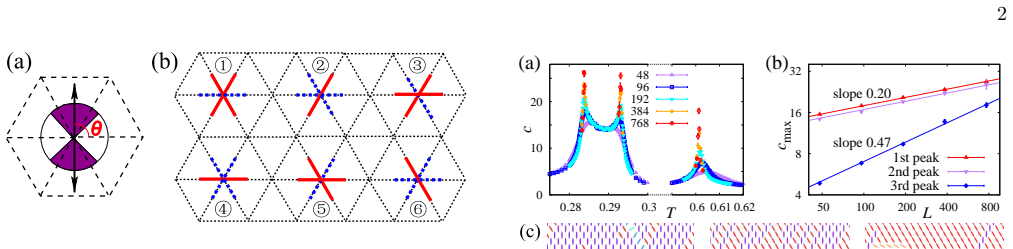
The central claim is that adding a second patch to Janus particles turns a simple lattice model into a source of new orientational critical phenomena. In the asymmetric model (χ = 0.4, E_PP = −1, E_NN = −0.6, E_PN = 0), Monte Carlo on triangular lattices shows three continuous transitions. The first two connect a six-fold nematic phase to two three-fold-ordered phases of the same symmetry, with specific-heat peak scaling giving 1/ν = 1.10(1) for both — one shared universality class, not the 2D Ising value of 1. The third transition has 1/ν = 1.24(2), close to the 3-state Potts value 6/5. In the symmetric model (χ = 1/2, E_PP = E_NN = −1), the ground state is a set of striped configurations w
What carries the argument
The key device is the reduction of continuously rotating disks to six edge-covering states. Because interaction strengths depend only on contact type (PP, NN, PN), a disk's continuous orientation collapses to six discrete states on the triangular lattice: for 1/3 < χ < 2/3, states 1, 3, 5 cover four neighboring edges with patches and appear with probability χ − 1/3 over a full rotation, while states 2, 4, 6 cover two edges and appear with probability 2/3 − χ. This turns the orientational problem into a six-state lattice spin model with a director (head-tail) symmetry, which the paper analyzes with Metropolis Monte Carlo, finite-size scaling of specific-heat peaks (c_max ~ L^{−2+2/ν}), the ne
Load-bearing premise
The central claim presupposes that the six-state model simulated in the Monte Carlo faithfully represents a continuously rotating two-patch disk at the stated coverage; in particular, the unequal appearance probabilities of the six states (χ − 1/3 and 2/3 − χ, which for χ = 0.4 differ by a factor of four) must actually enter the simulation, and the Methods section does not say they do.
What would settle it
Run the same triangular-lattice model with continuously sampled director angles (or with Monte Carlo acceptance weighted by the geometric appearance probabilities) at χ = 0.4 and the same energy parameters; if the number, location, or exponents of the three transitions change, the six-state reduction is not the model claimed. A cheaper check: at low temperature, measure the ratio of occupation densities of states (1, 3, 5) to states (2, 4, 6) — for a true χ = 0.4 disk it should be (χ − 1/3)/(2/3 − χ) = 1/4, while a bare six-state model gives 1.
If this is right
- The first two transitions of the asymmetric model form a shared universality class with 1/ν = 1.10(1), distinct from the 2D Ising value of 1, with shift exponents λ ≈ 2.1(4) and 2.3(1) that are not equal to 1/ν.
- The third asymmetric transition has 1/ν = 1.24(2), placing it near the 3-state Potts class (1/ν = 6/5), matching earlier results for Janus particles and rigid rods on the triangular lattice.
- The symmetric model realizes the six-state clock double-BKT scenario: two BKT transitions at Tc1 = 0.530(4) and Tc2 = 0.595(4) enclosing a critical phase with η rising from 1/9 to 1/4.
- Varying χ and the PP/NN ratio, the paper suggests, should connect the asymmetric and symmetric phase diagrams, yielding a continuous family of orientational critical behaviors.
- The symmetric ground state has subextensive entropy S = kL ln 2 + k ln 6 with an intermediate symmetry — ordered along stripes, disordered across them — analogous to compass-model states.
Where Pith is reading between the lines
- If the geometric appearance probabilities are absent from the Monte Carlo (as the Methods text suggests), the simulated χ = 0.4 model is the bare six-state model, and a truly continuously rotating 40%-covered disk would differ by a single-site field; the phase diagram would then need re-checking with the weights included — a quick numerical test.
- The same edge-covering reduction should extend to disks with more than two opposite patches on the triangular lattice, plausibly realizing clock models with q > 6 and their predicted BKT windows; this is a direct testable extension the paper does not pursue.
- The strongly nonmonotonic nematic order parameter across the dual transitions is an experimentally visible signature: in dense colloidal monolayers or rotating magnetic spinner arrays, a temperature scan crossing the two transitions would show ⟨m⟩ rising then falling, which could serve as a built-in probe of the transitions.
- The asymmetric model's departure from Ising behavior despite a two-fold symmetry breaking, together with λ ≠ 1/ν, suggests an enriched symmetry class rather than a plain Ising transition; identifying that class is left open.
Editorial analysis
A structured set of objections, weighed in public.
Circularity Check
No significant circularity; measured exponents are benchmarked against independent Potts/clock results.
full rationale
The paper's derivation chain is linear and self-contained: two-patch models are defined by patch coverage and interaction strengths; continuous rotations are reduced to six edge-covering states (an exact reduction for the energy because interactions depend only on contact type); Monte Carlo simulations measure specific heat, state densities, and nematic order parameter; finite-size scaling extracts 1/ν and η; these values are then compared with external universality classes (3-state Potts for the third transition, 6-state clock model for the symmetric BKT transitions). No reported exponent is obtained by fitting a parameter to the quantity it is claimed to predict: 1/ν=1.10(1), 1.24(2) and η∈[1/9,1/4] are measured outputs, not inputs. The self-citations that exist (refs. [18,45,46,53]) are not load-bearing: they serve as comparative benchmarks, background references, or future-work examples, and no uniqueness theorem or ansatz is imported from the authors' prior work to force a conclusion. The statement of appearance probabilities (χ−1/3 vs. 2/3−χ) is not incorporated into the described symmetric MC proposal ('proposed to rotate to one of other five states'), which is a potential model-fidelity/correctness concern for the asymmetric χ=0.4 simulations, but it is not circularity: the simulated six-state Hamiltonian is still defined a priori and its phase behavior is an independent numerical result. The paper's own caveat that the inequality λ≠1/ν 'require[s] further investigation' is an admitted open explanation, not a circular step. Overall, the central claims are not equivalent to their inputs by construction.
Axiom & Free-Parameter Ledger
free parameters (2)
- Patch coverage chi =
0.4 (asymmetric model); 0.5 (symmetric model)
- Interaction strengths E_PP, E_NN, E_PN =
Asymmetric: (-1, -0.6, 0). Symmetric: (-1, -1, 0).
axioms (5)
- domain assumption Energy depends only on contact type (PP/NN/PN), so a disk's continuous orientation reduces to six edge-covering states.
- standard math Uniform trial moves among the other five states plus Metropolis acceptance samples the intended equilibrium distribution.
- standard math Specific-heat peak scaling cmax(L) ~ L^(2/nu - 2) and peak-shift scaling Tc(L) - Tc(infinity) ~ L^(-lambda), per Barber's finite-size scaling.
- domain assumption Each width-one stripe of the symmetric-model ground state can flip between two neighboring director states independently, giving degeneracy 2^L per pair of states.
- standard math Qg = g(L/2)/g(L/4) and the eta(L) analysis behave for this model as they do for q-state clock models.
Cite this review
Pith. "Pith review of Orientational phase transitions induced by two-patch interactions." pith.science (2026). https://pith.science/paper/KO4VYULD
@misc{pith2026250903981,
  author       = {Pith},
  title        = {Pith review of: Orientational phase transitions induced by two-patch interactions},
  year         = {2026},
  howpublished = {\url{https://pith.science/paper/KO4VYULD}},
  note         = {Machine review of arXiv:2509.03981}
}
read the original abstract
For two-patch particles in two dimensions, we find that the coupling of anisotropic patchy interactions and the triangular lattice leads to novel phase behaviors. For asymmetric patch-patch (PP) and nonpatch-nonpatch (NN) interactions, the system has dual orientationally ordered phases of the same symmetry, intermediated by a nematic phase. Both phase transitions from the nematic phase to dual ordered phases are continuous and belong to the same universality class, and they lead to highly nonmonotonic variations of the nematic order parameter. The system becomes disordered at high temperature through another continuous transition. When the PP and NN interactions become symmetric, the system has subextensive ground-state entropy, and with increasing temperature it undergoes two Berezinskii-Kosterlitz-Thouless phase transitions, with a critical phase connecting a nematic phase and a disordered phase. These results open up new opportunities for designing patchy interactions to study orientational phase transitions and critical phenomena.
Figures


Forward citations
Cited by 1 Pith paper
-
Fractionalized Vortices Drive Kosterlitz-Thouless Transitions in Dipole-Conserving Systems
In the dipole-conserving XY model, KT transitions occur via simultaneous or split deconfinement of two fractional vortex species, with anisotropy controlling whether one or two transitions appear.
Reference graph
Works this paper leans on
-
[1]
C. Casagrande, P. Fabre, E. Rapha¨ el, and M. Veyssi´ e, “Janus beads”: Realization and behaviour at water/oil interfaces, Europhysics Letters 9, 251 (1989)
work page 1989
-
[2]
P. G. de Gennes, Soft matter, Rev. Mod. Phys. 64, 645 (1992)
work page 1992
-
[3]
Z. Zhang and S. C. Glotzer, Self-assembly of patchy par- ticles, Nano Letters 4, 1407 (2004)
work page 2004
-
[4]
A. Walther and A. H. E. M¨ uller, Janus particles: Synthe- sis, self-assembly, physical properties, and applications, Chemical Reviews 113, 5194 (2013)
work page 2013
- [5]
-
[6]
W. Li, H. Palis, R. M´ erindol, J. Majimel, S. Ravaine, and E. Duguet, Colloidal molecules and patchy particles: complementary concepts, synthesis and self-assembly, Chem. Soc. Rev. 49, 1955 (2020)
work page 1955
-
[7]
Y. Li, F. Liu, S. Demirci, U. K. Dey, T. Rawah, A. Chaudary, R. Ortega, Z. Yang, E. Pirhadi, B. Huang, X. Yong, and S. Jiang, Two sides of the coin: synthe- sis and applications of Janus particles, Nanoscale 17, 88 (2025)
work page 2025
-
[8]
M. He, J. P. Gales, ´E. Ducrot, Z. Gong, G.-R. Yi, S. Sacanna, and D. J. Pine, Colloidal diamond, Nature 585, 524 (2020)
2020
-
[9]
H. Liu, M. Matthies, J. Russo, L. Rovigatti, R. P. Narayanan, T. Diep, D. McKeen, O. Gang, N. Stephanopoulos, F. Sciortino, H. Yan, F. Romano, and P. ˇSulc, Inverse design of a pyrochlore lattice of DNA origami through model-driven experiments, Science 384, 776 (2024)
work page 2024
-
[10]
G. Posnjak, X. Yin, P. Butler, O. Bienek, M. Dass, S. Lee, I. D. Sharp, and T. Liedl, Diamond-lattice pho- tonic crystals assembled from DNA origami, Science384, 781 (2024)
work page 2024
-
[11]
C. Beneduce, D. E. P. Pinto, L. Rovigatti, F. Romano, P. ˇSulc, F. Sciortino, and J. Russo, Falsifiability test for classical nucleation theory, Phys. Rev. Lett. 134, 148201 (2025)
work page 2025
-
[12]
H. Shin and K. S. Schweizer, Theory of two-dimensional self-assembly of Janus colloids: crystallization and orien- tational ordering, Soft Matter 10, 262 (2014)
work page 2014
- [13]
-
[14]
K. Mitsumoto and H. Yoshino, Orientational ordering of closely packed Janus particles, Soft Matter 14, 3919 (2018)
work page 2018
- [15]
-
[16]
A. Patrykiejew and W. R˙ zysko, The order–disorder tran- sitions in systems of Janus-like particles on a triangular lattice-revisited, Physica A 570, 125819 (2021)
work page 2021
- [17]
-
[18]
H. Hu, R. M. Ziff, and Y. Deng, Universal critical behav- ior of percolation in orientationally ordered Janus parti- cles and other anisotropic systems, Phys. Rev. Lett. 129, 278002 (2022)
work page 2022
- [19]
-
[20]
Q. Chen, S. C. Bae, and S. Granick, Directed self- assembly of a colloidal kagome lattice, Nature 469, 381 (2011)
work page 2011
-
[21]
F. Romano and F. Sciortino, Two dimensional assembly of triblock Janus particles into crystal phases in the two bond per patch limit, Soft Matter 7, 5799 (2011)
work page 2011
- [22]
-
[23]
S. A. Mallory and A. Cacciuto, Activity-enhanced self- assembly of a colloidal kagome lattice, J. Am. Chem. Soc. 141, 2500 (2019)
work page 2019
- [24]
-
[25]
J. F. Schubert, S. F. Navas, and S. H. L. Klapp, Self-assembly and time-dependent control of active and passive triblock Janus colloids (2025), arXiv:2504.20764 [cond-mat.soft]
work page internal anchor Pith review Pith/arXiv arXiv 2025
-
[26]
X. Mao, Q. Chen, and S. Granick, Entropy favours open colloidal lattices, Nature Materials 12, 217 (2013)
work page 2013
-
[27]
Z. Nussinov and J. van den Brink, Compass models: The- ory and physical motivations, Rev. Mod. Phys. 87, 1 (2015)
work page 2015
- [28]
-
[29]
S. Saryal and D. Dhar, Cusp singularities in the distribu- tion of orientations of asymmetrically pivoted hard disks on a lattice, Phys. Rev. E 108, 044110 (2023)
work page 2023
-
[30]
L. P. Dadhichi, J. Kethapelli, R. Chajwa, S. Ramaswamy, and A. Maitra, Nonmutual torques and the unimportance of motility for long-range order in two-dimensional flocks, Phys. Rev. E 101, 052601 (2020)
work page 2020
-
[31]
D. Dopierala, H. Chat´ e, X.-q. Shi, and A. Solon, In- escapable anisotropy of nonreciprocal XY models, Phys. Rev. Lett. 135, 088302 (2025)
work page 2025
- [32]
-
[33]
S. A. M. Loos, S. H. L. Klapp, and T. Martynec, Long- range order and directional defect propagation in the nonreciprocal XY model with vision cone interactions, Phys. Rev. Lett. 130, 198301 (2023)
work page 2023
-
[34]
G. Bandini, D. Venturelli, S. A. M. Loos, A. Jelic, and A. Gambassi, The XY model with vision cone: non- reciprocal vs. reciprocal interactions, J. Stat. Mech. , 053205 (2025)
work page 2025
-
[35]
Z.-Y. Liu, B. Zheng, L.-L. Nian, and L. Xiong, Dy- namic approach to the two-dimensional nonreciprocal XY model with vision cone interactions, Phys. Rev. E 111, 014131 (2025)
work page 2025
-
[36]
J. V. Jos´ e, L. P. Kadanoff, S. Kirkpatrick, and D. R. Nel- son, Renormalization, vortices, and symmetry-breaking perturbations in the two-dimensional planar model, Phys. Rev. B 16, 1217 (1977)
work page 1977
-
[37]
S. Elitzur, R. B. Pearson, and J. Shigemitsu, Phase struc- ture of discrete Abelian spin and gauge systems, Phys. Rev. D 19, 3698 (1979)
work page 1979
-
[38]
Y. Tomita and Y. Okabe, Probability-changing cluster al- gorithm for two-dimensional XY and clock models, Phys. Rev. B 65, 184405 (2002)
work page 2002
-
[39]
H. Ueda, K. Okunishi, K. Harada, R. Krˇ cm´ ar, A. Gen- diar, S. Yunoki, and T. Nishino, Finite- m scaling anal- ysis of Berezinskii-Kosterlitz-Thouless phase transitions and entanglement spectrum for the six-state clock model, Phys. Rev. E 101, 062111 (2020)
work page 2020
-
[40]
H. Chen, P. Hou, S. Fang, and Y. Deng, Monte carlo study of duality and the Berezinskii-Kosterlitz-Thouless phase transitions of the two-dimensional q-state clock model in flow representations, Phys. Rev. E 106, 024106 (2022)
work page 2022
-
[41]
L. M. Tuan, T. T. Long, D. X. Nui, P. T. Minh, N. D. Trung Kien, and D. X. Viet, Binder ratio in the two- dimensional q-state clock model, Phys. Rev. E 106, 034138 (2022)
work page 2022
-
[42]
E. Bianchi, J. Largo, P. Tartaglia, E. Zaccarelli, and F. Sciortino, Phase diagram of patchy colloids: Towards empty liquids, Phys. Rev. Lett. 97, 168301 (2006)
work page 2006
-
[43]
J. M. Tavares, P. I. C. Teixeira, and M. M. Telo da Gama, Criticality of colloids with distinct interaction patches: The limits of linear chains, hyperbranched polymers, and dimers, Phys. Rev. E 80, 021506 (2009)
work page 2009
-
[44]
P. J. M. Swinkels, R. Sinaasappel, Z. Gong, S. Sacanna, W. V. Meyer, F. Sciortino, and P. Schall, Networks of limited-valency patchy particles, Phys. Rev. Lett. 132, 078203 (2024)
work page 2024
-
[45]
Q. Wang, Z. He, J. Wang, and H. Hu, Percolation thresholds of randomly rotating patchy particles on archimedean lattices, Phys. Rev. E 105, 034118 (2022)
work page 2022
-
[46]
J. Wang, X. Wang, W. Liu, and H. Hu, Percolation thresholds of disks with random nonoverlapping patches on four regular two-dimensional lattices, Phys. Rev. E 109, 064104 (2024)
work page 2024
-
[47]
M. N. Barber, “Finite-size scaling”,in Phase Transitions and Critical Phenomena, edited by C. Domb and J. L. Lebowitz, Vol. 8 (Academic Press, New York, 1983)
work page 1983
-
[48]
C.-N. Chen, C.-K. Hu, N. S. Izmailian, and M.-C. Wu, Specific heat and partition function zeros for the dimer model on the checkerboard B lattice: Finite-size effects, Phys. Rev. E 99, 012102 (2019)
work page 2019
-
[49]
G. dos Santos, E. Cisternas, E. E. Vogel, and A. J. Ramirez-Pastor, Orientational phase transition in mono- layers of multipolar straight rigid rods: The case of 2- thiophene molecule adsorption on the au(111) surface, Phys. Rev. E 107, 014133 (2023)
work page 2023
-
[50]
O. Borisenko, G. Cortese, R. Fiore, M. Gravina, and A. Papa, Numerical study of the phase transitions in the two-dimensional Z(5) vector model, Phys. Rev. E 83, 041120 (2011)
work page 2011
-
[51]
T. Surungan, S. Masuda, Y. Komura, and Y. Ok- abe, Berezinskii–Kosterlitz–Thouless transition on reg- ular and villain types of q-state clock models, J. Phys. A: Math. Theor. 52, 275002 (2019)
work page 2019
-
[52]
Y. Okabe and H. Otsuka, BKT transitions of the XY and six-state clock models on the various two-dimensional lat- tices, J. Phys. A: Math. Theor. 58, 065003 (2025)
work page 2025
-
[53]
R. Ding, H. Hu (unpublished)
- [54]
-
[55]
C. X. Du, H. A. Zhang, T. G. Pearson, J. Ng, P. L. McEuen, I. Cohen, and M. P. Brenner, Programming in- teractions in magnetic handshake materials, Soft Matter 18, 6404 (2022)
work page 2022
-
[56]
J. Wang, Z. Sun, H. Chen, G. Wang, D. Chen, G. Chen, J. Shuai, M. Yang, Y. Jiao, and L. Liu, Hyperuniform networks of active magnetic robotic spinners, Phys. Rev. Lett. 134, 248301 (2025). 7 END MA TTER Peak positions of the specific heat and more details for densities ρs in the asymmetric model — 0.2838 0.2846 200 400 600L 0.28374+4.51L-2.1 0.2915 0.2925...
work page 2025
discussion (0)
Sign in with ORCID, Apple, or X to comment. Anyone can read and Pith papers without signing in.