REVIEW 3 major objections 7 minor 42 references
The paper claims that decomposing a complex prompt into LLM-generated bounding boxes and routing each region through specialized diffusion experts improves compositional fidelity and style diversity over a single-model backbone.
Reviewed by Pith at T0; open to challenge. T0 means a machine referee read the full paper against a public rubric. the ladder, T0–T4 →
MEPG combines LLM-based spatial planning with a mixture of SDXL experts and staged local/global denoising, but the reported gains are modest and the main quality/diversity claims are not backed by experiments.
T0 review reviewed 2026-08-05 challenge →
load-bearing objection Plausible framework, but the load-bearing spatial-routing gate has no specified input and the promised FID/LPIPS evidence is missing. the 3 major comments →
MEPG:Multi-Expert Planning and Generation for Compositionally-Rich Image Generation
The pith
A machine-rendered reading of the paper's core claim, the machinery that carries it, and where it could break.
The reading
Core claim
MEPG aims to establish that compositional image generation can be decomposed into a planning step and a regional generation step. The Position-Style-Aware module uses a LoRA-tuned LLM to turn a complex prompt into element lists, descriptions, and rectangular coordinates (x1,y1)-(x2,y2), yielding prompt-mask pairs. The Multi-Expert Diffusion module then routes each region: a gating function assigns weights to expert models and fuses their outputs, with local denoising dominating the first 70% of steps and a global pass consolidating the result. Evidence is the GenEval table, where the framework reaches 0.58 overall and 0.27 on position versus 0.55 and 0.15 for the SDXL backbone, plus qualitat
What carries the argument
The load-bearing mechanism is the Sparse-MoeBlock, which replaces the query/key/value and feed-forward modules of the diffusion backbone with weighted sums of corresponding modules from several expert models, the weights being wi = sigmoid(G(X))_i. Around it, cross-denoising schedules local generation first (p1 = 0.7 of steps) and global generation second, fusing expert outputs by xt = sum_i alpha_i(t) x_i(t), so regional detail and global coherence are both served. The PSA module supplies the spatial structure: a LoRA-tuned LLM converts text prompts into bounding-box coordinates and prompt-mask pairs.
Load-bearing premise
The whole 'spatial expert routing' claim rests on the gate actually seeing region-specific information, but the paper defines the gate input only as 'usually a scalar' and never shows that changing a region box changes the weights.
What would settle it
Run a fixed prompt with only the bounding-box coordinates moved between regions (e.g., the cat box on the left vs the right) and log the gate weights; if the weights do not change, or if reassigning a region to a realism expert instead of an anime expert does not change the output style, then the per-region routing claim is false and the measured gains would come from the text-to-box planner.
If this is right
- The base diffusion model's parameters stay frozen; only the gate and the LLM adapter are trained, so expert models can be swapped in or out without re-tuning the backbone.
- Compositional accuracy improves on the tasks the framework targets: GenEval overall goes from 0.55 to 0.58 and position from 0.15 to 0.27 over SDXL, with two-object accuracy at 0.76.
- Layout becomes an editable variable: the PSA module's coordinates can be changed at inference, and users can assign different style experts to different regions.
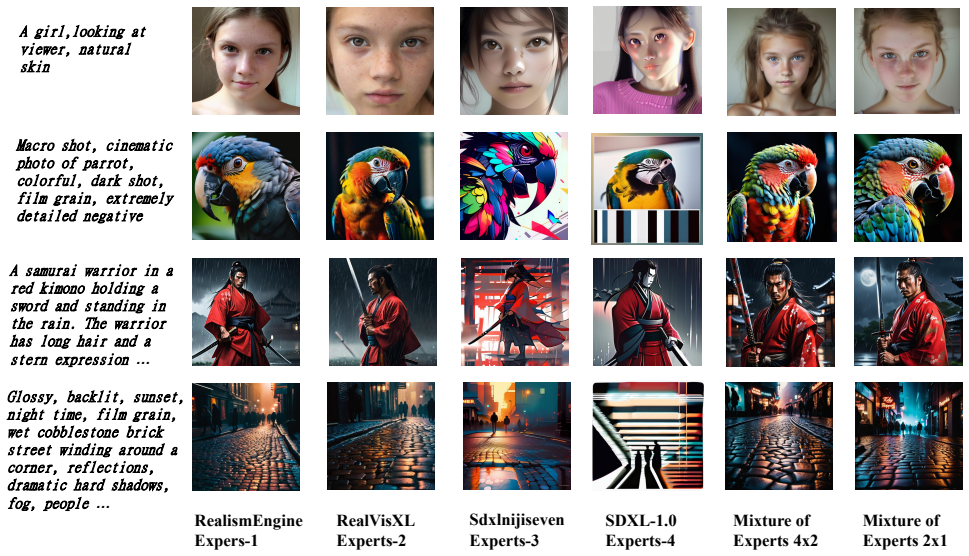
- Style diversity is decoupled from a single model's aesthetic: mixing photorealistic, anime, and character-prone expert checkpoints yields distinct but globally coherent outputs.
Where Pith is reading between the lines
- A direct test the paper does not run: sweep the bounding-box coordinates of one object while holding text fixed and inspect the gate weights; if they are unchanged, the 'spatial' expert routing is actually global style mixing, and the position gains come from the PSA planner.
- The same planning-plus-routing decomposition could be wrapped around any diffusion backbone with replaceable qkv/feed-forward blocks; the paper only demonstrates it on four SDXL-style experts.
- The per-region expert mixture, trained on style-sorted data, suggests an untested compositionality claim: arbitrary style checkpoints could be plugged in without retraining, making the gate a general-purpose style blender.
Editorial analysis
A structured set of objections, weighed in public.
Referee Report
Summary. The paper proposes MEPG (also called MEPT), a text-to-image framework that combines an LLM-based planning module (PSA) with a Mixture-of-Experts diffusion module (MED). The PSA module uses a LoRA-fine-tuned LLM to decompose complex prompts into spatial coordinates and per-region descriptions. The MED module is intended to route different expert models to different spatial regions during denoising, with a cross-denoising schedule that interleaves local and global generation. The authors claim improved compositional fidelity and style diversity, and report GenEval results showing Ours-MEPT at 0.58 overall vs. SDXL's 0.55, with qualitative style and edit examples.
Significance. If the central mechanism were sound, the idea of combining an LLM-based spatial planner with a lightweight portfolio of off-the-shelf SDXL experts would be practically useful, especially for editable layout control and style diversity. The use of public datasets (LAHR and LAION-SG) and open expert models is a strength, and the modular expert-swapping design is a worthwhile goal. However, the paper's load-bearing technical component—the spatially-aware gating mechanism—is not actually specified, and the quantitative evaluation does not measure the dimensions advertised in the introduction and abstract. The current manuscript does not provide a verifiable implementation of its core novelty, so the significance of the claimed results cannot be assessed.
major comments (3)
- [§3.2, gating formula w_i = σ(G(X))_i] The gating mechanism is the load-bearing component for the paper's central claim of 'spatial-semantic expert allocation' and 'cross-region generation'. However, the text states that G(X) is 'usually a scalar', while the formula indexes the output as σ(G(X))_i; a scalar cannot carry an index i, so the equation is dimensionally incoherent as written. More importantly, the input X to the gate is never specified. No spatial coordinates, region masks, or attention features are shown being passed into the gate. If X is only a global text embedding or denoising timestep, as in previous MoE text-to-image work, the expert selection is not spatially conditioned and the claimed per-region expert activation has no mechanism. The authors must define X explicitly, show how region information enters the gate, and verify that different spatial regions can select different experts.
- [§1 vs. §5.1, Table 1] The Introduction promises '+12.3% FID improvement' and '+18.7% LPIPS gain', and the Abstract claims significant improvement in 'image quality and style diversity'. Yet the experiments section reports only GenEval scores; no FID or LPIPS values appear anywhere in the paper. Table 1 therefore cannot support the headline quantitative claims. The authors should either report the promised metrics or remove the unsupported claims from the abstract and introduction.
- [Table 1, §5.1 and §5.3] The reported GenEval gains are small and inconsistent. Ours-MEPT overall is 0.58 vs. SDXL's 0.55, with position improving from 0.15 to 0.27, but counting drops from 0.39 to 0.35 and color from 0.85 to 0.80. No error bars, variance, or significance tests are provided, so it is unclear whether the overall difference is meaningful. The comparison is also not 'same backbone' in a strict sense: the MED module uses four different SDXL-derived expert models (e.g., RealVisXL, nijiseven), not the original SDXL. The authors should clarify what the baseline actually is and provide statistical evaluation.
minor comments (7)
- [Throughout] The framework is called MEPG in the title and abstract but MEPT in several places (e.g., §1, §5.1, Table 1). Please use one consistent name.
- [§3.2] The text says the SparseMoeBlock consists of a gating function, a softmax function, and expert modules, but the formula uses a sigmoid function. Clarify which nonlinearity is actually used.
- [§4.1 and §5.1] The setup sets p1 = 0.7, while §5.1 states 'MEPT framework adopts p1 = 0.5'. Also, the fusion weights α_i^(t) in Eq. (2) are only described as 'empirically determined'. Please report the values and how they were chosen.
- [§3.2 and §3.3] The number of experts is denoted n in §3.2 and M in Eq. (2). Use a single notation.
- [§5.3, Figure 5] The conditions 'BaseModel', 'PSA+Global', 'PSA+MED', and 'prompt+MED' are not all defined in the text. Please define each ablation condition precisely.
- [Table 1] The table formatting is inconsistent (e.g., missing spaces in some entries) and no details are given for the baseline implementations. Also, the caption says 'Geneval' but the benchmark is 'GenEval'.
- [References] The LoRA reference (Hu 2021) is missing author and title details. Please complete all references.
Circularity Check
No significant circularity: central evaluation is external and independent.
full rationale
I found no circular reduction in the paper's derivation chain. The PSA module is trained on the LAHR/GoT dataset and the MED gate is trained on LAION-SG, both separate from the GenEval benchmark used for evaluation. The central claims are therefore tested against an external benchmark not used to fit the method's components. The fusion weights are described as 'empirically determined' rather than predicted from data, so they do not constitute fitted inputs relabeled as predictions. The undefined gate input X in Section 3.2 is a serious soundness/implementation gap—it does not show how spatial information reaches the gate—but it is not circularity: no equation, fitted value, or self-citation is reused as the evidence for the same claim. There is no load-bearing self-citation, no imported uniqueness theorem, and no renaming of a known result. The missing FID/LPIPS quantification is a reporting gap, not a circular step. After checking the claimed derivation chain, I found no step that reduces to its own inputs by construction.
Axiom & Free-Parameter Ledger
free parameters (5)
- local-dominant proportion p1 =
0.7 default, 0.5 for GenEval
- fusion weights alpha_i^(t) =
not reported
- coordinate range [0,1000) =
0 to 1000
- max_elements in LoRA prompt =
not specified
- expert model portfolio =
RealVisXL, RealismEngine, sdxlnijiseven, halcyon-sdxl-photorealism
axioms (4)
- domain assumption LAHR dataset coordinates are reliable spatial ground truth for LoRA training
- domain assumption LAION-SG aesthetic rating >6 selects for style diversity suitable for gate training
- domain assumption Replacing QKV projections in a frozen UNet with a weighted sum of expert projections preserves denoising validity
- ad hoc to paper Gating output G(X) encodes spatial-semantic region features
invented entities (1)
-
SparseMoeBlock
no independent evidence
Cite this review
Pith. "Pith review of MEPG:Multi-Expert Planning and Generation for Compositionally-Rich Image Generation." pith.science (2026). https://pith.science/paper/HZZWE7NK
@misc{pith2026250904126,
  author       = {Pith},
  title        = {Pith review of: MEPG:Multi-Expert Planning and Generation for Compositionally-Rich Image Generation},
  year         = {2026},
  howpublished = {\url{https://pith.science/paper/HZZWE7NK}},
  note         = {Machine review of arXiv:2509.04126}
}
read the original abstract
Text-to-image diffusion models have achieved remarkable image quality, but they still struggle with complex, multiele ment prompts, and limited stylistic diversity. To address these limitations, we propose a Multi-Expert Planning and Gen eration Framework (MEPG) that synergistically integrates position- and style-aware large language models (LLMs) with spatial-semantic expert modules. The framework comprises two core components: (1) a Position-Style-Aware (PSA) module that utilizes a supervised fine-tuned LLM to decom pose input prompts into precise spatial coordinates and style encoded semantic instructions; and (2) a Multi-Expert Dif fusion (MED) module that implements cross-region genera tion through dynamic expert routing across both local regions and global areas. During the generation process for each lo cal region, specialized models (e.g., realism experts, styliza tion specialists) are selectively activated for each spatial par tition via attention-based gating mechanisms. The architec ture supports lightweight integration and replacement of ex pert models, providing strong extensibility. Additionally, an interactive interface enables real-time spatial layout editing and per-region style selection from a portfolio of experts. Ex periments show that MEPG significantly outperforms base line models with the same backbone in both image quality and style diversity.
Figures




Reference graph
Works this paper leans on
-
[1]
Balaji, Y.; Nah, S.; Huang, X.; Vahdat, A.; Song, J.; Kreis, K.; Aittala, M.; Aila, T.; Laine, S.; Catanzaro, B.; et al. 2022. eDiffi: Text-to-Image Diffusion Models with an Ensemble of Expert Denoisers. arXiv preprint arXiv:2211.01324
Pith/arXiv arXiv 2022
-
[2]
Batifol, S.; Blattmann, A.; Boesel, F.; Consul, S.; Diagne, C.; Dockhorn, T.; English, J.; English, Z.; Esser, P.; Kulal, S.; et al. 2025. FLUX. 1 Kontext: Flow Matching for In-Context Image Generation and Editing in Latent Space. arXiv e-prints, arXiv--2506
work page 2025
-
[3]
Betker, J.; Goh, G.; Jing, L.; Brooks, T.; Wang, J.; Li, L.; Ouyang, L.; Zhuang, J.; Lee, J.; Guo, Y.; et al. 2023. Improving image generation with better captions. Computer Science. https://cdn. openai. com/papers/dall-e-3. pdf, 2(3): 8
work page 2023
-
[4]
Black, K.; Janner, M.; Du, Y.; Kostrikov, I.; and Levine, S. 2023. Training Diffusion Models with Reinforcement Learning. In ICML 2023 Workshop on Structured Probabilistic Inference backslash Generative Modeling
work page 2023
-
[5]
Changpinyo, S.; Sharma, P.; Ding, N.; and Soricut, R. 2021. Conceptual 12m: Pushing web-scale image-text pre-training to recognize long-tail visual concepts. In Proceedings of the IEEE/CVF Conference on Computer Vision and Pattern Recognition, 3558--3568
work page 2021
-
[6]
X.; Gao, H.; Chen, D.; Li, J.; Zeng, W.; Yu, X.; Wu, Y.; Xie, Z.; Li, Y
Dai, D.; Deng, C.; Zhao, C.; Xu, R. X.; Gao, H.; Chen, D.; Li, J.; Zeng, W.; Yu, X.; Wu, Y.; Xie, Z.; Li, Y. K.; Huang, P.; Luo, F.; Ruan, C.; Sui, Z.; and Liang, W. 2024. DeepSeekMoE: Towards Ultimate Expert Specialization in Mixture-of-Experts Language Models. arXiv:2401.06066
Pith/arXiv arXiv 2024
-
[7]
Dhariwal, P.; and Nichol, A. 2021. Diffusion Models Beat GANs on Image Synthesis. Advances in Neural Information Processing Systems (NeurIPS), 34: 8780--8794
work page 2021
- [8]
-
[9]
Esser, P.; Kulal, S.; Blattmann, A.; Entezari, R.; M \"u ller, J.; Saini, H.; Levi, Y.; Lorenz, D.; Sauer, A.; Boesel, F.; et al. 2024. Scaling rectified flow transformers for high-resolution image synthesis. In Forty-first international conference on machine learning
2024
-
[10]
Fan, Y.; Watkins, O.; Du, Y.; Liu, H.; Ryu, M.; Boutilier, C.; Abbeel, P.; Ghavamzadeh, M.; Lee, K.; and Lee, K. 2023. Reinforcement learning for fine-tuning text-to-image diffusion models. In Conference on Neural Information Processing Systems (NeurIPS)
work page 2023
-
[11]
Fang, R.; Duan, C.; Wang, K.; Huang, L.; Li, H.; Yan, S.; Tian, H.; Zeng, X.; Zhao, R.; Dai, J.; Liu, X.; and Li, H. 2025. GoT: Unleashing Reasoning Capability of Multimodal Large Language Model for Visual Generation and Editing. arXiv preprint arXiv:2503.10639
Pith/arXiv arXiv 2025
-
[12]
Fedus, W.; Zoph, B.; and Shazeer, N. 2022. Switch Transformers: Scaling to Trillion Parameter Models with Simple and Efficient Sparsity. Journal of Machine Learning Research (JMLR), 23(120): 1--39
work page 2022
-
[13]
Feng, W.; Zhu, W.; Fu, T.-J.; Jampani, V.; Akula, A.; He, X.; Basu, S.; Wang, X. E.; and Wang, W. Y. 2023. LayoutGPT: Compositional Visual Planning and Generation with Large Language Models. In Oh, A.; Naumann, T.; Globerson, A.; Saenko, K.; Hardt, M.; and Levine, S., eds., Advances in Neural Information Processing Systems, volume 36, 18225--18250. Curran...
work page 2023
-
[14]
Ghosh, D.; Hajishirzi, H.; and Schmidt, L. 2023. GenEval: An Object-Focused Framework for Evaluating Text-to-Image Alignment. NIPS
work page 2023
-
[15]
Ho, J.; Jain, A.; and Abbeel, P. 2020. Denoising Diffusion Probabilistic Models. arXiv preprint arXiv:2006.11239
Pith/arXiv arXiv 2020
-
[16]
Hu, E. J. e. a. 2021. LoRA: Low-Rank Adaptation of Large Language Models. ICLR
work page 2021
-
[17]
Hu, X.; Wang, R.; Fang, Y.; Fu, B.; Cheng, P.; and Yu, G. 2024. ELLA: Equip Diffusion Models with LLM for Enhanced Semantic Alignment. arXiv:2403.05135
Pith/arXiv arXiv 2024
-
[18]
Jacobs, R. A.; Jordan, M. I.; Nowlan, S. J.; and Hinton, G. E. 1991. Adaptive Mixtures of Local Experts. Neural Computation, 79--87
work page 1991
-
[19]
Lee, K.; Liu, H.; Ryu, M.; Watkins, O.; Du, Y.; Boutilier, C.; Abbeel, P.; Ghavamzadeh, M.; and Gu, S. S. 2023. Aligning text-to-image models using human feedback. arXiv preprint arXiv:2302.12192
Pith/arXiv arXiv 2023
-
[20]
J.; Zhang, S.; and Shakhnarovich, G
Li, Y.; Liu, H.; Wu, Q.; Lee, Y. J.; Zhang, S.; and Shakhnarovich, G. 2023. GLIGEN: Open-Set Grounded Text-to-Image Generation. In Proceedings of the IEEE/CVF Conference on Computer Vision and Pattern Recognition (CVPR), 23411--23422
work page 2023
-
[21]
Li, Z.; Meng, C.; Li, Y.; Yang, L.; Zhang, S.; Ma, J.; Li, J.; Yang, G.; Yang, C.; Yang, Z.; et al. 2024. Laion-sg: An enhanced large-scale dataset for training complex image-text models with structural annotations. arXiv preprint arXiv:2412.08580
Pith/arXiv arXiv 2024
-
[22]
Liang, Z.; Yuan, Y.; Gu, S.; Chen, B.; Hang, T.; Cheng, M.; Li, J.; and Zheng, L. 2024. Aesthetic Post-Training Diffusion Models from Generic Preferences with Step-by-step Preference Optimization. CVPR
work page 2024
-
[23]
Lin, T.-Y.; Maire, M.; Belongie, S.; Hays, J.; Perona, P.; Ramanan, D.; Doll \'a r, P.; and Zitnick, C. L. 2014. Microsoft coco: Common objects in context. In C European Conference on Computer Vision
work page 2014
-
[24]
Nichol, A. Q.; and Dhariwal, P. 2021. Improved Denoising Diffusion Probabilistic Models. International Conference on Machine Learning (ICML), 8162--8171
work page 2021
-
[25]
Saharia, C.; Chan, W.; Saxena, S.; Li, L.; Whang, J.; Denton, E.; Ghasemipour, S. K. S.; Ayan, B. K.; Mahdavi, S. S.; Lopes, R. G.; Salimans, T.; Ho, J.; Fleet, D. J.; and Norouzi, M. 2022. Photorealistic Text-to-Image Diffusion Models with Deep Language Understanding. arXiv:2205.11487
Pith/arXiv arXiv 2022
-
[26]
Schuhmann, C.; Beaumont, R.; Vencu, R.; Gordon, C. W.; Wightman, R.; Cherti, M.; Coombes, T.; Katta, A.; Mullis, C.; Wortsman, M.; Schramowski, P.; Kundurthy, S. R.; Crowson, K.; Schmidt, L.; Kaczmarczyk, R.; Jitsev, J.; et al. 2022. LAION-5B: An Open Large-Scale Dataset for Training Next-Generation Image-Text Models. In Advances in Neural Information Pro...
work page 2022
-
[27]
Shazeer, N.; Mirhoseini, A.; Maziarz, K.; Davis, A.; Le, Q. V.; Hinton, G.; and Dean, J. 2017. Outrageously Large Neural Networks: The Sparsely-Gated Mixture-of-Experts Layer. In International Conference on Learning Representations (ICLR)
work page 2017
-
[28]
Sohl-Dickstein, J.; Weiss, E.; Maheswaranathan, N.; and Ganguli, S. 2015. Deep unsupervised learning using nonequilibrium thermodynamics. In International conference on machine learning, 2256--2265. pmlr
work page 2015
-
[29]
Sun, P.; Jiang, Y.; Chen, S.; Zhang, S.; Peng, B.; Luo, P.; and Yuan, Z. 2024. Autoregressive Model Beats Diffusion: Llama for Scalable Image Generation. arXiv preprint arXiv:2406.06525
Pith/arXiv arXiv 2024
-
[30]
Wan, T.; Wang, A.; and et al., B. A. 2025. Wan2.2: Open and Advanced Large-Scale Video Generative Models. https://github.com/Wan-Video/Wan2.2
work page 2025
- [31]
-
[32]
Xie, J.; Li, Y.; Huang, Y.; Zhang, H.; Zhang, Y.; and Liu, M. Z. S. 2023. BoxDiff: Text-to-Image Synthesis with Training-Free Box-Constrained Diffusion. In Proceedings of the IEEE/CVF International Conference on Computer Vision (ICCV), 14969--14979
work page 2023
-
[33]
Xue, Z.; Song, G.; Guo, Q.; Liu, B.; Zong, Z.; Liu, Y.; and Luo, P. 2023 a . RAPHAEL: Text-to-Image Generation via Large Mixture of Diffusion Paths. In Advances in Neural Information Processing Systems, 41693--41706
work page 2023
-
[34]
Xue, Z.; Song, G.; Guo, Q.; Liu, B.; Zong, Z.; Liu, Y.; and Luo, P. 2023 b . RAPHAEL: Text-to-Image Generation via Large Mixture of Diffusion Paths. In Oh, A.; Naumann, T.; Globerson, A.; Saenko, K.; Hardt, M.; and Levine, S., eds., Advances in Neural Information Processing Systems, volume 36, 41693--41706. Curran Associates, Inc
work page 2023
-
[35]
Yang, A.; Li, A.; Yang, B.; Zhang, B.; Hui, B.; Zheng, B.; Yu, B.; Gao, C.; Huang, C.; Lv, C.; Zheng, C.; Liu, D.; Zhou, F.; Huang, F.; Hu, F.; Ge, H.; Wei, H.; Lin, H.; Tang, J.; Yang, J.; Tu, J.; Zhang, J.; Yang, J.; Yang, J.; Zhou, J.; Zhou, J.; Lin, J.; Dang, K.; Bao, K.; Yang, K.; Yu, L.; Deng, L.; Li, M.; Xue, M.; Li, M.; Zhang, P.; Wang, P.; Zhu, Q...
Pith/arXiv arXiv 2025
-
[36]
Yang, L.; Yu, Z.; Meng, C.; Xu, M.; Ermon, S.; and Cui, B. 2024. Mastering text-to-image diffusion: Recaptioning, planning, and generating with multimodal llms. In Forty-first International Conference on Machine Learning
work page 2024
-
[37]
Yang, S.; Chen, T.; and Zhou, M. 2024. A Dense Reward View on Aligning Text-to-Image Diffusion with Preference. In Forty-first International Conference on Machine Learning
work page 2024
-
[38]
Yang, Z.; Wang, J.; Gan, Z.; Li, L.; Lin, K.; Liu, Z.; and Wang, L. 2023. ReCo: Region-Controlled Text-to-Image Generation. In Proceedings of the IEEE/CVF Conference on Computer Vision and Pattern Recognition (CVPR), 14246--14255
work page 2023
-
[39]
Zheng, G.; Zhou, W.; Li, X.; Qi, Z.; Shan, Y.; Zheng, G.; and Yang, J. 2023. LayoutDiffusion: Controllable Diffusion Model for Layout-to-Image Generation. In Proceedings of the IEEE/CVF Conference on Computer Vision and Pattern Recognition (CVPR), 22430--22439
work page 2023
-
[40]
Zhu, J.; Chen, Y.; Ding, M.; Luo, P.; Wang, L.; and Wang, J. 2024. MoLE: Enhancing Human-centric Text-to-image Diffusion via Mixture of Low-rank Experts. In Advances in Neural Information Processing Systems, 29354--29386
work page 2024
-
[41]
, " * write output.state after.block = add.period write newline
ENTRY address archivePrefix author booktitle chapter edition editor eid eprint howpublished institution isbn journal key month note number organization pages publisher school series title type volume year label extra.label sort.label short.list INTEGERS output.state before.all mid.sentence after.sentence after.block FUNCTION init.state.consts #0 'before.a...
-
[42]
write newline
" write newline "" before.all 'output.state := FUNCTION n.dashify 't := "" t empty not t #1 #1 substring "-" = t #1 #2 substring "--" = not "--" * t #2 global.max substring 't := t #1 #1 substring "-" = "-" * t #2 global.max substring 't := while if t #1 #1 substring * t #2 global.max substring 't := if while FUNCTION word.in bbl.in capitalize " " * FUNCT...
This paper was first reviewed by deepseek-v4-flash on August 5, 2026.
discussion (0)
Sign in with ORCID, Apple, or X to comment. Anyone can read and Pith papers without signing in.