REVIEW 4 major objections 6 minor 21 references
Real-Time Performance Benchmarking of TinyML Models in Embedded Systems (PICO: Performance of Inference, CPU, and Operations)
T0 review · 4 major / 6 minor · reviewed 2026-08-05 · deepseek-v4-flash
Pith's one-line read Benchmarking gesture, keyword-spotting, and MobileNet V2 models on two embedded boards with CPU-only TensorFlow Lite, this paper finds the Raspberry Pi 4 runs 1.7x to 4.1x faster than the BeagleBone AI64 while using less CPU and memory, and
desk verdict Useful new benchmark numbers, but the headline platform claim is under-controlled and the paper contradicts itself. read the letter →
The pith
A machine-rendered reading of the paper's core claim, the machinery that carries it, and where it could break.
The reading
What carries the argument
The load-bearing instrument is the PICO-TINYML-BENCHMARK pipeline: a modular, platform-agnostic loop that preprocesses a dataset, runs 100 inference iterations through the TensorFlow Lite Runtime, records latency, CPU, and memory via psutil plus the model's output confidence each iteration, then visualizes and statistically summarizes the results. The controlled comparison design carries the argument: identical quantized models, identical TFLite configurations, hardware accelerators disabled on both boards, and CPU-only execution, so that platform differences in the four metrics are attributed to the boards themselves. The framework's own architecture — separating preprocessing, inference ex
What would settle it
Re-run the three benchmarks on both boards with pinned, identical software — the same TensorFlow Lite version and build flags, the same quantization, the same single-thread CPU configuration, the same kernel and governor — and check whether the 1.7x–4.1x latency gaps persist, especially the 2125 ms vs 513 ms MobileNet V2 difference; if they vanish or shrink, the hardware comparison was a software artifact.
Extended reading notes
Core claim
The paper's central claim is that, on CPU-only TensorFlow Lite inference, the Raspberry Pi 4 is the better-performing embedded platform for these TinyML workloads: it finished every benchmark faster than the BeagleBone AI64 — roughly 5.4x faster on gesture classification (1.76 vs 9.49 ms), 4.6x on keyword spotting (0.16 vs 0.74 ms), and 4.1x on MobileNet V2 (513.60 vs 2125.04 ms) — while also drawing less CPU and memory. Prediction confidence scores were near-identical and stable across 100 iterations on both boards, so the platforms do not differ on reliability. From this the paper argues that the Raspberry Pi 4 is better suited for applications requiring low latency and efficient resource
Load-bearing premise
The comparison assumes both boards ran software-equivalent stacks — the same TensorFlow Lite build and version, same quantization, same thread count, same kernel and CPU governor, and measurement windows covering the same operations — but the paper reports no build versions, thread settings, or governor settings, so the latency gaps could reflect software configuration rather than hardware capability.
Editorial extensions
If this is right
- For CPU-only TinyML inference, Raspberry Pi 4 delivers 1.7x–4.1x lower latency than BeagleBone AI64 across all three workloads, so latency-sensitive deployments on these models should prefer it.
- Raspberry Pi 4 also uses roughly a fifth to a half of the CPU and several points less memory, making it the stronger default for battery-operated and cost-constrained edge devices.
- Prediction confidence is stable and nearly identical on both platforms over 100 iterations, so prediction reliability does not differentiate the two boards for these models.
- The PICO framework's staged, 100-iteration measurement protocol is reusable: the same four metrics can be collected for other TFLite models, datasets, and boards without redesigning the harness.
- The BeagleBone AI64's advertised AI-specific hardware plays no part in these numbers; the paper explicitly leaves accelerator-assisted execution to future work, so its AI advantage is untested.
Reading between the lines
- The headline gaps should be read as properties of the boards as configured, not the silicon: if the two boards ran different TensorFlow Lite builds, thread counts, or CPU governors, or if spectrogram preprocessing for keyword spotting fell inside the timed region on one board, the 4.1x MobileNet V2 gap in particular could shrink substantially under a software-pinned rerun.
- The reported MobileNet V2 "confidence" of 17.16 is not a probability, which shows the metric is raw model-output scale; what the tables establish is cross-platform stability, not calibrated confidence, and cross-model confidence comparisons are not meaningful.
- A natural next experiment, implied by the paper's own future work, is the same framework with BeagleBone AI64's GPU/NPU enabled; that could plausibly reverse the latency ranking for AI workloads and would test the platform's actual selling point.
- Adding power and thermal metering — which the paper lists as future work — would let the same framework answer the battery-life question that latency and CPU percent only approximate.
Editorial analysis
A structured set of objections, weighed in public.
Referee Report
Summary. The paper introduces PICO-TINYML-BENCHMARK, a modular framework for benchmarking TinyML inference on embedded platforms. Using three quantized TensorFlow Lite models (gesture classification, keyword spotting, MobileNet V2) and 100 iterations per model, it reports inference latency, CPU utilization, memory utilization, and prediction confidence scores on BeagleBone AI64 and Raspberry Pi 4. The central empirical claim is that the Raspberry Pi 4 consistently outperforms the BeagleBone AI64 in latency (e.g., 513.60 ms vs. 2125.04 ms for MobileNet V2) while also using less CPU and memory, leading to the recommendation that the Raspberry Pi 4 is better suited for latency-sensitive and resource-constrained TinyML applications.
Significance. If the empirical result holds under properly controlled conditions, the comparison is a useful practical data point for TinyML practitioners: the two platforms share the same Cortex-A72 core but differ in clock speed and platform tuning, so the reported 4.1x MobileNet V2 gap is non-obvious and potentially informative. The framework's modularity and choice of system-level metrics are sensible extensions of existing benchmark efforts such as MLPerf Tiny. The paper is not circular: the conclusions are descriptive statistics of direct measurements, not predictions from fitted parameters. However, the value of the study hinges on experimental control and statistical reporting, and at present the missing software-stack details, absence of variance information, and ambiguous metric definitions prevent the central claims from being fully established. No code or data repository is provided, further limiting reproducibility.
major comments (4)
- [§III.E, §IV (RQ1), Table I] The central RQ1 claim — 'Raspberry Pi 4 consistently outperformed the BeagleBone AI64 in latency' — is not yet supported because software-stack equivalence is asserted rather than documented. Both platforms use the same Cortex-A72 core, and the BeagleBone AI64 runs at 2.0 GHz vs. 1.5 GHz on the Raspberry Pi 4, so a 4.1x gap for MobileNet V2 (513.60 vs. 2125.04 ms) is surprising and could be an artifact of different TFLite versions/builds, interpreter thread counts, XNNPack settings, CPU frequency governors, kernel configurations, or measurement windows. Section III.E states that 'identical TensorFlow Lite configurations' were used and that hardware accelerators were disabled, but it gives no TFLite version, build flags, thread settings, governor, or kernel details. If preprocessing (e.g., spectrogram generation for keyword spotting) was inside the timed region, the latency comparison wou
- [§IV, Tables I and II] The paper reports only means over 100 iterations and uses phrases such as 'consistently outperformed' and 'significantly better resource efficiency' without any measure of dispersion, confidence interval, or statistical test. Figure 2 shows latency distributions, but no numeric spread is reported. Since the headline claims concern consistency and significance, the authors should report standard deviations, coefficients of variation, min/max values, and either a non-parametric comparison (e.g., Mann-Whitney U) or at least non-overlapping confidence intervals. Without this information, RQ1 and RQ2 are descriptive summaries rather than established comparative conclusions.
- [§IV RQ2, Table II] The CPU and memory percentages in Table II are not directly comparable across the two platforms because the denominators differ: the BeagleBone AI64 has 8 GB of LPDDR4 RAM while the Raspberry Pi 4 has up to 4 GB, and the CPU frequencies and core configurations also differ. The statement that the Raspberry Pi 4 used '~23% less CPU and ~6% less memory' mixes relative and absolute claims. Please report absolute CPU time or normalized metrics, and absolute memory bytes, in addition to percentages, so that RQ2's resource-efficiency conclusion can be evaluated fairly.
- [§III.A, §IV RQ3, Table III, Figs. 4-5] The 'prediction confidence score' for MobileNet V2 is reported as 17.16 on both platforms, which is not a probability or a calibrated confidence value. If this is a logit or raw model output, the paper should define the metric explicitly and explain why equality across platforms is meaningful. RQ3's conclusion that 'predictions were highly consistent' depends on this metric; as written, identical deterministic model outputs could produce the same value regardless of platform stability. Additionally, no accuracy or error analysis on the benchmark datasets is reported, so 'prediction stability' remains undefined. Clarify the metric and the notion of stability being measured.
minor comments (6)
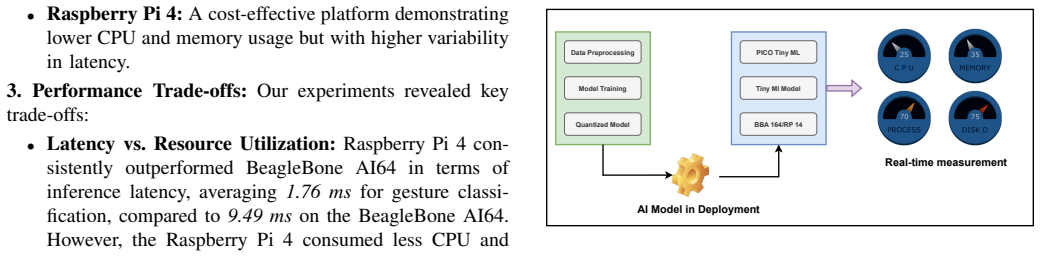
- [Fig. 1] The label 'BBA 164/RP 14' appears to be a typo for 'BBAI64/RPi4'.
- [Fig. 5 caption] The caption uses 'RPI64' instead of 'RPi4' and contains a grammar issue: 'prediction distribution for Gesture Classification for BBAI64 (center) and RPI64 (right)' should be corrected.
- [§IV Overall Comparison] The arrows render as '7→' (e.g., '9.49ms7→1.76ms') and the number formatting is inconsistent ('.74ms' should be '0.74 ms'). Please fix the typesetting.
- [Appendix, metric definitions] The definitions of 'CPU Utilization' and 'Memory Utilization' do not specify how and where measurements were sampled. Provide the exact instrumentation commands or library calls, including sampling intervals, so that readers can reproduce the resource measurements.
- [§I, 'Practical Implications'] The introduction states that 'latency-sensitive applications may prioritize platforms like BeagleBone AI64', which directly contradicts the RQ1 finding that the Raspberry Pi 4 has lower latency across all models. This sentence should be corrected or reworded to reflect the reported results.
- [References] References [11], [13], and [20] are generic landing pages without version or commit identifiers. For reproducibility, please cite specific model versions, TensorFlow Lite versions, or commit hashes.
Circularity Check
No circularity: the paper reports direct measurements; no fitted input is relabeled as prediction and no load-bearing self-citation chain exists.
full rationale
The paper's principal claims (RQ1 latency, RQ2 resource utilization, RQ3 prediction stability) are descriptive statistics of measurements taken by the PICO framework over 100 iterations per model/platform. Inference latencies in Table I (e.g., 9.49 ms vs 1.76 ms for gesture classification) are logged values, not outputs of an equation fitted to those same values. Section III.E's assertion that both boards used 'identical TensorFlow Lite configurations' with hardware accelerators disabled is an experimental-control assumption, not a derivation; if the stacks differed, the measured numbers would still be measurements, so the concern would be external validity, not circularity. The paper contains no self-citations, no imported uniqueness theorem, and no ansatz smuggled in via prior work: references to hardware documentation and standard tooling (TFLite, psutil) are independent support for the measurement setup. The Limitations section explicitly restricts scope but does not hide a circular step. Therefore there is no circularity to flag.
Assumptions & free parameters
free parameters (1)
- Iteration count (n=100) =
100
assumptions (4)
- domain assumption Both platforms ran software-equivalent inference stacks (same TFLite build, quantization, thread count, CPU governor), so latency and resource differences are attributable to hardware.
- domain assumption psutil CPU and memory percentages measured during iteration windows reflect only the inference workload attributable to the model.
- domain assumption 100 point estimates suffice to support distributional claims of consistency and stability.
- domain assumption Outputs reported as confidence scores (for example, MobileNet V2 17.16) are valid, comparable probability scores.
invented entities (1)
-
PICO-TINYML-BENCHMARK framework
Cite this review
Pith. "Pith review of Real-Time Performance Benchmarking of TinyML Models in Embedded Systems (PICO: Performance of Inference, CPU, and Operations)." pith.science (2026). https://pith.science/paper/GFZSZ3CC
@misc{pith2026250904721,
  author       = {Pith},
  title        = {Pith review of: Real-Time Performance Benchmarking of TinyML Models in Embedded Systems (PICO: Performance of Inference, CPU, and Operations)},
  year         = {2026},
  howpublished = {\url{https://pith.science/paper/GFZSZ3CC}},
  note         = {Machine review of arXiv:2509.04721}
}
read the original abstract
This paper presents PICO-TINYML-BENCHMARK, a modular and platform-agnostic framework for benchmarking the real-time performance of TinyML models on resource-constrained embedded systems. Evaluating key metrics such as inference latency, CPU utilization, memory efficiency, and prediction stability, the framework provides insights into computational trade-offs and platform-specific optimizations. We benchmark three representative TinyML models -- Gesture Classification, Keyword Spotting, and MobileNet V2 -- on two widely adopted platforms, BeagleBone AI64 and Raspberry Pi 4, using real-world datasets. Results reveal critical trade-offs: the BeagleBone AI64 demonstrates consistent inference latency for AI-specific tasks, while the Raspberry Pi 4 excels in resource efficiency and cost-effectiveness. These findings offer actionable guidance for optimizing TinyML deployments, bridging the gap between theoretical advancements and practical applications in embedded systems.
Figures


Figures from the paper (2 more)


Reference graph
Works this paper leans on
-
[1]
Internet of Things (IoT): A Literature Review,
S. Madakam, R. Ramaswamy, and S. Tripathi, “Internet of Things (IoT): A Literature Review,”Journal of Computer and Communications, vol. 3, pp. 164–173, 2015. doi: 10.4236/jcc.2015.35021. [Online]. Available: https://www.scirp.org/journal/paperinformation?paperid=56616
-
[2]
Edge Computing: Vision and Challenges,
W. Shi, J. Cao, Q. Zhang, Y . Li, and L. Xu, “Edge Computing: Vision and Challenges,”IEEE Internet of Things Journal, vol. 3, no. 5, pp. 637–646, 2016, doi: 10.1109/JIOT.2016.2579198
arXiv 2016
-
[3]
P. Warden and D. Situnayake,TinyML: Machine Learning with Tensor- Flow Lite on Arduino and Ultra-Low-Power Microcontrollers. O’Reilly Media, Inc., 2019
work page 2019
-
[4]
Advancements in TinyML: Applications, Limitations, and Impact on IoT Devices,
A. Elhanashi, P. Dini, S. Saponara, and Q. Zheng, “Advancements in TinyML: Applications, Limitations, and Impact on IoT Devices,” Electronics, vol. 13, no. 17, Art. no. 3562, 2024. doi: 10.3390/electron- ics13173562. [Online]. Available: https://www.mdpi.com/2079-9292/13/ 17/3562
-
[5]
To prune, or not to prune: exploring the efficacy of pruning for model compression,
M. Zhu and S. Gupta, “To prune, or not to prune: exploring the efficacy of pruning for model compression,”arXiv, Oct. 2017. [Online]. Available: https://arxiv.org/abs/1710.01878
arXiv 2017
-
[6]
DTMM: Deploying TinyML Models on Extremely Weak IoT Devices with Pruning
L. Han, Z. Xiao, and Z. Li, “DTMM: Deploying TinyML Models on Extremely Weak IoT Devices with Pruning,”arXiv, Jan. 2024. [Online]. Available: https://arxiv.org/abs/2401.09068
work page Pith review arXiv 2024
-
[7]
Efficient Neural Networks for Tiny Machine Learning: A Comprehensive Review,
M. T. L ˆe, P. Wolinski, and J. Arbel, “Efficient Neural Networks for Tiny Machine Learning: A Comprehensive Review,”arXiv, Nov. 2023. [Online]. Available: https://arxiv.org/abs/2311.11883
arXiv 2023
-
[8]
Edge Impulse: An MLOps Platform for Tiny Machine Learning
S. Hymel, C. Banbury, D. Situnayake, A. Elium, C. Ward, M. Kelcey, M. Baaijens, M. Majchrzycki, J. Plunkett, D. Tischler, A. Grande, L. Moreau, D. Maslov, A. Beavis, J. Jongboom, and V . J. Reddi, “Edge Impulse: An MLOps Platform for Tiny Machine Learning,” arXiv preprint arXiv:2212.03332, Dec. 2023. [Online]. Available: https: //arxiv.org/abs/2212.03332
work page Pith review arXiv 2023
Show all 21 references
-
[9]
Available: https: //www.raspberrypi.com/products/raspberry-pi-4-model-b/specifications/
Raspberry Pi 4 Model B Specifications, Raspberry Pi. Available: https: //www.raspberrypi.com/products/raspberry-pi-4-model-b/specifications/
-
[10]
Available: https:// docs.beagleboard.org/boards/beaglebone/ai-64/index.html
BeagleBone AI-64 Documentation, BeagleBoard. Available: https:// docs.beagleboard.org/boards/beaglebone/ai-64/index.html
-
[11]
Available: https://github.com/tensorflow/examples/blob/master/lite/%examples/ gesture classification
TensorFlow Lite Gesture Classification, GitHub. Available: https://github.com/tensorflow/examples/blob/master/lite/%examples/ gesture classification
-
[12]
Available: https://siliconlabs.github.io/ mltk/ static/kws overview/index.html
Keyword Spotting, Silicon Labs. Available: https://siliconlabs.github.io/ mltk/ static/kws overview/index.html
-
[13]
Available: https://pytorch.org/hub/pytorch vision mobilenet v2/
MobileNet V2, PyTorch. Available: https://pytorch.org/hub/pytorch vision mobilenet v2/
-
[14]
[Online]
TensorFlow Lite Micro,TensorFlow, 2020. [Online]. Available: https: //www.tensorflow.org/lite/microcontrollers
2020
-
[15]
Power-Performance Char- acterization of TinyML Systems,
Y . Zhang, D. Wijerathne, Z. Li, and T. Mitra, “Power-Performance Char- acterization of TinyML Systems,” inProceedings of the 2022 IEEE 40th International Conference on Computer Design (ICCD), Olympic Valley, CA, USA, 2022, pp. 644–651, doi: 10.1109/ICCD56317.2022.00099
2022
-
[16]
[Online]
MLPerf Tiny Benchmark,arXiv, 2021. [Online]. Available: https://arxiv. org/abs/2106.07597
2021 arXiv
-
[17]
TensorFlow Lite Runtime for inference execution,
TensorFlow Lite, “TensorFlow Lite Runtime for inference execution,” TensorFlow, 2023. [Online]. Available: https://www.tensorflow.org/lite
2023
-
[18]
Arya, Hand Gesture Recognition Dataset, Kaggle,
R. Arya, Hand Gesture Recognition Dataset, Kaggle,
-
[19]
Available: https://siliconlabs.github.io/mltk/docs/python api%/datasets/audio/ speech commands v2.html
Speech Commands V2 Dataset, Silicon Labs, 2021. Available: https://siliconlabs.github.io/mltk/docs/python api%/datasets/audio/ speech commands v2.html
2021
-
[20]
MobileNet V2, Hugging Face. Available: https://huggingface.co/google/ mobilenet v2 1.4 224?library=transformers APPENDIX METRICDESCRIPTIONS •Inference Latency:The time (in milliseconds) taken to complete a single inference. Measured across 100 iterations to analyze consistency...
-
[2021]
Available: https://www.kaggle.com/datasets/aryarishabh/ hand-gesture-recognition-dataset
Reviewed August 5, 2026 · model on record in the stance chip above.
Discussion (0). Sign in to comment.