REVIEW 5 major objections 5 minor 51 references
RINSER predicts Windows API names in obfuscated malware with 85.77% accuracy by training BERT on 'API codeprints' extracted from disassembly.
Reviewed by Pith at T0; open to challenge. T0 means a machine referee read the full paper against a public rubric. the ladder, T0–T4 →
T0 review · deepseek-v4-flash
2026-08-05 05:49 UTC pith:YNBSKQ4I
load-bearing objection RINSER is a genuinely useful new application with a large dataset, but the headline numbers are undercut by arithmetic errors, a binary-split leak risk, and a FLIRT-label circularity that needs an independent validation set. the 5 major comments →
RINSER: Accurate API Prediction Using Masked Language Models
The pith
A machine-rendered reading of the paper's core claim, the machinery that carries it, and where it could break.
Core claim
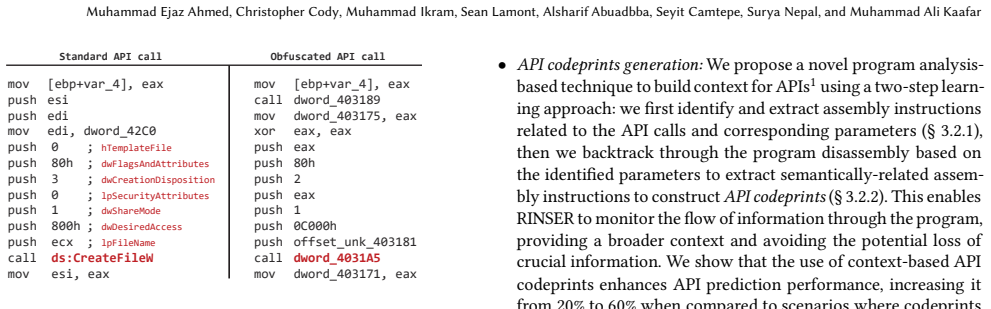
The central claim is that the assembly context around a call is enough to name the API, and that a masked-language-model objective can learn that mapping without labels. The paper introduces API codeprints: the API name, its parameter names and values, and the instructions semantically tied to those parameter values. BERT-style pretraining on 4.7M codeprints teaches the model to fill a mask over the API name; fine-tuning adapts it to stripped binaries. On 1,148 unseen binaries accuracy is 88.80%, and on binaries whose API names IDA leaves unresolved, RINSER recovers 69,921 names, including 65 APIs tied to C2, spying, and evasion.
What carries the argument
The key object is the API codeprint, built in three steps: find API call sites and parameter pushes from IDA-disassembled code; semantically backtrack from each register-based parameter value through preceding instructions to collect the instructions that touch the same registers; and symbolically map memory and address operands to tokens like 'mem', 'complex', and 'saddr' to control vocabulary. The codeprint is fed to a masked language model (BERT), which is trained to predict the masked API token from its surrounding context; this is what lets the model transfer to stripped and obfuscated binaries.
Load-bearing premise
The whole pipeline assumes IDA FLIRT reliably annotates which API is called and the names of its parameters; if that annotation is wrong, both the training label and the test label are wrong, so the measured accuracy reflects fidelity to IDA as much as true API identification.
What would settle it
Compile a set of Windows C programs with symbols and known API names, strip them, and obfuscate names with a method other than dynamic GetProcAddress resolution (e.g., direct IAT rewriting with hash-based lookup), then compare RINSER's predictions to the true names; if codeprint extraction drops below the claimed ~91% parameter-detection accuracy or accuracy on such binaries falls far below 85%, the push-and-annotation assumption is the breaking point. Alternatively, inspect mispredictions: RINSER outputs parameters like 'hwnd' or symbols like 'maddr' for non-API tokens, indicating the model i
If this is right
- An analyst who sees an obfuscated 'call dword_4031A5' can be shown the most likely API name in seconds, cutting manual reverse-engineering time.
- The approach should transfer to other API-name prediction tasks: parameter-value prediction, API call sequence prediction, and deobfuscation of dynamically resolved imports using GetProcAddress.
- Releasing the 4.7M-codeprint dataset gives other researchers a common benchmark to compare API prediction work on Windows, where source-independent large datasets were missing.
- Because the model learns context rather than exact import entries, it stays accurate when control flow is displaced by jump-based transformations, with accuracy dropping only from 89.03% to 85.43%.
Where Pith is reading between the lines
- The evaluation's ceiling is set by IDA FLIRT: reported accuracy partly measures agreement with FLIRT's annotations, so gains on fully unknown APIs may be lower or higher than 85.77%; a test against independently compiled, symbol-known Windows programs would separate the two.
- The semantic-backtracking design suggests the method could extend from x86 stdcall to x64 and fastcall conventions, where parameters pass in registers, provided codeprint construction is adapted.
- A natural stress test is malware that hides calls by push/ret sequences or statically linked libraries — the paper notes these as limitations; future work could use a classifier trained on surrounding instructions rather than only the call operand.
- If the codeprint dataset is public as claimed, it enables transfer learning for low-resource malware families by fine-tuning on a handful of labeled samples.
Editorial analysis
A structured set of objections, weighed in public.
Referee Report
Summary. The paper presents RINSER, a framework for predicting Windows API function names from x86 PE binaries. RINSER introduces 'API codeprints', which combine an API's name, its parameter names/values, and semantically related assembly instructions obtained by register-based backtracking from IDA Pro disassembly (Algorithm 1 and 2). The codeprints are tokenized and normalized, then used to pre-train a BERT-style masked language model; the model is fine-tuned for stripped binaries. The authors report 85.77% accuracy on a 10% test split of 4.7M codeprints, 82.88% on simulated stripped codeprints, 88.80% on 1,148 unseen binaries, and 69,921 predicted API names in cases where IDA did not resolve the API. They also compare with three baselines and evaluate robustness against instruction randomization and code displacement.
Significance. If the central claims hold, the paper makes a useful contribution: it provides a large malware-derived WinAPI dataset, a concrete codeprint construction method, and evidence that masked language modeling can exploit API calling context. The ablation study (Appendix A) convincingly shows that full codeprints matter, and the manual validation of 65 obfuscated API names (Appendix E.3) is a genuinely independent check. However, the headline accuracy numbers rest on FLIRT-derived labels, and several reported numbers are internally inconsistent. These issues are load-bearing for the main claims and need to be fixed before the results can be accepted at face value.
major comments (5)
- [§5.4, Table 3] Table 3 reports per-row accuracies that do not match the counts in the same table. Row 1: 337,283/449,472 = 75.0%, not 56.94%. Row 2: 164,763/187,084 = 88.1%, not 73.34%. Row ≥6: 74,437/77,092 = 96.6%, not 91.84%. Only the overall 821,895/991,561 = 82.88% is consistent. The surrounding paragraph explains the parameter-count trend using these rows, so the corrected numbers are needed; as printed, the claim that accuracy increases monotonically with parameter count is not supported.
- [§3.2.1, §4.2, §5.2] Algorithm 1 (Steps 8–15) identifies API names and parameter names from IDA FLIRT annotations, and §4.2 constructs the labeled dataset from those same annotations. The validation against Microsoft documentation in §4.2 checks API/parameter-name lists, not the per-callsite labels used for training and testing. Both train and test labels therefore originate from the same FLIRT/IDA pipeline, so the reported accuracy may partly measure the model's agreement with IDA's annotation decisions rather than its ability to infer API identity independently. The §5.2 extraction accuracy (91.4%/90.5%) also derives from FLIRT-based extraction. Please provide an independent ground truth for a random sample of test codeprints (e.g., compiled known source or manual reverse engineering) and report accuracy on that sample, along with an analysis of cases where FLIRT annotations are wrong.
- [§4.2, Table 2, §5.3] Table 2 reports a 10% test split of 4,744,969 codeprints, but the paper does not state that the split is at the binary level. If codeprints from the same binary appear in both training and test, the 85.77% accuracy in §5.3 can be inflated by binary-specific leakage. The in-the-wild evaluation in §E.2 on 1,148 unseen binaries is an encouraging complementary result, but the main headline number should either be recomputed with a binary-disjoint split or explicitly accompanied by a statement of the split unit and the corresponding accuracy.
- [§5.5, §E.3] Section 5.5 reports that RINSER 'correctly predicted' 69,921 API names among 148,685 IDA-unresolved codeprints. Since IDA did not resolve these names, correctness is not defined unless there is an independent ground truth, such as the corresponding non-obfuscated binaries. The manual validation of 65 unique APIs in Appendix E.3 covers only the unique-name level, not the 69,921 predicted instances. Please specify how each of the 69,921 predictions was verified, or report the deobfuscation evaluation only on the subset with known ground truth. The '66% deobfuscation' result on the manually crafted dataset also lacks the denominator and per-API details.
- [Appendix D, Table 9] Table 9 is internally inconsistent with the main results. The 'Actual predictions' column gives 89.21% for Normal §5.3 and 82.08% for Stripped §5.4, but §§5.3–5.4 report 85.77% and 82.88%. The Obfuscated row's 47.03% matches 69,921/148,685 only if that is the intended denominator, which is not stated in §5.5. Please reconcile these values and clarify whether different test sets were used. Also, the improvement column reports percentage-point differences (e.g., 0.41 pp) but labels them as percentages; this should be corrected.
minor comments (5)
- [Abstract, §1] The paper calls the dataset 'the largest publicly available dataset of this type' but no repository link or availability statement appears in this version. Please add a URL or DOI, and clarify the exact release conditions.
- [Algorithm 1, Algorithm 2] The algorithm pseudocode contains typesetting artifacts such as '/u1D439 instrs' and repeated 'instrs' placeholders, and the Unicode variables are difficult to read. Please clean the pseudocode so that the extraction steps are unambiguous.
- [References] Reference [25] is labeled 'Hugging Face. Windows apis to intents by malware' and points to malapi.io, but the text in §5.1 cites it for the Transformers fill-mask pipeline. The correct reference appears to be [33]. Please verify and fix this citation.
- [Table 10] Table 10 lists 'WriteProcessMemory' twice in the 5-parameter row. Remove the duplicate entry.
- [§5.1] The notation for predicted and ground-truth API names uses the same symbol for both quantities ('predicted API name (/u1D464)' and 'ground truth API name (/u1D464)'). Use distinct symbols, e.g., ŷ and y, to define the accuracy metric.
Circularity Check
No significant circularity; the API-name predictions are a standard masked-token recovery task over codeprints whose labels and features come from an external annotator (IDA FLIRT) with independent Microsoft documentation validation.
full rationale
RINSER's derivation chain is not circular in the sense of the review rubric. Algorithm 1 constructs API codeprints by reading API names from call operands and parameter names from IDA FLIRT annotations; the ground-truth dataset in Section 4.2 is also based on FLIRT annotations, but those annotations are an external signature-recognition tool, and the paper states that the extracted names were validated against Microsoft's official documentation, which serves as an independent reference. The prediction task in Section 5.1 masks the API-name token from a codeprint and asks the model to fill it in from the remaining tokens; this is a conventional cloze-style supervised setup, not an equation in which the predicted value is defined in terms of the input. The stripped-binary evaluation removes the API and parameter names before prediction, and the obfuscated-binary evaluation uses codeprints in which IDA did not resolve an API name at all, so those settings are not trivially reducible to reading off the label. The large-scale in-the-wild evaluation on 1,148 unseen binaries is external to the training split, and the manual confirmation of 65 obfuscated APIs is an independent check. The overlap between the feature source and label source (both IDA FLIRT) is a legitimate validity and dataset-bias concern that could affect how much the reported accuracy reflects reproduction of FLIRT's signature decisions, but it is not a self-definitional or by-construction circularity under the rules of this pass. There is also no load-bearing self-citation, no imported uniqueness theorem, and no ansatz smuggled in via citation.
Axiom & Free-Parameter Ledger
free parameters (4)
- cosine similarity threshold for context groups =
0.91
- symbolic mapping thresholds for hex addresses =
saddr (<=2 hex digits), maddr (2-4), laddr (>4), complex (>=3 operands)
- top-k API truncation for baseline comparison =
1,024
- BERT masking probability =
15%
axioms (4)
- domain assumption IDA Pro FLIRT annotations correctly identify API names and parameter names in normal binaries
- domain assumption x86 stdcall parameters are always passed via push instructions and annotated by IDA
- ad hoc to paper Register dataflow backtracking captures all semantically relevant context for an API call
- domain assumption Unpacked malware binaries from VirusShare are representative of real-world obfuscated malware
invented entities (2)
-
API codeprint
no independent evidence
-
context-based groups
no independent evidence
Cite this review
Pith. "Pith review of RINSER: Accurate API Prediction Using Masked Language Models." pith.science (2026). https://pith.science/paper/YNBSKQ4I
@misc{pith2026250904887,
  author       = {Pith},
  title        = {Pith review of: RINSER: Accurate API Prediction Using Masked Language Models},
  year         = {2026},
  howpublished = {\url{https://pith.science/paper/YNBSKQ4I}},
  note         = {Machine review of arXiv:2509.04887}
}
read the original abstract
Malware authors commonly use obfuscation to hide API identities in binary files, making analysis difficult and time-consuming for a human expert to understand the behavior and intent of the program. Automatic API prediction tools are necessary to efficiently analyze unknown binaries, facilitating rapid malware triage while reducing the workload on human analysts. In this paper, we present RINSER (AccuRate API predictioN using maSked languagE model leaRning), an automated framework for predicting Windows API (WinAPI) function names. RINSER introduces the novel concept of API codeprints, a set of API-relevant assembly instructions, and supports x86 PE binaries. RINSER relies on BERT's masked language model (LM) to predict API names at scale, achieving 85.77% accuracy for normal binaries and 82.88% accuracy for stripped binaries. We evaluate RINSER on a large dataset of 4.7M API codeprints from 11,098 malware binaries, covering 4,123 unique Windows APIs, making it the largest publicly available dataset of this type. RINSER successfully discovered 65 obfuscated Windows APIs related to C2 communication, spying, and evasion in our dataset, which the commercial disassembler IDA failed to identify. Furthermore, we compared RINSER against three state-of-the-art approaches, showing over 20% higher prediction accuracy. We also demonstrated RINSER's resilience to adversarial attacks, including instruction randomization and code displacement, with a performance drop of no more than 3%.
Figures


Reference graph
Works this paper leans on
-
[1]
https://malwareandstuff.com/deobfuscating-danabots- api-hashing/
API hashing. https://malwareandstuff.com/deobfuscating-danabots- api-hashing/
- [2]
-
[3]
https://www.hex-rays.com/products/ida/support/idapython_docs/
IDAPython documentation. https://www.hex-rays.com/products/ida/support/idapython_docs/
-
[4]
https://learn.microsoft.com/en-us/windows/win32/api/fileapi/nf-fileapi-createfilew
Microsoft Documentation. https://learn.microsoft.com/en-us/windows/win32/api/fileapi/nf-fileapi-createfilew
-
[5]
https://virusshare.com/hashfiles/unpacked_hashes.md5
Unpacked hashes. https://virusshare.com/hashfiles/unpacked_hashes.md5
- [6]
-
[7]
Hojjat Aghakhani, Fabio Gritti, Francesco Mecca, Marti na Lindorfer, Stefano Or- tolani, Davide Balzarotti, Giovanni Vigna, and Christophe r Kruegel. When mal- ware is packin’heat; limits of machine learning classifiers based on static analy- sis features. In Network and Distributed Systems Security (NDSS) Symposium 2020, 2020
work page 2020
-
[8]
Fo recasting malware capabilities from cyber attack memory images
Omar Alrawi, Moses Ike, Matthew Pruett, Ranjita Pai Kast uri, Srimanta Barua, Taleb Hirani, Brennan Hill, and Brendan Saltaformaggio. Fo recasting malware capabilities from cyber attack memory images. In 30th USENIX Security Sympo- sium (USENIX Security 21) , pages 3523–3540, 2021
work page 2021
-
[9]
Steven Bird, Ewan Klein, and Edward Loper. Natural language processing with Python: analyzing text with the natural language toolkit . " O’Reilly Media, Inc. ", 2009
work page 2009
-
[10]
How ai can help reverse engineer malware: Predicting functio n names of code
Jeff Burt. How ai can help reverse engineer malware: Predicting functio n names of code. https://www.theregister.com/2022/03/26/machine_learning_malware/
work page 2022
-
[11]
Binlin Cheng, Jiang Ming, Jianmin Fu, Guojun Peng, Ting Chen, Xiaosong Zhang, and Jean-Yves Marion. Towards paving the way for large-scale windows malware analysis: Generic binary unpacking with orders-of -magnitude perfor- mance boost. In Proceedings of the 2018 ACM SIGSAC Conference on Computer and Communications Security, pages 395–411, 2018
work page 2018
-
[12]
{Obfuscation-Resilient} executable payload extrac- tion from packed malware
Binlin Cheng, Jiang Ming, Erika A Leal, Haotian Zhang, J ianming Fu, Guojun Peng, and Jean-Yves Marion. {Obfuscation-Resilient} executable payload extrac- tion from packed malware. In30th USENIX Security Symposium (USENIX Security 21), pages 3451–3468, 2021
work page 2021
-
[13]
Api deobfuscator: Resolving obfuscated api fun ctions in modern packers
S Choi. Api deobfuscator: Resolving obfuscated api fun ctions in modern packers. In BlackHat, 2015
work page 2015
-
[14]
Investigating graph embedding methods for cross-platform binary code simi- larity detection
Victor Cochard, Damian Pfammatter, Chi Thang Duong, an d Mathias Humbert. Investigating graph embedding methods for cross-platform binary code simi- larity detection. In 2022 IEEE 7th European Symposium on Security and Privacy (EuroS&P), pages 60–73. IEEE, 2022
work page 2022
-
[15]
Neural reverse en gineering of stripped binaries using augmented control flow graphs
Yaniv David, Uri Alon, and Eran Yahav. Neural reverse en gineering of stripped binaries using augmented control flow graphs. Proceedings of the ACM on Pro- gramming Languages, 4(OOPSLA):1–28, 2020
work page 2020
-
[16]
Bert: Pre- training of deep bidirectional transformers for language u nderstanding
Jacob Devlin, Ming-Wei Chang, Kenton Lee, and Kristina Toutanova. Bert: Pre- training of deep bidirectional transformers for language u nderstanding. arXiv preprint arXiv:1810.04805, 2018
Pith/arXiv arXiv 2018
-
[17]
Steven HH Ding, Benjamin CM Fung, and Philippe Charland . Asm2vec: Boosting static representation robustness for binary clone search against code obfuscation and compiler optimization. In 2019 IEEE Symposium on Security and Privacy (SP) , pages 472–489. IEEE, 2019
work page 2019
-
[18]
Understan ding android obfuscation techniques: A large-scale investigation in th e wild
Shuaike Dong, Menghao Li, Wenrui Diao, Xiangyu Liu, Jia n Liu, Zhou Li, Feng- hao Xu, Kai Chen, Xiaofeng Wang, and Kehuan Zhang. Understan ding android obfuscation techniques: A large-scale investigation in th e wild. In International conference on security and privacy in communication system s, pages 172–192. Springer, 2018
work page 2018
-
[19]
{DeepReflect}: Discovering malicious functionality through binary recon struction
Evan Downing, Yisroel Mirsky, Kyuhong Park, and Wenke L ee. {DeepReflect}: Discovering malicious functionality through binary recon struction. In 30th USENIX Security Symposium (USENIX Security 21) , pages 3469–3486, 2021
work page 2021
-
[20]
Dee pbindiff: Learning program-wide code representations for binary diffing
Yue Duan, Xuezixiang Li, Jinghan Wang, and Heng Yin. Dee pbindiff: Learning program-wide code representations for binary diffing. InNetwork and distributed system security symposium , 2020
work page 2020
-
[21]
The IDA pro book, second eddition
Chris Eagle. The IDA pro book, second eddition . no starch press, 2011
work page 2011
- [22]
-
[23]
Debin: Predicting debug information in stripped binaries
Jingxuan He, Pesho Ivanov, Petar Tsankov, Veselin Rayc hev, and Martin Vechev. Debin: Predicting debug information in stripped binaries. In Proceedings of the 2018 ACM SIGSAC Conference on Computer and Communications S ecurity, pages 1667–1680, 2018
work page 2018
-
[24]
Hexrays. IDA FLIRT Tec. https://hex-rays.com/products/ida/tech/flirt/in_depth/
-
[25]
Windows apis to intents by malware
Hugging Face. Windows apis to intents by malware. https ://malapi.io/. Accessed: 2022-12-19
work page 2022
-
[26]
Xin Jin, Kexin Pei, Jun Yeon Won, and Zhiqiang Lin. Symlm : Predicting func- tion names in stripped binaries via context-sensitive exec ution-aware code em- beddings. In Proceedings of the 2022 ACM SIGSAC Conference on Computer and Communications Security, pages 1631–1645, 2022
work page 2022
-
[27]
Towards generic deo bfuscation of win- dows api calls
Vadim Kotov and Michael Wojnowicz. Towards generic deo bfuscation of win- dows api calls. Workshop on Binary Analysis Research (BAR), NDSS , 2018
work page 2018
-
[28]
Abstracting stack to detect obfuscated calls in binaries
Arun Lakhotia and Eric Uday Kumar. Abstracting stack to detect obfuscated calls in binaries. In Source Code Analysis and Manipulation, Fourth IEEE Interna tional Workshop on, pages 17–26. IEEE, 2004
work page 2004
-
[29]
Palmtree: learning a n assembly language model for instruction embedding
Xuezixiang Li, Yu Qu, and Heng Yin. Palmtree: learning a n assembly language model for instruction embedding. In Proceedings of the 2021 ACM SIGSAC Con- ference on Computer and Communications Security , pages 3236–3251, 2021
work page 2021
-
[30]
Malgraph: Hierarchical graph neural networ ks for robust win- dows malware detection
Xiang Ling, Lingfei Wu, Wei Deng, Zhenqing Qu, Jiangyu Z hang, Sheng Zhang, and Tengfei Ma. Malgraph: Hierarchical graph neural networ ks for robust win- dows malware detection. pages 1998–2007, 2022
work page 1998
-
[31]
Research on software s ecurity and compati- bility test for mobile application
Zhenyu Liu, Yun Hu, and Lizhi Cai. Research on software s ecurity and compati- bility test for mobile application. In Fourth edition of the International Conference on the Innovative Computing Technology (INTECH 2014) , pages 140–145. IEEE, 2014. Muhammad Ejaz Ahmed, Christopher Cody, Muhammad Ikram, Sea n Lamont, Alsharif Abuadbba, Seyit Camtepe, Surya N...
work page 2014
-
[32]
Malware makeover: Breaking ml-based static analysis b y modifying exe- cutable bytes
Keane Lucas, Mahmood Sharif, Lujo Bauer, Michael K Reit er, and Saurabh Shin- tre. Malware makeover: Breaking ml-based static analysis b y modifying exe- cutable bytes. In Proceedings of the 2021 ACM Asia Conference on Computer and Communications Security, pages 744–758, 2021
work page 2021
- [33]
- [34]
-
[35]
Prevalence and impact of low-entrop y packing schemes in the malware ecosystem
Alessandro Mantovani, Simone Aonzo, Xabier Ugarte-Pe drero, Alessio Merlo, and Davide Balzarotti. Prevalence and impact of low-entrop y packing schemes in the malware ecosystem. In NDSS, 2020
work page 2020
-
[36]
Safe: Self-attentive function embeddi ngs for binary similar- ity
Luca Massarelli, Giuseppe Antonio Di Luna, Fabio Petro ni, Roberto Baldoni, and Leonardo Querzoni. Safe: Self-attentive function embeddi ngs for binary similar- ity. In Detection of Intrusions and Malware, and Vulnerability Ass essment: 16th International Conference, DIMV A 2019, Gothenburg, Sweden, June 19–20, 2019, Pro- ceedings 16, pages 309–329. Sprin...
work page 2019
-
[37]
Microsoft. sendto function (winsock.h). https://learn.microsoft.com/en-us/windows/win32/api/winsock/nf-winsock-sendto
-
[38]
Microsoft. Technical documentation. https://learn.microsoft.com/en-us/docs/
-
[39]
Smashing the gadgets: Hindering return-oriented programming using in- place code random- ization
Vasilis Pappas, Michalis Polychronakis, and Angelos D Keromytis. Smashing the gadgets: Hindering return-oriented programming using in- place code random- ization. In 2012 IEEE Symposium on Security and Privacy , pages 601–615. IEEE, 2012
work page 2012
-
[40]
Identifying behavior dispatchers fo r malware anal- ysis
Kyuhong Park, Burak Sahin, Yongheng Chen, Jisheng Zhao , Evan Downing, Hong Hu, and Wenke Lee. Identifying behavior dispatchers fo r malware anal- ysis. In Proceedings of the 2021 ACM Asia Conference on Computer and Co mmu- nications Security, pages 759–773, 2021
work page 2021
-
[41]
Xfl: Naming func- tions in binaries with extreme multi-label learning
James Patrick-Evans, Moritz Dannehl, and Johannes Kin der. Xfl: Naming func- tions in binaries with extreme multi-label learning. In 2023 IEEE Symposium on Security and Privacy (SP) , pages 2375–2390. IEEE, 2023
work page 2023
-
[42]
Trex: Learning execution semantics from micro-traces for binary similarity
Kexin Pei, Zhou Xuan, Junfeng Yang, Suman Jana, and Bais hakhi Ray. Trex: Learning execution semantics from micro-traces for binary similarity. arXiv preprint arXiv:2012.08680, 2020
Pith/arXiv arXiv 2012
-
[43]
Identification of Obfuscated Function Clones in Binaries using Ma- chine Learning
Michael Pucher. Identification of Obfuscated Function Clones in Binaries using Ma- chine Learning. PhD thesis, Wien, 2022
work page 2022
-
[44]
Software testing techniques and strategies
Abhijit A Sawant, Pranit H Bari, and PM Chawan. Software testing techniques and strategies. International Journal of Engineering Research and Applica tions (IJERA), 2(3):980–986, 2012
work page 2012
-
[45]
Eureka: A framework for enabling static malware analysis
Monirul Sharif, Vinod Yegneswaran, Hassen Saidi, Phillip Porras, and Wenke Lee. Eureka: A framework for enabling static malware analysis. I n European Sympo- sium on Research in Computer Security , pages 481–500. Springer, 2008
work page 2008
-
[46]
A museum of api obfuscation on win32
Masaki Suenaga. A museum of api obfuscation on win32. Symantec Security Re- sponse, 2009
work page 2009
-
[47]
An experimentation framework for evaluating disassembly and decom- pilation tools for c++ and java
Lori Vinciguerra, Linda Wills, Nidhi Kejriwal, Paul Ma rtino, and Ralph Vin- ciguerra. An experimentation framework for evaluating disassembly and decom- pilation tools for c++ and java. In 10th Working Conference on Reverse Engineer- ing, 2003. WCRE 2003. Proceedings. , pages 14–14. IEEE Computer Society, 2003
work page 2003
-
[48]
A n api deobfusca- tion method combining dynamic and static techniques
Qi Xi, Tianyang Zhou, Qingxian Wang, and Yongjun Zeng. A n api deobfusca- tion method combining dynamic and static techniques. In Proceedings 2013 Inter- national Conference on Mechatronic Sciences, Electric Eng ineering and Computer (MEC), pages 2133–2138. IEEE, 2013
work page 2013
-
[49]
Hawkeye: cross- platform malware detection with representation learning o n graphs
Peng Xu, Youyi Zhang, Claudia Eckert, and Apostolis Zar ras. Hawkeye: cross- platform malware detection with representation learning o n graphs. In Interna- tional Conference on Artificial Neural Networks , pages 127–138. Springer, 2021
work page 2021
-
[50]
Order matters: Semantic-aware neural networks for binary code si milarity detection
Zeping Yu, Rui Cao, Qiyi Tang, Sen Nie, Junzhou Huang, an d Shi Wu. Order matters: Semantic-aware neural networks for binary code si milarity detection. In Proceedings of the AAAI Conference on Artificial Intelligenc e, volume 34, pages 1145–1152, 2020
work page 2020
-
[51]
Neural Machine Translation Inspired Binary Code Similarity Comparison beyond Function Pairs
Fei Zuo, Xiaopeng Li, Patrick Young, Lannan Luo, Qiang Z eng, and Zhexin Zhang. Neural machine translation inspired binary code sim ilarity comparison beyond function pairs. arXiv preprint arXiv:1808.04706 , 2018. A Ablation study In the ablation study, we investigate the impact on the performance of RINSER in predicting API names under the following thre...
work page internal anchor Pith review Pith/arXiv arXiv 2018
discussion (0)
Sign in with ORCID, Apple, or X to comment. Anyone can read and Pith papers without signing in.