REVIEW 3 major objections 4 minor 1 cited by
This paper claims that in 200 GeV Au+Au collisions, the expansion stage—not the initial-state model—sets the final hadron spectra and elliptic flow, by building a hybrid model that swaps evolution stages between two frameworks.
Reviewed by Pith at T0; open to challenge. T0 means a machine referee read the full paper against a public rubric. the ladder, T0–T4 →
T0 review · deepseek-v4-flash
2026-08-05 05:25 UTC pith:4L7RZMV4
load-bearing objection A genuinely new EPOSir+PHSDe hybrid tool, but the headline claim that evolution dominates over initial conditions is only partially supported because the rope modifications change the initial state, not just the evolution. the 3 major comments →
Disentangling Initial-State and Evolution Effects in Heavy-Ion Collisions Using EPOS and PHSD
The pith
A machine-rendered reading of the paper's core claim, the machinery that carries it, and where it could break.
Core claim
In Au+Au collisions at 200 GeV per nucleon pair, the final hadron transverse-momentum spectra and elliptic flow v2 are controlled by the evolutionary dynamics rather than by the initial-stage model. The authors demonstrate this by constructing EPOSir+PHSDe, which uses EPOS's initial conditions (with a rope modification to fix overproduction) as the starting point for the non-equilibrium partonic and hadronic transport evolution of PHSD. EPOSir+PHSDe produces results much closer to PHSD—which starts from entirely different initial conditions but evolves with the same transport dynamics—than to EPOS, which starts from the same initial conditions but evolves hydrodynamically. The momentum eccen
What carries the argument
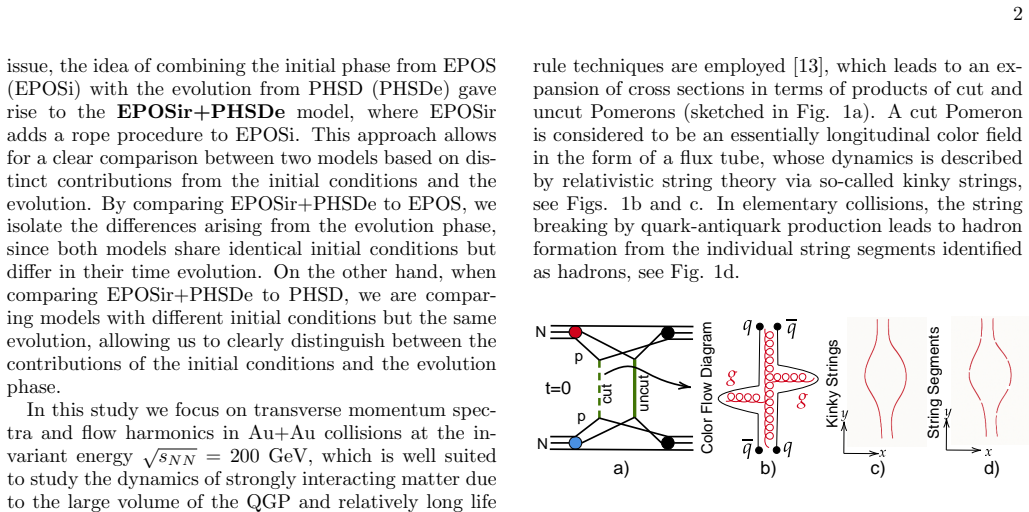
The central object is the EPOSir+PHSDe hybrid: EPOS's initial stage (instantaneous S-matrix multiple scatterings followed by core–corona separation) is modified with a rope procedure—fusing overlapping string segments into clusters that decay with imposed transverse and longitudinal flow profiles—and the resulting prehadrons are extrapolated back in time, melted into partons where the energy density exceeds 0.5 GeV/fm^3, and then evolved with PHSD's off-shell transport dynamics. This setup acts as a control experiment in which the evolution stage is swapped while the initial conditions are kept as close as possible, making the comparison of the EPOS and PHSD legs the load-bearing comparison.
Load-bearing premise
That the EPOSir+PHSDe leg really keeps the EPOS initial conditions unchanged; in practice, the unmodified EPOS initial conditions overproduce particles by a factor of about two when fed into PHSD, so a rope procedure with imposed flow profiles has to be inserted first.
What would settle it
Feed the unmodified EPOS initial conditions directly into PHSD, rescaling the overproduction instead of using the rope procedure with its imposed flow profiles; if the resulting pT spectra and v2 then track EPOS rather than PHSD, the claim that evolution dominates would be refuted.
If this is right
- If evolution dominates, the initial-state model (saturation, S-matrix, Lund strings) matters less for bulk observables than the way thermalization and expansion are modeled.
- The intermediate-pT (1–5 GeV/c) enhancement of proton and kaon yields in EPOS—and its good v2 description—is a signature of early hydrodynamic flow, not of the specific initial geometry.
- Transport-based evolution (PHSD) does not convert initial spatial fluctuations into large flow as efficiently as hydrodynamics; this explains the softer spectra and lower high-pT v2 in both PHSD and the hybrid.
- The hybrid framework provides a tool to systematically swap initial and evolution modules to isolate where model-data deviations arise.
- Experimental data at 200 GeV cannot by themselves discriminate initial-state models because bulk observables are insensitive to them.
Where Pith is reading between the lines
- The rope procedure itself injects approximate flow profiles before transport begins, so part of the 'evolution dominance' may be coded into the modified initial conditions; using raw EPOSi in PHSD (with multiplicity rescaled) could shift the conclusion.
- If this hierarchy holds, initial-state differences should show up more strongly in smaller systems (p–A) or at lower collision energies, where the fireball lives shorter and the expansion has less time to erase the initial geometry.
- The finding suggests that improving descriptions of the pre-equilibrium stage—how fast local thermalization sets in and how the early pressure gradients develop—is more urgent for matching bulk data than refining initial-state fluctuation modeling.
- The same disentangling method could be applied to other pairs of models (e.g., hydro-based vs transport-based with different hadronization schemes) to attribute the origin of specific observables like strangeness or flow harmonics v3 and v4.
Editorial analysis
A structured set of objections, weighed in public.
Referee Report
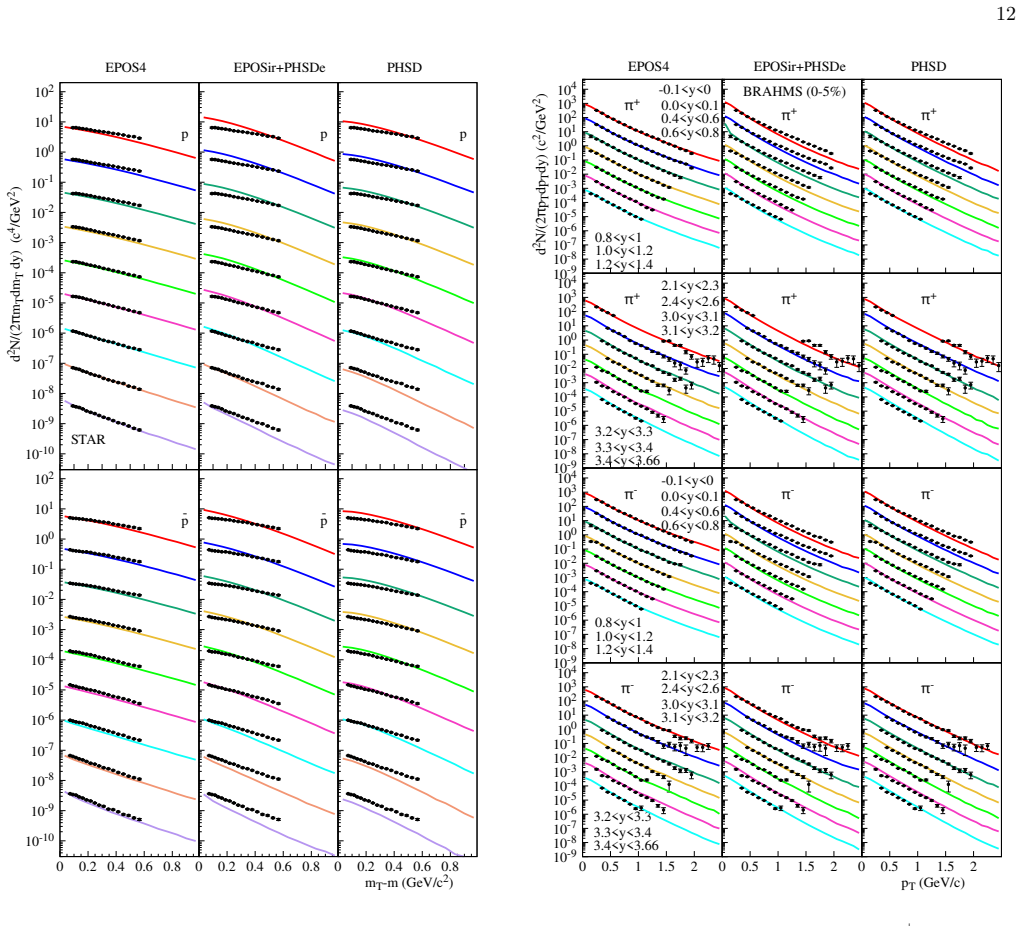
Summary. The paper develops a hybrid model, EPOSir+PHSDe, which uses EPOS initial conditions (modified by a rope/cluster procedure) as the input to the PHSD transport evolution. It compares this hybrid with full EPOS and full PHSD for Au+Au collisions at sqrt(s_NN)=200 GeV, using rapidity/pseudorapidity distributions, transverse-mass and pT spectra, and elliptic flow v2, with comparisons to BRAHMS, PHENIX, PHOBOS, and STAR data. The central claim is that the dynamical evolution, rather than the initial conditions, dominates the final-state bulk observables. The paper also studies the time evolution of the momentum eccentricity epsilon_P and analyzes core-corona and viscosity effects in EPOS.
Significance. The question addressed is important: separating initial-state from final-state-evolution effects is a classic confounder in heavy-ion phenomenology. The paper's second comparison leg (EPOSir+PHSDe vs. PHSD: different initial conditions, similar evolution, similar final results) is a genuinely informative simulation outcome, and the model validation against multiple RHIC datasets is a concrete strength. The hybrid framework itself is a useful tool. However, the headline claim rests on a comparison leg that the manuscript itself concedes is not clean: EPOSir is not the same initial condition as EPOSi, because the rope procedure reduces the prehadron multiplicity by roughly a factor of two and imposes ad hoc flow profiles. Thus the central disentangling logic is presently under-supported, although the qualitative direction may survive additional controls.
major comments (3)
- [Sec. III.B, III.E; Sec. VI] The premise that EPOS and EPOSir+PHSDe 'share identical initial conditions' is contradicted by the text itself. Sec. III.B states that using EPOSi directly in PHSD 'turned out not to work at all' because the multiplicity was too high by roughly a factor of two, and Fig. 7 shows EPOSir reducing dN/dη by about that factor. The rope procedure fuses core string segments into clusters, decays them with transverse and longitudinal flow profiles, and repositions the children at parent positions (Sec. III.C). Therefore the EPOS vs. EPOSir+PHSDe comparison changes both the initial condition and the evolution, so the Abstract and Sec. VI conclusion that evolution dominates is not established by that leg. A control isolating the rope modification is needed, e.g., comparing EPOSir as initial condition with a hydro evolution against EPOSi, or normalizing EPOSi input to the same multiplicity before PH
- [Sec. III.D] The near-complete melting of PHSD core prehadrons into partons within 0.064 fm/c may erase most of the initial-state information before the dynamical evolution has really begun. Melting is triggered by the local energy density exceeding ε_C=0.5 GeV/fm^3, and the manuscript does not quantify how much of the similarity between EPOSir+PHSDe and PHSD is due to this immediate melting prescription rather than to the subsequent PHSD transport. A sensitivity study varying the melting threshold or delaying the melting would clarify whether the conclusion is robust. As written, the comparison is consistent with the claim that the melting step itself, not the generic 'evolution', controls the outcome.
- [Sec. III.B] The rope/cluster algorithm contains several tunable ingredients: the cell-centered grid and slicing, the cluster definition, and the ad hoc transverse and longitudinal flow profiles. These are introduced specifically to reduce the multiplicity by about a factor of two, and no parameter variation or systematic uncertainty is given. The conclusion that initial conditions have minor influence could therefore be an artifact of tuning EPOSir to an initial state that already resembles PHSD. Please provide at least a limited scan over the rope parameters or a demonstration that the final spectra and v2 are insensitive to them within a physically reasonable range.
minor comments (4)
- [General / Sec. I] The outline says the summary is in Section IV, but the actual summary appears in Section VI. Please correct the cross-reference.
- [Fig. 10] The caption lists the middle panels as 'EPOSir+PHSDe (middle left)' and 'PHSD (middle right)', but the text says 'PHSD and EPOSir+PHSDe momentum eccentricities are shown in the middle left and middle right panels'. Please ensure panel labels match the description.
- [General] There are several typos ('accomodating', 'Pomeons', 'presudorapidity', 'intial'), and some figure captions use inconsistent notation for dN/(2π pT dpT dy). A careful proofreading pass would help.
- [Sec. III.C] The equation for the back-extrapolation, Eq. (2), omits the vector symbols on R and V? This is a presentation issue but makes the coordinate-space discussion harder to follow.
Circularity Check
Rope modification breaks the 'identical initial conditions' premise; the disentangling conclusion is partly built into the fitted EPOSir input.
specific steps
-
fitted input called prediction
[Sec. III.B (EPOSir: EPOSi+ropes) and Sec. III.E (Momentum eccentricity caveat)]
"Naively, one may directly use all the 'EPOS prehadrons' as prehadrons for PHSD. But this turned out not to work at all, the multiplicity will be much too high. So we modify EPOSi by introducing ropes... These rope slices (or clusters) are not static, but they are assumed to have a transverse flow profile (resulting in higher transverse momenta of its decay products) and have a longitudinal flow profile (resulting in a broader rapidity distribution). Both effects will reduce the particle multiplicity of particles from cluster decay."
The disentangling argument requires EPOS and EPOSir+PHSDe to 'share identical initial conditions' (Sec. I). But EPOSir is an ad hoc modification of EPOSi, introduced because unmodified EPOSi gives roughly twice the measured multiplicity when fed into PHSD. The rope clusters are assigned transverse and longitudinal flow profiles and reduce prehadron multiplicity, i.e. the initial state is adjusted with collective-flow-like effects. Thus the comparison does not isolate the evolution stage: the observed differences from EPOS, and the similarity to PHSD, are partly inherited from the fitted rope input. The paper concedes this at Sec. III.E: 'we cannot use directly EPOSi as initial condition for PHSDe, but we need to add the rope procedure (→EPOSir)'. The central claim that evolution dominates
full rationale
The paper performs real simulations and compares with independent BRAHMS/PHENIX/STAR/PHOBOS data, so the final spectra and v_n are not derived from the inputs by algebra. The main circularity-like defect is not a mathematical reduction but a violated identification assumption: the rope procedure changes the initial state (multiplicity and flow profiles) before PHSD evolution, so the EPOS vs EPOSir+PHSDe leg cannot isolate evolution effects. The EPOSir+PHSDe vs PHSD leg uses the same evolution, but the EPOSir initial state has been modified with ad hoc transverse/longitudinal flow to make it compatible with PHSD, so the closeness to PHSD is partly input-driven. The paper openly concedes this in Sec. III.E. No equation is used to define the conclusion into existence, and no uniqueness theorem or ansatz is smuggled via citation; self-citations are validation-oriented rather than load-bearing. I therefore score partial circularity (4), not 0, because the central 'dominant influence of dynamical evolution' claim is confounded by the fitted rope input, though it still has independent simulation content.
Axiom & Free-Parameter Ledger
free parameters (6)
- EPOS shear viscosity to entropy ratio eta/s =
0.08 (default), 0.24 (variation)
- Rope cluster transverse and longitudinal flow profiles =
not specified
- Rope/cluster algorithm parameters (grid, slicing) =
not specified
- Critical energy density epsilon_C for melting =
0.5 GeV/fm^3
- DQPM coupling parameter =
fixed by matching lQCD entropy density at mu_B=0
- PHSD/Lund tune parameters =
pre-tuned in ref [39]
axioms (6)
- domain assumption EPOS initial state: instantaneous parallel partonic scatterings described by S-matrix theory with Pomeron exchange and a dynamical saturation scale
- domain assumption EPOS core-corona separation and fast local thermalization followed by viscous hydrodynamics (eta/s=0.08, zero bulk viscosity)
- ad hoc to paper Rope hypothesis: overlapping core strings fuse, and cluster decay with flow profiles reduces prehadron multiplicity by roughly a factor of two
- domain assumption Prehadron melting: when local energy density exceeds epsilon_C, prehadrons melt into DQPM partons; nearly all melt within the first 0.064 fm/c
- ad hoc to paper Back-extrapolation of prehadrons from the proper-time hyperbola to constant time using straight-line trajectories, children placed at parent positions
- standard math PHSD off-shell transport from a first-order gradient expansion of the Kadanoff-Baym equations with DQPM spectral functions
invented entities (2)
-
Ropes and rope-decay clusters
no independent evidence
-
PHSD core prehadrons (children placed at parent positions)
no independent evidence
Cite this review
Pith. "Pith review of Disentangling Initial-State and Evolution Effects in Heavy-Ion Collisions Using EPOS and PHSD." pith.science (2026). https://pith.science/paper/4L7RZMV4
@misc{pith2026250905428,
  author       = {Pith},
  title        = {Pith review of: Disentangling Initial-State and Evolution Effects in Heavy-Ion Collisions Using EPOS and PHSD},
  year         = {2026},
  howpublished = {\url{https://pith.science/paper/4L7RZMV4}},
  note         = {Machine review of arXiv:2509.05428}
}
read the original abstract
In this study we examine the impact of the initial stage and dynamical evolution on final-state observables in heavy-ion collisions. For this goal we develop a novel approach, EPOSir+PHSDe, which employs EPOS initial conditions as the starting point for parton and hadron evolution within the PHSD microscopic transport approach. By examining the space-time evolution of matter in this model and comparing to EPOS (which starts with an S-matrix approach for parallel scatterings for the initial conditions and uses a hydrodynamic evolution for the quark-gluon plasma stage with the UrQMD as afterburner) and PHSD (which starts with primary high energy $NN$ scattering realized via the LUND string model and continues with fully microscopic transport dynamics for strongly interacting partonic and hadronic matter), we identify the key differences in the final particle distributions among the three approaches. Our analysis focuses on rapidity, transverse momentum spectra, and flow harmonics $v_2$ for Au+Au collisions at the invariant energy of $\sqrt{s_{NN}}=200$ GeV. We find a dominant influence of dynamical evolution over the initial conditions on the final observables.
Figures




Forward citations
Cited by 1 Pith paper
-
Energy loss of heavy-flavor quarks in color string medium
Preliminary simulations show charm quarks lose significantly less transverse momentum in a fluctuating color string medium than in the hydrodynamic expansion of the EPOS4HQ model.
Reference graph
Works this paper leans on
-
[1]
T. Hirano and M. Gyulassy, Nucl. Phys. A769, 71 (2006), arXiv:nucl-th/0506049
Pith/arXiv arXiv 2006
-
[2]
E. Shuryak, Prog. Part. Nucl. Phys.62, 48 (2009), arXiv:0807.3033 [hep-ph]
Pith/arXiv arXiv 2009
-
[3]
H. van Hees, V. Greco, and R. Rapp, Phys. Rev. C73, 034913 (2006), arXiv:nucl-th/0508055. 24
Pith/arXiv arXiv 2006
-
[4]
H. Song, S. A. Bass, U. Heinz, T. Hirano, and C. Shen, Phys. Rev. Lett.106, 192301 (2011), [Erratum: Phys.Rev.Lett. 109, 139904 (2012)], arXiv:1011.2783 [nucl-th]
Pith/arXiv arXiv 2011
-
[5]
Anomalous Viscosity of an Expanding Quark-Gluon Plasma
M. Asakawa, S. A. Bass, and B. Muller, Phys. Rev. Lett. 96, 252301 (2006), arXiv:hep-ph/0603092
work page internal anchor Pith review Pith/arXiv arXiv 2006
-
[6]
J. Berges, K. Boguslavski, S. Schlichting, and R. Venugopalan, Phys. Rev. D89, 074011 (2014), arXiv:1303.5650 [hep-ph]
Pith/arXiv arXiv 2014
-
[7]
A. Kurkela, A. Mazeliauskas, J.-F. Paquet, S. Schlicht- ing, and D. Teaney, Phys. Rev. Lett.122, 122302 (2019), arXiv:1805.01604 [hep-ph]
Pith/arXiv arXiv 2019
-
[8]
G. Giacalone, A. Mazeliauskas, and S. Schlichting, Phys. Rev. Lett.123, 262301 (2019), arXiv:1908.02866 [hep- ph]
Pith/arXiv arXiv 2019
-
[9]
Importance of initial and final state effects for azimuthal correlations in p+Pb collisions
M. Greif, C. Greiner, B. Schenke, S. Schlichting, and Z. Xu, Nucl. Phys. A982, 491 (2019), arXiv:1903.00314 [nucl-th]
work page internal anchor Pith review Pith/arXiv arXiv 2019
-
[10]
Y. Xu, P. Moreau, T. Song, M. Nahrgang, S. A. Bass, and E. Bratkovskaya, Phys. Rev. C96, 024902 (2017), arXiv:1703.09178 [nucl-th]
Pith/arXiv arXiv 2017
-
[11]
K. Werner, Phys. Rev. C108, 064903 (2023), arXiv:2301.12517 [hep-ph]
Pith/arXiv arXiv 2023
-
[12]
K. Werner and B. Guiot, Phys. Rev. C108, 034904 (2023), arXiv:2306.02396 [hep-ph]
Pith/arXiv arXiv 2023
-
[13]
K. Werner, Phys. Rev. C109, 034918 (2024), arXiv:2310.09380 [hep-ph]
Pith/arXiv arXiv 2024
-
[14]
K. Werner, Phys. Rev. C109, 014910 (2024), arXiv:2306.10277 [hep-ph]
Pith/arXiv arXiv 2024
-
[15]
Werner, (2024), arXiv:2410.09955 [hep-ph]
K. Werner, (2024), arXiv:2410.09955 [hep-ph]
Pith/arXiv arXiv 2024
- [16]
-
[17]
K. Werner, Phys. Rev. Lett.98, 152301 (2007), arXiv:0704.1270 [nucl-th]
Pith/arXiv arXiv 2007
-
[18]
and PHSD [24]. 19 0 0.01 0.02 0.03 0.04 0.05 0.06 0.07 0.08 charged particles 3-15% PHOBOS (a) EPOSir+PHSDe EPOS PHSD data v2 charged particles 15-25% PHOBOS (b) 0 0.01 0.02 0.03 0.04 0.05 0.06 0.07 -4 -2 0 2 4 charged particles 25-50% PHOBOS (c) v2 -4 -2 0 2 4 charged particles MB PHOBOS (d) FIG. 27. Elliptic flow as a function of pseudorapidity (v 2(η))...
-
[19]
K. Werner, B. Guiot, I. Karpenko, and T. Pierog, Phys. Rev. C89, 064903 (2014), arXiv:1312.1233 [nucl-th]
Pith/arXiv arXiv 2014
-
[20]
K. Werner, I. Karpenko, T. Pierog, M. Bleicher, and K. Mikhailov, Phys. Rev. C82, 044904 (2010), arXiv:1004.0805 [nucl-th]
Pith/arXiv arXiv 2010
-
[21]
W. Cassing and E. L. Bratkovskaya, Nucl. Phys. A831, 215 (2009), arXiv:0907.5331 [nucl-th]
Pith/arXiv arXiv 2009
-
[22]
W. Cassing and E. L. Bratkovskaya, Phys. Rev. C78, 034919 (2008), arXiv:0808.0022 [hep-ph]
Pith/arXiv arXiv 2008
-
[23]
E. L. Bratkovskaya, W. Cassing, V. P. Konchakovski, and O. Linnyk, Nucl. Phys. A856, 162 (2011), arXiv:1101.5793 [nucl-th]
Pith/arXiv arXiv 2011
-
[24]
W. Cassing, Eur. Phys. J. ST168, 3 (2009), arXiv:0808.0715 [nucl-th]
Pith/arXiv arXiv 2009
-
[25]
T. Song, H. Berrehrah, D. Cabrera, J. M. Torres-Rincon, L. Tolos, W. Cassing, and E. Bratkovskaya, Phys. Rev. C92, 014910 (2015), arXiv:1503.03039 [nucl-th]
Pith/arXiv arXiv 2015
-
[26]
V. P. Konchakovski, E. L. Bratkovskaya, W. Cassing, V. D. Toneev, and V. Voronyuk, Phys. Rev. C85, 011902 (2012), arXiv:1109.3039 [nucl-th]
work page internal anchor Pith review Pith/arXiv arXiv 2012
-
[27]
O. Linnyk, E. L. Bratkovskaya, and W. Cassing, Prog. Part. Nucl. Phys.87, 50 (2016), arXiv:1512.08126 [nucl- th]
Pith/arXiv arXiv 2016
-
[28]
E. L. Bratkovskaya, A. Palmese, W. Cassing, E. Seifert, T. Steinert, and P. Moreau, J. Phys. Conf. Ser.878, 012018 (2017)
work page 2017
- [29]
-
[30]
P. Moreau, O. Soloveva, L. Oliva, T. Song, W. Cassing, and E. Bratkovskaya, Phys. Rev. C100, 014911 (2019), arXiv:1903.10257 [nucl-th]
Pith/arXiv arXiv 2019
-
[31]
Semiclassical transport of particles with dynamical spectral functions
W. Cassing and S. Juchem, Nucl. Phys. A665, 377 (2000), arXiv:nucl-th/9903070
work page internal anchor Pith review Pith/arXiv arXiv 2000
-
[32]
I. G. Beardenet al.(BRAHMS), Phys. Rev. Lett.88, 202301 (2002), arXiv:nucl-ex/0112001
Pith/arXiv arXiv 2002
-
[33]
L. P. Kadanoff and G. Baym,Quantum Statistical me- chanics(W. A. Benjamin, Inc., New York, 1962)
work page 1962
-
[34]
W. Cassing and S. Juchem, Nucl. Phys. A672, 417 (2000), arXiv:nucl-th/9910052
work page internal anchor Pith review Pith/arXiv arXiv 2000
- [35]
-
[36]
Nonequilibrium Quantum-Field Dynamics and Off-Shell Transport for $\phi^4$-theory in 2+1 dimensions
S. Juchem, W. Cassing, and C. Greiner, Nucl. Phys. A 743, 92 (2004), arXiv:nucl-th/0401046
work page internal anchor Pith review Pith/arXiv arXiv 2004
- [37]
-
[38]
B. Nilsson-Almqvist and E. Stenlund, Comput. Phys. Commun.43, 387 (1987)
work page 1987
-
[39]
V. Kireyeu, I. Grishmanovskii, V. Kolesnikov, V. Voronyuk, and E. Bratkovskaya, Eur. Phys. J. A56, 223 (2020), arXiv:2006.14739 [hep-ph]
Pith/arXiv arXiv 2020
-
[40]
T. Sjostrand, S. Mrenna, and P. Z. Skands, JHEP05, 026 (2006), arXiv:hep-ph/0603175
Pith/arXiv arXiv 2006
-
[41]
Chiral symmetry restoration in heavy-ion collisions at intermediate energies
A. Palmese, W. Cassing, E. Seifert, T. Steinert, P. Moreau, and E. L. Bratkovskaya, Phys. Rev. C94, 044912 (2016), arXiv:1607.04073 [nucl-th]
work page internal anchor Pith review Pith/arXiv arXiv 2016
-
[42]
Chiral symmetry restoration versus deconfinement in heavy-ion collisions at high baryon density
W. Cassing, A. Palmese, P. Moreau, and E. L. Bratkovskaya, Phys. Rev. C93, 014902 (2016), arXiv:1510.04120 [nucl-th]
work page internal anchor Pith review Pith/arXiv arXiv 2016
-
[43]
T. Song, L. Tolos, J. Wirth, J. Aichelin, and E. Bratkovskaya, Phys. Rev. C103, 044901 (2021), arXiv:2012.05589 [nucl-th]
work page internal anchor Pith review Pith/arXiv arXiv 2021
-
[44]
E. L. Bratkovskaya and W. Cassing, Nucl. Phys. A807, 214 (2008), arXiv:0712.0635 [nucl-th]
Pith/arXiv arXiv 2008
-
[45]
S. Borsanyi, J. N. Guenther, R. Kara, Z. Fodor, P. Parotto, A. Pasztor, C. Ratti, and K. K. Szabo, Phys. Rev. D105, 114504 (2022), arXiv:2202.05574 [hep-lat]
Pith/arXiv arXiv 2022
- [46]
-
[47]
W. Cassing, Nucl. Phys. A795, 70 (2007), arXiv:0707.3033 [nucl-th]
Pith/arXiv arXiv 2007
-
[48]
W. Cassing, Nucl. Phys. A791, 365 (2007), arXiv:0704.1410 [nucl-th]
Pith/arXiv arXiv 2007
-
[49]
Y. Aoki, S. Borsanyi, S. Durr, Z. Fodor, S. D. Katz, S. Krieg, and K. K. Szabo, JHEP06, 088 (2009), arXiv:0903.4155 [hep-lat]
Pith/arXiv arXiv 2009
-
[50]
O. Soloveva, P. Moreau, and E. Bratkovskaya, Phys. Rev. C101, 045203 (2020), arXiv:1911.08547 [nucl-th]
Pith/arXiv arXiv 2020
-
[51]
J. A. Fotakis, O. Soloveva, C. Greiner, O. Kaczmarek, and E. Bratkovskaya, Phys. Rev. D104, 034014 (2021), arXiv:2102.08140 [hep-ph]
Pith/arXiv arXiv 2021
-
[52]
M. Chenget al., Phys. Rev. D77, 014511 (2008), arXiv:0710.0354 [hep-lat]
Pith/arXiv arXiv 2008
-
[53]
I. Grishmanovskii, O. Soloveva, T. Song, C. Greiner, and E. Bratkovskaya, Phys. Rev. C109, 024911 (2024), arXiv:2308.03105 [hep-ph]
Pith/arXiv arXiv 2024
-
[54]
O. Soloveva, P. Moreau, L. Oliva, V. Voronyuk, V. Kireyeu, T. Song, and E. Bratkovskaya, Particles3, 178 (2020), arXiv:2001.05395 [nucl-th]
Pith/arXiv arXiv 2020
- [55]
-
[56]
Antikaon production in A+A collisions at SIS energies within an off-shell G-matrix approach
W. Cassing, L. Tolos, E. L. Bratkovskaya, and A. Ramos, Nucl. Phys. A727, 59 (2003), arXiv:nucl-th/0304006
work page internal anchor Pith review Pith/arXiv arXiv 2003
-
[57]
I. G. Beardenet al.(BRAHMS), Phys. Rev. Lett.94, 162301 (2005), arXiv:nucl-ex/0403050
work page internal anchor Pith review Pith/arXiv arXiv 2005
-
[58]
R. Marty, E. Bratkovskaya, W. Cassing, and J. Aichelin, 25 Phys. Rev. C92, 015201 (2015), arXiv:1412.5375 [hep- ph]
work page internal anchor Pith review Pith/arXiv arXiv 2015
-
[59]
Identified particle distributions in pp and Au+Au collisions at sqrt{s_NN}=200 GeV
J. Adamset al.(STAR), Phys. Rev. Lett.92, 112301 (2004), arXiv:nucl-ex/0310004
work page internal anchor Pith review Pith/arXiv arXiv 2004
-
[60]
I. G. Beardenet al.(BRAHMS), Phys. Rev. Lett.93, 102301 (2004), arXiv:nucl-ex/0312023
Pith/arXiv arXiv 2004
-
[61]
and from the STAR collaboration [62]. •the fact that EPOSir+PHSDe and PHSD, which start with completely different initial conditions, but follow approximately a similar dynamical evo- lution, end up with rather similar spectra, indicate the dominant role of the dynamical evolution versus the initial conditions for the bulk observables such 0 100 200 300 4...
-
[62]
B. B. Backet al.(PHOBOS), Phys. Lett. B578, 297 (2004), arXiv:nucl-ex/0302015
work page internal anchor Pith review Pith/arXiv arXiv 2004
-
[63]
A. Adareet al.(PHENIX), Phys. Rev. C88, 024906 (2013), arXiv:1304.3410 [nucl-ex]
arXiv 2013
-
[64]
Scaling Properties of Hyperon Production in Au+Au Collisions at sqrt(s_NN) = 200 GeV
J. Adamset al.(STAR), Phys. Rev. Lett.98, 062301 (2007), arXiv:nucl-ex/0606014
work page internal anchor Pith review Pith/arXiv arXiv 2007
-
[65]
V. P. Konchakovski, W. Cassing, and V. D. Toneev, J. Phys. G42, 055106 (2015), arXiv:1411.5534 [nucl-th]
work page internal anchor Pith review Pith/arXiv arXiv 2015
-
[66]
K. H. Ackermannet al.(STAR), Phys. Rev. Lett.86, 402 (2001), arXiv:nucl-ex/0009011
Pith/arXiv arXiv 2001
-
[67]
A. Adareet al.(PHENIX), Phys. Rev. C93, 051902 (2016), arXiv:1412.1038 [nucl-ex]
arXiv 2016
-
[68]
B. B. Backet al.(PHOBOS), Phys. Rev. C72, 051901 (2005), arXiv:nucl-ex/0407012
work page internal anchor Pith review Pith/arXiv arXiv 2005
-
[69]
S. A. Voloshin, A. M. Poskanzer, A. Tang, and G. Wang, Phys. Lett. B659, 537 (2008), arXiv:0708.0800 [nucl-th]
Pith/arXiv arXiv 2008
-
[70]
A. M. Poskanzer and S. A. Voloshin, Phys. Rev. C58, 1671 (1998), arXiv:nucl-ex/9805001
Pith/arXiv arXiv 1998
discussion (0)
Sign in with ORCID, Apple, or X to comment. Anyone can read and Pith papers without signing in.