REVIEW 4 major objections 8 minor 31 references
Khana: A Comprehensive Indian Cuisine Dataset
T0 review · 4 major / 8 minor · reviewed 2026-08-05 · deepseek-v4-flash
Pith's one-line read Khana introduces a 131,000-image, 80-class benchmark for Indian food, organized by a category-to-variety taxonomy, with classification baselines topping out at 86.72% top-1 accuracy.
desk verdict Khana is a plausible new Indian food dataset with a real taxonomy, but the paper overclaims segmentation/retrieval benchmarks and doesn't release the data, so it's a conditional contribution. read the letter →
The pith
A machine-rendered reading of the paper's core claim, the machinery that carries it, and where it could break.
The reading
What carries the argument
The carrying object is the dataset's taxonomy itself: category, then dish, then variety. Each label is a dish variety nested under a dish and a food category, and the same dish can appear in multiple regional variants (for example, many dosa varieties). The hierarchy supplies the class structure for classification, is intended to structure retrieval and semantic search, and was designed to expand without breaking existing labels. The baselines then probe this structure with standard convolutional and transformer architectures; the comparison shows the dataset is learnable and quantifies the ceiling for ordinary classifiers.
What would settle it
Take a random sample of, say, 200 Khana images; have independent Indian-food experts label each dish from the taxonomy without seeing the dataset's labels; measure agreement. If agreement with Khana's labels is substantially below the 86.72% top-1 baseline, or the estimated label noise rate exceeds typical benchmark levels, the reported accuracy and the dataset's benchmark claim are undermined.
Extended reading notes
Core claim
The paper's central claim is that Khana provides a much-needed Indian-cuisine benchmark at this scale: roughly 131K images, 80 labels, 500x500 resolution, organized by a category-to-dish-to-variety taxonomy that captures regional and preparation-based relationships. The dataset construction uses automated keyword and menu-name matching for initial labels, consolidated by manual verification, and the paper argues the resulting class structure reflects real culinary diversity, including visually similar dishes and varied presentations of the same dish. As evidence the benchmark is usable, the paper shows fine-tuned pre-trained models converge and report strong baseline numbers; the best result
Load-bearing premise
The load-bearing premise is that the automatically keyword-matched labels, after manual verification, are accurate enough that the reported accuracies reflect the dataset's true difficulty; if many labels are wrong, the benchmark numbers and the dataset's usefulness are undermined.
Editorial extensions
If this is right
- Food-image systems get a standardized Indian-cuisine test bed, so model comparisons on Indian food become possible instead of relying on Western or East Asian datasets.
- Because the taxonomy covers regional variants, models trained on Khana are set up to distinguish dishes that look alike, which is exactly the fine-grained recognition challenge the paper highlights.
- The baseline accuracies provide a first calibration: standard pre-trained models reach roughly 81-87% top-1 accuracy, so gains above that bar would represent real progress on this dataset.
- The benchmark is announced as covering classification, segmentation, and retrieval, so the same labels are intended to support dietary logging, recipe recommendation, and delivery-app navigation.
Reading between the lines
- If label noise is low, the 80-class taxonomy could transfer as a lightweight label set for improving food-tracking apps in India, especially since all images share a uniform 500x500 resolution.
- The gap between top-1 accuracy around 86% and top-5 accuracy around 97% suggests a long tail of confusion among similar dishes; an error analysis on pairs such as vada pav and dabeli would test whether the taxonomy's regional distinctions are learnable.
- The manual verification step is the least documented part of the pipeline; an independent expert re-labeling of a random sample would let users estimate label noise and decide how much to trust the reported baselines.
- One could test whether using the taxonomy as a structured loss (category and dish hierarchy) improves fine-grained accuracy beyond plain fine-tuning on flat labels.
Editorial analysis
A structured set of objections, weighed in public.
Referee Report
Summary. The paper introduces Khana, a new dataset of approximately 131K Indian food images organized into 80 dish-variety labels under a hand-built taxonomy of categories (e.g., curry, south indian, sweet, bread). The dataset is collected via keyword search and online food-delivery platforms, with automated labeling and manual verification of some samples. The paper claims the dataset is a benchmark for food image classification, segmentation, and retrieval, and it reports fine-tuning experiments with four ImageNet-pretrained models (ResNet-152, EfficientNet-V2-S, ViT-B-16, ConvNeXT-S), giving top-1 and top-5 accuracy plus training-loss curves.
Significance. If the dataset is released and its labels are reliable, Khana would fill a genuine gap: Indian cuisine is underrepresented in public food-image benchmarks, and the proposed taxonomy is a useful organizational device. The scale (131K images, 80 classes) is competitive with several existing regional food datasets. The paper also provides a straightforward classification baseline that could be reproduced by others. However, the stated multi-task benchmark claims (segmentation, retrieval) are not backed by any annotations or experiments, and label quality is not quantitatively validated. As a classification-only dataset, the contribution is modest but still potentially valuable; as a "comprehensive benchmark" covering three tasks, the current manuscript overclaims.
major comments (4)
- [Abstract and Section 1 vs. Section 4] The paper repeatedly states that Khana is a benchmark for classification, segmentation, and retrieval and that state-of-the-art models are evaluated on all three tasks. Section 4, however, contains only image classification experiments: Table 3 reports top-1/top-5 accuracy, Figure 6 shows training loss, and the text discusses only classifiers. Section 3 describes no segmentation masks, no retrieval queries/annotations, and no evaluation protocol for either task. This mismatch directly undermines the central contribution as stated. The authors should either add genuine segmentation and retrieval data plus experiments, or explicitly revise the claims to present Khana as a classification dataset with future extensions.
- [Section 3.2] Label quality is a load-bearing issue for any benchmark. The paper says labels are assigned automatically by keyword/search-menu matching, then 'the image folder for each label was manually verified by three annotators, who achieved inter-annotator agreement for classifying certain samples.' No sample size, no agreement metric (e.g., Cohen's kappa), and no fraction of labels actually verified are reported. Without quantitative verification, it is impossible to know whether the reported accuracies reflect true dataset difficulty or label noise. Please provide a label-validation protocol with numbers, or release confidence labels/annotations.
- [Section 3.3] A dataset paper should make the data and metadata accessible and documented. The manuscript mentions a webpage, but gives no direct download link, no license, no dataset card, and no details on how the taxonomy CSV is distributed. It also does not address legal/ethical aspects of scraping images from restaurant delivery platforms and search engines. For reproducibility and community use, these details are essential.
- [Section 4.2 / Table 3] The experimental evaluation is thin for a paper calling Khana a comprehensive benchmark. Only four ImageNet-pretrained models are compared, with no per-class accuracy, no confusion analysis, no comparison to prior Indian-food or fine-grained food classification approaches, and no validation/test set details (e.g., number of samples per split, whether classes are balanced across splits). Since the paper's own Section 5 acknowledges class imbalance, the evaluation should at least report per-class performance or class-balanced accuracy to allow meaningful conclusions.
minor comments (8)
- [Title/Abstract] Typo: 'W ebpage' should be 'Webpage'.
- [Section 3] Typo: 'smart taxonomoy' should be 'smart taxonomy'.
- [Section 3.3] Typo: 'datset' should be 'dataset'.
- [Section 4.2] Typo: 'Out experimental' should be 'Our experimental'.
- [Figure 2 caption] The caption contains the stray text 'Loading [MathJax]/extensions/MathMenu.js', likely a rendering artifact; it should be removed.
- [Table 2] The reported 'Trainable Params' values are inconsistent with the described setup of freezing most layers and training a final classifier. For example, a linear head on ResNet-152's 2048-d features with 80 classes would have ~164K parameters, not 102,450. Please verify the parameter counts and clarify exactly which layers are fine-tuned.
- [Section 4.1] The phrase 'as shown in 3' appears without a clear reference; if it refers to a transformation equation or figure, please cite it properly.
- [Section 4.2] Only training loss curves are shown. Adding validation/test loss or a small accuracy-vs-epoch curve would give a more complete picture of convergence and overfitting.
Circularity Check
No significant circularity: the dataset construction and benchmark evaluations are self-contained empirical contributions.
full rationale
This paper does not derive any target result from its own assumptions in a circular way. The dataset is constructed from external sources: images are collected from search engines and food delivery platforms using keyword-based crawling, deduplicated with torchvision embeddings, filtered by resolution, and labels are manually verified by annotators. The taxonomy is a design choice, not a prediction derived from the data. The experiments are standard supervised fine-tuning of pre-trained models on a fixed train/validation/test split, with held-out test accuracy reported; no fitted parameter is renamed as a prediction. There are no self-citations, no imported uniqueness theorems, and no ansatz smuggled in via citation. The abstract's claim that segmentation and retrieval are evaluated is unsupported by the experiments, but that is a scope-consistency or completeness flaw, not a circularity. Accordingly, no circular step can be exhibited, and the circularity score is 0.
Assumptions & free parameters
assumptions (4)
- domain assumption Indian cuisine can be meaningfully partitioned into the 80 dish varieties defined by the author's taxonomy.
- domain assumption Web-scraped images from search engines and delivery platforms are representative of the corresponding dish.
- domain assumption ImageNet-pretrained features transfer to Indian food images.
- domain assumption Automated keyword matching plus manual verification yields accurate labels.
invented entities (1)
-
Khana taxonomy of 80 Indian dish varieties
Cite this review
Pith. "Pith review of Khana: A Comprehensive Indian Cuisine Dataset." pith.science (2026). https://pith.science/paper/GUQTTED5
@misc{pith2026250906006,
  author       = {Pith},
  title        = {Pith review of: Khana: A Comprehensive Indian Cuisine Dataset},
  year         = {2026},
  howpublished = {\url{https://pith.science/paper/GUQTTED5}},
  note         = {Machine review of arXiv:2509.06006}
}
read the original abstract
As global interest in diverse culinary experiences grows, food image models are essential for improving food-related applications by enabling accurate food recognition, recipe suggestions, dietary tracking, and automated meal planning. Despite the abundance of food datasets, a noticeable gap remains in capturing the nuances of Indian cuisine due to its vast regional diversity, complex preparations, and the lack of comprehensive labeled datasets that cover its full breadth. Through this exploration, we uncover Khana, a new benchmark dataset for food image classification, segmentation, and retrieval of dishes from Indian cuisine. Khana fills the gap by establishing a taxonomy of Indian cuisine and offering around 131K images in the dataset spread across 80 labels, each with a resolution of 500x500 pixels. This paper describes the dataset creation process and evaluates state-of-the-art models on classification, segmentation, and retrieval as baselines. Khana bridges the gap between research and development by providing a comprehensive and challenging benchmark for researchers while also serving as a valuable resource for developers creating real-world applications that leverage the rich tapestry of Indian cuisine. Webpage: https://khana.omkar.xyz
Figures
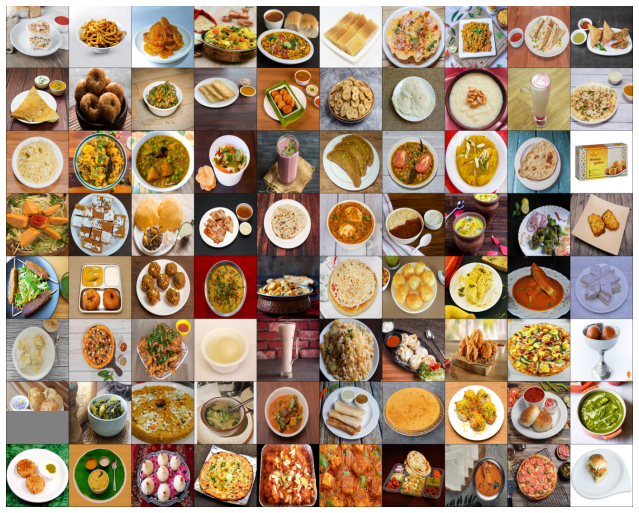


Figures from the paper (3 more)


Reference graph
Works this paper leans on
-
[1]
Food delivery market size to cross Rs 2 lakh crore by 2030: Bain-Swiggy report — eco- nomictimes.indiatimes.com.https://economictimes.indiatimes.com/tech/startups/o nline-food-delivery-market-to-grow-18-on-year-to-rs-2-lakh-crore-by-2030-b ain-report/articleshow/111452013.cms. [Accessed 16-01-2025]
-
[2]
Taste Atlas. These are the 100 Best Cuisines in 2025 - TasteAtlas Awards 24/25 — tasteat- las.com.https://www.tasteatlas.com/best/cuisines, 2024. [Accessed 15-01-2025]
work page 2025
-
[3]
Food-101 – mining discrimina- tive components with random forests
Lukas Bossard, Matthieu Guillaumin, and Luc Van Gool. Food-101 – mining discrimina- tive components with random forests. InComputer Vision – ECCV 2014, pages 446–461. Springer International Publishing, 2014
work page 2014
-
[4]
Chinesefoodnet: A large- scale image dataset for chinese food recognition, 2017
Xin Chen, Yu Zhu, Hua Zhou, Liang Diao, and Dongyan Wang. Chinesefoodnet: A large- scale image dataset for chinese food recognition, 2017
work page 2017
-
[5]
Learning cnn-based features for retrieval of food images
Gianluigi Ciocca, Paolo Napoletano, and Raimondo Schettini. Learning cnn-based features for retrieval of food images. InNew Trends in Image Analysis and Processing – ICIAP 2017, page 426–434. Springer International Publishing, 2017. 10
work page 2017
-
[6]
An image is worth 16x16 words: Transformers for image recognition at scale
Alexey Dosovitskiy, Lucas Beyer, Alexander Kolesnikov, Dirk Weissenborn, Xiaohua Zhai, Thomas Unterthiner, Mostafa Dehghani, Matthias Minderer, Georg Heigold, Sylvain Gelly, Jakob Uszkoreit, and Neil Houlsby. An image is worth 16x16 words: Transformers for image recognition at scale. In9th International Conference on Learning Representations, ICLR 2021, V...
work page 2021
-
[7]
Charles Freitas, Filipe Cordeiro, and Valmir Macario. Myfood dataset, 2020
work page 2020
-
[8]
Musefood: Multi-sensor- based food volume estimation on smartphones, 2019
Junyi Gao, Weihao Tan, Liantao Ma, Yasha Wang, and Wen Tang. Musefood: Multi-sensor- based food volume estimation on smartphones, 2019
work page 2019
Show all 31 references
-
[9]
Deep residual learning for image recognition
Kaiming He, Xiangyu Zhang, Shaoqing Ren, and Jian Sun. Deep residual learning for image recognition. In2016 IEEE Conference on Computer Vision and Pattern Recognition (CVPR), pages 770–778, 2016
2016
-
[10]
Nsoesie, and Margrit Betke
Mona Jalal, Kaihong Wang, Sankara Jefferson, Yi Zheng, Elaine O. Nsoesie, and Margrit Betke. Scraping social media photos posted in kenya and elsewhere to detect and analyze foodtypes. InProceedings of the 5th International Workshop on Multimedia Assisted Dietary Management, M...
2019
-
[11]
Foodx-251: A dataset for fine-grained food classification, 2019
Parneet Kaur, Karan Sikka, Weijun Wang, Serge Belongie, and Ajay Divakaran. Foodx-251: A dataset for fine-grained food classification, 2019
2019
-
[12]
Cleannet: Transfer learning for scalable image classifier training with label noise
Kuang-Huei Lee, Xiaodong He, Lei Zhang, and Linjun Yang. Cleannet: Transfer learning for scalable image classifier training with label noise. In2018 IEEE/CVF Conference on Computer Vision and Pattern Recognition, page 5447–5456. IEEE, June 2018
2018
-
[13]
Deep- food: Deep learning-based food image recognition for computer-aided dietary assessment, 2016
Chang Liu, Yu Cao, Yan Luo, Guanling Chen, Vinod Vokkarane, and Yunsheng Ma. Deep- food: Deep learning-based food image recognition for computer-aided dietary assessment, 2016
2016
-
[14]
Deep learning in food image recognition: A comprehensive review.Applied Sciences, 15 (14), 2025
Detianjun Liu, Enguang Zuo, Dingding Wang, Liang He, Liujing Dong, and Xinyao Lu. Deep learning in food image recognition: A comprehensive review.Applied Sciences, 15 (14), 2025. URLhttps://www.mdpi.com/2076-3417/15/14/7626
2025
-
[15]
From canteen food to daily meals: Generalizing food recognition to more practical scenarios.IEEE Transactions on Multimedia, page 1–10, 2024
Guoshan Liu, Yang Jiao, Jingjing Chen, Bin Zhu, and Yu-Gang Jiang. From canteen food to daily meals: Generalizing food recognition to more practical scenarios.IEEE Transactions on Multimedia, page 1–10, 2024
2024
-
[16]
A convnet for the 2020s.CoRR, abs/2201.03545, 2022
Zhuang Liu, Hanzi Mao, Chao-Yuan Wu, Christoph Feichtenhofer, Trevor Darrell, and Saining Xie. A convnet for the 2020s.CoRR, abs/2201.03545, 2022. URLhttps://arxiv. org/abs/2201.03545
2022 arXiv
-
[17]
TorchVision: PyTorch’s Computer Vision library
TorchVision maintainers and contributors. TorchVision: PyTorch’s Computer Vision library. https://github.com/pytorch/vision. [Accessed 16-01-2025]
2025
-
[18]
Recipe1m+: A dataset for learning cross-modal embeddings for cooking recipes and food images, 2018
Javier Marin, Aritro Biswas, Ferda Ofli, Nicholas Hynes, Amaia Salvador, Yusuf Aytar, Ingmar Weber, and Antonio Torralba. Recipe1m+: A dataset for learning cross-modal embeddings for cooking recipes and food images, 2018
2018
-
[19]
Isia food-500: A dataset for large-scale food recognition via stacked global- local attention network
Weiqing Min, Linhu Liu, Zhiling Wang, Zhengdong Luo, Xiaoming Wei, Xiaolin Wei, and Shuqiang Jiang. Isia food-500: A dataset for large-scale food recognition via stacked global- local attention network. InProceedings of the 28th ACM International Conference on Mul- timedia, MM...
2020
-
[20]
Large scale visual food recognition.IEEE Transactions on Pattern Analysis and Machine Intelligence, 45(8):9932–9949, August 2023
WeiqingMin, ZhilingWang, YuxinLiu, MengjiangLuo, LipingKang, XiaomingWei, Xiaolin Wei, and Shuqiang Jiang. Large scale visual food recognition.IEEE Transactions on Pattern Analysis and Machine Intelligence, 45(8):9932–9949, August 2023
2023
-
[21]
Mining discrimi- native food regions for accurate food recognition
Jianing Qiu, Frank Po Wen Lo, Yingnan Sun, Siyao Wang, and Benny Lo. Mining discrimi- native food regions for accurate food recognition. In30th British Machine Vision Conference 2019, BMVC 2019, Cardiff, UK, September 9-12, 2019, page 158. BMVA Press, 2019
2019
-
[22]
Leveraging automatic personalised nutrition: food image recognition benchmark and dataset based on nutrition taxonomy.Multimedia Tools and Applications, April 2024
Sergio Romero-Tapiador, Ruben Tolosana, Aythami Morales, Julian Fierrez, Ruben Vera- Rodriguez, Isabel Espinosa-Salinas, Gala Freixer, Enrique Carrillo de Santa Pau, Ana Ramírez de Molina, and Javier Ortega-Garcia. Leveraging automatic personalised nutrition: food image recogn...
2024
-
[23]
Doyen Sahoo, Wang Hao, Shu Ke, Wu Xiongwei, Hung Le, Palakorn Achananuparp, Ee- Peng Lim, and Steven C. H. Hoi. Foodai: Food image recognition via deep learning for smart food logging. InProceedings of the 25th ACM SIGKDD International Conference on Knowledge Discovery & Data ...
2019
-
[24]
Doyen Sahoo, Wang Hao, Shu Ke, Wu Xiongwei, Hung Le, Palakorn Achananuparp, Ee- Peng Lim, and Steven C. H. Hoi. Foodai: Food image recognition via deep learning for smart food logging. InProceedings of the 25th ACM SIGKDD International Conference on Knowledge Discovery and Dat...
2019
-
[25]
Learning food image similarity for food image retrieval
Wataru Shimoda and Keiji Yanai. Learning food image similarity for food image retrieval. In2017 IEEE Third International Conference on Multimedia Big Data (BigMM), pages 165–168, 2017
2017
-
[26]
EfficientNet: Rethinking model scaling for convolutional neu- ral networks
Mingxing Tan and Quoc Le. EfficientNet: Rethinking model scaling for convolutional neu- ral networks. InProceedings of the 36th International Conference on Machine Learning, volume 97 ofProceedings of Machine Learning Research, pages 6105–6114. PMLR, 09–15 Jun 2019. URLhttps:/...
2019
-
[27]
Mingxing Tan and Quoc V. Le. Efficientnetv2: Smaller models and faster training. In Proceedings of the 38th International Conference on Machine Learning, ICML 2021, 18-24 July 2021, Virtual Event, volume 139 ofProceedings of Machine Learning Research, pages 10096–10106. PMLR, ...
2021
-
[28]
Chakkrit Termritthikun, Paisarn Muneesawang, and Surachet Kanprachar. Nu-innet: Thai food image recognition using convolutional neural networks on smartphone.Journal of Telecommunication, Electronic and Computer Engineering (JTEC), 9(2-6):63–67, June 2017
2017
-
[29]
Hao Wang, Doyen Sahoo, Chenghao Liu, Ee peng Lim, and Steven C. H. Hoi. Learning cross-modal embeddings with adversarial networks for cooking recipes and food images, 2019
2019
-
[30]
Hao Wang, Doyen Sahoo, Chenghao Liu, Ke Shu, Palakorn Achananuparp, Ee peng Lim, and Steven C. H. Hoi. Cross-modal food retrieval: Learning a joint embedding of food images and recipes with semantic consistency and attention mechanism, 2020. 12
2020
-
[31]
Hoi, and Qianru Sun
Xiongwei Wu, Xin Fu, Ying Liu, Ee-Peng Lim, Steven C.H. Hoi, and Qianru Sun. A large- scale benchmark for food image segmentation. InProceedings of the 29th ACM International Conference on Multimedia, MM ’21, page 506–515. ACM, October 2021. 13
2021
Reviewed August 5, 2026 · model on record in the stance chip above.
Discussion (0). Continue with ORCID to comment.