REVIEW 4 major objections 4 minor 44 references
A machine-learned tight-binding model computes electronic properties for 100 million atoms, matching graphene's room-temperature mobility.
Reviewed by Pith at T0; open to challenge. T0 means a machine referee read the full paper against a public rubric. the ladder, T0–T4 →
A machine learning tight-binding framework reconstructs DFT-level Hamiltonians and computes electronic properties for systems with up to 100 million atoms, including graphene mobility versus carrier concentration.
T0 review reviewed 2026-08-04 challenge →
load-bearing objection GPUTB is a credible ML-TB framework with an impressive scale demonstration and a convincing experimental mobility check, but the Hamiltonian is fit only to high-symmetry k-path eigenvalues, leaving off-path DOS and heterojunction transfer claims under-validated, and the missing code/data blocks independent verification. the 4 major comments →
GPUTB: Efficient Machine Learning Tight-Binding Method for Large-Scale Electronic Properties Calculations
The pith
A machine-rendered reading of the paper's core claim, the machinery that carries it, and where it could break.
The reading
Core claim
The paper introduces GPUTB, a machine-learning method that maps an atomic structure directly to a sparse orthogonal tight-binding Hamiltonian. The mapping is trained by matching predicted band structures to DFT reference bands on small periodic cells, with band mean absolute errors reported around 13-26 meV across SiGe, graphene, diamond, GaP, AlAs, and h-BN/graphene. The key claim is that the resulting Hamiltonian is accurate enough beyond the training cell: it is used with a linear-scaling quantum transport solver to compute density of states for a 100-million-atom graphene sheet, room-temperature mobility versus carrier concentration for 6.5-million-atom graphene, and the DOS of million-a
What carries the argument
An environment-dependent Slater-Koster Hamiltonian built from message-passing graph neural networks. Hopping integrals between an atom pair are written as the product of geometric Slater-Koster coefficients and a neural-network output whose input is a Chebyshev-polynomial expansion of the pair's local environment; onsite energies come from a separate network on the atomic environment descriptor. This yields an orthogonal sparse Hamiltonian with no overlap matrix, which is precisely what the linear-scaling transport solver needs to keep every step linear in the number of atoms.
Load-bearing premise
The whole pipeline assumes that a model trained on small perfect cells with finite-temperature snapshots recognizes the same local bonding environments in 100-million-atom, polycrystalline, and heterojunction systems, so the learned parameters transfer without re-fitting and without charge self-consistency.
What would settle it
Take a graphene/h-BN heterojunction with a moiré period not sampled during training, compute its density of states with GPUTB, and compare against a converged DFT band-structure calculation on the same geometry; if the band-gap opening or the DOS near the Fermi level deviates by much more than the claimed 13-26 meV band MAE, the environmental-transfer premise is falsified.
If this is right
- Finite-temperature electronic structure and transport become practical for millions of atoms, not just perfect crystals; polycrystalline and heterojunction samples are within reach.
- A single GPUTB model can describe structurally distinct allotropes and heterostructures, so transfer across phases requires no separate training per structure.
- The combination with linear-scaling transport means density of states and conductivity are computed in O(N), opening micrometer-scale samples to direct simulation.
- Graphene's room-temperature mobility as a function of carrier concentration is reproduced from a Hamiltonian trained on small DFT cells, giving a predictive bridge between ab-initio accuracy and experiment.
Where Pith is reading between the lines
- If the local-environment descriptor is as transferable as claimed, the same trained model should predict defect states and grain-boundary conductance without retraining; a direct test would be a DFT comparison for a single vacancy in graphene.
- Because the Hamiltonian is sparse and orthogonal, the sampling of ionic configurations, not the electronic solve, becomes the main remaining cost; combining GPUTB with faster generative sampling would make device-scale workflows routine.
- The method's fixed basis and finite cutoff mean long-range electrostatic environments, such as metal-water interfaces, are likely outside its reach; testing on such systems would clarify how much expressivity the network needs.
Editorial analysis
A structured set of objections, weighed in public.
Referee Report
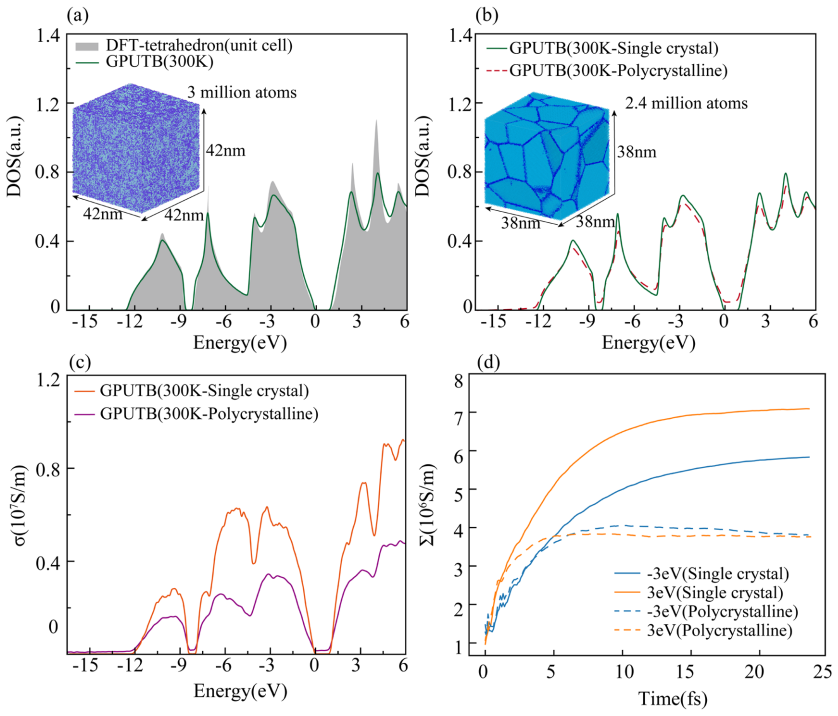
Summary. This paper presents GPUTB, a machine-learning tight-binding framework that constructs environment-dependent Slater-Koster Hamiltonians from DFT band structures. The Hamiltonians are used with the linear-scaling quantum transport (LSQT) method to compute density of states, conductivity, and carrier mobility for large systems. Reported band-structure MAEs are 13.0–25.8 meV for SiGe, graphene, diamond, GaP, and AlAs, with transfer from an 8-atom training cell to 64- and 216-atom supercells. The method is applied to graphene DOS with over 100 million atoms, to 2.4–3.0 million atom SiGe single-crystal and polycrystalline systems, and to h-BN/graphene heterojunctions. The room-temperature graphene mobility versus carrier concentration is compared with experimental data. The central claim is that GPUTB provides an accurate and efficient bridge from DFT accuracy to device-scale electronic property calculations.
Significance. If the accuracy and transferability claims are substantiated, GPUTB would be a practically useful tool for device-scale electronic-structure calculations. The strongest evidence is the external experimental benchmark for graphene mobility and the demonstration of DOS calculations on 100-million-atom systems. The paper also shows flexibility with respect to basis sets, exchange-correlation functionals, allotropes, and heterojunctions, and it offers an efficiency comparison against DeePTB. However, the validation has important gaps: training is performed only on high-symmetry k-path eigenvalues, and the large-scale DOS comparisons are made against 0 K DFT tetrahedron DOS, so the claims about off-path Hamiltonian accuracy and finite-temperature DOS are not yet established at the reported level of precision.
major comments (4)
- [§2.3, Eq. (3)] The training loss in Eq. (3) is evaluated only on high-symmetry k-path eigenvalues ('High-symmetry k-path selections were made for band structure calculations'). DOS and LSQT conductivity, Eqs. (3)–(4) in §2.4, depend on the full Brillouin zone and on off-path Hamiltonian matrix elements through the velocity operator. Fitting a low-dimensional k-path slice may leave parts of the environment-dependent Hamiltonian underdetermined. No uniform-k-grid validation is reported. I recommend adding a validation set on uniform k-meshes for small cells and reporting band-structure and DOS errors over the full BZ.
- [Fig. 3(a), Fig. 4(a)] The finite-temperature DOS for SiGe (Fig. 3a) and for 100-million-atom graphene (Fig. 4a) is compared to a 0 K DFT tetrahedron DOS. This comparison conflates thermal broadening with model error and cannot discriminate between temperature effects and Hamiltonian inaccuracy. A direct comparison of GPUTB DOS against DFT DOS at the same temperature and k-point sampling for small supercells is needed to validate the method quantitatively.
- [§3, polycrystalline and heterojunction results] The polycrystalline SiGe DOS/conductivity and the h-BN/graphene heterojunction DOS are presented without quantitative reference DFT calculations for the same disordered or interface geometries. The mid-gap defect states and the heterojunction bandgap opening are discussed only qualitatively. Since GPUTB uses a fixed orthogonal TB Hamiltonian with no charge self-consistency or explicit long-range electrostatics, it is not obvious that these effects are captured reliably. I request benchmarks on small grain-boundary and heterojunction supercells with quantitative error metrics.
- [Reproducibility / Data availability] No code or training/test data are provided; the Data Availability statement only says 'Data will be made available on request.' For a machine-learning method paper, this hampers independent verification of the central claims. I encourage the authors to release the code, trained models, and representative training/testing datasets.
minor comments (4)
- [Table 1] The table header appears garbled (repeated 'c/c', 'm/c', and 'Average' entries). Please clarify the columns and define how the 'Average' values are computed.
- [Equation numbering] Two equations are labeled (3): the conductivity equation in §2.4 and the loss function in §3. Please renumber.
- [Fig. 4(c) caption] The caption reads 'Band structure of unit-cell h-BN/graphene heterojunction with 1 million atoms,' which is self-contradictory. Clarify whether the band structure is for a small unit cell and the DOS for the 1-million-atom system.
- [Fig. 2 and Fig. 4(b)] MAEs and mobility curves are reported without uncertainties. Please provide error bars or standard deviations over multiple model initializations and/or MD frames to assess statistical significance.
Circularity Check
No significant circularity; the large-scale DOS and mobility are derived from a fitted Hamiltonian and benchmarked against independent experiments, not re-imported training targets.
full rationale
The derivation chain is: DFT band eigenvalues (training targets in Eq. 3) -> GPUTB neural-network SK Hamiltonian -> LSQT DOS (Eq. 4) and conductivity -> mobility. The loss function in Eq. 3 contains only band-eigenvalue residuals; neither DOS nor mobility/conductivity appears in any loss term, so the large-scale DOS (100M atoms) and mobility (6.5M atoms) are derived quantities, not fitted inputs renamed as predictions. The mobility-versus-carrier-concentration result is compared with independent experiments (Mayorov et al. [29], Chen et al. [30], Shishir et al. [31]), providing external falsification and breaking any circular loop. The Fig. 4(a) DOS check does reuse the same ABACUS/PBE DFT reference that generated the band-structure training data, but because training is restricted to high-symmetry k-path eigenvalues while DOS integrates over the full Brillouin zone and mobility depends additionally on the velocity operator, the predicted transport properties are not identical to the loss by construction; this is an in-family consistency check, weaker than an independent benchmark, but not a circular reduction. The LSQT engine (Refs [10-13]) and NEP/GPUMD (Refs [28,42,43]) are co-authored tooling, but they are independently published methods, and the experimental agreement here supplies outside support, so these self-citations do not constitute load-bearing circularity. The skeptic's underdetermination concern (path-only training may not fix off-path Hamiltonian matrix elements or the velocity operator) is an accuracy/identifiability risk, not circularity; it means the transport prediction is not entailed by the training data, the opposite of a reduction to inputs. The authors' stated limitation that simple networks may struggle with metal/water interfaces (Sec. 4) concerns scope, not the derivation's self-containedness. No equation-level reduction or fitted-parameter-renamed-as-prediction is present.
Axiom & Free-Parameter Ledger
free parameters (7)
- cutoff radius r_cut =
5 Å
- number of Chebyshev basis functions N_basis
- MLP weights for onsite, hopping, and environment networks =
trained
- band weights w_b in loss function
- finite-temperature training frames =
200 frames per system
- NEP force-field parameters =
RMSE 3.24 meV/atom energy, 89.88 meV/Å force
- iterative band expansion schedule =
e.g., band 2 through 26 for SiGe
axioms (7)
- standard math Slater-Koster two-center integral approximation
- standard math Orthogonal tight-binding Hamiltonian representation
- domain assumption DFT band structures are reliable reference data
- ad hoc to paper Chebyshev and message-passing descriptors capture all relevant local chemical environment information
- ad hoc to paper Small-cell training transfers to large supercells and heterojunctions
- domain assumption LSQT with 200 propagation steps and random states converges
- domain assumption NEP force field structures are representative of true finite-temperature configurations
Cite this review
Pith. "Pith review of GPUTB: Efficient Machine Learning Tight-Binding Method for Large-Scale Electronic Properties Calculations." pith.science (2026). https://pith.science/paper/5CBJQMZ7
@misc{pith2026250906525,
  author       = {Pith},
  title        = {Pith review of: GPUTB: Efficient Machine Learning Tight-Binding Method for Large-Scale Electronic Properties Calculations},
  year         = {2026},
  howpublished = {\url{https://pith.science/paper/5CBJQMZ7}},
  note         = {Machine review of arXiv:2509.06525}
}
read the original abstract
The high computational cost of ab-initio methods limits their application in predicting electronic properties at the device scale. Therefore, an efficient method is needed to map the atomic structure to the electronic structure quickly. Here, we develop GPUTB, a GPU-accelerated tight-binding (TB) machine learning framework. GPUTB employs atomic environment descriptors, enabling the model parameters to incorporate environmental dependence. This allows the model to transfer to different basis, xc-functionals, and allotropes easily. Combined with the linear scaling quantum transport method, we have calculated the electronic density of states for up to 100 million atoms in pristine graphene. Trained on finite-temperature structures, the model can be easily extended to millions of atom finite-temperature systems. Furthermore, GPUTB can also successfully describe h-BN/graphene heterojunction systems, demonstrating its capability to handle complex material with high precision. We accurately reproduce the relationship between carrier concentration and room temperature mobility in graphene to verify the framework's accuracy. Therefore, our GPUTB framework presents a delicate balance between computational accuracy and efficiency, providing a powerful computational tool for investing electronic properties for large systems with millions of atoms.
Figures



Reference graph
Works this paper leans on
-
[1]
L. E. Ratcliff, S. Mohr, G. Huhs, T. Deutsch, M. Masella, and L. Genovese, Challenges in large scale quantum mechanical calculations, WIREs Comput Mol Sci 7, e1290 (2017)
work page 2017
-
[2]
G. Galli and M. Parrinello, Large scale electronic structure calculations, Phys. Rev. Lett. 69, 3547 (1992)
work page 1992
-
[3]
T. Ozaki and H. Kino, Efficient projector expansion for the ab initio LCAO method, Phys. Rev. B 72, 045121 (2005)
work page 2005
-
[4]
D. Sánchez-Portal, P. Ordejón, E. Artacho, and J. M. Soler, Density-functional method for very large systems with LCAO basis sets, International Journal of Quantum Chemistry 65, 453 (1997)
work page 1997
- [5]
-
[6]
T. Ozaki and H. Kino, Numerical atomic basis orbitals from H to Kr, Phys. Rev. B 69 , 195113 (2004)
work page 2004
-
[7]
M. Chen, G. -C. Guo, and L. He, Systematically improvable optimized atomic basis sets for ab initio calculations, J. Phys.: Condens. Matter 22, 445501 (2010)
work page 2010
-
[8]
P. Li, X. Liu, M. Chen, P. Lin, X. Ren, L. Lin, C. Yang, and L. He, Large -scale ab initio simulations based on systematically improvable atomic basis, Computational Materials Science 112, 503 (2016)
work page 2016
-
[9]
S. Roche and D. Mayou, Conductivity of Quasiperiodic Systems: A Numerical Study, Phys. Rev. Lett. 79, 2518 (1997)
work page 1997
-
[10]
Z. Fan, A. Uppstu, T. Siro, and A. Harju, Efficient linear -scaling quantum transport calculations on graphics processing units and applications on electron transport in graphene, Computer Physics Communications 185, 28 (2014)
work page 2014
-
[11]
Z. Fan, V . Vierimaa, and A. Harju, GPUQT: An efficient linear-scaling quantum transport code fully implemented on graphics processing units, Computer Physics Communications 230, 113 (2018)
work page 2018
-
[12]
Z. Fan, J. H. Garcia, A. W. Cummings, J. E. Barrios -Vargas, M. Panhans, A. Harju, F. Ortmann, and S. Roche, Linear scaling quantum transport methodologies, Physics Reports 903, 1 (2021)
work page 2021
-
[13]
Z. Fan, Y . Xiao, Y . Wang, P. Ying, S. Chen, and H. Dong, Combining linear -scaling quantum transport and machine -learning molecular dynamics to study thermal and electronic transports in complex materials, J. Phys.: Condens. Matter 36, 245901 (2024)
work page 2024
-
[14]
Hu et al., Observation of Rydberg moiré excitons, Science 380, 1367 (2023)
Q. Hu et al., Observation of Rydberg moiré excitons, Science 380, 1367 (2023)
work page 2023
-
[15]
S. Cui, C. Jiang, Z. Zhan, T. Wilson, N. Zhang, X. Xie, S. Yuan, H. Wang, C. Lewandowski, and G. Ni, Nanoscale Optical Conductivity Imaging of Double -Moiré Twisted Bilayer Graphene, Nano Lett. 24, 11490 (2024)
work page 2024
- [16]
- [17]
-
[18]
M. Nakhaee, S. A. Ketabi, and F. M. Peeters, Tight-Binding Studio: A technical software package to find the parameters of tight -binding Hamiltonian, Computer Physics Communications 254, 107379 (2020)
work page 2020
- [19]
-
[20]
M. Gaus, Q. Cui, and M. Elstner, DFTB3: Extension of the Self -Consistent-Charge Density-Functional Tight-Binding Method (SCC -DFTB), J. Chem. Theory Comput. 7 , 931 (2011)
work page 2011
-
[21]
Learning local equivariant representations for quantum operators
Z. Zhouyin, Z. Gan, S. K. Pandey, L. Zhang, and Q. Gu, Learning Local Equivariant Representations for Quantum Operators, arXiv:2407.06053
work page internal anchor Pith review Pith/arXiv arXiv
-
[22]
X. Gong, H. Li, N. Zou, R. Xu, W. Duan, and Y . Xu, General framework for E(3) - equivariant neural network representation of density functional theory Hamiltonian, Nat Commun 14, 2848 (2023)
work page 2023
- [23]
-
[24]
A. A. Mostofi, J. R. Yates, Y .-S. Lee, I. Souza, D. Vanderbilt, and N. Marzari, wannier90: A tool for obtaining maximally -localised Wannier functions, Computer Physics Communications 178, 685 (2008)
work page 2008
-
[25]
A. A. Mostofi, J. R. Yates, G. Pizzi, Y .-S. Lee, I. Souza, D. Vanderbilt, and N. Marzari, An updated version of wannier90: A tool for obtaining maximally-localised Wannier functions, Computer Physics Communications 185, 2309 (2014)
work page 2014
-
[26]
Q. Gu, L. Zhang, and J. Feng, Neural network representation of electronic structure from ab initio molecular dynamics, Science Bulletin 67, 29 (2022)
work page 2022
-
[27]
Q. Gu, Z. Zhouyin, S. K. Pandey, P. Zhang, L. Zhang, and W. E, Deep learning tight- binding approach for large -scale electronic simulations at finite temperatures with ab initio accuracy, Nat Commun 15, 6772 (2024)
work page 2024
-
[28]
Z. Fan, Z. Zeng, C. Zhang, Y . Wang, K. Song, H. Dong, Y . Chen, and T. Ala -Nissila, Neuroevolution machine learning potentials: Combining high accuracy and low cost in atomistic simulations and application to heat transport, Phys. Rev. B 104, 104309 (2021)
work page 2021
-
[29]
A. S. Mayorov et al., Micrometer -Scale Ballistic Transport in Encapsulated Graphene at Room Temperature, Nano Lett. 11, 2396 (2011)
work page 2011
-
[30]
J.-H. Chen, C. Jang, S. Xiao, M. Ishigami, and M. S. Fuhrer, Intrinsic and extrinsic performance limits of graphene devices on SiO2, Nature Nanotech 3, 206 (2008)
work page 2008
-
[31]
R. S. Shishir and D. K. Ferry, Intrinsic mobility in graphene, J. Phys.: Condens. Matter 21, 232204 (2009)
work page 2009
-
[32]
M. Gori, G. Monfardini, and F. Scarselli, A New Model for Learning in Graph Domains , in Proceedings. 2005 IEEE International Joint Conference on Neural Networks, 2005. , V ol. 2 (IEEE, Montreal, Que., Canada, 2005), pp. 729–734
work page 2005
- [33]
-
[34]
J. C. Slater and G. F. Koster, Simplified LCAO Method for the Periodic Potential Problem, 16 / 21 Phys. Rev. 94, 1498 (1954)
work page 1954
-
[35]
See Supplemental Material [url] for Training and Electronic Structure Calculation Methods, which includes Refs. [9-12]., (n.d.)
-
[36]
C. Ben Mahmoud, A. Anelli, G. Csányi, and M. Ceriotti, Learning the electronic density of states in condensed matter, Phys. Rev. B 102, 235130 (2020)
work page 2020
-
[37]
Z.-G. Chen, Z. Shi, W. Yang, X. Lu, Y . Lai, H. Yan, F. Wang, G. Zhang, and Z. Li, Observation of an intrinsic bandgap and Landau level renormalization in graphene/boron - nitride heterostructures, Nat Commun 5, 4461 (2014)
work page 2014
-
[38]
J. Jung, A. M. DaSilva, A. H. MacDonald, and S. Adam, Origin of band gaps in graphene on hexagonal boron nitride, Nat Commun 6, 6308 (2015)
work page 2015
-
[39]
M. Yankowitz, J. Xue, D. Cormode, J. D. Sanchez-Yamagishi, K. Watanabe, T. Taniguchi, P. Jarillo-Herrero, P. Jacquod, and B. J. LeRoy, Emergence of superlattice Dirac points in graphene on hexagonal boron nitride, Nature Phys 8, 382 (2012)
work page 2012
-
[40]
P. Lin, X. Ren, X. Liu, and L. He, Ab initio electronic structure calculations based on numerical atomic orbitals: Basic fomalisms and recent progresses, WIREs Comput Mol Sci 14, e1687 (2024)
work page 2024
-
[41]
P. Lin, X. Ren, and L. He, Strategy for constructing compact numerical atomic orbital basis sets by incorporating the gradients of reference wavefunctions, Phys. Rev. B 103 , 235131 (2021)
work page 2021
-
[42]
Z. Fan, W. Chen, V . Vierimaa, and A. Harju, Efficient molecular dynamics simulations with many-body potentials on graphics processing units, Computer Physics Communications 218, 10 (2017)
work page 2017
-
[43]
K. Song et al., General -purpose machine-learned potential for 16 elemental metals and their alloys, Nat Commun 15, 10208 (2024)
work page 2024
-
[44]
M. Schlipf and F. Gygi, Optimization algorithm for the generation of ONCV pseudopotentials, Computer Physics Communications 196, 36 (2015). 17 / 21 Figures captions Fig. 1. Flowchart and network architecture of GPUTB calculations. (a) The embedding network of GPUTB, where vi, vj is the node message, e ij is the edge message, Zi, Zj indicates the types of ...
work page 2015
This paper was first reviewed by deepseek-v4-flash on August 4, 2026.
discussion (0)
Sign in with ORCID, Apple, or X to comment. Anyone can read and Pith papers without signing in.