REVIEW 3 major objections 5 minor 49 references
Direct state prediction beats function calling in cockpit agents
Reviewed by Pith at T0; open to challenge. T0 means a machine referee read the full paper against a public rubric. the ladder, T0–T4 →
Agents that directly set the car's state in a new vehicle simulator outperformed API-calling agents on both accuracy and speed.
T0 review reviewed 2026-08-04 challenge →
load-bearing objection VehicleWorld is a genuinely useful, well-documented cockpit environment, but the SFC-vs-FC result is confounded by SFC seeing the full state JSON; needs an FC+state control before the headline claim holds. the 3 major comments →
VehicleWorld: A Highly Integrated Multi-Device Environment for Intelligent Vehicle Interaction
The pith
A machine-rendered reading of the paper's core claim, the machinery that carries it, and where it could break.
The reading
Core claim
The paper's central discovery is a comparison result in a purpose-built environment: when an agent controls a tightly coupled multi-device system, directly predicting the target system state outperforms predicting a sequence of API calls. The evidence is VehicleWorld, a virtual intelligent cockpit with 30 device modules, 250 executable APIs, and 680 properties, plus a global Environment class that manages shared resources such as volume, sound channel, and temperature. In this environment, users issue requests like 'The weather is hot, turn on the air conditioner, then play my music collection,' and the agent must coordinate music, air conditioner, and global state. Traditional Function Call
What carries the argument
State-based Function Call (SFC) is the central mechanism: a two-stage prompting procedure where the agent first sees the complete structured JSON state of all devices and chooses the relevant modules, then sees only the selected devices' state JSON and writes direct state-transition assignments instead of API calls. These assignments are executed by the environment, and the updated state is returned as feedback for the next turn. The design depends on VehicleWorld's executable world model: every API is implemented as code that reads and writes typed attributes, and a global Environment singleton holds system-wide resources and enforces coordination. The state document is therefore both the a
Load-bearing premise
The comparison assumes that SFC and FC differ only in output format, but SFC also gets a full snapshot of every device's settings after each turn while FC only gets API return values; if the advantage is the snapshot rather than "direct state prediction," the central claim is not established by these experiments.
What would settle it
Run the identical FC evaluation but, after every code execution, append the complete current state JSON (the same serialized device and Environment state that SFC receives) to the feedback. If FC accuracy rises to roughly SFC levels, the claimed advantage of direct state prediction over function calling is instead an effect of state transparency; if FC remains near 51% average accuracy, the paper's interpretation survives. A complementary check is to execute SFC's state writes only through the API methods' validation layer and measure whether the advantage shrinks when direct writes cannot byp
If this is right
- In environments with observable global state, feeding the full state back to the agent and letting it write transitions can reduce exploratory turns and token cost compared to discovery-based API calling.
- A hybrid design — using state perception for device selection and API calls for execution — appears to combine the strengths of both paradigms and achieves the best end-to-end accuracy in this benchmark.
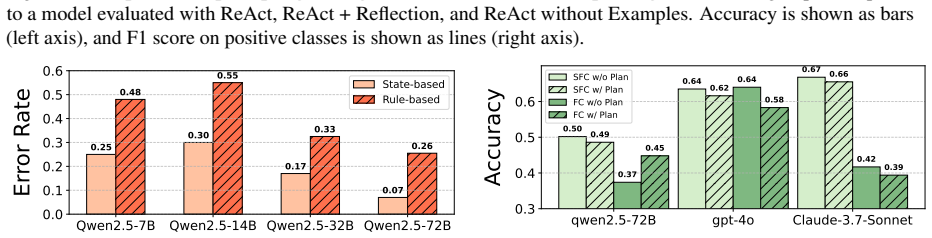
- State-based evaluation, which checks whether intended attribute changes actually happen, aligns more closely with human expert judgments than rule-based exact API sequence matching.
- SFC degrades less than FC when in-context examples are removed, suggesting direct state prediction is more robust to missing demonstrations.
- Adding reflection helps both paradigms, while adding explicit planning has mixed effects: it can hurt SFC and strong FC models, an effect the paper attributes to overthinking.
Where Pith is reading between the lines
- The experiments as reported do not fully control for information access: SFC agents receive the complete state JSON after every execution, while FC agents receive only API return values and must call Environment.to_dict() to recover global state. If state transparency alone explains the gains, the paper's 'direct state prediction' claim would not be isolated; a controlled ablation that appends the
- Direct state writes may bypass API-level parameter validation and business rules. In a real vehicle, a predicted state is a specification, not an action; deploying SFC would require a safety layer that translates desired states into validated control commands.
- The same state-based reasoning could transfer to other tightly coupled stateful environments — smart homes, operating systems, robot control — where a parseable state document and executable transitions can be provided, though the authors do not test this.
- The state-based evaluation metric rewards outcomes over procedures, which matches user intent but may count a procedurally invalid execution as correct if the final state is right; an extension that scores both procedure and outcome would test the metric's sensitivity.
Editorial analysis
A structured set of objections, weighed in public.
Referee Report
Summary. VehicleWorld introduces a simulated intelligent-vehicle cockpit environment with 30 modules, 250 APIs, and 680 state attributes, plus a benchmark of 1,291 expert-reviewed tasks. The paper also proposes State-based Function Call (SFC), an agent protocol in which the model receives the full state JSON, selects relevant devices, and emits direct state-transition code rather than sequential API calls. Experiments across eight LLMs and three prompting strategies report that SFC outperforms traditional Function Calling (FC) in state-accuracy (51.1% vs 61.5% average in Table 4) and in interaction turns/tokens (Figure 4), and that a hybrid FC+SFC method does better still (Figure 10). The environment and benchmark are released on GitHub.
Significance. If the central comparison were clean, the paper would make a useful dual contribution: a substantial executable automotive-domain testbed and a concrete demonstration that explicit state feedback can improve LLM-driven device control. The environment itself is a real asset: it is fully executable, includes realistic cross-device couplings through a global Environment singleton, and the authors publish the code. The benchmark construction pipeline with expert review, the state-based evaluation that outperforms rule-based evaluation on a 200-sample human-annotated FC subset, and the breadth of models (open- and closed-source, Qwen2.5/3, Llama, DeepSeek, GPT-4o, Claude) are also positive features. However, the headline claim that 'direct state prediction outperforms function calling' is not yet established, because the SFC and FC protocols differ in information access as well as in output format. The lack of variance/statistical testing further weakens the quantitative claim. The resource value of VehicleWorld can stand even if the algorithmic claim needs rework.
major comments (3)
- [Section 5.3 and Appendix A.4, Listings 5/7] The central FC-vs-SFC comparison is confounded by asymmetric state observability. In SFC, the agent is handed the complete JSON state of all devices at the start (Listing 7) and 'current device states are appended to the feedback' after every code execution (Appendix A.4). In FC, the prompt tells the agent to call Environment.to_dict() only 'if the task involves global system environment' (Listing 5, step 3), and no full device-state document is appended after execution. The aggregate gain in Table 4 (51.1% vs 61.5%) could therefore be caused by SFC receiving strictly more information per turn, not by state-transition output being inherently superior. The device-selection advantage in Figure 10 is exactly what full-state visibility would produce. Please add an FC+state control — same FC output format and API-call execution, but with the same complete state JSON appended as feedback — and
- [Section 6.2 / Table 4 / Appendix A.1] All results are single-sample evaluations at temperature 0.7 (Appendix A.1: 'we adopted single-sample evaluation for all experiments'), yet Table 4 reports only point estimates with no variance, confidence intervals, or significance tests. Some differences are small (GPT-4o: 70.2 vs 70.9; DeepSeek-v3: 70.0 vs 71.9; Qwen2.5-72B: 58.8 vs 64.8), so the word 'significantly outperforms' in the abstract and conclusions is not supported by the evidence as reported. The statement that 'results remained highly stable across multiple runs' needs to be demonstrated, not asserted. Please provide multiple seeds or bootstrap/paired per-task tests (the benchmark has fixed tasks, so paired tests are natural) and report confidence intervals. This is load-bearing because the paper's central quantitative claim rests on these aggregate numbers.
- [Section 5.3 / Appendix B] The evaluation metric is defined over attribute-level state changes: F1 positive, F1 negative, and Accuracy all compare the set of attributes the model changed against the set of attributes changed by the reference API execution. SFC's output is literally code that assigns attribute values, so the metric is representationally aligned with the proposed method. The ground truth is not generated by SFC itself (it comes from executing the reference API calls), so this is not a direct circularity, but it is a construct-validity concern: semantically equivalent solutions that reach the same user intent through different attribute changes may be penalized, and the metric may systematically favor the representation that matches it. The state-based metric was validated against human annotations only on 200 FC outputs (Appendix A.3, Figure 8), not on SFC outputs or on the relative FC-vs-SFC compar
minor comments (5)
- [Table 4/Table 7/Figure 10] Qwen3-4B/8B/32B are listed in Table 7 and evaluated in Figure 10, but they do not appear in Table 4, which is described as results 'across all evaluated models.' Clarify which models are in each table and why the Qwen3 series is omitted from the main accuracy table.
- [Figure 4] The text calls Figure 4 a 'latency' comparison, but the figure plots average interaction turns and output tokens, not wall-clock latency. Token counts and turns are proxies for latency, not latency itself. Rename the axis labels and text accordingly, or add actual execution-time measurements.
- [Section 6.3] The explanation that high-performing models 'suffer from overthinking' and 'generate fabricated facts' is speculative; no analysis of the generated reasoning traces or error cases is provided. Support this claim with error annotations or soften the language.
- [Appendix A.3] The error-rate formula is written as (FP+FN)/(TP+TN+FP+FN), which is the ordinary misclassification rate, but FP/FN are not defined in that appendix. Define them (e.g., FP = automatic says correct but human says incorrect, etc.) to make the comparison interpretable.
- [Listing 7 / Appendix F] Several state-JSON examples contain corrupted key names such as 'd ow nl oa de d_v id eo s' and inconsistent indentation, which makes the prompt format hard to reproduce. Clean the listings or point readers to the GitHub version.
Circularity Check
One self-justifying validation of the state-based evaluator; the central SFC-vs-FC result is independently executed and not circular.
specific steps
-
self definitional
[Appendix A.3 (Error Rate), Figure 8; Table 11 in Appendix H]
"The rule-based method checks the API call sequence for exact matches in API names, parameter keys and values, and call count. In contrast, the state-based method judges correctness based on whether the final system state satisfies the intended task goal. ... If multiple valid approaches exist, consider the output correct if any valid approach is used. ... A function call output is considered correct if it would result in the expected system state through valid API calls with appropriate parameters."
The paper claims state-based evaluation has lower error rates than rule-based evaluation, but the human gold standard is defined with the same state-outcome criterion: Table 11 tells experts a function call is correct 'if it would result in the expected system state,' and it explicitly instructs them to accept any valid approach. The state-based evaluator also judges correctness by whether the final system state satisfies the task goal. The rule-based evaluator, by contrast, is deliberately a stricter exact-sequence matcher (exact API names, parameter keys/values, call count). Thus the measured error-rate gap in Figure 8 is built in: the human labels and the state-based evaluator share the same state-outcome vocabulary, while the rule-based evaluator is definitionally misaligned with that
full rationale
The central derivation chain—SFC vs FC—is not circular. The expected state changes are obtained by executing the benchmark's reference API calls (Section 5.1: 'we execute both the <inits> and <api_call> blocks to validate code correctness' and persist intermediate states), and both paradigms are evaluated by executing their outputs in the same environment and comparing the resulting state changes against those API-derived targets. The metric is impartial to output format: SFC's direct state assignments and FC's API calls both produce executable state mutations, and correctness is judged on resulting state, not on whether the output was phrased as a state transition. There are no load-bearing self-citations or imported uniqueness theorems. The most concrete circularity is the paper's validation of its own state-based evaluator (Appendix A.3, Figure 8): the human expert criterion is defined in terms of resulting expected system state, the same criterion used by the state-based evaluator, while the rule-based comparator is a deliberately different sequence-exact criterion explicitly told to be overridden by any valid approach. That makes the lower error rate of state-based evaluation partly by construction. This is a secondary methodological circularity and does not by itself force the main SFC-vs-FC outcome, but it inflates the paper's claim that executable environments enable 'accurate evaluation.' The noted information asymmetry—SFC receives the full state JSON each turn while FC must call Environment.to_dict() only if needed—is a genuine experimental confound for the 'direct state prediction outperforms function calling' conclusion, but it is an experimental-design concern rather than a definitional reduction, so it is not scored as circularity under the stated criteria.
Axiom & Free-Parameter Ledger
axioms (4)
- domain assumption Vehicle APIs can be faithfully modeled as get/set operations over JSON state attributes.
- domain assumption The 30 devices and 680 attributes cover realistic cockpit usage.
- domain assumption State-based metrics correctly encode user intent.
- ad hoc to paper Claude-generated scenarios are free of bias toward state-transition solutions.
Cite this review
Pith. "Pith review of VehicleWorld: A Highly Integrated Multi-Device Environment for Intelligent Vehicle Interaction." pith.science (2026). https://pith.science/paper/B2UD4OUZ
@misc{pith2026250906736,
  author       = {Pith},
  title        = {Pith review of: VehicleWorld: A Highly Integrated Multi-Device Environment for Intelligent Vehicle Interaction},
  year         = {2026},
  howpublished = {\url{https://pith.science/paper/B2UD4OUZ}},
  note         = {Machine review of arXiv:2509.06736}
}
read the original abstract
Intelligent vehicle cockpits present unique challenges for API Agents, requiring coordination across tightly-coupled subsystems that exceed typical task environments' complexity. Traditional Function Calling (FC) approaches operate statelessly, requiring multiple exploratory calls to build environmental awareness before execution, leading to inefficiency and limited error recovery. We introduce VehicleWorld, the first comprehensive environment for the automotive domain, featuring 30 modules, 250 APIs, and 680 properties with fully executable implementations that provide real-time state information during agent execution. This environment enables precise evaluation of vehicle agent behaviors across diverse, challenging scenarios. Through systematic analysis, we discovered that direct state prediction outperforms function calling for environmental control. Building on this insight, we propose State-based Function Call (SFC), a novel approach that maintains explicit system state awareness and implements direct state transitions to achieve target conditions. Experimental results demonstrate that SFC significantly outperforms traditional FC approaches, achieving superior execution accuracy and reduced latency. We have made all implementation code publicly available on Github https://github.com/OpenMOSS/VehicleWorld.
Figures



Reference graph
Works this paper leans on
-
[1]
Functionality implemented through executing relevant getter and setter methods
-
[2]
Appworld: A controllable world of apps and people for benchmarking interactive coding agents. arXiv preprint arXiv:2407.18901. Boshi Wang, Hao Fang, Jason Eisner, Benjamin Van Durme, and Yu Su. 2024. Llms in the imag- inarium: tool learning through simulated trial and error.arXiv preprint arXiv:2403.04746. Zhiheng Xi, Wenxiang Chen, Xin Guo, Wei He, Yiwen...
Pith/arXiv arXiv 2024
-
[3]
Detailed parameter validation and error handling
-
[4]
Clear method signatures , including parameter types and return types
-
[5]
Structured return values , including operation results and related state information
-
[6]
Clear state transition logic
-
[7]
"" Inner class , used as an attribute of MyClass , the example contains a simple attribute info
If API method parameters involve enumeration classes , the possible values should be specified in the comments ### Documentation - Each entity class needs to set up a to_dict method to print the class ’ s attributes , value types , and attribute descriptions - If it ’ s an enum attribute , the complete range of possible values needs to be given in the des...
- [8]
-
[10]
search_module () ‘ to obtain all the functionality modules of the vehicle system
** Get System Function Modules ** First call ‘ Environment . search_module () ‘ to obtain all the functionality modules of the vehicle system
-
[11]
** Query APIs for Specific Modules ** After selecting the required function module , call ‘ Environment . search_api ( modules =[ ’ module_name ’]) ‘ to query the API methods of that module , and then proceed with the calls
-
[12]
to_dict () ‘ to get the current system status
** Get System Global Status ( if needed ) ** If the task involves global system environment ( such as temperature , volume , etc .) , call ‘ Environment . to_dict () ‘ to get the current system status . ** API Call Requirements ** - Each code block can contain multiple related API calls , but should remain concise . - Ensure the code can be executed direc...
-
[13]
Choose the most efficient API combination to complete tasks , avoiding unnecessary code
-
[14]
Correctly handle API errors and exception situations
-
[15]
If the system status does not support the user ’ s request , clearly decline . ** Example Task Flow ** User : Navigate to the nearest gas station and turn up the navigation volume a bit Assistant : I ’ ll help you navigate to the nearest gas station and increase the navigation volume . First I need to check the available system modules : ‘‘‘ python Enviro...
-
[16]
Each module name should match exactly with the keys in the system status dictionary
-
[17]
Separate multiple modules with newlines
-
[18]
Only select modules that are directly relevant to fulfilling the user ’ s request
-
[19]
Consider the current state and capabilities of each module
-
[20]
Prioritize modules that are most likely to be needed for the task ## Example : User : Play the video I ’ ve downloaded Current System Status : { " video ": { " value ": { " current_video ": { " value ": { " video_id ": { " value ": " dl_001 " , " type ": " str " , " description ": " Unique identifier for video " } , " title ": { " value ": " Highway Safet...
work page 2025
-
[21]
The system will first provide you with the current status of the vehicle environment , including various information related to the task . You should fully understand the system status information and generate status modification code to complete the user - specified task
-
[22]
After each code execution , the system status will be updated , and you need to determine whether the task has been completed or further operations are needed based on the return value of the code execution and the updated system status
-
[23]
## Status Analysis Principles When analyzing system status , please follow these principles :
If the system status does not support executing the user ’ s request , please refuse . ## Status Analysis Principles When analyzing system status , please follow these principles :
-
[24]
Carefully check all available system modules and parameters
-
[25]
Understand the data types and value ranges of each field
-
[26]
Pay attention to the dependency relationships of status values , such as certain operations requiring specific sound channels
-
[27]
Prioritize using the ready - made data provided by the system , avoiding creating unnecessary new values
-
[28]
Ensure changes comply with system constraints 31 ## Response Format Your response should include the following parts :
-
[29]
Brief analysis of the user ’ s question and code execution results
-
[30]
Code execution section ( surrounded by ‘‘‘ python ‘‘‘ , containing only status changes , do not include other code )
-
[31]
Do not generate other additional content ## Example Task Flow ### Example 1 User : Play the video I ’ ve downloaded Current system status : vw = { " video ": { " value ": { " current_video ": { " value ": { " video_id ": { " value ": " dl_001 " , " type ": " str " , " description ": " Unique identifier for video " } , " title ": { " value ": " Highway Saf...
-
[32]
Background:We will provide you with API information. Each entry includes: • The device using this API • Detailed description of the API functionality • Required parameter information
-
[33]
Requirements Analysis Phase:Carefully analyze the provided information, clarifying the following points: • Functional Boundaries:Determine the core functionality and boundaries of the API, clarifying what tasks it needs to accomplish •Use Cases:Consider the scenarios and ways the API will be used in practical applications • User Expectations:Understand en...
-
[34]
API Design Principles:Follow these general design principles: •Simplicity:The API should be concise and clear, exposing only necessary functionality •Consistency:Maintain consistency in naming and structure for ease of understanding and use •Intuitiveness:Design parameters and return values to be intuitive, reducing the learning curve
-
[35]
Structure Design:Design the basic structure of the API, including: •Naming Conventions:Design clear and intuitive API names based on functional characteristics •Parameter Design:Determine necessary input parameters and their data types •Return Value Design:Plan the response structure and content of the API
-
[36]
Documentation:Write clear and complete API documentation: •General Description:Provide an overview and purpose of the API •Parameter Details:Explain in detail the purpose, type, format, and constraints of each parameter •Call Examples:Provide specific API call examples and response examples 37 Table 10: Instruction for Test Set Construction and Manual Scr...
-
[37]
Background:We will provide you with user-intelligent cockpit interaction scenarios. Each scenario includes: • Environment initialization statement • User query statement • API call corresponding to the query statement
-
[38]
Review and Screening Criteria:Review each interaction scenario based on the following criteria: • Authenticity:Whether the scenario matches real users’ in-vehicle interaction habits and expressions •Clarity:Whether the user query statement is clear and unambiguous • Completeness:Whether the scenario description contains sufficient contextual information t...
-
[39]
API Matching Assessment:Evaluate the matching degree between query statements and API calls: •Functional Match:Whether the API call meets the functional requirements expressed in query • Parameter Correctness:Whether API parameters correctly reflect the specific requirements in query • Contextual Relevance:Whether the API call takes into account the conte...
-
[40]
Scenario Annotation:Add the following annotations to each scenario: • Scenario Classification:Label the functional category to which the scenario belongs (e.g., naviga- tion, music control, environment control, etc.) • Expression Type:Label the type of user query expression (direct command, inquiry, ambiguous expression, etc.) •Complexity Level:Rate the c...
-
[41]
adjust temperature to 22 degrees
Background:We will provide you with Function Call output samples from an intelligent cockpit system for evaluation. Each sample includes: • The original user query expressing an intent or request (e.g., "adjust temperature to 22 degrees") • The Function Call (FC) output generated by the model, including API calls and parameters • Reference to available AP...
-
[42]
Review Function Call Output:Carefully examine the model-generated function calls, paying close attention to: •Intent Fulfillment:Does the function call sequence correctly address what the user requested? •API Selection:Are the appropriate APIs called for the requested task? •Parameter Accuracy:Are all parameter values correct and aligned with the user’s r...
-
[43]
Determine Correctness:Based on your review, determine whether the Function Call output is correct or incorrect. • A function call output is considered correct if it would result in the expected system state through valid API calls with appropriate parameters
-
[44]
Record Results:For each Function Call output, record the following information: • Your Assessment (Correct or Incorrect) • For incorrect assessments, note specific issues (wrong API, missing calls, incorrect parameters) Important Considerations: • Focus on practical outcomes and user intent fulfillment rather than superficial differences • Consider the co...
-
[45]
Research Objective: • The primary goal of this human expert annotation process is to establish a high-quality benchmark dataset for comparing different function call generation methodologies in intelligent cockpit systems. • These expert annotations serve as the gold standard against which both our proposed method and traditional approaches will be evalua...
-
[46]
Comparative Analysis Framework: • Baseline Comparison:Human-annotated data will be used to assess how closely traditional function call methods match expert expectations versus our novel approach. • Alignment Metrics:We will quantify the degree of alignment between each automated method and human annotations using precision, recall, F1 scores, and custom ...
-
[47]
Expected Research Outcomes: • Method Validation:Demonstrate whether our proposed method produces function calls that more accurately reflect human expert judgment compared to traditional approaches. • Performance Gaps:Identify specific scenarios or query types where the performance gap between methods is most significant
-
[48]
Practical Applications of Research Findings: • System Selection:Determine which function call generation approach should be implemented in production intelligent cockpit systems. • Hybrid Optimization:Identify opportunities to combine strengths of both approaches based on comparison with human annotations. • User Experience Enhancement:Leverage insights f...
-
[49]
Annotation Quality Control: • Multiple expert annotators will evaluate each sample to ensure reliability and minimize individual bias. • Inter-annotator agreement metrics will be calculated to validate the consistency and quality of the human benchmark data. • The final gold standard will prioritize samples with high annotator consensus to ensure a reliab...
-
[2024]
Planning and Editing What You Retrieve for Enhanced Tool Learning
Planning and editing what you retrieve for enhanced tool learning.arXiv preprint arXiv:2404.00450. Zhenchao Jin, Mengchen Liu, Dongdong Chen, Lingt- ing Zhu, Yunsheng Li, and Lequan Yu. 2024. Toolbridge: An open-source dataset to equip llms with external tool capabilities.arXiv preprint arXiv:2410.10872. Yahya Sowti Khiabani, Farris Atif, Chieh Hsu, Sven ...
work page internal anchor Pith review Pith/arXiv arXiv 2024
This paper was first reviewed by deepseek-v4-flash on August 4, 2026.
discussion (0)
Sign in with ORCID, Apple, or X to comment. Anyone can read and Pith papers without signing in.