REVIEW 3 major objections 7 minor 62 references
A real2sim2real pipeline that mines web images, reconstructs high-fidelity 3D assets from a single view, and inserts them into driving scenes, improving rare-object 2D/3D detection by 2–4% mAP.
Reviewed by Pith at T0; open to challenge. T0 means a machine referee read the full paper against a public rubric. the ladder, T0–T4 →
2026-08-04 23:03 UTC pith:ABVMPGOW
load-bearing objection Solid engineering and better geometry/texture numbers, but the downstream claim that high-fidelity synthetic data is what drives detection gains is untested; needs a real-data volume control before publication. the 3 major comments →
SynthDrive: Scalable Real2Sim2Real Sensor Simulation Pipeline for High-Fidelity Asset Generation and Driving Data Synthesis
The pith
A machine-rendered reading of the paper's core claim, the machinery that carries it, and where it could break.
Core claim
The central claim is that automated rare-case data synthesis is feasible end to end. SynthDrive comprises three modules: CLIP-guided image mining (from driving data or web search), a hybrid single-image-to-3D asset generator, and a scenario synthesizer that places assets into real videos with reconstructed road geometry, HDR lighting, and video harmonization. The asset generator combines a feed-forward large reconstruction model for mesh initialization, iterative normal-supervised mesh optimization with differentiable rendering, and diffusion-based super-resolution plus view-based texture fusion. On the GSO benchmark the method reports 0.0164 Chamfer Distance and 19.05 PSNR, outperforming In
What carries the argument
The hybrid image-to-3D generation pipeline. A single input image is expanded into multi-view images (Zero123++) and normal maps (StableNormal); InstantMesh produces a coarse mesh; iterative differentiable mesh refinement fits that mesh to predicted normals and silhouettes with Laplacian smoothing; textures are upsampled by diffusion super-resolution and fused by assigning each vertex the color from the most front-facing view, with seam smoothing and propagation to invisible vertices. This geometry-plus-texture refinement chain is what the paper argues closes the realism gap for perception training.
Load-bearing premise
The downstream performance gain is attributed to the fidelity of the synthetic data, but the paper never controls for the effect of simply adding more training examples, so a real-data augmentation baseline could erase the measured advantage.
What would settle it
Train a detector on real data plus 20% additional real (not synthetic) examples, and compare against real data plus 20% SynthDrive synthetic examples; if the gains match, the central claim that the synthetic pipeline's fidelity matters is not supported. Likewise, replacing the iterative mesh refinement or texture fusion with the InstantMesh baseline and re-running the downstream detection test would test whether the asset-generation improvements are responsible for the 2–4% mAP gains.
If this is right
- Rare and safety-critical objects (portable traffic lights, debris, irregular vehicles) become producible on demand from a text prompt, removing manual asset modeling from the loop.
- The automated asset bank can scale to thousands of diverse objects, enabling broader corner-case coverage than CG-based simulators like CARLA.
- Mixed real-plus-synthetic training at roughly 20% synthetic data gives the best downstream detection gains in the reported experiments; higher fractions (50%) degrade performance.
- Single-view reconstruction in under a minute and 20-minute 2-minute-video synthesis make the pipeline practical for repeated, large-scale data generation.
Where Pith is reading between the lines
- The reported 2–4% mAP improvement might be partly a data-volume effect: the paper trains on real+20% synthetic data but never compares to real+20% additional real data, so the fidelity-specific benefit is not yet isolated.
- The pipeline's modularity suggests it could extend to other sensor modalities (e.g., radar or thermal) or to closed-loop evaluation of driving policies, not just perception detectors.
- Because mining is text-prompt driven and web-sourced, asset quality and viewpoint coverage may vary; a filtering or quality-scoring step could make the asset bank more robust for production use.
Editorial analysis
A structured set of objections, weighed in public.
Referee Report
Summary. This paper presents SynthDrive, a real2sim2real pipeline for automated mining of images from driving data and the web, generating high-fidelity 3D assets from single images, and synthesizing rare-case driving data. The 3D generation module combines a multi-view diffusion model, LRM initialization, iterative normal-supervised mesh refinement, and an explicit texture fusion algorithm. On GSO and RealCar360, the method outperforms baselines such as InstantMesh and CRM on CD, VolIoU, PSNR, SSIM, and LPIPS. For downstream perception, the authors augment real training data with synthetic data for 2D detection on self-collected rare categories (A-frame sign, warning tripod) and 3D detection on NuScenes rare classes (traffic cone, construction vehicle, motorcycle), reporting gains of roughly +2 to +4 mAP/AP. The central claim is that the proposed high-fidelity synthetic data improves rare-object detection.
Significance. The asset generation component is a solid engineering contribution with consistent quantitative improvements over strong single-image reconstruction baselines. The proposed texture fusion and mesh refinement steps are well motivated and ablated. If the downstream improvements were shown to be attributable to the fidelity of the synthetic data rather than to raw data volume, the system would be practically valuable for safety-critical corner-case training. However, the current evidence is insufficient to support this attribution, as detailed in the major comments. The paper is well written and contains a thorough set of experiments on reconstruction quality, but the central downstream claim requires a critical control.
major comments (3)
- [Sec. IV-C, Table IV] The downstream 3D detection experiment compares real training data with real+20% and real+50% synthetic data, but never with real augmented by the same number of real examples. Without a real+20%/real+50% control, the NDS +1.7 and mAP +2.1 gains could simply reflect having more training samples. The paper's stated contribution is high-fidelity synthetic data; to support this, the authors should add a comparison where the same number of real samples is added instead of synthetic, and ideally repeat with different random subsets.
- [Sec. IV-C, Table IV] The results are non-monotonic: at 50% synthetic data, NDS and mAP decrease relative to 20% (42.4 to 41.6, 35.6 to 35.2), and the construction vehicle AP drops below the real-only baseline (10.4 vs 10.5). No error bars, confidence intervals, or training seeds are reported, so it is unclear whether the 20% gains are statistically significant. The claim of 'significantly improved' is not supported. Please report variance over at least 3 seeds and a discussion of the non-monotonic trend.
- [Sec. IV-C, Table III] The 2D detection experiment uses a self-collected dataset and reports AP/AR for real vs real+syn. The description of the synthetic data generation (40,026 A-frame signs, 19,544 tripods) lacks details on how the annotations are produced and verified, and again there is no control of adding an equal amount of real data. Without such a control, the +3.1/+4.1 AP gains cannot be attributed to SynthDrive's fidelity. Please include a real-augmentation baseline and statistics over multiple runs.
minor comments (7)
- [Sec. IV-A] Typo: '15,0000' should likely be '150,000'; 'valuation protocol' should be 'evaluation protocol'.
- [Sec. II-B] Typo: 'Singe view' should be 'Single view'.
- [Throughout] The dataset name is inconsistently given as RealCar360 and 3DRealCar; please standardize.
- [Fig. 2] Labels 'Step 3. Scenario Synthesis - Real' and 'Step 2. ... - Sim' are confusing; clarify the direction of real2sim2real.
- [Sec. IV-D] The texture fusion ablation in Fig. 7 is qualitative; consider adding a quantitative metric (e.g., sharpness or FID) if possible.
- [Sec. III-B] In the loss equation, define \(\hat{N}_i\) and \(\hat{M}_i\) explicitly as rendered normal and silhouette maps.
- [References] Reference [58] (Blender) contains placeholder 'accessed: yyyy-mm-dd'; provide the actual access date.
Circularity Check
No significant circularity; central claims are externally validated. One minor self-citation is not load-bearing.
full rationale
The paper's central asset-generation claims are benchmarked against external ground-truth datasets (GSO, RealCar360), and its downstream claim is a standard transfer test: synthetic-augmented training evaluated on real held-out NuScenes and self-collected 2D test sets. No equation or result is defined in terms of the quantity it purports to predict. The 3D generation metrics (CD, volume IoU, PSNR) are computed against external meshes/images; the downstream detection improvements are measured on real test data, not on the synthetic data used for training. The only apparent self-citation is Ref. [57] (W. Yin, a co-author), used in Sec. III-C for optional multi-view stereo when LiDAR is unavailable; it is an implementation fallback and does not carry any of the paper's claims, so it is not load-bearing. The absence of a real+20% real training control in Sec. IV-C is a genuine validity concern (the observed gain could be volume-driven rather than fidelity-driven), and the lack of variance reporting is a robustness concern, but these are experimental confounds rather than circularity: the tested quantity is not statistically forced by a fitted parameter or by a self-referential definition. Under the rubric, this is no significant circularity; the minor self-citation alone warrants at most the low end of the scale.
Axiom & Free-Parameter Ledger
free parameters (5)
- lambda_mask =
1
- lambda_lap =
0.5
- mesh_refinement_steps =
20
- synthetic_data_mixing_ratio =
20% for 3D detection, ~20% for 2D detection
- texture_super_resolution_factor =
2
axioms (4)
- domain assumption Pretrained components (Zero123++, InstantMesh, StableNormal, Kandinsky super-resolution, Harmonizer) perform as expected when recombined.
- domain assumption CLIP-guided retrieval and web search return relevant, diverse images for arbitrary rare-object text prompts.
- domain assumption GSO and RealCar360 evaluation protocols are appropriate proxies for asset fidelity needed in AV sensor simulation.
- domain assumption Synthetic and real data are distributionally compatible when mixed for detector training, so that gains are not just a data-volume effect.
Cite this review
Pith. "Pith review of SynthDrive: Scalable Real2Sim2Real Sensor Simulation Pipeline for High-Fidelity Asset Generation and Driving Data Synthesis." pith.science (2026). https://pith.science/paper/ABVMPGOW
@misc{pith2026250906798,
  author       = {Pith},
  title        = {Pith review of: SynthDrive: Scalable Real2Sim2Real Sensor Simulation Pipeline for High-Fidelity Asset Generation and Driving Data Synthesis},
  year         = {2026},
  howpublished = {\url{https://pith.science/paper/ABVMPGOW}},
  note         = {Machine review of arXiv:2509.06798}
}
read the original abstract
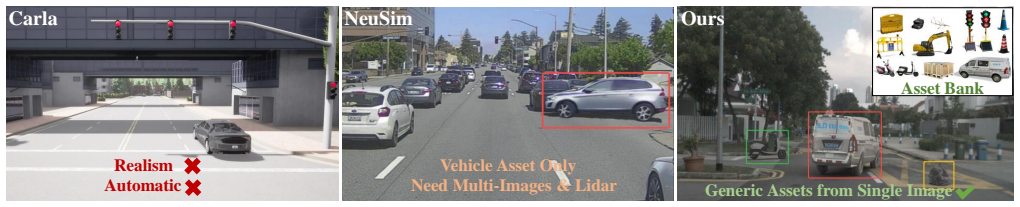
In the field of autonomous driving, sensor simulation is essential for generating rare and diverse scenarios that are difficult to capture in real-world environments. Current solutions fall into two categories: 1) CG-based methods, such as CARLA, which lack diversity and struggle to scale to the vast array of rare cases required for robust perception training; and 2) learning-based approaches, such as NeuSim, which are limited to specific object categories (vehicles) and require extensive multi-sensor data, hindering their applicability to generic objects. To address these limitations, we propose a scalable real2sim2real system that leverages 3D generation to automate asset mining, generation, and rare-case data synthesis.
Figures


Reference graph
Works this paper leans on
-
[1]
Carla: An open urban driving simulator,
A. Dosovitskiy, G. Ros, F. Codevilla, A. Lopez, and V . Koltun, “Carla: An open urban driving simulator,” inConference on robot learning. PMLR, 2017, pp. 1–16
2017
-
[2]
Reconstructing objects in-the-wild for realistic sensor simulation,
Z. Yang, S. Manivasagam, Y . Chen, J. Wang, R. Hu, and R. Urtasun, “Reconstructing objects in-the-wild for realistic sensor simulation,” in2023 IEEE International Conference on Robotics and Automation (ICRA). IEEE, 2023, pp. 11 661–11 668
work page 2023
-
[3]
Advsim: Generating safety-critical scenarios for self- driving vehicles,
J. Wang, A. Pun, J. Tu, S. Manivasagam, A. Sadat, S. Casas, M. Ren, and R. Urtasun, “Advsim: Generating safety-critical scenarios for self- driving vehicles,” inProceedings of the IEEE/CVF Conference on Computer Vision and Pattern Recognition, 2021, pp. 9909–9918
2021
-
[4]
Ners: Neural reflectance surfaces for sparse-view 3d reconstruction in the wild,
J. Zhang, G. Yang, S. Tulsiani, and D. Ramanan, “Ners: Neural reflectance surfaces for sparse-view 3d reconstruction in the wild,” Advances in Neural Information Processing Systems, vol. 34, pp. 29 835–29 847, 2021
work page 2021
-
[5]
Cadsim: Robust and scalable in-the-wild 3d reconstruction for controllable sensor simulation,
J. Wang, S. Manivasagam, Y . Chen, Z. Yang, I. A. B ˆarsan, A. J. Yang, W.-C. Ma, and R. Urtasun, “Cadsim: Robust and scalable in-the-wild 3d reconstruction for controllable sensor simulation,”arXiv preprint arXiv:2311.01447, 2023
Pith/arXiv arXiv 2023
-
[6]
Geosim: Realistic video simulation via geometry-aware composition for self-driving,
Y . Chen, F. Rong, S. Duggal, S. Wang, X. Yan, S. Manivasagam, S. Xue, E. Yumer, and R. Urtasun, “Geosim: Realistic video simulation via geometry-aware composition for self-driving,” inProceedings of the IEEE/CVF conference on computer vision and pattern recognition, 2021, pp. 7230–7240
work page 2021
-
[7]
Neural fields meet explicit geometric representations for inverse rendering of urban scenes,
Z. Wang, T. Shen, J. Gao, S. Huang, J. Munkberg, J. Hasselgren, Z. Gojcic, W. Chen, and S. Fidler, “Neural fields meet explicit geometric representations for inverse rendering of urban scenes,” in Proceedings of the IEEE/CVF Conference on Computer Vision and Pattern Recognition, 2023, pp. 8370–8380
work page 2023
-
[8]
Neural light field estimation for street scenes with differentiable virtual object insertion,
Z. Wang, W. Chen, D. Acuna, J. Kautz, and S. Fidler, “Neural light field estimation for street scenes with differentiable virtual object insertion,” inEuropean Conference on Computer Vision. Springer, 2022, pp. 380–397
work page 2022
-
[9]
LightSim: Neural Lighting Simulation for Urban Scenes
A. Pun, G. Sun, J. Wang, Y . Chen, Z. Yang, S. Manivasagam, W.-C. Ma, and R. Urtasun, “Lightsim: Neural lighting simulation for urban scenes,”arXiv preprint arXiv:2312.06654, 2023
work page internal anchor Pith review Pith/arXiv arXiv 2023
-
[10]
Anything in any scene: Photoreal- istic video object insertion,
C. Bai, Z. Shao, G. Zhang, D. Liang, J. Yang, Z. Zhang, Y . Guo, C. Zhong, Y . Qiu, Z. Wanget al., “Anything in any scene: Photoreal- istic video object insertion,”arXiv preprint arXiv:2401.17509, 2024
Pith/arXiv arXiv 2024
-
[11]
Dreamfusion: Text- to-3d using 2d diffusion,
B. Poole, A. Jain, J. T. Barron, and B. Mildenhall, “Dreamfusion: Text- to-3d using 2d diffusion,”arXiv preprint arXiv:2209.14988, 2022
Pith/arXiv arXiv 2022
-
[12]
Triposr: Fast 3d object reconstruction from a single image,
D. Tochilkin, D. Pankratz, Z. Liu, Z. Huang, A. Letts, Y . Li, D. Liang, C. Laforte, V . Jampani, and Y .-P. Cao, “Triposr: Fast 3d object reconstruction from a single image,”arXiv preprint arXiv:2403.02151, 2024
Pith/arXiv arXiv 2024
-
[13]
Grm: Large gaussian reconstruction model for efficient 3d reconstruction and generation,
Y . Xu, Z. Shi, W. Yifan, H. Chen, C. Yang, S. Peng, Y . Shen, and G. Wetzstein, “Grm: Large gaussian reconstruction model for efficient 3d reconstruction and generation,”arXiv preprint arXiv:2403.14621, 2024
Pith/arXiv arXiv 2024
-
[14]
J. Xu, W. Cheng, Y . Gao, X. Wang, S. Gao, and Y . Shan, “Instantmesh: Efficient 3d mesh generation from a single image with sparse-view large reconstruction models,”arXiv preprint arXiv:2404.07191, 2024
Pith/arXiv arXiv 2024
-
[15]
Zero-1-to-3: Zero-shot one image to 3d object,
R. Liu, R. Wu, B. Van Hoorick, P. Tokmakov, S. Zakharov, and C. V ondrick, “Zero-1-to-3: Zero-shot one image to 3d object,” in Proceedings of the IEEE/CVF international conference on computer vision, 2023, pp. 9298–9309
2023
-
[16]
Zero123++: a single image to consistent multi-view diffusion base model,
R. Shi, H. Chen, Z. Zhang, M. Liu, C. Xu, X. Wei, L. Chen, C. Zeng, and H. Su, “Zero123++: a single image to consistent multi-view diffusion base model,” 2023
work page 2023
-
[17]
One-2-3-45: Any single image to 3d mesh in 45 seconds without per-shape optimization,
M. Liu, C. Xu, H. Jin, L. Chen, M. Varma T, Z. Xu, and H. Su, “One-2-3-45: Any single image to 3d mesh in 45 seconds without per-shape optimization,”Advances in Neural Information Processing Systems, vol. 36, 2024
work page 2024
-
[18]
M. Liu, R. Shi, L. Chen, Z. Zhang, C. Xu, X. Wei, H. Chen, C. Zeng, J. Gu, and H. Su, “One-2-3-45++: Fast single image to 3d objects with consistent multi-view generation and 3d diffusion,” in Proceedings of the IEEE/CVF Conference on Computer Vision and Pattern Recognition, 2024, pp. 10 072–10 083
work page 2024
-
[19]
Unique3d: High-quality and efficient 3d mesh generation from a single image,
K. Wu, F. Liu, Z. Cai, R. Yan, H. Wang, Y . Hu, Y . Duan, and K. Ma, “Unique3d: High-quality and efficient 3d mesh generation from a single image,”arXiv preprint arXiv:2405.20343, 2024
Pith/arXiv arXiv 2024
-
[20]
Wonder3d: Single image to 3d using cross-domain diffusion,
X. Long, Y .-C. Guo, C. Lin, Y . Liu, Z. Dou, L. Liu, Y . Ma, S.-H. Zhang, M. Habermann, C. Theobaltet al., “Wonder3d: Single image to 3d using cross-domain diffusion,” inProceedings of the IEEE/CVF Conference on Computer Vision and Pattern Recognition, 2024, pp. 9970–9980
2024
-
[21]
Learning transferable visual models from natural language supervision,
A. Radford, J. W. Kim, C. Hallacy, A. Ramesh, G. Goh, S. Agarwal, G. Sastry, A. Askell, P. Mishkin, J. Clarket al., “Learning transferable visual models from natural language supervision,” inInternational conference on machine learning. PMLR, 2021, pp. 8748–8763
2021
-
[22]
Stablenormal: Reducing diffusion variance for stable and sharp normal,
C. Ye, L. Qiu, X. Gu, Q. Zuo, Y . Wu, Z. Dong, L. Bo, Y . Xiu, and X. Han, “Stablenormal: Reducing diffusion variance for stable and sharp normal,”arXiv preprint arXiv:2406.16864, 2024
Pith/arXiv arXiv 2024
-
[23]
Kandinsky 3.0 tech- nical report,
V . Arkhipkin, A. Filatov, V . Vasilev, A. Maltseva, S. Azizov, I. Pavlov, J. Agafonova, A. Kuznetsov, and D. Dimitrov, “Kandinsky 3.0 tech- nical report,”arXiv preprint arXiv:2312.03511, 2023
Pith/arXiv arXiv 2023
-
[24]
Nerf: Representing scenes as neural radiance fields for view synthesis,
B. Mildenhall, P. P. Srinivasan, M. Tancik, J. T. Barron, R. Ramamoor- thi, and R. Ng, “Nerf: Representing scenes as neural radiance fields for view synthesis,”Communications of the ACM, vol. 65, no. 1, pp. 99–106, 2021
2021
-
[25]
Neus: Learning neural implicit surfaces by volume rendering for multi-view reconstruction,
P. Wang, L. Liu, Y . Liu, C. Theobalt, T. Komura, and W. Wang, “Neus: Learning neural implicit surfaces by volume rendering for multi-view reconstruction,”arXiv preprint arXiv:2106.10689, 2021
Pith/arXiv arXiv 2021
-
[26]
3d gaussian splatting for real-time radiance field rendering
B. Kerbl, G. Kopanas, T. Leimk ¨uhler, and G. Drettakis, “3d gaussian splatting for real-time radiance field rendering.”ACM Trans. Graph., vol. 42, no. 4, pp. 139–1, 2023
2023
-
[27]
Instant neural graphics primitives with a multiresolution hash encoding,
T. M ¨uller, A. Evans, C. Schied, and A. Keller, “Instant neural graphics primitives with a multiresolution hash encoding,”ACM transactions on graphics (TOG), vol. 41, no. 4, pp. 1–15, 2022
2022
-
[28]
Block-nerf: Scalable large scene neural view synthesis,
M. Tancik, V . Casser, X. Yan, S. Pradhan, B. Mildenhall, P. P. Srinivasan, J. T. Barron, and H. Kretzschmar, “Block-nerf: Scalable large scene neural view synthesis,” inProceedings of the IEEE/CVF Conference on Computer Vision and Pattern Recognition, 2022, pp. 8248–8258
work page 2022
-
[29]
Mip-nerf 360: Unbounded anti-aliased neural radiance fields,
J. T. Barron, B. Mildenhall, D. Verbin, P. P. Srinivasan, and P. Hedman, “Mip-nerf 360: Unbounded anti-aliased neural radiance fields,” in Proceedings of the IEEE/CVF conference on computer vision and pattern recognition, 2022, pp. 5470–5479
2022
-
[30]
Zip-nerf: Anti-aliased grid-based neural radiance fields,
——, “Zip-nerf: Anti-aliased grid-based neural radiance fields,” in Proceedings of the IEEE/CVF International Conference on Computer Vision, 2023, pp. 19 697–19 705
2023
-
[31]
Neuralangelo: High-fidelity neural surface reconstruction,
Z. Li, T. M ¨uller, A. Evans, R. H. Taylor, M. Unberath, M.-Y . Liu, and C.-H. Lin, “Neuralangelo: High-fidelity neural surface reconstruction,” inProceedings of the IEEE/CVF Conference on Computer Vision and Pattern Recognition, 2023, pp. 8456–8465
work page 2023
-
[32]
Monosdf: Exploring monocular geometric cues for neural implicit surface recon- struction,
Z. Yu, S. Peng, M. Niemeyer, T. Sattler, and A. Geiger, “Monosdf: Exploring monocular geometric cues for neural implicit surface recon- struction,”Advances in neural information processing systems, vol. 35, pp. 25 018–25 032, 2022
work page 2022
-
[33]
Unisim: A neural closed-loop sensor simulator,
Z. Yang, Y . Chen, J. Wang, S. Manivasagam, W.-C. Ma, A. J. Yang, and R. Urtasun, “Unisim: A neural closed-loop sensor simulator,” in Proceedings of the IEEE/CVF Conference on Computer Vision and Pattern Recognition, 2023, pp. 1389–1399
2023
-
[34]
Bakedsdf: Meshing neural sdfs for real-time view synthesis,
L. Yariv, P. Hedman, C. Reiser, D. Verbin, P. P. Srinivasan, R. Szeliski, J. T. Barron, and B. Mildenhall, “Bakedsdf: Meshing neural sdfs for real-time view synthesis,” inACM SIGGRAPH 2023 Conference Proceedings, 2023, pp. 1–9
work page 2023
-
[35]
Mip-splatting: Alias-free 3d gaussian splatting,
Z. Yu, A. Chen, B. Huang, T. Sattler, and A. Geiger, “Mip-splatting: Alias-free 3d gaussian splatting,” inProceedings of the IEEE/CVF Conference on Computer Vision and Pattern Recognition, 2024, pp. 19 447–19 456
2024
-
[36]
Drivinggaussian: Composite gaussian splatting for surrounding dy- namic autonomous driving scenes,
X. Zhou, Z. Lin, X. Shan, Y . Wang, D. Sun, and M.-H. Yang, “Drivinggaussian: Composite gaussian splatting for surrounding dy- namic autonomous driving scenes,” inProceedings of the IEEE/CVF Conference on Computer Vision and Pattern Recognition, 2024, pp. 21 634–21 643
work page 2024
-
[37]
Street gaussians for modeling dynamic urban scenes,
Y . Yan, H. Lin, C. Zhou, W. Wang, H. Sun, K. Zhan, X. Lang, X. Zhou, and S. Peng, “Street gaussians for modeling dynamic urban scenes,” arXiv preprint arXiv:2401.01339, 2024
Pith/arXiv arXiv 2024
-
[38]
3drealcar: An in-the-wild rgb-d car dataset with 360-degree views,
X. Du, H. Sun, S. Wang, Z. Wu, H. Sheng, J. Ying, M. Lu, T. Zhu, K. Zhan, and X. Yu, “3drealcar: An in-the-wild rgb-d car dataset with 360-degree views,”arXiv preprint arXiv:2406.04875, 2024
Pith/arXiv arXiv 2024
-
[39]
Dreamcar: Leveraging car-specific prior for in-the-wild 3d car reconstruction,
X. Du, H. Sun, M. Lu, T. Zhu, and X. Yu, “Dreamcar: Leveraging car-specific prior for in-the-wild 3d car reconstruction,”arXiv preprint arXiv:2407.16988, 2024
Pith/arXiv arXiv 2024
-
[40]
Magic123: One image to high-quality 3d object generation using both 2d and 3d diffusion priors,
G. Qian, J. Mai, A. Hamdi, J. Ren, A. Siarohin, B. Li, H.-Y . Lee, I. Skorokhodov, P. Wonka, S. Tulyakovet al., “Magic123: One image to high-quality 3d object generation using both 2d and 3d diffusion priors,”arXiv preprint arXiv:2306.17843, 2023
Pith/arXiv arXiv 2023
-
[41]
Make-it-3d: High-fidelity 3d creation from a single image with diffu- sion prior,
J. Tang, T. Wang, B. Zhang, T. Zhang, R. Yi, L. Ma, and D. Chen, “Make-it-3d: High-fidelity 3d creation from a single image with diffu- sion prior,” inProceedings of the IEEE/CVF international conference on computer vision, 2023, pp. 22 819–22 829
2023
-
[42]
Score jacobian chaining: Lifting pretrained 2d diffusion models for 3d generation,
H. Wang, X. Du, J. Li, R. A. Yeh, and G. Shakhnarovich, “Score jacobian chaining: Lifting pretrained 2d diffusion models for 3d generation,” inProceedings of the IEEE/CVF Conference on Computer Vision and Pattern Recognition, 2023, pp. 12 619–12 629
work page 2023
-
[43]
High-resolution image synthesis with latent diffusion models,
R. Rombach, A. Blattmann, D. Lorenz, P. Esser, and B. Ommer, “High-resolution image synthesis with latent diffusion models,” in Proceedings of the IEEE/CVF conference on computer vision and pattern recognition, 2022, pp. 10 684–10 695
2022
-
[44]
Sdxl: Improving latent diffusion models for high-resolution image synthesis,
D. Podell, Z. English, K. Lacey, A. Blattmann, T. Dockhorn, J. M ¨uller, J. Penna, and R. Rombach, “Sdxl: Improving latent diffusion models for high-resolution image synthesis,”arXiv preprint arXiv:2307.01952, 2023
Pith/arXiv arXiv 2023
-
[45]
Syncdreamer: Generating multiview-consistent images from a single- view image,
Y . Liu, C. Lin, Z. Zeng, X. Long, L. Liu, T. Komura, and W. Wang, “Syncdreamer: Generating multiview-consistent images from a single- view image,”arXiv preprint arXiv:2309.03453, 2023
Pith/arXiv arXiv 2023
-
[46]
Mvdream: Multi- view diffusion for 3d generation,
Y . Shi, P. Wang, J. Ye, M. Long, K. Li, and X. Yang, “Mvdream: Multi- view diffusion for 3d generation,”arXiv preprint arXiv:2308.16512, 2023
Pith/arXiv arXiv 2023
-
[47]
Lrm: Large reconstruction model for single image to 3d,
Y . Hong, K. Zhang, J. Gu, S. Bi, Y . Zhou, D. Liu, F. Liu, K. Sunkavalli, T. Bui, and H. Tan, “Lrm: Large reconstruction model for single image to 3d,”arXiv preprint arXiv:2311.04400, 2023
Pith/arXiv arXiv 2023
-
[48]
Crm: Single image to 3d textured mesh with convolutional reconstruction model,
Z. Wang, Y . Wang, Y . Chen, C. Xiang, S. Chen, D. Yu, C. Li, H. Su, and J. Zhu, “Crm: Single image to 3d textured mesh with convolutional reconstruction model,”arXiv preprint arXiv:2403.05034, 2024
Pith/arXiv arXiv 2024
-
[49]
Attention is all you need.(nips), 2017,
A. Vaswani, N. Shazeer, N. Parmar, J. Uszkoreit, L. Jones, A. N. Gomez, L. Kaiser, and I. Polosukhin, “Attention is all you need.(nips), 2017,”arXiv preprint arXiv:1706.03762, vol. 10, p. S0140525X16001837, 2017
Pith/arXiv arXiv 2017
-
[50]
Objaverse: A universe of annotated 3d objects,
M. Deitke, D. Schwenk, J. Salvador, L. Weihs, O. Michel, E. Vander- Bilt, L. Schmidt, K. Ehsani, A. Kembhavi, and A. Farhadi, “Objaverse: A universe of annotated 3d objects,” inProceedings of the IEEE/CVF Conference on Computer Vision and Pattern Recognition, 2023, pp. 13 142–13 153
2023
-
[51]
Objaverse-xl: A universe of 10m+ 3d objects,
M. Deitke, R. Liu, M. Wallingford, H. Ngo, O. Michel, A. Kusupati, A. Fan, C. Laforte, V . V oleti, S. Y . Gadreet al., “Objaverse-xl: A universe of 10m+ 3d objects,”Advances in Neural Information Processing Systems, vol. 36, 2024
work page 2024
-
[52]
Direct2. 5: Diverse text-to-3d generation via multi-view 2.5 d diffusion,
Y . Lu, J. Zhang, S. Li, T. Fang, D. McKinnon, Y . Tsin, L. Quan, X. Cao, and Y . Yao, “Direct2. 5: Diverse text-to-3d generation via multi-view 2.5 d diffusion,” inProceedings of the IEEE/CVF Confer- ence on Computer Vision and Pattern Recognition, 2024, pp. 8744– 8753
work page 2024
-
[53]
Continuous remeshing for inverse rendering,
W. Palfinger, “Continuous remeshing for inverse rendering,”Computer Animation and Virtual Worlds, vol. 33, no. 5, p. e2101, 2022
2022
-
[54]
Modular primitives for high-performance differentiable rendering,
S. Laine, J. Hellsten, T. Karras, Y . Seol, J. Lehtinen, and T. Aila, “Modular primitives for high-performance differentiable rendering,” ACM Transactions on Graphics (ToG), vol. 39, no. 6, pp. 1–14, 2020
work page 2020
-
[55]
O. Sorkine, D. Cohen-Or, Y . Lipman, M. Alexa, C. R ¨ossl, and H.- P. Seidel, “Laplacian surface editing,” inProceedings of the 2004 Eurographics/ACM SIGGRAPH symposium on Geometry processing, 2004, pp. 175–184
work page 2004
-
[56]
Neural kernel surface reconstruction,
J. Huang, Z. Gojcic, M. Atzmon, O. Litany, S. Fidler, and F. Williams, “Neural kernel surface reconstruction,” inProceedings of the IEEE/CVF Conference on Computer Vision and Pattern Recog- nition, 2023, pp. 4369–4379
2023
-
[57]
Adaptive fusion of single-view and multi-view depth for autonomous driving,
J. Cheng, W. Yin, K. Wang, X. Chen, S. Wang, and X. Yang, “Adaptive fusion of single-view and multi-view depth for autonomous driving,” inProceedings of the IEEE/CVF Conference on Computer Vision and Pattern Recognition, 2024, pp. 10 138–10 147
work page 2024
- [58]
-
[59]
Harmonizer: Learning to perform white-box image and video harmonization,
Z. Ke, C. Sun, L. Zhu, K. Xu, and R. W. Lau, “Harmonizer: Learning to perform white-box image and video harmonization,” inEuropean Conference on Computer Vision. Springer, 2022, pp. 690–706
work page 2022
-
[60]
Google scanned objects: A high-quality dataset of 3d scanned household items,
L. Downs, A. Francis, N. Koenig, B. Kinman, R. Hickman, K. Rey- mann, T. B. McHugh, and V . Vanhoucke, “Google scanned objects: A high-quality dataset of 3d scanned household items,” in2022 International Conference on Robotics and Automation (ICRA). IEEE, 2022, pp. 2553–2560
work page 2022
-
[61]
FCOS: A simple and strong anchor-free object detector,
Z. Tian, C. Shen, H. Chen, and T. He, “FCOS: A simple and strong anchor-free object detector,” 2021
work page 2021
-
[62]
Bev- former: learning bird’s-eye-view representation from lidar-camera via spatiotemporal transformers,
Z. Li, W. Wang, H. Li, E. Xie, C. Sima, T. Lu, Q. Yu, and J. Dai, “Bev- former: learning bird’s-eye-view representation from lidar-camera via spatiotemporal transformers,”IEEE Transactions on Pattern Analysis and Machine Intelligence, 2024
2024
This paper was first reviewed by deepseek-v4-flash on August 4, 2026.
discussion (0)
Sign in with ORCID, Apple, or X to comment. Anyone can read and Pith papers without signing in.