REVIEW 4 major objections 5 minor 2 cited by
Compact language models match cloud-scale LLMs on wearable health prediction.
Reviewed by Pith at T0; open to challenge. T0 means a machine referee read the full paper against a public rubric. the ladder, T0–T4 →
T0 review · deepseek-v4-flash
2026-08-04 22:31 UTC pith:ALBC42MA
load-bearing objection Useful benchmark, but the 'SLMs match LLMs' headline rests on a comparison to Health-LLM baselines that isn't apples-to-apples. the 4 major comments →
HealthSLM-Bench: Benchmarking Small Language Models for Mobile and Wearable Healthcare Monitoring
The pith
A machine-rendered reading of the paper's core claim, the machinery that carries it, and where it could break.
Core claim
On its own terms, the paper establishes that compact language models are not a compromise version of LLMs for this benchmark: across the three datasets, SLM means are better than LLM means for stress, readiness, and fatigue in zero-shot settings, and after low-rank instruction tuning they beat LLMs on fatigue accuracy and calorie error by wide margins. The deployment experiment shows two top SLMs producing complete responses in about 1.8 to 7.6 seconds on a phone, versus about 57 seconds for a 7-billion-parameter LLM, while using 9–28% less RAM. The paper also documents where parity fails: one SLM consistently underperforms, calorie regression is much harder for SLMs in zero-shot settings, a
What carries the argument
HealthSLM-Bench, a prompt-based benchmark that converts 14-day wearable sensor summaries (steps, calories, resting heart rate, sleep, self-reported mood) into instruction prompts, evaluates nine SLMs under zero-shot, few-shot, and instruction-tuning protocols, and compares their mean accuracy and mean absolute error against published LLM numbers. Instruction tuning uses LoRA, low-rank adaptation that trains small injected matrices while freezing the base model. On-device evaluation uses 4-bit quantized models run through a lightweight inference engine, with latency and memory metrics borrowed from the mobile-benchmark literature.
Load-bearing premise
The headline comparison assumes the earlier LLM results were obtained under the same prompts, same greedy decoding, same token cap, and same handling of unparseable outputs as the new SLM runs; if any of these differ, the parity claim could be an artifact.
What would settle it
Re-run one LLM and one SLM on the same split of one dataset with an identical prompt template, greedy decoding, a 30-token cap, and a single parser; then recompute means with failed predictions counted as errors rather than omitted. If the LLM's mean error then drops below the SLM's, the paper's comparable-performance claim is not reproducible.
If this is right
- On-device SLMs can handle privacy-sensitive health inference without sending raw physiological data to a server.
- A phone can run a fine-tuned SLM end-to-end in seconds, making real-time monitoring feasible; the paper reports about 1.8 seconds total for the smallest model versus about 57 seconds for a 7B LLM.
- LoRA instruction tuning is enough to bring SLMs to LLM-level health accuracy, avoiding the cost of full fine-tuning.
- Certain tasks, notably fatigue and calorie estimation, favor SLMs after tuning, while stress, readiness, and activity remain somewhat better handled by LLMs.
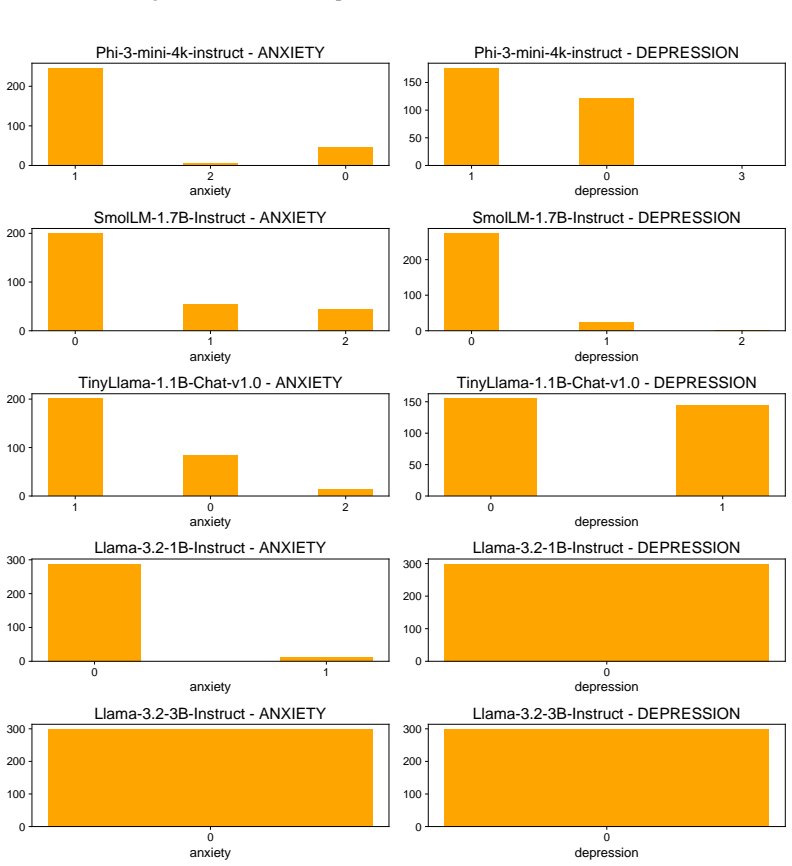
- Class imbalance and few-shot collapse are the main remaining barriers to adoption, and the benchmark quantifies exactly where each model fails.
Where Pith is reading between the lines
- The paper aggregates 14 days into summary statistics, so it cannot see recovery dynamics or circadian patterns; prompting with raw daily sequences could let larger models pull ahead, which would bracket the parity claim to aggregated inputs.
- Because the labels are self-reported fatigue, stress, mood, and sleep quality, a natural test is whether the same parity survives on objective clinical endpoints such as polysomnography or blood pressure readings.
- The majority-class collapse after fine-tuning suggests that imbalance-aware LoRA, such as class-weighted loss or minority oversampling, might convert the current comparable result into a clear SLM advantage on imbalanced tasks.
- If the few-shot collapse on some tasks stems from prompt format rather than model capacity, instruction-formatting search could be a cheaper fix than scaling model size.
Editorial analysis
A structured set of objections, weighed in public.
Referee Report
Summary. The paper introduces HealthSLM-Bench, a benchmark that evaluates nine small language models (SLMs) in the 1B-4B range on eight health prediction tasks drawn from three wearable/mobile datasets (PMData, GLOBEM, AW-FB). The evaluation covers zero-shot, few-shot (N=1,3,5,10), and LoRA-based instruction tuning. The authors compare SLM results with LLM baselines from Health-LLM [23], report that SLMs match or exceed LLM performance on several tasks, and deploy two fine-tuned SLMs on an iPhone 15 Pro Max to measure TTFT, token throughput, CPU, and RAM usage against Llama-2-7b. They conclude that SLMs are a promising privacy-preserving and efficient alternative to cloud-based healthcare LLMs, while acknowledging limitations from class imbalance and few-shot collapse.
Significance. If the claims hold, this is a useful contribution: it extends prior SLM health-monitoring work to a broader set of models, datasets, and adaptation protocols, and it includes rare on-device deployment measurements. The efficiency measurements and the systematic comparison of nine SLMs are concrete assets for the community. However, the central SLM-vs-LLM comparison currently depends on cross-paper baseline numbers whose protocol equivalence is not demonstrated, and the averaging over different subsets of models makes the headline means difficult to interpret. The paper does not yet provide code/checkpoints despite promising them, so reproducibility is currently limited to the textual protocol.
major comments (4)
- [§5, 5.1; Table 3; Appendix A] The headline claim that SLMs match or outperform LLMs rests on comparing SLM runs with LLM numbers taken from Health-LLM [23]. Section 5 says 'under the same settings as in [23]', but Appendix A specifies greedy decoding, max 30 generated tokens, Alpaca-style prompts, and output-constraint parsing for SLMs; no evidence is given that Health-LLM used the same decoding, max-token limit, prompt template, or failed-output handling. In Table 3, the LLM mean for stress (0.64) is computed over 10 models excluding GPT-3.5/GPT-4, whereas the SLM mean (0.61) averages all 9 models. If failure handling or decoding differs, the observed SLM advantage on stress/readiness/fatigue could be an artifact of averaging over different subsets. This is the load-bearing part of the benchmark and must be resolved by reproducing the baselines or reporting the exact Health-LLM protocol.
- [Table 4; §5.1 (Few-shot learning)] The few-shot comparison is asymmetric. LLM rows are labeled 'FS-best' (the best result across shot counts from [23]), while SLM rows are fixed FS-1, FS-3, FS-5, FS-10. Comparing the best-of-k LLM result with a single one-shot SLM result inflates the LLM baseline, not the SLM one, and conflates model capability with prompt-selection budget. For a fair benchmark, either report the same N for both families or provide the full shot-count sweep for LLMs.
- [Tables 3–5; dash handling] No explicit rule is given for how '-' (failed predictions) are treated in mean rows. In Table 3 the stress mean 0.64 excludes GPT-3.5/GPT-4 but the SLM mean 0.61 includes all 9 models; in Table 5 Gemma-2-2b-it has dashes for three PMData tasks, and the SLM mean likely drops it. Averages over different model sets are not comparable. The paper should report the number of valid predictions per model/task and compute means either over the same set or with an explicit imputation/failure penalty.
- [§5.2; Table 6] The efficiency comparison is narrower than implied. Only two SLMs are deployed and compared with Llama-2-7b as a proxy for the fine-tuned LLM baseline, and the summary statistics come from 10 randomly selected samples with no confidence intervals or variance. The conclusion that SLMs preserve latency and memory advantages is reasonable for these specific models, but it does not support a general efficiency claim across the nine SLMs in the benchmark. Reporting per-model variance and the prompt-length distribution would strengthen the claim.
minor comments (5)
- [§4.1] The AW-FB dataset heading appears as 'A W_FB' in several places; use 'AW-FB' consistently.
- [Appendix A] Typographical issues: 're-productiveness' should be 'reproducibility' and 'with batch size of 128 with 3 number of epochs' should be rephrased.
- [Table 4] Header contains 'across across eight healthcare monitoring tasks'; remove the duplicate word.
- [References] References [57] and [58] refer to the same llama.cpp repository; unify and correct the year/attribution.
- [§5.2] Table 6 title 'Efficiency & Utilization of LLMs & SLMs' is misleading because only one LLM (Llama-2-7b) is included.
Circularity Check
No significant circularity: the paper is an empirical benchmark whose central claim rests on external LLM baselines, not on fitted parameters or self-citation chains.
full rationale
This is an empirical evaluation, not a derivation chain. The headline claim (Section 5.1: 'SLMs achieve comparable or better performance than LLMs across the three health datasets') is supported by two independent inputs: (i) the authors' own zero-shot, few-shot, and LoRA-tuned evaluations of SLMs, described concretely in Appendix A (greedy decoding, max 30 generated tokens, Alpaca-style templates, LoRA fine-tuning), and (ii) LLM baseline numbers taken from Health-LLM [23], an external paper by different authors. The LLM numbers are not outputs of the present paper's pipeline, not fitted parameters, and not defined in terms of the SLM results, so the comparison cannot be circular by construction. No fitted input is renamed as a prediction: the instruction-tuned models are evaluated on test data, and no parameter is tuned to a subset and then reported as a prediction of a closely related quantity. The self-citations [18] and [55] are used only for prompt construction, data-processing conventions, and related-work context; they are not invoked as a uniqueness theorem, a forbidden-alternative argument, or the justification for the central claim. The Appendix also openly discloses the SLM inference protocol, which is a transparency feature rather than a circular step. The legitimate concern raised by the reader—whether the 'same settings as in [23]' claim truly holds given Appendix A's greedy decoding and 30-token cap, and whether Table 3's means are computed over different model subsets—is a threat to external validity and fair comparison, not circularity: even if the protocols differ, the conclusion would be an artifact of uneven evaluation, not a tautology or a fitted-input-renamed-as-prediction. Since the central result depends on independent external baselines and direct held-out evaluation, the paper is self-contained against the circularity failure modes considered here. Score 0.
Axiom & Free-Parameter Ledger
free parameters (6)
- LoRA rank
- Learning rate =
5e-5
- Max generated tokens =
30
- 14-day data window =
14 days
- Data split seed
- Few-shot example selection
axioms (4)
- domain assumption Self-reported labels in PMData, GLOBEM, and AW-FB are treated as ground truth for health status.
- ad hoc to paper The LLM baseline numbers from Health-LLM [23] are directly comparable to the authors' SLM evaluations.
- domain assumption Accuracy and MAE are sufficient summary metrics for the health prediction tasks.
- domain assumption Greedy decoding at max 30 tokens yields valid, complete predictions for all tasks.
Cite this review
Pith. "Pith review of HealthSLM-Bench: Benchmarking Small Language Models for Mobile and Wearable Healthcare Monitoring." pith.science (2026). https://pith.science/paper/ALBC42MA
@misc{pith2026250907260,
  author       = {Pith},
  title        = {Pith review of: HealthSLM-Bench: Benchmarking Small Language Models for Mobile and Wearable Healthcare Monitoring},
  year         = {2026},
  howpublished = {\url{https://pith.science/paper/ALBC42MA}},
  note         = {Machine review of arXiv:2509.07260}
}
read the original abstract
Mobile and wearable healthcare monitoring play a vital role in facilitating timely interventions, managing chronic health conditions, and ultimately improving individuals' quality of life. Previous studies on large language models (LLMs) have highlighted their impressive generalization abilities and effectiveness in healthcare prediction tasks. However, most LLM-based healthcare solutions are cloud-based, which raises significant privacy concerns and results in increased memory usage and latency. To address these challenges, there is growing interest in compact models, Small Language Models (SLMs), which are lightweight and designed to run locally and efficiently on mobile and wearable devices. Nevertheless, how well these models perform in healthcare prediction remains largely unexplored. We systematically evaluated SLMs on health prediction tasks using zero-shot, few-shot, and instruction fine-tuning approaches, and deployed the best performing fine-tuned SLMs on mobile devices to evaluate their real-world efficiency and predictive performance in practical healthcare scenarios. Our results show that SLMs can achieve performance comparable to LLMs while offering substantial gains in efficiency and privacy. However, challenges remain, particularly in handling class imbalance and few-shot scenarios. These findings highlight SLMs, though imperfect in their current form, as a promising solution for next-generation, privacy-preserving healthcare monitoring.
Figures




Forward citations
Cited by 2 Pith papers
-
Little Brains, Big Feats: Exploring Compact Language Models
Small language models can run RAG generation on-device without GPUs in reasonable time.
-
ECG Foundation Models and Medical LLMs for Agentic Cardiovascular Intelligence at the Edge: A Review and Outlook
ECG foundation models for signal interpretation and medical LLMs for reasoning can be integrated into agentic systems for real-time cardiovascular intelligence on edge devices.
Reference graph
Works this paper leans on
-
[1]
Cecilia Dinh-Le, Rebecca Chuang, Sonia Chokshi, and Devin Mann. Wearable health technology and electronic health record integration: scoping review and future directions.Journal of Medical Internet Research, 21(9):e12861, 2019
work page 2019
-
[2]
Nhat Pham, Hong Jia, Minh Tran, Tuan Dinh, Nam Bui, Young Kwon, Dong Ma, Phuc Nguyen, Cecilia Mascolo, and Tam Vu. Pros: an efficient pattern-driven compressive sensing framework for low-power biopotential-based wearables with on-chip intelligence. InProceedings of the 28th Annual International Conference on Mobile Computing And Networking, pages 661–675, 2022
work page 2022
-
[3]
Ur2m: Uncertainty and resource-aware event detection on microcontrollers
Hong Jia, Young D Kwon, Dong Mat, Nhat Pham, Lorena Qendro, Tam Vu, and Cecilia Mascolo. Ur2m: Uncertainty and resource-aware event detection on microcontrollers. In2024 IEEE International Conference on Pervasive Computing and Communications (PerCom), pages 1–10. IEEE, 2024
work page 2024
-
[4]
Yu Wu, Dimitris Spathis, Hong Jia, Ignacio Perez-Pozuelo, Tomas I Gonzales, Soren Brage, Nicholas Wareham, and Cecilia Mascolo. Udama: Unsupervised domain adaptation through multi-discriminator adversarial training with noisy labels improves cardio-fitness prediction. In Machine Learning for Healthcare Conference, pages 863–883. PMLR, 2023
work page 2023
-
[5]
AI on the Pulse: Real-Time Health Anomaly Detection with Wearable and Ambient Intelligence
Lucas Gabrielli et al. Ai on the pulse: Integrating wearable sensors, ambient intelligence, and large language models for continuous health monitoring.arXiv preprint arXiv:2508.03436,
work page internal anchor Pith review Pith/arXiv arXiv
-
[6]
Yassir Ghadi et al. Wearable eeg and ai for real-time personalized health monitoring and intervention.Journal of Cloud Computing, 14(1):1–15, 2025
work page 2025
-
[7]
Emilio Ferrara. A survey on large language models for sensor-based human activity recognition and health monitoring.Sensors, 24(15):5045, 2024
work page 2024
-
[8]
Llasa: Multimodal large language models for interpreting human activity from inertial sensor data
Muhammad Imran et al. Llasa: Multimodal large language models for interpreting human activity from inertial sensor data. InProceedings of the Annual Meeting of the Association for Computational Linguistics (ACL), 2024
work page 2024
-
[9]
Amir Khasentino et al. Personal health llms: Towards context-aware and adaptive health monitoring from wearable sensor data.Nature Medicine, 2025. In press
work page 2025
-
[10]
Security and privacy challenges of large language models.ACM Computing Surveys, 58(2):1–38, 2025
Anish Das. Security and privacy challenges of large language models.ACM Computing Surveys, 58(2):1–38, 2025. doi: 10.1145/3712001. URL https://dl.acm.org/doi/10. 1145/3712001
doi:10.1145/3712001 2025
-
[11]
H. Li, Y . Chen, J. Luo, Y . Kang, X. Zhang, Q. Hu, C. Chan, and Y . Song. Privacy in large language models: Attacks, defences and future directions.arXiv, 2024. URL https://arxiv. org/pdf/2310.10383. Available: https://arxiv.org/pdf/2310.10383
Pith/arXiv arXiv 2024
-
[12]
Camel: Energy-Aware LLM Inference on Resource-Constrained Devices
Tianqi Xu, Wei Zhang, Chen Li, and Yifan Wang. Camel: Energy-aware llm inference on resource-constrained devices.arXiv preprint arXiv:2508.09173, 2025
work page internal anchor Pith review Pith/arXiv arXiv 2025
-
[13]
Hui Wang, Qiang Liu, and Mei Chen. Large language models on edge devices: Challenges and opportunities for intelligent data analysis.Frontiers in Computer Science, 7:1538277, 2025
work page 2025
-
[14]
Phi-3 technical report: A highly capable language model locally on your phone
Microsoft. Phi-3 technical report: A highly capable language model locally on your phone. Technical Report, 2024. URLhttps://arxiv.org/pdf/2404.14219v4
Pith/arXiv arXiv 2024
-
[15]
Tinyllama: An open-source small language model
Peiyuan Zhang, Guangtao Zeng, Tianduo Wang, and Wei Lu. Tinyllama: An open-source small language model. https://github.com/jzhang38/TinyLlama, 2024. TinyLlama achieves approximately 70-80% of LLaMA2’s performance on commonsense reasoning tasks such as HellaSwag and ARC-Challenge
work page 2024
-
[16]
Qwen2-1.5b: A new series of large language models, 2024
Qwen. Qwen2-1.5b: A new series of large language models, 2024. URL https:// huggingface.co/Qwen/Qwen2-1.5B. Accessed: 2024-09-01. 10
work page 2024
-
[17]
Gemma 2: Improving open language models at a practical size
Gemma Team and Google DeepMind. Gemma 2: Improving open language models at a practical size. Technical report, Google DeepMind, 2024. For full author list, see Contributions and Acknowledgments section. Correspondence togemma-2-report@google.com
work page 2024
-
[18]
Efficient and personalized mobile health event prediction via small language models
Xin Wang, Ting Dang, Vassilis Kostakos, and Hong Jia. Efficient and personalized mobile health event prediction via small language models. InProceedings of the 30th Annual International Conference on Mobile Computing and Networking, ACM MobiCom ’24, page 2353–2358, New York, NY , USA, 2024. Association for Computing Machinery. ISBN 9798400704895. doi: 10....
-
[19]
Marcus, Suchi Saria, and Daniel Halperin
Brandon Ballinger, Joy Hsieh, Avesh Singh, Nitish Sohoni, Jae Wang, Fangfei Li, Amit Sharma, Akshay Sharma, Gregory M. Marcus, Suchi Saria, and Daniel Halperin. Deepheart: Semi-supervised sequence learning for cardiovascular risk prediction. InProceedings of the Thirty-Second AAAI Conference on Artificial Intelligence (AAAI), pages 2079–2086. AAAI Press, ...
work page 2079
-
[20]
Kristján Hallgrímsson, Tom Goodwin, Sujit Ghosh, Peter Bühlmann, Christian Mathys, Vincent Lefort, Ara Darzi, Lionel Tarassenko, and David A. Clifton. Learning individualized cardio- vascular responses from large-scale wearable sensors data. InProceedings of the Thirty-Third AAAI Conference on Artificial Intelligence (AAAI), pages 941–948. AAAI Press, 201...
work page 2019
-
[21]
T. Mullick, A. Radovic, S. Shaaban, and A. Doryab. Predicting depression in adolescents using mobile and wearable sensors: Multimodal machine learning–based exploratory study.JMIR Formative Research, 6(6):e35807, 2022. doi: 10.2196/35807. URL https://formative. jmir.org/2022/6/e35807
-
[22]
Sebastian Kasl, Nathanael S. Holtzman, Md. Masudul Islam Shandhi, Tanishq Gupta, Jiang Kuang, Gregory D. Hager, Shawn S. Lam, and Suchi Saria. On the generalizability of wearable- based machine learning for respiratory virus detection. InProceedings of the 9th Machine Learning for Healthcare Conference (MLHC), volume 248 ofProceedings of Machine Learning ...
work page 2024
-
[23]
Health-llm: Large language models for health prediction via wearable sensor data
Yubin Kim, Xuhai Xu, Daniel McDuff, Cynthia Breazeal, and Hae Won Park. Health-llm: Large language models for health prediction via wearable sensor data. In Tom Pollard, Edward Choi, Pankhuri Singhal, Michael Hughes, Elena Sizikova, Bobak Mortazavi, Irene Chen, Fei Wang, Tasmie Sarker, Matthew McDermott, and Marzyeh Ghassemi, editors,Proceedings of the fi...
work page 2024
-
[24]
Exploring Large-Scale Language Models to Evaluate EEG-Based Multimodal Data for Mental Health
Yongquan Hu, Shuning Zhang, Ting Dang, Hong Jia, Flora D Salim, Wen Hu, and Aaron J Quigley. Exploring large-scale language models to evaluate eeg-based multimodal data for mental health.arXiv preprint arXiv:2408.07313, 2024
work page internal anchor Pith review Pith/arXiv arXiv 2024
-
[25]
Xuhai Xu, Bingsheng Yao, Yuanzhe Dong, Saadia Gabriel, Hong Yu, James Hendler, Marzyeh Ghassemi, Anind K. Dey, and Dakuo Wang. Mental-llm: Leveraging large language models for mental health prediction via online text data. InProceedings of the ACM on Interactive, Mobile, Wearable and Ubiquitous Technologies, volume 8, pages Article 32, 32 pages. Associati...
doi:10.1145/3643540 2024
-
[26]
Large language models encode clinical knowledge.Nature, 620(7972):172–180, 2023
Karan Singhal, Shekoofeh Azizi, Tao Tu, S Sara Mahdavi, Jason Wei, Hyung Won Chung, Nathan Scales, Ajay Tanwani, Heather Cole-Lewis, Stephen Pfohl, et al. Large language models encode clinical knowledge.Nature, 620(7972):172–180, 2023
2023
-
[27]
Capa- bilities of gpt-4 on medical challenge problems.arXiv preprint arXiv:2303.13375, 2023
Harsha Nori, Nicholas King, Scott Mayer McKinney, Dean Carignan, and Eric Horvitz. Capa- bilities of gpt-4 on medical challenge problems.arXiv preprint arXiv:2303.13375, 2023
Pith/arXiv arXiv 2023
-
[28]
Cathy Mengying Fang, Valdemar Danry, Nathan Whitmore, Andria Bao, Andrew Hutchison, Cayden Pierce, and Pattie Maes. Physiollm: Supporting personalized health insights with wearables and large language models.arXiv preprint arXiv:2406.19283, 2024. 11
Pith/arXiv arXiv 2024
-
[29]
Shengding Hu, Yuge Tu, Xu Han, Chaoqun He, Ganqu Cui, Xiang Long, Zhi Zheng, Yewei Fang, Yuxiang Huang, Weilin Zhao, et al. Minicpm: Unveiling the potential of small language models with scalable training strategies.arXiv preprint arXiv:2404.06395, 2024
Pith/arXiv arXiv 2024
-
[30]
Zhenyan Lu, Xiang Li, Dongqi Cai, Rongjie Yi, Fangming Liu, Wei Liu, Jian Luan, Xiwen Zhang, Nicholas D. Lane, and Mengwei Xu. Demystifying small language models for edge deployment. InProceedings of the 63rd Annual Meeting of the Association for Computational Linguistics (Volume 1: Long Papers), pages 14747–14764, Vienna, Austria, 2025
work page 2025
-
[31]
Mobileaibench: Benchmarking llms and lmms for on-device use cases
Rithesh Murthy, Liangwei Yang, Juntao Tan, Tulika Manoj Awalgaonkar, Yilun Zhou, Shelby Heinecke, Sachin Desai, Jason Wu, Ran Xu, Sarah Tan, et al. Mobileaibench: Benchmarking llms and lmms for on-device use cases. 2023
work page 2023
-
[32]
Phi-3-mini-4k-instruct: A lightweight, state-of-the-art open model, 2024
Microsoft. Phi-3-mini-4k-instruct: A lightweight, state-of-the-art open model, 2024. URL https://phi.microsoft.com/phi-3-mini-4k-instruct. Accessed: 2024-09-01
work page 2024
-
[33]
Tinyllama-1.1b-chat-v1.0: A compact llama model with 1.1b parameters, 2024
TinyLlama. Tinyllama-1.1b-chat-v1.0: A compact llama model with 1.1b parameters, 2024. URLhttps://github.com/jzhang38/TinyLlama. Accessed: 2024-09-01
work page 2024
-
[34]
Gemma 2: A lightweight, state-of-the-art open model family, 2024
Google. Gemma 2: A lightweight, state-of-the-art open model family, 2024. URL https: //huggingface.co/google/gemma-2-2b. Accessed: 2024-09-01
work page 2024
-
[35]
Smollm-1.7b-instruct: A series of small language models, 2024
HuggingFaceTB. Smollm-1.7b-instruct: A series of small language models, 2024. URL https://huggingface.co/HuggingFaceTB/SmolLM-1.7B-Instruct . Accessed: 2024- 09-01
work page 2024
-
[36]
Meta AI. Llama 3.2 model card. Hugging Face, 2024. Release date: September 25, 2024. Includes lightweight text-only (1 B, 3 B) and multimodal (11 B, 90 B) models
work page 2024
-
[37]
Pmdata: A sports logging dataset
Vajira Thambawita, Steven Alexander Hicks, Hanna Borgli, Håkon Kvale Stensland, Debesh Jha, Martin Kristoffer Svensen, Svein-Arne Pettersen, Dag Johansen, Håvard Dagenborg Johansen, Susann Dahl Pettersen, Simon Nordvang, Sigurd Pedersen, Anders Gjerdrum, Tor-Morten Grønli, Per Morten Fredriksen, Ragnhild Eg, Kjeld Hansen, Siri Fagernes, Christine Claudi, ...
-
[38]
Tom B. Brown, Benjamin Mann, Nick Ryder, Melanie Subbiah, Jared Kaplan, Prafulla Dhariwal, Arvind Neelakantan, Pranav Shyam, Girish Sastry, Amanda Askell, Sandhini Agarwal, Ariel Herbert-V oss, Gretchen Krueger, Tom Henighan, Rewon Child, Aditya Ramesh, Daniel M. Ziegler, Jeffrey Wu, Clemens Winter, Christopher Hesse, Mark Chen, Eric Sigler, Mateusz Litwi...
Pith/arXiv arXiv 2020
-
[39]
Chain-of-thought prompting elicits reasoning in large language models
John Wei, Michael Bosma, Dale Schuurmans, and et al. Chain-of-thought prompting elicits reasoning in large language models. InProceedings of NeurIPS 2022, 2022. URL https: //arxiv.org/abs/2201.11903
Pith/arXiv arXiv 2022
-
[40]
Self-consistency improves chain-of-thought reasoning in language models
Xinyang Wang, Hinrich Schütze, and et al. Self-consistency improves chain-of-thought reasoning in language models. InProceedings of NeurIPS 2022, 2022. URL https: //arxiv.org/abs/2203.11171
Pith/arXiv arXiv 2022
-
[41]
Zhao, Kelvin Guu, Adams Wei Yu, Brian Lester, Nan Du, Andrew M
Jason Wei, Maarten Bosma, Vincent Y . Zhao, Kelvin Guu, Adams Wei Yu, Brian Lester, Nan Du, Andrew M. Dai, and Quoc V . Le. Finetuned language models are zero-shot learners. In Proceedings of the International Conference on Learning Representations (ICLR), 2022. URL https://iclr.cc/virtual/2022/oral/6255
work page 2022
-
[42]
Stanford alpaca: An instruction-following llama model
Rohan Taori, Ishaan Gulrajani, Tianyi Zhang, Yann Dubois, Xuechen Li, Carlos Guestrin, Percy Liang, and Tatsunori Hashimoto. Stanford alpaca: An instruction-following llama model. https://crfm.stanford.edu/2023/03/13/alpaca.html, 2023. Accessed: 2025-04-27. 12
work page 2023
-
[43]
Smith, Iz Beltagy, and Hannaneh Hajishirzi
Yizhong Wang, Hamish Ivison, Pradeep Dasigi, Jack Hessel, Tushar Khot, Khyathi Chandu, David Wadden, Kelsey MacMillan, Noah A. Smith, Iz Beltagy, and Hannaneh Hajishirzi. How far can camels go? exploring the state of instruction tuning on open resources. InAd- vances in Neural Information Processing Systems (NeurIPS), Datasets and Benchmarks Track,
-
[44]
Dolly: The first truly open-source instruction-tuned model
Mike Conover, Matt Hayes, Ankit Mathur, Jianwei Xie, Sam Shah, Ali Ghodsi, Patrick Wendell, and Matei Zaharia. Dolly: The first truly open-source instruction-tuned model. Databricks blog,
-
[45]
Vicuna: An open-source chatbot impressing gpt-4 with 90 LMSYS blog post,
Vicuna Team. Vicuna: An open-source chatbot impressing gpt-4 with 90 LMSYS blog post,
-
[46]
Hu, Yelong Shen, Phillip Wallis, Zeyuan Allen-Zhu, Yuanzhi Li, Shean Wang, Lu Wang, and Weizhu Chen
Edward J. Hu, Yelong Shen, Phillip Wallis, Zeyuan Allen-Zhu, Yuanzhi Li, Shean Wang, Lu Wang, and Weizhu Chen. Lora: Low-rank adaptation of large language models. In Proceedings of the Tenth International Conference on Learning Representations (ICLR), 2022. URLhttps://openreview.net/forum?id=nZeVKeeFYf9
work page 2022
-
[47]
Fine-tuned on the Stanford Alpaca dataset
-
[48]
Daniel Fuller. Replication data for: Using machine learning methods to predict physical activity types with apple watch and fitbit data using indirect calorimetry as the criterion, 2020. URL https://doi.org/10.7910/DVN/ZS2Z2J. Accessed: 2025-04-29
-
[49]
Instruction tuning inspired by Alpaca’s methodology
-
[50]
Geneactiv: Raw data accelerometer for physical activity and sleep research
Activinsights Ltd. Geneactiv: Raw data accelerometer for physical activity and sleep research. https://www.activinsights.com/products/geneactiv/, 2015. Accessed: 2025-08- 30
work page 2015
-
[51]
Morris, Eve Riskin, Jennifer Mankoff, and Anind K
Xuhai Xu, Han Zhang, Yasaman Sefidgar, Yiyi Ren, Xin Liu, Woosuk Seo, Jennifer Brown, Kevin Kuehn, Mike Merrill, Paula Nurius, Shwetak Patel, Tim Althoff, Margaret E. Morris, Eve Riskin, Jennifer Mankoff, and Anind K. Dey. Globem dataset: Multi-year datasets for longitudinal human behavior modeling generalization, 2023. URL https://arxiv.org/abs/ 2211.02733
Pith/arXiv arXiv 2023
-
[52]
Fitbit charge 2: Heart rate + fitness wristband
Fitbit Inc. Fitbit charge 2: Heart rate + fitness wristband. https://www.fitbit.com/ global/us/products/trackers/charge2, 2016. Accessed: 2025-08-30
work page 2016
-
[53]
Fitbit versa 2: Health & fitness smartwatch
Fitbit Inc. Fitbit versa 2: Health & fitness smartwatch. https://www.fitbit.com/global/ us/products/smartwatches/versa2, 2019. Accessed: 2025-08-30
work page 2019
-
[54]
Tinyllama: A distilled version of llama for efficient language tasks
LLaMA Open Source Team. Tinyllama: A distilled version of llama for efficient language tasks. https://github.com/TinyLlama, 2024. Highlights the use of knowledge distillation for TinyLlama-1.1B derived from LLaMA-13B
work page 2024
-
[55]
Apple Inc. Apple watch series 2. https://support.apple.com/kb/SP745, 2016. Accessed: 2025-08-30
work page 2016
-
[56]
Hugging Face. Gguf, 2023. URL https://huggingface.co/docs/hub/en/gguf. Ac- cessed: 2025-09-05
work page 2023
-
[57]
Fine-tune small language model (slm) phi-3 using azure machine learning
Microsoft Corporation. Fine-tune small language model (slm) phi-3 using azure machine learning. https://techcommunity.microsoft.com/t5/ai-machine-learning-blog/ fine-tune-small-language-model-slm-phi-3-using-azure-machine/ba-p/ 4130399, 2024. Accessed: 2025-06-09
work page 2024
-
[58]
llama.cpp: Efficient llm inference in c/c++
Georgi Gerganov and community. llama.cpp: Efficient llm inference in c/c++. https:// github.com/ggml-org/llama.cpp, 2023. Released March 10, 2023; accessed 2025-09-06. 13
work page 2023
-
[59]
Hong Jia, Shiya Fu, Feng Xia, Vassilis Kostakos, and Ting Dang. Beyond scale: Small language models are comparable to gpt-4 in mental health understanding.arXiv preprint arXiv:2507.08031, 2025
Pith/arXiv arXiv 2025
-
[60]
Qwen2.5 technical report, 2025
Qwen, :, An Yang, Baosong Yang, Beichen Zhang, Binyuan Hui, Bo Zheng, Bowen Yu, Chengyuan Li, Dayiheng Liu, Fei Huang, Haoran Wei, Huan Lin, Jian Yang, Jianhong Tu, Jianwei Zhang, Jianxin Yang, Jiaxi Yang, Jingren Zhou, Junyang Lin, Kai Dang, Keming Lu, Keqin Bao, Kexin Yang, Le Yu, Mei Li, Mingfeng Xue, Pei Zhang, Qin Zhu, Rui Men, Runji Lin, Tianhao Li,...
Pith/arXiv arXiv 2025
-
[61]
Ggerganov/llama.cpp: Llm inference in c/c++
Ggerganov. Ggerganov/llama.cpp: Llm inference in c/c++. URL https://github.com/ ggerganov/llama.cpp
-
[62]
Trevor Hastie, Robert Tibshirani, and Jerome Friedman.The Elements of Statistical Learning: Data Mining, Inference, and Prediction. Springer, 2009. 14 Appendix A Implementation Details We fine-tune our SLMs on a NVIDIA A100 80GB GPUs with a batch size of 128 with 3 number of epochs for the purpose of fine-tuning, with Adam optimizer and a learning rate as...
work page 2009
-
[63]
Kwon, Alessio Orsino, Ting Dang, Domenico Talia, and Cecilia Mascolo
Hong Jia, Young D. Kwon, Alessio Orsino, Ting Dang, Domenico Talia, and Cecilia Mascolo. Tinytta: Efficient test-time adaptation via early-exit ensembles on edge devices. InAdvances in Neural Information Processing Systems, volume 37, pages 43274–43299, 2024
work page 2024
-
[65]
Bishop.Pattern Recognition and Machine Learning
Christopher M. Bishop.Pattern Recognition and Machine Learning. Springer, 2006
2006
-
[2023]
URL https://proceedings.neurips.cc/paper_files/paper/2023/hash/ ec6413875e4ab08d7bc4d8e225263398-Abstract-Datasets_and_Benchmarks.html
work page 2023
-
[2025]
Accessed: 2025-09-04
work page 2025
discussion (0)
Sign in with ORCID, Apple, or X to comment. Anyone can read and Pith papers without signing in.