REVIEW 4 major objections 4 minor 6 references
The smart-fridge paper's own reliability curves show BCE beats the focal-loss variants it proposed for calibration.
Reviewed by Pith at T0; open to challenge. T0 means a machine referee read the full paper against a public rubric. the ladder, T0–T4 →
A smart fridge system uses YOLO and compares BCE, focal, and adaptive focal losses, finding BCE best calibrated despite the abstract's claim that focal loss fixes calibration.
T0 review reviewed 2026-08-04 challenge →
load-bearing objection The abstract promises a focal-loss calibration fix, but the paper's own results show that BCE calibrates better and the focal variants are underconfident; the experimental reporting is too thin to trust the numbers. the 4 major comments →
A smart fridge with AI-enabled food computing
The pith
A machine-rendered reading of the paper's core claim, the machinery that carries it, and where it could break.
The reading
Core claim
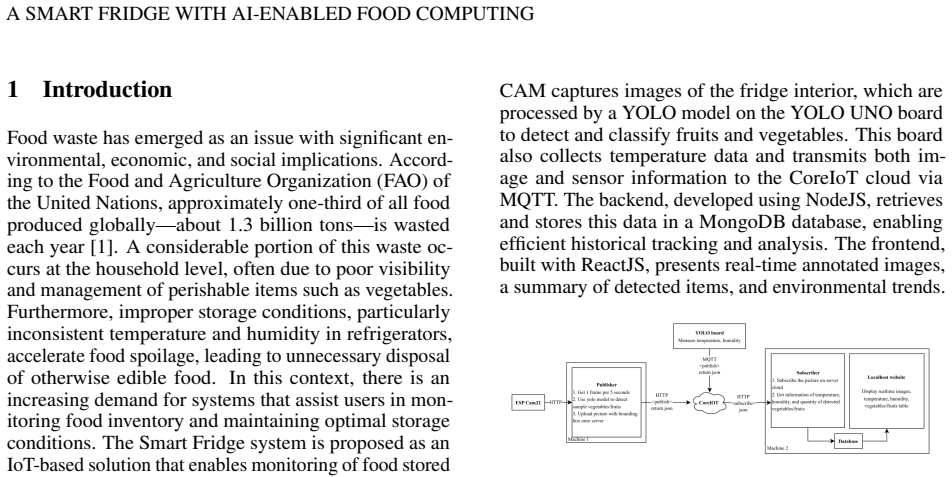
The authors report building a complete pipeline—ESP32-CAM image capture, YOLOv7 detection on a YOLO UNO board, MQTT publish-subscribe to the CoreIoT cloud, a NodeJS/MongoDB backend, and a ReactJS dashboard—that detects and counts vegetables and fruits in a refrigerator and charts temperature and humidity over time. Their stated technical contribution is a calibration-aware focal loss intended to correct overconfident predictions; the reliability diagram they present shows instead that CALFOCAL and ADAFOCAL are underconfident, while the BCE-trained model's confidence curve hugs the ideal diagonal. Taken on the paper's own terms, then, the system works end to end and reaches mAP@0.5 of 0.769 a
What carries the argument
The key mechanism is the reliability/calibration curve (predicted confidence versus actual accuracy) used to judge three loss objectives: CALFOCAL, a calibration-aware focal loss that down-weights easy examples through a focusing parameter; ADAFOCAL, an adaptive variant that adjusts the focusing parameter per class from validation error; and plain BCE, which scores each class independently. The curve's diagonal marks perfect calibration, so the distance from that line is the paper's yardstick for trustworthiness. The supporting hardware/software path—ESP32-CAM to YOLO UNO to MQTT broker to cloud, then to NodeJS/MongoDB and ReactJS—is what makes the comparison an end-to-end fridge monitoring
Load-bearing premise
The loss comparison collapses if the dataset was not split cleanly between training and testing; the paper does not say how big the dataset is, what classes it contains, or how the split was made.
What would settle it
Retrain the same YOLOv7 model on a fixed, publicly documented vegetable/fruit dataset with a seeded random split, using identical hyperparameters for BCE, CALFOCAL, and ADAFOCAL, and plot the reliability curves on the unseen test split; if BCE no longer lies closest to the diagonal, or if the focal variants move onto it, the paper's reported ordering fails.
If this is right
- A smart fridge can run on a low-cost ESP32-CAM plus a small YOLO board, giving households automatic per-minute inventory counts and remote web access.
- Combining object counts with temperature and humidity history enables alerts when storage conditions threaten food quality, supporting waste reduction.
- For food detection, BCE-trained confidence values should be preferred when users act on probability-based warnings, because BCE sits closest to the ideal calibration line.
- Focal-loss variants should not be presumed to improve calibration in this setting; their underconfidence means extra post-hoc calibration or tuning would be required.
- The mAP@0.5 of 0.769 after focal-loss training indicates the detector can handle common classes such as apples, water spinach, and purple sweet potato, though less-consistent classes like beetroot and spinach need more data.
Where Pith is reading between the lines
- The abstract credits the focal-loss variant with improving calibration, whereas the reliability curves and Section 5 say the focal variants are underconfident and BCE is best; the curves are the stronger evidence, so any citation of this paper for 'focal loss calibrates better' would misread it.
- Because no dataset size, class distribution, or train/validation/test split is reported, a controlled rerun on a public food dataset with a seeded split is the cheapest way to confirm whether BCE's calibration advantage is real or an artifact.
- Occluded and layered items are the stated hard case; counting accuracy would likely improve more from temporal aggregation across the per-minute frames than from swapping loss functions.
- A practical next step is to pair the best-calibrated BCE detector with post-hoc temperature scaling and uncertainty estimates, giving users explicit confidence levels on inventory counts and spoilage alerts.
Editorial analysis
A structured set of objections, weighed in public.
Referee Report
Summary. The paper presents an IoT smart-fridge system built around an ESP32-CAM, a YOLO-based detector running on a YOLO UNO board, MQTT/HTTP communication, MongoDB storage, and a web dashboard. The authors evaluate three loss functions for the detector: standard focal loss (referred to as CALFOCAL), adaptive focal loss (ADAFOCAL), and binary cross-entropy (BCE). The abstract claims that a focal-loss variant mitigates over-confidence and under-confidence and that robust functional calibration significantly improves detection reliability. However, Section 5 reports the opposite: CALFOCAL and ADAFOCAL are underconfident and BCE achieves better calibration. The manuscript lacks dataset size, class distribution, train/validation/test split, and key hyperparameters, and it provides only qualitative calibration curves without quantitative metrics.
Significance. If the reported comparative findings were properly supported, the observation that focal-loss variants can produce underconfident predictions while BCE calibrates better in a food-detection task would be a modest but potentially useful negative result for practitioners. The system-level integration (ESP32-CAM, YOLO UNO, MQTT, web dashboard, temperature/humidity logging) is a tangible engineering contribution. However, the central claimed calibration benefit of the focal-loss variant is unsupported by the paper's own results, and the missing dataset and training details prevent reproducibility. There are no machine-checked proofs or released code; the evidence is entirely empirical and under-reported.
major comments (4)
- [Abstract and Section 5] The abstract claims that 'we implement a variant of focal loss that mitigates over-confidence and under-confidence' and that 'robust functional calibration significantly improves detection reliability.' Section 5 states the opposite: 'CALFOCAL and ADAFOCAL demonstrate underconfidence... despite their design to handle class imbalance and calibration,' and 'BCE achieves better calibration.' This is a direct internal contradiction between the paper's stated contribution and its own reported results. The central claim of the paper is therefore not supported; the abstract and introduction must be rewritten to present the work as a comparative evaluation in which focal variants fail to improve calibration, or the method must be changed and re-evaluated.
- [Section 4.1] The dataset is described only as 'a combination of real images captured by the ESP32-CAM and additional images sourced from online repositories.' No size, class counts, train/validation/test split, annotation protocol, or augmentation details are given. Section 4.2 states that 50 epochs were used, but the optimizer, learning rate, batch size, image resolution, gamma in Eq. (1), lambda in Eq. (2), and any temperature-scaling parameters mentioned in the abstract are not reported. Without these details, the reported mAP@0.5=0.769 and the calibration curves are not reproducible and the comparison across loss functions cannot be assessed.
- [Abstract and Section 3] The abstract promises 'adaptive, class-wise error calibration via temperature scaling,' but no temperature scaling is defined or implemented in Sections 3–4. The name CALFOCAL is used but never defined; the only equations are standard focal loss (Eq. 1) and adaptive focal loss (Eq. 2). No new loss variant is introduced, despite the abstract's wording. A reader cannot tell what method is actually being evaluated or how 'calibration-aware' focal loss differs from standard focal loss.
- [Section 4.2 and Figures 9-10] Calibration is assessed only qualitatively through reliability diagrams. No Expected Calibration Error (ECE), Maximum Calibration Error (MCE), or confidence histogram is reported, and no error bars or multiple-seed runs appear anywhere. The statement that focal-loss models are 'severely underconfident' is therefore not quantitatively supported. Additionally, the text says the precision-recall curve is shown in Figure 9, but Figure 9 is the reliability/calibration curve; Figure 8 is the precision-recall curve.
minor comments (4)
- [Section 4.2] The claim that several classes reach 'over 0.450 average precision' is an oddly low threshold in light of the reported mAP@0.5=0.769. Clarify whether these are per-class AP values at IoU 0.5 and consider reporting a less trivial threshold.
- [Figures 6-7] Figures 6 and 7 ('Before applying focal loss' and 'After applying focal loss') are not called out in the text and appear in the related-work section; move them to Section 4.2 and reference them explicitly.
- [References] Reference [2] (joint computation offloading) appears unrelated to the smart-fridge topic; reference [4] is given as an arXiv PDF link rather than an abstract page. Please verify and format all references consistently.
- [Throughout] There are typos such as 'as show in Figure 9' and missing spaces in author names (e.g., 'andKhanh'). The capitalization of 'Focal Loss'/'focal loss' is inconsistent.
Circularity Check
No circularity: the paper empirically compares existing loss functions; its abstract/conclusion contradiction is a correctness issue, not a circular derivation.
full rationale
The paper does not contain a derivation that reduces to its own inputs. It implements three existing loss functions (focal loss, adaptive focal loss, and binary cross-entropy) and reports an empirical comparison of their calibration on a YOLO-based detector. The published equations are standard external definitions (Eqs. 1–2), and the references point to outside work rather than to the authors' own prior results. No fitted parameter is relabeled as a prediction, no uniqueness theorem is imported from self-citation, and no ansatz is smuggled in through an author-overlapping citation. The only serious defect is that the abstract's headline claim—that the implemented focal-loss variant mitigates over-confidence and under-confidence—is contradicted by the paper's own Section 5 and Figure 9, which state that CALFOCAL and ADAFOCAL demonstrate underconfidence and that BCE achieves better calibration. This is an internal inconsistency between the stated contribution and the reported results, not a circularity in the mathematical or empirical chain. Similarly, the underspecified dataset description in Section 4.1 undermines evaluation quality, but it does not make the argument circular. Therefore the circularity score is 0.
Axiom & Free-Parameter Ledger
free parameters (3)
- Focal loss focusing parameter gamma
- Adaptive focal loss coefficient lambda
- Temperature scaling parameter (mentioned in abstract)
axioms (3)
- domain assumption YOLO from Ultralytics is a valid object detector for this task
- domain assumption The training dataset is representative of real fridge conditions and properly split
- domain assumption All three loss models were trained under identical conditions except loss
invented entities (2)
-
CALFOCAL
no independent evidence
-
ADAFOCAL
no independent evidence
Cite this review
Pith. "Pith review of A smart fridge with AI-enabled food computing." pith.science (2026). https://pith.science/paper/GILRS75W
@misc{pith2026250907400,
  author       = {Pith},
  title        = {Pith review of: A smart fridge with AI-enabled food computing},
  year         = {2026},
  howpublished = {\url{https://pith.science/paper/GILRS75W}},
  note         = {Machine review of arXiv:2509.07400}
}
read the original abstract
The Internet of Things (IoT) plays a crucial role in enabling seamless connectivity and intelligent home automation, particularly in food management. By integrating IoT with computer vision, the smart fridge employs an ESP32-CAM to establish a monitoring subsystem that enhances food management efficiency through real-time food detection, inventory tracking, and temperature monitoring. This benefits waste reduction, grocery planning improvement, and household consumption optimization. In high-density inventory conditions, capturing partial or layered images complicates object detection, as overlapping items and occluded views hinder accurate identification and counting. Besides, varied angles and obscured details in multi-layered setups reduce algorithm reliability, often resulting in miscounts or misclassifications. Our proposed system is structured into three core modules: data pre-processing, object detection and management, and a web-based visualization. To address the challenge of poor model calibration caused by overconfident predictions, we implement a variant of focal loss that mitigates over-confidence and under-confidence in multi-category classification. This approach incorporates adaptive, class-wise error calibration via temperature scaling and evaluates the distribution of predicted probabilities across methods. Our results demonstrate that robust functional calibration significantly improves detection reliability under varying lighting conditions and scalability challenges. Further analysis demonstrates a practical, user-focused approach to modern food management, advancing sustainable living goals through reduced waste and more informed consumption.
Figures


Reference graph
Works this paper leans on
-
[1]
Global food losses and food waste
Jenny Gustavsson Christel Cederberg Ulf Sonesson and Robert van Otterdijk Alexan- dre Meybeck. Global food losses and food waste. Technical report, Food and Agricul- ture Organization of the United Nations, 2011. Retrieved from https://openknowledge. fao.org/server/api/core/bitstreams/ 10388b16-5f1a-45d0-b690-e89bb78d33bb/ content
work page 2011
-
[2]
Joint com- putation offloading, sfc placement, and resource al- location for multi-site mec systems
Phuong-Duy Nguyen and Long Bao Le. Joint com- putation offloading, sfc placement, and resource al- location for multi-site mec systems. In2020 IEEE Wireless Communications and Networking Confer- ence (WCNC), pages 1–6. IEEE, 2020
work page 2020
-
[3]
L. Tao, M. Dong, and C. Xu. Dual focal loss for calibration. InProceedings of the 40th Interna- tional Conference on Machine Learning (ICML), volume 202 ofProceedings of Machine Learning Research. PMLR, 2023. Retrieved from https: //arxiv.org/abs/2305.13665
work page internal anchor Pith review Pith/arXiv arXiv 2023
- [4]
-
[5]
Dr.A.Usha Ruby, Prasannavenkatesan Theerthagiri, Dr.I.Jeena Jacob, and Dr.Y .Vamsidhar. Binary cross entropy with deep learning technique for image classification.International Jour- nal of Advanced Trends in Computer Science and Engineering, 9(4), 2020. Retrieved from https://www.warse.org/IJATCSE/static/ pdf/file/ijatcse175942020.pdf
work page 2020
-
[6]
Yolov7: Trainable bag-of-freebies sets new state-of-the-art for real-time object detec- tors, 2022
Chien-Yao Wang, Alexey Bochkovskiy, and Hong- Yuan Mark Liao. Yolov7: Trainable bag-of-freebies sets new state-of-the-art for real-time object detec- tors, 2022. Retrieved from https://arxiv.org/ abs/2207.02696. 7
Pith/arXiv arXiv 2022
This paper was first reviewed by deepseek-v4-flash on August 4, 2026.
discussion (0)
Sign in with ORCID, Apple, or X to comment. Anyone can read and Pith papers without signing in.