REVIEW 3 major objections 6 minor 1 cited by
This paper claims that LLMs identify refactoring motivations that agree with human judgment in 80% of cases but align with literature-based motivations in only 47%, revealing a surface-level focus.
Reviewed by Pith at T0; open to challenge. T0 means a machine referee read the full paper against a public rubric. the ladder, T0–T4 →
LLM-generated refactoring motivations agree with expert raters about 80% of the time, align with literature motivations in roughly half of cases, and correlate only weakly with software metrics.
T0 review reviewed 2026-08-04 challenge →
load-bearing objection Useful empirical work on LLM-extracted refactoring motivations, but the headline percentages don't reconcile and the ground truth is experts, not developers. the 3 major comments →
What Were You Thinking? An LLM-Driven Large-Scale Study of Refactoring Motivations in Open-Source Projects
The pith
A machine-rendered reading of the paper's core claim, the machinery that carries it, and where it could break.
The reading
Core claim
The paper's central discovery is a measured asymmetry: given the refactoring type, its machine-generated description, commit message, and diff, LLMs and human experts agree on the motivation roughly four times out of five (156/198; Cohen's kappa = 0.567), yet only about 47% of LLM motivations match the catalogue of developer-reported motivations from the reference study. A Bowker symmetry test shows the disagreements are not random: humans invoke architectural and strategic considerations, while LLMs lean on local syntax and immediate readability. The LLMs also extended 22% of aligned motivations with new detail and produced entirely novel motivations in 25% of cases, and over 55% of open-co
What carries the argument
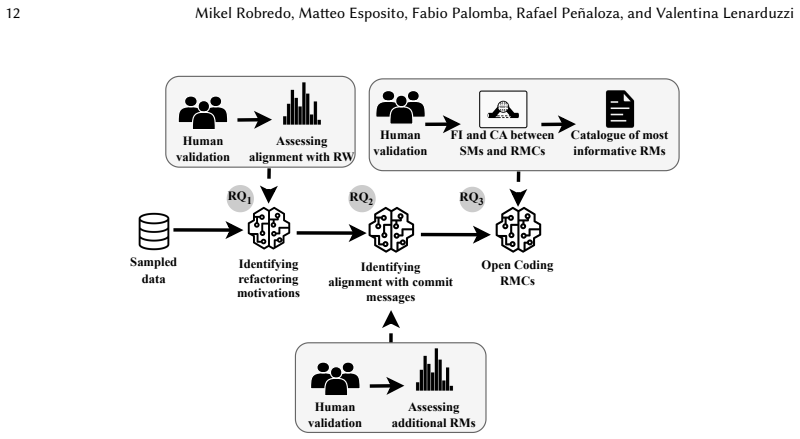
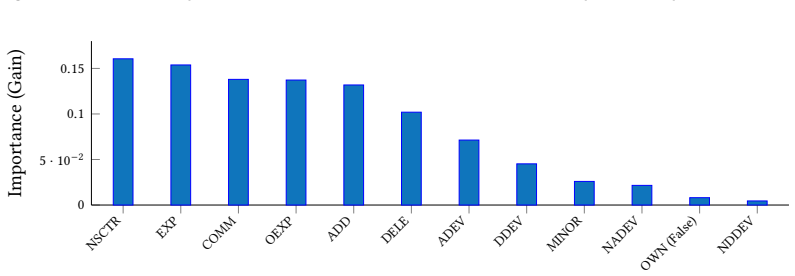
The analytical engine is a four-model LLM pipeline: Marco-o1 ('LRM') proposes the motivation; Mistral NeMo, DeepSeek R1, and Microsoft Phi-4 validate it in sequence, with Phi-4 as arbiter; three human experts validate a statistically significant subset (198 pairs) by majority vote. Motivations were extracted with zero-shot chain-of-thought prompting over refactoring type, RefactoringMiner description, commit message, and diff; then open-coded into 14 categories. Metric influence was assessed with Random Forest (MDA, MDG) and XGBoost (information gain), and correlations with Spearman's rho and Kendall's tau under Bonferroni and Benjamini-Hochberg corrections.
Load-bearing premise
The study's results stand on the assumption that three human experts, given only the refactoring type, tool description, commit message, and diff, can recover the original developer's true motivation, and that their majority vote is valid ground truth for judging the LLM.
What would settle it
Ask the developers who performed a random sample of the 385 refactorings to state their actual motivation, then compare those self-reports with both the LLM's motivation and the experts' labels; if self-reports align with LLM output more than with expert inference, or if expert labels do not match developer self-reports, the 80% agreement and the 'struggles with architectural reasoning' conclusion would measure expert inference rather than true developer motivation.
If this is right
- LLM-derived motivations should be treated as partial, localized explanations, not ground truth; recommendation systems that use them alone will inherit the systematic disagreement with holistic human judgment.
- Metric-only refactoring recommendation is not viable: after correction only 17 of 574 metric-motivation correlations are significant, all weak, so metrics need LLM or other semantic context.
- Hybrid systems that feed metrics as context into LLM reasoning are the indicated direction the paper argues for.
- Because most motivations (over 55%) are pragmatic clarity/simplification goals, refactoring tools should prioritize short-term readability and redundancy reduction over abstract design principles.
- LLMs can enrich documented motivations (22% of cases) with explicit rationale—readability, testability, naming—useful for documentation, onboarding, and code review.
Where Pith is reading between the lines
- Editorial inference: the 20% LLM-human gap may shrink if prompts include project-level context (issue tracker links, architectural diagrams, historical design decisions); this is testable by an A/B study with enriched prompts on the same 385 observations.
- Editorial inference: the 47% alignment with the literature may be as much a verdict on the reference catalogue as on LLMs; the 25% novel motivations suggest the 2016 catalogue misses motives that now dominate open-source practice.
- Editorial inference: because the expert labels are themselves inferences from limited data, the 80% agreement is an upper bound on true motivation recovery; a developer self-report study on the same commits would calibrate both LLM and expert accuracy.
- Editorial inference: the weak metric correlations suggest current product/process metrics measure change activity rather than intent; new indicators capturing semantic diff intent or naming-quality deltas might correlate more strongly.
Editorial analysis
A structured set of objections, weighed in public.
Referee Report
Summary. The paper presents a large-scale empirical study of refactoring motivations in 114 open-source Java projects, using four LLMs (Marco-o1, Mistral NeMo, DeepSeek R1, and Phi-4) to infer motivations from refactoring commits identified with RefactoringMiner. The authors sample 385 refactorings, validate LLM outputs with three human experts, compare LLM-derived motivations against the developer-reported motivations of Silva et al. (2016), and open-code the LLM-derived motivations into 14 categories. They then train Random Forest and XGBoost models and compute Spearman/Kendall correlations to assess which product and process metrics are associated with the resulting motivation categories. The headline findings are that LLMs agree with human raters in ~80% of cases, that only 47% of LLM motivations align with literature-based motivations, that 22% of motivations are enriched, and that metric–motivation correlations are statistically weak. The paper concludes that LLMs capture surface-level motivations but struggle with architectural reasoning, and advocates hybrid LLM-plus-metric systems.
Significance. If the central results were internally consistent, the paper would make a useful contribution to empirical software engineering: it extends a well-known dataset (Silva et al.), introduces a reproducible LLM-based pipeline for refactoring-motivation mining, and offers a large catalogue of motivation categories and metric-importance rankings. The availability of a replication package, the use of multiple LLMs with explicit roles, and the human validation protocol are concrete strengths. However, the central quantitative claims are not consistently derivable from the paper's own tables, and the RQ3 analysis is based on LLM-generated motivation labels rather than externally verified developer intent. These issues affect the main contributions as stated, so the results should not be accepted in their current form.
major comments (3)
- [Abstract; §3.1–§3.2; Tables 8 and 9] The central alignment percentages are mutually inconsistent. The abstract and the RQ1 result box state that only 47% of LLM-generated RMs aligned with the reference study. However, §3.1 states that 'Based on human annotations, 97 out of 198 RMs (approximately 49%) aligned with those reported in the reference study,' and Table 8 gives the Yes–Yes cell as 97 (48.99%). Section 3.2 and Table 9 report 105 direct matches (53.03%), 44 extensions (22.22%), and 49 non-matches (24.74%). The abstract's 47% is the complement of the Table 9 'Yes' percentage (44+49=93, 93/198=47%), which is not an alignment rate. Since the paper's conclusion that LLMs are 'surface-level' is calibrated to these numbers, the counts must be reconciled and the abstract and result boxes corrected before the claims can be evaluated.
- [§2.4.3; §3.3.1–§3.3.3] RQ3 is conducted on motivation categories obtained by open-coding the LLM-generated RMs. The 14 RMCs are therefore derived from the same LLM outputs whose validity RQ1/RQ2 only partially establish. The feature-importance and correlation analyses in §3.3.2 and §3.3.3 consequently describe relationships between software metrics and LLM labels, not between metrics and independently verified developer motivations. Human validation of the open coding does not remove this circularity, since the category definitions themselves were produced by the LLMs. The paper should either re-run RQ3 with human-coded or developer-reported motivations as the dependent variable, or explicitly reframe RQ3 and the discussion as an analysis of LLM-perceived motivations rather than actual developer intentions.
- [§2.4.1; §3.1] The 80% agreement and the subsequent qualitative conclusions about LLMs 'struggling with architectural reasoning' rest on agreement between LLMs and three expert raters, not between LLMs and the original developers. The expert raters saw only the RT, RMT description, commit message, and diff, which are exactly the localized cues the paper later argues are insufficient for architectural intent. The dataset used as reference contains the original developers' own written motivations, so a direct LLM-to-developer comparison is possible (or, at minimum, an expert-rater reliability check against the developer statements) and should be reported. Without this, the claim that LLMs miss 'strategic rationales' is an interpretation of expert disagreement rather than a measured property of developer intent.
minor comments (6)
- [§3.1, Table 7] The text refers to 'MC (13.64%)' but Table 7 lists 'MovC'; please use consistent abbreviation and define it.
- [Table 4] The RFC metric description contains the placeholder '[citeme]'.
- [Appendix A.1] Typo: 'checksytle/checkstyle' should be 'checkstyle/checkstyle'.
- [§3.1] 156/198 = 78.8%, which is reasonably described as 'approximately 80%' in prose, but the abstract and result boxes present '80%' without the approximation; consider stating the exact fraction.
- [§2.4.3] The notation 'H01,02' appears malformed; it should likely read 'H0C' or a similarly defined hypothesis label.
- [§3.3.1, Figure 5] The legend for 'unique motivation instances' is unclear: it is not obvious whether grey bars count unique strings, unique subcategories, or something else. Please clarify in the caption.
Circularity Check
No significant circularity: central claims are anchored to the external Silva et al. dataset and independent human validation; the RQ3 reliance on LLM-generated categories is a disclosed construct-validity limitation rather than a circular derivation.
full rationale
The paper's central chain—LLM-generated refactoring motivations compared against the externally published Silva et al. motivations with three human experts validating a statistically sampled subset—is not circular. The '80% human agreement' and '47%/53%/49% literature alignment' numbers come from contingency tables and human ratings, even though several percentages are internally inconsistent (a correctness/reporting concern, not a circularity concern). RQ3 uses the LLM-generated and human-validated motivation categories as the dependent variable for feature importance and correlation analysis; this means the metric rankings describe those categories rather than independently verified developer intent. However, the paper does not define the metrics in terms of the motivations, nor does it fit a parameter to a subset and then predict a mathematically forced quantity. The open-coding taxonomy is derived from LLM outputs with human validation on a sample, and the paper explicitly acknowledges in Section 5 (Construct Validity) that assuming LLM feedback is correct is a threat. No load-bearing step reduces to a self-citation: the reference study [65] and the metric-selection works [29,54] are external to the authors, and the authors' own prior works cited are not used as evidence for the central empirical claims. No uniqueness theorem, no ansatz smuggled via citation, and no renaming of a known result as a new derivation are present. The main weaknesses are reporting inconsistencies in the percentage claims and the construct-validity caveat on RQ3, neither of which amounts to circular reasoning by the paper's own construction.
Axiom & Free-Parameter Ledger
free parameters (1)
- LLM temperature =
0.8 (fixed)
axioms (5)
- domain assumption Commit messages and code diffs provide sufficient signal to infer genuine developer motivation.
- domain assumption Silva et al. developer-reported motivations are a valid reference ground truth.
- domain assumption Human expert raters can reliably reconstruct developers' motivations from the same commit context.
- domain assumption RefactoringMiner correctly identifies refactorings.
- domain assumption The sampled 385 refactorings represent the 13,725,139 mined refactorings.
invented entities (1)
-
14-category refactoring motivation taxonomy (RMC)
no independent evidence
Cite this review
Pith. "Pith review of What Were You Thinking? An LLM-Driven Large-Scale Study of Refactoring Motivations in Open-Source Projects." pith.science (2026). https://pith.science/paper/GFQRV3Y2
@misc{pith2026250907763,
  author       = {Pith},
  title        = {Pith review of: What Were You Thinking? An LLM-Driven Large-Scale Study of Refactoring Motivations in Open-Source Projects},
  year         = {2026},
  howpublished = {\url{https://pith.science/paper/GFQRV3Y2}},
  note         = {Machine review of arXiv:2509.07763}
}
read the original abstract
Context. Code refactoring improves software quality without changing external behavior. Despite its advantages, its benefits are hindered by the considerable cost of time, resources, and continuous effort it demands. Aim. Understanding why developers refactor, and which metrics capture these motivations, may support wider and more effective use of refactoring in practice. Method. We performed a large-scale empirical study to analyze developers refactoring activity, leveraging Large Language Models (LLMs) to identify underlying motivations from version control data, comparing our findings with previous motivations reported in the literature. Results. LLMs matched human judgment in 80% of cases, but aligned with literature-based motivations in only 47%. They enriched 22% of motivations with more detailed rationale, often highlighting readability, clarity, and structural improvements. Most motivations were pragmatic, focused on simplification and maintainability. While metrics related to developer experience and code readability ranked highest, their correlation with motivation categories was weak. Conclusions. We conclude that LLMs effectively capture surface-level motivations but struggle with architectural reasoning. Their value lies in providing localized explanations, which, when combined with software metrics, can form hybrid approaches. Such integration offers a promising path toward prioritizing refactoring more systematically and balancing short-term improvements with long-term architectural goals.
Figures






Forward citations
Cited by 1 Pith paper
-
Identifying unique developers in OSS projects: A family of models
Creates a ground-truth dataset via LLM-assisted matching and benchmarks classical ML models against an Indel baseline for identifying duplicate developer identities in OSS commit data.
Reference graph
Works this paper leans on
-
[1]
Marah Abdin, Jyoti Aneja, Harkirat Behl, Sébastien Bubeck, Ronen Eldan, Suriya Gunasekar, Michael Harrison, Russell J Hewett, Mojan Javaheripi, Piero Kauffmann, et al. 2024. Phi-4 technical report.arXiv preprint arXiv:2412.08905(2024)
Pith/arXiv arXiv 2024
-
[2]
Pouria Alikhanifard and Nikolaos Tsantalis. 2025. A Novel Refactoring and Semantic Aware Abstract Syntax Tree Differencing Tool and a Benchmark for Evaluating the Accuracy of Diff Tools.ACM Transactions on Software Engineering and Methodology34, 2, Article 40 (Jan. 2025), 63 pages. https://doi.org/10.1145/3696002
doi:10.1145/3696002 2025
-
[3]
Vahid Alizadeh, Marouane Kessentini, Mohamed Wiem Mkaouer, Mel Ó Cinnéide, Ali Ouni, and Yuanfang Cai. 2018. An interactive and dynamic search-based approach to software refactoring recommendations.IEEE Transactions on Software Engineering46, 9 (2018), 932–961
2018
-
[4]
goodness of fit
Theodore W Anderson and Donald A Darling. 1952. Asymptotic theory of certain" goodness of fit" criteria based on stochastic processes.The annals of mathematical statistics(1952), 193–212
1952
-
[5]
2015.Java code metrics calculator (CK)
Maurício Aniche. 2015.Java code metrics calculator (CK). Available in https://github.com/mauricioaniche/ck/
2015
-
[6]
Paris C Avgeriou, Davide Taibi, Apostolos Ampatzoglou, Francesca Arcelli Fontana, Terese Besker, Alexander Chatzi- georgiou, Valentina Lenarduzzi, Antonio Martini, Athanasia Moschou, Ilaria Pigazzini, et al. 2020. An overview and comparison of technical debt measurement tools.Ieee software38, 3 (2020), 61–71
2020
-
[7]
Yoav Benjamini and Yosef Hochberg. 1995. Controlling the false discovery rate: a practical and powerful approach to multiple testing.Journal of the Royal statistical society: series B (Methodological)57, 1 (1995), 289–300
1995
-
[8]
2013.Convergence of probability measures
Patrick Billingsley. 2013.Convergence of probability measures. John Wiley & Sons
work page 2013
-
[9]
Albert H Bowker. 1948. A test for symmetry in contingency tables.Journal of the american statistical association43, 244 (1948), 572–574
work page 1948
-
[10]
L. Breiman. 2001. Random forests.Machine learning45, 1 (2001), 5–32
work page 2001
-
[11]
Tianqi Chen and Carlos Guestrin. 2016. XGBoost: A Scalable Tree Boosting System.Proceedings of the 22nd ACM SIGKDD International Conference on Knowledge Discovery and Data Mining - KDD ’16, 785–794. https://doi.org/10.114 5/2939672.2939785
arXiv 2016
-
[12]
Jacob Cohen. 1960. A coefficient of agreement for nominal scales.Educational and psychological measurement20, 1 (1960), 37–46
1960
-
[13]
Cyril Dalmasso, Philippe Broet, and Thierry Moreau. 2005. A simple procedure for estimating the false discovery rate. Bioinformatics21, 5 (2005), 660–668
work page 2005
-
[14]
2007.Statistics without maths for psychology
CP Dancey. 2007.Statistics without maths for psychology. Prentice Hall
work page 2007
-
[15]
Joshua Davis, Liesbet Van Bulck, Brigitte N Durieux, and Charlotta Lindvall. 2024. The temperature feature of ChatGPT: modifying creativity for clinical research.JMIR human factors11, 1 (2024), e53559
work page 2024
-
[16]
Kalyanmoy Deb, Amrit Pratap, Sameer Agarwal, and TAMT Meyarivan. 2002. A fast and elitist multiobjective genetic algorithm: NSGA-II.IEEE transactions on evolutionary computation6, 2 (2002), 182–197
2002
-
[17]
Matteo Esposito and Davide Falessi. 2023. Uncovering the Hidden Risks: The Importance of Predicting Bugginess in Untouched Methods. In2023 IEEE 23rd International Working Conference on Source Code Analysis and Manipulation (SCAM). IEEE, 277–282
work page 2023
-
[18]
Matteo Esposito, Xiaozhou Li, Sergio Moreschini, Noman Ahmad, Tomas Cerny, Karthik Vaidhyanathan, Valentina Lenarduzzi, and Davide Taibi. 2025. Generative AI for Software Architecture. Applications, Trends, Challenges, and Future Directions.arXiv preprint arXiv:2503.13310(2025)
Pith/arXiv arXiv 2025
-
[19]
Matteo Esposito, Francesco Palagiano, Valentina Lenarduzzi, and Davide Taibi. 2024. Beyond Words: On Large Language Models Actionability in Mission-Critical Risk Analysis. InInternational Symposium on Empirical Software Engineering and Measurement, ESEM 2024, Xavier Franch, Maya Daneva, Silverio Martínez-Fernández, and Luigi Quaranta (Eds.). 517–527
work page 2024
-
[20]
Matteo Esposito, Francesco Palagiano, Valentina Lenarduzzi, and Davide Taibi. 2024. On Large Language Models in Mission-Critical IT Governance: Are We Ready Yet?ICSE-SEIP ’25(2024)
work page 2024
-
[21]
Matteo Esposito, Mikel Robredo, Murali Sridharan, Guilherme Horta Travassos, Rafael Peñaloza, and Valentina Lenarduzzi. 2025. A Call for Critically Rethinking and Reforming Data Analysis in Empirical Software Engineering. arXiv preprint arXiv:2501.12728(2025)
work page internal anchor Pith review Pith/arXiv arXiv 2025
-
[22]
Davide Falessi, Simone Mesiano Laureani, Jonida Çarka, Matteo Esposito, and Daniel Alencar da Costa. 2023. Enhancing the defectiveness prediction of methods and classes via JIT.Empirical Software Engineering28, 2 (2023), 37
work page 2023
-
[23]
Joseph L Fleiss. 1971. Measuring nominal scale agreement among many raters.Psychological bulletin76, 5 (1971), 378
work page 1971
-
[24]
1999.Refactoring: Improving the Design of Existing Code
Martin Fowler. 1999.Refactoring: Improving the Design of Existing Code. Addison-Wesley Professional. ACM Trans. Softw. Eng. Methodol., Vol. 1, No. 1, Article . Publication date: September 2025. 36 Mikel Robredo, Matteo Esposito, Fabio Palomba, Rafael Peñaloza, and Valentina Lenarduzzi
work page 1999
-
[25]
Felix Grund, Shaiful Alam Chowdhury, Nick C Bradley, Braxton Hall, and Reid Holmes. 2021. CodeShovel: Constructing method-level source code histories. InInternational Conference on Software Engineering (ICSE). IEEE, 1510–1522
work page 2021
-
[26]
Hong Han, Xiaoling Guo, and Hua Yu. 2016. Variable selection using mean decrease accuracy and mean decrease gini based on random forest. InInternational conference on software engineering and service science (icsess). IEEE, 219–224
work page 2016
-
[27]
Sture Holm. 1979. A simple sequentially rejective multiple test procedure.Scandinavian journal of statistics(1979), 65–70
work page 1979
-
[28]
Yanjie Jiang, Xiaye Chi, Yuxia Zhang, Weixing Ji, Guangjie Li, Weixiao Wang, Yunni Xia, Lu Zhang, and Hui Liu. 2025. Automated Recommendation of Extracting Local Variable Refactorings.ACM Transactions on Software Engineering and Methodology(2025)
work page 2025
-
[29]
Yasutaka Kamei, Emad Shihab, Bram Adams, Ahmed E Hassan, Audris Mockus, Anand Sinha, and Naoyasu Ubayashi
-
[30]
Satnam Kaur, Lalit K Awasthi, and AL Sangal. 2021. A brief review on multi-objective software refactoring and a new method for its recommendation.Archives of Computational Methods in Engineering28 (2021), 3087–3111
work page 2021
-
[31]
Marouane Kessentini and Ali Ouni. 2017. Detecting android smells using multi-objective genetic programming. In 2017 IEEE/ACM 4th International Conference on Mobile Software Engineering and Systems (MOBILESoft). IEEE, 122–132
work page 2017
-
[32]
Dae-Kyoo Kim. 2025. Comparative analysis of design pattern implementation validity in LLM-based code refactoring. Journal of Systems and Software230 (2025), 112519
work page 2025
-
[33]
Miryung Kim, Thomas Zimmermann, and Nachiappan Nagappan. 2012. A field study of refactoring challenges and benefits. InProceedings of the ACM SIGSOFT 20th International Symposium on the Foundations of Software Engineering. 1–11
work page 2012
-
[34]
Takeshi Kojima, Shixiang Shane Gu, Machel Reid, Yutaka Matsuo, and Yusuke Iwasawa. 2022. Large language models are zero-shot reasoners.Advances in neural information processing systems35 (2022), 22199–22213
2022
-
[35]
Zarina Kurbatova, Ivan Veselov, Yaroslav Golubev, and Timofey Bryksin. 2020. Recommendation of move method refactoring using path-based representation of code. InProceedings of the IEEE/ACM 42nd International Conference on Software Engineering Workshops. 315–322
work page 2020
-
[36]
Guilherme Lacerda, Fabio Petrillo, Marcelo Pimenta, and Yann Gaël Guéhéneuc. 2020. Code smells and refactoring: A tertiary systematic review of challenges and observations.Journal of Systems and Software167 (2020), 110610
work page 2020
-
[37]
J Richard Landis and Gary G Koch. 1977. The measurement of observer agreement for categorical data.Biometrics (1977), 159–174
work page 1977
-
[38]
Valentina Lenarduzzi, Terese Besker, Davide Taibi, Antonio Martini, and Francesca Arcelli Fontana. 2021. A systematic literature review on technical debt prioritization: Strategies, processes, factors, and tools.Journal of Systems and Software171 (2021), 110827
2021
-
[39]
Valentina Lenarduzzi, Fabiano Pecorelli, Nyyti Saarimaki, Savanna Lujan, and Fabio Palomba. 2023. A critical comparison on six static analysis tools: Detection, agreement, and precision.Journal of Systems and Software198 (2023), 111575
work page 2023
-
[40]
Bo Liu, Yanjie Jiang, Yuxia Zhang, Nan Niu, Guangjie Li, and Hui Liu. 2025. Exploring the potential of general purpose LLMs in automated software refactoring: an empirical study.Automated Software Engineering32, 1 (2025), 26
work page 2025
-
[41]
Quinn McNemar. 1947. Note on the sampling error of the difference between correlated proportions or percentages. Psychometrika12, 2 (1947), 153–157
work page 1947
-
[42]
Prabhaker Mishra, Chandra M Pandey, Uttam Singh, Anshul Gupta, Chinmoy Sahu, and Amit Keshri. 2019. Descriptive statistics and normality tests for statistical data.Annals of cardiac anaesthesia22, 1 (2019), 67–72
work page 2019
-
[43]
Mistral AI team Mistral AI. 2023. Mistral 7B. https://mistral.ai/news/announcing-mistral-7b
work page 2023
-
[44]
Mistral AI team Mistral AI. 2024. Mistral Nemo. https://mistral.ai/news/mistral-nemo
work page 2024
-
[45]
Kristin K Nicodemus. 2011. On the stability and ranking of predictors from random forest variable importance measures. Briefings in bioinformatics12, 4 (2011), 369–373
work page 2011
-
[46]
Ally S Nyamawe, Hui Liu, Zhendong Niu, Wentao Wang, and Nan Niu. 2018. Recommending refactoring solutions based on traceability and code metrics.IEEE Access6 (2018), 49460–49475
work page 2018
-
[47]
OpenAI. 2025. openai — pypi.org. https://pypi.org/project/openai/. [Accessed 28-04-2025]
work page 2025
-
[48]
Fabio Palomba, Andy Zaidman, Rocco Oliveto, and Andrea De Lucia. 2017. An exploratory study on the relationship between changes and refactoring. In2017 IEEE/ACM 25th International Conference on Program Comprehension (ICPC). IEEE, 176–185
work page 2017
-
[49]
Jevgenija Pantiuchina, Fiorella Zampetti, Simone Scalabrino, Valentina Piantadosi, Rocco Oliveto, Gabriele Bavota, and Massimiliano Di Penta. 2020. Why developers refactor source code: A mining-based study.ACM Transactions on Software Engineering and Methodology (TOSEM)29, 4 (2020), 1–30
work page 2020
-
[50]
Anthony Peruma, Steven Simmons, Eman Abdullah AlOmar, Christian D Newman, Mohamed Wiem Mkaouer, and Ali Ouni. 2022. How do i refactor this? An empirical study on refactoring trends and topics in Stack Overflow.Empirical ACM Trans. Softw. Eng. Methodol., Vol. 1, No. 1, Article . Publication date: September 2025. What Were You Thinking? An LLM-Driven Large-...
work page 2022
-
[51]
Dorin Pomian, Abhiram Bellur, Malinda Dilhara, Zarina Kurbatova, Egor Bogomolov, Timofey Bryksin, and Danny Dig. 2024. Next-generation refactoring: Combining llm insights and ide capabilities for extract method. InInternational Conference on Software Maintenance and Evolution (ICSME). IEEE, 275–287
work page 2024
-
[52]
Dorin Pomian, Abhiram Bellur, Malinda Dilhara, Zarina Kurbatova, Egor Bogomolov, Andrey Sokolov, Timofey Bryksin, and Danny Dig. 2024. Em-assist: Safe automated extractmethod refactoring with llms. InCompanion Proceedings of the 32nd ACM International Conference on the Foundations of Software Engineering. 582–586
work page 2024
-
[53]
Farhad Pourpanah, Moloud Abdar, Yuxuan Luo, Xinlei Zhou, Ran Wang, Chee Peng Lim, Xi-Zhao Wang, and QM Jonathan Wu. 2022. A review of generalized zero-shot learning methods.IEEE transactions on pattern analysis and machine intelligence45, 4 (2022), 4051–4070
2022
-
[54]
Foyzur Rahman and Premkumar Devanbu. 2013. How, and why, process metrics are better. InInternational Conference on Software Engineering. IEEE Press, 432–441
work page 2013
-
[55]
Mohammad Masudur Rahman and Chanchal K Roy. 2014. An insight into the pull requests of github. InProceedings of the 11th working conference on mining software repositories. 364–367
work page 2014
-
[56]
Gopi Krishnan Rajbahadur, Shaowei Wang, Gustavo A Oliva, Yasutaka Kamei, and Ahmed E Hassan. 2021. The impact of feature importance methods on the interpretation of defect classifiers.IEEE Transactions on Software Engineering48, 7 (2021), 2245–2261
work page 2021
-
[57]
Mikel Robredo, Nyyti Saarimäki, Matteo Esposito, Davide Taibi, Rafael Peñaloza, and Valentina Lenarduzzi. 2025. Evaluating time-dependent methods and seasonal effects in code technical debt prediction.Journal of Systems and Software(2025), 112545
work page 2025
-
[58]
2011.Encyclopedia of machine learning
Claude Sammut and Geoffrey I Webb. 2011.Encyclopedia of machine learning. Springer Science & Business Media
work page 2011
-
[59]
Margarete Sandelowski. 1995. Sample size in qualitative research.Research in nursing & health18, 2 (1995), 179–183
work page 1995
-
[60]
Simone Scalabrino, Mario Linares-Vásquez, Rocco Oliveto, and Denys Poshyvanyk. 2018. A comprehensive model for code readability.Journal of Software: Evolution and Process30, 6 (2018), e1958
2018
-
[61]
Agnia Sergeyuk, Yaroslav Golubev, Timofey Bryksin, and Iftekhar Ahmed. 2024. Using AI-Based Coding Assistants in Practice: State of Affairs.Perceptions, and Ways Forward10 (2024)
work page 2024
-
[62]
Samuel Sanford Shapiro and Martin B Wilk. 1965. An analysis of variance test for normality (complete samples). Biometrika52, 3/4 (1965), 591–611
work page 1965
-
[63]
Atsushi Shirafuji, Yusuke Oda, Jun Suzuki, Makoto Morishita, and Yutaka Watanobe. 2023. Refactoring programs using large language models with few-shot examples. In2023 30th Asia-Pacific Software Engineering Conference (APSEC). IEEE, 151–160
work page 2023
-
[64]
Danilo Silva, João Silva, Gustavo Jansen De Souza Santos, Ricardo Terra, and Marco Tulio O Valente. 2020. RefDiff 2.0: A Multi-language Refactoring Detection Tool.IEEE Transactions on Software Engineering(2020)
work page 2020
-
[65]
Danilo Silva, Nikolaos Tsantalis, and Marco Túlio Valente. 2016. Why we refactor? confessions of GitHub contributors. InInternational Symposium on Foundations of Software Engineering, FSE, Thomas Zimmermann, Jane Cleland-Huang, and Zhendong Su (Eds.). ACM, 858–870
work page 2016
-
[66]
Minjun Son, Yun-Jae Won, and Sungjin Lee. 2025. Optimizing Large Language Models: A Deep Dive into Effective Prompt Engineering Techniques.Applied Sciences (2076-3417)15, 3 (2025)
work page 2025
-
[67]
Charles Spearman. 1961. The proof and measurement of association between two things.The American Journal of Psychology(1961)
work page 1961
-
[68]
M. A. Stephens. 1974. EDF Statistics for Goodness of Fit and Some Comparisons.J. Amer. Statist. Assoc.69, 347 (1974), 730–737
work page 1974
-
[69]
Tom Stuart. 2013.Understanding Computation: From Simple Machines to Impossible Programs. " O’Reilly Media, Inc. "
work page 2013
-
[70]
Gábor Szoke, Gábor Antal, Csaba Nagy, Rudolf Ferenc, and Tibor Gyimóthy. 2014. Bulk fixing coding issues and its effects on software quality: Is it worth refactoring?. In2014 IEEE 14th International Working Conference on Source Code Analysis and Manipulation. IEEE, 95–104
work page 2014
-
[71]
Gábor Szőke, Csaba Nagy, Rudolf Ferenc, and Tibor Gyimóthy. 2014. A case study of refactoring large-scale industrial systems to efficiently improve source code quality. InComputational Science and Its Applications–ICCSA 2014: 14th International Conference, Guimarães, Portugal, June 30–July 3, 2014, Proceedings, Part V 14. Springer, 524–540
work page 2014
-
[72]
Nikolaos Tsantalis, Victor Guana, Eleni Stroulia, and Abram Hindle. 2013. A multidimensional empirical study on refactoring activity.. InCASCON. 132–146
work page 2013
-
[73]
Jeffrey S Vitter. 1985. Random sampling with a reservoir.ACM Transactions on Mathematical Software (TOMS)11, 1 (1985), 37–57
work page 1985
-
[74]
Jason Wei, Xuezhi Wang, Dale Schuurmans, Maarten Bosma, Fei Xia, Ed Chi, Quoc V Le, Denny Zhou, et al . 2022. Chain-of-thought prompting elicits reasoning in large language models.Advances in neural information processing systems35 (2022), 24824–24837. ACM Trans. Softw. Eng. Methodol., Vol. 1, No. 1, Article . Publication date: September 2025. 38 Mikel Ro...
work page 2022
-
[75]
Claes Wohlin, Per Runeson, Martin Höst, Magnus C. Ohlsson, and Björn Regnell. 2012.Experimentation in Software Engineering. Springer
work page 2012
-
[76]
S Paul Wright. 1992. Adjusted p-values for simultaneous inference.Biometrics(1992), 1005–1013
work page 1992
-
[77]
Xiaohan Xu, Ming Li, Chongyang Tao, Tao Shen, Reynold Cheng, Jinyang Li, Can Xu, Dacheng Tao, and Tianyi Zhou
-
[78]
Yue Yu, Huaimin Wang, Gang Yin, and Charles X Ling. 2014. Reviewer recommender of pull-requests in GitHub. In 2014 IEEE International Conference on Software Maintenance and Evolution. IEEE, 609–612
work page 2014
-
[79]
Yue Yu, Huaimin Wang, Gang Yin, and Tao Wang. 2016. Reviewer recommendation for pull-requests in GitHub: What can we learn from code review and bug assignment?Information and Software Technology74 (2016), 204–218
work page 2016
-
[80]
Yang Zhang, Yanlei Li, Grant Meredith, Kun Zheng, and Xiaobin Li. 2025. Move method refactoring recommendation based on deep learning and LLM-generated information.Information Sciences697 (2025), 121753
work page 2025
This paper was first reviewed by deepseek-v4-flash on August 4, 2026.
discussion (0)
Sign in with ORCID, Apple, or X to comment. Anyone can read and Pith papers without signing in.