REVIEW 4 major objections 5 minor 18 references
An LLM-guided feedback loop can design quantum circuit Born machine ansätze that are much shallower and more noise-robust than a standard deep baseline, demonstrated on a 12-qubit financial modeling task.
Reviewed by Pith at T0; open to challenge. T0 means a machine referee read the full paper against a public rubric. the ladder, T0–T4 →
T0 review · deepseek-v4-flash
2026-08-04 20:39 UTC pith:OQ47O65Q
load-bearing objection Real hardware numbers, real confound: the LLM ansatz wins only without post-selection and only against a much deeper baseline, so the paper's central attribution is not yet established. the 4 major comments →
LLM-Guided Ans\"atze Design for Quantum Circuit Born Machines in Financial Generative Modeling
The pith
A machine-rendered reading of the paper's core claim, the machinery that carries it, and where it could break.
Core claim
On the paper's own terms, the discovery is that conditioning ansatz search on hardware topology, qubit connectivity, basis gates, and gate error rates—and refining proposals with measured reverse KL divergence, depth, and validity—lets a language model find QCBM circuits that survive real-device noise better than a standard deep template. The supporting result is a 12-qubit experiment on Japanese government bond interest-rate changes in which the LLM-generated depth-28 ansatz reaches hardware KL divergence 7.37 without error mitigation and 6.91 with it, compared with 9.32 and 8.92 for the depth-85 TwoLocal baseline. On a noiseless simulator the gap reverses slightly (3.67 vs 3.10), so the pa
What carries the argument
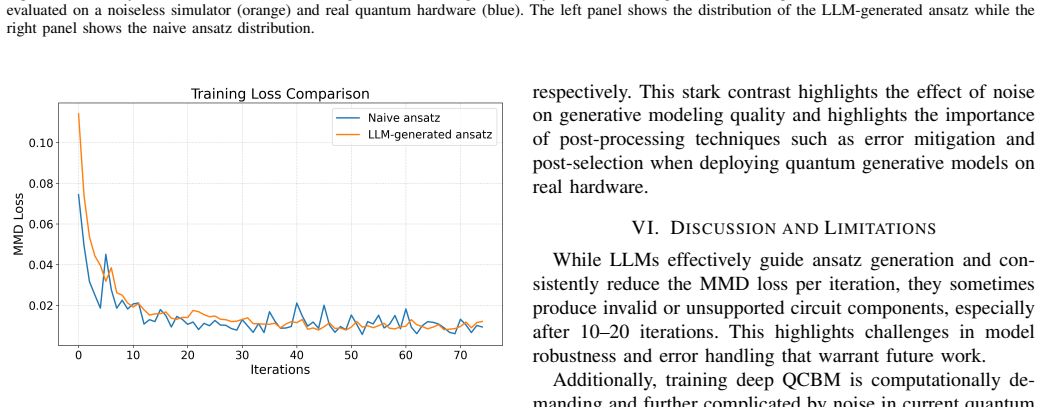
The load-bearing mechanism is an iterative prompt-feedback loop rather than a new quantum gate or identity. An initial prompt encodes the hardware profile (qubit count, connectivity, basis gates, error rates); the LLM proposes a circuit; each round the system returns three numbers—reverse KL divergence after training, circuit depth, and a validity flag—plus the instruction to prioritize KL reduction over depth. The LLM responds by pruning or appending layers. Training itself uses maximum mean discrepancy loss with a Gaussian kernel and parameter-shift gradients, and the hardware-aware initialization lets the final circuit run without transpilation.
Load-bearing premise
The load-bearing premise is that the LLM's guided search, rather than simply the much shallower circuit depth, drives the hardware improvement; the paper tests only a depth-85 baseline against its depth-28 circuit.
What would settle it
Run a standard layered ansatz with depth matched to 28 (and comparable parameter count) on the same 12-qubit Japanese bond-rate task and the same hardware; if its KL divergence matches the LLM circuit's value of about 7.37, then circuit depth is the dominant factor and the LLM-specific contribution is not established.
If this is right
- If the central claim holds, automated LLM-guided architecture search can replace manual ansatz design for quantum generative models on near-term hardware.
- Shallow, hardware-native circuits become a concrete design target: the depth reduction from 85 to 28 is the clearest lever behind the observed noise resilience.
- The same feedback loop—prompt with hardware constraints, evaluate, refine—can be transferred to other quantum machine learning tasks such as classifiers or feature maps, and to other device topologies.
- The post-selection results, where KL drops to roughly 0.7 for both circuits, imply that most of the hardware degradation is correctable noise, so error mitigation and post-processing remain complementary to architectural search.
Where Pith is reading between the lines
- The comparison is between depth 28 and depth 85; without a depth-matched shallow baseline, the cleanest conclusion is that shallower hardware-native circuits are noise-robust, and the specific contribution of the LLM's search remains to be isolated.
- A natural control experiment would fix the optimization loop but replace the LLM's proposals with random or evolutionary circuits constrained to depth 28; matching hardware KL would suggest the loop, not the LLM's prior knowledge, is doing the work.
- The use of reverse KL on hardware may reward conservative distributions that avoid improbable outcomes; reporting forward KL or MMD on real-device samples would test whether the reported advantage reflects genuine distribution fidelity rather than mode-avoidance.
Editorial analysis
A structured set of objections, weighed in public.
Referee Report
Summary. The paper proposes a prompt-based LLM framework for generating hardware-aware QCBM ansätze and evaluates it on a 12-qubit financial generative modeling task (daily changes in JGB interest rates). The LLM is prompted with hardware topology, gate error rates, and basis gates, and receives iterative feedback on KL divergence, circuit depth, and validity. The LLM-generated circuit (depth 28) is compared to a Qiskit TwoLocal baseline (18 repetitions, depth ~85) on a noiseless simulator and on IBM fez hardware. Reported results: simulator KL 3.67 vs. 3.10; hardware KL 7.37±0.11 vs. 9.32±0.06 without error mitigation, and 6.91±0.13 vs. 8.92±0.07 with error mitigation. Post-selection KL values are approximately 0.78 (LLM) and 0.68 (TwoLocal). The paper claims the LLM-generated ansatz is significantly shallower and achieves superior generative performance on real hardware.
Significance. If the attribution were established, this would be a practical demonstration of LLM-guided quantum architecture search on real hardware, with relevance to QCBM-based financial modeling and to the broader goal of automating hardware-aware circuit design. The paper has genuine strengths: it reports real 12-qubit hardware measurements, uses a standard baseline, applies measurement error mitigation, and the direct numeric comparison in Table I does show a hardware advantage for the shallower LLM-generated circuit. However, the central interpretation—that LLM guidance, rather than circuit depth, produces the hardware advantage—is not supported by the current experimental design. The post-selection result also reverses the ranking. As a proof-of-concept the paper is suggestive, but additional control experiments are needed before the stated claims can be accepted.
major comments (4)
- [§V.B, §IV.C, Table I] The headline hardware comparison is between the LLM-generated circuit (depth 28) and TwoLocal with 18 repetitions (depth ~85). No depth-matched control is run: there is no shallow TwoLocal, no random shallow ansatz, and no noise-simulation study that varies depth independently of the design method. On the noiseless simulator the LLM circuit is worse (KL 3.67 vs. 3.10, §V.A), so the hardware reversal is fully consistent with the LLM circuit simply having less gate noise. The abstract's attribution of the improvement to LLM-guided search is therefore not established. Please add depth-matched controls and/or a noise-sweep experiment that isolates depth from the design method.
- [§V.B.a] After post-selection on valid bitstrings, the KL divergence is reported as approximately 0.78 for the LLM-generated ansatz and 0.68 for TwoLocal, reversing the ranking from Table I. The abstract's unqualified statement of 'superior generative performance' is not robust to a standard post-processing step. The paper should either temper the claim, report post-selected metrics in the main comparison, or explain why the ranking reversal does not affect the conclusion.
- [§III.A, §IV.D] The LLM search is a single run: GPT-4.1 at default temperature, with one prompt sequence and one resulting circuit. There are no independent LLM search runs, no training random seeds, and the reported hardware statistics are shot noise only. The stochasticity of LLM sampling and of QCBM training is therefore uncharacterized. Please report results over multiple independent LLM search runs and training initializations to show that the presented circuit is representative rather than a lucky draw.
- [§II.A] The KL divergence formula is written as D_KL(P∥Q) = Σ_x P(x) log(P(x)/Q(x)) with the sum over P(x)>0, but the text says the paper computes the reverse KL D_KL(Q∥P) with Q the model distribution. For the reverse KL the formula and support condition should be over Q, not P. Since all reported quantitative claims depend on this quantity, please clarify the exact formula actually used in the evaluation.
minor comments (5)
- [Title, Authors] The title contains an encoding artifact 'Ans ¨atze'; it should read 'Ansätze'. The third affiliation line lists '3nd' instead of '3rd'.
- [§IV.D, §V.B] The text states that GPT-4.1 and GPT-4o were used and then says GPT-4.1 was selected for all experimental results. Please make the final choice explicit earlier and avoid the impression that both models contributed results. Also, 'Mthreepackage' should be 'Mthree package'.
- [§IV.B] There is an inconsistency in the training budget: §IV.B says 'stochastic gradient descent over 30 epochs', but later in the same section it says training typically spans 50 to 100 epochs. Please harmonize these statements.
- [§III.A] The description of how the LLM 'prunes' or 'appends' layers is qualitative. A small pseudocode listing or explicit prompt template would improve reproducibility and clarify what information is fed back to the model.
- [§V.A, Fig. 2] The simulator comparison reports KL 3.67 vs. 3.10 and MMD convergence, but the text says 'both achieve similar performance.' The KL difference is roughly 18% relative to the baseline; please state whether this difference is within expected training variability, especially since no seeds are reported.
Circularity Check
No circularity: LLM-ansatz evaluation is an empirical benchmark; the depth/KL confound is a validity threat, not a circular derivation.
full rationale
The manuscript is an empirical architecture-search study rather than a derivation. The claimed chain is: hardware-conditioned prompts -> LLM circuit proposals -> iterative feedback (KL divergence, depth, validity) -> MMD-based training -> simulator and hardware evaluation against a TwoLocal baseline. None of these steps defines its reported performance metric in terms of the method's own inputs. The KL divergence appears both as a feedback signal to the LLM and as the headline evaluation metric, but this is an optimization loop, not a definitional equivalence; the competing baseline is trained and measured with the same protocol. The only self-citation is [13], used in the introduction as a general QML reference, and it is not load-bearing for the ansatz generation or for the hardware result. The MMD bandwidth sigma=3 is adopted from prior work [2], not from the authors' own work. The depth difference (28 vs 85) is a possible confound for the hardware comparison, but confounding is a correctness risk, not circular reasoning. Therefore no specific circular step can be exhibited and the circularity score is 0.
Axiom & Free-Parameter Ledger
free parameters (2)
- MMD Gaussian kernel bandwidth σ =
3
- Qubits per JGB maturity =
4
axioms (4)
- domain assumption MMD loss with a Gaussian kernel is a suitable training objective for QCBMs
- domain assumption Reverse KL divergence D_KL(Q||P) is a reliable evaluation metric on noisy hardware
- domain assumption Training on a noiseless simulator transfers to real hardware without retraining
- standard math The parameter-shift rule yields unbiased gradients for the generated circuits
Cite this review
Pith. "Pith review of LLM-Guided Ans\"atze Design for Quantum Circuit Born Machines in Financial Generative Modeling." pith.science (2026). https://pith.science/paper/OQ47O65Q
@misc{pith2026250908385,
  author       = {Pith},
  title        = {Pith review of: LLM-Guided Ans\"atze Design for Quantum Circuit Born Machines in Financial Generative Modeling},
  year         = {2026},
  howpublished = {\url{https://pith.science/paper/OQ47O65Q}},
  note         = {Machine review of arXiv:2509.08385}
}
read the original abstract
Quantum generative modeling using quantum circuit Born machines (QCBMs) shows promising potential for practical quantum advantage. However, discovering ans\"atze that are both expressive and hardware-efficient remains a key challenge, particularly on noisy intermediate-scale quantum (NISQ) devices. In this work, we introduce a prompt-based framework that leverages large language models (LLMs) to generate hardware-aware QCBM architectures. Prompts are conditioned on qubit connectivity, gate error rates, and hardware topology, while iterative feedback, including Kullback-Leibler (KL) divergence, circuit depth, and validity, is used to refine the circuits. We evaluate our method on a financial modeling task involving daily changes in Japanese government bond (JGB) interest rates. Our results show that the LLM-generated ans\"atze are significantly shallower and achieve superior generative performance compared to the standard baseline when executed on real IBM quantum hardware using 12 qubits. These findings demonstrate the practical utility of LLM-driven quantum architecture search and highlight a promising path toward robust, deployable generative models for near-term quantum devices.
Figures


Reference graph
Works this paper leans on
-
[1]
Circuit Design based on Feature Similarity for Quantum Generative Modeling
Makarski, Mathis, et al. ”Circuit Design based on Feature Similarity for Quantum Generative Modeling.” arXiv preprint arXiv:2503.11983 (2025)
work page internal anchor Pith review Pith/arXiv arXiv 2025
-
[2]
Rudolph, Manuel S., et al. ”Trainability barriers and opportunities in quantum generative modeling.” npj Quantum Information 10.1 (2024): 116
work page 2024
-
[3]
Ueda, Kento, and Atsushi Matsuo. ”Optimizing Ansatz Design in Quan- tum Generative Adversarial Networks Using Large Language Models.” arXiv preprint arXiv:2503.12884 (2025)
Pith/arXiv arXiv 2025
-
[4]
Nakaji, Kouhei, et al. ”The generative quantum eigensolver (GQE) and its application for ground state search.” arXiv preprint arXiv:2401.09253 (2024)
arXiv 2024
-
[5]
Sakka, Kenya, Kosuke Mitarai, and Keisuke Fujii. ”Automating quan- tum feature map design via large language models.” arXiv preprint arXiv:2504.07396 (2025)
arXiv 2025
-
[6]
Javadi-Abhari, Ali, et al. Quantum Computing with Qiskit. arXiv:2405.08810, arXiv, 15 May 2024. arXiv.org, arxiv.org/abs/2405.08810
Pith/arXiv arXiv 2024
-
[7]
”Scalable mitigation of measurement errors on quantum computers.” PRX Quantum 2.4 (2021): 040326
Nation, Paul D., et al. ”Scalable mitigation of measurement errors on quantum computers.” PRX Quantum 2.4 (2021): 040326
work page 2021
-
[8]
”Differentiable learning of quantum circuit born machines.” Physical Review A 98.6 (2018): 062324
Liu, Jin-Guo, and Lei Wang. ”Differentiable learning of quantum circuit born machines.” Physical Review A 98.6 (2018): 062324
work page 2018
-
[9]
Benedetti, Marcello, et al. ”A generative modeling approach for bench- marking and training shallow quantum circuits.” npj Quantum informa- tion 5.1 (2019): 45
work page 2019
-
[10]
Ackley, David H., Geoffrey E. Hinton, and Terrence J. Sejnowski. ”A learning algorithm for Boltzmann machines.” Cognitive science 9.1 (1985): 147-169
work page 1985
-
[11]
Kullback, Solomon, and Richard A. Leibler. ”On information and sufficiency.” The annals of mathematical statistics 22.1 (1951): 79-86
work page 1951
-
[12]
Cerezo, Marco, et al. ”Challenges and opportunities in quantum machine learning.” Nature computational science 2.9 (2022): 567-576
work page 2022
-
[13]
Gujju, Yaswitha, Atsushi Matsuo, and Rudy Raymond. ”Quantum ma- chine learning on near-term quantum devices: Current state of supervised and unsupervised techniques for real-world applications.” Physical Re- view Applied 21.6 (2024): 067001
work page 2024
-
[14]
”Quantum machine learning.” Nature 549.7671 (2017): 195-202
Biamonte, Jacob, et al. ”Quantum machine learning.” Nature 549.7671 (2017): 195-202
work page 2017
-
[15]
”Gpt-4o: The cutting-edge advancement in multimodal LLM.” Authorea Preprints (2024)
Islam, Raisa, and Owana Marzia Moushi. ”Gpt-4o: The cutting-edge advancement in multimodal LLM.” Authorea Preprints (2024)
work page 2024
-
[16]
”A kernel two-sample test.” The Journal of Machine Learning Research 13.1 (2012): 723-773
Gretton, Arthur, et al. ”A kernel two-sample test.” The Journal of Machine Learning Research 13.1 (2012): 723-773
work page 2012
-
[17]
”Adam: A method for stochastic optimization.” arXiv preprint arXiv:1412.6980 (2014)
Kingma, Diederik P., and Jimmy Ba. ”Adam: A method for stochastic optimization.” arXiv preprint arXiv:1412.6980 (2014)
Pith/arXiv arXiv 2014
-
[18]
”General parameter-shift rules for quantum gradients.” Quantum 6 (2022): 677
Wierichs, David, et al. ”General parameter-shift rules for quantum gradients.” Quantum 6 (2022): 677
work page 2022
discussion (0)
Sign in with ORCID, Apple, or X to comment. Anyone can read and Pith papers without signing in.