Interacting k-essence field with non-pressureless Dark Matter: Cosmological Dynamics and Observational Constraints
Pith reviewed 2026-05-18 18:09 UTC · model grok-4.3
The pith
Interacting k-essence dark energy with two coupling forms reproduces all major cosmic epochs and fits data competitively with flat ΛCDM.
A machine-rendered reading of the paper's core claim, the machinery that carries it, and where it could break.
Core claim
When dark energy is realized as a k-essence field with inverse-square potential and coupled to dark matter through either a Hubble-proportional term or a density-pressure combination, the cosmology admits late-time de-Sitter attractors that are free of ghosts, passes through every standard epoch, and yields observationally acceptable Hubble values in the 67–70 km/s/Mpc range while remaining statistically competitive with flat ΛCDM.
What carries the argument
The autonomous system of first-order differential equations obtained by rewriting the Friedmann and scalar-field equations in terms of dimensionless density parameters and an interaction variable; the system locates the fixed points that govern the sequence of cosmic eras and supplies the background evolution used for likelihood evaluation.
If this is right
- The models traverse radiation, matter, and accelerated eras in the correct order without additional tuning.
- Late-time de-Sitter fixed points guarantee ghost-free accelerated expansion.
- The predicted Hubble constant range overlaps values inferred from both early- and late-universe probes.
- Statistical evidence remains comparable to flat ΛCDM across the combined dataset of chronometers, BAO, supernovae, and lensing.
Where Pith is reading between the lines
- If the interaction kernels prove physically correct, future BAO or weak-lensing surveys could directly measure the energy-transfer rate between the dark sectors.
- The autonomous-system approach can be reused to test other scalar potentials or interaction shapes without re-deriving the entire background dynamics.
- The reported H0 interval offers a concrete target for next-generation distance-ladder or CMB experiments that aim to resolve the Hubble tension.
Load-bearing premise
The two chosen interaction kernels are assumed to capture the dominant energy transfer between the dark sectors.
What would settle it
A high-precision reconstruction of the dark-sector coupling function that deviates from both the Hubble-proportional and density-pressure forms, or a measured Hubble constant lying well outside the 67–70 km/s/Mpc interval while the late-time equation of state remains inconsistent with a de-Sitter attractor.
Figures
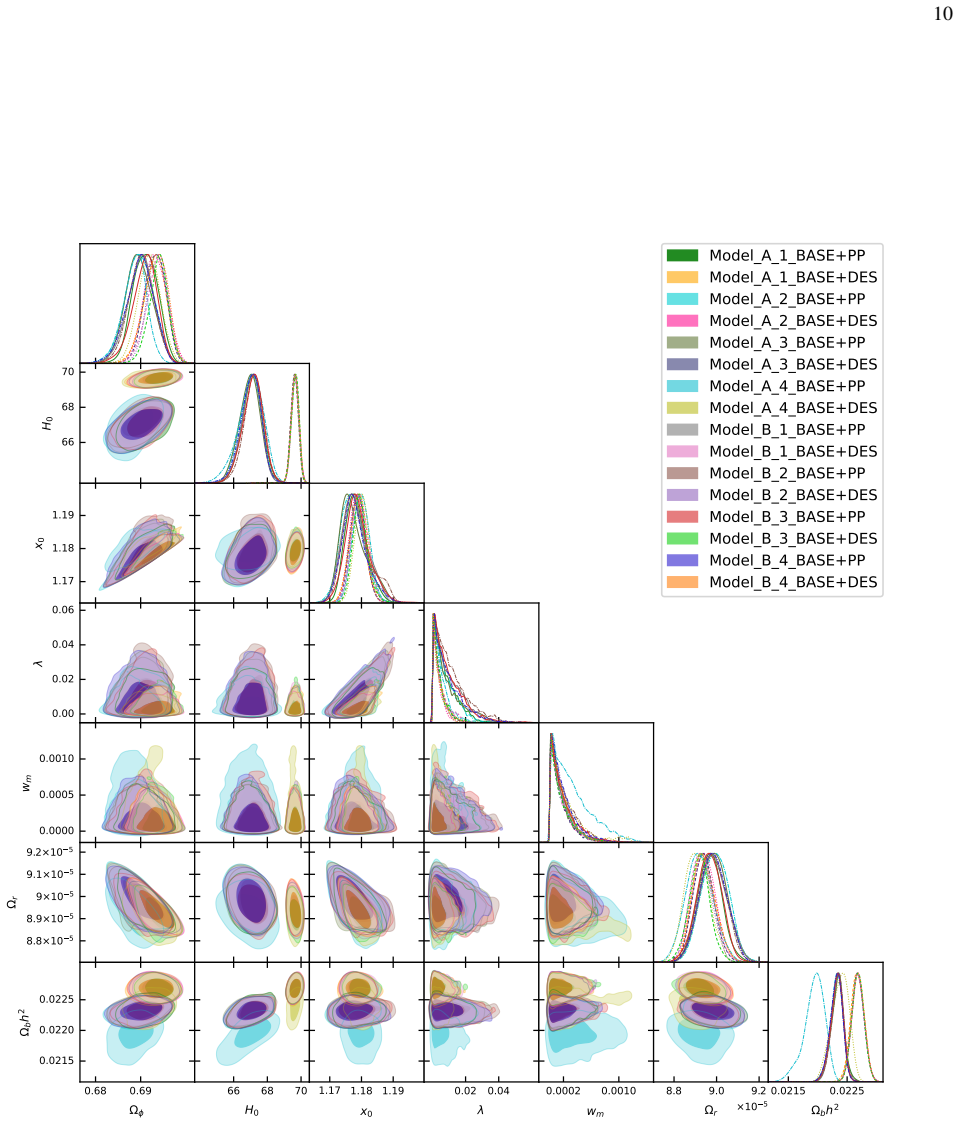


read the original abstract
We investigate a class of interacting dark energy and dark matter (DM) models, where dark energy is modeled as a $k$-essence scalar field with an inverse-square potential. Two general forms of interaction are considered: one proportional to the Hubble parameter, and another independent of the Hubble parameter, depending instead on combinations of the energy densities and pressures of the dark sectors. {The cosmological evolution is reformulated in terms of an autonomous system of equations, which provides a convenient phase-space parametrization for the numerical integration of the background dynamics and for confronting the models with observations.} The models are tested against a wide range of observational datasets, including cosmic chronometers (CC), BAO measurements from DESI DR2, compressed Planck data (PLA), Pantheon+ (PP), DES supernovae, Big Bang Nucleosynthesis (BBN), and strong lensing data from H0LiCOW (HCW). The analysis shows that the models consistently reproduce all major cosmological epochs and yield statistically competitive results compared to the flat $\Lambda$CDM model. The models exhibit late-time de-Sitter solutions, ensuring ghost-free evolution, with the Hubble constant in the range $H_0 \sim 67$--$70$ km/s/Mpc.
Editorial analysis
A structured set of objections, weighed in public.
Referee Report
Summary. The paper investigates interacting dark energy-dark matter models in which dark energy is realized as a k-essence scalar field with an inverse-square potential. Two interaction kernels are introduced (one proportional to the Hubble parameter, the other constructed from energy-density and pressure combinations). The background cosmology is recast as an autonomous dynamical system whose fixed points are analyzed numerically; the models are then confronted with a combination of cosmic-chronometer, DESI DR2 BAO, compressed Planck, Pantheon+, DES supernovae, BBN and H0LiCOW strong-lensing data. The central claims are that the models reproduce the standard radiation-matter-dark-energy sequence, possess stable late-time de-Sitter attractors that guarantee ghost-free evolution, and yield statistically competitive fits to flat ΛCDM with H0 in the range 67–70 km s⁻¹ Mpc⁻¹.
Significance. If the background dynamics and parameter constraints are robust, the work supplies a concrete phase-space classification of interacting k-essence cosmologies together with multi-probe observational bounds. The reported H0 interval and the existence of de-Sitter attractors are potentially relevant to the Hubble tension and to the broader program of interacting dark-sector models. The significance is limited, however, by the absence of any linear perturbation analysis, which is required to substantiate the ghost-free claim once the interaction is active at first order.
major comments (2)
- [abstract, §5] The assertion of “ghost-free evolution” (abstract and §5) is based exclusively on the existence of stable de-Sitter fixed points of the background autonomous system. No coupled perturbation equations for the k-essence field and the interacting, non-pressureless DM are solved; consequently it is not demonstrated that the effective sound speed remains positive or that gradient instabilities are absent when the pressure-dependent interaction kernel is included at linear order. This omission directly affects the viability claim.
- [§4, Table 2] The observational constraints (Table 2 and §4) are derived from background-sensitive data only. Because the interaction term enters the continuity equations at the background level, the reported posterior intervals on the coupling constants and on H0 could shift once the full perturbation likelihood (including lensing and growth-rate data) is used; the current competitiveness with ΛCDM therefore rests on an incomplete dataset.
minor comments (2)
- [Eq. (12)] The definition of the second interaction kernel Q2 (Eq. (12)) mixes energy densities and pressures without an explicit statement of the resulting effective equation-of-state parameter; a short derivation of w_eff would clarify the late-time attractor analysis.
- [Figure 3] Figure 3 (phase portraits) would benefit from an overlay of the observational 1σ and 2σ contours on the (x,y) plane to show which fixed points are actually realized by the data.
Simulated Author's Rebuttal
We thank the referee for the careful and constructive report. The comments correctly identify limitations in our current analysis regarding perturbation-level stability and the scope of the observational constraints. We address each major comment below and indicate planned revisions.
read point-by-point responses
-
Referee: [abstract, §5] The assertion of “ghost-free evolution” (abstract and §5) is based exclusively on the existence of stable de-Sitter fixed points of the background autonomous system. No coupled perturbation equations for the k-essence field and the interacting, non-pressureless DM are solved; consequently it is not demonstrated that the effective sound speed remains positive or that gradient instabilities are absent when the pressure-dependent interaction kernel is included at linear order. This omission directly affects the viability claim.
Authors: We agree that the ghost-free claim in the abstract and §5 rests solely on the background analysis. The stable late-time de Sitter attractors ensure that the homogeneous evolution approaches a phase with no ghost instabilities for the k-essence field. However, we acknowledge that this does not automatically guarantee the absence of gradient instabilities or a positive effective sound speed once the interaction is promoted to linear order. In the revised manuscript we will qualify the relevant statements to make clear that the ghost-free assertion applies to the background dynamics only, and we will add a short paragraph noting that a full first-order perturbation analysis is required for a complete viability assessment and is left for future work. revision: partial
-
Referee: [§4, Table 2] The observational constraints (Table 2 and §4) are derived from background-sensitive data only. Because the interaction term enters the continuity equations at the background level, the reported posterior intervals on the coupling constants and on H0 could shift once the full perturbation likelihood (including lensing and growth-rate data) is used; the current competitiveness with ΛCDM therefore rests on an incomplete dataset.
Authors: We thank the referee for this observation. Our constraints are obtained from background observables (CC, DESI DR2 BAO, compressed Planck, Pantheon+, DES supernovae, BBN and H0LiCOW) that constrain the expansion history. While these data are appropriate for testing the autonomous system and the background evolution, we recognize that the posteriors on the coupling parameters and H0 could change when perturbation-level likelihoods are included. In the revised version we will insert explicit caveats in §4 and the conclusions stating that the reported intervals are background-only results and that a joint analysis with growth-rate and lensing data is needed to assess the models’ competitiveness with ΛCDM at the perturbation level. revision: yes
Circularity Check
No significant circularity; derivation self-contained via external data
full rationale
The paper defines two explicit interaction kernels Q, rewrites the background continuity and Friedmann equations as an autonomous dynamical system, locates fixed points (including late-time de-Sitter), and then performs standard parameter estimation against independent external datasets (CC, DESI DR2 BAO, compressed Planck, Pantheon+, DES SN, BBN, H0LiCOW). None of the load-bearing steps reduces by construction to a fitted parameter renamed as a prediction, nor to a self-citation chain; the observational constraints and epoch reproduction follow directly from numerical integration against those external benchmarks. The choice of kernels is stated as an assumption rather than derived from the target result.
Axiom & Free-Parameter Ledger
free parameters (2)
- interaction coupling constants
- k-essence potential scale
axioms (2)
- standard math The background FLRW metric and standard energy-momentum conservation equations hold for the interacting dark sectors.
- domain assumption The chosen interaction terms do not introduce ghosts or instabilities at the background level.
Lean theorems connected to this paper
-
IndisputableMonolith/Foundation/BranchSelection.leanbranch_selection unclear?
unclearRelation between the paper passage and the cited Recognition theorem.
We reformulate these equations into an autonomous system … Model A: Q=3H(αρ_m + ξ1 P_m + …)X^γ … Model B: Q=3H0(…)X^γ … construct the autonomous dynamical system …
-
IndisputableMonolith/Foundation/AlphaDerivationExplicit.leanalphaProvenanceCert unclear?
unclearRelation between the paper passage and the cited Recognition theorem.
The models exhibit late-time de-Sitter solutions, ensuring ghost-free evolution … H0 ∼ 67–70 km/s/Mpc
What do these tags mean?
- matches
- The paper's claim is directly supported by a theorem in the formal canon.
- supports
- The theorem supports part of the paper's argument, but the paper may add assumptions or extra steps.
- extends
- The paper goes beyond the formal theorem; the theorem is a base layer rather than the whole result.
- uses
- The paper appears to rely on the theorem as machinery.
- contradicts
- The paper's claim conflicts with a theorem or certificate in the canon.
- unclear
- Pith found a possible connection, but the passage is too broad, indirect, or ambiguous to say the theorem truly supports the claim.
Reference graph
Works this paper leans on
-
[1]
Since the new variable is time dependent, the time derivative ofℎmust be included in the autonomous system, only for Model B: ¤ℎ 𝐻 =ℎ ¤𝐻 𝐻2 .(3.13) Thus, the dynamics of the system are described by Eqs. (3.5)– (3.8) together with Eq. (3.13). It is customary to investigate stability by analyzing the critical points of the autonomous system1. For the presen...
work page 1903
-
[2]
Measurements of Omega and Lambda from 42 High-Redshift Supernovae
S. Perlmutteret al.(Supernova Cosmology Project), Measure- ments ofΩandΛfrom 42 high redshift supernovae, Astrophys. J.517, 565 (1999), arXiv:astro-ph/9812133
work page internal anchor Pith review Pith/arXiv arXiv 1999
- [3]
-
[4]
D. N. Spergelet al.(WMAP), First year Wilkinson Microwave Anisotropy Probe (WMAP) observations: Determination of cosmological parameters, Astrophys. J. Suppl.148, 175 (2003), arXiv:astro-ph/0302209
work page internal anchor Pith review Pith/arXiv arXiv 2003
-
[5]
B. D. Sherwinet al., Evidence for dark energy from the cosmic microwave background alone using the Atacama Cosmology Telescope lensing measurements, Phys. Rev. Lett.107, 021302 (2011), arXiv:1105.0419 [astro-ph.CO]
work page internal anchor Pith review Pith/arXiv arXiv 2011
-
[6]
E. L. Wright, Constraints on Dark Energy from Supernovae, Gamma Ray Bursts, Acoustic Oscillations, Nucleosynthesis and Large Scale Structure and the Hubble constant, Astrophys. J.664, 633 (2007), arXiv:astro-ph/0701584
work page internal anchor Pith review Pith/arXiv arXiv 2007
-
[7]
J. Kwanet al.(DES), Cosmology from large-scale galaxy clus- tering and galaxy–galaxy lensing with Dark Energy Survey Science Verification data, Mon. Not. Roy. Astron. Soc.464, 4045 (2017), arXiv:1604.07871 [astro-ph.CO]
work page internal anchor Pith review Pith/arXiv arXiv 2017
- [8]
- [9]
-
[10]
S. H. Suyuet al., Cosmology from gravitational lens time delays and Planck data, Astrophys. J. Lett.788, L35 (2014), arXiv:1306.4732 [astro-ph.CO]
work page internal anchor Pith review Pith/arXiv arXiv 2014
-
[11]
The Atacama Cosmology Telescope: CMB Polarization at $200<\ell<9000$
S. Naesset al.(ACTPol), The Atacama Cosmology Tele- scope: CMB Polarization at200< ℓ <9000, JCAP10, 007, arXiv:1405.5524 [astro-ph.CO]
work page internal anchor Pith review Pith/arXiv arXiv
-
[12]
P. A. R. Adeet al.(Planck), Planck 2015 results. XIII. Cos- mological parameters, Astron. Astrophys.594, A13 (2016), arXiv:1502.01589 [astro-ph.CO]
work page internal anchor Pith review Pith/arXiv arXiv 2015
-
[13]
Weak Lensing with SDSS Commissioning Data: The Galaxy-Mass Correlation Function To 1/h Mpc
P. Fischeret al.(SDSS), Weak lensing with SDSS commis- sioning data: The Galaxy mass correlation function to1ℎ −1 Mpc, Astron. J.120, 1198 (2000), arXiv:astro-ph/9912119
work page internal anchor Pith review Pith/arXiv arXiv 2000
-
[14]
A. Sandage, G. A. Tammann, A. Saha, B. Reindl, F. D. Mac- chetto, and N. Panagia, The Hubble Constant: A Summary of the HST Program for the Luminosity Calibration of Type Ia Supernovae by Means of Cepheids, Astrophys. J.653, 843 (2006), arXiv:astro-ph/0603647
work page internal anchor Pith review Pith/arXiv arXiv 2006
-
[15]
J. R. Primack, Dark matter and structure formation, in Midrasha Mathematicae in Jerusalem: Winter School in Dy- namical Systems(1997) arXiv:astro-ph/9707285
work page internal anchor Pith review Pith/arXiv arXiv 1997
-
[16]
Dark matter and structure formation a review
A. Del Popolo, Dark matter and structure formation a review, Astron. Rep.51, 169 (2007), arXiv:0801.1091 [astro-ph]
work page internal anchor Pith review Pith/arXiv arXiv 2007
-
[17]
J. Diao, S. Wei, Z. Wei, and C. Liu, The impact of the dark matter on galaxy formation, J. Phys. Conf. Ser.2441, 012025 (2023)
work page 2023
- [18]
-
[19]
G. R. Blumenthal, S. M. Faber, J. R. Primack, and M. J. Rees, Formation of Galaxies and Large Scale Structure with Cold Dark Matter, Nature311, 517 (1984)
work page 1984
- [20]
-
[21]
Weinberg, The Cosmological Constant Problem, Rev
S. Weinberg, The Cosmological Constant Problem, Rev. Mod. Phys.61, 1 (1989)
work page 1989
-
[22]
S. E. Rugh and H. Zinkernagel, The Quantum vacuum and the cosmological constant problem, Stud. Hist. Phil. Sci. B33, 663 (2002), arXiv:hep-th/0012253
work page internal anchor Pith review Pith/arXiv arXiv 2002
-
[23]
Cosmological Constant - the Weight of the Vacuum
T. Padmanabhan, Cosmological constant: The Weight of the vacuum, Phys. Rept.380, 235 (2003), arXiv:hep-th/0212290
work page internal anchor Pith review Pith/arXiv arXiv 2003
-
[24]
S. M. Carroll, W. H. Press, and E. L. Turner, The Cosmological constant, Ann. Rev. Astron. Astrophys.30, 499 (1992)
work page 1992
-
[25]
Planck 2018 results. VI. Cosmological parameters
N. Aghanimet al.(Planck), Planck 2018 results. VI. Cosmo- logical parameters, Astron. Astrophys.641, A6 (2020), [Er- ratum: Astron.Astrophys. 652, C4 (2021)], arXiv:1807.06209 [astro-ph.CO]
work page internal anchor Pith review Pith/arXiv arXiv 2018
-
[26]
A. G. Riess, S. Casertano, W. Yuan, J. B. Bowers, L. Macri, J. C. Zinn, and D. Scolnic, Cosmic Distances Calibrated to 1% Precision with Gaia EDR3 Parallaxes and Hubble Space Telescope Photometry of 75 Milky Way Cepheids Confirm Tension withΛCDM, Astrophys. J. Lett.908, L6 (2021), arXiv:2012.08534 [astro-ph.CO]
-
[27]
W. L. Freedman, B. F. Madore, T. Hoyt, I. S. Jang, R. Beaton, M. G. Lee, A. Monson, J. Neeley, and J. Rich, Calibration of the Tip of the Red Giant Branch (TRGB) 10.3847/1538- 4357/ab7339 (2020), arXiv:2002.01550 [astro-ph.GA]
- [28]
- [29]
-
[30]
D. Dutcheret al.(SPT-3G), Measurements of the E-mode po- larization and temperature-E-mode correlation of the CMB from SPT-3G 2018 data, Phys. Rev. D104, 022003 (2021), arXiv:2101.01684 [astro-ph.CO]
- [31]
-
[32]
M. Pascaleet al., SN H0pe: The First Measurement of H0 from a Multiply Imaged Type Ia Supernova, Discovered by JWST, Astrophys. J.979, 13 (2025), arXiv:2403.18902 [astro-ph.CO]
-
[33]
A. G. Adameet al.(DESI), DESI 2024 VI: cosmological con- straints from the measurements of baryon acoustic oscillations, JCAP02, 021, arXiv:2404.03002 [astro-ph.CO]
work page internal anchor Pith review Pith/arXiv arXiv 2024
-
[34]
M. Cort ˆes and A. R. Liddle, Interpreting DESI’s evidence for evolving dark energy, JCAP12, 007, arXiv:2404.08056 [astro- ph.CO]
-
[35]
Extended Dark Energy analysis using DESI DR2 BAO measurements
K. Lodhaet al.(DESI), Extended Dark Energy analysis using DESI DR2 BAO measurements (2025), arXiv:2503.14743 [astro-ph.CO]
work page internal anchor Pith review Pith/arXiv arXiv 2025
-
[36]
S. Hussain, S. Arora, A. Wang, and B. Rose, Probing the Dynamics of Gaussian Dark Energy Equation of State Using DESI BAO (2025), arXiv:2505.09913 [astro-ph.CO]
- [37]
-
[38]
M. Scherer, M. A. Sabogal, R. C. Nunes, and A. De Felice, Challenging theΛCDM model: 5𝜎evidence for a dynamical dark energy late-time transition, Phys. Rev. D112, 043513 (2025), arXiv:2504.20664 [astro-ph.CO]
-
[39]
DESI DR2 Results II: Measurements of Baryon Acoustic Oscillations and Cosmological Constraints
M. Abdul Karimet al.(DESI), DESI DR2 Results II: Mea- surements of Baryon Acoustic Oscillations and Cosmological Constraints (2025), arXiv:2503.14738 [astro-ph.CO]
work page internal anchor Pith review Pith/arXiv arXiv 2025
-
[40]
L. Huang, R.-G. Cai, and S.-J. Wang, The DESI DR1/DR2 evidence for dynamical dark energy is biased by low-redshift supernovae, Sci. China Phys. Mech. Astron.68, 100413 (2025), arXiv:2502.04212 [astro-ph.CO]
- [41]
- [42]
-
[43]
J. A. S. Lima, Alternative dark energy models: An Overview, Braz. J. Phys.34, 194 (2004), arXiv:astro-ph/0402109
work page internal anchor Pith review Pith/arXiv arXiv 2004
-
[44]
P.-J. Wu, Comparison of dark energy models using late- universe observations (2025), arXiv:2504.09054 [astro- ph.CO]
-
[45]
Modified Gravity and Cosmology
T. Clifton, P. G. Ferreira, A. Padilla, and C. Skordis, Mod- ified Gravity and Cosmology, Phys. Rept.513, 1 (2012), arXiv:1106.2476 [astro-ph.CO]
work page internal anchor Pith review Pith/arXiv arXiv 2012
-
[46]
A. G ´omez-Valent, N. E. Mavromatos, and J. Sol `a Peracaula, Stringy running vacuum model and current tensions in cosmol- ogy, Class. Quant. Grav.41, 015026 (2024), arXiv:2305.15774 [gr-qc]
- [47]
-
[48]
W. Zimdahl and D. Pavon, Interacting quintessence, Phys. Lett. B521, 133 (2001), arXiv:astro-ph/0105479
work page internal anchor Pith review Pith/arXiv arXiv 2001
-
[49]
Unified Dark Matter Scalar Field Models
D. Bertacca, N. Bartolo, and S. Matarrese, Unified Dark Mat- ter Scalar Field Models, Adv. Astron.2010, 904379 (2010), arXiv:1008.0614 [astro-ph.CO]
work page internal anchor Pith review Pith/arXiv arXiv 2010
-
[50]
Unified Dark Energy-Dark Matter model with Inverse Quintessence
S. Ansoldi and E. I. Guendelman, Unified Dark Energy- Dark Matter model with Inverse Quintessence, JCAP05, 036, arXiv:1209.4758 [gr-qc]
work page internal anchor Pith review Pith/arXiv arXiv
- [51]
-
[52]
D. J. Gross and J. H. Sloan, The Quartic Effective Action for the Heterotic String, Nucl. Phys. B291, 41 (1987)
work page 1987
- [53]
-
[54]
S. Nojiri, S. D. Odintsov, and M. Sasaki, Gauss-Bonnet dark en- ergy, Phys. Rev. D71, 123509 (2005), arXiv:hep-th/0504052
work page internal anchor Pith review Pith/arXiv arXiv 2005
-
[55]
S. Tsujikawa and M. Sami, String-inspired cosmology: Late time transition from scaling matter era to dark energy universe caused by a Gauss-Bonnet coupling, JCAP01, 006, arXiv:hep- th/0608178
-
[56]
S. Hussain, S. Arora, Y. Rana, B. Rose, and A. Wang, In- teracting models of dark energy and dark matter in Einstein scalar Gauss Bonnet gravity, JCAP11, 042, arXiv:2408.05484 [gr-qc]
-
[57]
Interacting Scalar Fields as Dark Energy and Dark Matter in Einstein scalar Gauss Bonnet Gravity
S. Hussain, S. Arora, Y. Rana, B. Rose, and A. Wang, Interact- ing Scalar Fields as Dark Energy and Dark Matter in Einstein scalar Gauss Bonnet Gravity, (2025), arXiv:2507.05207 [gr- qc]
work page internal anchor Pith review Pith/arXiv arXiv 2025
- [58]
- [59]
-
[60]
T. Nishioka and Y. Fujii, Inflation and the decaying cosmolog- ical constant, Phys. Rev. D45, 2140 (1992)
work page 1992
- [61]
-
[62]
E. J. Copeland, A. R. Liddle, and D. Wands, Exponential po- tentials and cosmological scaling solutions, Phys. Rev. D57, 4686 (1998), arXiv:gr-qc/9711068
work page internal anchor Pith review Pith/arXiv arXiv 1998
-
[63]
C. Armendariz-Picon, V. F. Mukhanov, and P. J. Steinhardt, A Dynamical solution to the problem of a small cosmological constant and late time cosmic acceleration, Phys. Rev. Lett.85, 4438 (2000), arXiv:astro-ph/0004134
work page internal anchor Pith review Pith/arXiv arXiv 2000
-
[64]
C. Armendariz-Picon, V. F. Mukhanov, and P. J. Steinhardt, Essentials of k essence, Phys. Rev. D63, 103510 (2001), arXiv:astro-ph/0006373
work page internal anchor Pith review Pith/arXiv arXiv 2001
- [65]
-
[66]
W. Fang, H. Tu, Y. Li, J. Huang, and C. Shu, Full Investigation on the Dynamics of Power-Law Kinetic Quintessence, Phys. Rev. D89, 123514 (2014), arXiv:1406.0128 [gr-qc]
work page internal anchor Pith review Pith/arXiv arXiv 2014
-
[67]
C. Armendariz-Picon, T. Damour, and V. F. Mukhanov, k - inflation, Phys. Lett. B458, 209 (1999), arXiv:hep-th/9904075
work page internal anchor Pith review Pith/arXiv arXiv 1999
-
[68]
C. Armendariz-Picon and E. A. Lim, Haloes of k-essence, JCAP08, 007, arXiv:astro-ph/0505207
work page internal anchor Pith review Pith/arXiv arXiv
-
[69]
Ghost Condensation and a Consistent Infrared Modification of Gravity
N. Arkani-Hamed, H.-C. Cheng, M. A. Luty, and S. Muko- hyama, Ghost condensation and a consistent infrared modifi- cation of gravity, JHEP05, 074, arXiv:hep-th/0312099
work page internal anchor Pith review Pith/arXiv arXiv
-
[70]
R. J. Scherrer, Purely kinetic k-essence as unified dark matter, Phys. Rev. Lett.93, 011301 (2004), arXiv:astro-ph/0402316
work page internal anchor Pith review Pith/arXiv arXiv 2004
-
[71]
A. Chatterjee, S. Hussain, and K. Bhattacharya, Dynami- cal stability of the k-essence field interacting nonminimally with a perfect fluid, Phys. Rev. D104, 103505 (2021), arXiv:2105.00361 [gr-qc]
-
[72]
S. Hussain, A. Chatterjee, and K. Bhattacharya, Ghost Conden- sates and Pure Kinetic k-Essence Condensates in the Presence of Field–Fluid Non-Minimal Coupling in the Dark Sector, Uni- verse9, 65 (2023), arXiv:2203.10607 [gr-qc]
-
[73]
K. Bhattacharya, A. Chatterjee, and S. Hussain, Dynamical stability in presence of non-minimal derivative dependent cou- pling of k-essence field with a relativistic fluid, Eur. Phys. J. C 83, 488 (2023), arXiv:2206.12398 [gr-qc]
-
[74]
S. Hussain, S. Chakraborty, N. Roy, and K. Bhattacharya, Dynamical systems analysis of tachyon-dark-energy models from a new perspective, Phys. Rev. D107, 063515 (2023), arXiv:2208.10352 [gr-qc]
-
[75]
R.-J. Yang and X.-T. Gao, Observational constraints on purely kinetic k-essence dark energy models, Chin. Phys. Lett.26, 089501 (2009)
work page 2009
- [76]
-
[77]
S. Hussain, S. Nelleri, and K. Bhattacharya, Comprehensive study of k-essence model: dynamical system analysis and ob- servational constraints from latest Type Ia supernova and BAO observations, JCAP03, 025, arXiv:2406.07179 [astro-ph.CO]
-
[78]
R. R. Caldwell, M. Kamionkowski, and N. N. Weinberg, Phan- tom energy and cosmic doomsday, Phys. Rev. Lett.91, 071301 (2003), arXiv:astro-ph/0302506
work page internal anchor Pith review Pith/arXiv arXiv 2003
-
[79]
K. J. Ludwick, The viability of phantom dark energy: A review, Mod. Phys. Lett. A32, 1730025 (2017), arXiv:1708.06981 [astro-ph.CO]
work page internal anchor Pith review Pith/arXiv arXiv 2017
-
[80]
B. Wang, E. Abdalla, F. Atrio-Barandela, and D. Pavon, Dark Matter and Dark Energy Interactions: Theoretical Chal- lenges, Cosmological Implications and Observational Signa- tures, Rept. Prog. Phys.79, 096901 (2016), arXiv:1603.08299 [astro-ph.CO]
work page internal anchor Pith review Pith/arXiv arXiv 2016
discussion (0)
Sign in with ORCID, Apple, or X to comment. Anyone can read and Pith papers without signing in.