REVIEW 2 major objections 5 minor 39 references
This paper claims that a smoothly saturating penalty on constraint cost, applied inside the safe region as an incentive, lets a PPO-style constrained RL algorithm find exact constrained optima and lower violation rates.
Reviewed by Pith at T0; open to challenge. T0 means a machine referee read the full paper against a public rubric. the ladder, T0–T4 →
T0 review · deepseek-v4-flash
2026-08-04 19:29 UTC pith:5P23W4EU
load-bearing objection The main optimality theorem is false (invalid inequality in Lemma 4); the algorithm is a plausible empirical variant but the paper needs major revision. the 2 major comments →
Incentivizing Safer Actions in Policy Optimization for Constrained Reinforcement Learning
The pith
A machine-rendered reading of the paper's core claim, the machinery that carries it, and where it could break.
Core claim
The paper's central discovery is that a particular activation function, CELU, when used as a penalty on the cost constraint's surrogate loss, creates an incentive zone inside the safe region and a smooth penalty zone outside it. The authors prove (Theorem 1) that under Slater's condition and with η ≥ ||λ*||∞, the minimizers of the combined loss L_R + η Σ CELU(L_Ci) coincide with the solutions of the original CMDP, so the incentive does not distort the optimum. Theorem 2 bounds the worst-case suboptimality from using the current policy's advantage estimates and the truncated penalty, giving a finite error in terms of KL divergence and advantage magnitudes. Empirically, IP3O is compared agains
What carries the argument
The CELU function—CELU(x,α)=x for x≥0 and α(exp(x/α)−1) for x<0—is the load-bearing component. Its negative branch saturates at −α, creating a bounded incentive for staying strictly inside the feasible region and a smooth, continuously differentiable transition into penalty outside. This saturating shape is what the authors claim prevents overly conservative policies while still guiding the policy away from the boundary. The other key piece is the importance-weighted surrogate loss from PPO, extended to cost advantages, with the penalty applied per-constraint and summed into the total loss.
Load-bearing premise
The load-bearing premise is that the penalty term η·CELU(x) dominates λ_i·x for every possible constraint slack x; the supplied proof only shows CELU(x) ≥ −α, which is too weak to guarantee this domination, so the optimality-equivalence theorem is not proven by the argument given.
What would settle it
Compute the pointwise gap: for a constraint with Lagrange multiplier λ_i and penalty weight η, find any slack value x where η·CELU(x) < λ_i·x. For instance, α=1, η=3, λ_i=1, x=−0.21 yields 3·CELU(−0.21) ≈ −0.57 < −0.21, violating the inequality. Such a counterexample would show the proof of Lemma 4 fails, and if the corresponding policy exists it would contradict Theorem 1's equivalence claim.
If this is right
- If Theorem 1 holds, safe RL algorithms can use a single scalar penalty weight η without a learned Lagrange multiplier and still reach the exact constrained optimum, removing dual oscillation.
- The smooth incentive region means policies are proactively steered away from constraint boundaries rather than only reacting after violation, which should reduce boundary noise during training.
- The worst-case error bound in Theorem 2 gives a concrete guarantee on suboptimality when the cost surrogate is approximated, enabling safe deployment with known performance degradation.
- The method's extension to multi-agent cooperative driving shows the incentive principle is not limited to single-agent control and could apply to other multi-agent safety tasks.
Where Pith is reading between the lines
- A stronger version of the theorem might hold for any penalty whose negative branch lies above the line λ_i·x, not just CELU; this would make the design principle transferable to other saturating activations like GELU or softplus.
- The incentive region could be tuned per constraint rather than globally, weighting safety of the most critical constraints more heavily; the paper's η is a single scalar, but a per-constraint η_i would be a natural extension.
- The empirical claim that IP3O reduces violations without sacrificing return could be tested on safety benchmarks with tight budgets, where a conservative bias would be most visible.
- If the proof gap for Lemma 4 is filled, the algorithm's theoretical guarantee would be genuinely parameter-free in η; otherwise, the practical method still works but lacks the advertised optimality certificate.
Editorial analysis
A structured set of objections, weighed in public.
Referee Report
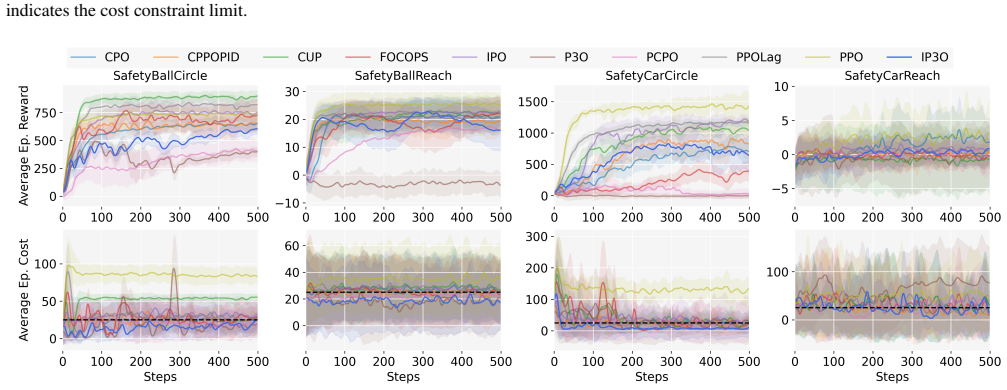
Summary. The paper proposes IP3O, a constrained RL algorithm that augments the PPO loss with a CELU penalty on the constraint slack (Eq. 6). CELU provides a bounded incentive for strictly feasible policies and turns into a linear penalty after violation. The authors claim that for η ≥ ||λ*||∞ the penalized loss shares the same optimum as the original constrained problem (Theorem 1), and derive a worst-case optimality error bound (Theorem 2). They report experiments on MuJoCo Safety Velocity, Safety Gymnasium, Bullet Safety Gymnasium, and MetaDrive.
Significance. If the theoretical claims held, IP3O would offer a simple smooth penalty with an equivalence guarantee and broad empirical support. The empirical component is genuinely broad: multiple single-agent and multi-agent benchmark suites, baselines adapted from OmniSafe, and ablations on α and d, with code and supplementary material provided. However, the central equivalence is false: Lemma 4's key inequality fails for negative slack, and a one-dimensional example contradicts Theorem 1. Theorem 2 is proved for an h-clipped loss that the authors state they did not use. Consequently, the paper's advertised theoretical guarantees are not established; the remaining contribution is an empirical study of a heuristic penalty.
major comments (2)
- [Supplementary A.1, Lemma 4] Lemma 4's proof asserts for L_Ci<0 that η CELU(L_Ci) ≥ λ_i^* L_Ci, citing CELU(x)≥−α. This implication is invalid. From CELU(x)≥−α one only gets η CELU(x)≥−ηα; since λ_i x can be arbitrarily close to 0 from below, the claimed inequality fails. Example: α=1, η=3, λ_i=1, x=−0.21: CELU(x)=e^{−0.21}−1≈−0.189, so η CELU(x)≈−0.568<−0.21=λ_i x. More generally, for x→0−, CELU(x)=x+O(x^2), so the inequality becomes η x≥λ_i x, false for every η>λ_i. Hence the negative-slack branch of Lemma 4 collapses and Theorem 1 is not proved. The failure is not merely a proof gap: for scalar problem max x subject to x≤0 (so λ*=1), Eq. (6) with α=1, η=3 is minimized at x=ln(1/3)≈−1.099, a strictly feasible point, not at the constrained optimum x=0. Thus the claimed equivalence in Theorem 1 is false as stated.
- [Theorem 2 and Section 4.2] Theorem 2's error bound contains |α log(h)|, but h appears only in the clipped variant max(CELU(·),−α(1−h)). The authors explicitly state in Section 4.2 that this clipping was not required in practice, and Algorithm 1 uses the unclipped Eq. (6). Therefore Theorem 2 is a bound for a different algorithm; for the actual loss the derivation of the |α log(h)| term does not apply, and the residual CELU gradient continues below −α(1−h). The proof also refers to 'Lemma 2' (the intended reference is Lemma 6). This leaves the paper without a worst-case guarantee for the evaluated algorithm.
minor comments (5)
- [Figure 2 caption] Typo: 'Comaprison' should be 'Comparison'.
- [Supplementary A] Typo: 'dicuss' should be 'discuss'.
- [Equation (3) and Algorithm 1] The state distribution is written as d^π in Eq. (3) but as d^πk in the surrounding text and algorithm; the notation should be made consistent.
- [Theorem 1 statement] The condition η ≥ ||λ*||∞ involves the unknown optimal Lagrange multiplier; the paper should state explicitly whether this is a non-constructive existence guarantee and how the chosen η=20 relates to λ*.
- [Lemma 5] The proof silently assumes ¯π is feasible for Eq. (10) at the start; this assumption should be stated explicitly.
Circularity Check
No significant circularity: The theoretical claims are conditional equivalence and error-bound statements, not definitions; the main concern is a proof gap in Lemma 4, which is a correctness issue rather than circular reasoning.
full rationale
The paper's derivation is not circular. Theorem 1 is a conditional equivalence claim: it asserts that if the penalty coefficient η dominates the optimal dual multiplier λ* of the original constrained problem, then the minimizer of the penalized loss (Eq. 6/11) is also a minimizer of the surrogate constrained problem (Eq. 4/10). The condition references the dual solution but is an external hypothesis, not a quantity fitted from the algorithm's own outputs; the proof attempts to compare solution sets via Lemmas 4 and 5 rather than defining the solution into existence. Theorem 2's error bound is derived from the performance-difference lemma (Lemma 6, citing Achiam et al.) and from the Lipschitz property of CELU; the appearance of the algorithm's own hyperparameters η, α, h in the bound is ordinary for an optimization error bound and does not amount to renaming a fitted quantity as a prediction. There are no self-citations, no imported uniqueness theorems, and no ansatz smuggled in from the authors' prior work; the CELU choice is attributed to Barron (2017) and Clevert (2015). The main substantive concern is a correctness gap in the supplementary proof of Lemma 4: the negative-slack branch claims η·CELU(x) ≥ λ_i·x from CELU(x) ≥ −α, which does not follow (for η > λ_i and x < 0 near 0, the inequality is false). That is an invalid proof step, not a circular definition, so it does not raise the circularity score.
Axiom & Free-Parameter Ledger
free parameters (3)
- η (penalty factor) =
20.0
- α (CELU slope) =
0.5 (MuJoCo Velocity); 0.1 (Safety Gym); 1.0 (Bullet Safety Gym)
- h (stagnation clipping) =
not used in practice
axioms (4)
- standard math Performance difference lemma (Kakade-Langford)
- domain assumption Slater's condition and strong duality for the CMDP
- standard math CELU is 1-Lipschitz and CELU(x) ≥ x
- domain assumption Convergence of the iterative policy update to a limit π*
read the original abstract
Constrained Reinforcement Learning (RL) aims to maximize the return while adhering to predefined constraint limits, which represent domain-specific safety requirements. In continuous control settings, where learning agents govern system actions, balancing the trade-off between reward maximization and constraint satisfaction remains a significant challenge. Policy optimization methods often exhibit instability near constraint boundaries, resulting in suboptimal training performance. To address this issue, we introduce a novel approach that integrates an adaptive incentive mechanism in addition to the reward structure to stay within the constraint bound before approaching the constraint boundary. Building on this insight, we propose Incrementally Penalized Proximal Policy Optimization (IP3O), a practical algorithm that enforces a progressively increasing penalty to stabilize training dynamics. Through empirical evaluation on benchmark environments, we demonstrate the efficacy of IP3O compared to the performance of state-of-the-art Safe RL algorithms. Furthermore, we provide theoretical guarantees by deriving a bound on the worst-case error of the optimality achieved by our algorithm.
Figures




Reference graph
Works this paper leans on
-
[1]
Constrained policy optimiza- tion
[Achiamet al., 2017 ] Joshua Achiam, David Held, Aviv Tamar, and Pieter Abbeel. Constrained policy optimiza- tion. InInternational Conference on Machine Learning, pages 22–31. PMLR,
2017
-
[2]
We also conducted experi- ments using the MetaDrive simulator [Liet al., 2022 ]
B Empirical Details We showed evaluation results across three widely-used safe RL environments: MuJoCo Safety Velocity [Jiet al., 2023 ], Safety Gymnasium [Rayet al., 2019 ], and Bullet Safety Gymnasium [Gronauer, 2022 ]. We also conducted experi- ments using the MetaDrive simulator [Liet al., 2022 ]. All the environments can be defined using a CMDP. B.1 ...
2023
-
[4]
Risk-constrained reinforcement learning with percentile risk criteria.Journal of Machine Learning Research, 18(167):1–51,
[Chowet al., 2018 ] Yinlam Chow, Mohammad Ghavamzadeh, Lucas Janson, and Marco Pavone. Risk-constrained reinforcement learning with percentile risk criteria.Journal of Machine Learning Research, 18(167):1–51,
2018
-
[9]
A general safety framework for learning-based control in uncertain robotic systems.IEEE Transactions on Automatic Control, 64(7):2737–2752,
[Fisacet al., 2018 ] Jaime F Fisac, Anayo K Akametalu, Melanie N Zeilinger, Shahab Kaynama, Jeremy Gillula, and Claire J Tomlin. A general safety framework for learning-based control in uncertain robotic systems.IEEE Transactions on Automatic Control, 64(7):2737–2752,
2018
-
[10]
Exterior penalty pol- icy optimization with penalty metric network under con- straints
[Gaoet al., 2024 ] Shiqing Gao, Jiaxin Ding, Luoyi Fu, Xin- bing Wang, and Chenghu Zhou. Exterior penalty pol- icy optimization with penalty metric network under con- straints. InProceedings of the Thirty-Third Interna- tional Joint Conference on Artificial Intelligence, IJCAI- 24,
2024
-
[13]
Omnisafe: An infrastructure for accelerating safe reinforcement learn- ing research.Journal of Machine Learning Research, 25(285):1–6,
[Jiet al., 2024 ] Jiaming Ji, Jiayi Zhou, Borong Zhang, Jun- tao Dai, Xuehai Pan, Ruiyang Sun, Weidong Huang, Yi- ran Geng, Mickel Liu, and Yaodong Yang. Omnisafe: An infrastructure for accelerating safe reinforcement learn- ing research.Journal of Machine Learning Research, 25(285):1–6,
2024
-
[14]
Doubly ro- bust off-policy value evaluation for reinforcement learn- ing
[Jiang and Li, 2016] Nan Jiang and Lihong Li. Doubly ro- bust off-policy value evaluation for reinforcement learn- ing. InInternational Conference on Machine Learning, pages 652–661. PMLR,
2016
-
[17]
End-to-end training of deep visuomotor policies.Journal of Machine Learning Re- search, 17(39):1–40,
[Levineet al., 2016 ] Sergey Levine, Chelsea Finn, Trevor Darrell, and Pieter Abbeel. End-to-end training of deep visuomotor policies.Journal of Machine Learning Re- search, 17(39):1–40,
2016
-
[18]
Metadrive: Composing diverse driving scenarios for generalizable re- inforcement learning.IEEE Transactions on Pattern Anal- ysis and Machine Intelligence, 45(3):3461–3475,
[Liet al., 2022 ] Quanyi Li, Zhenghao Peng, Lan Feng, Qi- hang Zhang, Zhenghai Xue, and Bolei Zhou. Metadrive: Composing diverse driving scenarios for generalizable re- inforcement learning.IEEE Transactions on Pattern Anal- ysis and Machine Intelligence, 45(3):3461–3475,
2022
-
[19]
Ipo: Interior-point policy optimization under constraints
[Liuet al., 2020 ] Yongshuai Liu, Jiaxin Ding, and Xin Liu. Ipo: Interior-point policy optimization under constraints. InProceedings of the AAAI Conference on Artificial Intel- ligence, volume 34, pages 4940–4947,
2020
-
[20]
The law and ethics of high-frequency trading.Minn
[McNamara, 2016] Steven McNamara. The law and ethics of high-frequency trading.Minn. JL Sci. & Tech., 17:71,
2016
-
[21]
Chance-constrained dynamic pro- gramming with application to risk-aware robotic space ex- ploration.Autonomous Robots, 39:555–571,
[Onoet al., 2015 ] Masahiro Ono, Marco Pavone, Yoshiaki Kuwata, and J Balaram. Chance-constrained dynamic pro- gramming with application to risk-aware robotic space ex- ploration.Autonomous Robots, 39:555–571,
2015
-
[22]
[Rayet al., 2019 ] Alex Ray, Joshua Achiam, and Dario Amodei. Benchmarking safe exploration in deep rein- forcement learning.arXiv preprint arXiv:1910.01708, 7(1):2,
Pith/arXiv arXiv 2019
-
[24]
Trust region policy opti- mization.arXiv preprint arXiv:1502.05477,
[Schulman, 2015] John Schulman. Trust region policy opti- mization.arXiv preprint arXiv:1502.05477,
Pith/arXiv arXiv 2015
-
[25]
Responsive safety in reinforcement learn- ing by pid lagrangian methods
[Stookeet al., 2020 ] Adam Stooke, Joshua Achiam, and Pieter Abbeel. Responsive safety in reinforcement learn- ing by pid lagrangian methods. InInternational Con- ference on Machine Learning, pages 9133–9143. PMLR,
2020
-
[26]
Value-decomposition networks for cooperative multi-agent learning.arXiv preprint arXiv:1706.05296,
[Sunehaget al., 2017 ] Peter Sunehag, Guy Lever, Audrunas Gruslys, Wojciech Marian Czarnecki, Vinicius Zambaldi, Max Jaderberg, Marc Lanctot, Nicolas Sonnerat, Joel Z Leibo, Karl Tuyls, et al. Value-decomposition networks for cooperative multi-agent learning.arXiv preprint arXiv:1706.05296,
Pith/arXiv arXiv 2017
-
[27]
MIT press,
[Sutton and Barto, 2018] Richard S Sutton and Andrew G Barto.Reinforcement learning: An introduction. MIT press,
2018
-
[28]
Reward constrained policy optimization
[Tessleret al., 2018 ] Chen Tessler, Daniel J Mankowitz, and Shie Mannor. Reward constrained policy optimization. International Conference on Learning Representations,
2018
-
[29]
Projection- based constrained policy optimization.International Conference on Learning Representations,
[Yanget al., 2020 ] Tsung-Yen Yang, Justinian Rosca, Karthik Narasimhan, and Peter J Ramadge. Projection- based constrained policy optimization.International Conference on Learning Representations,
2020
-
[30]
Constrained update projection approach to safe policy optimization.Advances in Neural Information Pro- cessing Systems, 35:9111–9124,
[Yanget al., 2022 ] Long Yang, Jiaming Ji, Juntao Dai, Lin- rui Zhang, Binbin Zhou, Pengfei Li, Yaodong Yang, and Gang Pan. Constrained update projection approach to safe policy optimization.Advances in Neural Information Pro- cessing Systems, 35:9111–9124,
2022
-
[31]
Convergent policy optimization for safe reinforcement learning.Advances in Neural Information Processing Systems, 32,
[Yuet al., 2019 ] Ming Yu, Zhuoran Yang, Mladen Kolar, and Zhaoran Wang. Convergent policy optimization for safe reinforcement learning.Advances in Neural Information Processing Systems, 32,
2019
-
[32]
Reinforcement learning in healthcare: A survey.ACM Computing Surveys (CSUR), 55(1):1–36,
[Yuet al., 2021 ] Chao Yu, Jiming Liu, Shamim Nemati, and Guosheng Yin. Reinforcement learning in healthcare: A survey.ACM Computing Surveys (CSUR), 55(1):1–36,
2021
-
[33]
The surprising effectiveness of ppo in cooperative multi-agent games.Advances in Neural Information Processing Sys- tems, 35:24611–24624,
[Yuet al., 2022 ] Chao Yu, Akash Velu, Eugene Vinitsky, Ji- axuan Gao, Yu Wang, Alexandre Bayen, and Yi Wu. The surprising effectiveness of ppo in cooperative multi-agent games.Advances in Neural Information Processing Sys- tems, 35:24611–24624,
2022
-
[34]
First order constrained optimization in policy space.Advances in Neural Information Processing Sys- tems, 33:15338–15349,
[Zhanget al., 2020 ] Yiming Zhang, Quan Vuong, and Keith Ross. First order constrained optimization in policy space.Advances in Neural Information Processing Sys- tems, 33:15338–15349,
2020
-
[35]
Penalized proximal policy optimization for safe rein- forcement learning
[Zhanget al., 2022 ] Linrui Zhang, Li Shen, Long Yang, Shixiang Chen, Bo Yuan, Xueqian Wang, and Dacheng Tao. Penalized proximal policy optimization for safe rein- forcement learning. InInternational Joint Conference on Artificial Intelligence,
2022
-
[36]
Evaluating model-free reinforcement learning toward safety-critical tasks
[Zhanget al., 2023 ] Linrui Zhang, Qin Zhang, Li Shen, Bo Yuan, Xueqian Wang, and Dacheng Tao. Evaluating model-free reinforcement learning toward safety-critical tasks. InProceedings of the AAAI Conference on Artifi- cial Intelligence, volume 37, pages 15313–15321,
2023
-
[37]
A.1 Proof of Theorem 1 Before discussing the proof of the Theorem, we mention the performance difference lemma for expressing the perfor- mance bound over policy improvement. Lemma 3( [Kakade and Langford, 2002 ]).Given a reward functionR, for any two policiesπandπ ′ and any start state distributionρ, J π′ R − Jπ R = 1 1−γ Es∼dπ′ a∼π′ [Aπ R(s, a)](8) In g...
2002
-
[38]
A.2 Proof of Theorem 2 Before discussing the proof for Theorem 2 we discuss the following lemma for defining the limits on performance dif- ference given that the trajectories for policy optimization are sampled from the current policy,π k. Lemma 6( [Achiamet al., 2017 ]).For any reward function, R, and policiesπandπ ′, letε π′ R = maxs |Ea∼π′[Aπ R(s, a)]...
2017
-
[2002]
Deep reinforcement learning for autonomous driving: A survey.IEEE Transactions on In- telligent Transportation Systems, 23(6):4909–4926,
[Kiranet al., 2021 ] B Ravi Kiran, Ibrahim Sobh, Victor Tal- paert, Patrick Mannion, Ahmad A Al Sallab, Senthil Yoga- mani, and Patrick P´erez. Deep reinforcement learning for autonomous driving: A survey.IEEE Transactions on In- telligent Transportation Systems, 23(6):4909–4926,
2021
-
[2015]
Augmented proximal policy op- timization for safe reinforcement learning
[Daiet al., 2023 ] Juntao Dai, Jiaming Ji, Long Yang, Qian Zheng, and Gang Pan. Augmented proximal policy op- timization for safe reinforcement learning. InProceed- ings of the AAAI Conference on Artificial Intelligence, vol- ume 37, pages 7288–7295,
2023
-
[2016]
Approximately optimal approximate reinforcement learning
[Kakade and Langford, 2002] Sham Kakade and John Lang- ford. Approximately optimal approximate reinforcement learning. InProceedings of the Nineteenth International Conference on Machine Learning, pages 267–274,
2002
-
[2017]
Routledge,
[Altman, 2021] Eitan Altman.Constrained Markov decision processes. Routledge,
2021
-
[2018]
[Clevert, 2015] Djork-Arn´e Clevert. Fast and accurate deep network learning by exponential linear units (elus).arXiv preprint arXiv:1511.07289,
Pith/arXiv arXiv 2015
-
[2019]
Prox- imal policy optimization algorithms.arXiv preprint arXiv:1707.06347,
[Schulmanet al., 2017 ] John Schulman, Filip Wolski, Pra- fulla Dhariwal, Alec Radford, and Oleg Klimov. Prox- imal policy optimization algorithms.arXiv preprint arXiv:1707.06347,
Pith/arXiv arXiv 2017
-
[2020]
Trustworthy artificial intelligence requirements in the autonomous driving domain.Computer, 56(2):29–39,
[Fernandez-Llorca and G´omez, 2023] David Fernandez- Llorca and Emilia G ´omez. Trustworthy artificial intelligence requirements in the autonomous driving domain.Computer, 56(2):29–39,
2023
-
[2021]
Continuously dif- ferentiable exponential linear units.arXiv preprint arXiv:1704.07483,
[Barron, 2017] Jonathan T Barron. Continuously dif- ferentiable exponential linear units.arXiv preprint arXiv:1704.07483,
Pith/arXiv arXiv 2017
-
[2022]
Safety gymna- sium: A unified safe reinforcement learning benchmark
[Jiet al., 2023 ] Jiaming Ji, Borong Zhang, Jiayi Zhou, Xue- hai Pan, Weidong Huang, Ruiyang Sun, Yiran Geng, Yi- fan Zhong, Josef Dai, and Yaodong Yang. Safety gymna- sium: A unified safe reinforcement learning benchmark. InThirty-seventh Conference on Neural Information Pro- cessing Systems Datasets and Benchmarks Track,
2023
-
[2023]
Natural policy gradient primal-dual method for constrained markov decision pro- cesses.Advances in Neural Information Processing Sys- tems, 33:8378–8390,
[Dinget al., 2020 ] Dongsheng Ding, Kaiqing Zhang, Tamer Basar, and Mihailo Jovanovic. Natural policy gradient primal-dual method for constrained markov decision pro- cesses.Advances in Neural Information Processing Sys- tems, 33:8378–8390,
2020
-
[2024]
Bullet-safety-gym: A framework for constrained reinforcement learning
[Gronauer, 2022] Sven Gronauer. Bullet-safety-gym: A framework for constrained reinforcement learning
2022
discussion (0)
Sign in with ORCID, Apple, or X to comment. Anyone can read and Pith papers without signing in.