REVIEW 3 major objections 6 minor 97 references
Vortex triplets, symmetry breaking, and emergent nonequilibrium plastic crystals in an active-spinner fluid
T0 review · 3 major / 6 minor · reviewed 2026-08-04 · deepseek-v4-flash
Pith's one-line read A fluid of active spinners self-assembles into a triangular crystal of spinning vortex triplets, a nonequilibrium counterpart of a plastic crystal.
desk verdict A credible new discovery -- a spontaneous vortex-triplet crystal in the ARCHNS model -- but the plastic-crystal label and finite-size robustness need more work before I'd buy the strong claims. read the letter →
The pith
A machine-rendered reading of the paper's core claim, the machinery that carries it, and where it could break.
The reading
What carries the argument
The active-rotor Cahn-Hilliard-Navier-Stokes (ARCHNS) model couples a scalar order parameter φ (positive for counterclockwise spinners, negative for clockwise) to an incompressible velocity field u through a torque-induced activity term τ∇²φ in the vorticity equation. The activity term acts as a source of vorticity that can overcome viscous and frictional dissipation, driving the emergent vortex triplets and their crystalline arrangement.
What would settle it
Run the same parameters (τ=4, σ=1, φ0=0.5) in larger boxes (e.g., 4π×4π and 8π×8π) with multiple initial seeds and higher resolution N; if the Bragg peaks at k0, √3 k0, and 2k0 broaden or disappear, or if the lattice spacing changes systematically with system size, the central claim of a plastic crystal fails. Independently, a measurement of the orientational order parameter (which should vanish for a plastic crystal) would settle whether the state is truly plastic rather than a rotating crystal.
Extended reading notes
Core claim
The central claim is that the ARCHNS model, with a torque term τ∇²φ coupling the phase field to vorticity, undergoes a spontaneous symmetry-breaking transition from disordered or doublet-dominated states to a triangular crystal of vortex triplets as activity τ increases past dissipation. At illustrative parameters τ=4, σ=1, φ0=0.5, the vorticity field shows sharp Bragg peaks at the reciprocal lattice vectors of a triangular lattice with spacing a≈0.5842, indicating long-range positional order. Individual vortex triplets spin with quasiperiodic, chaotic dynamics and no net vorticity, so the state is identified as a nonequilibrium plastic crystal. The paper also maps partial phase diagrams in
Load-bearing premise
The triangular order observed in a single 2π×2π box is genuine long-range crystalline order and not a finite-size or periodic-boundary artifact.
Editorial extensions
If this is right
- If correct, active-spinner fluids can self-assemble into a new class of nonequilibrium states: plastic crystals with positional order but no orientational order, formed without any externally imposed periodic forcing.
- The vortex-triplet crystal provides a concrete testbed for studying 2D active-crystal formation, melting, and excitations, a direction the paper explicitly flags for future work.
- The suppression of the inverse energy cascade in the crystal state suggests that self-organized vortical structures can act as strong localizers of energy, potentially a general mechanism in active turbulence.
- The phase diagrams in τ–σ and φ0–τ space offer a guide for experimentalists seeking to realize such crystals with synthetic or biological rotors.
- The quasiperiodic, chaotic spinning of the triplets implies that the crystal is dynamically alive with local time dependence, which could be probed through time-resolved experiments.
Reading between the lines
- If the crystal survives in larger domains, the lattice spacing a≈0.5842 would become a tunable length scale controlled by activity, potentially useful for designing active materials with programmable vortex lattices.
- One could test whether the plastic-crystal state is robust to weak external shear or noise; if not, it might be more accurately described as a metastable pattern rather than a true thermodynamic phase.
- The measured lattice spacing is only about 10.7 box lengths, so the reported Bragg peaks may conceal finite-size effects; a systematic finite-size scaling study would be a natural next step.
- The paper's identification of 'no net vorticity' with plastic-crystal behavior suggests a general criterion: a nonequilibrium plastic crystal is a state with broken translational symmetry but dynamically fluctuating local orientation, which could be formalized with an orientational order parameter.
Signed reviews
Editorial analysis
A structured set of objections, weighed in public.
Referee Report
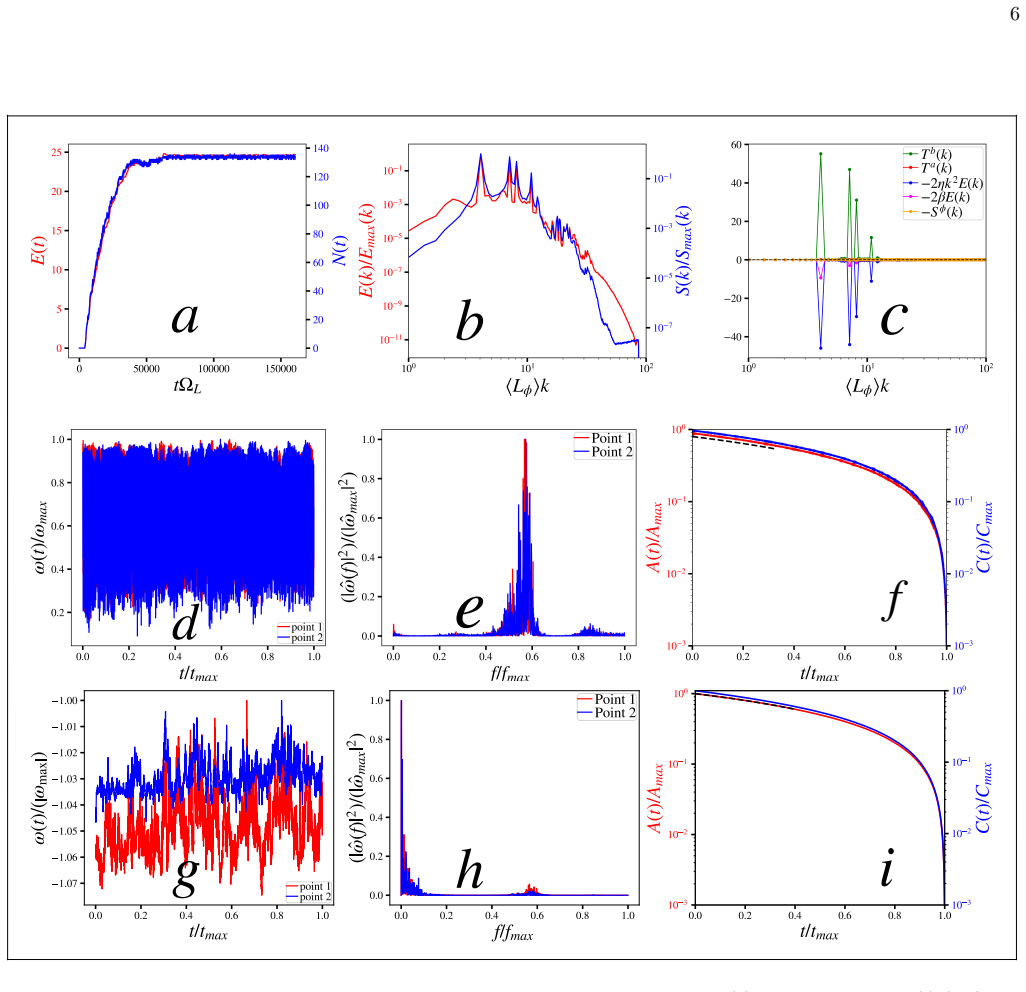
Summary. The paper studies the two-dimensional active-rotor Cahn-Hilliard-Navier-Stokes (ARCHNS) model, Eqs. (1)-(4), by pseudospectral DNS. It reports that for representative parameters (e.g., tau=4, sigma=1, phi0=0.5) the system settles into a statistically steady triangular lattice of spinning vortex triplets, visible in real-space vorticity plots and in sharp Fourier peaks at k0, sqrt(3)k0, and 2k0. The authors interpret this state as a spontaneous nonequilibrium plastic crystal: positional order with out-of-phase spinning of the triplets and no net vorticity. They also present phase diagrams in the (tau,sigma) and (phi0,tau) planes, spectral energy-balance results, local vorticity time series and power spectra, and Okubo-Weiss topology diagnostics.
Significance. If the central claim is correct, the paper reports a new spontaneous self-organized state in an active-spinner fluid: a vortex-triplet crystal arising without spatially periodic external forcing, and explicitly identified as a nonequilibrium counterpart of a plastic crystal. This would be a worthwhile contribution to active-matter physics and to the discussion of two-dimensional crystalline order in nonequilibrium settings. The paper's strengths include a well-posed model, a clearly documented numerical method, supplemental videos, and a spectral-balance analysis that directly shows where energy injection is balanced by dissipation. However, the load-bearing evidence for the crystal and for the plastic-crystal identification is currently incomplete: the translational and orientational order are not quantified, and the entire claim rests on a single square 2pi x 2pi domain with only about ten lattice spacings per side.
major comments (3)
- [Numerical Methods; Fig. 4(b)] The central 'crystal' claim rests on DNS in a single 2pi x 2pi box with N=1024. With the reported lattice spacing a ~ 0.5842, the box contains only about 10.7 lattice spacings. No larger box (L=4pi or 8pi), no different resolution, no multiple random seeds, and no rectangular or rotated periodic domain are reported; neither is a positional correlation length or a Bragg-peak-width versus system-size analysis. The sharp peaks in Fig. 4(b) could therefore reflect a finite-size ordered patch or a lattice orientation/spacing pinned by the square periodic box, rather than spontaneous long-range crystalline order. The authors' final section explicitly defers large-scale DNS to future work, but this test is required to support the present claim. At minimum, add an L=4pi run at the same parameters, a positional correlation function, and a peak-width/size scaling; ideally also vary box aspect rati
- [Fig. 4(d)-(i); Videos V0-V8] Calling the state a plastic crystal requires both positional order and the absence of orientational order. The manuscript shows real-space plots and Fourier spectra for positional order, and vorticity time series for 'spinning', but no measure of orientational order is computed. No bond-orientational correlation g6(r), no triplet-orientation correlation, and no orientational correlation length are reported. The claim that the triplets rotate rapidly and out of phase so that there is no net vorticity is also asserted from videos and a frame choice, but not quantified. Without these diagnostics, the 'plastic' part of the identification is not supported. Please compute orientation correlations and a quantitative check of out-of-phase spinning (e.g., cross-correlations of triplet orientation angles).
- [Figs. 2(a) and 3(a)] The phase diagrams are obtained by visual classification of pseudocolor vorticity plots and their Fourier transforms, with a single realization per parameter set and no stated quantitative criterion separating 'triplet-vortex crystal' from 'disordered crystal' or 'incipient' states. This makes the reported re-entrant transitions and phase boundaries non-reproducible. Introduce a scalar measure of crystalline order (e.g., main Bragg-peak amplitude, hexatic order parameter, or defect density), specify the threshold used, and report at least one independent initial seed (or averaged statistics over several seeds) for the parameter points near the phase boundaries.
minor comments (6)
- [Section 'The Self-Assembly...'] Typo: 'pseudocolor plots of of omega(x,y,t)' should read 'of the vorticity field'.
- [Fig. 4 caption] The caption states that panels (g), (h), and (i) are counterparts of those in (e), (f), and (g); this should reference panels (d), (e), and (f).
- [Fig. 4(e)] The claim of quasiperiodicity with incommensurate fundamental frequencies f1 and f2 is asserted but no numerical values, no fit, and no uncertainty are provided. If this claim is retained, specify f1, f2, f1/f2, and the fitting procedure or peak-extraction method.
- [Fig. 4(b)] The statement that the spectra 'suggest omega proportional to phi' is not quantitatively checked. A cross-spectrum or a correlation coefficient between vorticity and phase fields would make this assertion testable.
- [Model and Methods, Eq. (12)] Typos: 'where x' if the right-nearest neighbour' should be 'where x' is the right-nearest neighbour'; 'close of the triplet centre' should be 'close to the triplet centre'.
- [General] The manuscript would benefit from a data/code availability statement; the CUDA DNS is described but no repository or access information is given.
Circularity Check
No significant circularity: the central crystal claim is a direct DNS observation of the stated PDEs, not a prediction forced by fitting or by self-citation.
full rationale
The paper's central claim—spontaneous emergence of a triangular vortex-triplet crystal in an active-spinner fluid—is a direct numerical observation of the ARCHNS equations, which are written out explicitly in the paper (Eqs. 1–7). The crystal is not obtained by fitting a parameter, by imposing a lattice, or by defining an observable in terms of the claimed result. The Bragg-peak positions in Fig. 4(b) are diagnostics extracted from the simulation, not inputs to it. The model is attributed to earlier work including the authors' own [1], but the equations are fully specified and solvable independently of that citation; this is normal scientific attribution, not load-bearing circularity. The only self-cited supporting argument is the remark that at large activity the spectral similarity suggests ω ∝ φ, 'which follows from a theoretical dominant-balance argument [1] applied to Eq. (10).' This is a supporting observation, not the basis of the crystal claim; the crystal is shown in real-space vorticity plots and Fourier spectra before this remark, so removing the self-citation does not affect the main result. No fitted input is relabeled as a prediction, and no uniqueness theorem from the authors' prior work is invoked to force the interpretation. The plastic-crystal label is an interpretation of observed positional peaks and time-dependent triplet dynamics, not a derived consequence that is equivalent to its own definition. The paper's finite-size limitations (single 2π×2π box, no size-scaling or bond-orientational correlation measurement) are evidentiary weaknesses, not circular reasoning: they do not make the claimed observation mathematically identical to the model's inputs. Accordingly, the paper is self-contained against its own assumptions and the score is 0.
Assumptions & free parameters
free parameters (3)
- Initial fluctuation amplitude delta_phi(t=0) =
uniform in [-0.1, 0.1]
- Domain size and resolution =
2 pi x 2 pi, N=1024
- Model parameters (tau, sigma, phi0, nu, beta, M, epsilon) =
various values in Table I
assumptions (4)
- domain assumption The ARCHNS PDE system (1)-(4) is an adequate phenomenological model for a binary fluid of active spinners.
- domain assumption 2D incompressible flow with periodic boundary conditions on a square domain.
- domain assumption The observed statistically steady state is a true nonequilibrium steady state and not a long-lived transient.
- domain assumption The Hohenberg-Mermin-Wagner theorem does not forbid crystalline order in this active 2D system.
Cite this review
Pith. "Pith review of Vortex triplets, symmetry breaking, and emergent nonequilibrium plastic crystals in an active-spinner fluid." pith.science (2026). https://pith.science/paper/CW2KXJ4T
@misc{pith2026250909273,
  author       = {Pith},
  title        = {Pith review of: Vortex triplets, symmetry breaking, and emergent nonequilibrium plastic crystals in an active-spinner fluid},
  year         = {2026},
  howpublished = {\url{https://pith.science/paper/CW2KXJ4T}},
  note         = {Machine review of arXiv:2509.09273}
}
read the original abstract
The formation of patterns and exotic nonequilibrium steady states in active-fluid systems continues to pose challenging problems -- theoretical, numerical, and experimental -- for statistical physicists and fluid dynamicists. We combine theoretical ideas from statistical mechanics and fluid mechanics to uncover a new type of self-assembled crystal of vortex triplets in an active-spinner fluid. We begin with the two-dimensional Cahn-Hilliard-Navier-Stokes (CHNS) model for a binary-fluid system of active rotors that has two important ingredients: a scalar order parameter field phi that distinguishes regions with clockwise (CW) and counter-clockwise (CCW) spinners; and an incompressible velocity field u. In addition to the conventional CHNS coupling between phi and u, this model has a torque-induced activity term, with coefficient tau, whose consequences we explore. We demonstrate that, if we increase the activity tau, it overcomes dissipation and this system displays a hitherto unanticipated emergent triangular crystal, with spinning vortex triplets at its vertices. We show that this is a nonequilibrium counterpart of an equilibrium plastic crystal. We characterise the statistical properties of this novel crystal and suggest possible experimental realisations of this new state of active matter.
Figures


Figures from the paper (2 more)

Reference graph
Works this paper leans on
-
[1]
B. Maji, N. B. Padhan, and R. Pandit, Emergent turbu- lence and coarsening arrest in active-spinner fluids, arXiv preprint arXiv:2503.03843 (2025)
arXiv 2025
-
[2]
N. B. Padhan and R. Pandit, The cahn–hilliard–navier– stokesframeworkformultiphasefluidflows: laminar, tur- bulent and active, Journal of Fluid Mechanics1010, P1 (2025)
2025
-
[3]
M.teVrugtandR.Wittkowski,Areviewofactivematter reviews, arXiv preprint arXiv:2405.15751 (2024)
arXiv 2024
-
[4]
M. J. Bowick, N. Fakhri, M. C. Marchetti, and S. Ra- maswamy, Symmetry, thermodynamics, and topology in active matter, Physical Review X12, 010501 (2022)
2022
-
[5]
Shankar, A
S. Shankar, A. Souslov, M. J. Bowick, M. C. Marchetti, andV.Vitelli,Topologicalactivematter,NatureReviews Physics4, 380 (2022)
2022
-
[6]
M. C. Marchetti, J.-F. Joanny, S. Ramaswamy, T. B. Liverpool, J. Prost, M. Rao, and R. A. Simha, Hydrody- namics of soft active matter, Reviews of modern physics 85, 1143 (2013)
2013
-
[7]
Pandit and K
R. Pandit and K. V. Kiran, Particles and fields in min- imal hydrodynamic models for active turbulence, Euro- physics Letters (2025)
2025
-
[8]
Ramaswamy, The mechanics and statistics of active matter,Annu.Rev.Condens.MatterPhys.1,323(2010)
S. Ramaswamy, The mechanics and statistics of active matter,Annu.Rev.Condens.MatterPhys.1,323(2010)
2010
Show all 97 references
-
[9]
Castellano, S
C. Castellano, S. Fortunato, and V. Loreto, Statistical physics of social dynamics, Reviews of modern physics 81, 591 (2009)
2009
-
[10]
Bottinelli, D
A. Bottinelli, D. T. Sumpter, and J. L. Silverberg, Emer- gent structural mechanisms for high-density collective motion inspired by human crowds, Physical review let- ters117, 228301 (2016)
2016
-
[11]
Becco, N
C. Becco, N. Vandewalle, J. Delcourt, and P. Poncin, Experimental evidences of a structural and dynamical transition in fish school, Physica A: Statistical Mechanics and its Applications367, 487 (2006)
2006
-
[12]
Bialek, A
W. Bialek, A. Cavagna, I. Giardina, T. Mora, E. Sil- vestri, M. Viale, and A. M. Walczak, Statistical mechan- ics for natural flocks of birds, Proceedings of the National Academy of Sciences109, 4786 (2012)
2012
-
[13]
Cavagna, A
A. Cavagna, A. Cimarelli, I. Giardina, G. Parisi, R. San- tagati, F. Stefanini, and M. Viale, Scale-free correlations in starling flocks, Proceedings of the National Academy of Sciences107, 11865 (2010)
2010
-
[14]
C. Chen, S. Liu, X.-q. Shi, H. Chaté, and Y. Wu, Weak synchronization and large-scale collective oscillation in dense bacterial suspensions, Nature542, 210 (2017)
2017
-
[15]
I. S. Aranson, Active colloids, Physics-Uspekhi56, 79 (2013)
2013
-
[16]
Elgeti, R
J. Elgeti, R. G. Winkler, and G. Gompper, Physics of mi- croswimmers—single particle motion and collective be- havior: a review, Reports on progress in physics78, 056601 (2015)
2015
-
[17]
Driscoll and B
M. Driscoll and B. Delmotte, Leveraging collective effects in externally driven colloidal suspensions: Experiments and simulations, Current opinion in colloid & interface science40, 42 (2019)
2019
-
[18]
K. Yeo, E. Lushi, and P. M. Vlahovska, Collective dy- namics in a binary mixture of hydrodynamically coupled microrotors, Physical review letters114, 188301 (2015)
2015
-
[19]
Goto and H
Y. Goto and H. Tanaka, Purely hydrodynamic ordering of rotating disks at a finite reynolds number, Nature com- munications6, 5994 (2015)
2015
-
[20]
N. H. Nguyen, D. Klotsa, M. Engel, and S. C. Glotzer, Emergent collective phenomena in a mixture of hard shapes through active rotation, Physical review letters 112, 075701 (2014)
2014
-
[21]
Kokot, S
G. Kokot, S. Das, R. G. Winkler, G. Gompper, I. S. Aranson, and A. Snezhko, Active turbulence in a gas of self-assembled spinners, Proceedings of the National Academy of Sciences114, 12870 (2017)
2017
-
[22]
Banerjee, A
D. Banerjee, A. Souslov, A. G. Abanov, and V. Vitelli, Odd viscosity in chiral active fluids, Nature communica- tions8, 1573 (2017)
2017
-
[23]
B. A. Grzybowski, H. A. Stone, and G. M. Whitesides, 11 Dynamic self-assembly of magnetized, millimetre-sized objects rotating at a liquid–air interface, Nature405, 1033 (2000)
2000
-
[24]
Huang, Z
B. Huang, Z. Ramanis, S. K. Dutcher, and D. J. Luck, Uniflagellar mutants of chlamydomonas: evidence for the role of basal bodies in transmission of positional informa- tion, Cell29, 745 (1982)
1982
-
[25]
Brokaw, D
C. Brokaw, D. Luck, and B. Huang, Analysis of the move- ment of chlamydomonas flagella: the function of the radial-spoke system is revealed by comparison of wild- type and mutant flagella., Journal of Cell Biology92, 722 (1982)
1982
-
[26]
A. P. Petroff, X.-L. Wu, and A. Libchaber, Fast-moving bacteria self-organize into active two-dimensional crys- tals of rotating cells, Physical review letters114, 158102 (2015)
2015
-
[27]
I. H. Riedel, K. Kruse, and J. Howard, A self-organized vortex array of hydrodynamically entrained sperm cells, Science309, 300 (2005)
2005
-
[28]
Drescher, K
K. Drescher, K. C. Leptos, I. Tuval, T. Ishikawa, T. J. Pedley, and R. E. Goldstein, Dancing volvox: hydrody- namic bound states of swimming algae, Physical review letters102, 168101 (2009)
2009
-
[29]
T. H. Tan, A. Mietke, J. Li, Y. Chen, H. Higinbotham, P. J. Foster, S. Gokhale, J. Dunkel, and N. Fakhri, Odd dynamics of living chiral crystals, Nature607, 287 (2022)
2022
-
[30]
Wang, S.-t
Y. Wang, S.-t. Fei, Y.-M. Byun, P. E. Lammert, V. H. Crespi, A. Sen, and T. E. Mallouk, Dynamic interactions between fast microscale rotors, Journal of the American Chemical Society131, 9926 (2009)
2009
-
[31]
Zhang, A
B. Zhang, A. Sokolov, and A. Snezhko, Reconfigurable emergent patterns in active chiral fluids, Nature commu- nications11, 4401 (2020)
2020
-
[32]
B. A. Grzybowski, X. Jiang, H. A. Stone, and G. M. Whitesides, Dynamic, self-assembled aggregates of mag- netized, millimeter-sized objects rotating at the liquid-air interface: Macroscopic, two-dimensional classical artifi- cial atoms and molecules, Physical Review E64, 011603 (2001)
2001
-
[33]
K. Han, G. Kokot, S. Das, R. G. Winkler, G. Gompper, and A. Snezhko, Reconfigurable structure and tunable transport in synchronized active spinner materials, Sci- ence advances6, eaaz8535 (2020)
2020
-
[34]
C. W. Shields IV, K. Han, F. Ma, T. Miloh, G. Yossifon, and O. D. Velev, Supercolloidal spinners: Complex active particles for electrically powered and switchable rotation, Advanced Functional Materials28, 1803465 (2018)
2018
-
[35]
J.-C. Tsai, F. Ye, J. Rodriguez, J. P. Gollub, and T. Lubensky, A chiral granular gas, Physical review let- ters94, 214301 (2005)
2005
-
[36]
Sabrina, M
S. Sabrina, M. Tasinkevych, S. Ahmed, A. M. Brooks, M. Olvera de la Cruz, T. E. Mallouk, and K. J. Bishop, Shape-directed microspinners powered by ultrasound, ACS nano12, 2939 (2018)
2018
-
[37]
M. E. Friese, T. A. Nieminen, N. R. Heckenberg, and H. Rubinsztein-Dunlop, Optical alignment and spinning of laser-trapped microscopic particles, Nature394, 348 (1998)
1998
-
[38]
Farhadi, S
S. Farhadi, S. Machaca, J. Aird, B. O. T. Maldonado, S. Davis, P. E. Arratia, and D. J. Durian, Dynamics and thermodynamics of air-driven active spinners, Soft mat- ter14, 5588 (2018)
2018
-
[39]
Spellings, M
M. Spellings, M. Engel, D. Klotsa, S. Sabrina, A. M. Drews, N. H. Nguyen, K. J. Bishop, and S. C. Glotzer, Shape control and compartmentalization in active col- loidal cells, Proceedings of the National Academy of Sci- ences112, E4642 (2015)
2015
-
[40]
B. C. Van Zuiden, J. Paulose, W. T. Irvine, D. Bartolo, and V. Vitelli, Spatiotemporal order and emergent edge currents in active spinner materials, Proceedings of the national academy of sciences113, 12919 (2016)
2016
-
[41]
Schwarz-Linek, C
J. Schwarz-Linek, C. Valeriani, A. Cacciuto, M. Cates, D. Marenduzzo, A. Morozov, and W. Poon, Phase sepa- ration and rotor self-assembly in active particle suspen- sions, Proceedings of the National Academy of Sciences 109, 4052 (2012)
2012
-
[42]
Lenz, J.-F
P. Lenz, J.-F. Joanny, F. Jülicher, and J. Prost, Mem- branes with rotating motors, Physical review letters91, 108104 (2003)
2003
-
[43]
H. Aref, P. K. Newton, M. A. Stremler, T. Tokieda, and D. L. Vainchtein, Vortex crystals, TAM Reports 1008 (2002)
2002
-
[44]
Durkin and J
D. Durkin and J. Fajans, Experiments on two- dimensional vortex patterns, Physics of fluids12, 289 (2000)
2000
-
[45]
Perlekar and R
P. Perlekar and R. Pandit, Turbulence-induced melting of a nonequilibrium vortex crystal in a forced thin fluid film, New Journal of Physics12, 023033 (2010)
2010
-
[46]
I. O. Götze and G. Gompper, Dynamic self-assembly and directed flow of rotating colloids in microchannels, Phys- ical Review E84, 031404 (2011)
2011
-
[47]
Gupta and R
A. Gupta and R. Pandit, Melting of a nonequilibrium vortexcrystalinafluidfilmwithpolymers: Elasticversus fluid turbulence, Physical Review E95, 033119 (2017)
2017
-
[48]
Sabrina, M
S. Sabrina, M. Spellings, S. C. Glotzer, and K. J. Bishop, Coarsening dynamics of binary liquids with active rota- tion, Soft Matter11, 8409 (2015)
2015
-
[49]
N. W. Ashcroft and N. D. Mermin,Solid State Physics (Holt, Rinehart and Winston, New York, NY, 1976)
1976
-
[50]
Sólyom,Fundamentals of the Physics of Solids (Springer, 2007)
J. Sólyom,Fundamentals of the Physics of Solids (Springer, 2007)
2007
-
[51]
In our pseudospectral DNS, we work with zero mean ve- locity and zero mean vorticity
-
[52]
M. C. Mahato, M. R. Lakshmi, R. Pandit, and H. Krish- namurthy, Liquid-mesophase-solid transitions: System- atics of a density-wave theory, Physical Review A38, 1049 (1988)
1988
-
[53]
Sherwood, The plastically crystalline state, ed
J. Sherwood, The plastically crystalline state, ed. jn sher- wood (1979)
1979
-
[54]
Bini and G
R. Bini and G. Pratesi, High-pressure infrared study of solid methane: Phase diagram up to 30 gpa, Physical Review B55, 14800 (1997)
1997
-
[55]
Gotoh and M
K. Gotoh and M. Yamada, Instability of a cellular flow, Journal of the Physical Society of Japan53, 3395 (1984)
1984
-
[56]
Braun, F
R. Braun, F. Feudel, and N. Seehafer, Bifurcations and chaos in an array of forced vortices, Physical Review E 55, 6979 (1997)
1997
-
[57]
N. T. Ouellette and J. P. Gollub, Curvature fields, topol- ogy, and the dynamics of spatiotemporal chaos, Physical review letters99, 194502 (2007)
2007
-
[58]
Altland and B
A. Altland and B. D. Simons,Condensed matter field theory(Cambridge university press, 2010)
2010
-
[59]
Fradkin,Field theories of condensed matter physics (Cambridge University Press, 2013)
E. Fradkin,Field theories of condensed matter physics (Cambridge University Press, 2013)
2013
-
[60]
N. B. Padhan, D. Vincenzi, and R. Pandit, Interface- induced turbulence in viscous binary fluid mixtures, Physical Review Fluids9, L122401 (2024). 12
2024
-
[61]
Alert, J.-F
R. Alert, J.-F. Joanny, and J. Casademunt, Universal scaling of active nematic turbulence, Nature Physics16, 682 (2020)
2020
-
[62]
In Fourier space˜ω(k) =ik× ˜u(k); we set ˜u(k) = 0, so there is no mean velocity; therefore,˜ω(k) = 0, and there is no mean vorticity
-
[63]
Okubo, Horizontal dispersion of floatable particles in the vicinity of velocity singularities such as convergences, inDeep sea research and oceanographic abstracts, Vol
A. Okubo, Horizontal dispersion of floatable particles in the vicinity of velocity singularities such as convergences, inDeep sea research and oceanographic abstracts, Vol. 17 (Elsevier, 1970) pp. 445–454
1970
-
[64]
Weiss, The dynamics of enstrophy transfer in two- dimensional hydrodynamics, Physica D: Nonlinear Phe- nomena48, 273 (1991)
J. Weiss, The dynamics of enstrophy transfer in two- dimensional hydrodynamics, Physica D: Nonlinear Phe- nomena48, 273 (1991)
1991
-
[65]
Perlekar and R
P. Perlekar and R. Pandit, Statistically steady turbulence in thin films: direct numerical simulations with ekman friction, New Journal of Physics11, 073003 (2009)
2009
-
[66]
Pandit, D
R. Pandit, D. Banerjee, A. Bhatnagar, M. Brachet, A. Gupta, D. Mitra, N. Pal, P. Perlekar, S. S. Ray, V. Shukla,et al., An overview of the statistical prop- erties of two-dimensional turbulence in fluids with par- ticles, conducting fluids, fluids with polymer additives, binar...
2017
-
[67]
van Kan, B
A. van Kan, B. Favier, K. Julien, and E. Knobloch, Spontaneous suppression of inverse energy cascade in instability-driven 2-d turbulence, Journal of Fluid Me- chanics952, R4 (2022)
2022
-
[68]
van Kan, B
A. van Kan, B. Favier, K. Julien, and E. Knobloch, From a vortex gas to a vortex crystal in instability-driven two- dimensional turbulence, Journal of Fluid Mechanics984, A41 (2024)
2024
-
[69]
Mukherjee, R
S. Mukherjee, R. K. Singh, M. James, and S. S. Ray, In- termittency, fluctuations and maximal chaos in an emer- gent universal state of active turbulence, Nature Physics 19, 891 (2023)
2023
-
[70]
N. B. Padhan and R. Pandit, Activity-induced droplet propulsion and multifractality, Physical Review Research 5, L032013 (2023)
2023
-
[71]
K. V. Kiran, A. Gupta, A. K. Verma, and R. Pandit, Irreversibility in bacterial turbulence: Insights from the mean-bacterial-velocity model, Physical Review Fluids8, 023102 (2023)
2023
-
[72]
N. B. Padhan, K. V. Kiran, and R. Pandit, Novel tur- bulence and coarsening arrest in active-scalar fluids, Soft Matter20, 3620 (2024)
2024
-
[73]
K. V. Kiran, K. Kumar, A. Gupta, R. Pandit, and S. S. Ray, Onset of intermittency and multiscaling in active turbulence, Physical Review Letters134, 088302 (2025)
2025
-
[74]
Ferrante, A
E. Ferrante, A. E. Turgut, M. Dorigo, and C. Huepe, Elasticity-based mechanism for the collective motion of self-propelled particles with springlike interactions: a model system for natural and artificial swarms, Physi- cal review letters111, 268302 (2013)
2013
-
[75]
A. M. Menzel, T. Ohta, and H. Löwen, Active crystals and their stability, Physical Review E89, 022301 (2014)
2014
-
[76]
X.-q. Shi, F. Cheng, and H. Chaté, Extreme spontaneous deformations of active crystals, Physical Review Letters 131, 108301 (2023)
2023
-
[77]
Q. Yang, M. Jiang, F. Picano, and L. Zhu, Shaping ac- tive matter from crystalline solids to active turbulence, Nature Communications15, 2874 (2024)
2024
-
[78]
Palacci, S
J. Palacci, S. Sacanna, A. P. Steinberg, D. J. Pine, and P. M. Chaikin, Living crystals of light-activated colloidal surfers, Science339, 936 (2013)
2013
-
[79]
Oswald and A
P. Oswald and A. Dequidt, Measurement of the continu- ous lehmann rotation of cholesteric droplets subjected<? format?> to a temperature gradient, Physical review let- ters100, 217802 (2008)
2008
-
[80]
Deseigne, O
J. Deseigne, O. Dauchot, and H. Chaté, Collective mo- tion of vibrated polar disks, Physical review letters105, 098001 (2010)
2010
-
[81]
In our system this symmetry is translational invariance
-
[82]
P. C. Hohenberg, Existence of long-range order in one and two dimensions, Physical Review158, 383 (1967)
1967
-
[83]
N. D. Mermin and H. Wagner, Absence of ferromag- netism or antiferromagnetism in one-or two-dimensional isotropic heisenberg models, Physical Review Letters17, 1133 (1966)
1966
-
[84]
B. I. Halperin, On the hohenberg–mermin–wagner the- orem and its limitations, Journal of Statistical Physics 175, 521 (2019)
2019
-
[85]
N.D.Mermin,Crystallineorderintwodimensions,Phys- ical review176, 250 (1968)
1968
-
[86]
D. R. Nelson and B. Halperin, Dislocation-mediated melting in two dimensions, Physical Review B19, 2457 (1979)
1979
-
[87]
Young, Melting and the vector coulomb gas in two dimensions, Physical Review B19, 1855 (1979)
A. Young, Melting and the vector coulomb gas in two dimensions, Physical Review B19, 1855 (1979)
1979
-
[88]
K. J. Strandburg, Two-dimensional melting, Reviews of modern physics60, 161 (1988)
1988
-
[89]
James, D
M. James, D. A. Suchla, J. Dunkel, and M. Wilczek, Emergence and melting of active vortex crystals, Nature communications12, 5630 (2021)
2021
-
[90]
Keta and S
Y.-E. Keta and S. Henkes, Long-range order in two- dimensional systems with fluctuating active stresses, Soft Matter21, 5710 (2025)
2025
-
[91]
S. Dey, A. Bhattacharya, and S. Karmakar, Enhanced long wavelength mermin-wagner-hohenberg fluctuations in active crystals and glasses, Nature Communications 16, 5498 (2025)
2025
-
[92]
For example, phonons in an equilibrium crystal
-
[93]
M. E. Cates and E. Tjhung, Theories of binary fluid mix- tures: from phase-separation kinetics to active emulsions, Journal of Fluid Mechanics836, P1 (2018)
2018
-
[94]
Boffetta and R
G. Boffetta and R. E. Ecke, Two-dimensional turbulence, Annual review of fluid mechanics44, 427 (2012)
2012
-
[95]
M. K. Verma,Energy transfers in fluid flows: multiscale and spectral perspectives(Cambridge University Press, 2019)
2019
-
[96]
Canuto, M
C. Canuto, M. Y. Hussaini, A. Quarteroni, and T. A. Zang,Spectral methods: evolution to complex geometries and applications to fluid dynamics(Springer Science & Business Media, 2007)
2007
-
[97]
S. M. Cox and P. C. Matthews, Exponential time dif- ferencing for stiff systems, Journal of Computational Physics176, 430 (2002)
2002
Reviewed August 4, 2026 · model on record in the stance chip above.
Discussion (0). Continue with ORCID to comment.