REVIEW 4 major objections 5 minor 84 references
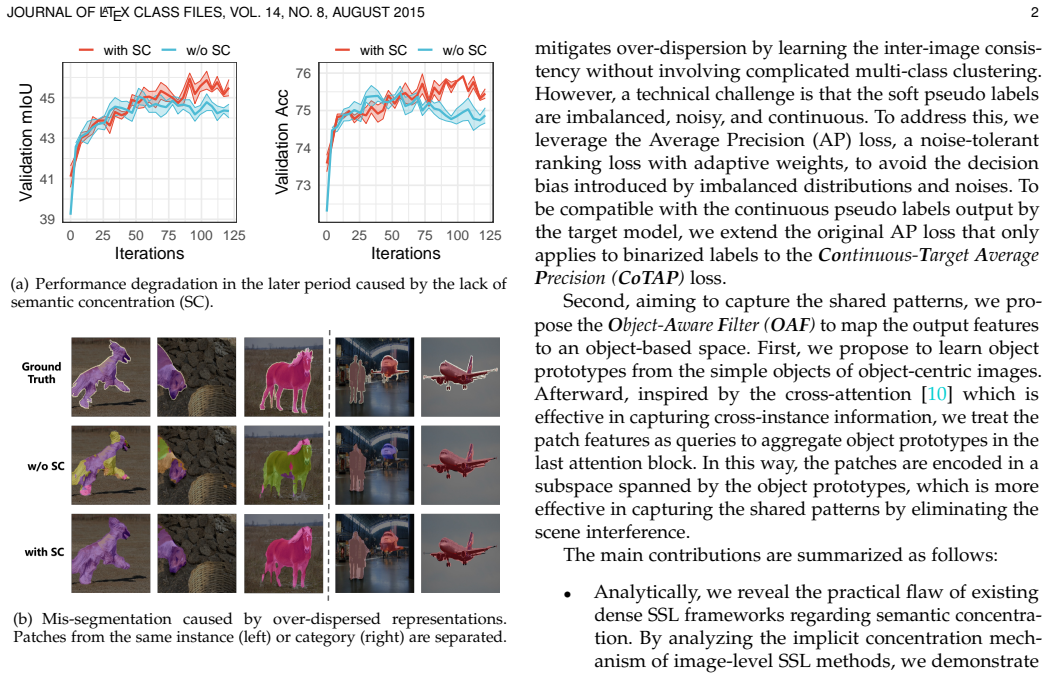
Dense self-supervised representations are over-dispersed because strict spatial alignment and scene-centric backgrounds weaken semantic concentration; the paper proposes explicit concentration via a noise-tolerant ranking loss and an object
Reviewed by Pith at T0; open to challenge. T0 means a machine referee read the full paper against a public rubric. the ladder, T0–T4 →
2026-08-04 19:06 UTC pith:Q2CTFJSQ
load-bearing objection A solid dense-SSL paper with a genuinely new ranking loss and object-aware filter; the empirical story is convincing but the paper needs multi-seed reporting and a clarification of the pseudo-label source before I'd trust the ablation. the 4 major comments →
Semantic Concentration for Self-Supervised Dense Representations Learning
The pith
A machine-rendered reading of the paper's core claim, the machinery that carries it, and where it could break.
Core claim
The authors claim that dense self-supervised representations can be made semantically concentrated by explicitly distilling cross-image patch correspondences and by filtering features through object prototypes. The paper's central mechanism is the CoTAP loss, which generalizes Average Precision ranking loss to continuous soft targets, thereby tolerating the noisy and skewed patch-pair similarities that the target branch provides. The Object-Aware Filter learns a set of object prototypes from object-centric images and uses cross-attention to represent each patch as a combination of these prototypes, reducing background interference. Experiments show that fine-tuning strong SSL models with the
What carries the argument
The Continuous-Target Average Precision (CoTAP) loss extends the AP loss—a ranking loss that up-weights pairs with high target scores—to accept continuous pseudo-labels, making it robust to noisy correspondence estimates; it is implemented via an upper bound with a Huber surrogate to remain differentiable and efficient. The Object-Aware Filter (OAF) learns M object prototypes from object-centric images and uses cross-attention with patch features as queries, producing object-centered representations that highlight shared patterns across images. A theoretical analysis based on a Lipschitz encoder and k-NN classifier formalizes the roles of non-strict spatial alignment and shared patterns, lea
Load-bearing premise
The ranking signal in the target branch's patch-pair similarities must be reliable enough that focusing on top-ranked pairs via the CoTAP adaptive weights distills genuine semantic correspondences rather than amplifying noise.
What would settle it
Run the method on a strong base model (e.g., DINO) and measure the positive rate of top-ranked patch pairs during fine-tuning: if the positive rate does not rise above the early training level shown in the paper's Fig. 4(a), then the CoTAP loss is likely learning noise. More directly, if ablations show that replacing CoTAP with binary cross-entropy on the same pseudo-labels gives equal performance, the claimed noise tolerance is not essential.
If this is right
- If correct, the framework provides a recipe for turning any image-level SSL checkpoint into a strong dense representation encoder by fine-tuning with explicit semantic concentration.
- The CoTAP loss offers a general noise-tolerant mechanism for matching patch across images without labels, potentially useful beyond segmentation, such as video tracking or correspondence learning.
- The OAF shows that cross-attention over learned object prototypes can compensate for scene-centric background dominance, which could transfer to other scene-understanding tasks.
- The analysis linking non-strict alignment and shared patterns to k-NN classification error sharpens the understanding of why certain augmentations matter for dense SSL.
- The consistent gains on instance-level tasks like VOS indicate that semantic concentration does not destroy instance discrimination, contrary to a possible trade-off.
Where Pith is reading between the lines
- The paper's diagnosis of over-dispersion could generalize to other dense prediction objectives (e.g., depth estimation, keypoints), where strict spatial alignment is common and scene clutter is high; one could test whether similar concentration losses improve those tasks.
- The dependency on object-centric images to learn clean prototypes is an acknowledged limitation; a promising extension is to learn prototypes adaptively from uncurated data, as the authors note, which would make the method scalable to larger mixtures of scenes.
- The CoTAP loss is a specific instance of a broader idea: use ranking-based objectives for noisy continuous supervision. This could be applied to self-supervised learning in other modalities, such as audio or text, where correspondences are soft and imbalanced.
- The theoretical error bound suggests that increasing q_T (shared pattern probability) and decreasing p_T (poor alignment probability) directly lower the classification error; a testable prediction is that augmentations designed to increase shared patterns (e.g., style transfer) would yield further gains.
Editorial analysis
A structured set of objections, weighed in public.
Referee Report
Summary. The paper addresses over-dispersion in self-supervised dense representations by introducing explicit 'semantic concentration'. It argues that image-level SSL implicitly concentrates semantics through non-strict spatial alignment and shared patterns, while dense SSL with strict spatial alignment and scene-centric data loses this property. To restore it, the authors propose (i) CoTAP, a continuous-target Average Precision ranking loss that distills patch correspondence rankings from the EMA target branch, and (ii) an Object-Aware Filter (OAF) that maps patch features into a space spanned by learnable object prototypes. The framework is evaluated by fine-tuning DINO, iBOT, Leopart, and Mugs on ImageNet-1k plus COCO, with downstream linear/FCN segmentation, detection, instance segmentation, VOS, and image classification. The main reported gains include +3.4 mIoU from CoTAP and +0.9 mIoU from OAF in the DINO ablation (Table 7), and a ViT-B/8 COCOStuff-27 mIoU of 54.7 (Table 2). A theoretical analysis of the implicit concentration mechanism and appendices with proofs are also provided.
Significance. If the empirical claims hold, the paper makes a useful practical contribution: it provides a recipe for improving dense representations of existing SSL backbones with relatively short fine-tuning, and the consistency of gains across segmentation, detection, VOS, and classification is impressive. The paper also ships several strengths: a code link, formal propositions with proofs in the appendix, and a control experiment (Fig. 7) that addresses the extra-epoch/extra-data confound for at least the ViT-S/16 setting. The proposed CoTAP idea—extending AP loss to continuous soft targets with adaptive weighting—is interesting and reasonably motivated. The main weaknesses are evidential: key definitions and loss composition are ambiguous, pseudo-label reliability is not directly measured, multi-seed variability is absent, and the fairness control is not extended to the largest architectures.
major comments (4)
- [§4.2, Eqs. (4)–(5), Eq. (14)] The pseudo-label source and loss composition are unclear. Eq. (4) defines q(x)_i = SK(\hat f_o(x)_i), i.e., using the online branch, not the target branch. But Eq. (5) then treats [q(v2)]_sg as the target for p(v1), and Sec. 4.3 describes St from the target branch as supervision. If q is really online, the dense alignment is not target distillation and the noise-tolerance argument changes substantially. Please define p and q consistently (likely q should be SK(\hat f_t(v2))) and update Fig. 3/Eq. (5). Relatedly, Eq. (14) omits λ3·Lproto despite Sec. 5.1 setting λ3=1 and Fig. 3 showing Lproto; specify exactly how the prototype entropy loss enters the total objective.
- [§5.2, Table 2; §5.5, Fig. 7] The headline ViT-B/8 result (DINO+Ours 54.7 vs DINO 45.9) is confounded by additional COCO data and 100k extra iterations. Fig. 7 controls for these factors, but the reported control appears to use the default ViT-S/16 setting; no extended-training/COCO-only baselines are shown for ViT-B/8 or ViT-B/16 in Table 2. Without such controls for the architectures used in the main table, the fair comparison claim is not established for the strongest reported numbers. Add the Fig. 7-style controls for ViT-B/16 and ViT-B/8, or qualify those rows as additional-data comparisons.
- [§5.4, Table 7; §5.3, Tables 3–6] All main experiments appear to be single runs with no seeds or error bars. This is especially concerning for the smaller deltas that carry the component analysis: OAF adds +0.9 mIoU (row 6→7 in Table 7), and detection/instance gains are +0.4 to +0.6 AP in Table 5. These margins are well within typical run-to-run variation for fine-tuning ViT backbones. Please report mean±std over at least three seeds for the ablations and the principal comparisons, or otherwise justify that the differences are statistically meaningful.
- [§4.3, Fig. 4; Table 7] The load-bearing assumption of CoTAP is that high target-branch similarity is a reliable ranking signal for semantic correspondence, so that the adaptive weights γ̃ focus on informative pairs. Fig. 4(a) shows that in the initial DINO model the positive rate at high cosine similarity is low on both COCO and VOC, which means the teacher is a noisy ranker at the beginning of fine-tuning. Fig. 4(b) is measured after training and cannot establish that the +3.4 mIoU gain comes from semantic concentration rather than from a generic ranking regularizer. Please add a direct precision@top-k measurement of target correspondences during early fine-tuning (e.g., at 0, 10k, 20k, 50k iterations), and include an ablation that replaces CoTAP with a standard margin ranking loss on the same target similarities to verify that the AP-style adaptive weighting is the causal component.
minor comments (5)
- [Eq. (2)] The notation 'St(u,v), S t(u,v)' is duplicated in the text; the second should clearly be So(u,v). Please also clarify whether the maps are HW×HW matrices for every pair (u,v), as used in Eq. (10).
- [Eq. (12)] There is a stray closing bracket after 'Σ_{q_j<q_i} ℓ(p_i−p_j)]', and 'differential' should be 'differentiable'. The Huber surrogate definition also has an unusual conditional structure; a short explanation of τ2 as a margin in Eq. (11) would help.
- [§3.3, Assumption 2 and Remark 1] Assumption 2 effectively postulates the shared-pattern structure that the paper then 'reveals'. Since Sec. 3.2 states the theory is not essential for the method, this is acceptable, but the wording 'analytically reveal' in the introduction overstates the contribution; consider softening.
- [References] Reference [24] is a duplicate of [23] (BYOL), and [80] and [81] are the same paper (Zhuo et al.). Please deduplicate.
- [Appendix B.1, Table 8] The symbol '■' is used in the table but only explained in the caption as 'means applying the same random cropping'. Please add a legend or use 'SameCrop' as a column label for clarity.
Circularity Check
No significant circularity: CoTAP is a self-distillation regularizer evaluated on external benchmarks; the theoretical assumptions are input-space conditions, not restatements of the learned result.
full rationale
The core claim is that the CoTAP ranking loss and the object-aware filter improve dense SSL representations. The CoTAP loss (Eq. 12) trains the online branch to rank patch-pair similarities consistently with the EMA target branch's similarities; this is a standard self-distillation loop (DINO/Leopart style), not a claim that the target provides ground truth. Downstream evaluation is performed on external labeled benchmarks (COCOStuff, PASCAL VOC, ADE20k, Cityscapes, DAVIS), so no fitted parameter is renamed as a prediction. The AP-loss formulation is cited from the authors' prior work [63,64], but the equation is explicitly stated and its adaptive-weighting/noise-tolerance property is visible from the formula itself; no uniqueness theorem or unverified premise is imported. The theoretical Assumption 2 is an input-space condition about shared patterns, and Theorem 1 derives a conditional error bound from it; the conclusion is not identical to the assumption, so this is a standard conditional analysis, not circularity. The post-hoc diagnostics (Fig. 4) and ablations (Table 7) are evaluations, not training inputs. Two textual/consistency issues exist: Eq. (4) defines q(x)_i with SK(ˆfo(x)_i) rather than the target features, and Lproto is listed among hyperparameters but omitted from the total loss Eq. (14). These are correctness/consistency concerns, not circularity, because the central derivation does not reduce to its own inputs by construction.
Axiom & Free-Parameter Ledger
free parameters (6)
- Loss weights λ1, λ¯1, λ2, λ¯2 (and λ3) =
1 (all set to 1; λ3 absent from Eq. 14)
- CoTAP threshold τ1 =
-0.2
- CoTAP margin τ2 =
0.5
- Prototype temperature τ3 =
0.1
- Number of object prototypes M =
64
- k-NN size for image-level concentration
axioms (6)
- domain assumption Lipschitz continuous encoder (Assumption 1, Sec. 3.3)
- ad hoc to paper Existence of shared-pattern constants d_T, q_T (Assumption 2, Sec. 3.3)
- domain assumption Target-branch cosine similarity ranks patch pairs by semantic relatedness (Sec. 4.3)
- domain assumption Object-centric prototypes encode foreground objects and transfer to scene-centric data (Sec. 4.4)
- domain assumption k-NN image neighbors are semantic positives (Sec. 4.3, L¯sc)
- standard math Standard optimization results: KKT conditions, spectral decomposition, Young's inequality (Appendix A)
invented entities (1)
-
Learnable object prototypes U (M×K_s×K_s×D)
no independent evidence
Cite this review
Pith. "Pith review of Semantic Concentration for Self-Supervised Dense Representations Learning." pith.science (2026). https://pith.science/paper/Q2CTFJSQ
@misc{pith2026250909429,
  author       = {Pith},
  title        = {Pith review of: Semantic Concentration for Self-Supervised Dense Representations Learning},
  year         = {2026},
  howpublished = {\url{https://pith.science/paper/Q2CTFJSQ}},
  note         = {Machine review of arXiv:2509.09429}
}
read the original abstract
Recent advances in image-level self-supervised learning (SSL) have made significant progress, yet learning dense representations for patches remains challenging. Mainstream methods encounter an over-dispersion phenomenon that patches from the same instance/category scatter, harming downstream performance on dense tasks. This work reveals that image-level SSL avoids over-dispersion by involving implicit semantic concentration. Specifically, the non-strict spatial alignment ensures intra-instance consistency, while shared patterns, i.e., similar parts of within-class instances in the input space, ensure inter-image consistency. Unfortunately, these approaches are infeasible for dense SSL due to their spatial sensitivity and complicated scene-centric data. These observations motivate us to explore explicit semantic concentration for dense SSL. First, to break the strict spatial alignment, we propose to distill the patch correspondences. Facing noisy and imbalanced pseudo labels, we propose a noise-tolerant ranking loss. The core idea is extending the Average Precision (AP) loss to continuous targets, such that its decision-agnostic and adaptive focusing properties prevent the student model from being misled. Second, to discriminate the shared patterns from complicated scenes, we propose the object-aware filter to map the output space to an object-based space. Specifically, patches are represented by learnable prototypes of objects via cross-attention. Last but not least, empirical studies across various tasks soundly support the effectiveness of our method. Code is available in https://github.com/KID-7391/CoTAP.
Figures


Reference graph
Works this paper leans on
-
[1]
S. Amir, Y. Gandelsman, S. Bagon, and T. Dekel. Deep vit features as dense visual descriptors.European Conference on Computer Vision Workshop, 2021
2021
-
[2]
Asano, C
Y. Asano, C. Rupprecht, and A. Vedaldi. Self-labelling via simul- taneous clustering and representation learning. InInternational Conference on Learning Representations, 2019
2019
-
[3]
M. Assran, R. Balestriero, Q. Duval, F. Bordes, I. Misra, P . Bo- janowski, P . Vincent, M. Rabbat, and N. Ballas. The hidden uniform cluster prior in self-supervised learning.arXiv preprint arXiv:2210.07277, 2022
Pith/arXiv arXiv 2022
-
[4]
Balestriero and Y
R. Balestriero and Y. LeCun. Contrastive and non-contrastive self- supervised learning recover global and local spectral embedding methods. InAdvances in Neural Information Processing Systems, 2022
2022
-
[5]
Caesar, J
H. Caesar, J. Uijlings, and V . Ferrari. Coco-stuff: Thing and stuff classes in context. InIEEE/CVF Conference on Computer Vision and Pattern Recognition, pages 1209–1218, 2018. JOURNAL OF LATEX CLASS FILES, VOL. 14, NO. 8, AUGUST 2015 15 Fig. 9: Visualizations of the segmentation results for FCN transfer learning. Best viewed in colors
2018
-
[6]
Cai and N
Z. Cai and N. Vasconcelos. Cascade r-cnn: High quality object detection and instance segmentation.IEEE Transactions on Pattern Analysis and Machine Intelligence, 43(5):1483–1498, 2019
2019
-
[7]
Caron, P
M. Caron, P . Bojanowski, J. Mairal, and A. Joulin. Unsupervised pre-training of image features on non-curated data. InInternational Conference on Computer Vision, pages 2959–2968, 2019
2019
-
[8]
Caron, I
M. Caron, I. Misra, J. Mairal, P . Goyal, P . Bojanowski, and A. Joulin. Unsupervised learning of visual features by contrasting cluster assignments.Advances in Neural Information Processing Systems, 33:9912–9924, 2020
2020
-
[9]
Caron, H
M. Caron, H. Touvron, I. Misra, H. Jégou, J. Mairal, P . Bojanowski, and A. Joulin. Emerging properties in self-supervised vision transformers. InInternational Conference on Computer Vision, pages 9650–9660, 2021
2021
-
[10]
C.-F. R. Chen, Q. Fan, and R. Panda. Crossvit: Cross-attention multi-scale vision transformer for image classification. InIEEE/CVF Conference on Computer Vision and Pattern Recognition, pages 357–366, 2021
2021
-
[11]
T. Chen, S. Kornblith, M. Norouzi, and G. Hinton. A simple framework for contrastive learning of visual representations. In International Conference on Machine Learning, pages 1597–1607, 2020
2020
-
[12]
X. Chen, H. Fan, R. Girshick, and K. He. Improved baselines with momentum contrastive learning.arXiv preprint arXiv:2003.04297, 2020
Pith/arXiv arXiv 2003
-
[13]
Chen and K
X. Chen and K. He. Exploring simple siamese representation learning. InIEEE/CVF Conference on Computer Vision and Pattern Recognition, pages 15750–15758, 2021
2021
-
[14]
X. Chen, S. Xie, and K. He. An empirical study of training self-supervised vision transformers. InInternational Conference on Computer Vision, pages 9640–9649, 2021
2021
-
[15]
J. H. Cho, U. Mall, K. Bala, and B. Hariharan. Picie: Unsupervised semantic segmentation using invariance and equivariance in clustering. InIEEE/CVF Conference on Computer Vision and Pattern Recognition, pages 16794–16804, 2021
2021
-
[16]
Cordts, M
M. Cordts, M. Omran, S. Ramos, T. Rehfeld, M. Enzweiler, R. Be- nenson, U. Franke, S. Roth, and B. Schiele. The cityscapes dataset for semantic urban scene understanding. InIEEE/CVF Conference on Computer Vision and Pattern Recognition, pages 3213–3223, 2016
2016
-
[17]
M. Cuturi. Sinkhorn distances: Lightspeed computation of optimal transport.Advances in Neural Information Processing Systems, 26, 2013
2013
-
[18]
S. Dai, Q. Xu, P . Wen, Y. Liu, and Q. Huang. Exploring non- contrastive self-supervised representation learning for image-based profiling.arXiv preprint arXiv:2506.14265, 2025
arXiv 2025
-
[19]
Dosovitskiy, L
A. Dosovitskiy, L. Beyer, A. Kolesnikov, D. Weissenborn, X. Zhai, T. Unterthiner, M. Dehghani, M. Minderer, G. Heigold, S. Gelly, et al. An image is worth 16x16 words: Transformers for image recognition at scale. InInternational Conference on Learning Representations, 2021
2021
-
[20]
Everingham, L
M. Everingham, L. Van Gool, C. K. Williams, J. Winn, and A. Zisserman. The pascal visual object classes (voc) challenge. International Journal of Computer Vision, 88:303–338, 2010
2010
-
[21]
Garrido, Y
Q. Garrido, Y. Chen, A. Bardes, L. Najman, and Y. LeCun. On the duality between contrastive and non-contrastive self-supervised learning. InInternational Conference on Learning Representations, 2023
2023
-
[22]
Gidaris, P
S. Gidaris, P . Singh, and N. Komodakis. Unsupervised repre- sentation learning by predicting image rotations. InInternational Conference on Learning Representations, 2018
2018
-
[24]
Grill, F
J.-B. Grill, F. Strub, F. Altché, C. Tallec, P . Richemond, E. Buchatskaya, C. Doersch, B. Avila Pires, Z. Guo, M. Ghesh- laghi Azar, et al. Bootstrap your own latent-a new approach to self-supervised learning.Advances in Neural Information Processing Systems, 33:21271–21284, 2020
2020
-
[25]
Hamilton, Z
M. Hamilton, Z. Zhang, B. Hariharan, N. Snavely, and W. T. Freeman. Unsupervised semantic segmentation by distilling feature correspondences. InInternational Conference on Learning Representations, 2022
2022
-
[26]
K. He, X. Chen, S. Xie, Y. Li, P . Dollár, and R. Girshick. Masked autoencoders are scalable vision learners. InIEEE/CVF Conference on Computer Vision and Pattern Recognition, pages 16000–16009, 2022
2022
-
[27]
K. He, H. Fan, Y. Wu, S. Xie, and R. Girshick. Momentum contrast for unsupervised visual representation learning. InIEEE/CVF Conference on Computer Vision and Pattern Recognition, pages 9729– 9738, 2020
2020
-
[28]
K. He, R. Girshick, and P . Dollár. Rethinking imagenet pre-training. InIEEE/CVF Conference on Computer Vision and Pattern Recognition, pages 4918–4927, 2019
2019
-
[29]
K. He, G. Gkioxari, P . Dollár, and R. Girshick. Mask r-cnn. In International Conference on Computer Vision, pages 2961–2969, 2017
2017
-
[30]
Huang, Q
J. Huang, Q. Dong, S. Gong, and X. Zhu. Unsupervised deep learning by neighbourhood discovery. InInternational Conference on Machine Learning, pages 2849–2858. PMLR, 2019
2019
-
[31]
Huang, M
W. Huang, M. Yi, X. Zhao, and Z. Jiang. Towards the generalization of contrastive self-supervised learning. InInternational Conference on Learning Representations, 2022
2022
-
[32]
S. Khan, M. Naseer, M. Hayat, S. W. Zamir, F. S. Khan, and M. Shah. Transformers in vision: A survey.ACM Computing Surveys, 54(10s):1–41, 2022
2022
-
[33]
K. Li, Z. Wang, Z. Cheng, R. Yu, Y. Zhao, G. Song, L. Yuan, and J. Chen. Acseg: Adaptive conceptualization for unsupervised semantic segmentation.arXiv preprint arXiv:2210.05944, 2022. JOURNAL OF LATEX CLASS FILES, VOL. 14, NO. 8, AUGUST 2015 16
Pith/arXiv arXiv 2022
-
[34]
Y. Li, H. Mao, R. Girshick, and K. He. Exploring plain vision transformer backbones for object detection. InEuropean Conference on Computer Vision, pages 280–296. Springer, 2022
2022
-
[35]
Z. Li, J. Tang, and T. Mei. Deep collaborative embedding for social image understanding.IEEE Transactions on Pattern Analysis and Machine Intelligence, 41(9):2070–2083, 2018
2070
-
[36]
Z. Li, Y. Zhu, F. Yang, W. Li, C. Zhao, Y. Chen, Z. Chen, J. Xie, L. Wu, R. Zhao, et al. Univip: A unified framework for self-supervised visual pre-training. InIEEE/CVF Conference on Computer Vision and Pattern Recognition, pages 14627–14636, 2022
2022
-
[37]
Z.-Y. Li, S. Gao, and M.-M. Cheng. Sere: Exploring feature self- relation for self-supervised transformer.IEEE Transactions on Pattern Analysis and Machine Intelligence, 2023
2023
-
[38]
T.-Y. Lin, M. Maire, S. Belongie, J. Hays, P . Perona, D. Ramanan, P . Dollár, and C. L. Zitnick. Microsoft coco: Common objects in context. InEuropean Conference on Computer Vision, pages 740–755, 2014
2014
-
[39]
Y. Liu, Q. Xu, P . Wen, S. Dai, and Q. Huang. Not all pairs are equal: Hierarchical learning for average-precision-oriented video retrieval. InACM International Conference on Multimedia, pages 3828–3837, 2024
2024
-
[40]
Y. Liu, Q. Xu, P . Wen, S. Dai, and Q. Huang. When the future becomes the past: Taming temporal correspondence for self- supervised video representation learning. InIEEE/CVF Conference on Computer Vision and Pattern Recognition, pages 24033–24044, 2025
2025
-
[41]
Z. Liu, Y. Lin, Y. Cao, H. Hu, Y. Wei, Z. Zhang, S. Lin, and B. Guo. Swin transformer: Hierarchical vision transformer using shifted windows. InInternational Conference on Computer Vision, pages 10012–10022, 2021
2021
-
[42]
Loshchilov and F
I. Loshchilov and F. Hutter. Decoupled weight decay regularization. InInternational Conference on Learning Representations, 2019
2019
-
[43]
Melas-Kyriazi, C
L. Melas-Kyriazi, C. Rupprecht, I. Laina, and A. Vedaldi. Deep spectral methods: A surprisingly strong baseline for unsupervised semantic segmentation and localization. InIEEE/CVF Conference on Computer Vision and Pattern Recognition, pages 8364–8375, 2022
2022
-
[44]
Noroozi and P
M. Noroozi and P . Favaro. Unsupervised learning of visual representations by solving jigsaw puzzles. InEuropean Conference on Computer Vision, pages 69–84, 2016
2016
-
[45]
P . O. O Pinheiro, A. Almahairi, R. Benmalek, F. Golemo, and A. C. Courville. Unsupervised learning of dense visual representations. Advances in Neural Information Processing Systems, 33:4489–4500, 2020
2020
-
[46]
Pathak, P
D. Pathak, P . Krahenbuhl, J. Donahue, T. Darrell, and A. A. Efros. Context encoders: Feature learning by inpainting. InIEEE/CVF Conference on Computer Vision and Pattern Recognition, pages 2536– 2544, 2016
2016
-
[47]
J. Pont-Tuset, F. Perazzi, S. Caelles, P . Arbeláez, A. Sorkine- Hornung, and L. Van Gool. The 2017 davis challenge on video object segmentation.arXiv preprint arXiv:1704.00675, 2017
Pith/arXiv arXiv 2017
-
[48]
Raghavan, P
V . Raghavan, P . Bollmann, and G. S. Jung. A critical investigation of recall and precision as measures of retrieval system performance. ACM Transactions on Information Systems, 7(3):205–229, 1989
1989
-
[49]
P . H. Richemond, A. Tam, Y. Tang, F. Strub, B. Piot, and F. Hill. The edge of orthogonality: A simple view of what makes byol tick. arXiv preprint arXiv:2302.04817, 2023
Pith/arXiv arXiv 2023
-
[50]
Roy and M
O. Roy and M. Vetterli. The effective rank: A measure of effective dimensionality. InEuropean Signal Processing Conference, pages 606–610, 2007
2007
-
[51]
Russakovsky, J
O. Russakovsky, J. Deng, H. Su, J. Krause, S. Satheesh, S. Ma, Z. Huang, A. Karpathy, A. Khosla, M. Bernstein, et al. Imagenet large scale visual recognition challenge.International Journal of Computer Vision, 115(3):211–252, 2015
2015
-
[52]
Stegmüller, T
T. Stegmüller, T. Lebailly, B. Bozorgtabar, T. Tuytelaars, and J.- P . Thiran. Croc: Cross-view online clustering for dense visual representation learning. InIEEE/CVF Conference on Computer Vision and Pattern Recognition, pages 7000–7009, 2023
2023
-
[53]
Q. Su, A. Netchaev, H. Li, and S. Ji. Flsl: Feature-level self- supervised learning.Advances in Neural Information Processing Systems, 36:6568–6581, 2023
2023
-
[54]
J. Tang, X. Shu, G.-J. Qi, Z. Li, M. Wang, S. Yan, and R. Jain. Tri- clustered tensor completion for social-aware image tag refinement. IEEE Transactions on Pattern Analysis and Machine Intelligence, 39(8):1662–1674, 2016
2016
-
[55]
Tarvainen and H
A. Tarvainen and H. Valpola. Mean teachers are better role models: Weight-averaged consistency targets improve semi-supervised deep learning results.Advances in Neural Information Processing Systems, 30, 2017
2017
-
[56]
Y. Tian, X. Chen, and S. Ganguli. Understanding self-supervised learning dynamics without contrastive pairs. InInternational Conference on Machine Learning, pages 10268–10278, 2021
2021
-
[57]
Tomasev, I
N. Tomasev, I. Bica, B. McWilliams, L. Buesing, R. Pascanu, C. Blundell, and J. Mitrovic. Pushing the limits of self-supervised resnets: Can we outperform supervised learning without labels on imagenet? InInternational Conference on Machine Learning Pre- training Workshop, 2022
2022
-
[58]
Vaswani, N
A. Vaswani, N. Shazeer, N. Parmar, J. Uszkoreit, L. Jones, A. N. Gomez, Ł. Kaiser, and I. Polosukhin. Attention is all you need. Advances in Neural Information Processing Systems, 30, 2017
2017
-
[59]
Vincent, H
P . Vincent, H. Larochelle, Y. Bengio, and P .-A. Manzagol. Extracting and composing robust features with denoising autoencoders. In International Conference on Machine Learning, pages 1096–1103, 2008
2008
-
[60]
A. N. Wang, C. Hoang, Y. Xiong, Y. LeCun, and M. Ren. Poodle: Pooled and dense self-supervised learning from naturalistic videos. InInternational Conference on Learning Representations, 2025
2025
-
[61]
Z. Wang, Q. Xu, Z. Yang, Y. He, X. Cao, and Q. Huang. Optimizing partial area under the top-k curve: Theory and practice.IEEE Transactions on Pattern Analysis and Machine Intelligence, 45(4):5053– 5069, 2022
2022
-
[62]
X. Wei, T. Zhang, Y. Li, Y. Zhang, and F. Wu. Multi-modality cross attention network for image and sentence matching. InIEEE/CVF Conference on Computer Vision and Pattern Recognition, pages 10941– 10950, 2020
2020
-
[63]
P . Wen, Q. Xu, Z. Yang, Y. He, and Q. Huang. Exploring the algorithm-dependent generalization of auprc optimization with list stability. InAdvances in Neural Information Processing Systems, volume 35, pages 28335–28349, 2022
2022
-
[64]
P . Wen, Q. Xu, Z. Yang, Y. He, and Q. Huang. Algorithm-dependent generalization of auprc optimization: Theory and algorithm.IEEE Transactions on Pattern Analysis and Machine Intelligence, 2024
2024
-
[65]
X. Wen, B. Zhao, A. Zheng, X. Zhang, and X. QI. Self-supervised visual representation learning with semantic grouping. InAdvances in Neural Information Processing Systems, 2022
2022
-
[66]
X. Weng, L. Huang, L. Zhao, R. Anwer, S. H. Khan, and F. Shah- baz Khan. An investigation into whitening loss for self-supervised learning.Advances in Neural Information Processing Systems, 35:29748– 29760, 2022
2022
-
[67]
Z. Wu, Y. Xiong, S. X. Yu, and D. Lin. Unsupervised feature learning via non-parametric instance discrimination. InIEEE/CVF Conference on Computer Vision and Pattern Recognition, pages 3733–3742, 2018
2018
-
[68]
Z. Xie, Y. Lin, Z. Yao, Z. Zhang, Q. Dai, Y. Cao, and H. Hu. Self-supervised learning with swin transformers.arXiv preprint arXiv:2105.04553, 2021
Pith/arXiv arXiv 2021
-
[69]
Z. Xie, Y. Lin, Z. Zhang, Y. Cao, S. Lin, and H. Hu. Propagate yourself: Exploring pixel-level consistency for unsupervised visual representation learning. InIEEE/CVF Conference on Computer Vision and Pattern Recognition, pages 16684–16693, 2021
2021
-
[70]
Yang and Y
T. Yang and Y. Ying. Auc maximization in the era of big data and ai: A survey.ACM Computing Surveys (CSUR), 2022
2022
-
[71]
Ye and J
S. Ye and J. Lu. Sequence unlearning for sequential recommender systems. InAustralasian Joint Conference on Artificial Intelligence, pages 403–415. Springer, 2023
2023
-
[72]
Ye and J
S. Ye and J. Lu. Robust recommender systems with rating flip noise. ACM Transactions on Intelligent Systems and Technology, 16(1):1–19, 2024
2024
-
[73]
S. Ye, J. Lu, and G. Zhang. Towards safe machine unlearning: A paradigm that mitigates performance degradation. InACM on Web Conference 2025, pages 4635–4652, 2025
2025
-
[74]
Zbontar, L
J. Zbontar, L. Jing, I. Misra, Y. LeCun, and S. Deny. Barlow twins: Self-supervised learning via redundancy reduction. InInternational Conference on Machine Learning, pages 12310–12320. PMLR, 2021
2021
-
[75]
Zhang, H
D. Zhang, H. Zhang, J. Tang, X.-S. Hua, and Q. Sun. Causal inter- vention for weakly-supervised semantic segmentation.Advances in Neural Information Processing Systems, 33:655–666, 2020
2020
-
[76]
B. Zhou, H. Zhao, X. Puig, S. Fidler, A. Barriuso, and A. Torralba. Scene parsing through ade20k dataset. InIEEE/CVF Conference on Computer Vision and Pattern Recognition, pages 633–641, 2017
2017
-
[77]
J. Zhou, C. Wei, H. Wang, W. Shen, C. Xie, A. Yuille, and T. Kong. ibot: Image bert pre-training with online tokenizer.International Conference on Learning Representations, 2022
2022
-
[78]
P . Zhou, Y. Zhou, C. Si, W. Yu, T. K. Ng, and S. Yan. Mugs: A multi-granular self-supervised learning framework.arXiv preprint arXiv:2203.14415, 2022. JOURNAL OF LATEX CLASS FILES, VOL. 14, NO. 8, AUGUST 2015 17
Pith/arXiv arXiv 2022
-
[79]
Zhuang, A
C. Zhuang, A. L. Zhai, and D. Yamins. Local aggregation for unsupervised learning of visual embeddings. InInternational Conference on Computer Vision, pages 6002–6012, 2019
2019
-
[81]
Z. Zhuo, Y. Wang, J. Ma, and Y. Wang. Towards a unified theoretical understanding of non-contrastive learning via rank differential mechanism. InInternational Conference on Learning Representations, 2023
2023
-
[82]
Ziegler and Y
A. Ziegler and Y. M. Asano. Self-supervised learning of object parts for semantic segmentation. InIEEE/CVF Conference on Computer Vision and Pattern Recognition, pages 14502–14511, 2022. Peisong Wenreceived the B.S. degree in intel- ligent science and technology from Nankai Uni- versity in 2020 and the Ph.D. degree in computer science from University of C...
2022
This paper was first reviewed by deepseek-v4-flash on August 4, 2026.
discussion (0)
Sign in with ORCID, Apple, or X to comment. Anyone can read and Pith papers without signing in.