REVIEW 3 major objections 5 minor 1 cited by
Adaptive Token Merging for Efficient Transformer Semantic Communication at the Edge
T0 review · 3 major / 5 minor · reviewed 2026-08-04 · deepseek-v4-flash
Pith's one-line read Per-layer similarity thresholds let transformer tokens merge adaptively, preserving accuracy while sharply cutting computation and communication costs.
desk verdict Useful incremental extension of token merging with a solid system; but the validation-set tuning makes the headline numbers unproven. read the letter →
The pith
A machine-rendered reading of the paper's core claim, the machinery that carries it, and where it could break.
The reading
What carries the argument
The key object is the per-layer similarity threshold τℓ ∈ [0.5, 1] applied to cosine similarities between Value vectors of alternating token pairs. A source token is merged into its best-match destination only if their cosine similarity exceeds τℓ, producing a norm-weighted average token; this makes the number of merged tokens input-dependent. The other load-bearing component is multi-objective Bayesian optimization using three Gaussian-process surrogates (one for accuracy, one for FLOPs, one for communication cost) and the expected hypervolume improvement acquisition function, which yields a Pareto-optimal set of thresholds without retraining the transformer.
What would settle it
Apply the method to a fine-grained classification benchmark (e.g., distinguishing visually similar bird or flower species) where local, subtle differences are critical; if accuracy drops sharply compared with the no-merging baseline while the learned thresholds remain high, then Value-vector cosine similarity is not a sufficient redundancy measure. More directly, compute mutual information between Value-vector similarity and label-relevant content on a sample dataset: if many high-cosine pairs carry high mutual information with the label, the assumption is violated.
Extended reading notes
Core claim
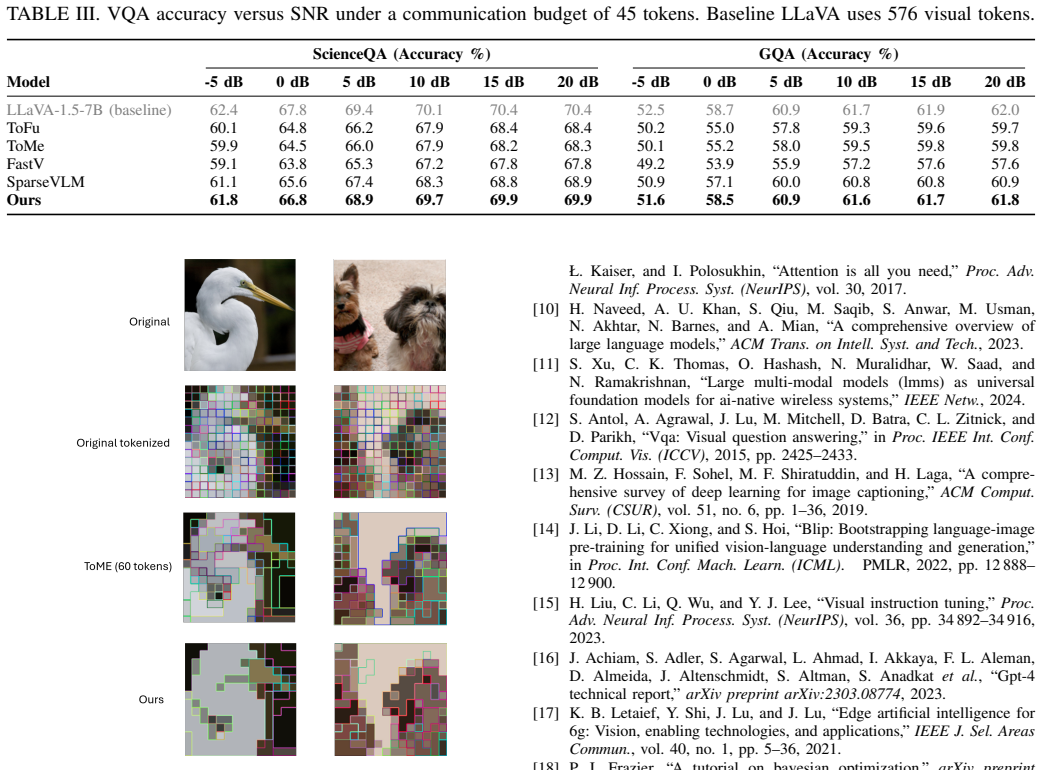
The central claim is that a transformer's tokens can be merged at each layer based on cosine similarity between their Value vectors, with the merge decision governed by a threshold that varies per layer and adapts to input redundancy. The paper formulates the search over per-layer thresholds as a multi-objective Bayesian optimization problem, producing a Pareto front of policies that trade off task accuracy, computational cost, and communication cost. On ImageNet, the method matches the accuracy of the unmodified transformer with 30% fewer FLOPs and under 20% of the original communication cost; on visual question answering with LLaVA, it achieves competitive performance at less than one-thir
Load-bearing premise
At every layer, the cosine similarity between Value vectors reliably identifies which tokens are semantically redundant, so merging all pairs above a threshold never discards task-relevant information.
Editorial extensions
If this is right
- A single pretrained transformer can be deployed across tasks and channel conditions by selecting a different Pareto-optimal threshold policy at runtime, without retraining or modifying weights.
- The method reduces both encoder-side compute and transmitted token count, directly lowering latency and bandwidth in edge-to-cloud semantic communication systems.
- More aggressive merging improves privacy against model inversion attacks, quantified by lower SSIM of reconstructed inputs, while trading off accuracy.
- The adaptive policy outperforms fixed-ratio, uniform, and random token-reduction baselines at matched compute budgets, especially in the low-compute and low-SNR regimes.
- The discovered Pareto fronts show diminishing returns: accuracy saturates beyond roughly 7–8 GFLOPs and 25–30 tokens for ImageNet, and beyond 30–55 GFLOPs and 5–45 tokens for VQA, identifying practical operating points.
Reading between the lines
- If the similarity-threshold proxy is sound, the same mechanism could extend to other token-based modalities (audio, point clouds, video) where spatial or temporal redundancy dominates, yielding similar training-free compression gains.
- The observed variance in SSIM for policies with similar accuracy and communication cost suggests that explicitly adding a privacy objective to the Bayesian optimization could discover policies that are both accurate and more private—an extension the paper only hints at.
- The method could be combined with lightweight learnable merging modules or hardware-aware objectives (latency, energy) to push the Pareto front further, provided the training-free property is relaxed.
- A direct information-theoretic comparison of the merging decisions could test whether cosine similarity of Value vectors is the right redundancy measure; if not, a different similarity kernel might yield even better trade-offs.
Editorial analysis
A structured set of objections, weighed in public.
Referee Report
Summary. The paper proposes a training-free, adaptive token-merging framework for transformer-based semantic communication at the edge. A per-layer cosine-similarity threshold governs which tokens are merged via norm-weighted averaging, so the number of surviving tokens is data-dependent. The per-layer thresholds are treated as a multi-objective policy searched by Bayesian optimization (Matérn GP surrogates and EHVI) to trade off task accuracy, FLOPs, and transmitted-token count. The framework is evaluated on ImageNet classification with a ViT-B/16 backbone and on GQA/ScienceQA with LLaVA-v1.5, using a fixed SwinJSCC codec over AWGN channels. The authors report matching unmodified-transformer accuracy at substantially reduced compute and communication, improved robustness across SNRs, and inherent privacy gains against model-inversion attacks.
Significance. If the claims hold, this is a practically valuable contribution: it is training-free, plug-and-play, and offers a principled way to navigate accuracy-efficiency-communication trade-offs for edge semantic communication. The formulation of adaptive merging as multi-objective Bayesian optimization is sensible, and the paper provides useful ablations (BO vs. Sobol vs. random search), cross-task experiments, channel-robustness sweeps, and a privacy analysis. The main weakness is not the conceptual framework but the evaluation protocol: the thresholds are selected on subsets of the same validation sets later used to report final accuracy, and no uncertainty quantification is provided. These issues directly affect the reliability of the headline empirical claims.
major comments (3)
- [Sec. VI-D] The optimization protocol undermines the independence of the reported results. The paper states that Bayesian optimization is run on a randomly sampled subset of the validation data (500 ImageNet images; 250 GQA/ScienceQA samples) and that the Pareto-optimal policies are re-evaluated on the full validation sets. Since the full validation sets contain the optimization subsets, the reported Pareto fronts and headline numbers are not unbiased estimates of generalization. The 0.5–1.2% margins over baselines in Fig. 6 and Table II may reflect selection bias rather than method superiority, particularly because baselines are not given comparable hyperparameter tuning on validation labels. I recommend re-evaluating all methods on a disjoint held-out test split (or using nested cross-validation) and reporting the resulting numbers.
- [Sec. VII-B and Fig. 6] No error bars or multiple seeds are reported. The claimed improvements over ToMe/ToFu are on the order of 0.5–1.2 percentage points, which is small relative to typical run-to-run and validation-sample variability in ImageNet and VQA evaluations. Without standard deviations or confidence intervals over at least three independent runs (or bootstrap resampling of the validation set), the statement that the method 'matches the accuracy of the unmodified transformer with 30% fewer FLOPs' is not statistically verifiable. This is a load-bearing issue for an empirical systems claim.
- [Sec. V-A, Eqs. (13)–(15)] The merging heuristic relies on the untested assumption that cosine similarity between Value vectors is a sufficient proxy for semantic redundancy at every layer. Because the thresholds are tuned on the evaluation distribution, the experiments cannot separate the effectiveness of this proxy from overfitting the thresholds to the validation labels. I suggest adding an ablation that fixes thresholds (e.g., a constant threshold or thresholds derived without labels) to show the proxy alone provides meaningful gains, or comparing against an alternative similarity measure (e.g., attention-based or embedding-distance based) under matched budgets.
minor comments (5)
- [Abstract] 'FLOPS' is a rate (operations per second), not a count; the abstract says '30% fewer floating-point operations per second' but the paper measures total FLOPs per forward pass. Reword to 'floating-point operations' or 'FLOPs'.
- [Sec. III-A, Eq. (3)] Communication cost is defined as the number of transmitted tokens, but the JSCC encoder maps tokens to q channel symbols. Clarify whether q is exactly proportional to token count or whether JSCC introduces additional compression; this affects the 'under 20% communication cost' claim.
- [Table II] The baseline is labeled 'ToFU' in the table but 'ToFu' in the text. Also, it would be useful to state the communication cost (tokens transmitted) for each model in the table, not just the compute budget, to support the 'one-tenth bandwidth' claim.
- [Sec. VII-D, Fig. 8] The privacy evaluation reports SSIM values for Pareto-optimal points but does not include a no-merging baseline (e.g., full 576 tokens) on the same figure. Adding such a reference point would better quantify the privacy benefit.
- [General] The paper repeatedly calls the method 'novel' and 'first' (e.g., Sec. I); the related work section is thorough, but some claims are stronger than the evidence. Softening these statements would improve accuracy.
Circularity Check
No circular dependency: the paper's claims are empirical and the threshold-search protocol, while risking selection bias, does not reduce by construction to the reported metrics.
full rationale
The paper contains no derivation that equates an output to an input by construction. Token merging is defined operationally (Eqs. 13-16): similarity thresholds decide merges; FLOPs and communication cost are computed from resulting token counts; accuracy is measured externally on ImageNet/GQA/ScienceQA. The Bayesian optimization in Sec. VI-D fits thresholds to a random subset of validation data and re-evaluates on full validation; this is disclosed and creates possible selection bias, but it is not circular in the sense of a fitted parameter being renamed as a prediction, because the reported numbers are evaluations on validation data, not deductions from the surrogate. The few self-citations ([1], [8]) are disclosure/related work and are not load-bearing. No uniqueness theorem, ansatz-by-citation, or renaming pattern is present. Internal limitations (e.g., the cosine-similarity proxy is a heuristic) are correctness risks, not circularity.
Assumptions & free parameters
free parameters (3)
- per-layer similarity thresholds tau_l =
Pareto-optimal vectors in [0.5,1]^L, task-specific, not listed numerically in text
- Bayesian optimization hyperparameters (n0, evaluation budget T, kernel priors) =
not fully specified
- Communication budget in tokens (35 or 45) =
35 tokens (Fig. 7), 45 tokens (Table III)
assumptions (4)
- domain assumption Token pairs with cosine similarity above a threshold are semantically redundant and can be averaged without harming task accuracy.
- domain assumption Norm-weighted averaging of source and destination token embeddings preserves the information needed by the task head.
- domain assumption Communication cost equals the number of surviving tokens, i.e., each token maps to exactly one channel symbol through SwinJSCC.
- domain assumption The SwinJSCC encoder/decoder, trained with random-SNR augmentation and fixed, generalizes across -5 to 20 dB SNRs for merged token sequences.
Cite this review
Pith. "Pith review of Adaptive Token Merging for Efficient Transformer Semantic Communication at the Edge." pith.science (2026). https://pith.science/paper/TL7YQ72F
@misc{pith2026250909955,
  author       = {Pith},
  title        = {Pith review of: Adaptive Token Merging for Efficient Transformer Semantic Communication at the Edge},
  year         = {2026},
  howpublished = {\url{https://pith.science/paper/TL7YQ72F}},
  note         = {Machine review of arXiv:2509.09955}
}
read the original abstract
Large-scale transformers are central to modern semantic communication, yet their high computational and communication costs hinder deployment on resource-constrained edge devices. This paper introduces a training-free framework for adaptive token merging, a novel mechanism that compresses transformer representations at runtime by selectively merging semantically redundant tokens under per-layer similarity thresholds. Unlike prior fixed-ratio reduction, our approach couples merging directly to input redundancy, enabling data-dependent adaptation that balances efficiency and task relevance without retraining. We cast the discovery of merging strategies as a multi-objective optimization problem and leverage Bayesian optimization to obtain Pareto-optimal trade-offs between accuracy, inference cost, and communication cost. On ImageNet classification, we match the accuracy of the unmodified transformer with 30\% fewer floating-point operations per second and under 20\% of the original communication cost, while for visual question answering our method achieves performance competitive with the full LLaVA model at less than one-third of the compute and one-tenth of the bandwidth. Finally, we show that our adaptive merging is robust across varying channel conditions and provides inherent privacy benefits, substantially degrading the efficacy of model inversion attacks. Our framework provides a practical and versatile solution for deploying powerful transformer models in resource-limited edge intelligence scenarios.
Figures


Figures from the paper (6 more)


Forward citations
Cited by 1 Pith paper
-
AirTF: Over-the-Air Token Fusion for Task-Oriented Multi-Modal Token Communications
Concurrent over-the-air fusion of spatially aligned ViT tokens from multi-modal sensors improves semantic segmentation mIoU and spectral efficiency versus orthogonal and CNN baselines.
Reference graph
Works this paper leans on
-
[1]
O. Erak, O. Alhussein, H. Abou-Zeid, and M. Bennis, “Adaptive pareto-optimal token merging for edge transformer TABLE III. VQA accuracy versus SNR under a communication budget of 45 tokens. Baseline LLaV A uses 576 visual tokens. ScienceQA (Accuracy %) GQA (Accuracy %) Model -5 dB 0 dB 5 dB 10 dB 15 dB 20 dB -5 dB 0 dB 5 dB 10 dB 15 dB 20 dB LLaV A-1.5-7B...
arXiv 2025
-
[2]
A vision of 6G wireless systems: Applications, trends, technologies, and open research problems,
W. Saad, M. Bennis, and M. Chen, “A vision of 6G wireless systems: Applications, trends, technologies, and open research problems,”IEEE Netw., vol. 34, no. 3, pp. 134–142, 2020
2020
-
[3]
Semantic communications: Overview, open issues, and future research directions,
X. Luo, H.-H. Chen, and Q. Guo, “Semantic communications: Overview, open issues, and future research directions,”IEEE Wireless Commun., vol. 29, no. 1, pp. 210–219, 2022
2022
-
[4]
Less data, more knowledge: Building next generation semantic communication networks,
C. Chaccour, W. Saad, M. Debbah, Z. Han, and H. V . Poor, “Less data, more knowledge: Building next generation semantic communication networks,”IEEE Commun. Surveys Tuts., 2024
2024
-
[5]
Deep joint source- channel coding for wireless image transmission,
E. Bourtsoulatze, D. B. Kurka, and D. Gündüz, “Deep joint source- channel coding for wireless image transmission,”IEEE Trans. Cogn. Commun. Netw, vol. 5, no. 3, pp. 567–579, 2019
2019
-
[6]
Learning task-oriented communication for edge inference: An information bottleneck approach,
J. Shao, Y . Mao, and J. Zhang, “Learning task-oriented communication for edge inference: An information bottleneck approach,”IEEE J. Sel. Areas Commun., vol. 40, no. 1, pp. 197–211, 2021
2021
-
[7]
Privacy-preserving task-oriented semantic communications against model inversion attacks,
Y . Wang, S. Guo, Y . Deng, H. Zhang, and Y . Fang, “Privacy-preserving task-oriented semantic communications against model inversion attacks,” IEEE Trans. on Wireless Commun., vol. 23, no. 8, pp. 10 150–10 165, 2024
2024
-
[8]
Contrastive learning and adversar- ial disentanglement for task-oriented semantic communications,
O. Erak, O. Alhussein, and W. Tong, “Contrastive learning and adversar- ial disentanglement for task-oriented semantic communications,”arXiv preprint arXiv:2410.22784, 2024
arXiv 2024
Show all 52 references
-
[9]
Attention is all you need,
A. Vaswani, N. Shazeer, N. Parmar, J. Uszkoreit, L. Jones, A. N. Gomez, Ł. Kaiser, and I. Polosukhin, “Attention is all you need,”Proc. Adv. Neural Inf. Process. Syst. (NeurIPS), vol. 30, 2017
2017
-
[10]
A comprehensive overview of large language models,
H. Naveed, A. U. Khan, S. Qiu, M. Saqib, S. Anwar, M. Usman, N. Akhtar, N. Barnes, and A. Mian, “A comprehensive overview of large language models,”ACM Trans. on Intell. Syst. and Tech., 2023
2023
-
[11]
Large multi-modal models (lmms) as universal foundation models for ai-native wireless systems,
S. Xu, C. K. Thomas, O. Hashash, N. Muralidhar, W. Saad, and N. Ramakrishnan, “Large multi-modal models (lmms) as universal foundation models for ai-native wireless systems,”IEEE Netw., 2024
2024
-
[12]
Vqa: Visual question answering,
S. Antol, A. Agrawal, J. Lu, M. Mitchell, D. Batra, C. L. Zitnick, and D. Parikh, “Vqa: Visual question answering,” inProc. IEEE Int. Conf. Comput. Vis. (ICCV), 2015, pp. 2425–2433
2015
-
[13]
A compre- hensive survey of deep learning for image captioning,
M. Z. Hossain, F. Sohel, M. F. Shiratuddin, and H. Laga, “A compre- hensive survey of deep learning for image captioning,”ACM Comput. Surv. (CSUR), vol. 51, no. 6, pp. 1–36, 2019
2019
-
[14]
Blip: Bootstrapping language-image pre-training for unified vision-language understanding and generation,
J. Li, D. Li, C. Xiong, and S. Hoi, “Blip: Bootstrapping language-image pre-training for unified vision-language understanding and generation,” inProc. Int. Conf. Mach. Learn. (ICML). PMLR, 2022, pp. 12 888– 12 900
2022
-
[15]
Visual instruction tuning,
H. Liu, C. Li, Q. Wu, and Y . J. Lee, “Visual instruction tuning,”Proc. Adv. Neural Inf. Process. Syst. (NeurIPS), vol. 36, pp. 34 892–34 916, 2023
2023
-
[16]
Gpt-4 technical report,
J. Achiam, S. Adler, S. Agarwal, L. Ahmad, I. Akkaya, F. L. Aleman, D. Almeida, J. Altenschmidt, S. Altman, S. Anadkatet al., “Gpt-4 technical report,”arXiv preprint arXiv:2303.08774, 2023
2023 arXiv
-
[17]
Edge artificial intelligence for 6g: Vision, enabling technologies, and applications,
K. B. Letaief, Y . Shi, J. Lu, and J. Lu, “Edge artificial intelligence for 6g: Vision, enabling technologies, and applications,”IEEE J. Sel. Areas Commun., vol. 40, no. 1, pp. 5–36, 2021
2021
-
[18]
A tutorial on bayesian optimization,
P. I. Frazier, “A tutorial on bayesian optimization,”arXiv preprint arXiv:1807.02811, 2018
2018 arXiv
-
[19]
Model inversion attacks that exploit confidence information and basic countermeasures,
M. Fredrikson, S. Jha, and T. Ristenpart, “Model inversion attacks that exploit confidence information and basic countermeasures,” inProc. 22nd ACM SIGSAC Conf. Comput. Commun. Secur. (CCS), 2015, pp. 1322–1333
2015
-
[20]
Edge ai: On-demand acceler- ating deep neural network inference via edge computing,
E. Li, L. Zeng, Z. Zhou, and X. Chen, “Edge ai: On-demand acceler- ating deep neural network inference via edge computing,”IEEE Trans. Wireless Commun., vol. 19, no. 1, pp. 447–457, 2019
2019
-
[21]
Energy-aware inference offloading for dnn-driven applications in mobile edge clouds,
Z. Xu, L. Zhao, W. Liang, O. F. Rana, P. Zhou, Q. Xia, W. Xu, and G. Wu, “Energy-aware inference offloading for dnn-driven applications in mobile edge clouds,”IEEE Trans. Parallel Distrib. Syst., vol. 32, pp. 799–814, 2020
2020
-
[22]
Partial offloading scheduling and power allocation for mobile edge computing systems,
Z. Kuang, L. Li, J. Gao, L. Zhao, and A. Liu, “Partial offloading scheduling and power allocation for mobile edge computing systems,” IEEE Internet Things J., vol. 6, no. 4, pp. 6774–6785, 2019
2019
-
[23]
Swinjscc: Taming swin transformer for deep joint source-channel coding,
K. Yang, S. Wang, J. Dai, X. Qin, K. Niu, and P. Zhang, “Swinjscc: Taming swin transformer for deep joint source-channel coding,”IEEE Trans. Cogn. Commun. Netw., 2024
2024
-
[24]
Token communications: A unified framework for cross-modal context-aware semantic communications,
L. Qiao, M. B. Mashhadi, Z. Gao, R. Tafazolli, M. Bennis, and D. Niyato, “Token communications: A unified framework for cross-modal context-aware semantic communications,”arXiv preprint arXiv:2502.12096, 2025
2025 arXiv
-
[25]
Toward intelligent communications: Large model empowered semantic communications,
H. Xie, Z. Qin, X. Tao, and Z. Han, “Toward intelligent communications: Large model empowered semantic communications,”IEEE Commun. Mag., vol. 63, no. 1, pp. 69–75, 2025
2025
-
[26]
Adaptive semantic token selection for ai-native goal-oriented commu- nications,
A. Devoto, S. Petruzzi, J. Pomponi, P. D. Lorenzo, and S. Scardapane, “Adaptive semantic token selection for ai-native goal-oriented commu- nications,”arXiv preprint arXiv:2405.02330, 2024
2024 arXiv
-
[27]
Token merging: Your vit but faster,
D. Bolya, C.-Y . Fu, X. Dai, P. Zhang, C. Feichtenhofer, and J. Hoff- man, “Token merging: Your vit but faster,” inProc. Int. Conf. Learn. Represent., 2023
2023
-
[28]
Adaptive sparse vit: towards learnable adaptive token pruning by fully exploiting self-attention,
X. Liu, T. Wu, and G. Guo, “Adaptive sparse vit: towards learnable adaptive token pruning by fully exploiting self-attention,” ser. Proc. Int. Joint Conf. Artif. Intell., 2023
2023
-
[29]
Token fusion: Bridging the gap between token pruning and token merging,
M. Kim, S. Gao, Y .-C. Hsu, Y . Shen, and H. Jin, “Token fusion: Bridging the gap between token pruning and token merging,” inProc. IEEE/CVF Winter Conf. Appl. Comput. Vis. (WACV), 2024, pp. 1383–1392
2024
-
[30]
An image is worth 1/2 tokens after layer 2: Plug-and-play inference acceleration for large vision-language models,
L. Chen, H. Zhao, T. Liu, S. Bai, J. Lin, C. Zhou, and B. Chang, “An image is worth 1/2 tokens after layer 2: Plug-and-play inference acceleration for large vision-language models,” inProc. Eur. Conf. Comput. Vis. (ECCV). Springer, 2024, pp. 19–35
2024
-
[31]
Sparsevlm: Visual token sparsification for efficient vision-language model inference,
Y . Zhang, C.-K. Fan, J. Ma, W. Zheng, T. Huang, K. Cheng, D. Gu- dovskiy, T. Okuno, Y . Nakata, K. Keutzeret al., “Sparsevlm: Visual token sparsification for efficient vision-language model inference,”arXiv preprint arXiv:2410.04417, 2024
2024 arXiv
-
[32]
Fit and prune: Fast and training- free visual token pruning for multi-modal large language models,
W. Ye, Q. Wu, W. Lin, and Y . Zhou, “Fit and prune: Fast and training- free visual token pruning for multi-modal large language models,” in Proc. AAAI Conf. Artif. Intell. (AAAI), vol. 39, no. 21, 2025, pp. 22 128– 22 136
2025
-
[33]
Latency-aware neural architecture search with multi-objective bayesian optimization,
D. Eriksson, P. I.-J. Chuang, S. Daulton, P. Xia, A. Shrivastava, A. Babu, S. Zhao, A. A. Aly, G. Venkatesh, and M. Balandat, “Latency-aware neural architecture search with multi-objective bayesian optimization,” inProc. 8th Int. Conf. Mach. Learn. (ICML) Workshop Autom. Mach....
2021
-
[34]
Adversarial examples: Attacks and defenses for deep learning,
X. Yuan, P. He, Q. Zhu, and X. Li, “Adversarial examples: Attacks and defenses for deep learning,”IEEE Trans. Neural Netw. Learn. Syst., vol. 30, no. 9, pp. 2805–2824, 2019
2019
-
[35]
Advflow: Incon- spicuous black-box adversarial attacks using normalizing flows,
H. Mohaghegh Dolatabadi, S. Erfani, and C. Leckie, “Advflow: Incon- spicuous black-box adversarial attacks using normalizing flows,”Proc. Adv. Neural Inf. Process. Syst. (NeurIPS), vol. 33, pp. 15 871–15 884, 2020
2020
-
[36]
On the computational complexity of self-attention,
F. D. Keles, P. M. Wijewardena, and C. Hegde, “On the computational complexity of self-attention,” inInt. Conf. Algorithmic Learn. Theory. PMLR, 2023, pp. 597–619
2023
-
[37]
A bayesian approach to constrained single-and multi-objective optimization,
P. Feliot, J. Bect, and E. Vazquez, “A bayesian approach to constrained single-and multi-objective optimization,”J. Global Optim., vol. 67, no. 1, pp. 97–133, 2017
2017
-
[38]
Classes of kernels for machine learning: a statistics perspective,
M. G. Genton, “Classes of kernels for machine learning: a statistics perspective,”J. Mach. Learn. Res., vol. 2, no. Dec, pp. 299–312, 2001
2001
-
[39]
Gaussian processes in machine learning,
C. E. Rasmussen, “Gaussian processes in machine learning,” inSummer school on machine learning. Springer, 2003, pp. 63–71
2003
-
[40]
Multi-objective optimisation using evolutionary algorithms: an introduction,
K. Deb, “Multi-objective optimisation using evolutionary algorithms: an introduction,” inMulti-objective evolutionary optimisation for product design and manufacturing. Springer, 2011, pp. 3–34
2011
-
[41]
Multiobjective evolutionary algorithms: a comparative case study and the strength pareto approach,
E. Zitzler and L. Thiele, “Multiobjective evolutionary algorithms: a comparative case study and the strength pareto approach,”IEEE Trans. Evol. Comput., vol. 3, no. 4, pp. 257–271, 2002
2002
-
[42]
Multi-objective bayesian global optimization using expected hypervolume improvement gradient,
K. Yang, M. Emmerich, A. Deutz, and T. Bäck, “Multi-objective bayesian global optimization using expected hypervolume improvement gradient,”Swarm Evol. Comput., vol. 44, pp. 945–956, 2019
2019
-
[43]
User preferences in bayesian multi- objective optimization: the expected weighted hypervolume improve- ment criterion,
P. Feliot, J. Bect, and E. Vazquez, “User preferences in bayesian multi- objective optimization: the expected weighted hypervolume improve- ment criterion,” inProc. Int. Conf. Mach. Learn., Optim., Data Sci. Springer, 2018, pp. 533–544
2018
-
[44]
Differentiable expected hyper- volume improvement for parallel multi-objective bayesian optimization,
S. Daulton, M. Balandat, and E. Bakshy, “Differentiable expected hyper- volume improvement for parallel multi-objective bayesian optimization,” Proc. Adv. Neural Inf. Process. Syst. (NeurIPS), vol. 33, pp. 9851–9864, 2020
2020
-
[45]
Single-and multiobjective evolutionary optimization assisted by gaussian random field metamodels,
M. T. Emmerich, K. C. Giannakoglou, and B. Naujoks, “Single-and multiobjective evolutionary optimization assisted by gaussian random field metamodels,”IEEE Trans. Evol. Comput., vol. 10, no. 4, pp. 421– 439, 2006
2006
-
[46]
Masked autoencoders are scalable vision learners,
K. He, X. Chen, S. Xie, Y . Li, P. Dollár, and R. Girshick, “Masked autoencoders are scalable vision learners,” inProc. IEEE/CVF Conf. Comput. Vis. Pattern Recognit. (CVPR), 2022, pp. 16 000–16 009
2022
-
[47]
Learning transferable visual models from natural language supervision,
A. Radford, J. W. Kim, C. Hallacy, A. Ramesh, G. Goh, S. Agarwal, G. Sastry, A. Askell, P. Mishkin, J. Clarket al., “Learning transferable visual models from natural language supervision,” inProc. Int. Conf. Mach. Learn. (ICML). PmLR, 2021, pp. 8748–8763
2021
-
[48]
Distribution of points in a cube and approximate evaluation of integrals,
I. M. Sobol, “Distribution of points in a cube and approximate evaluation of integrals,”USSR Comput. Math. Math. Phys., vol. 7, pp. 86–112, 1967
1967
-
[49]
Imagenet: A large-scale hierarchical image database,
J. Deng, W. Dong, R. Socher, L.-J. Li, K. Li, and L. Fei-Fei, “Imagenet: A large-scale hierarchical image database,” inProc. IEEE Conf. Comput. Vis. Pattern Recognit., 2009, pp. 248–255
2009
-
[50]
Gqa: A new dataset for real- world visual reasoning and compositional question answering,
D. A. Hudson and C. D. Manning, “Gqa: A new dataset for real- world visual reasoning and compositional question answering,” inProc. IEEE/CVF Conf. Comput. Vis. Pattern Recognit. (CVPR), 2019, pp. 6700–6709
2019
-
[51]
Learn to explain: Multimodal reasoning via thought chains for science question answering,
P. Lu, S. Mishra, T. Xia, L. Qiu, K.-W. Chang, S.-C. Zhu, O. Tafjord, P. Clark, and A. Kalyan, “Learn to explain: Multimodal reasoning via thought chains for science question answering,”Adv. Neural Inf. Process. Syst. (NeurIPS), vol. 35, pp. 2507–2521, 2022
2022
-
[52]
Image quality assessment: from error visibility to structural similarity,
Z. Wang, A. C. Bovik, H. R. Sheikh, and E. P. Simoncelli, “Image quality assessment: from error visibility to structural similarity,”IEEE Trans. Image Process., vol. 13, no. 4, pp. 600–612, 2004
2004
Reviewed August 4, 2026 · model on record in the stance chip above.
Discussion (0). Sign in to comment.