REVIEW 4 major objections 6 minor 52 references
ReFine, a two-component framework, outperforms state-of-the-art tabular data generators in low-data regimes by combining random-forest-derived rules with dual-granularity filtering.
Reviewed by Pith at T0; open to challenge. T0 means a machine referee read the full paper against a public rubric. the ladder, T0–T4 →
T0 review · deepseek-v4-flash
2026-08-04 18:23 UTC pith:Q5PSKN7K
load-bearing objection Solid, novel framework for low-data tabular generation, but the paper's own tables contradict its 'best on every task' claim and the retention schedule is fit on the evaluation datasets. the 4 major comments →
Limited Reference, Reliable Generation: A Two-Component Framework for Tabular Data Generation in Low-Data Regimes
The pith
A machine-rendered reading of the paper's core claim, the machinery that carries it, and where it could break.
Core claim
On its own terms, the paper claims that a two-component framework, ReFine, solves the two failure modes of prompt-based LLM tabular generation in low-data regimes. The first component trains a random forest on the small real dataset, selects the top-3 trees by training accuracy, extracts their root-to-leaf paths, and uses an LLM with self-consistency (5 runs, majority vote) to merge and aggregate these paths into one conjunctive 'if [label] then conditions' rule per class or regression interval; these rules are embedded into the generation prompt. The second component estimates localized redundancy by assigning each synthetic sample to its nearest real training seed via Distance to Closest R
What carries the argument
The framework is carried by two mechanisms. (1) Rule-guided generation: symbolic 'if–then' rules extracted from the top-k trees of a random forest, unified through an LLM merge-and-aggregate step with self-consistency voting, are embedded into prompts to steer the LLM toward dataset-specific feature-label dependencies; the 'if [target]=t, then C1 and ... and Cm' form supports inverse reasoning. (2) Dual-granularity filtering: a proxy distribution is built by assigning each synthetic sample to its nearest real seed (DCR), and a Gini coefficient quantifies redundancy; the Gini ratio partitions samples into high/low frequency subsets, applies chunk-level retention (log-scaled) and instance-leve
Load-bearing premise
The entire filtering component assumes that the proxy distribution—built by assigning each synthetic sample to the nearest real training seed and measuring Gini inequality—truthfully reflects which regions of feature space are over-sampled; if that proxy is wrong, the filter could keep redundant samples or discard rare useful ones.
What would settle it
Run ReFine on a dataset with known modality structure, generate synthetic data, and compute both the DCR-Gini proxy distribution and a non-parametric density estimate (e.g., kernel density estimation on the synthetic points). If the Spearman rank correlation between the two estimated mode frequencies is low (<0.5), and filtering based on the direct density estimate yields higher downstream F1/R2 than the DCR-Gini filter, then the load-bearing assumption is falsified.
If this is right
- ReFine improves downstream task performance in low-data regimes without any fine-tuning of the LLM, so the approach can be used with API-only models.
- The gains are consistent across seen and unseen datasets, indicating the method reduces reliance on the LLM's pretraining memory of the dataset.
- The ablation shows both rule-guided generation and dual-granularity filtering contribute independently, and their combination is always at least as good as either alone.
- The rule-guiding step transfers across LLMs: rules generated by a weaker model improve a stronger model's synthetic data quality.
- The Gini-based redundancy measure is more stable and effective than entropy-based filtering in this pipeline.
Where Pith is reading between the lines
- The DCR-Gini proxy assumes that nearest-neighbor assignment to real seeds captures true sampling density; an obvious test is to compare it against direct density estimation of the synthetic distribution and use whichever better predicts downstream gains.
- The retention schedule ratio2 = 0.15 ln(ratio1) + 0.55 is empirically fitted and the paper itself notes it may not hold in extreme distributions; a data-driven or Bayesian schedule could extend the framework.
- Since the reference model for both filtering and surprisal is XGBoost, the framework's performance may be partially tied to that model family; testing with a different model (e.g., logistic regression) would reveal whether the filter is model-agnostic.
- The 'unseen dataset' analysis argues that some prior LLM methods' gains come from memorization; this motivates a standardized contamination check for future tabular generation benchmarks.
Editorial analysis
A structured set of objections, weighed in public.
Referee Report
Summary. The paper proposes ReFine, a two-component framework for tabular data generation in low-data regimes. Component I extracts symbolic if-then rules from top-performing decision trees of a random forest, merges and aggregates them via LLM self-consistency, and embeds them into prompts to guide LLM generation. Component II applies dual-granularity filtering: chunk-level pruning of high-frequency synthetic samples and instance-level retention of low-frequency samples, with quantities controlled by a Gini-based redundancy score and a log-scaled retention function. The authors evaluate on eight datasets with training sizes 30, 60, and 90, reporting F1/R2 of downstream XGBoost models trained on synthetic data and tested on real data. The central claim is that ReFine consistently outperforms state-of-the-art baselines and attains the best score on every task, with average rank 1.6.
Significance. If the empirical claims were fully supported, this would be a useful contribution to the low-data tabular synthesis literature. The two challenges identified (distributional drift and localized redundancy) are well motivated, and the idea of combining symbolic rule guidance with distribution-aware filtering is reasonable and practically relevant. The authors also take data contamination seriously by using memorization tests and including unseen datasets, which is a strength. The ablations of rule format, aggregation strategy, and filtering granularity provide insight. However, the paper's own tables contradict the strongest claims, and the calibration of key filtering constants on the evaluation datasets raises a circularity concern. The contribution is therefore promising but needs substantial empirical and presentational revision before the claims are credible.
major comments (4)
- [Sec. V-D, Table III] The statement 'ReFine attains the best score on every task, with an average rank of 1.6' is not supported by Table III under the natural row-level reading. Several rows show the full I+II method losing to a baseline or to one of its own components: Apple n=60 (64.21 vs EPIC 68.92 and CLLM 68.60), Adult n=90 (72.87 vs CLLM 74.11 and Component I alone 78.45), Heart n=90 (80.08 vs TABSYN 81.43 and Component I alone 82.44), Farm n=30 (-0.30 vs CLLM -0.29 and Component II alone -0.23), Disease n=90 (72.86 vs CLLM 74.04). Similarly, Table VII contradicts the claim that dual-granularity filtering 'consistently achieves the best downstream performance across all datasets and data regimes': for Student n=30, instance-level filtering alone yields 0.39 vs dual-granularity 0.38. The average rank may be defensible under a different aggregation convention, but the central claim of consistent superiori
- [Sec. IV-B, Eq. (6), Sec. V-F] The retention coefficients A=0.15 and B=0.55 are described as 'empirically set' and later as 'derived from cross-dataset regression' using the same datasets that appear in the main evaluation (Fig. 7 and Table VIII). If A and B are fitted on the evaluation datasets, the filtering outcome is partially determined by constants adapted to those datasets, making the reported gains circular. The conclusion itself acknowledges that the 'empirically derived logarithmic scaling' may limit generalizability. The authors should clarify exactly how A and B were calibrated, report whether the calibration data were held out from the evaluation, and provide a sensitivity analysis over A and B.
- [Algorithm 2, Eq. (8)] The pseudocode and text are inconsistent for the reference model M. In the text preceding Eq. (4), M is trained on D_train and used to compute correctness/confidence. In Algorithm 2 line 22, 'Train reference model M on D_aug(S)' reuses the symbol M for a model trained on the filtered augmented data. If the same M is used both for line 19 filtering scores and line 22 surprisal, the filtering and selection are coupled; if they are different models, the notation should be changed. Moreover, selecting the chunk size by minimizing surprisal on D_train is a form of validation on the training set; the authors should justify that this does not overfit the filter to D_train, especially because the final downstream model is also evaluated after training on the resulting D_aug.
- [Sec. V-D, Table III] No statistical tests are reported. Many differences in Table III are small relative to the reported standard deviations (e.g., Disease n=30: 70.47 vs 62.07 for Component II-only; Student n=30: 0.38 vs 0.39 for instance-level-only). The paper should report paired tests across the 10 seeds, at least for the primary comparisons against CLLM and against each component, and specify how the average rank in the last row is computed (e.g., per dataset, per n, or per row). Without this, claims of 'consistent improvement' and 'best on every task' are not statistically grounded.
minor comments (6)
- [Abstract / Intro] The abstract claims ReFine 'consistently outperforms state-of-the-art methods'; this overstates the results in Table III. Consider wording such as 'outperforms on average' or 'achieves the best average rank'.
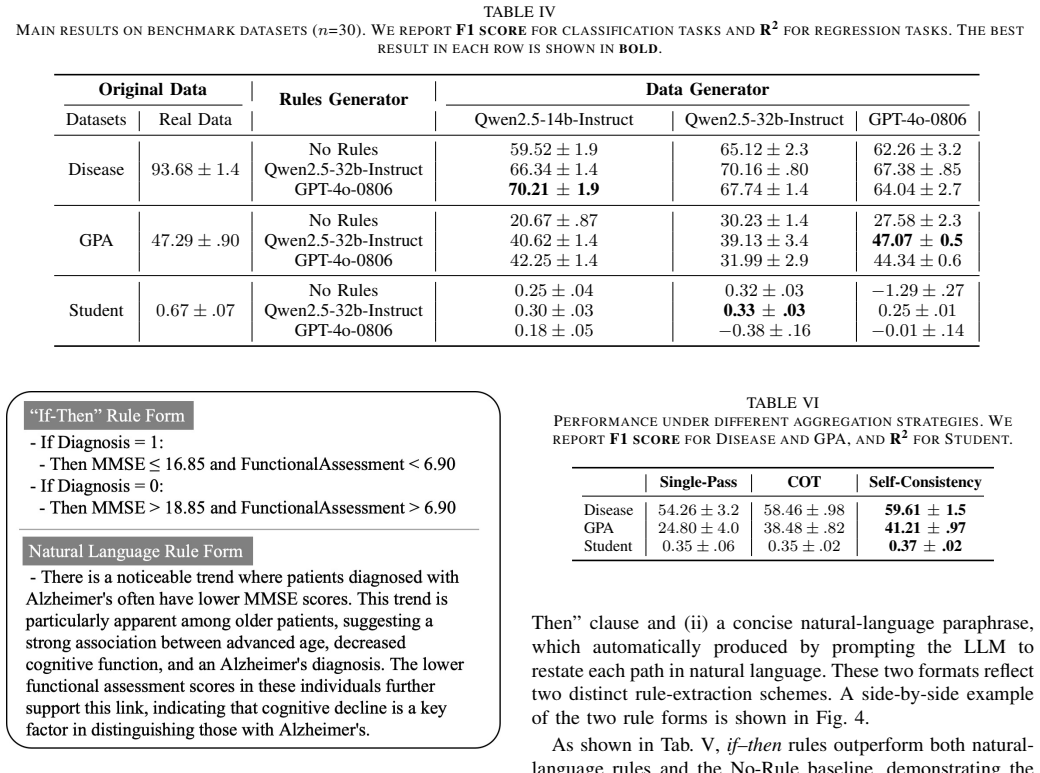
- [Table VII caption] The caption says 'PERFORMANCE UNDER DIFFERENT AGGREGATION STRATEGIES' but the table compares instance-level, chunk-level, and dual-granularity filtering strategies, not aggregation strategies. Rename the caption.
- [Algorithm 2] Line 19 uses Conf(x) and Uncert(x) and thresholds Conf_thresh / Uncert_thresh from Eq. (7), but these thresholds are not defined in the pseudocode. Adding them would make the algorithm self-contained.
- [Sec. V-C] The setup text says 'GPT-3.5-Turbo-1106 for rules generation' but the Section V ablations use GPT-4o-0806 as the rule generator. Clarify which backbone is used for the main results and which for ablations.
- [Eq. (4)] The notation P_M^t(y|x) is not formally defined. It should specify that this is the predictive probability assigned to the true label y by the reference model at epoch t.
- [Fig. 7] The scatter plot lacks axis labels for both axes and any legend explaining the color scale. The caption mentions lighter/darker colors but no color bar is visible. Please improve the figure legibility.
Circularity Check
Main results partly circular: retention coefficients A,B are fit on the same benchmark datasets used for evaluation.
specific steps
-
fitted input called prediction
[Sec. IV-B.2.1 (Eq. 6) and Sec. V-F.2]
"ratio2 = Aln(ratio1) + B, (6) ... The coefficients A=0.15 and B=0.55 are empirically set, see Sec. V-F for details. ... As a result, the coefficients A=0.15 and B=0.55, derived from cross-dataset regression, generalize well without tuning."
The retention ratio ratio2 directly controls how many chunks of the high-frequency synthetic subset survive filtering, and therefore determines the composition of D_aug and the downstream MLE scores. The paper states that A and B are 'derived from cross-dataset regression' on the same benchmark datasets whose results in Table III are then used to claim that ReFine 'attains the best score on every task.' Thus the headline improvement is not a parameter-free prediction; it is partly an artifact of fitting the filter's retention schedule to the evaluation datasets. This is not fully definitional because A,B do not by themselves fix the win margins, but it is a fitted-input-called-prediction pattern.
full rationale
No self-citation, no imported uniqueness theorem, and no definitional equality were found. The two components are empirical heuristics: rule extraction from trees and DCR-based Gini filtering are not tautologically tied to the downstream metrics. The main circularity concern is the empirically fitted retention coefficients A,B: they are fit on the same benchmark datasets used for the main evaluation and then applied to those datasets, so the evaluation is partially self-referential. This is a hyperparameter-tuning-on-test-set issue rather than a logical equivalence. Separately, the paper's claim that ReFine 'attains the best score on every task' is not supported by its own Table III (e.g., Farm n=30: I+II -0.30 vs II alone -0.23 and CLLM -0.29; Apple n=60: 64.21 vs EPIC 68.92; Adult n=90: 72.87 vs Component I 78.45), but that is an internal-consistency/correctness problem, not circularity. Overall the derivation is not circular by definition; the fitted constants create partial evaluation circularity, hence score 4.
Axiom & Free-Parameter Ledger
free parameters (8)
- A (log-retention slope) =
0.15
- B (log-retention intercept) =
0.55
- top-k trees k =
3
- self-consistency runs G =
5
- chunk size S =
selected per dataset from {20,25,...,60}
- synthetic sample count M =
~2000
- T (epochs for correctness) =
not stated
- confidence threshold 0.5 =
0.5
axioms (5)
- domain assumption Tree-based models (random forests) capture feature-label dependencies in tabular data even with N=30 samples
- domain assumption LLMs can merge and aggregate if-then rules and generate rows consistent with those rules when prompted
- domain assumption Distance-to-closest-record (DCR) is a valid similarity measure for mixed-type tabular data
- domain assumption A reference model (XGBoost) trained on D_train provides reliable correctness, confidence, and uncertainty estimates for synthetic rows
- ad hoc to paper The retention function form ratio2 = A ln(ratio1) + B is appropriate across all datasets
Cite this review
Pith. "Pith review of Limited Reference, Reliable Generation: A Two-Component Framework for Tabular Data Generation in Low-Data Regimes." pith.science (2026). https://pith.science/paper/Q5PSKN7K
@misc{pith2026250909960,
  author       = {Pith},
  title        = {Pith review of: Limited Reference, Reliable Generation: A Two-Component Framework for Tabular Data Generation in Low-Data Regimes},
  year         = {2026},
  howpublished = {\url{https://pith.science/paper/Q5PSKN7K}},
  note         = {Machine review of arXiv:2509.09960}
}
read the original abstract
Synthetic tabular data generation is increasingly essential in machine learning, supporting downstream applications when real-world, high-quality tabular data is insufficient. Existing tabular generation approaches, such as generative adversarial networks (GANs) and fine-tuned Large Language Models (LLMs), typically require sufficient reference data, limiting their effectiveness in domain-specific datasets with scarce records. While prompt-based LLMs offer flexibility without parameter tuning, they often generate distributionally drifted data with localized redundancy, leading to degradation in downstream task performance. To overcome these issues, we propose ReFine, a framework that (i) extracts symbolic if-then rules from interpretable models and embeds them into prompts to explicitly guide the generation process toward the domain-specific distribution, and (ii) applies dual-granularity filtering that mitigates over-sampling patterns while preserving rare but informative samples to reduce localized redundancy. Extensive experiments on diverse benchmarks demonstrate that ReFine provides robust downstream utility, achieving a top-tier average rank across datasets and data regimes, with an average relative improvement of 7.48% in extreme low-data regimes.
Figures




Reference graph
Works this paper leans on
-
[1]
Google dataset search by the numbers,
O. Benjelloun, S. Chen, and N. Noy, “Google dataset search by the numbers,” inInternational semantic web conference. Springer, 2020, pp. 667–682
2020
-
[2]
Statistical relational tables for statistical database manage- ment,
S. P. Ghosh, “Statistical relational tables for statistical database manage- ment,”IEEE Transactions on Software Engineering, no. 12, pp. 1106– 1116, 2012
2012
-
[3]
A multi-task learning framework for reading comprehension of scientific tabular data,
X. Yang, M. Zhang, J. Fan, Z. Luo, and Y . Yang, “A multi-task learning framework for reading comprehension of scientific tabular data,” in 2024 IEEE 40th International Conference on Data Engineering (ICDE). IEEE, 2024, pp. 3710–3724
2024
-
[4]
S i 1 o f use: Cross- silo synthetic data generation with latent tabular diffusion models,
A. Shankar, H. Brouwer, R. Hai, and L. Chen, “S i 1 o f use: Cross- silo synthetic data generation with latent tabular diffusion models,” in 2024 IEEE 40th International Conference on Data Engineering (ICDE). IEEE, 2024, pp. 110–123
2024
-
[5]
Challenges and opportunities of generative models on tabular data,
A. X. Wang, S. S. Chukova, C. R. Simpson, and B. P. Nguyen, “Challenges and opportunities of generative models on tabular data,” Applied Soft Computing, p. 112223, 2024
2024
-
[6]
Kovalerchuk and E
B. Kovalerchuk and E. Vityaev,Data mining in finance: advances in relational and hybrid methods. Springer Science & Business Media, 2005, vol. 547
2005
-
[7]
Differential privacy and machine learning: a survey and review,
Z. Ji, Z. C. Lipton, and C. Elkan, “Differential privacy and machine learning: a survey and review,”arXiv preprint arXiv:1412.7584, 2014
Pith/arXiv arXiv 2014
-
[8]
Syn- thetic data generation for tabular health records: A systematic review,
M. Hernandez, G. Epelde, A. Alberdi, R. Cilla, and D. Rankin, “Syn- thetic data generation for tabular health records: A systematic review,” Neurocomputing, vol. 493, pp. 28–45, 2022
2022
-
[9]
Modeling tabular data using conditional gan,
L. Xu, M. Skoularidou, A. Cuesta-Infante, and K. Veeramachaneni, “Modeling tabular data using conditional gan,”Advances in neural information processing systems, vol. 32, 2019
2019
-
[10]
Tabddpm: Modelling tabular data with diffusion models,
A. Kotelnikov, D. Baranchuk, I. Rubachev, and A. Babenko, “Tabddpm: Modelling tabular data with diffusion models,” inInternational Confer- ence on Machine Learning. PMLR, 2023, pp. 17 564–17 579
2023
-
[11]
Mixed-type tabular data synthesis with score-based diffusion in latent space,
H. Zhang, J. Zhang, B. Srinivasan, Z. Shen, X. Qin, C. Faloutsos, H. Rangwala, and G. Karypis, “Mixed-type tabular data synthesis with score-based diffusion in latent space,” inThe twelfth International Conference on Learning Representations, 2024
2024
-
[12]
Large language models (llms) on tabular data: Prediction, generation, and understanding–a survey,
X. Fang, W. Xu, F. A. Tan, J. Zhang, Z. Hu, Y . Qi, S. Nickleach, D. Socolinsky, S. Sengamedu, and C. Faloutsos, “Large language models (llms) on tabular data: Prediction, generation, and understanding–a survey,”arXiv preprint arXiv:2402.17944, 2024
Pith/arXiv arXiv 2024
-
[13]
Language mod- els are few-shot learners,
T. Brown, B. Mann, N. Ryder, M. Subbiah, J. D. Kaplan, P. Dhariwal, A. Neelakantan, P. Shyam, G. Sastry, A. Askellet al., “Language mod- els are few-shot learners,”Advances in neural information processing systems, vol. 33, pp. 1877–1901, 2020
1901
-
[14]
Large lan- guage models are zero-shot reasoners,
T. Kojima, S. S. Gu, M. Reid, Y . Matsuo, and Y . Iwasawa, “Large lan- guage models are zero-shot reasoners,”Advances in neural information processing systems, vol. 35, pp. 22 199–22 213, 2022
2022
-
[15]
Language models are realistic tabular data generators,
V . Borisov, K. Seßler, T. Leemann, M. Pawelczyk, and G. Kasneci, “Language models are realistic tabular data generators,” inICLR, 2023
2023
-
[16]
Curated llm: Synergy of llms and data curation for tabular augmentation in low- data regimes,
N. Seedat, N. Huynh, B. Van Breugel, and M. Van Der Schaar, “Curated llm: Synergy of llms and data curation for tabular augmentation in low- data regimes,”arXiv preprint arXiv:2312.12112, 2023
Pith/arXiv arXiv 2023
-
[17]
Fraud detection using machine learning and deep learning,
P. Raghavan and N. El Gayar, “Fraud detection using machine learning and deep learning,” in2019 international conference on computational intelligence and knowledge economy (ICCIKE). IEEE, 2019, pp. 334– 339
2019
-
[18]
Toward a unified framework for unsupervised complex tabular reasoning,
Z. Li, X. Li, Z. Duan, B. Dong, N. Liu, and J. Wang, “Toward a unified framework for unsupervised complex tabular reasoning,” in2023 IEEE 39th International Conference on Data Engineering (ICDE). IEEE, 2023, pp. 1691–1704
2023
-
[19]
A review on healthcare data privacy and security,
S. Bommareddy, J. A. Khan, R. Anandet al., “A review on healthcare data privacy and security,”Networking Technologies in Smart Health- care, pp. 165–187, 2022
2022
-
[20]
Metadiff: Meta-learning with conditional diffusion for few-shot learning,
B. Zhang, C. Luo, D. Yu, X. Li, H. Lin, Y . Ye, and B. Zhang, “Metadiff: Meta-learning with conditional diffusion for few-shot learning,” in Proceedings of the AAAI conference on artificial intelligence, vol. 38, no. 15, 2024, pp. 16 687–16 695
2024
-
[21]
Epic: Effective prompting for imbalanced- class data synthesis in tabular data classification via large language models,
J. Kim, T. Kim, and J. Choo, “Epic: Effective prompting for imbalanced- class data synthesis in tabular data classification via large language models,”Advances in Neural Information Processing Systems, vol. 37, pp. 31 504–31 542, 2024
2024
-
[22]
T. Zhong, Z. Yang, Z. Liu, R. Zhang, Y . Liu, H. Sun, Y . Pan, Y . Li, Y . Zhou, H. Jianget al., “Opportunities and challenges of large language models for low-resource languages in humanities research,” arXiv preprint arXiv:2412.04497, 2024
Pith/arXiv arXiv 2024
-
[23]
A systematic survey of prompt engineering in large language models: Techniques and applications,
P. Sahoo, A. K. Singh, S. Saha, V . Jain, S. Mondal, and A. Chadha, “A systematic survey of prompt engineering in large language models: Techniques and applications,”arXiv preprint arXiv:2402.07927, 2024
Pith/arXiv arXiv 2024
-
[24]
How realistic is your synthetic data? constraining deep generative models for tabular data,
M. C. Stoian, S. Dyrmishi, M. Cordy, T. Lukasiewicz, and E. Giunchiglia, “How realistic is your synthetic data? constraining deep generative models for tabular data,” inThe Twelfth International Conference on Learning Representations, 2024
2024
-
[25]
Prompt design and engineering: Introduction and ad- vanced methods,
X. Amatriain, “Prompt design and engineering: Introduction and ad- vanced methods,”arXiv preprint arXiv:2401.14423, 2024
Pith/arXiv arXiv 2024
-
[26]
Pre- train, prompt, and predict: A systematic survey of prompting methods in natural language processing,
P. Liu, W. Yuan, J. Fu, Z. Jiang, H. Hayashi, and G. Neubig, “Pre- train, prompt, and predict: A systematic survey of prompting methods in natural language processing,”ACM computing surveys, vol. 55, no. 9, pp. 1–35, 2023
2023
-
[27]
Frequency balanced datasets lead to better language models,
R. Zevallos, M. Farr ´us, and N. Bel, “Frequency balanced datasets lead to better language models,” inFindings of the Association for Computational Linguistics: EMNLP 2023, 2023, pp. 7859–7872
2023
-
[28]
Harmonic: Harnessing llms for tabular data synthesis and privacy protection,
Y . Wang, D. Feng, Y . Dai, Z. Chen, J. Huang, S. Ananiadou, Q. Xie, and H. Wang, “Harmonic: Harnessing llms for tabular data synthesis and privacy protection,” inThe Thirty-eight Conference on Neural Information Processing Systems Datasets and Benchmarks Track, 2024
2024
-
[29]
Large language models (llms) on tabular data: Prediction, generation, and understanding - a survey,
X. Fang, W. Xu, F. A. Tan, J. Zhang, Z. Hu, Y . J. Qi, S. Nickleach, D. Socolinsky, S. Srinivasan Sengamedu, and C. Faloutsos, “Large language models (llms) on tabular data: Prediction, generation, and understanding - a survey,”Transactions on Machine Learning Research, 2024
2024
-
[30]
Why do tree-based models still outperform deep learning on typical tabular data?
L. Grinsztajn, E. Oyallon, and G. Varoquaux, “Why do tree-based models still outperform deep learning on typical tabular data?”Advances in neural information processing systems, vol. 35, pp. 507–520, 2022
2022
-
[31]
Tabular data: Deep learning is not all you need,
R. Shwartz-Ziv and A. Armon, “Tabular data: Deep learning is not all you need,”Information Fusion, vol. 81, pp. 84–90, 2022
2022
-
[32]
Hierarchical pruning of deep ensembles with focal diversity,
Y . Wu, K.-H. Chow, W. Wei, and L. Liu, “Hierarchical pruning of deep ensembles with focal diversity,”ACM Transactions on Intelligent Systems and Technology, vol. 15, no. 1, pp. 1–24, 2024
2024
-
[33]
Pruning of random forest classifiers: A survey and future directions,
V . Y . Kulkarni and P. K. Sinha, “Pruning of random forest classifiers: A survey and future directions,” in2012 International Conference on Data Science & Engineering (ICDSE). IEEE, 2012, pp. 64–68
2012
-
[34]
A novel ensemble learning method using majority based voting of multiple selective decision trees,
M. Azad, T. H. Nehal, and M. Moshkov, “A novel ensemble learning method using majority based voting of multiple selective decision trees,” Computing, vol. 107, no. 1, p. 42, 2025
2025
-
[35]
A review of ensemble learning and data augmentation models for class imbalanced problems: Combination, implementation and evaluation,
A. A. Khan, O. Chaudhari, and R. Chandra, “A review of ensemble learning and data augmentation models for class imbalanced problems: Combination, implementation and evaluation,”Expert Systems with Applications, vol. 244, p. 122778, 2024
2024
-
[36]
Self-consistency improves chain of thought reasoning in language models,
X. Wang, J. Wei, D. Schuurmans, Q. V . Le, E. H. Chi, S. Narang, A. Chowdhery, and D. Zhou, “Self-consistency improves chain of thought reasoning in language models,” inThe Eleventh International Conference on Learning Representations, 2023
2023
-
[37]
Robust learning meets generative models: Can proxy dis- tributions improve adversarial robustness?
V . Sehwag, S. Mahloujifar, T. Handina, S. Dai, C. Xiang, M. Chiang, and P. Mittal, “Robust learning meets generative models: Can proxy dis- tributions improve adversarial robustness?” inInternational Conference on Learning Representations, 2021
2021
-
[38]
Improving adversarial robustness using proxy distributions,
——, “Improving adversarial robustness using proxy distributions,” arXiv preprint arXiv:2104.09425, vol. 1, 2021
Pith/arXiv arXiv 2021
-
[39]
A survey on llm-generated text detection: Necessity, methods, and future directions,
J. Wu, S. Yang, R. Zhan, Y . Yuan, L. S. Chao, and D. F. Wong, “A survey on llm-generated text detection: Necessity, methods, and future directions,”Computational Linguistics, pp. 1–66, 2025
2025
-
[40]
Privacy mechanisms and evaluation metrics for synthetic data generation: A systematic review,
P. A. Osorio-Marulanda, G. Epelde, M. Hernandez, I. Isasa, N. M. Reyes, and A. B. Iraola, “Privacy mechanisms and evaluation metrics for synthetic data generation: A systematic review,”IEEE Access, 2024
2024
-
[41]
Synthetic data privacy metrics,
A. Steier, L. Ramaswamy, A. Manoel, and A. Haushalter, “Synthetic data privacy metrics,”arXiv preprint arXiv:2501.03941, 2025
Pith/arXiv arXiv 2025
-
[42]
Gintropy: Gini index based generalization of entropy,
T. S. Bir ´o and Z. N ´eda, “Gintropy: Gini index based generalization of entropy,”Entropy, vol. 22, no. 8, p. 879, 2020
2020
-
[43]
A guide to formulating fairness in an optimization model,
V . Xinying Chen and J. N. Hooker, “A guide to formulating fairness in an optimization model,”Annals of Operations Research, vol. 326, no. 1, pp. 581–619, 2023
2023
-
[44]
J. Chen, Y . Zhang, B. Wang, W. X. Zhao, J.-R. Wen, and W. Chen, “Unveiling the flaws: exploring imperfections in synthetic data and mitigation strategies for large language models,”arXiv preprint arXiv:2406.12397, 2024
Pith/arXiv arXiv 2024
-
[45]
A systematic review of synthetic data generation techniques using generative ai,
M. Goyal and Q. H. Mahmoud, “A systematic review of synthetic data generation techniques using generative ai,”Electronics, vol. 13, no. 17, p. 3509, 2024
2024
-
[46]
Benchmark data contamination of large language models: A survey,
C. Xu, S. Guan, D. Greene, M. Kechadiet al., “Benchmark data contamination of large language models: A survey,”arXiv preprint arXiv:2406.04244, 2024
Pith/arXiv arXiv 2024
-
[47]
Detection of large language model contamination with tabular data,
B. Ronval, P. Dupont, and S. Nijssen, “Detection of large language model contamination with tabular data,” inInternational Symposium on Intelligent Data Analysis. Springer, 2025, pp. 234–245
2025
-
[48]
Elephants never forget: Memorization and learning of tabular data in large language models,
S. Bordt, H. Nori, V . Rodrigues, B. Nushi, and R. Caruana, “Elephants never forget: Memorization and learning of tabular data in large language models,” inConference on Language Modeling (COLM), 2024
2024
-
[49]
Xgboost: A scalable tree boosting system,
T. Chen and C. Guestrin, “Xgboost: A scalable tree boosting system,” inProceedings of the 22nd acm sigkdd international conference on knowledge discovery and data mining, 2016, pp. 785–794
2016
-
[50]
Faithful logical reasoning via symbolic chain-of-thought,
J. Xu, H. Fei, L. Pan, Q. Liu, M.-L. Lee, and W. Hsu, “Faithful logical reasoning via symbolic chain-of-thought,” inThe 62nd Annual Meeting of the Association for Computational Linguistics, 2024. [Online]. Available: https://arxiv.org/abs/2405.18357
Pith/arXiv arXiv 2024
-
[51]
Chain-of-thought prompting elicits reasoning in large language models,
J. Wei, X. Wang, D. Schuurmans, M. Bosma, F. Xia, E. Chi, Q. V . Le, D. Zhouet al., “Chain-of-thought prompting elicits reasoning in large language models,”Advances in neural information processing systems, vol. 35, pp. 24 824–24 837, 2022
2022
-
[52]
Decomposition of gini and the generalized entropy inequality measures,
S. Mussard, F. Seyte, and M. Terraza, “Decomposition of gini and the generalized entropy inequality measures,”Economics Bulletin, vol. 4, no. 7, pp. 1–6, 2003
2003
discussion (0)
Sign in with ORCID, Apple, or X to comment. Anyone can read and Pith papers without signing in.