REVIEW 6 major objections 5 minor 39 references
The paper claims that a federated multi-agent reinforcement learning framework can manage 6G edge resources across layers more effectively than centralized approaches, while keeping individual data private.
Reviewed by Pith at T0; open to challenge. T0 means a machine referee read the full paper against a public rubric. the ladder, T0–T4 →
FERMI-6G, a federated multi-agent DRQN framework with secure aggregation, reportedly improves latency, energy, reliability, and fairness over centralized and heuristic baselines in a simulated 6G edge network.
T0 review reviewed 2026-08-04 challenge →
load-bearing objection The framework is a coherent integration of known pieces, but the central comparison is invalid and the fairness numbers contradict each other; the claims in the abstract are not supported as presented. the 6 major comments →
Federated Multi-Agent Reinforcement Learning for Privacy-Preserving and Energy-Aware Resource Management in 6G Edge Networks
The pith
A machine-rendered reading of the paper's core claim, the machinery that carries it, and where it could break.
The reading
Core claim
On its own terms, the paper's central discovery is that a cross-layer, decentralized learning architecture—where each edge agent learns a DRQN-based policy over a composite action space (offloading, channel selection, CPU frequency) and synchronizes via a secure aggregation protocol based on elliptic-curve Diffie–Hellman key exchange and pairwise masks—can outperform centralized reinforcement learning and heuristic policies in a simulated 6G edge environment. The authors claim this holds across reliability, latency, energy efficiency, throughput, and scalability, and they trace the gains to the joint optimization of application-layer and MAC-layer decisions under partial observability. They
What carries the argument
The framework's load-bearing components are: (1) a Deep Recurrent Q-Network (DRQN) with LSTM layers that lets each agent act from partial local observations and temporal memory; (2) a composite action vector covering application-layer offloading, MAC-layer channel selection, and CPU frequency scaling; (3) a multi-objective reward function with normalized latency and energy, hybrid fairness (Jain's index plus channel-access entropy), reliability, spectral efficiency, and MAC success, plus dynamic penalties; and (4) a secure aggregation protocol using ECDH key exchange and AES masking so that only the average model is revealed. These pieces together turn the resource management problem into a
Load-bearing premise
The load-bearing premise is that the centralized RL baselines, which the authors had to train on simplified versions of the environment to avoid near-zero rewards and zero reliability, are faithful comparators to FERMI-6G; the paper itself concedes that direct quantitative comparisons between the two may be misleading because the performance differences partly reflect environment assumptions rather than learning strategies alone.
What would settle it
Run the centralized cross-layer RL baseline on the exact same full 6G simulation environment used for FERMI-6G, without simplification; if it achieves comparable reliability and reward, then the claimed advantage of the federated decentralized framework over centralized learning is not confirmed.
If this is right
- If the simulated gains transfer to real deployments, 6G edge networks could run task offloading and spectrum access without a central controller, cutting latency and avoiding a single point of failure.
- The privacy-preserving aggregation step means raw device data or gradients never leave the edge node, which would make compliance with data-protection regulations easier.
- Jointly learning offloading, channel, and CPU decisions appears to yield better energy efficiency than optimizing any layer alone, supporting cross-layer design as a default for resource management.
- The reported scalability (90% reliability at 50 agents) suggests federated learning can keep decentralized MARL effective as density grows, where centralized baselines degrade sharply.
- The paper's own discussion notes a fairness cost: cross-layer optimization can push agents toward selfish policies, so fairness-aware reward shaping becomes necessary if equity is a requirement.
Where Pith is reading between the lines
- Because the centralized baselines were trained on simplified environments, the true margin of FERMI-6G over centralized learning in realistic conditions remains untested; a matched-environment comparison could strengthen or moderate the claim.
- The secure aggregation scheme is analyzed under semi-honest, synchronous assumptions; extending it to asynchronous, dropout-prone, or malicious settings would require additional mechanisms such as robustness against missing masks or differential privacy.
- The fairness trade-off observed in the discussion suggests that adding an explicit fairness term to the reward, or using a constrained optimization objective, is a natural next step; one could test whether the reliability gain survives such a constraint.
- The simulation was run on a laptop with 5 agents; the scalability claim would be more convincing if reproduced across multiple random seeds on larger agent counts with resource-constrained hardware.
Editorial analysis
A structured set of objections, weighed in public.
Referee Report
Summary. The paper proposes FERMI-6G, a federated multi-agent deep reinforcement learning framework for cross-layer resource management (task offloading, spectrum access, CPU scaling) in 6G edge networks. Agents use DRQNs with LSTM to cope with partial observability, and a secure aggregation protocol based on ECDH key exchange and pairwise masking is introduced for privacy. The problem is formulated as a POMMDP with a multi-objective reward function. Simulation results are reported against centralized RL and a Fed-MARL baseline, claiming superior reliability, latency, energy efficiency, fairness, and scalability. The paper includes system modeling, algorithm pseudocode, secure aggregation derivation, and extensive simulation tables and figures.
Significance. If the claims were supported, the framework would be a useful engineering contribution: it combines well-known components (DRQN, FL, secure aggregation, multi-objective reward shaping) into a decentralized 6G resource-management solution. The secure aggregation protocol in Section III-E is standard and correctly derived, and the authors make a reasonable attempt at modeling a dense mobile edge environment. However, the experimental evaluation does not support the headline claims. The centralized baselines are not run on the same environment, the Fed-MARL ablation is confounded, and key reported numbers are internally contradictory. No code or reproducibility details are provided. The core empirical claim is therefore not established, and the paper as submitted does not meet the standards for a reliable comparative study.
major comments (6)
- [Section V-C and Section VI] The central comparison is invalid. The paper states that centralized RL frameworks were trained on simplified versions of the environment because the full environment produced 'extremely low rewards (around -147) or zero reliability,' and Section VI concedes that 'direct quantitative comparisons between the two frameworks may be misleading.' Table II nevertheless reports quantitative differences (e.g., reliability 96.83% vs 93.81%, energy efficiency 68.72 vs 19.84 bits/J) and the abstract claims outperformance over centralized MARL. These differences likely reflect environment complexity, not algorithmic superiority. A controlled, shared environment is required before any comparative claim can be made.
- [Section V-C, 'Baseline Refinement of Fed-MARL'] The Fed-MARL baseline is not a clean ablation for cross-layer optimization. The paper replaces stochastic MAC with a deterministic round-robin scheduler and CPU allocation with fixed heuristics, then compares FERMI-6G against this modified baseline. Thus the comparison conflates cross-layer learning with the removal of exploration stochasticity and the injection of hand-designed MAC/CPU policies. The conclusion that cross-layer coordination provides the observed gains is not supported by this experiment.
- [Table II vs. Section VI] Fairness values are internally inconsistent. Table II reports FERMI-6G fairness 0.79 ± 0.07 and Centralized RL (Cross-Layer) 0.99 ± 0.0046, while Section VI states FERMI-6G fairness drops to 0.3734 and the centralized cross-layer framework maintains ~0.80. These numbers cannot both be correct. This contradiction undermines the reliability of the entire results table and the fairness claims in the abstract.
- [Section V-B, Table I vs. Section V-A, Table II] The simulation setup specifies NUM_AGENTS=5, but Table II reports scalability as 'Reliability with 50 Agents' (90.01% for FERMI-6G). No description is given of how the 50-agent scenario was configured, trained, or evaluated. Without this detail, the scalability claim in the abstract is unsupported.
- [Section III-D, Eqs. (17) and (20)] Two different formulations for the total reward are given. Eq. (17) defines r_i(t) as a weighted sum of seven metrics, while Eq. (20) defines it as r_app + r_MAC + λΩ, with r_app and r_MAC in Eqs. (18)-(19). The relationship between these expressions is unexplained, and it is not stated which reward is used in the experiments. Since reward drives learning, this ambiguity affects reproducibility.
- [Abstract and Table II] The abstract claims FERMI-6G outperforms centralized MARL in latency, but Table II reports FERMI-6G latency 1.12 ± 0.69 s versus 0.92 ± 0.40 s for Centralized RL (Cross-Layer). The same table also shows Centralized RL (Cross-Layer) with higher fairness (0.99) than FERMI-6G (0.79). The headline claim is contradicted by the paper's own reported results.
minor comments (5)
- [Section III-D] Typo: 'Fusing hybrid’s index' should be 'Jain’s hybrid index.'
- [Eq. (5)] The summation notation is unclear; 'P T t=1' appears to sum over tasks rather than time. Please clarify the index and variable definitions.
- [Section V-B] The simulation lists an initial bandwidth of 150 GHz per channel, which is unrealistic for 6G systems and suggests a units error. Please verify the numerical values.
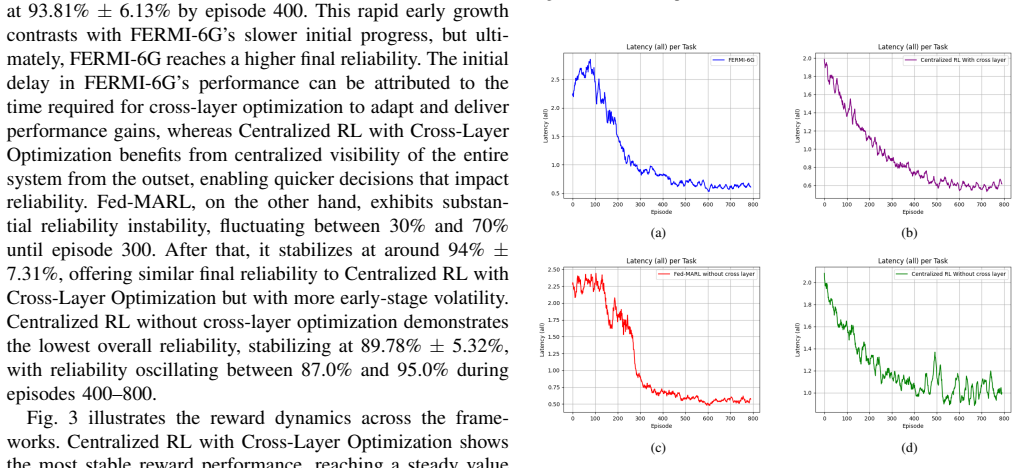
- [Section V-A and Fig. 4] The text uses 'Latency,' 'Task Completion Time,' and 'Offloading Delay' as separate metrics, but Figure 4 is labeled 'latency' with a single curve. Clarify which metric is plotted.
- [Throughout] Some references appear incomplete or preprint-only (e.g., [36]). Please verify all citations are in final published form where possible.
Circularity Check
No significant circularity: the framework's components are independently defined and the reported metrics are measured outcomes, not fitted predictions.
full rationale
I walked the paper's derivation chain. The POMMDP formulation, reward decomposition (Eqs. 4-20), DRQN training, and secure aggregation protocol (Eqs. 21-25) are all constructed from explicitly stated definitions and standard RL/FL machinery. The secure aggregation correctness is a self-contained algebraic identity: pairwise masks cancel in the aggregate, so no input is smuggled into the claimed privacy result. The reward function includes quantities that also appear as evaluation metrics (latency, energy, fairness, reliability, spectral efficiency, energy efficiency, MAC success), but this is ordinary RL objective design, not circular derivation: the paper does not fit a parameter to a subset of data and then report a closely related quantity as a prediction; it trains policies and measures their performance. The centralized baselines were trained on simplified environments, and the paper itself concedes in Section VI that 'direct quantitative comparisons between the two frameworks may be misleading, as performance differences partly reflect the underlying environment assumptions rather than the learning strategies alone.' That is a validity/benchmarking concern, not a circularity concern. No load-bearing self-citations were found; the privacy protocol cites external work (Bonawitz et al.), and no uniqueness theorem from the authors is invoked to forbid alternatives. Therefore no circular step meets the evidentiary bar.
Axiom & Free-Parameter Ledger
free parameters (5)
- Reward weights (w_L, w_E, w_F, w_SE, w_R, w_EE, w_MAC)
- Fairness weights beta_jain, beta_entropy
- Energy threshold E_threshold =
20% remaining energy
- Dynamic penalty constants P_dyn and P_energy =
2 if latency > 2 s or energy below threshold, else 1
- Spectral efficiency floor =
0.01 bps/Hz
axioms (4)
- domain assumption The simulation environment is a faithful proxy for 6G edge network behavior.
- domain assumption Secure aggregation with ECDH and AES masking provides the claimed privacy under semi-honest adversaries.
- domain assumption DRQN with LSTM and prioritized replay converges to good policies in this non-stationary multi-agent setting.
- domain assumption Centralized baselines trained on simplified environments are valid comparators.
Cite this review
Pith. "Pith review of Federated Multi-Agent Reinforcement Learning for Privacy-Preserving and Energy-Aware Resource Management in 6G Edge Networks." pith.science (2026). https://pith.science/paper/3BEQ3R5N
@misc{pith2026250910163,
  author       = {Pith},
  title        = {Pith review of: Federated Multi-Agent Reinforcement Learning for Privacy-Preserving and Energy-Aware Resource Management in 6G Edge Networks},
  year         = {2026},
  howpublished = {\url{https://pith.science/paper/3BEQ3R5N}},
  note         = {Machine review of arXiv:2509.10163}
}
read the original abstract
As sixth-generation (6G) networks move toward ultra-dense, intelligent edge environments, efficient resource management under stringent privacy, mobility, and energy constraints becomes critical. This paper introduces a novel Federated Multi-Agent Reinforcement Learning (Fed-MARL) framework that incorporates cross-layer orchestration of both the MAC layer and application layer for energy-efficient, privacy-preserving, and real-time resource management across heterogeneous edge devices. Each agent uses a Deep Recurrent Q-Network (DRQN) to learn decentralized policies for task offloading, spectrum access, and CPU energy adaptation based on local observations (e.g., queue length, energy, CPU usage, and mobility). To protect privacy, we introduce a secure aggregation protocol based on elliptic curve Diffie Hellman key exchange, which ensures accurate model updates without exposing raw data to semi-honest adversaries. We formulate the resource management problem as a partially observable multi-agent Markov decision process (POMMDP) with a multi-objective reward function that jointly optimizes latency, energy efficiency, spectral efficiency, fairness, and reliability under 6G-specific service requirements such as URLLC, eMBB, and mMTC. Simulation results demonstrate that Fed-MARL outperforms centralized MARL and heuristic baselines in task success rate, latency, energy efficiency, and fairness, while ensuring robust privacy protection and scalability in dynamic, resource-constrained 6G edge networks.
Figures



Reference graph
Works this paper leans on
-
[1]
6g wireless networks: Vision, requirements, architecture, and key technologies,
Z. Zhang, Y . Xiao, Z. Ma, M. Xiao, Z. Ding, X. Lei, G. K. Karagiannidis, and P. Fan, “6g wireless networks: Vision, requirements, architecture, and key technologies,”IEEE Vehicular Technology Magazine, vol. 14, no. 3, pp. 28–41, Sep. 2019
2019
-
[2]
Efficient multi-user computation offloading for mobile-edge cloud computing,
X. Chen, L. Jiao, W. Li, and X. Fu, “Efficient multi-user computation offloading for mobile-edge cloud computing,”IEEE/ACM Transactions on Networking, vol. 24, no. 5, pp. 2795–2808, Oct. 2016
2016
-
[3]
Vehicular intelligence in 6g: Networking, communications, and computing,
H. Guo, X. Zhou, J. Liu, and Y . Zhang, “Vehicular intelligence in 6g: Networking, communications, and computing,”Vehicular Communica- tions, vol. 33, p. 100399, Jan. 2022. 12
2022
-
[4]
Decentralizing 6g security: Existing challenges and future opportunities,
I. Ahmad, M. Hoque, J. Huusko, and J. Suomalainen, “Decentralizing 6g security: Existing challenges and future opportunities,” in2024 IEEE Future Networks World Forum (FNWF). Dubai, United Arab Emirates: IEEE, 2024
2024
-
[5]
What will 5g be?
J. G. Andrews, S. Buzzi, W. Choi, S. V . Hanly, A. Lozano, A. C. K. Soong, and J. C. Zhang, “What will 5g be?”IEEE Journal on Selected Areas in Communications, vol. 32, no. 6, pp. 1065–1082, Jun. 2014
2014
-
[6]
Edge AI: On-Demand Accelerating Deep Neural Network Inference via Edge Computing
E. Li, L. Zeng, Z. Zhou, and X. Chen, “Edge ai: On-demand accelerating deep neural network inference via edge computing,”IEEE Transactions on Wireless Communications, 2019, accepted for publication. [Online]. Available: https://doi.org/10.48550/arXiv.1910.05316
work page internal anchor Pith review Pith/arXiv arXiv doi:10.48550/arxiv.1910.05316 2019
-
[7]
Mobility- aware caching and computation offloading in 5g ultra-dense cellular networks,
M. Chen, Y . Hao, M. Qiu, J. Song, D. Wu, and I. Humar, “Mobility- aware caching and computation offloading in 5g ultra-dense cellular networks,”Sensors, vol. 16, no. 7, p. 974, Jul. 2016
2016
-
[8]
Distributed deep reinforcement learning architecture for task offloading in au- tonomous iot systems,
A. K. C. S. Boni, Y . Hablatou, H. Hassan, and K. Drira, “Distributed deep reinforcement learning architecture for task offloading in au- tonomous iot systems,” inProc. IEEE International Conference on Communications (ICC), 2021, pp. 112–118
2021
-
[9]
Distributed deep multi- agent reinforcement learning for cooperative edge caching in internet- of-vehicles,
H. Zhou, K. Jiang, S. He, G. Min, and J. Wu, “Distributed deep multi- agent reinforcement learning for cooperative edge caching in internet- of-vehicles,”IEEE Transactions on Wireless Communications, vol. 22, no. 12, pp. 9595–9609, Dec. 2023
2023
-
[10]
Federated reinforcement learning: Techniques, applications, and open challenges,
J. Qi, Q. Zhou, L. Lei, and K. Zheng, “Federated reinforcement learning: Techniques, applications, and open challenges,”arXiv preprint arXiv:2108.11887, Aug. 2021
Pith/arXiv arXiv 2021
-
[11]
Co- operative multi-agent reinforcement-learning-based distributed dynamic spectrum access in cognitive radio networks,
X. Tan, L. Zhou, H. Wang, Y . Sun, H. Zhao, and B.-C. Seet, “Co- operative multi-agent reinforcement-learning-based distributed dynamic spectrum access in cognitive radio networks,”IEEE Internet of Things Journal, vol. 9, no. 19, pp. 19 477–19 488, Oct. 2022
2022
-
[12]
Scheduling of real-time wireless flows: A comparative study of centralized and decentralized reinforcement learning approaches,
Q. Wang, J. Huang, and Y . Xu, “Scheduling of real-time wireless flows: A comparative study of centralized and decentralized reinforcement learning approaches,”IEEE/ACM Transactions on Networking, vol. 32, no. 5, pp. 3699–3714, Oct. 2024
2024
-
[13]
Centralized & distributed deep rein- forcement learning methods for downlink sum-rate optimization,
A. A. Khan and R. S. Adve, “Centralized & distributed deep rein- forcement learning methods for downlink sum-rate optimization,”IEEE Transactions on Wireless Communications, vol. 19, no. 12, pp. 8410– 8426, Dec. 2020
2020
-
[14]
Multi-agent deep reinforcement learning for dynamic power allocation in wireless networks,
Y . S. Nasir and D. Guo, “Multi-agent deep reinforcement learning for dynamic power allocation in wireless networks,”IEEE Journal on Selected Areas in Communications, vol. 37, no. 10, pp. 2239–2250, Oct. 2019
2019
-
[15]
A multiagent reinforcement learning ap- proach considering fairness for multi-intersection traffic signal control,
S. Cai, J. Fang, and M. Xu, “A multiagent reinforcement learning ap- proach considering fairness for multi-intersection traffic signal control,” IEEE Internet of Things Journal, vol. 12, no. 13, pp. 23 835–23 851, Jul. 2025
2025
-
[16]
Deep reinforcement learning for mobile 5g and beyond: Fundamentals, applications, and challenges,
Z. Xiong, Y . Zhang, D. Niyato, R. Deng, P. Wang, and L.-C. Wang, “Deep reinforcement learning for mobile 5g and beyond: Fundamentals, applications, and challenges,”IEEE Vehicular Technology Magazine, vol. 14, no. 2, pp. 44–55, Jun. 2019
2019
-
[17]
Communication-efficient learning of deep networks from decentralized data,
H. B. McMahan, E. Moore, D. Ramage, S. Hampson, and B. A. y Arcas, “Communication-efficient learning of deep networks from decentralized data,” inProceedings of the 20th International Conference on Artificial Intelligence and Statistics (AISTATS), 2017, pp. 1273–1282
2017
-
[18]
Advances and open problems in federated learning,
P. Kairouz, H. B. McMahan, B. Avent, A. Bellet, M. Bennis, A. N. Bhagoji, K. Bonawitz, Z. Charles, G. Cormode, R. Cummings, R. D’Oliveira, R. Eichner, J. H. Lee, D. G. Hsu, S. Jaggi, M. Joshi, J. Kleinberg, T. Kone ˇcn`y, H. B. McMahan, and et al., “Advances and open problems in federated learning,”Foundations and Trends® in Machine Learning, vol. 14, no....
2021
-
[19]
Federated learning for wireless communications: Motivation, opportunities and challenges,
S. Niknam, H. S. Dhillon, and J. H. Reed, “Federated learning for wireless communications: Motivation, opportunities and challenges,” IEEE Communications Magazine, vol. 58, no. 6, pp. 46–51, Jun. 2020
2020
-
[20]
A comprehensive study of gradient inversion attacks in federated learning and baseline defense strategies,
P. R. Ovi and A. Gangopadhyay, “A comprehensive study of gradient inversion attacks in federated learning and baseline defense strategies,” in2023 57th Annual Conference on Information Sciences and Systems (CISS), Mar. 2023
2023
-
[21]
Pp-marl: Efficient privacy-preserving multi-agent reinforcement learning for cooperative intelligence in com- munications,
T. Yuan, H.-M. Chung, and X. Fu, “Pp-marl: Efficient privacy-preserving multi-agent reinforcement learning for cooperative intelligence in com- munications,”IEEE Network, vol. 38, no. 5, pp. 196–203, Sep. 2024
2024
-
[22]
Practical secure aggregation for privacy-preserving machine learning,
K. A. Bonawitz, V . Ivanov, B. Kreuter, A. Marcedone, H. B. McMahan, S. Patel, D. Ramage, A. Segal, and K. Seth, “Practical secure aggregation for privacy-preserving machine learning,” inProceedings of the ACM Conference on Computer and Communications Security (CCS), 2017
2017
-
[23]
An offline multi-agent reinforcement learning framework for radio resource management,
E. Eldeeb and H. Alves, “An offline multi-agent reinforcement learning framework for radio resource management,”arXiv preprint arXiv:2501.12991, Jan. 2025
Pith/arXiv arXiv 2025
-
[24]
Wireless resource allocation algorithm based on multi-objective deep reinforcement learning for vehicle-to-vehicle communications,
K. Li, S. Ma, P. Dai, J. Ren, and P. Fan, “Wireless resource allocation algorithm based on multi-objective deep reinforcement learning for vehicle-to-vehicle communications,”J. Comput. Res. Dev., vol. 61, no. 9, pp. 2229–2245, Sep. 2024
2024
-
[25]
Exploring cross-layer techniques for security: Challenges and opportunities in wireless networks,
G. Thamilarasu and R. Sridhar, “Exploring cross-layer techniques for security: Challenges and opportunities in wireless networks,” inProceed- ings of MILCOM 2007 - IEEE Military Communications Conference, Orlando, FL, USA, Oct. 2007
2007
-
[26]
Multi-agent deep reinforcement learning for task offloading in vehicle edge computing,
B. Wang, L. Liu, and J. Wang, “Multi-agent deep reinforcement learning for task offloading in vehicle edge computing,” inProceedings of 2023 IEEE International Symposium on Broadband Multimedia Systems and Broadcasting (BMSB), Jun. 2023
2023
-
[27]
Energy-aware mobility management for mobile edge computing in ultra dense networks,
Y . Sun, S. Zhou, and J. Xu, “Energy-aware mobility management for mobile edge computing in ultra dense networks,”IEEE Journal on Selected Areas in Communications, vol. 35, no. 11, pp. 2637–2646, Nov. 2017
2017
-
[28]
A survey on resource allocation schemes in device-to-device communication,
S. Gupta, R. Patel, R. Gupta, S. Tanwar, and N. Patel, “A survey on resource allocation schemes in device-to-device communication,” inPro- ceedings of 2022 12th International Conference on Cloud Computing, Data Science & Engineering (Confluence), Noida, India, Jan. 2022
2022
-
[29]
5g orchestration and analysis: Dynamic approach, control and challenges faced,
H. S. Kamath, “5g orchestration and analysis: Dynamic approach, control and challenges faced,” inProceedings of 2022 IEEE Interna- tional Conference on Distributed Computing and Electrical Circuits and Electronics (ICDCECE), Ballari, India, Apr. 2022
2022
-
[30]
Multi-agent reinforcement learning for resource allocation in iot networks with edge computing,
X. Liu, J. Yu, Z. Feng, and Y . Gao, “Multi-agent reinforcement learning for resource allocation in iot networks with edge computing,”China Communications, vol. 17, no. 9, pp. 220–236, Sep. 2020
2020
-
[31]
Fully decentralized multi-agent reinforcement learning with networked agents,
K. Zhang, Z. Yang, H. Liu, T. Zhang, and T. Bas ¸ar, “Fully decentralized multi-agent reinforcement learning with networked agents,” inProc. 32nd AAAI Conf. Artif. Intel., New Orleans, LA, USA, Feb. 2018, pp. 3695–3702
2018
-
[32]
An insight into federated learning: A collaborative approach for machine learning,
P. Sharma, J. Kashniyal, and E. ESham, “An insight into federated learning: A collaborative approach for machine learning,” inProc. 2024 4th Int. Conf. on Advancement in Electronics and Communication Engineering (AECE), Ghaziabad, India, Nov. 2024
2024
-
[33]
Federated learning in vehicular networks,
A. M. Elbir, B. Soner, S. C ¸¨oleri, D. G ¨und¨uz, and M. Bennis, “Federated learning in vehicular networks,” inProc. 2022 IEEE Int. Mediterranean Conf. Commun. Netw. (MeditCom), Athens, Greece, Sep. 2022, pp. 72– 77
2022
-
[34]
Energy- aware selective inference task offloading for real-time edge computing applications,
A. B. Sada, A. Khelloufi, A. Naouri, H. Ning, and S. Dhelim, “Energy- aware selective inference task offloading for real-time edge computing applications,”IEEE Access, vol. 12, pp. 72 924–72 937, May 2024
2024
-
[35]
Reinforce- ment learning-based physical cross-layer security and privacy in 6g,
X. Lu, L. Xiao, P. Li, X. Ji, C. Xu, S. Yu, and W. Zhuang, “Reinforce- ment learning-based physical cross-layer security and privacy in 6g,” IEEE Communications Surveys & Tutorials, vol. 25, no. 1, pp. 425– 466, First Quarter 2023
2023
-
[36]
F. Metelo, A. Oliveira, S. Rackovi ´c, C. Soareset al., “Fauno: Semi- asynchronous federated reinforcement learning framework for task of- floading in edge systems,”arXiv preprint arXiv:2506.02668, 2025
arXiv 2025
-
[37]
Federated double deep q-learning for joint delay and energy minimization in iot networks,
S. Zarandi and H. Tabassum, “Federated double deep q-learning for joint delay and energy minimization in iot networks,”arXiv preprint arXiv:2104.11320, 2021
Pith/arXiv arXiv 2021
-
[38]
Fedrl-d2d: Federated deep reinforcement learning-empowered resource allocation scheme for energy efficiency maximization in d2d- assisted 6g networks,
H. M. F. Noman, K. Dimyati, K. A. Noordin, E. Hanafi, and A. Ab- drabou, “Fedrl-d2d: Federated deep reinforcement learning-empowered resource allocation scheme for energy efficiency maximization in d2d- assisted 6g networks,”IEEE Access, vol. 12, pp. 109 775–109 792, Jul. 2024
2024
-
[39]
Optical wireless communications: Research challenges for mac layer,
M. Bhutani, B. Lall, and M. Agrawal, “Optical wireless communications: Research challenges for mac layer,”IEEE Access, vol. 10, pp. 126 969– 126 989, Dec. 2022
2022
This paper was first reviewed by deepseek-v4-flash on August 4, 2026.
discussion (0)
Sign in with ORCID, Apple, or X to comment. Anyone can read and Pith papers without signing in.