REVIEW 3 major objections 5 minor 44 references
Mitigating Catastrophic Forgetting and Mode Collapse in Text-to-Image Diffusion via Latent Replay
T0 review · 3 major / 5 minor · reviewed 2026-08-05 · deepseek-v4-flash
Pith's one-line read Latent replay stops diffusion models from erasing old concepts
desk verdict The forgetting result is real, but the mode-collapse claim is unsupported because the paper's 'Vendi Score' isn't the Vendi Score. read the letter →
The pith
A machine-rendered reading of the paper's core claim, the machinery that carries it, and where it could break.
The reading
What carries the argument
The central object is a Latent Replay buffer: a fixed-size reservoir-sampled store of VAE-encoded latent vectors (dimension 4×64×64) paired with prompt tokens, replayed during training through a weighted diffusion denoising loss L_total = (1−λ_memory)L_current + λ_memory L_memory. The VAE and text encoder are frozen; only the denoising U-Net is fine-tuned, and replayed latents enter at the U-Net input. Because a stored latent is roughly 48 times smaller than a raw 512×512 image, the same memory budget buys far more stored examples, which is what lets the buffer cover more of an earlier concept's distribution.
What would settle it
Re-run the diversity evaluation on the paper's final generated images using the standard Vendi Score (exp of the sum of λ_i log λ_i for normalized similarity-matrix eigenvalues) and compare LR vs ER on the dog task; if LR's reported advantage (1.66 vs 1.17) does not reproduce, the mode-collapse claim is unsupported.
Extended reading notes
Core claim
Sequentially fine-tuning a text-to-image diffusion model on new concepts makes it forget earlier ones and narrow its outputs for what it remembers. The paper proposes storing VAE-encoded latent vectors (4×64×64, about 64 KB each) in a reservoir-sampled buffer and replaying them with current-task latents while only the U-Net is fine-tuned. Across five concepts, Latent Replay kept the earliest concept at 77.59% Image Alignment after all tasks, versus 65.64% for Experience Replay and 63.56% for naive fine-tuning, and preserved diversity of 1.66 compared with 1.13–1.17 for those methods—near the 1.68 offline, all-data score. It also reports that similarity-based latent retrieval does worse than
Load-bearing premise
The load-bearing premise is that the diversity metric labeled 'Vendi Score' actually measures what the paper claims; as written, its formula differs from the standard definition, so the mode-collapse conclusion stands or falls on that measurement.
Editorial extensions
If this is right
- If the reported results hold, a user could keep adding new concepts to a personalized text-to-image model over time, retaining earlier ones using only a few dozen megabytes of latent storage.
- Because 480 latents outperformed 100 raw images on both retention and diversity, latent replay should make continual learning viable on devices where storing full-resolution image histories is impractical.
- The random-over-similarity result implies that replay-buffer design for generative models should prioritize manifold coverage over semantic closeness to the current task.
- With a balanced replay weight near λ=0.5, the stability-plasticity trade-off is manageable: higher replay weights protect old tasks at the cost of new ones, lower weights do the opposite.
- The method approaches the offline upper bound on several later tasks, suggesting that sequential learning with a fixed latent buffer can approach the quality of training on all data at once.
Reading between the lines
- My read: the memory-efficiency effect is partly a coverage effect—same memory budget buys about 48× more stored examples, so the buffer spans more of the early concept's distribution. The paper does not isolate coverage from representation quality; a testable follow-up would hold the number of stored samples fixed and vary only storage type.
- The similarity-selection failure suggests that for generative replay, relevance-maximizing retrieval can systematically omit the tails of a concept distribution; coverage-based or uncertainty-based sampling is the natural next experiment.
- Because the paper evaluates with 10 images per prompt and 800 steps per task, its diversity numbers may be sensitive to evaluation scale; re-measuring with 50 images per prompt, as earlier personalization work used, would tell whether the diversity advantage is robust.
- A longer-term implication, if the diversity metric survives re-checking, is that latent replay could become a component of lifelong generative systems that compose old and new concepts, not just retain them individually.
Editorial analysis
A structured set of objections, weighed in public.
Referee Report
Summary. The paper proposes Latent Replay (LR) for continual learning in text-to-image diffusion models. Instead of storing raw images as in Experience Replay, LR stores VAE-encoded latents (4×64×64) in a fixed-size buffer with reservoir sampling and replays them during sequential fine-tuning of a Stable Diffusion U-Net. The authors compare LR to Naive fine-tuning, Experience Replay, a similarity-based variant (SLR), and an Offline upper bound on five sequentially learned concepts, using Image Alignment, Text Alignment, and a diversity metric. The headline results are that LR retains 77.59% IA on the earliest concept, surpasses ER and Naive on forgetting metrics, preserves output diversity, and that random latent replay beats similarity-based retrieval.
Significance. If the claims hold, the paper makes a useful practical contribution: storing 64 KB latents rather than 3 MB images enables replay-based continual learning in memory-constrained settings, and the counterintuitive result that random latent selection outperforms similarity-based selection is interesting for the diffusion personalization community. The study has notable strengths: ten seeded runs, non-parametric paired significance tests with multiple-comparison correction, a transparent memory-footprint comparison, ablations over buffer size, replay weight, and task order, and qualitative side-by-side comparisons. However, the central mode-collapse claim rests on a diversity metric that is mis-specified in Section 3.4.4, and the broad claim of outperforming 'existing methods' is not supported by the baseline set. These issues are fixable but require re-analysis or reframing.
major comments (3)
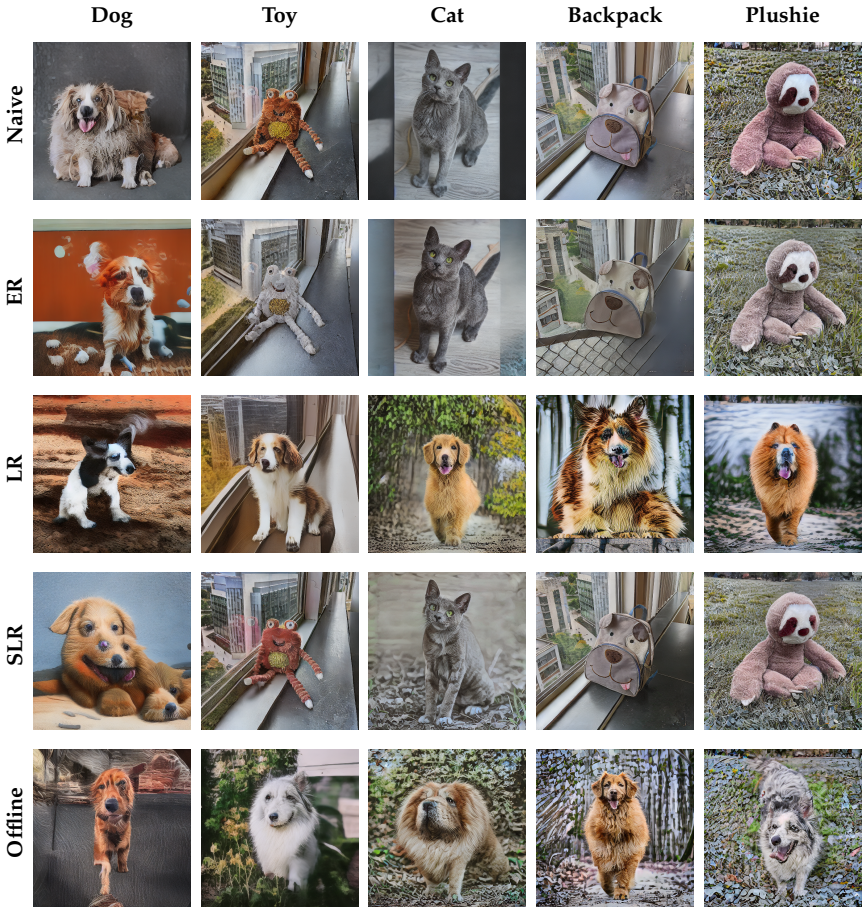
- [Section 3.4.4 and Table 4.3] The 'Vendi Score' as defined is not the Vendi Score. The paper gives V(S)=exp((1/n)Σ log(1/d_i)) with d_i an undefined 'local density' and cites 'Naeem et al., 2022, arXiv:2210.02410'. The actual Vendi Score (Friedman and Dieng, 2022) is exp(−Σ λ_i log λ_i), where λ_i are the eigenvalues of a normalized similarity matrix, and the cited arXiv paper has different authors. Since d_i is never defined, Table 4.3, the diversity rows of Table 4.5, Figure 4.1 (bottom), and Section 4.1.4's mode-collapse conclusions are not reproducible or interpretable. This is load-bearing because 'maintaining diverse outputs' is half of the central claim. Please recompute with the actual Vendi Score or another validated diversity metric and report the feature space and sample size used, or remove the diversity-based mode-collapse claim.
- [Abstract and Sections 2.4, 4.6] The abstract and conclusion state that Latent Replay 'significantly outperforms existing methods', but the experimental comparison includes only Naive, ER, SLR, and Offline. C-LoRA and STAMINA are discussed in Section 2.4 but not implemented, and regularization and parameter-isolation methods are not compared. Section 4.5 acknowledges this limitation, but the abstract and conclusions overclaim. Please either add the relevant state-of-the-art baselines or temper the claims to 'outperforms naive fine-tuning and experience replay' under the tested settings.
- [Section 3.2 and Table 3.2] The equal-memory comparison confounds representation type with the number of stored exemplars: ER stores 10 images while LR stores 480 latents, a 48× difference in count. Table 4.6's conclusion that LR 'captures the distribution better' than ER may be an effect of having many more stored examples rather than of the latent representation itself. Since the practical memory-efficiency claim is valid regardless, this is not fatal, but the mechanistic interpretation in Section 4.4.1 needs an additional control, e.g., ER with the same number of examples (at larger memory) or LR with the same number of latents as ER has images, to separate count from representation.
minor comments (5)
- [Section 3.4.4] The variable d_i is never defined. Even if the intended metric were a kernel-density-based diversity score, 'local density' needs a precise definition and a stated distance/kernel.
- [References] The reference 'Naeem et al., 2022' for the Vendi Score has an incorrect author list and arXiv ID. The correct citation is Dan Friedman and Adji Bousso Dieng, 'The Vendi Score: A Diversity Evaluation Metric for Machine Learning', arXiv:2210.02410.
- [Tables 4.4 and 4.6] Offline TFR-IA is reported as 0.34±0.89 in Table 4.4 and 0.32±0.85 in Table 4.6. Please explain whether these come from different runs or fix the inconsistency.
- [Section 4.5] The limitations paragraph discusses general limitations of the 'Vendi score' but does not flag that the formula in Section 3.4.4 is not the actual Vendi Score. The limitation should be updated after recomputation.
- [Figure 4.1 caption] Minor grammar: 'Figures 4.1 show' should be 'Figure 4.1 shows'.
Circularity Check
No circularity: Latent Replay is evaluated against external baselines and independent metrics; the Vendi Score mis-specification is a correctness issue, not a circular one.
full rationale
No significant circularity found. The paper is an empirical comparison, not a derivation whose conclusions are equivalent to its inputs. Latent Replay (Section 3.2.3) stores VAE-encoded latents of previous-task images and replays them through the diffusion loss (Eq. 3.1), but the claimed outcomes — IA, TA, TFR, and Diversity — are computed independently from generated images via CLIP cosine similarity and a separately defined diversity metric (Section 3.4). None of these metrics is defined in terms of the stored latents or fitted to the reported numbers. The one tuned parameter, lambda_memory, is set to 0.5 and then explicitly ablated in Table 4.7; this is ordinary hyperparameter selection, not a prediction forced by construction. The baseline comparisons (Naive, ER, SLR, Offline) are external methods trained under the same protocol, and the Offline upper bound is labeled as an upper bound by construction. There are no load-bearing self-citations: the citation to Pellegrini et al. (2020) is for the prior latent-replay concept, not for the paper's own empirical claims, and no uniqueness theorem or ansatz is imported from the authors' prior work. The manuscript does contain a flagged placeholder — “(Sun et al., 2024) (citation example)” in Section 1.3 — and a Limitations section (Section 4.5) acknowledging missing baselines and metric limitations. The more serious issue is that Section 3.4.4 defines the “Vendi Score” with an unstated d_i and a formula that does not match the cited metric (arXiv:2210.02410), so the diversity numbers in Table 4.3 are not reproducible as written; this affects support for the mode-collapse claim but does not make the derivation circular. These are correctness/verifiability concerns, not circularity.
Assumptions & free parameters
free parameters (4)
- lambda_memory =
0.5
- similarity top-k =
4
- loss instability thresholds =
1.0 for Naive/Offline, 1.5 for replay methods
- buffer sizes for small-memory comparison =
10 images vs 480 latents
assumptions (5)
- domain assumption VAE latent codes are a faithful-enough compressed representation of past concepts for replay to preserve both fidelity and diversity.
- domain assumption CLIP cosine similarity is a valid measure of image and text alignment.
- domain assumption The Vendi Score as described in Section 3.4.4 measures output diversity.
- standard math Reservoir sampling maintains an unbiased sample of past data.
- domain assumption Tasks arrive as distinct, labeled segments with clear boundaries.
Cite this review
Pith. "Pith review of Mitigating Catastrophic Forgetting and Mode Collapse in Text-to-Image Diffusion via Latent Replay." pith.science (2026). https://pith.science/paper/YZJMUNXM
@misc{pith2026250910529,
  author       = {Pith},
  title        = {Pith review of: Mitigating Catastrophic Forgetting and Mode Collapse in Text-to-Image Diffusion via Latent Replay},
  year         = {2026},
  howpublished = {\url{https://pith.science/paper/YZJMUNXM}},
  note         = {Machine review of arXiv:2509.10529}
}
read the original abstract
Continual learning -- the ability to acquire knowledge incrementally without forgetting previous skills -- is fundamental to natural intelligence. While the human brain excels at this, artificial neural networks struggle with "catastrophic forgetting," where learning new tasks erases previously acquired knowledge. This challenge is particularly severe for text-to-image diffusion models, which generate images from textual prompts. Additionally, these models face "mode collapse," where their outputs become increasingly repetitive over time. To address these challenges, we apply Latent Replay, a neuroscience-inspired approach, to diffusion models. Traditional replay methods mitigate forgetting by storing and revisiting past examples, typically requiring large collections of images. Latent Replay instead retains only compact, high-level feature representations extracted from the model's internal architecture. This mirrors the hippocampal process of storing neural activity patterns rather than raw sensory inputs, reducing memory usage while preserving critical information. Through experiments with five sequentially learned visual concepts, we demonstrate that Latent Replay significantly outperforms existing methods in maintaining model versatility. After learning all concepts, our approach retained 77.59% Image Alignment (IA) on the earliest concept, 14% higher than baseline methods, while maintaining diverse outputs. Surprisingly, random selection of stored latent examples outperforms similarity-based strategies. Our findings suggest that Latent Replay enables efficient continual learning for generative AI models, paving the way for personalized text-to-image models that evolve with user needs without excessive computational costs.
Figures


Figures from the paper (5 more)



Reference graph
Works this paper leans on
-
[1]
Stable diffusion v1.4 model card, 2022
CompVis. Stable diffusion v1.4 model card, 2022. URL https://huggingface.co/CompVis/stable-diffusion-v1-4
work page 2022
-
[2]
Yulai Cong, Miaoyun Zhao, Jiawei Li, Sofia Wang, and Lawrence Carin. Gan memory with no forgetting. Advances in Neural Information Processing Systems (NeurIPS), 33: 0 16481--16494, 2020
work page 2020
-
[3]
Bermano, Gal Chechik, and Daniel Cohen-Or
Rinon Gal, Yuval Alaluf, Yuval Atzmon, Or Patashnik, Amit H. Bermano, Gal Chechik, and Daniel Cohen-Or. An image is worth one word: Personalizing text-to-image generation using textual inversion. arXiv preprint, 2022
work page 2022
-
[4]
Ddgr: Continual learning with deep diffusion-based generative replay
Ruiying Gao and Wei Liu. Ddgr: Continual learning with deep diffusion-based generative replay. Proceedings of the International Conference on Machine Learning (ICML), pages 10744--10763, 2023
work page 2023
-
[5]
Ian Goodfellow, Jean Pouget-Abadie, Mehdi Mirza, Bing Xu, David Warde-Farley, Sherjil Ozair, Aaron Courville, and Yoshua Bengio. Generative adversarial nets. Advances in Neural Information Processing Systems (NeurIPS), 27, 2014
work page 2014
-
[6]
Goodfellow, Mehdi Mirza, Da Xiao, Aaron Courville, and Yoshua Bengio
Ian J. Goodfellow, Mehdi Mirza, Da Xiao, Aaron Courville, and Yoshua Bengio. An empirical investigation of catastrophic forgetting in gradient-based neural networks. arXiv preprint, 2013
work page 2013
-
[7]
Classifier-free diffusion guidance
Jonathan Ho and Tim Salimans. Classifier-free diffusion guidance. NeurIPS 2021 Workshop on Deep Generative Models and Downstream Applications, 2021
work page 2021
-
[8]
Denoising diffusion probabilistic models
Jonathan Ho, Ajay Jain, and Pieter Abbeel. Denoising diffusion probabilistic models. Advances in Neural Information Processing Systems (NeurIPS), 33: 0 6840--6851, 2020
2020
Show all 44 references
-
[9]
Dai, Matthew D
Cheng-Zhi Anna Huang, Ashish Vaswani, Jakob Uszkoreit, Noam Shazeer, Ian Simon, Curtis Hawthorne, Andrew M. Dai, Matthew D. Hoffman, Monica Dinculescu, and Douglas Eck. Music transformer. arXiv preprint, 2018
2018
-
[10]
Auto-encoding variational bayes
Diederik P Kingma and Max Welling. Auto-encoding variational bayes. arXiv preprint, 2013
2013
-
[11]
Rusu, Kieran Milan, John Quan, Tiago Ramalho, Agnieszka Grabska-Barwińska, et al
James Kirkpatrick, Razvan Pascanu, Neil Rabinowitz, Joel Veness, Guillaume Desjardins, Andrei A. Rusu, Kieran Milan, John Quan, Tiago Ramalho, Agnieszka Grabska-Barwińska, et al. Overcoming catastrophic forgetting in neural networks. Proceedings of the National Academy of Scie...
2017
-
[12]
Multiconcept customization of text-to-image diffusion
Nithin Kumari, Bowen Zhang, Richard Zhang, Eli Shechtman, and Jun-Yan Zhu. Multiconcept customization of text-to-image diffusion. arXiv preprint, 2022
2022
-
[13]
Controllable text-to-image generation
Bowen Li, Xiaojuan Qi, Philip Torr, and Thomas Lukasiewicz. Controllable text-to-image generation. Advances in Neural Information Processing Systems (NeurIPS), 32, 2019
2019
-
[14]
Learning without forgetting
Zhizhong Li and Derek Hoiem. Learning without forgetting. IEEE Transactions on Pattern Analysis and Machine Intelligence (TPAMI), 40 0 (12): 0 2935--2947, 2017
2017
-
[15]
Dynamic expansion for continual learning
Ching-Yao Lin, Hao Wu, Feng Zhu, Yihua Zhai, and Chang Xu. Dynamic expansion for continual learning. arXiv preprint, 2024
2024
-
[16]
Packnet: Adding multiple tasks to a single network by iterative pruning
Arun Mallya and Svetlana Lazebnik. Packnet: Adding multiple tasks to a single network by iterative pruning. Proceedings of the IEEE Conference on Computer Vision and Pattern Recognition (CVPR), pages 7765--7773, 2018
2018
-
[17]
Michael McCloskey and Neal J. Cohen. Catastrophic interference in connectionist networks: The sequential learning problem. Psychology of Learning and Motivation, 24: 0 109--165, 1989
1989
-
[18]
The vendi score: A diversity evaluation metric for machine learning
Muhammad Farrukh Naeem, Jooyoung Baek, Sanghyuk Woo, Joonseok Park, Junho Lee, Liam Paull, Sungjoo Kim, and Gunhee Kim. The vendi score: A diversity evaluation metric for machine learning. arXiv preprint, 2022. URL https://arxiv.org/abs/2210.02410
2022 arXiv
-
[19]
Parisi, Ronald Kemker, Jose L
German I. Parisi, Ronald Kemker, Jose L. Part, Christopher Kanan, and Stefan Wermter. Continual lifelong learning with neural networks: A review. Neural Networks, 113: 0 54--71, 2019
2019
-
[20]
Latent replay for real-time continual learning
Lorenzo Pellegrini, Gabriele Graffieti, Vincenzo Lomonaco, and Davide Maltoni. Latent replay for real-time continual learning. IEEE/RSJ International Conference on Intelligent Robots and Systems (IROS), pages 4436--4443, 2020
2020
-
[21]
Balas, Liliana Perescu-Popescu, and Nikos Mastorakis
Marian-Ciprian Popescu, Valentina E. Balas, Liliana Perescu-Popescu, and Nikos Mastorakis. Multilayer perceptron and neural networks. WSEAS Transactions on Circuits and Systems, 8 0 (7): 0 579--588, 2009
2009
-
[22]
Learning transferable visual models from natural language supervision
Alec Radford, Jong Wook Kim, Chris Hallacy, Aditya Ramesh, Gabriel Goh, Sandhini Agarwal, Girish Sastry, Amanda Askell, Pamela Mishkin, Jack Clark, Gretchen Krueger, and Ilya Sutskever. Learning transferable visual models from natural language supervision. In Marina Meila and ...
2021
-
[23]
Zero-shot text-to-image generation
Aditya Ramesh, Mikhail Pavlov, Gabriel Goh, Scott Gray, Chelsea Voss, Alec Radford, Mark Chen, and Ilya Sutskever. Zero-shot text-to-image generation. arXiv preprint, 2021
2021
-
[24]
Sylvestre-Alvise Rebuffi, Alexander Kolesnikov, Georg Sperl, and Christoph H. Lampert. icarl: Incremental classifier and representation learning. Proceedings of the IEEE Conference on Computer Vision and Pattern Recognition (CVPR), pages 2001--2010, 2017
2001
-
[25]
Learning to learn without forgetting by maximizing transfer and minimizing interference
Matthew Riemer, Ignacio Cases, Robert Ajemian, Miao Liu, Irina Rish, Yuhai Tu, and Gerald Tesauro. Learning to learn without forgetting by maximizing transfer and minimizing interference. arXiv preprint, 2018
2018
-
[26]
High-resolution image synthesis with latent diffusion models
Robin Rombach, Andreas Blattmann, Dominik Lorenz, Patrick Esser, and Björn Ommer. High-resolution image synthesis with latent diffusion models. Proceedings of the IEEE/CVF Conference on Computer Vision and Pattern Recognition (CVPR), pages 10684--10695, 2022
2022
-
[27]
Dreambooth: Fine tuning text-to-image diffusion models for subject-driven generation
Nataniel Ruiz, Yuanzhen Li, Varun Jampani, Yael Pritch, Michael Rubinstein, and Kfir Aberman. Dreambooth: Fine tuning text-to-image diffusion models for subject-driven generation. Proceedings of the IEEE/CVF Conference on Computer Vision and Pattern Recognition (CVPR), pages 2...
2023
-
[28]
Rusu, Neil Rabinowitz, Guillaume Desjardins, Hubert Soyer, James Kirkpatrick, Koray Kavukcuoglu, Razvan Pascanu, and Raia Hadsell
Andrei A. Rusu, Neil Rabinowitz, Guillaume Desjardins, Hubert Soyer, James Kirkpatrick, Koray Kavukcuoglu, Razvan Pascanu, and Raia Hadsell. Progressive neural networks. arXiv preprint, 2016
2016
-
[29]
Photorealistic text-to-image diffusion models with deep language understanding
Chitwan Saharia, William Chan, Saurabh Saxena, Lala Li, Jay Whang, Emily Denton, Seyed Kamyar Ghasemipour, Raphael Gontijo Lopes, Belinda Karagol Ayan, Tim Salimans, Jonathan Ho, David Fleet, and Mohammad Norouzi. Photorealistic text-to-image diffusion models with deep languag...
2022
-
[30]
Lfs-gan: Lifelong few-shot image generation
Jeon-Hyeong Seo, Junmo Kang, and Gyeongbae Park. Lfs-gan: Lifelong few-shot image generation. Proceedings of the IEEE/CVF International Conference on Computer Vision (ICCV), pages 11322--11332, 2023
2023
-
[31]
Brooks, Philip H.S
Yuanbo Shi, Nikhil Siddharth, Philip A. Brooks, Philip H.S. Torr, and Yanjie Liao. Deep generative models on 3d representations: A survey. arXiv preprint, 2023
2023
-
[32]
Continual learning with deep generative replay
Hanul Shin, Jung Kwon Lee, Jaehong Kim, and Jiwon Kim. Continual learning with deep generative replay. Advances in Neural Information Processing Systems (NeurIPS), 30, 2017
2017
-
[33]
Continual diffusion: Continual customization of text-to-image diffusion with c-lora
James Seale Smith, Jianwei Tian, Suhail Halbe, Yung-Chieh Hsu, and Zsolt Kira. Continual diffusion: Continual customization of text-to-image diffusion with c-lora. arXiv preprint, 2023
2023
-
[34]
Continual diffusion with stamina: Stack-and-mask incremental adapters
James Seale Smith, Yung-Chieh Hsu, Ling Zhang, Te Hua, Zsolt Kira, Yujun Shen, and Huiwen Jin. Continual diffusion with stamina: Stack-and-mask incremental adapters. arXiv preprint, 2024
2024
-
[35]
Improved techniques for training score-based generative models
Yang Song and Stefano Ermon. Improved techniques for training score-based generative models. Advances in Neural Information Processing Systems (NeurIPS), 33: 0 12438--12448, 2020
2020
-
[36]
Create your world: Lifelong text-to-image diffusion
Gan Sun, Wenbo Liang, Jun Dong, Jun Li, Zhengming Ding, and Yulai Cong. Create your world: Lifelong text-to-image diffusion. IEEE Transactions on Pattern Analysis and Machine Intelligence, 2024
2024
-
[37]
Wavenet: A generative model for raw audio
Aäron van den Oord, Sander Dieleman, Heiga Zen, Karen Simonyan, Oriol Vinyals, Alex Graves, Nal Kalchbrenner, Andrew Senior, and Koray Kavukcuoglu. Wavenet: A generative model for raw audio. arXiv preprint, 2016
2016
-
[38]
Supermasks in superposition
Mitchell Wortsman, Vivek Ramanujan, Rosanne Liu, Aniruddha Kembhavi, Mohammad Rastegari, Jason Yosinski, and Ali Farhadi. Supermasks in superposition. Advances in Neural Information Processing Systems (NeurIPS), 33: 0 15173--15184, 2020
2020
-
[39]
Memory replay gans: Learning to generate images from new categories without forgetting
Chenshen Wu, Luis Herranz, Xialei Liu, Yaxing Wang, Joost van de Weijer, and Bogdan Raducanu. Memory replay gans: Learning to generate images from new categories without forgetting. Advances in Neural Information Processing Systems (NeurIPS), 31, 2018
2018
-
[40]
Lion: Latent point diffusion models for 3d shape generation
Xiaohui Zeng, Arash Vahdat, Francis Williams, Zan Gojcic, Or Litany, Sanja Fidler, and Karsten Kreis. Lion: Latent point diffusion models for 3d shape generation. arXiv preprint, 2022
2022
-
[41]
Continual learning through synaptic intelligence
Friedemann Zenke, Ben Poole, and Surya Ganguli. Continual learning through synaptic intelligence. Proceedings of the International Conference on Machine Learning (ICML), pages 3987--3995, 2017
2017
-
[42]
Hyper-lifelonggan: Scalable lifelong learning for image conditioned generation
Miaoyun Zhai, Liang Chen, and Greg Mori. Hyper-lifelonggan: Scalable lifelong learning for image conditioned generation. Proceedings of the IEEE/CVF Conference on Computer Vision and Pattern Recognition (CVPR), pages 2246--2255, 2021
2021
-
[43]
Clog: Benchmarking continual learning of image generation models
Haotian Zhang, Junting Zhou, Haowei Lin, Hang Ye, Jianhua Zhu, Zihao Wang, Liangcai Gao, Yizhou Wang, and Yitao Liang. Clog: Benchmarking continual learning of image generation models. arXiv preprint arXiv:2406.04584, 2024
2024 arXiv
-
[44]
Adding conditional control to text-to-image diffusion models
Lvmin Zhang, Anyi Rao, and Maneesh Agrawala. Adding conditional control to text-to-image diffusion models. Proceedings of the IEEE/CVF International Conference on Computer Vision (ICCV), pages 3836--3847, 2023
2023
Reviewed August 5, 2026 · model on record in the stance chip above.
Discussion (0). Continue with ORCID to comment.