REVIEW 3 major objections 5 minor 39 references
Assessing the Limits of Graph Neural Networks for Vapor-Liquid Equilibrium Prediction: A Cryogenic Mixture Case Study
T0 review · 3 major / 5 minor · reviewed 2026-08-15 · deepseek-v4-flash
Pith's one-line read A structure-aware graph neural network trained on GERG-2008/CoolProp data interpolates single-phase cryogenic properties but accepts zero vapor-liquid equilibrium solves in its tested configuration and runs slower than the reference…
desk verdict Honest negative result with a useful fallback audit, but the fixed-template snapshot at inference confounds the claim that derivative quality is the reason the VLE solver fails. read the letter →
The pith
A machine-rendered reading of the paper's core claim, the machinery that carries it, and where it could break.
The reading
What carries the argument
The load-bearing object is the learned residual Helmholtz energy surface $A_\mathrm{res}(T, V_m, \mathbf{x}, \text{structure})$ predicted by DimeNet++, a directional message-passing graph neural network that pools atomic environments from a molecular-dynamics snapshot, from which pressure and internal energy are recovered by differentiating $A_\mathrm{res}$ with autograd. Because a VLE solve demands smooth, mutually consistent first derivatives of that surface across two phases, the argument turns on derivative quality rather than pointwise accuracy. Two supporting mechanisms carry the evaluation: a two-stage training schedule (pretraining on $A_\mathrm{res}$, then fine-tuning on pressure with a $C_v$ stability penalty) and a tiered, audited VLE driver that always attempts the GNN first and queries CoolProp only after the GNN attempt fails, so a 'CoolProp Fallback' label records a prior GNN failure by construction.
What would settle it
Re-run the VLE driver at 110 K and 120 K for CO2/CH4 and CH4/N2 supplying each probed state's own MD snapshot instead of the fixed template; if any GNN equilibria are accepted, the all-fallback outcome is partly a structural-feature mismatch. Independently, recompute the thermal-stability violation rates along the solver's actual line-search paths: if the dense-bin 28% flag rate disappears when per-state snapshots are used, derivative quality is better than the paper's central diagnosis claims.
Extended reading notes
Core claim
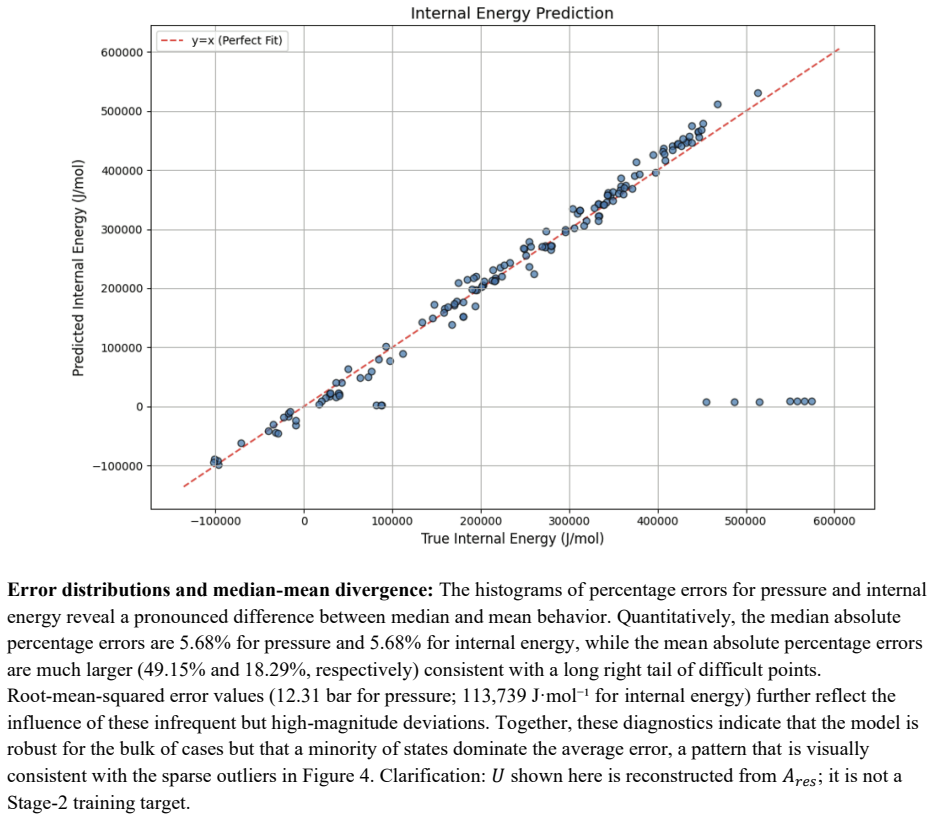
The paper's central claim is that a DimeNet++ surrogate predicting residual Helmholtz energy $A_\mathrm{res}$, with pressure and internal energy reconstructed by autograd differentiation, produces a surface that is pointwise adequate in the interior of the sampled single-phase regime but not equilibrium-ready. Median absolute percentage errors are 5.68% for both pressure and internal energy, while mean errors balloon to 49.15% and 18.29%, showing heavy tails concentrated in dense, cold liquids. When wired into a tiered VLE driver for CO2/CH4 and CH4/N2 at 110 K and 120 K, the GNN path returns no accepted equilibria: every plotted VLE point is a CoolProp/GERG-2008 fallback and the rest are logged as solver failures. Solver-free diagnostics attribute this to derivative quality: pressure paths along log-volume at fixed temperature become jagged with slope sign flips in the dense/cold regime, and local thermal-stability flags ($C_v$ proxies) reach 28% in one mid-to-high-density bin. The paper concludes that, as configured, the surrogate is not solver-ready for VLE and offers no single-phase runtime benefit; its value is a reproducible negative result.
Load-bearing premise
The VLE solver hands the model a single fixed molecular snapshot at every probed equilibrium state, even though training and all diagnostics used a fresh per-state snapshot, so the complete absence of GNN equilibria could be an artifact of feeding structures the model was not trained on rather than a fundamental deficiency of the learned derivatives.
Editorial extensions
If this is right
- For the tested binaries and temperatures, every VLE point plotted is a CoolProp/GERG-2008 reference, not a GNN result; the claimed 0% GNN success means the surrogate cannot yet stand in for an EoS in equilibrium calculations.
- Single-phase interpolation accuracy is necessary but not sufficient for VLE: the same network that looks accurate on parity plots fails root-finding because its local derivatives are jagged in dense/cold states.
- In its current end-to-end form the surrogate is slower, not faster, than the classical baseline (median 35.9 ms versus 0.057 ms per property call), so there is no runtime argument for adopting it.
- The remedy indicated by the paper's own diagnostics is to enforce thermodynamic consistency in the loss and to densify training coverage near phase boundaries, not merely to add more interior data.
- Error and stability diagnostics agree that dense/cold liquid conditions are the first place such structure-aware surrogates degrade, giving future work a concrete target regime.
Reading between the lines
- The paper never ablates the inference-time feature mismatch: training and diagnostics used a fresh per-state MD snapshot per thermodynamic state, while the VLE driver fed a single fixed template snapshot to every probed equilibrium condition; if that template is unrepresentative, the all-fallback outcome could be partly a distribution-shift artifact rather than pure derivative pathology.
- A direct test would settle this: rerun the VLE driver with per-state snapshots at each equilibrium state; if any GNN equilibria are then accepted, the conclusion would shift from 'derivative-quality deficit' to 'structural-feature mismatch'.
- The solver-free diagnostic protocol, pathwise pressure smoothness plus local stability flags, transfers directly to any learned equation-of-state surrogate, so the paper's negative result doubles as a reusable acceptance test for future physics-informed models.
- The latency gap is likely dominated by feature preparation and I/O rather than the network itself; a production deployment could close that gap, but doing so would not restore VLE capability, which is the binding failure.
Signed reviews
Editorial analysis
A structured set of objections, weighed in public.
Referee Report
Summary. The paper evaluates whether a DimeNet++ graph neural network trained on GERG-2008/CoolProp data for the cryogenic ternary CO2–CH4–N2 system can serve as a practical surrogate for an equation of state, with emphasis on vapor–liquid equilibrium (VLE) calculations. A curated dataset of 1,516 states is generated from an initial 5,200-state grid over the temperature range 90–120 K (abstract states 90–200 K) and pressures up to 200 bar (abstract states 100 bar), with each state paired with a short MD-derived structural snapshot. The model is trained in two stages: pretraining on residual Helmholtz energy, then fine-tuning on pressure with a Cv stability penalty. The paper reports that the surrogate interpolates single-phase properties reasonably well (median absolute percentage errors of about 5.7% for pressure and internal energy, but much larger means due to outliers), but that an audited VLE driver obtains zero GNN-produced equilibria on two binaries at two temperatures, with all accepted points being CoolProp fallback or solver failures. Diagnostic probes show jagged P–logV paths and thermal-stability flags in dense/cold regions, and a latency benchmark shows the GNN path is about three orders of magnitude slower than CoolProp for single-phase property calls. The paper concludes that the surrogate is not solver-ready for VLE and offers no runtime benefit, with the value being methodological.
Significance. If the result holds, the paper provides a well-scoped negative result with transparent auditing: the fallback audit, pathwise derivative diagnostics, and latency measurements are concrete and reproducible in spirit. The authors explicitly resist overclaiming, clearly state the narrow claim of non-solver-readiness, and acknowledge resource constraints that shaped the experimental design. The central observation that single-phase interpolation accuracy does not imply derivative quality sufficient for equilibrium solving is an important cautionary message for the machine-learning surrogate literature. However, the significance is moderated by two issues: the causal attribution of VLE failure to derivative quality is confounded by a train/inference snapshot mismatch, and the VLE solver implementation is not specified in enough detail to allow independent verification that the failure is not a solver artifact. The paper is also transparent about the lack of a public code/data release, which limits immediate reproducibility.
major comments (3)
- [Section 2 ('Structural snapshots for graph inputs'), Section 3 (same), Section 6 (VLE solver attempt)] The manuscript explicitly states that training and diagnostics use per-state MD snapshots, while the VLE solver deploys a fixed template snapshot at inference. This means the solver evaluates the surrogate at graph inputs drawn from a different distribution than those used in training and in the Section 7 diagnostic probes. The all-fallback outcome in Section 6 is therefore also compatible with an alternative explanation: the model may produce usable derivatives when given a structure representative of the probed liquid/vapor state, but fail when given the fixed template. The pathwise smoothness and stability diagnostics in Section 7 use per-state snapshots and cannot rule out this interpretation, because they probe a different input regime from the one used by the solver. The narrow claim 'the surrogate as configured with a fixed template is not solver-ready' remains supported, but the paper's broader causal claim that insufficient derivative smoothness/consistency is the limiting factor (Sections 7 and 9) is not established. Please either rerun the VLE driver with per-state structural inputs for the probed equilibrium states, or explicitly restrict the conclusion to the fixed-template configuration and discuss the structural-sensitivity possibility.
- [Section 6 (VLE solver attempt; also Section 4 'Fine-tuning on pressure')] The VLE solver and the chemical-potential computation are not described in sufficient detail. No equations are given for computing component chemical potentials from the residual Helmholtz energy, nor is any numerical scheme, initialization, tolerance, or convergence criterion reported. The phrase in Section 4, 'No equations are introduced here; if EQ files are provided...' also appears to delegate the loss specification to external files, but the VLE solver has no such reference. Without this specification, the all-fallback audit cannot be fully interpreted: the failures could stem from an implementation issue (e.g., a bug, a poor initial guess, or an overly strict acceptance threshold) rather than from the surrogate's derivative quality. Please provide the full mathematical formulation of the VLE driver, including the equilibrium conditions, the independent variables, the iterative scheme, and the criteria used to accept or reject a GNN-produced equilibrium.
- [Section 2 ('Curation via density filter') and Section 7 (Diagnostics)] The 15% density filter is described only qualitatively as removing 'physically implausible liquid states' by comparing CoolProp and MD densities. The paper does not report how many states were removed in different phase regions or whether any states near the saturated-liquid/saturated-vapor boundary were discarded. If the filter preferentially removes dense liquid states, it may directly eliminate the states most relevant to VLE and thereby shape the derivative-quality findings. The paper's future-work suggestion of 'targeted coverage near phase boundaries' acknowledges this, but the causal story would be strengthened by an analysis of what the filter removes and whether the remaining data could in principle support the derivatives required by a VLE solver.
minor comments (5)
- [Abstract vs. Section 2] The abstract states the dataset spans 90–200 K and pressures to 100 bar, while Section 2 states the temperature range is 90–120 K and pressures go up to 200 bar; the results use 110 K and 120 K. This inconsistency should be resolved.
- [Section 5 (last paragraph)] The sentence 'derivatives and VLE behavior are analyzed in Sections 7 and 8' appears to be a misreference: Section 8 is the latency benchmark, while VLE is the subject of Section 6. Please correct the section citations.
- [Section 7 (Local Stability Rates)] The thermal check is described as 'flag a violation when the local linear fit of U vs T produces a negative temperature slope (proxy for Cv >= 0).' The parenthetical should presumably read 'proxy for Cv < 0' (a negative slope of U vs T indicates negative isochoric heat capacity). Please clarify the wording.
- [Section 7 (Methodology for diagnostics)] The K-nearest-neighbors neighborhood size and the exact construction of the 'small neighborhoods' used for the finite-difference fits are not reported. Please provide the value of K and the definition of the neighborhood, since the stability rates (e.g., 12%, 28%, 4%) depend on this choice.
- [Section 8 (Latency)] The latency comparison would be fairer if the GNN path were also measured in a more optimized configuration (e.g., without the per-call Python overhead of feature preparation), but the paper acknowledges this caveat. Please ensure the text explicitly notes that the GNN timing includes all per-state Python-level feature preparation, while CoolProp is a compiled-library call.
Circularity Check
No circularity; the CoolProp-trained surrogate is evaluated against CoolProp by standard practice, and the all-fallback VLE audit is a transparent negative result.
full rationale
The paper's central claims do not reduce to their inputs by construction. The surrogate is trained on GERG-2008/CoolProp data and evaluated on held-out CoolProp states, which is standard supervised surrogate benchmarking and not circular. The VLE driver always attempts the GNN path first and only invokes CoolProp after the GNN attempt fails, so the 'CoolProp Fallback' labels record genuine GNN failures rather than disguised fits. Derivative-quality diagnostics (Sections 7) probe the learned surface directly and are not renamed training targets. No parameter is fitted to VLE outcomes and then reported as a prediction, and no load-bearing uniqueness theorem or self-citation chain is invoked. The paper itself discloses the limitations that matter here, including 'For training/diagnostics, the study uses per-state MD snapshots; in the VLE solver, the study deploys a fixed template snapshot at inference' (Sections 2 and 3) and 'No equations are introduced here; if EQ files are provided, the explicit penalty forms can be referenced' (Section 4). The fixed-template snapshot is a genuine confound for the causal attribution of the all-fallback outcome to derivative quality, and the omitted loss equations and unreported 10-point MD validation set are missing support. These weaken the explanatory conclusion but are not circularity: the narrow empirical findings 'as configured, not solver-ready' and 'no runtime benefit' follow from the experiments rather than from the definition of the inputs.
Assumptions & free parameters
free parameters (3)
- 15% density filter threshold =
0.15 (15%)
- C_v stability penalty weight =
not reported
- KNN neighborhood size (diagnostics) =
not reported
assumptions (5)
- domain assumption GERG-2008/CoolProp is a sufficiently accurate reference for cryogenic CO2-CH4-N2 properties.
- standard math Residual Helmholtz energy learned by the GNN can be differentiated to recover P and U with acceptable accuracy.
- ad hoc to paper The fixed template MD snapshot used at VLE inference is representative of molecular structure at equilibrium states.
- domain assumption The VLE driver correctly computes chemical potentials from A_res and correctly checks equilibrium and stability.
- ad hoc to paper The 15% density filter improves data quality and does not remove states necessary for VLE.
Cite this review
Pith. "Pith review of Assessing the Limits of Graph Neural Networks for Vapor-Liquid Equilibrium Prediction: A Cryogenic Mixture Case Study." pith.science (2026). https://pith.science/paper/QSBCQBMM
@misc{pith2026250910565,
  author       = {Pith},
  title        = {Pith review of: Assessing the Limits of Graph Neural Networks for Vapor-Liquid Equilibrium Prediction: A Cryogenic Mixture Case Study},
  year         = {2026},
  howpublished = {\url{https://pith.science/paper/QSBCQBMM}},
  note         = {Machine review of arXiv:2509.10565}
}
read the original abstract
Accurate and fast thermophysical models are needed to embed vapor-liquid equilibrium (VLE) calculations in design, optimization, and control loops for cryogenic mixtures. This study asks whether a structure-aware graph neural network (GNN; DimeNet++) trained on GERG-2008/CoolProp data can act as a practical surrogate for an equation of state (EoS). We generate a ternary dataset over 90-200 K and pressures to 100 bar, curate it with a 15% density filter (reducing 5,200 states to 1,516), and pair each state with a lightweight molecular-dynamics snapshot to supply structural features. The model is trained in two stages; pretraining on residual Helmholtz energy followed by pressure fine-tuning with a stability penalty; and evaluated via single-phase interpolation tests, solver-free derivative-quality diagnostics, an audited VLE driver, and a latency benchmark. Within its regime, the GNN interpolates single-phase properties reasonably well; however, the VLE driver accepts no GNN equilibria on tested binaries (all plotted VLE points are CoolProp fallback or the solver fails), and diagnostic probes reveal jagged P(V|T) paths and thermal-stability flags concentrated in dense/cold regions, indicating insufficient derivative smoothness/consistency for robust equilibrium solving. An end-to-end timing comparison shows no single-phase speed advantage relative to CoolProp (tens of milliseconds vs sub-millisecond). We conclude that, as configured, the surrogate in this study is not solver-ready for VLE and offers no runtime benefit; its value is methodological, delineating failure modes and pointing to remedies such as physics-informed training signals and targeted coverage near phase boundaries.
Figures


Figures from the paper (6 more)



Reference graph
Works this paper leans on
-
[1]
De Guido, Giorgia, and Elvira Spatolisano. “Simultaneous Multiphase Flash and Stability Analysis Calculations Including Solid CO2 for CO2–CH4, CO2–CH4–N2, and CO2–CH4–N2–O2 Mixtures.” Journal of Chemical & Engineering Data, vol. 66, no. 11, Sept. 2021, pp. 4132–47. Crossref, https://doi.org/10.1021/acs.jced.1c00330
-
[2]
Dabadghao, Vibhav, et al. “A Complementarity‐based Vapor‐liquid Equilibrium Formulation for Equation‐ oriented Simulation and Optimization.” AIChE Journal, vol. 69, no. 4, Jan. 2023. Portico, Crossref, https://doi.org/10.1002/aic.18029
-
[3]
The State of the Cubic Equations of State
Valderrama, José O. “The State of the Cubic Equations of State.” Industrial & Engineering Chemistry Research, vol. 42, no. 8, Mar. 2003, pp. 1603–18. Crossref, https://doi.org/10.1021/ie020447b
-
[4]
Multiparameter Equations of State
Span, Roland. Multiparameter Equations of State. Springer Berlin Heidelberg, 2000. Crossref, https://doi.org/10.1007/978-3-662-04092-8
-
[5]
Aimoli, Cassiano G., et al. “Force Field Comparison and Thermodynamic Property Calculation of Supercritical CO2 and CH4 Using Molecular Dynamics Simulations.” Fluid Phase Equilibria, vol. 368, Apr. 2014, pp. 80 –90. Crossref, https://doi.org/10.1016/j.fluid.2014.02.001
-
[6]
Bell, Ian H., et al. “Pure and Pseudo-Pure Fluid Thermophysical Property Evaluation and the Open-Source Thermophysical Property Library CoolProp.” Industrial & Engineering Chemistry Research, vol. 53, no. 6, Jan. 2014, pp. 2498–508. Crossref, https://doi.org/10.1021/ie4033999
-
[7]
Tkaczuk, J. (2021). Equations of state for the thermodynamic properties of cryogenic mixtures. Hal.science. https://theses.hal.science/tel-03729121
work page 2021
-
[8]
<i>Fast and Uncertainty-Aware Directional Message Passing for Non-Equilibrium Molecules</i>
Gasteiger, Johannes, et al. <i>Fast and Uncertainty-Aware Directional Message Passing for Non-Equilibrium Molecules</i>. 3, arXiv, 2020, doi:10.48550/ARXIV.2011.14115
Show all 39 references
-
[9]
Open Catalyst 2020 (OC20) Dataset and Community Challenges
Chanussot, Lowik, et al. “Open Catalyst 2020 (OC20) Dataset and Community Challenges.” ACS Catalysis, vol. 11, no. 10, May 2021, pp. 6059–72. Crossref, https://doi.org/10.1021/acscatal.0c04525
2020 doi
-
[10]
The Development of Thermodynamically Consistent and Physics -Informed Equation-of-State Model through Machine Learning
Hinz, J., et al. “The Development of Thermodynamically Consistent and Physics -Informed Equation-of-State Model through Machine Learning.” APL Machine Learning, vol. 2, no. 2, May 2024. Crossref, https://doi.org/10.1063/5.0192447
2024 doi
-
[11]
Efficient Evaluation of Vapour–Liquid Equilibria from Multi-Parameter Thermodynamic Models Using Differential Algebra
Re, B., et al. “Efficient Evaluation of Vapour–Liquid Equilibria from Multi-Parameter Thermodynamic Models Using Differential Algebra.” Journal of Computational and Applied Mathematics, vol. 273, Jan. 2015, pp. 404 –13. Crossref, https://doi.org/10.1016/j.cam.2014.05.005
2015 doi
-
[12]
Thermodynamic Modeling with Equations of State: Present Challenges with Established Methods
Wilhelmsen, Øivind, et al. “Thermodynamic Modeling with Equations of State: Present Challenges with Established Methods.” Industrial & Engineering Chemistry Research, vol. 56, no. 13, Mar. 2017, pp. 3503 –15. Crossref, https://doi.org/10.1021/acs.iecr.7b00317
2017 doi
-
[13]
Measurement and Correlation of the (p,ρ,T) Relation of Nitrogen. I. The Homogeneous Gas and Liquid Regions in the Temperature Range from 66 K to 340 K at Pressures up to 12 MPa
Nowak, P., et al. “Measurement and Correlation of the (p,ρ,T) Relation of Nitrogen. I. The Homogeneous Gas and Liquid Regions in the Temperature Range from 66 K to 340 K at Pressures up to 12 MPa.” The Journal of Chemical Thermodynamics, vol. 29, no. 10, Oct. 1997, pp. 1137 –5...
1997
-
[14]
Gibbs–Duhem-Informed Neural Networks for Binary Activity Coefficient Prediction
Rittig, Jan G., et al. “Gibbs–Duhem-Informed Neural Networks for Binary Activity Coefficient Prediction.” Digital Discovery, vol. 2, no. 6, 2023, pp. 1752–67. Crossref, https://doi.org/10.1039/d3dd00103b
2023 doi
-
[15]
Progress and Challenges of Integrated Machine Learning and Traditional Numerical Algorithms: Taking Reservoir Numerical Simulation as an Example
Chen, Xu, et al. “Progress and Challenges of Integrated Machine Learning and Traditional Numerical Algorithms: Taking Reservoir Numerical Simulation as an Example.” Mathematics, vol. 11, no. 21, Oct. 2023, p
2023
-
[16]
XGBoost and Physical-Informed Neural Networks as Surrogate Models for VLE and LLE in PC-SAFT
Pang, Yiwen, et al. XGBoost and Physical-Informed Neural Networks as Surrogate Models for VLE and LLE in PC-SAFT. June 2025. Crossref, https://doi.org/10.26434/chemrxiv-2025-zm631
2025 doi
-
[17]
The GERG-2008 Wide-Range Equation of State for Natural Gases and Other Mixtures: An Expansion of GERG-2004
Kunz, O., and W. Wagner. “The GERG-2008 Wide-Range Equation of State for Natural Gases and Other Mixtures: An Expansion of GERG-2004.” Journal of Chemical & Engineering Data, vol. 57, no. 11, Oct. 2012, pp. 3032–91. Crossref, https://doi.org/10.1021/je300655b
2008 doi
-
[18]
Demetriades, T. A. (2014). Modelling co₂ transport and the effect of impurities: a new equation of state for ccs pipeline transport. ProQuest Dissertations & Theses
2014
-
[19]
Overview of Common Thermophysical Property Modelling Approaches for Cryogenic Fluid Simulations at Supercritical Conditions
Madana Gopal, Jaya Vignesh, et al. “Overview of Common Thermophysical Property Modelling Approaches for Cryogenic Fluid Simulations at Supercritical Conditions.” Energies, vol. 16, no. 2, Jan. 2023, p. 885. Crossref, https://doi.org/10.3390/en16020885
2023 doi
-
[20]
Phase Diagrams and Thermodynamic Modeling of Solutions. 2019. Crossref, https://doi.org/10.1016/c2013 -0- 19504-9
2019 doi
-
[21]
Fast Parallel Algorithms for Short-Range Molecular Dynamics
Plimpton, Steve. “Fast Parallel Algorithms for Short-Range Molecular Dynamics.” Journal of Computational Physics, vol. 117, no. 1, Mar. 1995, pp. 1–19. Crossref, https://doi.org/10.1006/jcph.1995.1039
1995
-
[22]
Machine-Learned Interatomic Potentials by Active Learning: Amorphous and Liquid Hafnium Dioxide
Sivaraman, Ganesh, et al. “Machine-Learned Interatomic Potentials by Active Learning: Amorphous and Liquid Hafnium Dioxide.” Npj Computational Materials, vol. 6, no. 1, July 2020. Crossref, https://doi.org/10.1038/s41524-020-00367-7
2020 doi
-
[23]
Graph Neural Network-Based Molecular Property Prediction with Patch Aggregation
See, Teng Jiek, et al. “Graph Neural Network-Based Molecular Property Prediction with Patch Aggregation.” Journal of Chemical Theory and Computation, vol. 20, no. 20, Oct. 2024, pp. 8886 –96. Crossref, https://doi.org/10.1021/acs.jctc.4c00798
2024 doi
-
[24]
The Corresponding-States Principle and Its Practice. 2005. Crossref, https://doi.org/10.1016/b978 -0-444- 52062-3.x5000-3
2005 doi
-
[25]
Graph Neural Networks for Molecular and Materials Representation
Wu, Xing, et al. “Graph Neural Networks for Molecular and Materials Representation.” Journal of Materials Informatics, vol. 3, no. 2, 2023, p. 12. Crossref, https://doi.org/10.20517/jmi.2023.10
2023 doi
-
[26]
Thermodynamic Properties of 2,3,3,3-Tetrafluoroprop-1-Ene (R1234yf): Vapor Pressure and p–ρ–T Measurements and an Equation of State
Richter, Markus, et al. “Thermodynamic Properties of 2,3,3,3-Tetrafluoroprop-1-Ene (R1234yf): Vapor Pressure and p–ρ–T Measurements and an Equation of State.” Journal of Chemical & Engineering Data, vol. 56, no. 7, June 2011, pp. 3254–64. Crossref, https://doi.org/10.1021/...
2011 doi
-
[27]
A Fundamental Equation of State for the Calculation of Thermodynamic Properties of Chlorine
Thol, Monika, et al. “A Fundamental Equation of State for the Calculation of Thermodynamic Properties of Chlorine.” AIChE Journal, vol. 67, no. 9, May 2021. Portico, Crossref, https://doi.org/10.1002/aic.17326
2021 doi
- [28]
- [29]
-
[30]
Integrating Scientific Knowledge with Machine Learning for Engineering and Environmental Systems
Willard, Jared, et al. “Integrating Scientific Knowledge with Machine Learning for Engineering and Environmental Systems.” ACM Computing Surveys, vol. 55, no. 4, Nov. 2022, pp. 1 –37. Crossref, https://doi.org/10.1145/3514228
2022 doi
-
[31]
Towards Foundation Models for Scientific Machine Learning: Characterizing Scaling and Transfer Behavior
Subramanian, Shashank, et al. “Towards Foundation Models for Scientific Machine Learning: Characterizing Scaling and Transfer Behavior.” <i>ArXiv</i>, 1, arXiv, 2023, doi:10.48550/ARXIV.2306.00258
- [32]
-
[33]
Robust Estimation of a Location Parameter
Huber, Peter J. “Robust Estimation of a Location Parameter.” The Annals of Mathematical Statistics, vol. 35, no. 1, Mar. 1964, pp. 73–101. Crossref, https://doi.org/10.1214/aoms/1177703732
1964
-
[34]
Thermodynamics and an Introduction to Thermostatistics, 2nd Ed
Callen, Herbert B., and H. L. Scott. “Thermodynamics and an Introduction to Thermostatistics, 2nd Ed.” American Journal of Physics, vol. 66, no. 2, Feb. 1998, pp. 164–67. Crossref, https://doi.org/10.1119/1.19071
1998 doi
-
[35]
Butterworths Monographs in Chemistry
“Butterworths Monographs in Chemistry.” Liquids and Liquid Mixtures, 1982, p. ii. Crossref, https://doi.org/10.1016/b978-0-408-24193-9.50001-1
1982 doi
-
[36]
“Molecular Thermodynamics of Fluid‐phase Equilibria by John M
Vera, Juan H. “Molecular Thermodynamics of Fluid‐phase Equilibria by John M. Prausnitz, Rüdiger N. Lichtenthaler and Edmundo Comes de Azevedo, Third Edition, 1999; Prentice Hall PTR, Upper‐Saddle River, New Jersey 07458, Xxiii + 860 Pages; Price $131.95 CND; ISBN 0‐13‐977745‐8...
1999 doi
-
[37]
Multiphase Equilibrium Flash Calculations
Lucia, Angelo, et al. “Multiphase Equilibrium Flash Calculations.” Computers & Chemical Engineering, vol. 24, no. 12, Dec. 2000, pp. 2557–69. Crossref, https://doi.org/10.1016/s0098-1354(00)00563-9
-
[38]
The Isothermal Flash Problem. Part I. Stability
Michelsen, Michael L. “The Isothermal Flash Problem. Part I. Stability.” Fluid Phase Equilibria, vol. 9, no. 1, Dec. 1982, pp. 1–19. Crossref, https://doi.org/10.1016/0378-3812(82)85001-2
1982 doi
-
[4418]
Crossref, https://doi.org/10.3390/math11214418
Reviewed August 15, 2026 · model on record in the stance chip above.
Discussion (0). Continue with ORCID to comment.