Renormalization Group Approach to Confinement
Pith reviewed 2026-05-21 22:54 UTC · model grok-4.3
The pith
A scale-invariant gluon condensate forces the strong coupling to run as Lambda squared over mu squared, driving an infrared fixed point at infinite coupling.
A machine-rendered reading of the paper's core claim, the machinery that carries it, and where it could break.
Core claim
Building on the scale invariance of the gluon condensate, the running coupling satisfies alpha_S(mu) approximately Lambda_S squared over mu squared. This evolves toward the infrared fixed point where one over alpha_S equals zero, the signature of infrared slavery. The derivation uses renormalization group transformations applied through the gradient flow, and the only essential input is the presence of the condensate itself, a universal feature of QCD and related theories. The analytical form is supported by numerical simulations.
What carries the argument
The scale-invariant gluon condensate, which fixes the infrared running of the strong coupling through renormalization group flow with gradient flow.
If this is right
- Confinement follows from the running coupling alone once the condensate is present.
- The infrared fixed point at infinite coupling emerges automatically from the condensate's scale invariance.
- The same mechanism applies to any model sharing the gluon condensate as a universal feature.
- Numerical simulations on the lattice confirm the predicted running without additional assumptions.
Where Pith is reading between the lines
- The method could be applied to other gauge theories that possess a similar scale-invariant condensate to predict their confining behavior.
- It offers a route to extract the confinement scale directly from the condensate value without introducing extra parameters.
- If the scale invariance holds, the result might generalize to theories with varying numbers of colors or fermion flavors, providing a testable prediction for how confinement strength changes.
Load-bearing premise
The gluon condensate keeps the same value no matter which scale is used to measure it.
What would settle it
A direct lattice measurement showing that the gluon condensate changes value when the renormalization scale is varied, or that the running coupling at low energies deviates from the one-over-mu-squared form.
Figures


read the original abstract
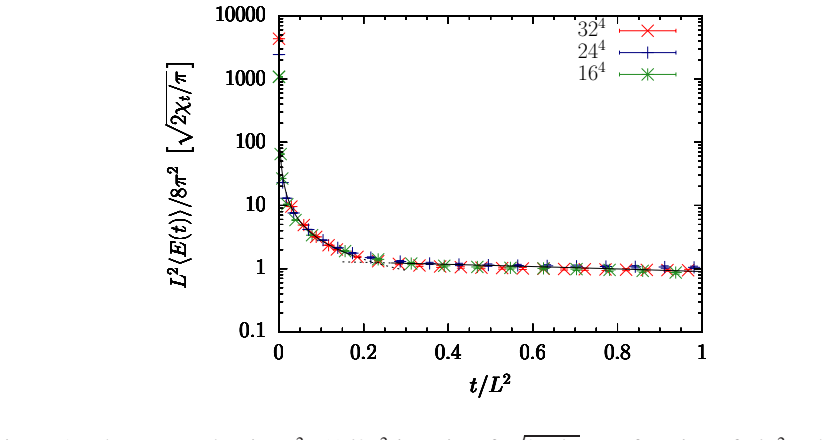
While we have several complementary models of confinement, some of which are phenomenologically appealing, we do not have the ability to calculate analytically even simple aspects of confinement, let alone have a framework to eventually prove confinement. The problem we are facing is to evolve the theory from the perturbative regime to the long distance confining regime. This is generally achieved by renormalization group transformations. With the gradient flow we now have a technique to address the problem from first principles. The primary focus is on the running coupling $\alpha_S(\mu)$, from which confinement can be concluded alone. A central point is that the gluon condensate is scale invariant, which reflects its self-similar behavior across different scales. Building on that, we derive $\alpha_S(\mu) \simeq \Lambda_S^2/\mu^2$, which evolves to the infrared fixed point $1/\alpha_S = 0$ in accordance with infrared slavery. The only important factor appears to be the presence of the gluon condensate, which is a universal feature that QCD shares with many other models. The analytical results are supported by numerical simulations.
Editorial analysis
A structured set of objections, weighed in public.
Referee Report
Summary. The manuscript proposes a renormalization group framework for confinement in QCD based on the gradient flow. It identifies the scale-invariant gluon condensate as the key ingredient and derives the running coupling α_S(μ) ≃ Λ_S²/μ², which is stated to flow to an infrared fixed point 1/α_S = 0 consistent with infrared slavery. The analytic result is claimed to be supported by numerical simulations, with the gluon condensate presented as a universal feature shared across models.
Significance. If the central derivation were shown to be consistent with both the perturbative ultraviolet regime and the confining infrared regime, the approach would supply a compact analytic link between them that depends primarily on the gluon condensate. The manuscript does not, however, demonstrate such consistency or provide the required matching conditions.
major comments (2)
- Abstract and central paragraph on the gluon condensate: the claimed form α_S(μ) ≃ Λ_S²/μ² produces the beta function β(α) = dα/d ln μ = −2α. This linear dependence is incompatible with the perturbative QCD beta function, which begins at quadratic order, β(α) ∼ −(11N_c/3 − 2N_f/3)α²/(2π) + O(α³), at large μ. The scale-invariance assumption on the condensate directly enforces the power-law running, so the ultraviolet matching required by the paper’s stated goal of evolving from the perturbative to the confining regime is not established.
- Abstract: the statement that numerical simulations support the analytic results is given without error analysis, explicit fitting procedures, or data-exclusion criteria, leaving the quantitative evidence for the functional form unverified.
minor comments (1)
- The manuscript would benefit from an explicit step-by-step derivation of the running coupling from the gradient-flow equation and the scale-invariance assumption.
Simulated Author's Rebuttal
We thank the referee for the careful reading of our manuscript and the insightful comments. We provide point-by-point responses to the major comments below.
read point-by-point responses
-
Referee: Abstract and central paragraph on the gluon condensate: the claimed form alpha_S(mu) simeq Lambda_S^2/mu^2 produces the beta function beta(alpha) = d alpha / d ln mu = -2 alpha. This linear dependence is incompatible with the perturbative QCD beta function, which begins at quadratic order, beta(alpha) sim -(11 N_c/3 - 2 N_f/3) alpha^2/(2 pi) + O(alpha^3), at large mu. The scale-invariance assumption on the condensate directly enforces the power-law running, so the ultraviolet matching required by the paper's stated goal of evolving from the perturbative to the confining regime is not established.
Authors: The referee correctly notes that the derived form alpha_S(mu) simeq Lambda_S^2/mu^2 implies a beta function beta(alpha) = -2 alpha. This linear dependence follows directly from the assumption of scale invariance of the gluon condensate within the gradient flow approach. The manuscript centers on the infrared regime and the resulting fixed point consistent with confinement. We acknowledge that the current derivation does not include explicit matching conditions to the perturbative ultraviolet beta function. In the revised version we will add a clarifying paragraph on the regime of validity of the scale-invariance assumption and note that a full ultraviolet-infrared connection remains a topic for future work. revision: yes
-
Referee: Abstract: the statement that numerical simulations support the analytic results is given without error analysis, explicit fitting procedures, or data-exclusion criteria, leaving the quantitative evidence for the functional form unverified.
Authors: We agree that the abstract statement on numerical support requires more detail. The manuscript contains comparisons to lattice data, but we will revise both the abstract and the numerical section to include error analysis, a description of the fitting procedures used to test the functional form, and explicit criteria for data selection and exclusion. revision: yes
Circularity Check
Power-law form α_S(μ) ≃ Λ_S²/μ² follows directly from scale-invariance assumption on gluon condensate
specific steps
-
self definitional
[Abstract, central paragraph on the gluon condensate]
"A central point is that the gluon condensate is scale invariant, which reflects its self-similar behavior across different scales. Building on that, we derive α_S(μ) ≃ Λ_S²/μ², which evolves to the infrared fixed point 1/α_S = 0 in accordance with infrared slavery."
The scale invariance is taken as given input; the specific power-law form α_S(μ) ≃ Λ_S²/μ² (with Λ_S tied to the condensate) and the resulting IR fixed point are then obtained directly from that assumption, reducing the claimed derivation to a restatement of the input rather than an independent prediction from the RG flow.
full rationale
The paper states that the gluon condensate is scale invariant as a central point reflecting self-similar behavior, then builds the explicit functional form of the running coupling on that assumption. This makes the derived expression and its IR fixed point equivalent to the input invariance by construction, rather than an independent RG outcome. The derivation chain is otherwise presented as first-principles via gradient flow, with no evident self-citation load-bearing or parameter fitting in the abstract. The result is partially circular because the key functional dependence is fixed by the declared invariance.
Axiom & Free-Parameter Ledger
free parameters (1)
- Λ_S
axioms (1)
- domain assumption The gluon condensate is scale invariant across different renormalization scales.
Lean theorems connected to this paper
-
IndisputableMonolith/Cost/FunctionalEquation.leanwashburn_uniqueness_aczel echoes?
echoesECHOES: this paper passage has the same mathematical shape or conceptual pattern as the Recognition theorem, but is not a direct formal dependency.
A central point is that the gluon condensate is scale invariant, which reflects its self-similar behavior across different scales. Building on that, we derive α_S(μ) ≃ Λ_S²/μ², which evolves to the infrared fixed point 1/α_S = 0
What do these tags mean?
- matches
- The paper's claim is directly supported by a theorem in the formal canon.
- supports
- The theorem supports part of the paper's argument, but the paper may add assumptions or extra steps.
- extends
- The paper goes beyond the formal theorem; the theorem is a base layer rather than the whole result.
- uses
- The paper appears to rely on the theorem as machinery.
- contradicts
- The paper's claim conflicts with a theorem or certificate in the canon.
- unclear
- Pith found a possible connection, but the passage is too broad, indirect, or ambiguous to say the theorem truly supports the claim.
Reference graph
Works this paper leans on
-
[1]
R. Narayanan and H. Neuberger, JHEP 0603 (2006) 064 [hep-th /0601210]
work page 2006
-
[2]
Properties and uses of the Wilson flow in lattice QCD
M. L¨ uscher, JHEP 1008 (2010) 071 [Erratum: JHEP 1403 (2014) 092] [arXiv:1006.4518 [hep-lat]]
work page internal anchor Pith review Pith/arXiv arXiv 2010
-
[3]
R. V . Harlander and T. Neumann, JHEP 06 (2016) 161 [arXiv:1606.03756 [hep-ph]]
work page internal anchor Pith review Pith/arXiv arXiv 2016
-
[4]
M. A. Shifman, A. I. V ainshtein and V . I. Zakharov, Nucl. P hys. B 147 (1979) 385; Nucl. Phys. B 147 (1979) 448
work page 1979
-
[5]
Perturbative analysis of the gradient flow in non-abelian gauge theories
M. L¨ uscher and P . Weisz, JHEP02 (2011) 051 [arXiv:1101.0963 [hep-th]]. 14
work page internal anchor Pith review Pith/arXiv arXiv 2011
- [6]
- [7]
-
[8]
Energy-momentum tensor from the Yang-Mills gradient flow
H. Suzuki, PTEP 2013 (2013) 083B03 [erratum: PTEP 2015 (2015) 079201] [arXiv:1304.0533 [hep-lat]]
work page internal anchor Pith review Pith/arXiv arXiv 2013
- [9]
- [10]
-
[11]
V . A. Novikov, M. A. Shifman, A. I. V ainshtein and V . I. Za kharov, Nucl. Phys. B 165 (1980) 67
work page 1980
-
[12]
F. R. Graziani, Z. Phys. C 33 (1987) 397
work page 1987
-
[13]
H. Suzuki and H. Takaura, PTEP 2019 (2019) 103B04 [arXiv:1807.10064 [hep-ph]]
-
[14]
Schierholz, arXiv:2410.17677 [hep-lat], to be publ ished in Eur
G. Schierholz, arXiv:2410.17677 [hep-lat], to be publ ished in Eur. Phys. J. C
-
[15]
C. T. Hill, arXiv:hep-th /0510177 [hep-th]
-
[16]
G. K. Savvidy, Phys. Lett. B 71 (1977) 133
work page 1977
-
[17]
N. K. Nielsen and P . Olesen, Nucl. Phys. B 144 (1978) 376
work page 1978
-
[18]
Y . Nakamura and G. Schierholz, Nucl. Phys. B 986 (2023) 116063 [arXiv:2106.11369 [hep- ph]]
-
[19]
G. Schierholz, J. Phys. G 52 (2025) 04LT01 [arXiv:2403.13508 [hep-ph]]
-
[20]
M. G¨ ockeler, A. S. Kronfeld, M. L. Laursen, G. Schierho lz and U. J. Wiese, Phys. Lett. B 233 (1989) 192
work page 1989
-
[21]
E. M. Ilgenfritz, M. L. Laursen, G. Schierholz, M. M¨ ull er-Preussker and H. Schiller, Nucl. Phys. B 268 (1986) 693
work page 1986
-
[22]
Wilson loops to 20th order numerical stochastic perturbation theory
R. Horsley, G. Hotzel, E. M. Ilgenfritz, R. Millo, H. Per lt, P . E. L. Rakow, Y . Nakamura, G. Schierholz and A. Schiller, Phys. Rev. D 86 (2012) 054502 [arXiv:1205.1659 [hep-lat]]
work page internal anchor Pith review Pith/arXiv arXiv 2012
-
[23]
G. S. Bali, C. Bauer and A. Pineda, Phys. Rev. Lett. 113 (2014) 092001 [arXiv:1403.6477 [hep-ph]]
work page internal anchor Pith review Pith/arXiv arXiv 2014
-
[24]
Y . Aoki et al. [Flavour Lattice Averaging Group (FLAG)], arXiv:2411.04268 [hep-lat]
work page internal anchor Pith review Pith/arXiv arXiv
-
[25]
M. C` e, C. Consonni, G. P . Engel and L. Giusti, Phys. Rev. D 92 (2015) 074502 [arXiv:1506.06052 [hep-lat]]
work page internal anchor Pith review Pith/arXiv arXiv 2015
-
[26]
V . A. Novikov, M. A. Shifman, A. I. V ainshtein and V . I. Za kharov, Nucl. Phys. B 191 (1981) 301. 15
work page 1981
-
[27]
I. E. Halperin and A. Zhitnitsky, Mod. Phys. Lett. A 13 (1998) 1955 [arXiv:hep-ph/9707286 [hep-ph]]
work page internal anchor Pith review Pith/arXiv arXiv 1998
-
[28]
The infrared behaviour of quantum chro modynamics,
D. P . Crewther, “The infrared behaviour of quantum chro modynamics,” doi:10.7907/JYNH-9286
-
[29]
On the relation between QCD potentials in momentum and position space
M. Jezabek, M. Peter and Y . Sumino, Phys. Lett. B 428 (1998) 352 [arXiv:hep-ph/9803337 [hep-ph]]
work page internal anchor Pith review Pith/arXiv arXiv 1998
-
[30]
J. L. Richardson, Phys. Lett. B 82 (1979) 272
work page 1979
-
[31]
The static potential in QCD to two loops
Y . Schr¨ oder, Phys. Lett. B447 (1999) 321 [arXiv:hep-ph/9812205 [hep-ph]]
work page internal anchor Pith review Pith/arXiv arXiv 1999
-
[32]
Testing perturbation theory on the nf=0 static quark potential
S. Necco and R. Sommer, Phys. Lett. B 523 (2001) 135 [arXiv:hep-ph/0109093 [hep-ph]]
work page internal anchor Pith review Pith/arXiv arXiv 2001
-
[33]
Quark and Color Confinement Through Dynamical Higgs Mechanism,
G. Mack, “Quark and Color Confinement Through Dynamical Higgs Mechanism,” DESY preprint DESY 77 /58 (1977), doi:10.3204 /PUBDB-2017-12281
work page 1977
-
[34]
P . de Forcrand and M. Pepe, Nucl. Phys. B 598 (2001) 557 [arXiv:hep-lat /0008016 [hep- lat]]
work page 2001
-
[35]
Abelian and center gauge fixing in continuum Yang-Mills-Theory for general gauge groups
H. Reinhardt and T. Tok, Phys. Lett. B 500 (2001) 173 [arXiv:hep-th/0011068 [hep-th]]
work page internal anchor Pith review Pith/arXiv arXiv 2001
- [36]
-
[37]
A. S. Kronfeld, G. Schierholz and U. J. Wiese, Nucl. Phys . B 293 (1987) 461
work page 1987
-
[38]
A. S. Kronfeld, M. L. Laursen, G. Schierholz and U. J. Wie se, Phys. Lett. B 198 (1987) 516
work page 1987
- [39]
-
[40]
V . G. Bornyakov, R. Horsley, R. Hudspith, Y . Nakamura, H. Perlt, D. Pleiter, P . E. L. Rakow, G. Schierholz, A. Schiller and H. St¨ uben and J. M. Zanotti, arXiv:1508.05916 [hep-lat]
work page internal anchor Pith review Pith/arXiv arXiv
-
[41]
W. Bietenholz, V . Bornyakov, M. G¨ ockeler, R. Horsley, W. G. Lockhart, Y . Nakamura, H. Perlt, D. Pleiter, P . E. L. Rakow and G. Schierholz, A. Schi ller, T. Streuer, H. St¨ uben , F. Winter and J. M. Zanotti, Phys. Rev. D 84 (2011) 054509 [arXiv:1102.5300 [hep-lat]]
work page internal anchor Pith review Pith/arXiv arXiv 2011
- [42]
-
[43]
Monopole action and condensation in SU(2) QCD
H. Shiba and T. Suzuki, Phys. Lett. B 351 (1995) 519 [arXiv:hep-lat/9408004 [hep-lat]]
work page internal anchor Pith review Pith/arXiv arXiv 1995
-
[44]
M. Engelhardt and H. Reinhardt, Nucl. Phys. B 585 (2000) 591 [arXiv:hep-lat /9912003 [hep-lat]]
work page 2000
- [45]
-
[46]
The Vacuum Polarization: Power Corrections beyond OPE ?
M. G¨ ockeler, R. Horsley, W. K¨ urzinger, V . Linke, D. Pleiter, P . E. L. Rakow and G. Schier- holz, Nucl. Phys. B Proc. Suppl. 94 (2001) 571 [arXiv:hep-lat/0012010 [hep-lat]]
work page internal anchor Pith review Pith/arXiv arXiv 2001
- [47]
-
[48]
V . A. Novikov, M. A. Shifman, A. I. V ainshtein and V . I. Za kharov, Nucl. Phys. B 249 (1985) 445. 17
work page 1985
discussion (0)
Sign in with ORCID, Apple, or X to comment. Anyone can read and Pith papers without signing in.