REVIEW 3 major objections 5 minor 1 cited by
M4GN aims to show that a three-tier, segment-centric hierarchy—built from physics-aware contiguous segments and a lightweight segment transformer—makes mesh-based graph-network surrogates both more accurate and faster than flat or coarsely-
Reviewed by Pith at T0; open to challenge. T0 means a machine referee read the full paper against a public rubric. the ladder, T0–T4 →
T0 review · deepseek-v4-flash
2026-08-04 17:42 UTC pith:5GNMEH6K
load-bearing objection Solid, incremental contribution to hierarchical mesh-GNN surrogates; the frozen-segmentation assumption is the one load-bearing gap. the 3 major comments →
M4GN: Mesh-based Multi-segment Hierarchical Graph Network for Dynamic Simulations
The pith
A machine-rendered reading of the paper's core claim, the machinery that carries it, and where it could break.
Core claim
The paper proposes that the main obstacle to hierarchical mesh GNNs is not the hierarchy itself but the quality of the coarse graph. It introduces a two-stage segmentation: a fast graph partitioner creates contiguous initial segments, then a superpixel-style refinement reassigns nodes using modal-decomposition features and obstacle-distance cues. Each segment is summarized by average pooling, which is permutation-invariant, and a transformer over the resulting segment tokens performs global reasoning. The claim is that this preserves fine-scale fidelity while making long-range propagation effectively one-hop, yielding an accuracy and efficiency balance that flat message passing and existing
What carries the argument
Hybrid mesh-graph segmentation: an initial graph partitioner produces contiguous segments, and a superpixel-style refinement adjusts boundaries using modal-decomposition features (structural eigenmodes for solids, Laplacian eigenfunctions for fluids) plus obstacle-distance cues. The segments become tokens through a permutation-invariant average-pooling encoder, and a fully connected segment-level transformer exchanges information across all segments at O(K^2) cost with K much smaller than the node count. This machinery converts long-range physical coupling into one-hop segment communication without discarding the original mesh resolution.
Load-bearing premise
The segmentation is computed once from the initial mesh and never updated during rollout, and for solids it uses only the first deformation mode; if the dominant deformation pattern or contact location moves during the simulation, the segment boundaries no longer match the physics.
What would settle it
Run M4GN on a beam where a contact load travels from the fixed end to the tip, so the high-deformation region migrates over time. Compare the frozen-segmentation model against a variant that recomputes segments every T steps. If the re-segmented variant achieves materially lower rollout RMSE, the fixed-segmentation premise is the load-bearing assumption; if not, the premise holds for this class of problems.
If this is right
- If correct, hierarchical surrogates can handle long-range interactions without deep message passing, so prediction error grows much more slowly as graph diameter increases.
- The segmentation is reusable: the transfer experiment shows that installing the same segmentation into a baseline architecture reduces its prediction error by roughly 15–23%.
- The new deforming-beam dataset and its scaled-up version provide a public 3D Lagrangian contact benchmark with graph diameters several times larger than existing solid-mechanics datasets, enabling systematic generalization tests.
- M4GN remains accurate when tested with different numbers of segments, suggesting the method is not tightly coupled to a finely tuned segment count.
- The reported efficiency gain (up to 22% faster inference, lower training memory, and linear-in-mesh-size preprocessing) makes the approach practical for time-sensitive simulation workflows.
Where Pith is reading between the lines
- Editorial extension: the frozen-segmentation design implies the method is best suited to simulations whose dominant dynamics are stationary in character; moving contact zones or shifting deformation patterns would require periodic re-segmentation, which the paper does not develop.
- Editorial extension: because modal decomposition is a one-time preprocessing step, the practical ceiling for very large meshes may shift from inference cost to the eigen-solve; a cheaper approximate modal basis could extend the same recipe to larger domains.
- Editorial extension: the segmentation-quality metrics (conductance, edge-cut ratio, silhouette score) could serve as a training-free heuristic for choosing segment counts on new datasets, reducing the empirical tuning the paper acknowledges.
Editorial analysis
A structured set of objections, weighed in public.
Referee Report
Summary. The paper proposes M4GN, a three-tier hierarchical graph network for mesh-based simulation. A hybrid segmentation pipeline (METIS initialization plus SLIC refinement guided by modal-decomposition features and obstacle-distance cues) partitions the mesh into contiguous segments. Segment features are obtained by permutation-invariant average pooling and processed by a segment-level transformer, while a micro-level GNN retains local message passing. Experiments on CylinderFlow, DeformingPlate, DeformingBeam, plus supplementary EAGLE/FlagSimple and a large-beam generalization set report lower RMSE (up to 56% reduction vs. EAGLE on DeformingBeam) and better mesh-quality metrics than GCN, g-U-Net, MGN, BSMS-GNN, and EAGLE.
Significance. The paper makes a useful contribution. The hybrid segmentation idea is a sensible response to the identified limitations of pooling/coarsening, the permutation-invariant aggregator is a clear simplification over EAGLE's GRU, and the DeformingBeam benchmark with a scaled-up variant is a valuable public resource for testing long-range and cross-scale generalization. The ablation suite is unusually thorough: six segmentation variants, segment count, overlap, PE, message-passing depth, and generalization tests, with mean/std over three seeds. There is no circular derivation; all reported comparisons are on held-out test sets. The main caveats are that the central segmentation assumption (frozen, initial-configuration-based partition) is not stress-tested on time-varying contact problems, and a few numerical claims in the abstract and tables need reconciliation. These are fixable with additional experiments and corrections.
major comments (3)
- [Appendix B.4; Appendix B.1; Section 2.4] Appendix B.4 says the graph is partitioned once and fixed across time; Appendix B.1 says solids use only the first mode. Section 2.4 says modal decomposition does not account for external obstacles, and DeformingPlate/Beam have moving obstacles and contact. Hence obstacle-distance features and mode-based boundaries computed at the initial configuration become stale as the obstacle moves. Appendix F.2 states that in Lagrangian systems 'where segmentation varies with time, only the refinement part is needed,' contradicting B.4, and no experiment re-segments during rollouts. This leaves the central 'dynamically consistent segment' claim untested for time-varying contact. Please add a re-segmentation ablation (recompute refinement periodically with updated obstacle distances) or justify the frozen first-mode choice.
- [Abstract; Table 12; Table 5] The abstract claims 'up to 22% faster inference than state-of-the-art baselines.' In Table 12, the largest main-experiment speedup is about 9.6% (DeformingPlate: M4GN 29.3 ms vs EAGLE 32.4 ms; DeformingBeam about 6.9%). In supplementary Table 5, M4GN's 28.4 ms vs MGN's 35.8 ms on the EAGLE dataset corresponds to about 21% lower time, not 22%. Please correct the abstract or report the exact comparison supporting 22%.
- [Appendix B.3; Table 3] Appendix B.3 states that for DeformingBeam, EAGLE and M4GN use a noise scale of 1e-4 while all other models use 1e-3. This 10x difference in input-noise regularization makes the comparison against MGN and BSMS-GNN on this dataset uncontrolled. Although the headline 56% improvement is computed against EAGLE (which also uses 1e-4), the broader claim of dominating all baselines, and the accuracy-efficiency trade-off analysis in Figure 3, depend on the other comparisons. Please either rerun the baselines with the same noise scale or provide a sensitivity study showing the conclusion is stable.
minor comments (5)
- [Algorithm 1] The output line defines f^md_i as (phi_1(i), phi_1(i), ..., phi_m(i)); the second component should be phi_2(i).
- [Table 8 vs Table 3] DeformingBeam GFh values for SLIC-MDOD_l and SLIC-MDOD_e are reported as 3.53e-03 and 3.02e-03, while Table 3 reports M4GN GFh as 0.31e-3. These are inconsistent by a factor of 10; please check units.
- [Table 12] CylinderFlow RMSE-all values in Table 12 (MGN 4.81e-2, M4GN 3.80e-2) do not match Table 3 (MGN 4.12e-2, M4GN 3.37e-2). The discrepancy is unexplained.
- [Figure 2 caption] The caption repeatedly uses 'MMSGN' where 'M4GN' is intended.
- [Section 4.2.1 / Table 3] On CylinderFlow, M4GN's 1-step RMSE (288e-5) is higher than MGN's (246e-5); the abstract's 'improves prediction accuracy' should specify that the gains are in rollout/aggregate RMSE, not necessarily 1-step error.
Circularity Check
No significant circularity: M4GN's claims are empirical and self-contained; segmentation features come from initial conditions, not prediction targets.
full rationale
The paper's central derivation is an architecture and preprocessing pipeline, evaluated empirically against held-out test sets. The segmentation policy π(G)=fs(G,I) uses graph partitioning, modal features from the initial configuration, and obstacle distances; these are computed from initial conditions and material/boundary setup, not from the prediction targets (node positions/velocities at future times). The macro-level transformer and micro-level GNN are trained with standard supervised L2 loss on next-step states; no fitted parameter is renamed as a prediction, and no equation defines a claimed output in terms of the quantity it is said to predict. Ablations (Tables 8–10, 12) vary segmentation variants, number of segments, overlap, PE, and message-passing steps using validation-based selection, which is model selection rather than circularity. Self-citations (e.g., Hu et al., 2023) appear only as background citations in the introduction and related work and are not load-bearing. The frozen-segmentation concern raised in the reader's take is an empirical robustness gap, not a circularity: the model would still be making genuine predictions from inputs even if that design choice is suboptimal. Therefore no circular steps are present.
Axiom & Free-Parameter Ledger
free parameters (6)
- Segment count K =
36 (CylinderFlow), 19 (DeformingPlate), 19 (DeformingBeam)
- SLIC compactness tau =
1.0, 1.0, 0.5
- Segment overlap delta =
1 (CylinderFlow, DeformingBeam), 0 (DeformingPlate)
- Positional encoding on/off =
on (CylinderFlow), off (DeformingPlate/Beam)
- Number of modal modes m =
1 (solids), 6 (CylinderFlow)
- World edge radius r_W =
0.01 (DeformingPlate), 0.002 (DeformingBeam)
axioms (8)
- domain assumption Low-frequency structural modes from K phi = lambda M phi capture the dominant deformation patterns relevant for segmentation (first mode used for solids).
- domain assumption Laplacian eigenfunctions of the static fluid domain serve as a proxy for physics-relevant flow structures.
- domain assumption A segmentation computed once from initial conditions remains dynamically valid for the entire rollout.
- standard math METIS yields contiguous, balanced partitions on the mesh graph.
- standard math SLIC local k-means refinement converges to a useful segmentation in O(|V|) time.
- domain assumption Average pooling over segment nodes preserves enough information for segment-level transformer reasoning.
- domain assumption A fully connected segment graph with random-walk structural encoding is a valid channel for inter-segment long-range exchange.
- domain assumption Contact between moving objects is represented by world edges within a fixed radius; no hard contact constraints are imposed.
Cite this review
Pith. "Pith review of M4GN: Mesh-based Multi-segment Hierarchical Graph Network for Dynamic Simulations." pith.science (2026). https://pith.science/paper/5GNMEH6K
@misc{pith2026250910659,
  author       = {Pith},
  title        = {Pith review of: M4GN: Mesh-based Multi-segment Hierarchical Graph Network for Dynamic Simulations},
  year         = {2026},
  howpublished = {\url{https://pith.science/paper/5GNMEH6K}},
  note         = {Machine review of arXiv:2509.10659}
}
read the original abstract
Mesh-based graph neural networks (GNNs) have become effective surrogates for PDE simulations, yet their deep message passing incurs high cost and over-smoothing on large, long-range meshes; hierarchical GNNs shorten propagation paths but still face two key obstacles: (i) building coarse graphs that respect mesh topology, geometry, and physical discontinuities, and (ii) maintaining fine-scale accuracy without sacrificing the speed gained from coarsening. We tackle these challenges with M4GN, a three-tier, segment-centric hierarchical network. M4GN begins with a hybrid segmentation strategy that pairs a fast graph partitioner with a superpixel-style refinement guided by modal-decomposition features, producing contiguous segments of dynamically consistent nodes. These segments are encoded by a permutation-invariant aggregator, avoiding the order sensitivity and quadratic cost of aggregation approaches used in prior works. The resulting information bridges a micro-level GNN, which captures local dynamics, and a macro-level transformer that reasons efficiently across segments, achieving a principled balance between accuracy and efficiency. Evaluated on multiple representative benchmark datasets, M4GN improves prediction accuracy by up to 56% while achieving up to 22% faster inference than state-of-the-art baselines.
Figures




Forward citations
Cited by 1 Pith paper
-
Data-free neural PDE solvers based on Graph Neural Networks and weak forms
A graph-neural-network PDE solver trained on the weak-form force residual — no simulation data — reports residual convergence below 1% on unseen load cases and one modified geometry, with residual-based test-time refinement.
Reference graph
Works this paper leans on
-
[7]
At this segmentation level, the model achieves the lowest RMSE and Chamfer Distance, indicating high prediction accuracy and precise shape representation
According to the plots, we identify 19 segments as the optimal number. At this segmentation level, the model achieves the lowest RMSE and Chamfer Distance, indicating high prediction accuracy and precise shape representation. The Hausdorff Distance is also minimized, reflecting excellent alignment between the predicted and true meshes. While the Silhouett...
2025
-
[11]
Semi-supervised classification with graph convolutional networks.arXiv preprint arXiv:1609.02907,
Thomas N Kipf and Max Welling. Semi-supervised classification with graph convolutional networks.arXiv preprint arXiv:1609.02907,
-
[13]
Mario Lino, Stathi Fotiadis, Anil A Bharath, and Chris Cantwell. Towards fast simulation of environmental fluid mechanics with multi-scale graph neural networks.arXiv preprint arXiv:2205.02637,
-
[14]
Learning mesh-based simulation with graph networks.arXiv preprint arXiv:2010.03409,
Tobias Pfaff, Meire Fortunato, Alvaro Sanchez-Gonzalez, and Peter W Battaglia. Learning mesh-based simulation with graph networks.arXiv preprint arXiv:2010.03409,
Pith/arXiv arXiv 2010
-
[15]
U-net: Convolutional networks for biomedical image segmentation
15 Published in Transactions on Machine Learning Research (09/2025) Olaf Ronneberger, Philipp Fischer, and Thomas Brox. U-net: Convolutional networks for biomedical image segmentation. InMedical image computing and computer-assisted intervention–MICCAI 2015: 18th international conference, Munich, Germany, October 5-9, 2015, proceedings, part III 18, pp. 2...
2025
-
[16]
Superpixels and supervoxels in an energy optimization framework
Olga Veksler, Yuri Boykov, and Paria Mehrani. Superpixels and supervoxels in an energy optimization framework. InComputer Vision–ECCV 2010: 11th European Conference on Computer Vision, Heraklion, Crete, Greece, September 5-11, 2010, Proceedings, Part V 11, pp. 211–224. Springer,
2010
-
[18]
Recent advances on machine learning for computational fluid dynamics: A survey
Haixin Wang, Yadi Cao, Zijie Huang, Yuxuan Liu, Peiyan Hu, Xiao Luo, Zezheng Song, Wanjia Zhao, Jilin Liu, Jinan Sun, et al. Recent advances on machine learning for computational fluid dynamics: A survey. arXiv preprint arXiv:2408.12171,
-
[19]
Revisiting over-smoothing in deep gcns.arXiv preprint arXiv:2003.13663,
Chaoqi Yang, Ruijie Wang, Shuochao Yao, Shengzhong Liu, and Tarek Abdelzaher. Revisiting over-smoothing in deep gcns.arXiv preprint arXiv:2003.13663,
Pith/arXiv arXiv 2003
-
[24]
For example, for triangular meshes, the aspect ratio is defined asLmax 2 √√ 3A , whereLmax is the longest edge length, A is the area of the triangle
assesses the shape quality of individual 2D or 3D mesh elements and is widely used in finite element method (FEM) literature to evaluate how closely each element approaches the ideal shape, such as an equilateral triangle or a regular tetrahedron. For example, for triangular meshes, the aspect ratio is defined asLmax 2 √√ 3A , whereLmax is the longest edg...
2025
-
[25]
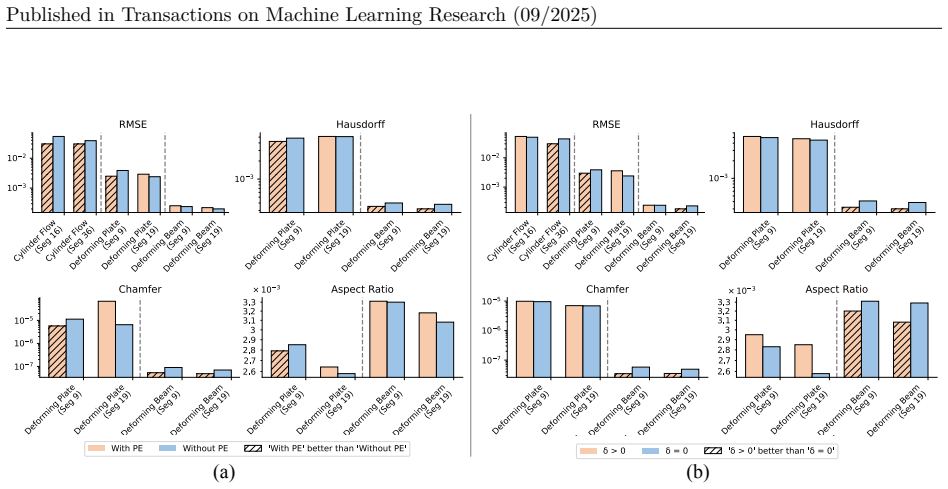
Segment overlap (δ) δ = 0(none), δ = 1(one -ring) Helps Eulerian or directional meshes at highNseg (smoothertransitions); canadd redundancy and hurt Lagrangian cases
or 2-D flows; disable for high -resolution or highly deformable 3-D meshes. Segment overlap (δ) δ = 0(none), δ = 1(one -ring) Helps Eulerian or directional meshes at highNseg (smoothertransitions); canadd redundancy and hurt Lagrangian cases. Use δ = 1for high Nseg andthe mesh is fixed; keepδ = 0for low Nseg. Table 7: Summary of key hyperparameters, their...
2025
-
[28]
E Generalization Studies To evaluate the generalizability of our M4GN model, we created a larger-scale DeformingBeam dataset, detailed in Appendix A. E.1 Performance on Larger-Scale Datasets Table 11 summarizes the generalization performance of various models trained on the DeformingBeam dataset and directly applied to DeformingBeam(large), a scaled-up ve...
2025
-
[29]
The time of our model tours is computed by adding the time used for segmentation and inference on a single NVIDIA Tesla P100 GPU
Since CylinderFlow and DeformingPlate are datasets from the MGN paper, we adopt their reported values for simulator timing (tGT ). The time of our model tours is computed by adding the time used for segmentation and inference on a single NVIDIA Tesla P100 GPU. F.2 Complexity Analysis M4GN is composed of four key components: an Encoder-Process-Decoder (EPD...
2025
-
[51]
27 Published in Transactions on Machine Learning Research (09/2025) Table 8: Ablation study on different segment extraction methods over different dataset. Segmentation Method Dataset GF h↓GF c↓MC↓Aspect Ratio↓RMSE-1 RMSE-all METIS Cylinder - - - - 3.44e-03 4.59e-02 Plate 5.32e-03 1.36e-05 5.33e-03 2.97e-03 2.67e-04 3.29e-03 Beam 3.88e-04 5.61e-08 5.18e-0...
2025
-
[128]
Node input includes mesh positionxi for CylinderFlow
The GCN model does not have edge input. Node input includes mesh positionxi for CylinderFlow. The implementation is from PyTorch Geometric. g-U-Net– The g-U-Net model is a modified version from PyTorch Geometric. Instead of GCN layers, it is built using the GNN layers similar to MGN. The level of scale is 7 for CylinderFlow, 6 for DeformingPlate, and 4 fo...
2020
-
[1993]
Steeven Janny, Aurélien Beneteau, Madiha Nadri, Julie Digne, Nicolas Thome, and Christian Wolf. Eagle: Large-scale learning of turbulent fluid dynamics with mesh transformers.arXiv preprint arXiv:2302.10803,
-
[1998]
Propagation of ocean waves in discrete spectral wave models.Journal of Computational Physics, 68(2):307–326,
13 Published in Transactions on Machine Learning Research (09/2025) Nico Booij and Leo H Holthuijsen. Propagation of ocean waves in discrete spectral wave models.Journal of Computational Physics, 68(2):307–326,
2025
-
[2005]
18 B Model Details 18 B.1 M4GN Configurations
16 Published in Transactions on Machine Learning Research (09/2025) Appendix: Table of Contents A Datasets 18 A.1 Datasets Details . . . . . . . . . . . . . . . . . . . . . . . . . . . . . . . . . . . . . . . . . . . 18 B Model Details 18 B.1 M4GN Configurations . . . . . . . . . . . . . . . . . . . . . . . . . . . . . . . . . . . . . . . . 18 B.2 Baselin...
2025
-
[2007]
Multiscale meshgraphnets
Meire Fortunato, Tobias Pfaff, Peter Wirnsberger, Alexander Pritzel, and Peter Battaglia. Multiscale meshgraphnets. InICML 2022 2nd AI for Science Workshop,
2022
-
[2009]
Deeper insights into graph convolutional networks for semi- supervised learning
Qimai Li, Zhichao Han, and Xiao-Ming Wu. Deeper insights into graph convolutional networks for semi- supervised learning. InProceedings of the AAAI conference on artificial intelligence, volume 32, 2018a. Yunzhu Li, Jiajun Wu, Russ Tedrake, Joshua B Tenenbaum, and Antonio Torralba. Learning particle dynamics for manipulating rigid bodies, deformable objec...
-
[2010]
Order matters: Sequence to sequence for sets.arXiv preprint arXiv:1511.06391,
Oriol Vinyals, Samy Bengio, and Manjunath Kudlur. Order matters: Sequence to sequence for sets.arXiv preprint arXiv:1511.06391,
-
[2012]
In our approach, we adapt SLIC to segment the mesh based on physics- informed features
is a clustering algorithm employed for partitioning data. In our approach, we adapt SLIC to segment the mesh based on physics- informed features. These features could guide SLIC to create a segmentation that captures the underlying physics of the system. The consequent mesh segments can potentially enable efficient macro-level information exchange tailore...
2025
-
[2013]
Predicting physics in mesh-reduced space with temporal attention.arXiv preprint arXiv:2201.09113,
14 Published in Transactions on Machine Learning Research (09/2025) Xu Han, Han Gao, Tobias Pfaff, Jian-Xun Wang, and Li-Ping Liu. Predicting physics in mesh-reduced space with temporal attention.arXiv preprint arXiv:2201.09113,
Pith/arXiv arXiv 2025
-
[2014]
Junyoung Chung, Caglar Gulcehre, KyungHyun Cho, and Yoshua Bengio. Empirical evaluation of gated recurrent neural networks on sequence modeling.arXiv preprint arXiv:1412.3555,
-
[2015]
Vijay Prakash Dwivedi, Anh Tuan Luu, Thomas Laurent, Yoshua Bengio, and Xavier Bresson. Graph neural networks with learnable structural and positional representations.arXiv preprint arXiv:2110.07875,
-
[2016]
Youn-Yeol Yu, Jeongwhan Choi, Woojin Cho, Kookjin Lee, Nayong Kim, Kiseok Chang, ChangSeung Woo, Ilho Kim, SeokWoo Lee, Joon Young Yang, et al. Learning flexible body collision dynamics with hierarchical contact mesh transformer.arXiv preprint arXiv:2312.12467,
-
[2019]
Jonathan Godwin, Michael Schaarschmidt, Alexander Gaunt, Alvaro Sanchez-Gonzalez, Yulia Rubanova, Petar Veličković, James Kirkpatrick, and Peter Battaglia. Simple gnn regularisation for 3d molecular property prediction & beyond.arXiv preprint arXiv:2106.07971,
-
[2020]
Kyunghyun Cho, Bart Van Merriënboer, Caglar Gulcehre, Dzmitry Bahdanau, Fethi Bougares, Holger Schwenk, and Yoshua Bengio. Learning phrase representations using rnn encoder-decoder for statistical machine translation.arXiv preprint arXiv:1406.1078,
-
[2022]
Graph u-nets
Hongyang Gao and Shuiwang Ji. Graph u-nets. Ininternational conference on machine learning, pp. 2083–2092. PMLR,
2083
-
[2023]
A compositional object-based approach to learning physical dynamics.arXiv preprint arXiv:1612.00341,
Michael B Chang, Tomer Ullman, Antonio Torralba, and Joshua B Tenenbaum. A compositional object-based approach to learning physical dynamics.arXiv preprint arXiv:1612.00341,
discussion (0)
Sign in with ORCID, Apple, or X to comment. Anyone can read and Pith papers without signing in.