Glauber quark and gluon contributions to quark energy loss at next-to-leading order and next-to-leading twist
Pith reviewed 2026-05-18 16:53 UTC · model grok-4.3
The pith
An incoming quark in nuclear matter loses energy through four distinct single-scattering kernels that incorporate both Glauber quarks and gluons at next-to-leading order and twist.
A machine-rendered reading of the paper's core claim, the machinery that carries it, and where it could break.
Core claim
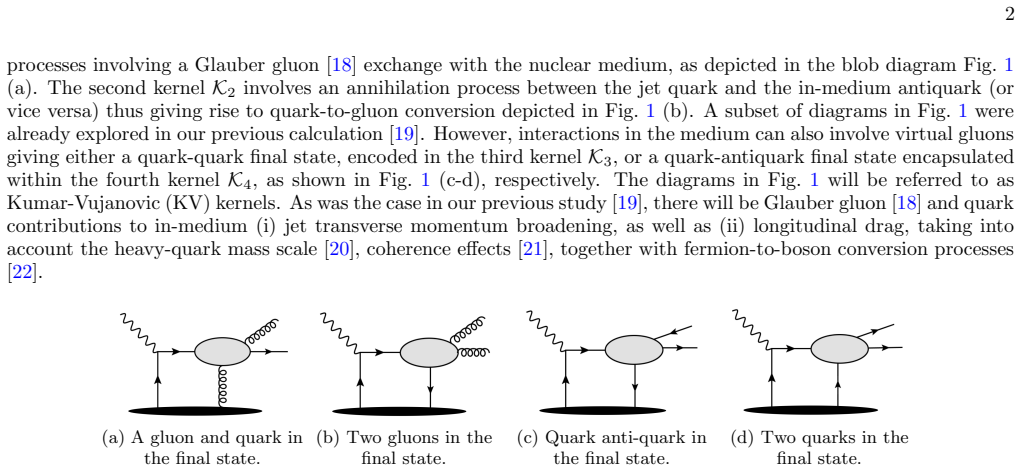
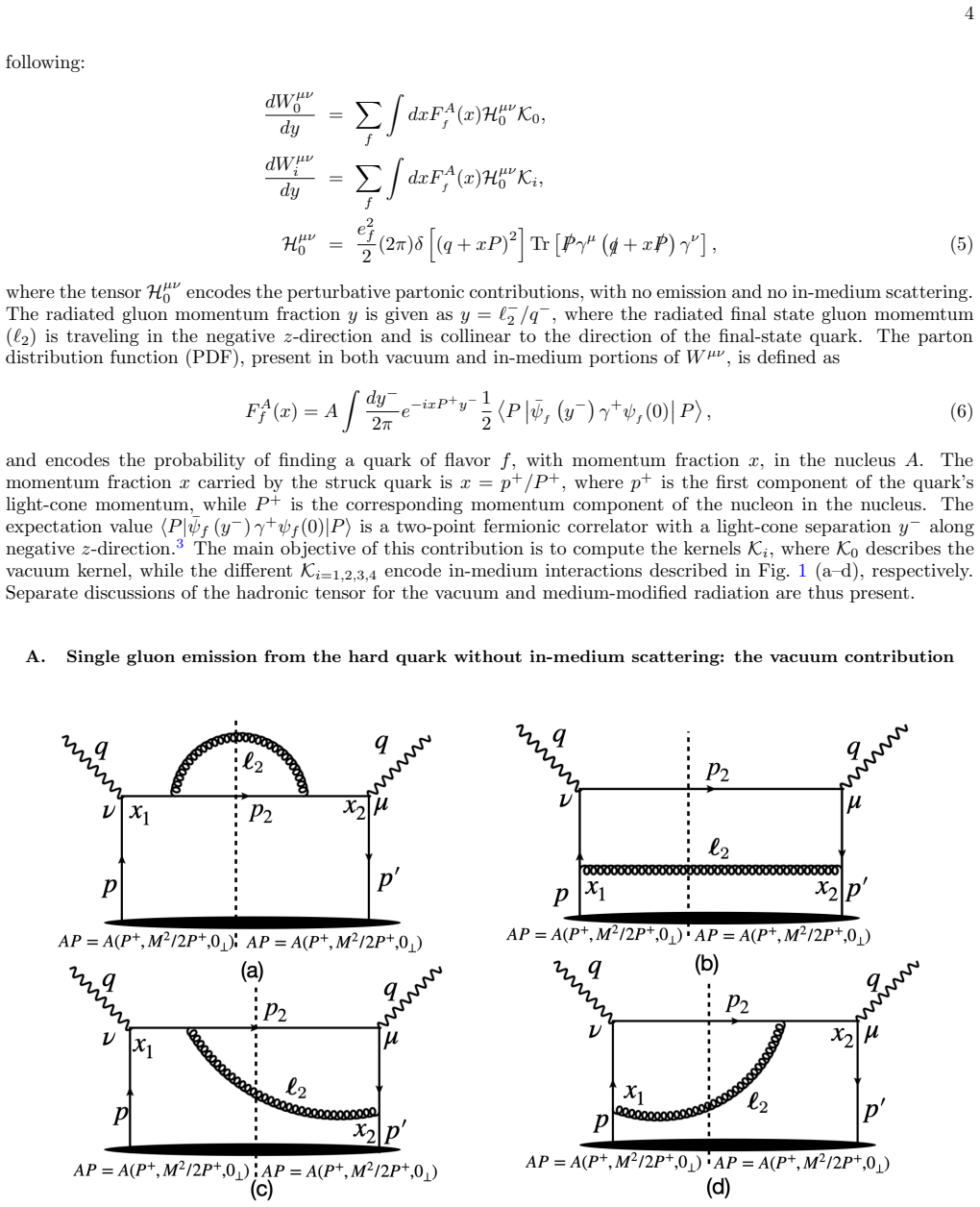
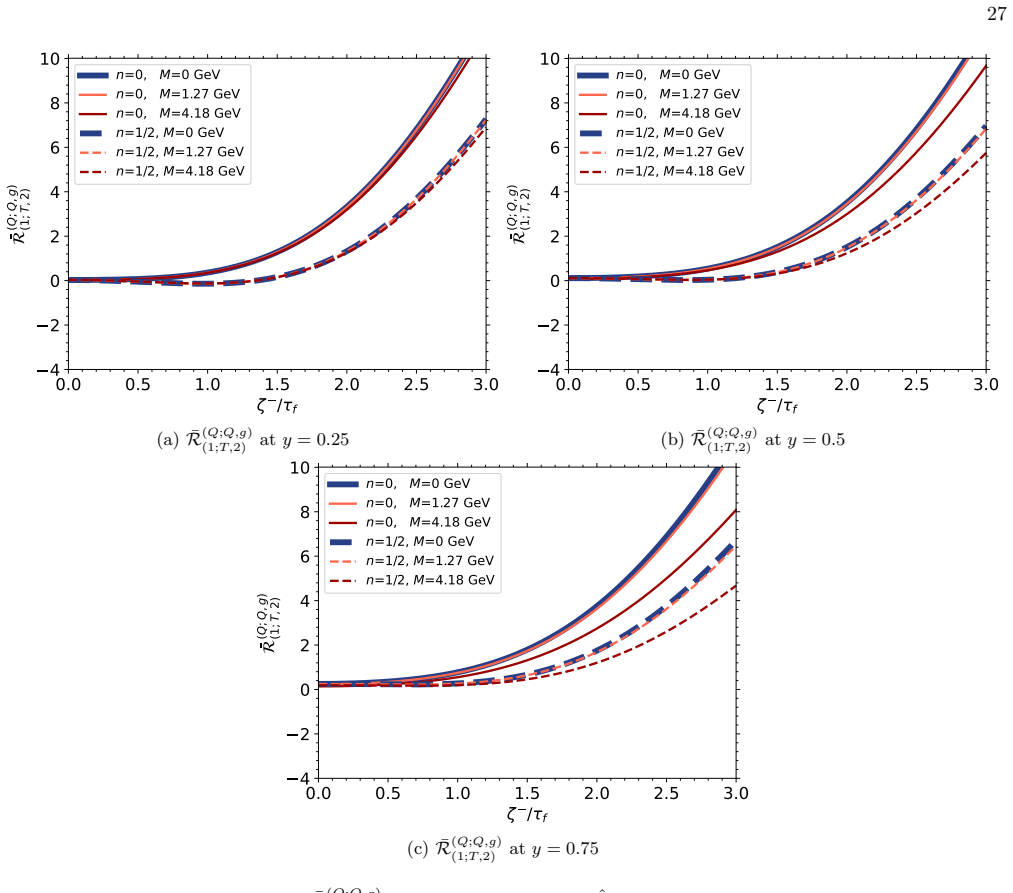
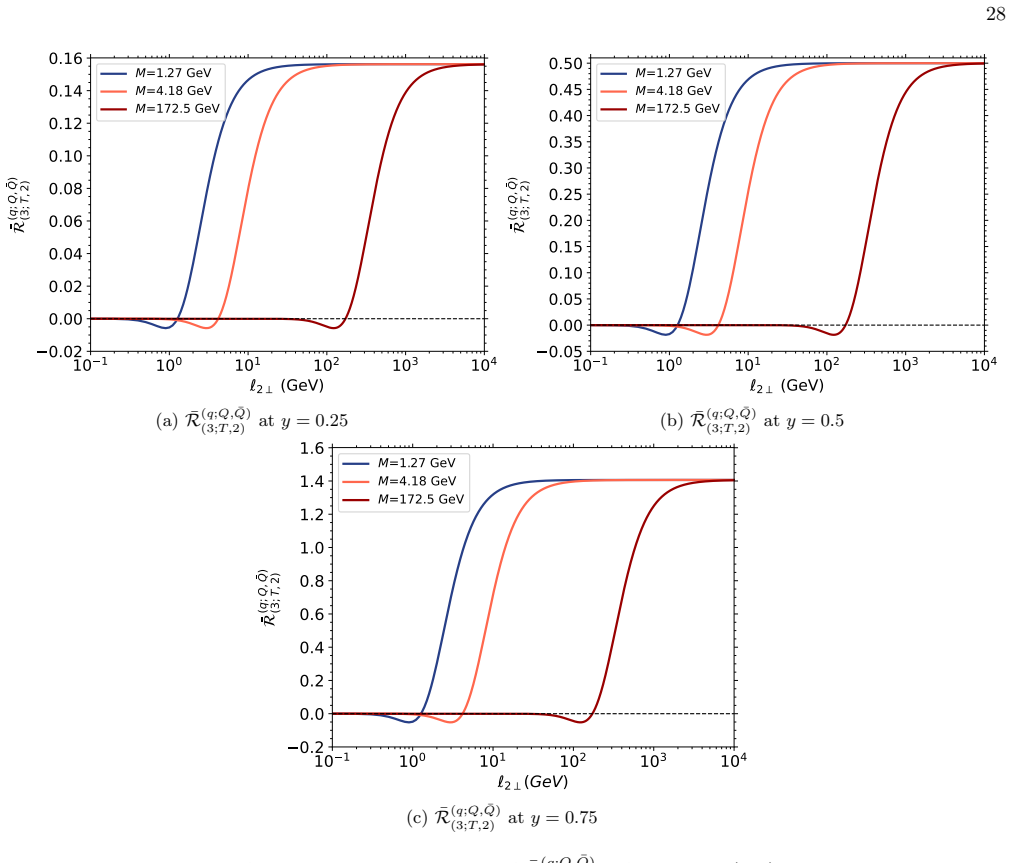
Using the higher-twist formalism at O(alpha_s squared), the authors obtain four scattering kernels K_i for incoming quark energy loss with final states (i) q+g, (ii) g+g, (iii) q+qbar' (flavor possibly different), and (iv) q+q' (flavor possibly different). Each kernel incorporates full phase factors from all contributing diagrams, the first-order derivative in k^- and second-order derivative in k_perp within the gradient expansion, and hard transverse-momentum dependence inside the in-medium parton distribution functions and jet transport coefficients. Heavy-quark mass effects appear in both initial and final states, Glauber quark interactions are added to the gluon channels, and coherence (
What carries the argument
Higher-twist single-scattering emission kernels for medium-induced quark energy loss, extended to include Glauber quark and gluon contributions together with heavy-quark mass corrections.
If this is right
- The four kernels supply the full set of single-scattering contributions needed to integrate for the total medium-induced energy loss of a quark.
- Hard transverse-momentum dependence inside the in-medium PDFs and transport coefficients enters the phase space of each kernel.
- Heavy-quark mass corrections modify both the initial virtuality and the final-state kinematics in every channel.
- The kernels can be inserted into existing jet-quenching calculations to obtain updated suppression factors that include quark scattering.
Where Pith is reading between the lines
- Consistency between these energy-loss kernels and the authors' prior photon-production results would test whether the same factorization applies uniformly across electromagnetic and strong probes.
- The explicit inclusion of q + q' and q + qbar' channels opens a route to flavor-dependent energy loss that could be contrasted with gluon-only calculations in Monte Carlo simulations.
- The second-order transverse-momentum derivatives suggest a natural next step of examining the corresponding diffusion coefficients in the transport equation for the jet.
Load-bearing premise
The factorization procedure previously used for medium-induced photon production in electron-nucleus deep-inelastic scattering continues to hold when Glauber quark interactions and heavy-quark mass effects are introduced for quark energy loss.
What would settle it
A numerical evaluation of the transverse-momentum-broadened energy-loss spectrum or the resulting nuclear modification factor for charm quarks that differs measurably from the spectrum obtained with only gluon-induced kernels at the same order.
Figures







read the original abstract
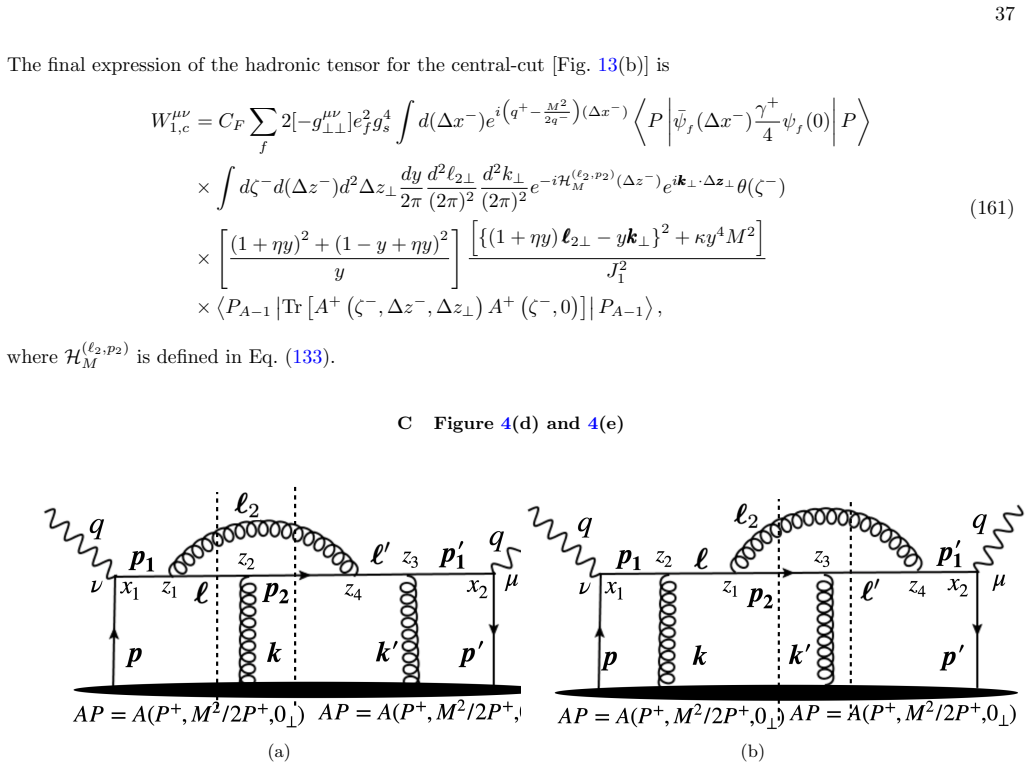
The higher-twist formalism is used at $O(\alpha^2_s)$ to compute all possible medium-induced single-scattering emission kernels for an incoming highly energetic and virtual quark traversing the nuclear environment. The effects of the heavy-quark mass scale are taken into account [Phys. Rev. C 94, 054902 (2016)] both in the initial state as well as in the final state, along with interactions involving both in-medium Glauber gluons and quarks [Nucl. Phys. A 793, 128 (2007)], as well as coherence effects [Phys. Rev. C 105, 024908 (2022)]. As this study is a continuation of our work on medium-induced photon production [Phys. Rev. C 112, 025204 (2025)], the general factorization procedure for $e$-$A$ deep-inelastic scattering is still used. An incoming quark energy loss in the nuclear medium yields four possible scattering kernels $K_i$ with the following final states: (i) $q+g$, (ii) $g+g$, (iii) $q+\bar{q}'$, where the quark $q$ may have a flavor different from the antiquark $\bar{q}'$, and (iv) $q+q'$, where, again, $q$ may have a flavor different from $q'$. The collisional kernels include full phase factors from all non-vanishing diagrams and complete first-order derivative in the longitudinal direction ($k^-$) as well as second-order derivative in the transverse momentum ($k_{\perp}$) gradient expansion. Furthermore, in-medium parton distribution functions and the related jet transport coefficients have a hard transverse-momentum dependence (of the emitted quark or gluon) present within the phase factor.
Editorial analysis
A structured set of objections, weighed in public.
Referee Report
Summary. The manuscript applies the higher-twist formalism at O(α_s²) to compute all medium-induced single-scattering emission kernels for an incoming highly energetic virtual quark in a nuclear medium. It incorporates heavy-quark mass effects in both initial and final states, interactions with in-medium Glauber gluons and quarks, and coherence effects. Building directly on the authors' prior photon-production calculation, the work reuses the same general factorization procedure for e-A deep-inelastic scattering and derives four scattering kernels K_i corresponding to final states (i) q+g, (ii) g+g, (iii) q+ qbar', and (iv) q+q', each including full phase factors, first-order k^- derivatives, second-order k_perp gradient expansions, and hard transverse-momentum dependence in the in-medium PDFs and jet transport coefficients.
Significance. If the factorization extension is valid and the kernels are correctly derived, the results would supply a more complete set of O(α_s²) medium-induced contributions to quark energy loss, explicitly including Glauber quark scatterers and mass effects that were previously omitted. This extension is relevant for phenomenological modeling of heavy-flavor suppression and jet quenching in heavy-ion collisions, where both gluon and quark interactions in the medium matter.
major comments (1)
- [Factorization procedure and kernel derivation] The central claim that the general factorization procedure developed for medium-induced photon production remains valid after inserting Glauber quark interactions and heavy-quark mass terms into initial and final states is load-bearing for the derivation of all four kernels K_i. The manuscript states that the procedure is still used but does not isolate or demonstrate the steps confirming that these insertions preserve the original power counting, do not generate new leading-power contributions, and leave the first-order k^- and second-order k_perp derivative expansions intact. This verification is required to support the explicit inclusion of full phase factors and hard-p_T dependence in the kernels.
minor comments (2)
- The abstract and summary describe the computational framework and list the four kernels but do not present explicit analytic expressions, numerical evaluations, or cross-checks against the gluon-only limit; these should be added to allow independent verification of the results.
- Notation for the four kernels K_i and the in-medium PDFs/jet transport coefficients could be clarified with a summary table or explicit definitions early in the text to improve readability.
Simulated Author's Rebuttal
We thank the referee for their thorough review and for identifying the need for explicit verification of the factorization procedure. We address the major comment below and outline the revisions we will make to strengthen the manuscript.
read point-by-point responses
-
Referee: [Factorization procedure and kernel derivation] The central claim that the general factorization procedure developed for medium-induced photon production remains valid after inserting Glauber quark interactions and heavy-quark mass terms into initial and final states is load-bearing for the derivation of all four kernels K_i. The manuscript states that the procedure is still used but does not isolate or demonstrate the steps confirming that these insertions preserve the original power counting, do not generate new leading-power contributions, and leave the first-order k^- and second-order k_perp derivative expansions intact. This verification is required to support the explicit inclusion of full phase factors and hard-p_T dependence in the kernels.
Authors: We agree that an explicit verification of the power counting is necessary to support the central claim. The present work extends the general factorization procedure established in our prior photon-production calculation (Phys. Rev. C 112, 025204 (2025)) by incorporating Glauber quark scatterers and heavy-quark mass terms in the initial and final states, following the higher-twist formalism of Refs. [Phys. Rev. C 94, 054902 (2016)] and [Nucl. Phys. A 793, 128 (2007)]. These insertions are introduced through the same set of diagrams and do not alter the leading-power structure: the Glauber quark contributions enter at the same twist as the gluon terms, while mass corrections appear as subleading modifications to the propagators that preserve the first-order k^- derivative and second-order k_perp gradient expansions. The full phase factors and hard transverse-momentum dependence in the in-medium PDFs and jet transport coefficients remain unchanged because they originate from the same eikonal and collinear approximations used in the photon case. To address the referee's concern, we will add a new subsection in Section II that isolates the key steps: (i) confirmation that no new leading-power operators are generated, (ii) verification that the derivative expansions are unaffected, and (iii) explicit power-counting arguments for the four kernels K_i. This addition will make the extension of the procedure fully transparent. revision: yes
Circularity Check
Central factorization procedure and derivative expansions imported from authors' prior photon-production paper via self-citation
specific steps
-
self citation load bearing
[Abstract]
"As this study is a continuation of our work on medium-induced photon production [Phys. Rev. C 112, 025204 (2025)], the general factorization procedure for e-A deep-inelastic scattering is still used."
The quoted statement imports the entire technical framework (phase factors, k^- first-order and k_perp second-order derivatives, coherence treatment) that generates the four scattering kernels K_i. The paper asserts that the procedure remains valid after adding Glauber quark interactions and heavy-quark mass effects in initial/final states, but provides no isolated verification steps for power-counting preservation; the kernels are therefore obtained by direct application of the cited prior procedure.
full rationale
The manuscript explicitly positions itself as a continuation and states that the general factorization procedure developed for medium-induced photon production is reused here. This procedure supplies the phase factors, first-order k^- derivatives, and second-order k_perp gradient expansion that define all four kernels K_i. While the paper performs explicit calculations for the new channels (including Glauber quarks and heavy-mass insertions), the load-bearing justification that these insertions preserve the original power counting and expansion validity rests on the self-citation rather than a re-derived or independently verified argument within this work. The explicit kernel expressions may still contain independent algebraic content, preventing a higher score.
Axiom & Free-Parameter Ledger
axioms (2)
- domain assumption Higher-twist formalism applies to medium-induced single-scattering emissions at O(α_s²) for virtual quarks
- domain assumption Factorization procedure from prior photon-production study extends to quark energy loss with Glauber quarks and mass effects
Lean theorems connected to this paper
-
IndisputableMonolith/Foundation/RealityFromDistinction.leanreality_from_one_distinction unclear?
unclearRelation between the paper passage and the cited Recognition theorem.
As this study is a continuation of our work on medium-induced photon production... the general factorization procedure for e-A deep-inelastic scattering is still used.
What do these tags mean?
- matches
- The paper's claim is directly supported by a theorem in the formal canon.
- supports
- The theorem supports part of the paper's argument, but the paper may add assumptions or extra steps.
- extends
- The paper goes beyond the formal theorem; the theorem is a base layer rather than the whole result.
- uses
- The paper appears to rely on the theorem as machinery.
- contradicts
- The paper's claim conflicts with a theorem or certificate in the canon.
- unclear
- Pith found a possible connection, but the passage is too broad, indirect, or ambiguous to say the theorem truly supports the claim.
Reference graph
Works this paper leans on
-
[1]
It involves nested integrals over variablesp ′+ andℓ ′+. The integrals are carried out using the method of contour integration as follows C= I I dℓ′+ (2π) dp′+ (2π) eiℓ′+(z− 3 −z− 2 )e−ip′+(x− 2 −z− 2 ) h (q+p ′)2 −M 2 −iϵ ih (q+p ′ −ℓ ′)2 −iϵ i [ℓ′2 −M 2 −iϵ] = I I dℓ′+ (2π) dp′+ (2π) eiℓ′+(z− 3 −z− 2 )e−ip′+(x− 2 −z− 2 ) 8q−(q− −ℓ ′−)ℓ′− h q+ +p ′+ − M2...
-
[2]
We identify one pole for each momentum variablep ′+ andℓ ′+. The contour integration for momentump ′+ is given as C1 = I dp′+ (2π) e−ip′+(x− 2 −z− 3 ) h (q+p ′)2 −M 2 −iϵ i = (−2πi) 2π θ x− 2 −z − 3 2q− e i q+− M2 2q− (x− 2 −z− 3 ). (202) 47 Similarly, the contour integration forℓ ′+ can be done giving: C2 = I dℓ′+ (2π) e−iℓ′+(z− 3 −z− 2 ) [ℓ′2 −M 2 −iϵ] ...
-
[3]
We identify one pole for each momentum variablep + andp ′+. The contour integration for momentump + is given as C1 = I dp+ (2π) eip+(x− 1 −z− 2 ) h (q+p) 2 +iϵ i = (2πi) 2π θ x− 1 −z − 2 2q− e−iq+(x− 1 −z− 2 ).(244) Similarly, the contour integration for momentump ′+ is carried out as C2 = I dp′+ (2π) e−ip′+(x− 2 −z− 3 ) h (q+p ′)2 −iϵ i = (−2πi) 2π θ x− ...
-
[4]
Transport coefficients in high temperature gauge theories: (I) Leading-log results
Peter Brockway Arnold, Guy D. Moore, and Laurence G. Yaffe, “Transport coefficients in high temperature gauge theories. 1. Leading log results,” JHEP11, 001 (2000), arXiv:hep-ph/0010177
work page internal anchor Pith review Pith/arXiv arXiv 2000
-
[5]
Effective Kinetic Theory for High Temperature Gauge Theories
Peter Brockway Arnold, Guy D. Moore, and Laurence G. Yaffe, “Effective kinetic theory for high temperature gauge theories,” JHEP01, 030 (2003), arXiv:hep-ph/0209353
work page internal anchor Pith review Pith/arXiv arXiv 2003
-
[6]
Yaffe, “Transport coefficients in high temperature gauge theories
Peter Brockway Arnold, Guy D Moore, and Laurence G. Yaffe, “Transport coefficients in high temperature gauge theories
-
[7]
Beyond leading log,” JHEP05, 051 (2003), arXiv:hep-ph/0302165
work page internal anchor Pith review Pith/arXiv arXiv 2003
-
[8]
Xiao-feng Guo and Xin-Nian Wang, “Multiple scattering, parton energy loss and modified fragmentation functions in deeply inelastic e A scattering,” Phys. Rev. Lett.85, 3591–3594 (2000), arXiv:hep-ph/0005044
work page internal anchor Pith review Pith/arXiv arXiv 2000
-
[9]
Multiple Parton Scattering in Nuclei: Parton Energy Loss
Xin-Nian Wang and Xiao-feng Guo, “Multiple parton scattering in nuclei: Parton energy loss,” Nucl. Phys. A696, 788–832 (2001), arXiv:hep-ph/0102230
work page internal anchor Pith review Pith/arXiv arXiv 2001
-
[10]
Hard collinear gluon radiation and multiple scattering in a medium
Abhijit Majumder, “Hard collinear gluon radiation and multiple scattering in a medium,” Phys. Rev. D85, 014023 (2012), arXiv:0912.2987 [nucl-th]
work page internal anchor Pith review Pith/arXiv arXiv 2012
-
[11]
Higher twist jet broadening and classical propagation
A. Majumder and Berndt Muller, “Higher twist jet broadening and classical propagation,” Phys. Rev. C77, 054903 (2008), arXiv:0705.1147 [nucl-th]
work page internal anchor Pith review Pith/arXiv arXiv 2008
-
[12]
Incorporating Space-Time Within Medium-Modified Jet Event Generators
Abhijit Majumder, “Incorporating Space-Time Within Medium-Modified Jet Event Generators,” Phys. Rev. C88, 014909 (2013), arXiv:1301.5323 [nucl-th]
work page internal anchor Pith review Pith/arXiv arXiv 2013
-
[13]
Nuclear modification of leading hadrons and jets within a virtuality ordered parton shower,
Shanshan Cao and Abhijit Majumder, “Nuclear modification of leading hadrons and jets within a virtuality ordered parton shower,” Phys. Rev. C101, 024903 (2020), arXiv:1712.10055 [nucl-th]
-
[14]
Shanshan Cao, Tan Luo, Guang-You Qin, and Xin-Nian Wang, “Linearized Boltzmann transport model for jet propaga- tion in the quark-gluon plasma: Heavy quark evolution,” Phys. Rev. C94, 014909 (2016), arXiv:1605.06447 [nucl-th]
work page internal anchor Pith review Pith/arXiv arXiv 2016
-
[15]
Multistage Monte-Carlo simulation of jet modification in a static medium
S. Caoet al.(JETSCAPE), “Multistage Monte-Carlo simulation of jet modification in a static medium,” Phys. Rev. C 96, 024909 (2017), arXiv:1705.00050 [nucl-th]
work page internal anchor Pith review Pith/arXiv arXiv 2017
-
[16]
MARTINI: An event generator for relativistic heavy-ion collisions
Bjoern Schenke, Charles Gale, and Sangyong Jeon, “MARTINI: An Event generator for relativistic heavy-ion collisions,” Phys. Rev. C80, 054913 (2009), arXiv:0909.2037 [hep-ph]
work page internal anchor Pith review Pith/arXiv arXiv 2009
-
[17]
J. H. Putschkeet al., “The JETSCAPE framework,” (2019), arXiv:1903.07706 [nucl-th]
work page internal anchor Pith review Pith/arXiv arXiv 2019
-
[18]
JETSCAPE framework:p+presults,
A. Kumaret al.(JETSCAPE), “JETSCAPE framework:p+presults,” Phys. Rev. C102, 054906 (2020), arXiv:1910.05481 [nucl-th]
-
[19]
R. Ehlerset al.(JETSCAPE), “Bayesian inference analysis of jet quenching using inclusive jet and hadron suppression measurements,” Phys. Rev. C111, 054913 (2025), arXiv:2408.08247 [hep-ph]
-
[20]
S. Navaset al.(Particle Data Group), “Review of particle physics,” Phys. Rev. D110, 030001 (2024)
work page 2024
-
[21]
Matthew R. Heffernan, Charles Gale, Sangyong Jeon, and Jean-Fran¸ cois Paquet, “Early-Times Yang-Mills Dynamics and the Characterization of Strongly Interacting Matter with Statistical Learning,” Phys. Rev. Lett.132, 252301 (2024), arXiv:2306.09619 [nucl-th]
-
[22]
Extending Soft-Collinear-Effective-Theory to describe hard jets in dense QCD media
Ahmad Idilbi and Abhijit Majumder, “Extending Soft-Collinear-Effective-Theory to describe hard jets in dense QCD media,” Phys. Rev. D80, 054022 (2009), arXiv:0808.1087 [hep-ph]
work page internal anchor Pith review Pith/arXiv arXiv 2009
-
[23]
Amit Kumar and Gojko Vujanovic, “Bremsstrahlung photon contributions to parton energy loss at high virtualityQ 2: A perturbative calculation at O(α sαem),” Phys. Rev. C112, 025204 (2025), arXiv:2502.02667 [hep-ph]
-
[24]
Drag induced radiative loss from semi-hard heavy quarks
Raktim Abir and Abhijit Majumder, “Drag-induced radiative energy loss from semihard heavy quarks,” Phys. Rev. C 94, 054902 (2016), arXiv:1506.08648 [nucl-th]
work page internal anchor Pith review Pith/arXiv arXiv 2016
-
[25]
Final-state gluon emission in deep-inelastic scattering at next-to-leading twist,
Chathuranga Sirimanna, Shanshan Cao, and Abhijit Majumder, “Final-state gluon emission in deep-inelastic scattering at next-to-leading twist,” Phys. Rev. C105, 024908 (2022), arXiv:2108.05329 [hep-ph]
-
[26]
Multiple Parton Scattering in Nuclei: Quark-quark Scattering
Andreas Schafer, Xin-Nian Wang, and Ben-Wei Zhang, “Multiple Parton Scattering in Nuclei: Quark-quark Scattering,” Nucl. Phys. A793, 128–170 (2007), arXiv:0704.0106 [hep-ph]
work page internal anchor Pith review Pith/arXiv arXiv 2007
-
[27]
32 (Cambridge University Press, 2011)
John Collins,Foundations of Perturbative QCD, Vol. 32 (Cambridge University Press, 2011)
work page 2011
-
[28]
Michael E. Peskin and Daniel V. Schroeder,An Introduction to quantum field theory(Addison-Wesley, Reading, USA, 1995)
work page 1995
-
[29]
Singularities and discontinuities of Feynman amplitudes,
R. E. Cutkosky, “Singularities and discontinuities of Feynman amplitudes,” J. Math. Phys.1, 429–433 (1960)
work page 1960
-
[30]
Failure of the collinear expansion in calculation of the induced gluon emission
P. Aurenche, B. G. Zakharov, and H. Zaraket, “Failure of the collinear expansion in calculation of the induced gluon emission,” JETP Lett.87, 605–610 (2008), arXiv:0804.4282 [hep-ph]
work page internal anchor Pith review Pith/arXiv arXiv 2008
-
[31]
H.F. Weinberger,A First Course in Partial Differential Equations with Complex Variables and Transform Methods, Blaisdell book in pure and applied mathematics (Dover Publications, 1995)
work page 1995
-
[32]
C.M. Bender and S.A. Orszag,Advanced Mathematical Methods for Scientists and Engineers I: Asymptotic Methods and Perturbation Theory(Springer New York, 2013)
work page 2013
-
[33]
Strauss,Partial Differential Equations: An Introduction(Wiley, 1992)
W.A. Strauss,Partial Differential Equations: An Introduction(Wiley, 1992)
work page 1992
-
[34]
Extracting jet transport coefficient from jet quenching at RHIC and LHC
Karen M. Burkeet al.(JET), “Extracting the jet transport coefficient from jet quenching in high-energy heavy-ion collisions,” Phys. Rev. C90, 014909 (2014), arXiv:1312.5003 [nucl-th]
work page internal anchor Pith review Pith/arXiv arXiv 2014
-
[35]
Multiple Parton Scattering in Nuclei: Modified DGLAP Evolution for Fragmentation Functions
Wei-tian Deng and Xin-Nian Wang, “Multiple Parton Scattering in Nuclei: Modified DGLAP Evolution for Fragmentation Functions,” Phys. Rev. C81, 024902 (2010), arXiv:0910.3403 [hep-ph]
work page internal anchor Pith review Pith/arXiv arXiv 2010
-
[36]
Global extraction of the jet transport coefficient in cold nuclear matter,
Peng Ru, Zhong-Bo Kang, Enke Wang, Hongxi Xing, and Ben-Wei Zhang, “Global extraction of the jet transport coefficient in cold nuclear matter,” Phys. Rev. D103, L031901 (2021), arXiv:1907.11808 [hep-ph]
-
[37]
Jet transport coefficient ˆqin lattice QCD,
Amit Kumar, Abhijit Majumder, and Johannes Heinrich Weber, “Jet transport coefficient ˆqin lattice QCD,” Phys. Rev. D106, 034505 (2022), arXiv:2010.14463 [hep-lat]. 64
-
[38]
Computing jet transport coefficients on the lattice,
Johannes Heinrich Weber, Amit Kumar, Abhijit Majumder, and Ismail Soudi, “Computing jet transport coefficients on the lattice,” PoSHardProbes2023, 180 (2023), arXiv:2307.08834 [hep-lat]
-
[39]
A lattice study of the jet quenching parameter
Marco Panero, Kari Rummukainen, and Andreas Sch¨ afer, “Lattice Study of the Jet Quenching Parameter,” Phys. Rev. Lett.112, 162001 (2014), arXiv:1307.5850 [hep-ph]
work page internal anchor Pith review Pith/arXiv arXiv 2014
-
[40]
Calculating the Jet Quenching Parameter $\hat{q}$ in Lattice Gauge Theory
Abhijit Majumder, “Calculating the jet quenching parameter ˆqin lattice gauge theory,” Phys. Rev. C87, 034905 (2013), arXiv:1202.5295 [nucl-th]
work page internal anchor Pith review Pith/arXiv arXiv 2013
-
[41]
Lattice calculation of transport coefficient ˆqin pure gluon plasma and (2+1)-flavor QCD plasma,
Amit Kumar, Abhijit Majumder, and Johannes Heinrich Weber, “Lattice calculation of transport coefficient ˆqin pure gluon plasma and (2+1)-flavor QCD plasma,” PoSHardProbes2020, 186 (2021), arXiv:2009.05655 [nucl-th]
-
[42]
First 4D lattice calculation of transport coefficient $\hat{q}$ for pure gluon plasma
Amit Kumar, Abhijit Majumder, and Chiho Nonaka, “First 4D lattice calculation of transport coefficient ˆqfor pure gluon plasma,” PoSHardProbes2018, 051 (2019), arXiv:1901.03878 [nucl-th]
work page internal anchor Pith review Pith/arXiv arXiv 2019
-
[43]
First calculation of $\hat{q}$ on a quenched SU(3) plasma
Amit Kumar, Abhijit Majumder, and Chiho Nonaka, “First calculation of ˆqon a quenched SU(3) plasma,” PoSLAT- TICE2018, 169 (2018), arXiv:1811.01329 [nucl-th]
work page internal anchor Pith review Pith/arXiv arXiv 2018
-
[44]
Modified coherence and the transverse extent of jets,
Amit Kumar, Abhijit Majumder, Chathuranga Sirimanna, and Yasuki Tachibana, “Modified coherence and the transverse extent of jets,” Phys. Rev. C112, 014907 (2025), arXiv:2501.07823 [hep-ph]
-
[45]
Comment on ``Success of collinear expansion in the calculation of induced gluon emission''
P. Aurenche, B. G. Zakharov, and H. Zaraket, “Comment on ‘Success of collinear expansion in the calculation of induced gluon emission’,” (2008), arXiv:0806.0160 [hep-ph]
work page internal anchor Pith review Pith/arXiv arXiv 2008
-
[46]
https://pdg.lbl.gov/2022/tables/rpp2022-sum-quarks.pdf
work page 2022
-
[47]
The medium-modifiedg→c csplitting function in the BDMPS-Z formalism,
Maximilian Attems, Jasmine Brewer, Gian Michele Innocenti, Aleksas Mazeliauskas, Sohyun Park, Wilke van der Schee, and Urs Achim Wiedemann, “The medium-modifiedg→c csplitting function in the BDMPS-Z formalism,” JHEP01, 080 (2023), arXiv:2203.11241 [hep-ph]
-
[48]
Maximilian Attems, Jasmine Brewer, Gian Michele Innocenti, Aleksas Mazeliauskas, Sohyun Park, Wilke van der Schee, Gregory Soyez, and Urs Achim Wiedemann, “Medium-Enhanced cc¯Radiation,” Phys. Rev. Lett.132, 212301 (2024), arXiv:2209.13600 [hep-ph]
-
[49]
Joao Barata, Jasmine Brewer, Kyle Lee, and Joao M. Silva, “Heavy Quark Pair Energy Correlators: From Profiling Partonic Splittings to Probing Heavy-Flavor Fragmentation,” (2025), arXiv:2508.19404 [hep-ph]
-
[50]
Quench- ing jets increases their flavor,
Chathuranga Sirimanna, Ismail Soudi, Gojko Vujanovic, Wen-Jing Xing, Shanshan Cao, and Abhijit Majumder, “Quench- ing jets increases their flavor,” Phys. Rev. C108, 014911 (2023), arXiv:2211.15553 [hep-ph]
-
[51]
Photon and Gluon Emission in Relativistic Plasmas
Peter Brockway Arnold, Guy D. Moore, and Laurence G. Yaffe, “Photon and gluon emission in relativistic plasmas,” JHEP06, 030 (2002), arXiv:hep-ph/0204343
work page internal anchor Pith review Pith/arXiv arXiv 2002
-
[52]
Energy Loss of Leading Partons in a Thermal QCD Medium
Sangyong Jeon and Guy D. Moore, “Energy loss of leading partons in a thermal QCD medium,” Phys. Rev. C71, 034901 (2005), arXiv:hep-ph/0309332
work page internal anchor Pith review Pith/arXiv arXiv 2005
-
[53]
Rouzbeh Modarresi Yazdi, Shuzhe Shi, Charles Gale, and Sangyong Jeon, “Leading order, next-to-leading order, and nonperturbative parton collision kernels: Effects in static and evolving media,” Phys. Rev. C106, 064902 (2022), arXiv:2206.05855 [hep-ph]
-
[54]
QCD jets in a hot and dense medium: A study of shower formation time and collision kernels,
Rouzbeh Modarresi-Yazdi, Shuzhe Shi, Charles Gale, and Sangyong Jeon, “QCD jets in a hot and dense medium: A study of shower formation time and collision kernels,” Phys. Rev. C111, 054904 (2025), arXiv:2407.19966 [hep-ph]
-
[55]
D. Everettet al.(JETSCAPE), “Phenomenological constraints on the transport properties of QCD matter with data- driven model averaging,” Phys. Rev. Lett.126, 242301 (2021), arXiv:2010.03928 [hep-ph]
-
[56]
Update on (2+1+1)-flavor QCD equation of state,
Johannes Heinrich Weber, Alexei Bazavov, and Peter Petreczky, “Update on (2+1+1)-flavor QCD equation of state,” PoSLATTICE2021, 060 (2021), arXiv:2110.03606 [hep-lat]
-
[57]
Update on the 2+1+1 flavor QCD equation of state with HISQ
A. Bazavovet al.(MILC), “Update on the 2+1+1 Flavor QCD Equation of State with HISQ,” PoSLATTICE2013, 154 (2014), arXiv:1312.5011 [hep-lat]
work page internal anchor Pith review Pith/arXiv arXiv 2014
discussion (0)
Sign in with ORCID, Apple, or X to comment. Anyone can read and Pith papers without signing in.