REVIEW 4 major objections 7 minor 54 references
Using Adam's second-moment statistics as a diagonal curvature proxy, OTA merging with FFG denoising surpasses TIES, linear averaging, and Fisher merging when consolidating five capability-specific SFT experts into one Llama-3.1-8B model.
Reviewed by Pith at T0; open to challenge. T0 means a machine referee read the full paper against a public rubric. the ladder, T0–T4 →
T0 review · deepseek-v4-flash
2026-08-04 16:57 UTC pith:GL2JJIS2
load-bearing objection Useful, honest merging paper whose empirical gains come mostly from FFG; the curvature-weighting story is overstated, but the method and analysis deserve a serious referee. the 4 major comments →
Harnessing Optimization Dynamics for Curvature-Informed Model Merging
The pith
A machine-rendered reading of the paper's core claim, the machinery that carries it, and where it could break.
Core claim
In the paper's own terms, the central discovery is that the diagonal curvature of the loss landscape, as proxied by Adam's second-moment estimates, is highly conserved across SFT checkpoints fine-tuned on different capabilities, and that a two-stage pipeline—curvature-guided grafting (FFG) followed by curvature-preconditioned aggregation (OTA)—exploits this shared geometry to consolidate capabilities better than existing weight-space methods. The denoising step is the engine: FFG masks most of the task-vector, keeping only parameters whose squared update times second moment is high, reverting the rest to the base weights, and thus removing conflicting low-value edits.
What carries the argument
Optimization Trajectory Aware (OTA) merging (Eq. 7) combines Fast Fisher Grafting (FFG), a saliency score s_i = (Δw_i)^2 · v_i built from Adam's second-moment accumulator, with a curvature-preconditioned average using P = Diag(√v + ε). The same second-moment tensor can be compressed via a rank-one, AdaFactor-style factorization, yielding nearly storage-free curvature access while preserving most of the benefit.
Load-bearing premise
That each SFT checkpoint is perfectly calibrated: the model's predicted label distribution matches the true data distribution, so the Hessian equals the observed empirical Fisher information.
What would settle it
Compute the true diagonal Fisher information for the same checkpoints (by sampling from the model's predictive distribution and backpropagating log-likelihood), compare the resulting saliency masks and merge scores against OTA's exp_avg_sq-based results; if performance diverges substantially, the proxy's claimed equivalence is not the operative mechanism. Also, measuring calibration error on each expert and showing that merge quality collapses when calibration is poor would directly stress Assumption 2.
If this is right
- If the central claim is right, model merging can be performed without computing Fisher information separately; the optimizer state already contains the needed curvature signal.
- Simple linear averaging's strong empirical performance is explained: checkpoints share similar curvature, so linear aggregation is implicitly preconditioned.
- Memory-light rank-1 compression is sufficient: second moments have stable ranks around 1.3, enabling practical merging at a tiny storage overhead.
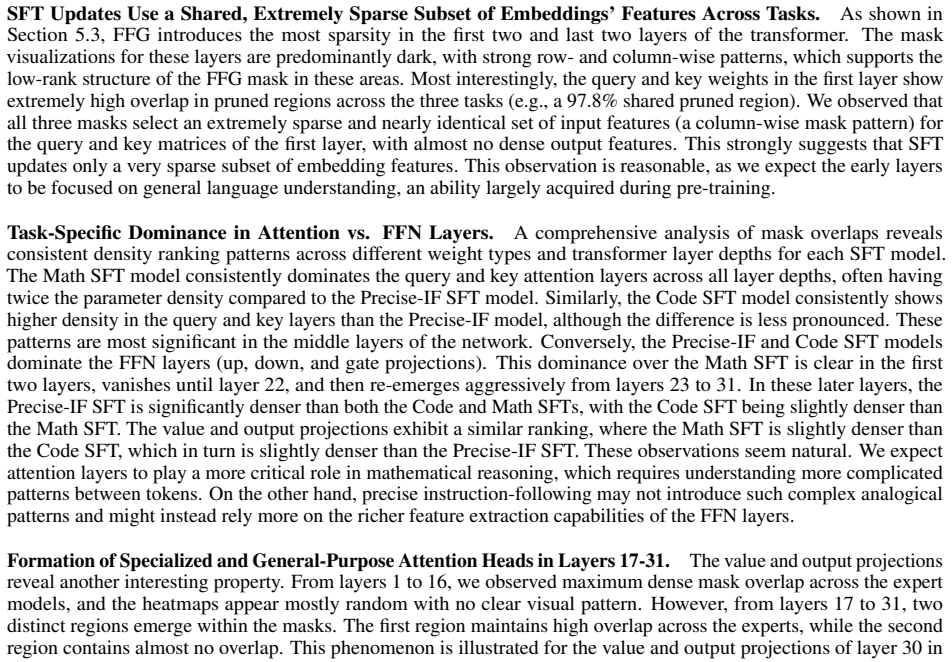
- FFG's structured sparsity (early/late query/key, token embeddings) suggests task localization may guide where to interpolate or adapt in future merges.
Where Pith is reading between the lines
- The perfect-calibration assumption may be weaker in practice; if it fails, the saliency score is still empirically useful but not literally a Fisher-derived quantity.
- The method could likely extend to other optimizers (e.g., LAMB) or to non-SFT adaptation such as LoRA deltas, since the second-moment accumulator is optimizer-generic.
- The low stable rank of the second moments suggests the loss surface is extremely flat in most weight directions; combining OTA with permutation alignment might push merged-model quality even higher.
- A testable extension is to replace exp_avg_sq with a sampled empirical Fisher or other curvature approximations and check whether the merge gains persist, which would isolate whether the proxy itself or the denoising mechanism drives the improvement.
Editorial analysis
A structured set of objections, weighed in public.
Referee Report
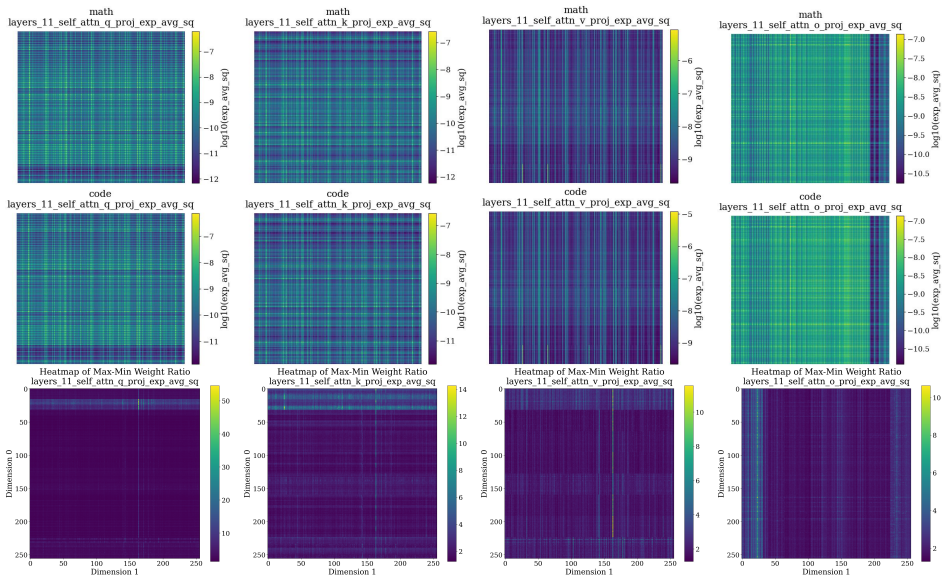
Summary. The paper proposes OTA-Merging, a two-stage recipe for merging multiple SFT checkpoints of an LLM. The method uses Adam's exp_avg_sq second-moment statistics as a 'free' diagonal Fisher/curvature proxy. Stage one, Fast Fisher Grafting (FFG), scores each task-vector coordinate by (Δw_i)^2 · v_i and grafts low-saliency coordinates back to the base model. Stage two aggregates the remaining task vectors with a preconditioner P* = Diag(√v + ε) (Eqs. 6–7). Stage three compresses v with an AdaFactor-style rank-1 approximation. Experiments merge five Llama-3.1-8B SFT experts (math, code, general instruction following, knowledge recall, precise instruction following). OTA+FFG reaches the highest average score (0.582), ahead of TIES (0.565), linear averaging (0.551), and Fisher merging (0.541). Ablations show that FFG is the main driver, and the rank-1 compressed variant scores 0.571. The paper also presents visual analyses of FFG masks and of shared curvature across experts, arguing that SFT models share a common curvature geometry, which explains why linear merging works.
Significance. If the central claims hold, the paper contributes a practical, nearly storage-free use of optimizer statistics for model merging, plus an interpretable sparsification technique (FFG) that appears to improve merging over strong baselines on an external benchmark. The release of code, training/evaluation scripts, and checkpoints is a concrete asset for reproducibility. The structural analyses of FFG masks are interesting and potentially useful for understanding where SFT knowledge is stored. However, the theoretical bridge connecting Adam's second moment to loss curvature is not established for the actual one-epoch SFT checkpoints, and the aggregation formula uses √v rather than the v that the theory justifies. The ablation evidence also suggests that the aggregation component, taken alone, is not beneficial. For these reasons the paper's 'curvature-informed' framing currently overreaches its support; the empirical recipe may still be valuable, but the narrative needs to be adjusted and the theoretical claims need to be either substantiated or explicitly downgraded to heuristics.
major comments (4)
- [§4.3, Eqs. (6)–(7)] The aggregation step is internally inconsistent with the theory in §4.1. Section 4.1 argues that Adam's second moment v is a scaled EMA of the diagonal FIM, so the curvature weighting should use v (as in Fisher merging). Equation (6) instead defines P* = Diag(√v + ε), which is neither the Fisher weight nor Adam's actual preconditioner (Adam divides by √v + ε). No argument in §4.3 derives √v as a curvature metric. Please either derive this weighting from a stated approximation, replace it with v, or present it explicitly as an additional heuristic. As written, the claim that Eq. (6)–(7) is 'curvature-aware' is not supported by the paper's own derivation.
- [Appendix A, Assumptions 1–2] The proof that the Hessian equals the observed empirical FIM and that the mini-batch outer product is a scaled FIM requires (A) late-NTK locality and (B) perfect calibration at the fine-tuned checkpoint. For one-epoch SFT checkpoints trained from a base model, neither assumption is plausible: the model is unlikely to be perfectly calibrated, and the final exp_avg_sq is an EMA over the whole trajectory, not a final-point Fisher estimate. Thus Lemma 1 and Lemma 2 do not establish that v is the diagonal Hessian at w*. This is load-bearing because the paper's central interpretive claim rests on it. A concrete empirical check would be to compute the diagonal empirical Fisher (or a Hessian-vector-product estimate) on these checkpoints and compare it with v, or to test sensitivity to calibration. Without such evidence, the 'curvature proxy' language should be treated as a heuristic.
- [Table 3, OTA (wo FFG) row] The ablation shows that curvature-only aggregation on unpruned task vectors scores 0.536, below plain linear averaging (0.551). This directly undercuts the claim that the curvature-aware aggregation in Eq. (7) is, on its own, a beneficial component of the method. The full OTA gain is driven by FFG; the aggregation component is either neutral or harmful when FFG is removed. The paper's abstract and introduction attribute interference mitigation to the curvature-aware aggregation, but the data support attributing it to FFG. To support the current claim, please show settings where the √v weighting improves over linear averaging with the same mask, or revise the narrative to present the aggregation as a secondary heuristic.
- [§4.4 and §5.5] The rank-1 AdaFactor-style compression is justified by the low stable rank of v (<1.3). Low stable rank is a spectral property and does not guarantee elementwise fidelity, which is what matters for per-coordinate saliency in Eq. (5) and for per-coordinate weighting in Eq. (7). The paper reports that compressed OTA retains performance (0.571 vs 0.582), but it does not report how much the FFG masks change when v is replaced by its rank-1 reconstruction. Please report mask overlap or elementwise error between full and compressed v, so readers can see whether the compression works for the selection task, not just for the final merged score.
minor comments (7)
- [Figure 1] The caption says 'FGG mask regions'; should be 'FFG mask regions'.
- [§3.3 / §4.2] FFG is named 'Fast Fisher Grafting' and connected to OBS, but the saliency in Eq. (5) is the diagonal OBD score (H_ii Δw_i^2), not OBS's full inverse-Hessian correction. Please align the terminology and references.
- [Table 3] The row label 'OTA (w Linear)' is referred to in the text as 'FFG-TA (Selection Only)'. Please use one name consistently to avoid confusion.
- [§5.2 / Table 3] No variance or number of seeds is reported for the merging results. Since merging is deterministic but evaluation (e.g., pass@10, IFEval) may have stochastic components, please state evaluation seeds or report standard errors.
- [§5.4 / Figure 4] The heatmaps downsample weight matrices by uniform row/column subsampling. Please state the exact subsampling procedure for each displayed matrix and note any distortion this introduces for the visual claims about column/row structure.
- [§5.5] The notions of 'input feature curvature' and 'output feature curvature' are informal. Please define them in terms of sums of v entries over rows/columns, or state that they are visual heuristics.
- [Appendix D / Stable rank] The stable rank plots show values below 1.3, but stable rank is bounded below by 1 by construction; the displayed range makes differences look larger than they are. Consider plotting from 1.0 with appropriate ticks.
Circularity Check
No circular reduction found: benchmark results are external; mild selection loop and interpretive gloss do not rise to circularity.
full rationale
I walked the claimed derivation chain. Section 4.1 argues that Adam's second moment v is a scaled EMA of the diagonal FIM via Lemma 1 and Lemma 2, relying on external references ([27], [28], [36]) and two explicit assumptions (Late NTK Locality, Perfect Calibration). This is a substantive theoretical bridge, not a definitional equivalence: v is not defined in terms of the merged-model quality, and the merged-model quality is not defined in terms of v. FFG (Eq. 5) uses s_i = (Delta w_i)^2 * v_i for mask selection, and OTA aggregation (Eq. 7) uses P* = Diag(sqrt(v)+epsilon). The reported merged-model scores (Table 3) come from external benchmarks (GSM8K, MATH, HumanEval, IFEval, BBH, DROP, POPQA), so they are not forced by construction from the saliency scores or the second-moment matrices. The paper tunes the sparsity ratio per expert to preserve each expert's fine-tuning performance; this is a standard hyperparameter selection loop, not a fitted parameter that is then renamed a 'prediction' of merged performance. The 'shared curvature explains linear merging' section is an interpretative narrative based on v-similarity, not a derivation whose conclusion is presupposed by the method. There are no load-bearing self-citations: the optimizer-as-Fisher-proxy idea is attributed to concurrent external work ([26]) and to Morwani et al. ([36]), and none of the present authors' prior work is invoked to force a uniqueness or ansatz choice. A genuine weakness is that Eq. 6-7 use sqrt(v) whereas the Hessian/Fisher equivalence justifies v (or a scaled v), and no argument derives sqrt(v) as the curvature metric; however, this is an internal inconsistency / missing derivation (a correctness risk), not circularity, because the aggregation result is not defined to be equivalent to the theory. Therefore no significant circularity is present. Score 2 reflects the mild per-expert sparsity tuning loop and the interpretive gloss, neither of which is a definitional reduction.
Axiom & Free-Parameter Ledger
free parameters (1)
- per-expert sparsity ratio rho =
not reported; tuned per expert and per method
axioms (4)
- domain assumption Late NTK locality: near the optimum, the network is locally linear so the Hessian is dominated by the Generalized Gauss-Newton term.
- domain assumption Perfect calibration at fine-tuned checkpoints: the model's predictive distribution equals the true conditional data distribution at convergence.
- domain assumption The final exponential moving average of squared gradients is a faithful proxy for the diagonal of the Fisher information at the final checkpoint.
- domain assumption Second-moment matrices have very low stable rank, so rank-1 AdaFactor-style compression preserves their effect.
read the original abstract
Model merging is an effective post-training strategy for composing capabilities in large language models without joint retraining. We study this in the supervised fine-tuning (SFT) stage, where multiple capability-based SFT checkpoints -- spanning math, code, precise instruction following, general instruction following, and knowledge recall -- must be consolidated into a single model. We introduce Optimization Trajectory Aware (OTA) Merging, a curvature-aware aggregation that leverages optimizer second-moment statistics as a diagonal curvature proxy to reweight parameter edits and mitigate interference. Complementing OTA, we propose Fast Fisher Grafting (FFG), a curvature-driven task-localization step that sparsifies conflicting or low-importance edits. FFG induces extremely low-rank masks concentrated in early attention query/key projections and token embeddings, exploiting shared curvature across capabilities. We further develop a memory-light compression of the second moments that preserves OTA's effect. Across diverse capability-based SFT checkpoints, OTA+FFG improves merged-model quality over strong weight-space baselines, reduces negative transfer, and remains robust across sparsity levels. Analyses reveal substantial curvature overlap between checkpoints, offering a novel lens on why simple linear merging can be effective in practice. Ablations confirm that FFG is critical for reducing task interference and that the compressed second moments retain the gains of the full formulation. To facilitate reproducibility, we open-source all code, training and evaluation scripts, visualization artifacts, and capability-specific SFT checkpoints at https://github.com/pmahdavi/ota-merge.
Figures





Reference graph
Works this paper leans on
-
[1]
Tom B. Brown, Benjamin Mann, Nick Ryder, Melanie Subbiah, Jared Kaplan, Prafulla Dhariwal, Arvind Nee- lakantan, Pranav Shyam, Girish Sastry, Amanda Askell, Sandhini Agarwal, Ariel Herbert-V oss, Gretchen Krueger, Tom Henighan, Rewon Child, Aditya Ramesh, Daniel M. Ziegler, Jeffrey Wu, Clemens Winter, Christopher Hesse, Mark Chen, Eric Sigler, Mateusz Lit...
1901
-
[2]
Linear mode connectivity and the lottery ticket hypothesis
Jonathan Frankle, Gintare Karolina Dziugaite, Daniel Roy, and Michael Carbin. Linear mode connectivity and the lottery ticket hypothesis. InInternational Conference on Machine Learning, pages 3259–3269. PMLR, 2020
2020
-
[3]
What matters for model merging at scale?, 2024
Prateek Yadav, Tu Vu, Jonathan Lai, Alexandra Chronopoulou, Manaal Faruqui, Mohit Bansal, and Tsendsuren Munkhdalai. What matters for model merging at scale?, 2024
2024
-
[4]
Adam: A method for stochastic optimization.arXiv preprint arXiv:1412.6980, 2014
Diederik P Kingma and Jimmy Ba. Adam: A method for stochastic optimization.arXiv preprint arXiv:1412.6980, 2014
Pith/arXiv arXiv 2014
-
[5]
Ties-merging: Resolving interference when merging models.Advances in Neural Information Processing Systems, 36:7093–7115, 2023
Prateek Yadav, Derek Tam, Leshem Choshen, Colin A Raffel, and Mohit Bansal. Ties-merging: Resolving interference when merging models.Advances in Neural Information Processing Systems, 36:7093–7115, 2023
2023
-
[6]
Task-specific skill localization in fine-tuned language models
Abhishek Panigrahi, Nikunj Saunshi, Haoyu Zhao, and Sanjeev Arora. Task-specific skill localization in fine-tuned language models. InInternational Conference on Machine Learning, pages 27011–27033. PMLR, 2023
2023
-
[7]
Adafactor: Adaptive learning rates with sublinear memory cost.arXiv preprint arXiv:1804.04235, 2018
Noam Shazeer and Mitchell Stern. Adafactor: Adaptive learning rates with sublinear memory cost.arXiv preprint arXiv:1804.04235, 2018
Pith/arXiv arXiv 2018
-
[8]
Model soups: averaging weights of multiple fine-tuned models improves accuracy without increasing inference time
Mitchell Wortsman, Gabriel Ilharco, Samir Ya Gadre, Rebecca Roelofs, Raphael Gontijo-Lopes, Ari S Morcos, Hongseok Namkoong, Ali Farhadi, Yair Carmon, Simon Kornblith, et al. Model soups: averaging weights of multiple fine-tuned models improves accuracy without increasing inference time. InInternational conference on machine learning, pages 23965–23998. P...
2022
-
[9]
Merging models with fisher-weighted averaging
Michael Matena and Colin Raffel. Merging models with fisher-weighted averaging. InInternational Conference on Learning Representations, 2022. URLhttps://openreview.net/forum?id=LSKlp_aceOC
2022
-
[10]
Editing models with task arithmetic.arXiv preprint arXiv:2212.04089, 2022
Gabriel Ilharco, Marco Tulio Ribeiro, Mitchell Wortsman, Suchin Gururangan, Ludwig Schmidt, Hannaneh Hajishirzi, and Ali Farhadi. Editing models with task arithmetic.arXiv preprint arXiv:2212.04089, 2022
Pith/arXiv arXiv 2022
-
[11]
Task arithmetic in the tan- gent space: Improved editing of pre-trained models
Guillermo Ortiz-Jimenez, Alessandro Favero, and Pascal Frossard. Task arithmetic in the tan- gent space: Improved editing of pre-trained models. InAdvances in Neural Information Processing Systems, 2023. URL https://papers.neurips.cc/paper_files/paper/2023/file/ d28077e5ff52034cd35b4aa15320caea-Paper-Conference.pdf
2023
-
[12]
Ainsworth, Jonathan Hayase, and Siddhartha Srinivasa
Samuel K. Ainsworth, Jonathan Hayase, and Siddhartha Srinivasa. Git re-basin: Merging models modulo permutation symmetries. InInternational Conference on Learning Representations, 2023. URL https:// openreview.net/forum?id=CQsmMYmlP5T
2023
-
[13]
Merging by matching models in task parameter subspaces.Trans- actions on Machine Learning Research, 2024
Derek Tam, Mohit Bansal, and Colin Raffel. Merging by matching models in task parameter subspaces.Trans- actions on Machine Learning Research, 2024. URL https://openreview.net/forum?id=qNGo6ghWFB. Certified and published on OpenReview
2024
-
[14]
EMR- merging: Tuning-free high-performance model merging
Chenyu Huang, Peng Ye, Tao Chen, Tong He, Xiangyu Yue, and Wanli Ouyang. EMR- merging: Tuning-free high-performance model merging. InAdvances in Neural Information Pro- cessing Systems, 2024. URL https://proceedings.neurips.cc/paper_files/paper/2024/file/ dda5cac5272a9bcd4bc73d90bc725ef1-Paper-Conference.pdf. NeurIPS 2024 Spotlight
2024
-
[15]
Arcee’s mergekit: A toolkit for merging large language models
Charles Goddard, Shamane Siriwardhana, Malikeh Ehghaghi, Luke Meyers, Vladimir Karpukhin, Brian Benedict, Mark McQuade, and Jacob Solawetz. Arcee’s mergekit: A toolkit for merging large language models. In Proceedings of the 2024 Conference on Empirical Methods in Natural Language Processing: Industry Track, pages 477–485, Miami, Florida, US, 2024. Associ...
doi:10.18653/v1/2024 2024
-
[16]
Babak Hassibi and David G. Stork. Second order derivatives for network pruning: Optimal brain surgeon. In Advances in Neural Information Processing Systems, volume 5, 1992. URL https://proceedings.neurips. cc/paper/1992/hash/303ed4c69846ab36c2904d3ba8573050-Abstract.html. 16
1992
-
[17]
Adapterfusion: Non-destructive task composition for transfer learning
Jonas Pfeiffer, Aishwarya Kamath, Andreas Rücklé, Kyunghyun Cho, and Iryna Gurevych. Adapterfusion: Non-destructive task composition for transfer learning. InProceedings of the 16th Conference of the European Chapter of the Association for Computational Linguistics: Main V olume, pages 487–503, Online, April 2021. Association for Computational Linguistics...
-
[18]
Lora soups: Merging loras for practical skill composition tasks, 2024
Akshara Prabhakar, Yuanzhi Li, Karthik Narasimhan, Sham Kakade, Eran Malach, and Samy Jelassi. Lora soups: Merging loras for practical skill composition tasks, 2024. URLhttps://arxiv.org/abs/2410.13025
Pith/arXiv arXiv 2024
-
[19]
Multi lora meets vision: Merging multiple adapters to create a multi task model, 2024
Ege Kesim and Selahattin Serdar Helli. Multi lora meets vision: Merging multiple adapters to create a multi task model, 2024. URLhttps://arxiv.org/abs/2411.14064
Pith/arXiv arXiv 2024
-
[20]
Denker, and Sara A
Yann LeCun, John S. Denker, and Sara A. Solla. Optimal brain damage. InAdvances in Neural Information Pro- cessing Systems, volume 2, pages 598–605. Morgan Kaufmann, 1990. URL https://proceedings.neurips. cc/paper/1989/hash/6c9882bbac1c7093bd25041881277658-Abstract.html
1990
-
[21]
Woodfisher: Efficient second-order approximation for neural network compres- sion
Sidak Pal Singh and Dan Alistarh. Woodfisher: Efficient second-order approximation for neural network compres- sion. InAdvances in Neural Information Processing Systems, volume 33, 2020. URL https://proceedings. neurips.cc/paper/2020/hash/d1ff1ec86b62cd5f3903ff19c3a326b2-Abstract.html
2020
-
[22]
SparseGPT: Massive language models can be accurately pruned in one-shot
Elias Frantar and Dan Alistarh. SparseGPT: Massive language models can be accurately pruned in one-shot. In Andreas Krause, Emma Brunskill, Kyunghyun Cho, Barbara Engelhardt, Sivan Sabato, and Jonathan Scarlett, editors,Proceedings of the 40th International Conference on Machine Learning, volume 202 ofProceedings of Machine Learning Research, pages 10323–...
2023
-
[23]
Mingjie Sun, Zhuang Liu, Anna Bair, and J. Zico Kolter. A simple and effective pruning approach for large language models.arXiv preprint arXiv:2306.11695, 2023. URLhttps://arxiv.org/abs/2306.11695
Pith/arXiv arXiv 2023
-
[24]
Victor Sanh, Thomas Wolf, and Alexander M. Rush. Movement pruning: Adaptive sparsity by fine-tuning. In Advances in Neural Information Processing Systems, volume 33, 2020. URL https://proceedings.neurips. cc/paper/2020/hash/eae15aabaa768ae4a5993a8a4f4fa6e4-Abstract.html
2020
-
[25]
Loss surfaces, mode connectivity, and fast ensembling of dnns
Timur Garipov, Pavel Izmailov, Dmitrii Podoprikhin, Dmitry Vetrov, and Andrew Gordon Wil- son. Loss surfaces, mode connectivity, and fast ensembling of dnns. InAdvances in Neu- ral Information Processing Systems, volume 31, 2018. URL https://papers.nips.cc/paper/ 8095-loss-surfaces-mode-connectivity-and-fast-ensembling-of-dnns
2018
-
[26]
Fishers for free? approximating the fisher information matrix by recycling the squared gradient accumulator
YuXin Li, Felix Dangel, Derek Tam, and Colin Raffel. Fishers for free? approximating the fisher information matrix by recycling the squared gradient accumulator. InProceedings of the 42nd International Conference on Machine Learning (ICML), 2025. PMLR 267
2025
-
[27]
Natural gradient works efficiently in learning.Neural computation, 10(2):251–276, 1998
Shun-Ichi Amari. Natural gradient works efficiently in learning.Neural computation, 10(2):251–276, 1998
1998
-
[28]
New insights and perspectives on the natural gradient method.Journal of Machine Learning Research, 21(146):1–76, 2020
James Martens. New insights and perspectives on the natural gradient method.Journal of Machine Learning Research, 21(146):1–76, 2020
2020
-
[29]
Optimizing neural networks with kronecker-factored approximate curvature
James Martens and Roger Grosse. Optimizing neural networks with kronecker-factored approximate curvature. In International conference on machine learning, pages 2408–2417. PMLR, 2015
2015
-
[30]
Merging models with fisher-weighted averaging.Advances in Neural Information Processing Systems, 35:17703–17716, 2022
Michael S Matena and Colin A Raffel. Merging models with fisher-weighted averaging.Advances in Neural Information Processing Systems, 35:17703–17716, 2022
2022
-
[31]
Merging by matching models in task parameter subspaces.arXiv preprint arXiv:2312.04339, 2023
Derek Tam, Mohit Bansal, and Colin Raffel. Merging by matching models in task parameter subspaces.arXiv preprint arXiv:2312.04339, 2023
Pith/arXiv arXiv 2023
-
[32]
Optimizing neural networks with kronecker-factored approximate curvature
James Martens and Roger Grosse. Optimizing neural networks with kronecker-factored approximate curvature. In Francis Bach and David Blei, editors,Proceedings of the 32nd International Conference on Machine Learning, volume 37 ofProceedings of Machine Learning Research, pages 2408–2417, Lille, France, 07–09 Jul 2015. PMLR. URLhttps://proceedings.mlr.press/...
2015
-
[33]
Optimal brain damage
Yann LeCun, John S Denker, and Sara A Solla. Optimal brain damage. InAdvances in neural information processing systems, volume 2, 1989
1989
-
[34]
Second order derivatives for network pruning: Optimal brain surgeon
Babak Hassibi and David G Stork. Second order derivatives for network pruning: Optimal brain surgeon. In Advances in neural information processing systems, volume 5, 1992. 17
1992
-
[35]
Adaptive subgradient methods for online learning and stochastic optimization.Journal of machine learning research, 12(7), 2011
John Duchi, Elad Hazan, and Yoram Singer. Adaptive subgradient methods for online learning and stochastic optimization.Journal of machine learning research, 12(7), 2011
2011
-
[36]
A new perspective on shampoo’s preconditioner.arXiv preprint arXiv:2406.17748, 2024
Depen Morwani, Itai Shapira, Nikhil Vyas, Eran Malach, Sham Kakade, and Lucas Janson. A new perspective on shampoo’s preconditioner.arXiv preprint arXiv:2406.17748, 2024
Pith/arXiv arXiv 2024
-
[37]
Nikhil Vyas, Yamini Bansal, and Preetum Nakkiran. Limitations of the ntk for understanding generalization in deep learning.arXiv preprint arXiv:2206.10012, 2022
Pith/arXiv arXiv 2022
-
[38]
Stanislav Fort, Gintare Karolina Dziugaite, Mansheej Paul, Sepideh Kharaghani, Daniel M Roy, and Surya Ganguli. Deep learning versus kernel learning: an empirical study of loss landscape geometry and the time evolution of the neural tangent kernel.Advances in Neural Information Processing Systems, 33:5850–5861, 2020
2020
-
[39]
Nathan Lambert, Jacob Morrison, Valentina Pyatkin, Shengyi Huang, Hamish Ivison, Faeze Brahman, Lester James V Miranda, Alisa Liu, Nouha Dziri, Shane Lyu, et al. T\" ulu 3: Pushing frontiers in open language model post-training.arXiv preprint arXiv:2411.15124, 2024
Pith/arXiv arXiv 2024
-
[40]
Llamafactory: Unified efficient fine-tuning of 100+ language models
Yaowei Zheng, Richong Zhang, Junhao Zhang, Yanhan Ye, Zheyan Luo, Zhangchi Feng, and Yongqiang Ma. Llamafactory: Unified efficient fine-tuning of 100+ language models. InProceedings of the 62nd Annual Meeting of the Association for Computational Linguistics (V olume 3: System Demonstrations), Bangkok, Thailand, 2024. Association for Computational Linguist...
Pith/arXiv arXiv 2024
-
[41]
Arcee’s mergekit: A toolkit for merging large language models
Charles Goddard, Shamane Siriwardhana, Malikeh Ehghaghi, Luke Meyers, Vladimir Karpukhin, Brian Benedict, Mark McQuade, and Jacob Solawetz. Arcee’s mergekit: A toolkit for merging large language models. In Proceedings of the 2024 Conference on Empirical Methods in Natural Language Processing: Industry Track, pages 477–485, 2024
2024
-
[42]
Le Yu, Yu Bowen, Haiyang Yu, Fei Huang, and Yongbin Li. Language models are super mario: Absorbing abilities from homologous models as a free lunch.arXiv.org, 2023. doi: 10.48550/arxiv.2311.03099
-
[43]
Model breadcrumbs: Scaling multi-task model merging with sparse masks
MohammadReza Davari and Eugene Belilovsky. Model breadcrumbs: Scaling multi-task model merging with sparse masks. InEuropean Conference on Computer Vision, pages 270–287. Springer, 2024
2024
-
[44]
Pong, Simon Sidor, William Saunders, Miles Brundage, Ilya Sutskever, Wojciech Zaremba, John Schulman, and Dario Amodei
Mark Chen, Jerry Tworek, Heewoo Jun, Qiming Yuan, Henrique Ponde de Oliveira Pinto, Jared Kaplan, Harri Edwards, Yuri Burda, Nicholas Joseph, Greg Brockman, Alex Ray, Raul Puri, Gretchen Krueger, Michael Petrov, Heidy Khlaaf, Girish Sastry, Pamela Mishkin, Brooke Chan, Scott Gray, Nick Ryder, Mikhail Pavlov, Alethea Power, Lukasz Kaiser, Mohammad Bavarian...
2021
-
[45]
Is your code generated by chatgpt really correct? rigorous evaluation of large language models for code generation, 2024
Jian Liu, Chenan Wang, Yushan Zhang, Yixin Fu, Yuan Jiang, Enyi Shen, and Qing Wang. Is your code generated by chatgpt really correct? rigorous evaluation of large language models for code generation, 2024
2024
-
[46]
Training verifiers to solve math word problems.arXiv preprint arXiv:2110.14168, 2021
Karl Cobbe, Vineet Kosaraju, Mohammad Bavarian, Mark Chen, Heewoo Jun, Lukasz Kaiser, Michael Petrov, Bob McGrew, Jerry Tworek, Douwe Kiela, Henrique Ponde de Oliveira Pinto, Jared Kaplan, and Dario Amodei. Training verifiers to solve math word problems.arXiv preprint arXiv:2110.14168, 2021
Pith/arXiv arXiv 2021
-
[47]
Measuring mathematical problem solving with the math dataset.arXiv preprint arXiv:2103.03874, 2021
Dan Hendrycks, Collin Burns, Saurav Kadavath, Akul Arora, Steven Basart, Eric Tang, Dawn Song, and Jacob Steinhardt. Measuring mathematical problem solving with the math dataset.arXiv preprint arXiv:2103.03874, 2021
Pith/arXiv arXiv 2021
-
[48]
Ifeval: A new benchmark for evaluating llms on instruction following, 2023
Yucheng Zhou, Tao Yu, Zihan Wang, Keerti Banweer, Yuning Mao, Pengcheng Yin, and Hai-Tao Zheng. Ifeval: A new benchmark for evaluating llms on instruction following, 2023
2023
-
[49]
Challenging big-bench tasks and whether chain-of-thought can solve them, 2022
Mirac Suzgun, Nathan Scales, Nathanael Schärli, Sebastian Gehrmann, Yi Tay, Hyung Won Chung, Aseem Rawat, Swayam Singhal, Siddhartha Brahma, Jason Wei, Aakanksha Chowdhery, and Denny Zhou. Challenging big-bench tasks and whether chain-of-thought can solve them, 2022
2022
-
[50]
Drop: A reading comprehension benchmark requiring discrete reasoning over paragraphs
Dheeru Dua, Yizhong Wang, Pradeep Dasigi, Gabriel Stanovsky, Sameer Singh, and Matt Gardner. Drop: A reading comprehension benchmark requiring discrete reasoning over paragraphs. InProceedings of the 2019 Conference of the North American Chapter of the Association for Computational Linguistics: Human Language Technologies, V olume 1 (Long and Short Papers...
2019
-
[51]
When not to trust language models: Investigating effectiveness of parametric and non-parametric memories, 2023
Alex Mallen, Akari Asai, Victor Zhong, Rajarshi Das, Hannaneh Hajishirzi, and Daniel Khashabi. When not to trust language models: Investigating effectiveness of parametric and non-parametric memories, 2023
2023
-
[52]
Lora: Low-rank adaptation of large language models.ICLR, 1(2):3, 2022
Edward J Hu, Yelong Shen, Phillip Wallis, Zeyuan Allen-Zhu, Yuanzhi Li, Shean Wang, Lu Wang, Weizhu Chen, et al. Lora: Low-rank adaptation of large language models.ICLR, 1(2):3, 2022
2022
-
[53]
Transformers as support vector machines.arXiv preprint arXiv:2308.16898, 2023
Davoud Ataee Tarzanagh, Yingcong Li, Christos Thrampoulidis, and Samet Oymak. Transformers as support vector machines.arXiv preprint arXiv:2308.16898, 2023
Pith/arXiv arXiv 2023
-
[54]
role": "system
Prateek Yadav, Derek Tam, Leshem Choshen, Colin Raffel, and Mohit Bansal. Ties-merging: Resolving interference when merging models.Neural Information Processing Systems, 2023. 19 A Theoretical Justifications and Proofs This section provides a detailed derivation of the theoretical insights presented in Section 4.1, which establish Adam’s second-moment acc...
2023
discussion (0)
Sign in with ORCID, Apple, or X to comment. Anyone can read and Pith papers without signing in.