REVIEW 4 major objections 4 minor 61 references
Standard attention's static token representations limit multivariate time series forecasting; the paper proposes prime attention, which modulates keys and values per token pair with a learnable filter, and reports consistent forecasting gai
Reviewed by Pith at T0; open to challenge. T0 means a machine referee read the full paper against a public rubric. the ladder, T0–T4 →
T0 review · deepseek-v4-flash
2026-08-04 16:38 UTC pith:FYH7EDN5
load-bearing objection A clean formalization of dynamic relational attention and a plausible modulation mechanism, but the empirical case is compromised by a warm-start protocol and a missing random-init baseline. the 4 major comments →
Dynamic Relational Priming Improves Transformer in Multivariate Time Series
The pith
A machine-rendered reading of the paper's core claim, the machinery that carries it, and where it could break.
Core claim
Prime attention replaces the static keys and values of standard attention with pair-modulated versions, e k_j = k_j ⊙ F_ij and e v_j = v_j ⊙ F_ij, where F_ij is a learnable filter (optionally seeded with estimated lead-lag and instantaneous correlations). The paper proves that standard attention implements static relational learning (a token's representation is invariant across interaction partners) and that prime attention implements dynamic relational learning (the representation of token j when interacting with i can differ from its representation when interacting with v). It further shows prime attention contains standard attention as a special case (F = 1), so it inherits universal appr
What carries the argument
The central object is the pair-specific modulation filter F_ij ∈ R^{d_model}, applied element-wise to the key and value of token j when it interacts with token i. This converts attention from static relational learning (one representation per token per layer) to dynamic relational learning (a tailored representation per pair), while leaving the attention coefficient computation and the O(N²·d) asymptotic complexity intact. The filter can be learned from random initialization or seeded with estimated lead-lag and instantaneous correlation features through an MLP.
Load-bearing premise
The benchmark gains assume prime attention is trained under the same protocol as standard attention, but the appendix says the transformer is first fine-tuned on standard attention and its attention module is then replaced with prime attention, so the improvements may partly be a warm-start artifact rather than dynamic relational learning itself.
What would settle it
Run a from-scratch training comparison on the Weather dataset with look-back 96, identical seeds and hyperparameters, between standard attention and prime attention with the filter randomly initialized near identity. If random-initialized prime attention does not beat standard attention, or if only lead-lag-initialized filters do, then the claim that pair-specific modulation per se drives the gains would be contradicted.
If this is right
- Any transformer for multivariate time series can be upgraded to prime attention by swapping the attention block, yielding consistent forecast accuracy gains on heterogeneous-channel data without increasing asymptotic complexity.
- On datasets where channels measure different physical quantities (Weather, Solar), gains reach up to 6.5%, while homogeneous datasets (ECL, Traffic) show only marginal changes, supporting the claim that the benefit comes from modeling pair-specific relational heterogeneity.
- Prime attention can match standard attention's accuracy with up to 40% shorter history (for example L=48 or 64 versus L=96), which is relevant for data-scarce or low-latency forecasting settings.
- The paper's formal distinction between static and dynamic relational learning gives a concrete vocabulary for what is missing in standard attention and a target for other relational architectures to aim at.
Where Pith is reading between the lines
- If the mechanism generalizes beyond channel-wise time series, the same per-pair modulation could benefit attention on other data with heterogeneous pair relations, such as knowledge graphs, multi-agent systems, or sensor networks.
- The ablation study shows random-initialized filters underperform filters seeded with lead-lag or instantaneous information, but it does not report whether random-initialized prime attention beats standard attention from scratch; if it does not, the reported gains may come from the injected pairwise priors rather than from dynamic modulation per se.
- The reported fine-tuning protocol—first training on standard attention, then swapping in prime attention—leaves open a warm-start effect; a from-scratch training comparison would separate the benefit of the mechanism from the benefit of a better starting point.
- The outlined GNN-based sparsification (reducing the filter memory from O(N²) to O(|E|)) is not evaluated empirically; if it works, it could make prime attention practical for high-dimensional systems where dense per-pair filters are prohibitive.
Editorial analysis
A structured set of objections, weighed in public.
Referee Report
Summary. The paper proposes 'prime attention' for multivariate time series (MTS) forecasting. In standard attention, each token presents the same key/value to every interaction; prime attention computes pair-specific modulations e_k_j = k_j ⊙ F_{i,j} and e_v_j = v_j ⊙ F_{i,j}, with F generated or learned as a function of pairwise statistics. The paper formalizes static vs. dynamic relational learning, proves that standard attention is static (Thm 4.3) and prime attention is dynamic (Thm 5.1), gives a universal-approximation inheritance argument, provides gradient-flow formulas, and reports experiments replacing standard attention in iTransformer, Timer-XL, and FreDF across 11 datasets, claiming consistent improvements and up to 6.5% forecasting accuracy gains, plus a sequence-length efficiency result.
Significance. The core idea is simple, well-motivated, and potentially practical: a drop-in attention modification with the same asymptotic cost could improve MTS forecasting across multiple backbones. The paper's formal categorization of static vs. dynamic relational learning is useful, and the empirical scope is broad, covering three recent transformer architectures and several standard benchmarks. The main strengths are the explicit pair-wise modulation formulation and the extensive backbone-level evaluation. However, the empirical claim is currently undercut by an inconsistency in the training protocol and by an ablation that leaves open whether the gains come from hand-crafted pairwise priors rather than from learnable dynamic priming. If the controlled comparison is fixed, the contribution would be solid; at present the headline result is not yet established.
major comments (4)
- [§7.1 vs. Appendix G] The main text says prime-attention variants are obtained 'by simply swapping out the main attention block ... changing nothing else and keeping with the original hyper-parameters except dropout' (§7.1). Appendix G, however, states: 'the transformer is first fine-tuned on standard attention and its attention module is subsequently replaced with prime attention only adjusting dropout rate.' If the latter is literal, prime attention begins from a converged standard-attention checkpoint and receives additional fine-tuning, while the standard baselines are trained from scratch. This is a warm-start and extra-training-budget artifact that alone could explain many of the reported gains. The paper must clarify the actual protocol, retrain both variants from scratch under identical budgets, or report both settings.
- [F.1, Figure 3] The filter ablation shows that random initialization of F underperforms lead-lag, instantaneous, and combined initializations, but it never reports whether randomly-initialized prime attention still beats standard attention. If random-init prime attention does not outperform standard attention, then the claimed improvements are attributable to the hand-crafted pairwise statistics (lead-lag, Pearson correlation, rolling std, rank transformation) rather than to dynamic relational priming, which is the paper's central claim. Please report random-init prime vs. standard attention on the main benchmarks, under the same training protocol.
- [Theorem 5.1 / Learnable Modulator Generation] Theorem 5.1 proves dynamic relational learning by treating F_{ji} and F_{jv} as 'independent learnable parameters' (Eqs. 19–20). In the actual construction, F_{i,j} = MLP(fs_{ij}) with a shared MLP over pairwise statistics (§5). The parameters are not independent; the outputs can differ only if the inputs differ. The conclusion may still hold, but the proof as written overstates the implementation. Similarly, Theorem D.1's containment argument assumes F can be set to the identity vector for all pairs, which a shared-MLP parameterization may not realize exactly. Please state the precise parameterization and revise the proofs accordingly.
- [Tables 1 and 6] All reported results are single MSE/MAE values with no error bars, multiple seeds, or significance tests. Several differences are very small (e.g., ETTm2 FreDF Avg. 0.289/0.327 vs. 0.289/0.327; ECL iTransformer Avg. 0.174/0.267 vs. 0.175/0.266). Given the warm-start ambiguity identified above, variance information is needed to support the claim of consistent improvement, especially for datasets where the gap is below 1%.
minor comments (4)
- [Section 1] Typo: 'comapre' should be 'compare'.
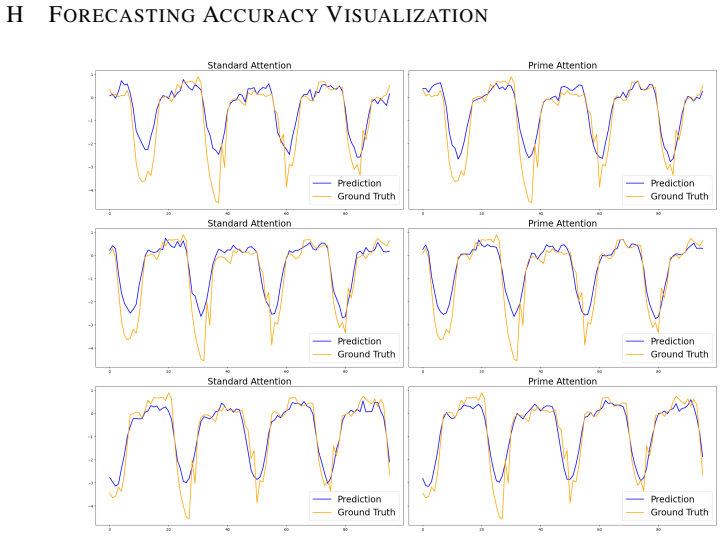
- [Figures 1 and 8] Figure 8 in Appendix F.4 duplicates Figure 1; the figure numbering and cross-references are inconsistent. Please unify or clearly distinguish the two.
- [Table 4] The table reports 10 epochs for all datasets, but it is unclear whether the standard-attention baselines were trained for the same number of epochs or to convergence. Please clarify, since this bears on the fairness of the comparison.
- [Section 7.2] The claim that prime attention 'can match or slightly outperform standard attention with up to 40% less sequence length' is based on only two datasets shown in Fig. 1. Please state explicitly that this is a partial result and avoid generalizing it across all benchmarks.
Circularity Check
The 'dynamic relational learning' theorem is definitional (pair-specific F restates Def. 4.2), and Appendix G's fine-tuning protocol differs from the claimed 'simply swapping'; the empirical comparisons are otherwise not circular.
specific steps
-
self definitional
[Section 5, Theorem 5.1 (Eqs. 11-12, 14-20); Definition 4.2]
"Definition 4.2 defines dynamic relational learning by h_{j→i}=ψ(x_j;θ_j,φ_ij), so h_{j→n} is not constrained to equal h_{j→i}. Theorem 5.1 then proves prime attention is dynamic: 'since F_ji and F_jv are independent learnable parameters, they are not constrained to be equal... Therefore, prime attention performs dynamic relational learning.'"
Dynamic relational learning is defined as pair-specific conditioning of a token's representation (φ_ij in Def. 4.2). Prime attention constructs exactly that: per-pair learnable F_ij modulates key/value (Eqs. 11-12). The proof of Theorem 5.1 simply observes F_ji and F_jv are independent parameters, i.e., it substitutes F for φ and restates the definition. The claimed theoretical result is therefore true by construction, not derived from an independent principle; it adds no content beyond the method's definition.
full rationale
The paper's headline empirical claim—that prime attention lowers MSE/MAE relative to standard attention (Tables 1/6)—is an external benchmark comparison, not a quantity computed from a fitted parameter and then renamed a prediction; no self-citation is load-bearing (all baselines are external works). The main circularity-adjacent issue is Section 5's Theorem 5.1: the 'dynamic relational learning' property is built into the definition of F_ij, so the proof is a restatement rather than an independent result. Section D's UA theorem is a valid containment argument (F=1 recovers standard attention) and is not circular. Appendix G, however, states the transformer is 'first fine-tuned on standard attention and its attention module is subsequently replaced with prime attention only adjusting dropout rate,' which contradicts Section 7.1's 'simply swapping out the main attention block.' This is a correctness/fairness risk for the empirical comparison (warm-start and extra training budget), but it is not a circularity because the reported numbers are still empirical measurements; the paper should clarify or rerun from-scratch training. Overall, no derivation reduces to its own input in a way that forces the central empirical conclusion, so the circularity score is low.
Axiom & Free-Parameter Ledger
free parameters (3)
- Pair-wise modulation F_ij (or parameters of the generating MLP) =
Learned end-to-end; initialized from lead-lag plus instantaneous statistics (full initialization)
- Projection matrix W mapping pairwise statistics to d_model =
Not specified; used in s_ij initialization, F_ij = MLP(sigma(R)W)
- Instantaneous-correlation statistics (Pearson, rolling std, rank transformation) and their combination =
Not specified
axioms (4)
- standard math Standard attention satisfies the universal approximation theorem (Cybenko 1989; Yun et al. 2020), and setting F_ij = 1 embeds standard attention in prime attention.
- domain assumption MTS channel-pair relationships are heterogeneous and static token representations limit their modeling.
- domain assumption FFT-based lead-lag and instantaneous correlation priors are useful initializations for F.
- ad hoc to paper A shared MLP generating F_ij from pairwise statistics preserves the independence of F_ji and F_jv assumed in Theorem 5.1.
read the original abstract
Standard attention mechanisms in transformers employ static token representations that remain unchanged across all pair-wise computations in each layer. This limits their representational alignment with the potentially diverse relational dynamics of each token-pair interaction. While they excel in domains with relatively homogeneous relationships, standard attention's static relational learning struggles to capture the diverse, heterogeneous inter-channel dependencies of multivariate time series (MTS) data--where different channel-pair interactions within a single system may be governed by entirely different physical laws or temporal dynamics. To better align the attention mechanism for such domain phenomena, we propose attention with dynamic relational priming (prime attention). Unlike standard attention where each token presents an identical representation across all of its pair-wise interactions, prime attention tailors each token dynamically (or per interaction) through learnable modulations to best capture the unique relational dynamics of each token pair, optimizing each pair-wise interaction for that specific relationship. This representational plasticity of prime attention enables effective extraction of relationship-specific information in MTS while maintaining the same asymptotic computational complexity as standard attention. Our results demonstrate that prime attention consistently outperforms standard attention across benchmarks, achieving up to 6.5\% improvement in forecasting accuracy. In addition, we find that prime attention achieves comparable or superior performance using up to 40\% less sequence length compared to standard attention, further demonstrating its superior relational modeling capabilities.
Figures



Reference graph
Works this paper leans on
-
[1]
Josh Achiam, Steven Adler, Sandhini Agarwal, Lama Ahmad, Ilge Akkaya, Florencia Leoni Aleman, Diogo Almeida, Janko Altenschmidt, Sam Altman, Shyamal Anadkat, et al. Gpt-4 technical report. arXiv preprint arXiv:2303.08774, 2023
Pith/arXiv arXiv 2023
-
[2]
Neural machine translation by jointly learning to align and translate
Dzmitry Bahdanau, Kyunghyun Cho, and Yoshua Bengio. Neural machine translation by jointly learning to align and translate. arXiv preprint arXiv:1409.0473, 2014
Pith/arXiv arXiv 2014
-
[3]
Round and round we go! what makes rotary positional encodings useful? In The Thirteenth International Conference on Learning Representations, 2025
Federico Barbero, Alex Vitvitskyi, Christos Perivolaropoulos, Razvan Pascanu, and Petar Veli c kovi \'c . Round and round we go! what makes rotary positional encodings useful? In The Thirteenth International Conference on Learning Representations, 2025. URL https://openreview.net/forum?id=GtvuNrk58a
2025
-
[4]
E (3)-equivariant graph neural networks for data-efficient and accurate interatomic potentials
Simon Batzner, Albert Musaelian, Lixin Sun, Mario Geiger, Jonathan P Mailoa, Mordechai Kornbluth, Nicola Molinari, Tess E Smidt, and Boris Kozinsky. E (3)-equivariant graph neural networks for data-efficient and accurate interatomic potentials. Nature communications, 13 0 (1): 0 2453, 2022
2022
-
[5]
How attentive are graph attention networks? arXiv preprint arXiv:2105.14491, 2021
Shaked Brody, Uri Alon, and Eran Yahav. How attentive are graph attention networks? arXiv preprint arXiv:2105.14491, 2021
Pith/arXiv arXiv 2021
-
[6]
End-to-end object detection with transformers
Nicolas Carion, Francisco Massa, Gabriel Synnaeve, Nicolas Usunier, Alexander Kirillov, and Sergey Zagoruyko. End-to-end object detection with transformers. In European conference on computer vision, pp.\ 213--229. Springer, 2020
2020
-
[7]
Simple TM : A simple baseline for multivariate time series forecasting
Hui Chen, Viet Luong, Lopamudra Mukherjee, and Vikas Singh. Simple TM : A simple baseline for multivariate time series forecasting. In The Thirteenth International Conference on Learning Representations, 2025. URL https://openreview.net/forum?id=oANkBaVci5
2025
-
[8]
From similarity to superiority: Channel clustering for time series forecasting
Jialin Chen, Jan Eric Lenssen, Aosong Feng, Weihua Hu, Matthias Fey, Leandros Tassiulas, Jure Leskovec, and Rex Ying. From similarity to superiority: Channel clustering for time series forecasting. Advances in Neural Information Processing Systems, 37: 0 130635--130663, 2024
2024
-
[9]
Tsmixer: An all-mlp architecture for time series forecasting
Si-An Chen, Chun-Liang Li, Nate Yoder, Sercan O Arik, and Tomas Pfister. Tsmixer: An all-mlp architecture for time series forecasting. arXiv preprint arXiv:2303.06053, 2023
Pith/arXiv arXiv 2023
-
[10]
George V. Cybenko. Approximation by superpositions of a sigmoidal function. Mathematics of Control, Signals and Systems, 2: 0 303--314, 1989. URL https://api.semanticscholar.org/CorpusID:3958369
1989
-
[11]
Expander graph propagation
Andreea Deac, Marc Lackenby, and Petar Veli c kovi \'c . Expander graph propagation. In Learning on Graphs Conference, pp.\ 38--1. PMLR, 2022
2022
-
[12]
Bert: Pre-training of deep bidirectional transformers for language understanding
Jacob Devlin, Ming-Wei Chang, Kenton Lee, and Kristina Toutanova. Bert: Pre-training of deep bidirectional transformers for language understanding. In Proceedings of the 2019 conference of the North American chapter of the association for computational linguistics: human language technologies, volume 1 (long and short papers), pp.\ 4171--4186, 2019
2019
-
[13]
An image is worth 16x16 words: Transformers for image recognition at scale
Alexey Dosovitskiy, Lucas Beyer, Alexander Kolesnikov, Dirk Weissenborn, Xiaohua Zhai, Thomas Unterthiner, Mostafa Dehghani, Matthias Minderer, Georg Heigold, Sylvain Gelly, et al. An image is worth 16x16 words: Transformers for image recognition at scale. arXiv preprint arXiv:2010.11929, 2020
Pith/arXiv arXiv 2010
-
[14]
Neural message passing for quantum chemistry
Justin Gilmer, Samuel S Schoenholz, Patrick F Riley, Oriol Vinyals, and George E Dahl. Neural message passing for quantum chemistry. In International conference on machine learning, pp.\ 1263--1272. Pmlr, 2017
2017
-
[15]
Understanding the difficulty of training deep feedforward neural networks
Xavier Glorot and Yoshua Bengio. Understanding the difficulty of training deep feedforward neural networks. In Yee Whye Teh and Mike Titterington (eds.), Proceedings of the Thirteenth International Conference on Artificial Intelligence and Statistics, volume 9 of Proceedings of Machine Learning Research, pp.\ 249--256, Chia Laguna Resort, Sardinia, Italy,...
2010
-
[16]
Attention mechanisms in computer vision: A survey
Meng-Hao Guo, Tian-Xing Xu, Jiang-Jiang Liu, Zheng-Ning Liu, Peng-Tao Jiang, Tai-Jiang Mu, Song-Hai Zhang, Ralph R Martin, Ming-Ming Cheng, and Shi-Min Hu. Attention mechanisms in computer vision: A survey. Computational visual media, 8 0 (3): 0 331--368, 2022
2022
-
[17]
Inductive representation learning on large graphs
Will Hamilton, Zhitao Ying, and Jure Leskovec. Inductive representation learning on large graphs. Advances in neural information processing systems, 30, 2017
2017
-
[18]
Graph representation learning
William L Hamilton. Graph representation learning. Morgan & Claypool Publishers, 2020
2020
-
[19]
The capacity and robustness trade-off: Revisiting the channel independent strategy for multivariate time series forecasting
Lu Han, Han-Jia Ye, and De-Chuan Zhan. The capacity and robustness trade-off: Revisiting the channel independent strategy for multivariate time series forecasting. IEEE Transactions on Knowledge and Data Engineering, 36 0 (11): 0 7129--7142, 2024
2024
-
[20]
Heterogeneous graph transformer
Ziniu Hu, Yuxiao Dong, Kuansan Wang, and Yizhou Sun. Heterogeneous graph transformer. In Proceedings of the web conference 2020, pp.\ 2704--2710, 2020
2020
-
[21]
Transformers are graph neural networks
Chaitanya K Joshi. Transformers are graph neural networks. arXiv preprint arXiv:2506.22084, 2025
Pith/arXiv arXiv 2025
-
[22]
On the expressive power of geometric graph neural networks
Chaitanya K Joshi, Cristian Bodnar, Simon V Mathis, Taco Cohen, and Pietro Lio. On the expressive power of geometric graph neural networks. In International conference on machine learning, pp.\ 15330--15355. PMLR, 2023
2023
-
[23]
Reversible instance normalization for accurate time-series forecasting against distribution shift
Taesung Kim, Jinhee Kim, Yunwon Tae, Cheonbok Park, Jang-Ho Choi, and Jaegul Choo. Reversible instance normalization for accurate time-series forecasting against distribution shift. In International Conference on Learning Representations, 2022. URL https://openreview.net/forum?id=cGDAkQo1C0p
2022
-
[24]
Adam: A method for stochastic optimization
Diederik P Kingma and Jimmy Ba. Adam: A method for stochastic optimization. arXiv preprint arXiv:1412.6980, 2014
Pith/arXiv arXiv 2014
-
[25]
Semi-supervised classification with graph convolutional networks
TN Kipf. Semi-supervised classification with graph convolutional networks. arXiv preprint arXiv:1609.02907, 2016
Pith/arXiv arXiv 2016
-
[26]
Modeling long-and short-term temporal patterns with deep neural networks
Guokun Lai, Wei-Cheng Chang, Yiming Yang, and Hanxiao Liu. Modeling long-and short-term temporal patterns with deep neural networks. In The 41st international ACM SIGIR conference on research & development in information retrieval, pp.\ 95--104, 2018
2018
-
[27]
Selective attention improves transformer
Yaniv Leviathan, Matan Kalman, and Yossi Matias. Selective attention improves transformer. In The Thirteenth International Conference on Learning Representations, 2025. URL https://openreview.net/forum?id=v0FzmPCd1e
2025
-
[28]
Lagts: Toward adaptive lag relationship modeling for multivariate time series forecasting
Ciyi Liu, Jiaqi Ye, Zhenpeng Yu, Shubao Zhao, Zhaoxiang Hou, Chengyi Yang, Yanlong Wen, and Xiaojie Yuan. Lagts: Toward adaptive lag relationship modeling for multivariate time series forecasting. In ICASSP 2025 - 2025 IEEE International Conference on Acoustics, Speech and Signal Processing (ICASSP), pp.\ 1--5, 2025 a . doi:10.1109/ICASSP49660.2025.10890275
arXiv 2025
-
[29]
Non-stationary transformers: Exploring the stationarity in time series forecasting
Yong Liu, Haixu Wu, Jianmin Wang, and Mingsheng Long. Non-stationary transformers: Exploring the stationarity in time series forecasting. Advances in neural information processing systems, 35: 0 9881--9893, 2022
2022
-
[30]
itransformer: Inverted transformers are effective for time series forecasting
Yong Liu, Tengge Hu, Haoran Zhang, Haixu Wu, Shiyu Wang, Lintao Ma, and Mingsheng Long. itransformer: Inverted transformers are effective for time series forecasting. In The Twelfth International Conference on Learning Representations, 2024. URL https://openreview.net/forum?id=JePfAI8fah
2024
-
[31]
Timer- XL : Long-context transformers for unified time series forecasting
Yong Liu, Guo Qin, Xiangdong Huang, Jianmin Wang, and Mingsheng Long. Timer- XL : Long-context transformers for unified time series forecasting. In The Thirteenth International Conference on Learning Representations, 2025 b . URL https://openreview.net/forum?id=KMCJXjlDDr
2025
-
[32]
A time series is worth 64 words: Long-term forecasting with transformers
Yuqi Nie, Nam H Nguyen, Phanwadee Sinthong, and Jayant Kalagnanam. A time series is worth 64 words: Long-term forecasting with transformers. arXiv preprint arXiv:2211.14730, 2022
Pith/arXiv arXiv 2022
-
[33]
Pytorch: An imperative style, high-performance deep learning library
Adam Paszke, Sam Gross, Francisco Massa, Adam Lerer, James Bradbury, Gregory Chanan, Trevor Killeen, Zeming Lin, Natalia Gimelshein, Luca Antiga, et al. Pytorch: An imperative style, high-performance deep learning library. Advances in neural information processing systems, 32, 2019
2019
-
[34]
Xiangfei Qiu, Hanyin Cheng, Xingjian Wu, Jilin Hu, Chenjuan Guo, and Bin Yang. A comprehensive survey of deep learning for multivariate time series forecasting: A channel strategy perspective. arXiv preprint arXiv:2502.10721, 2025
arXiv 2025
-
[35]
Recipe for a general, powerful, scalable graph transformer
Ladislav Ramp \'a s ek, Michael Galkin, Vijay Prakash Dwivedi, Anh Tuan Luu, Guy Wolf, and Dominique Beaini. Recipe for a general, powerful, scalable graph transformer. Advances in Neural Information Processing Systems, 35: 0 14501--14515, 2022
2022
-
[36]
Modeling relational data with graph convolutional networks
Michael Schlichtkrull, Thomas N Kipf, Peter Bloem, Rianne Van Den Berg, Ivan Titov, and Max Welling. Modeling relational data with graph convolutional networks. In European semantic web conference, pp.\ 593--607. Springer, 2018
2018
-
[37]
Roformer: Enhanced transformer with rotary position embedding
Jianlin Su, Murtadha Ahmed, Yu Lu, Shengfeng Pan, Wen Bo, and Yunfeng Liu. Roformer: Enhanced transformer with rotary position embedding. Neurocomputing, 568: 0 127063, 2024
2024
-
[38]
Attention is all you need
Ashish Vaswani, Noam Shazeer, Niki Parmar, Jakob Uszkoreit, Llion Jones, Aidan N Gomez, ukasz Kaiser, and Illia Polosukhin. Attention is all you need. Advances in neural information processing systems, 30, 2017
2017
-
[39]
Petar Veli c kovi \'c , Guillem Cucurull, Arantxa Casanova, Adriana Romero, Pietro Lio, and Yoshua Bengio. Graph attention networks. arXiv preprint arXiv:1710.10903, 2017
Pith/arXiv arXiv 2017
-
[40]
softmax is not enough (for sharp out-of-distribution), 2025
Petar Veli c kovi \'c , Christos Perivolaropoulos, Federico Barbero, and Razvan Pascanu. softmax is not enough (for sharp out-of-distribution), 2025. URL https://openreview.net/forum?id=wMj6PgKVuJ
2025
-
[41]
Building powerful and equivariant graph neural networks with structural message-passing
Clement Vignac, Andreas Loukas, and Pascal Frossard. Building powerful and equivariant graph neural networks with structural message-passing. Advances in neural information processing systems, 33: 0 14143--14155, 2020
2020
-
[42]
Fre DF : Learning to forecast in the frequency domain
Hao Wang, Lichen Pan, Yuan Shen, Zhichao Chen, Degui Yang, Yifei Yang, Sen Zhang, Xinggao Liu, Haoxuan Li, and Dacheng Tao. Fre DF : Learning to forecast in the frequency domain. In The Thirteenth International Conference on Learning Representations, 2025. URL https://openreview.net/forum?id=4A9IdSa1ul
2025
-
[43]
Timemixer++: A general time series pattern machine for universal predictive analysis
Shiyu Wang, Jiawei Li, Xiaoming Shi, Zhou Ye, Baichuan Mo, Wenze Lin, Shengtong Ju, Zhixuan Chu, and Ming Jin. Timemixer++: A general time series pattern machine for universal predictive analysis. arXiv preprint arXiv:2410.16032, 2024 a
Pith/arXiv arXiv 2024
-
[44]
Timemixer: Decomposable multiscale mixing for time series forecasting
Shiyu Wang, Haixu Wu, Xiaoming Shi, Tengge Hu, Huakun Luo, Lintao Ma, James Y Zhang, and JUN ZHOU. Timemixer: Decomposable multiscale mixing for time series forecasting. In International Conference on Learning Representations (ICLR), 2024 b
2024
-
[45]
Timemixer: Decomposable multiscale mixing for time series forecasting
Shiyu Wang, Haixu Wu, Xiaoming Shi, Tengge Hu, Huakun Luo, Lintao Ma, James Y Zhang, and Jun Zhou. Timemixer: Decomposable multiscale mixing for time series forecasting. arXiv preprint arXiv:2405.14616, 2024 c
Pith/arXiv arXiv 2024
-
[46]
Heterogeneous graph attention network
Xiao Wang, Houye Ji, Chuan Shi, Bai Wang, Yanfang Ye, Peng Cui, and Philip S Yu. Heterogeneous graph attention network. In The world wide web conference, pp.\ 2022--2032, 2019
2022
-
[47]
Timexer: Empowering transformers for time series forecasting with exogenous variables
Yuxuan Wang, Haixu Wu, Jiaxiang Dong, Guo Qin, Haoran Zhang, Yong Liu, Yunzhong Qiu, Jianmin Wang, and Mingsheng Long. Timexer: Empowering transformers for time series forecasting with exogenous variables. Advances in Neural Information Processing Systems, 37: 0 469--498, 2024 d
2024
-
[48]
JJ Wilson, Maya Bechler-Speicher, and Petar Veli c kovi \'c . Cayley graph propagation. arXiv preprint arXiv:2410.03424, 2024
Pith/arXiv arXiv 2024
-
[49]
Autoformer: Decomposition transformers with auto-correlation for long-term series forecasting
Haixu Wu, Jiehui Xu, Jianmin Wang, and Mingsheng Long. Autoformer: Decomposition transformers with auto-correlation for long-term series forecasting. Advances in neural information processing systems, 34: 0 22419--22430, 2021
2021
-
[50]
How powerful are graph neural networks? arXiv preprint arXiv:1810.00826, 2018
Keyulu Xu, Weihua Hu, Jure Leskovec, and Stefanie Jegelka. How powerful are graph neural networks? arXiv preprint arXiv:1810.00826, 2018
Pith/arXiv arXiv 2018
-
[51]
Differential transformer
Tianzhu Ye, Li Dong, Yuqing Xia, Yutao Sun, Yi Zhu, Gao Huang, and Furu Wei. Differential transformer. In The Thirteenth International Conference on Learning Representations, 2025. URL https://openreview.net/forum?id=OvoCm1gGhN
2025
-
[52]
Guoqi Yu, Jing Zou, Xiaowei Hu, Angelica I Aviles-Rivero, Jing Qin, and Shujun Wang. Revitalizing multivariate time series forecasting: Learnable decomposition with inter-series dependencies and intra-series variations modeling. arXiv preprint arXiv:2402.12694, 2024
Pith/arXiv arXiv 2024
-
[53]
Are transformers universal approximators of sequence-to-sequence functions? In International Conference on Learning Representations, 2020
Chulhee Yun, Srinadh Bhojanapalli, Ankit Singh Rawat, Sashank Reddi, and Sanjiv Kumar. Are transformers universal approximators of sequence-to-sequence functions? In International Conference on Learning Representations, 2020. URL https://openreview.net/forum?id=ByxRM0Ntvr
2020
-
[54]
Graph transformer networks
Seongjun Yun, Minbyul Jeong, Raehyun Kim, Jaewoo Kang, and Hyunwoo J Kim. Graph transformer networks. Advances in neural information processing systems, 32, 2019
2019
-
[55]
Are transformers effective for time series forecasting? In Proceedings of the AAAI conference on artificial intelligence, volume 37, pp.\ 11121--11128, 2023
Ailing Zeng, Muxi Chen, Lei Zhang, and Qiang Xu. Are transformers effective for time series forecasting? In Proceedings of the AAAI conference on artificial intelligence, volume 37, pp.\ 11121--11128, 2023
2023
-
[56]
Crossformer: Transformer utilizing cross-dimension dependency for multivariate time series forecasting
Yunhao Zhang and Junchi Yan. Crossformer: Transformer utilizing cross-dimension dependency for multivariate time series forecasting. In The Eleventh International Conference on Learning Representations, 2023. URL https://openreview.net/forum?id=vSVLM2j9eie
2023
-
[57]
Lifan Zhao and Yanyan Shen. Rethinking channel dependence for multivariate time series forecasting: Learning from leading indicators. arXiv preprint arXiv:2401.17548, 2024
Pith/arXiv arXiv 2024
-
[58]
write newline
" write newline "" before.all 'output.state := FUNCTION n.dashify 't := "" t empty not t #1 #1 substring "-" = t #1 #2 substring "--" = not "--" * t #2 global.max substring 't := t #1 #1 substring "-" = "-" * t #2 global.max substring 't := while if t #1 #1 substring * t #2 global.max substring 't := if while FUNCTION format.date year duplicate empty "emp...
-
[59]
@esa (Ref
\@ifxundefined[1] #1\@undefined \@firstoftwo \@secondoftwo \@ifnum[1] #1 \@firstoftwo \@secondoftwo \@ifx[1] #1 \@firstoftwo \@secondoftwo [2] @ #1 \@temptokena #2 #1 @ \@temptokena \@ifclassloaded agu2001 natbib The agu2001 class already includes natbib coding, so you should not add it explicitly Type <Return> for now, but then later remove the command n...
-
[60]
\@lbibitem[] @bibitem@first@sw\@secondoftwo \@lbibitem[#1]#2 \@extra@b@citeb \@ifundefined br@#2\@extra@b@citeb \@namedef br@#2 \@nameuse br@#2\@extra@b@citeb \@ifundefined b@#2\@extra@b@citeb @num @parse #2 @tmp #1 NAT@b@open@#2 NAT@b@shut@#2 \@ifnum @merge>\@ne @bibitem@first@sw \@firstoftwo \@ifundefined NAT@b*@#2 \@firstoftwo @num @NAT@ctr \@secondoft...
-
[61]
@open @close @open @close and [1] URL: #1 \@ifundefined chapter * \@mkboth \@ifxundefined @sectionbib * \@mkboth * \@mkboth\@gobbletwo \@ifclassloaded amsart * \@ifclassloaded amsbook * \@ifxundefined @heading @heading NAT@ctr thebibliography [1] @ \@biblabel @NAT@ctr \@bibsetup #1 @NAT@ctr @ @openbib .11em \@plus.33em \@minus.07em 4000 4000 `\.\@m @bibit...
discussion (0)
Sign in with ORCID, Apple, or X to comment. Anyone can read and Pith papers without signing in.