REVIEW 4 major objections 5 minor 1 cited by
Large multimodal models fail at inductive physical reasoning: a new benchmark shows they cannot infer physics that contradicts what they learned in training, and what little reasoning they do is driven by language, not vision.
Reviewed by Pith at T0; open to challenge. T0 means a machine referee read the full paper against a public rubric. the ladder, T0–T4 →
T0 review · deepseek-v4-flash
2026-08-04 17:41 UTC pith:OSBUDV5U
load-bearing objection A solid new benchmark with a robust language-bias finding, but the 'weak inductive reasoning' claim needs calibration against human/oracle baselines. the 4 major comments →
InPhyRe Discovers: Large Multimodal Models Struggle in Inductive Physical Reasoning
The pith
A machine-rendered reading of the paper's core claim, the machinery that carries it, and where it could break.
Core claim
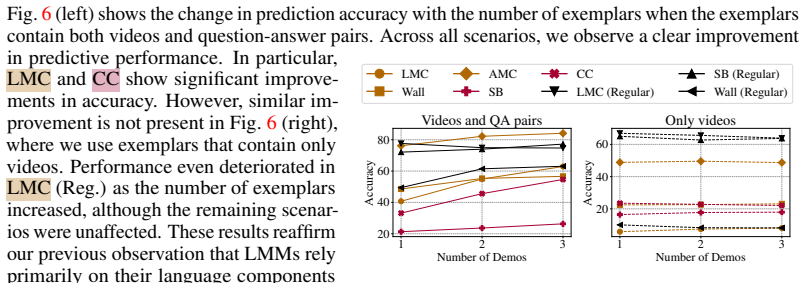
InPhyRe is the first visual question-answering benchmark purpose-built to measure inductive physical reasoning in LMMs by confronting them with collision videos that violate real-world physical laws, generated by intervening in a physics simulator. The paper reports three findings from 13 models: (1) LMMs can recite momentum and energy conservation but apply these laws inconsistently even in regular scenarios; (2) when exemplar videos follow laws unseen in training, almost all models show a substantial accuracy drop relative to regular scenarios, indicating weak inductive physical reasoning; and (3) removing question-answer pairs from the exemplars (video-only) cuts accuracy dramatically, sh
What carries the argument
The central object is InPhyRe, a synthetic benchmark of collision videos whose trajectories are generated by manually overriding a PyBullet simulation at the moment of collision so that they violate laws such as momentum conservation. Scenarios are grouped into irregular (law-violating) and regular (law-abiding) counterparts, and the key metric is the difference between few-shot accuracy in the irregular scenario and the model's best regular-scenario accuracy; a negative value is interpreted as weak inductive physical reasoning. A second experimental manipulation—exemplars with both video and question-answer pairs versus exemplars with video only—isolates the contribution of language and exp
Load-bearing premise
The paper assumes that the accuracy gap between irregular and regular scenarios measures inductive physical reasoning—that is, that the regular and irregular versions are matched in all respects except the violated law and that the intended law is uniquely inferable from three exemplars.
What would settle it
If human participants, given the same images and three exemplars, showed a similar or larger accuracy drop on the irregular scenarios, the gap would reflect task ambiguity or difficulty rather than a model-specific deficit in inductive physical reasoning.
If this is right
- In safety-critical settings where novel physics can occur, an LMM cannot be assumed to adapt from demonstrations; its predictions will default to parametric knowledge.
- Exemplars help LMMs only when they align with the physical laws already encoded in the model's parameters; conflicting demonstrations are not incorporated.
- The language-bias result implies that standard visual-question-answering accuracy can overstate a model's visual understanding; multimodal evaluation should separate textual and visual contributions.
- Instruction tuning as currently practiced does not address this gap; the authors suggest simulation-based feedback signals, similar to reinforcement learning from human feedback, as a direction.
- The same benchmark methodology—impossible or law-violating scenarios—can be applied to other branches of physics beyond mechanics.
Where Pith is reading between the lines
- The authors do not draw this conclusion, but the irregular-versus-regular gap likely conflates inductive reasoning with task difficulty: if the irregular versions are harder for reasons other than the violated law, part of the drop would appear even in a perfectly inductive agent.
- A testable extension the paper leaves implicit: adding human participants to the same scenarios would calibrate the gap; if humans show a comparable drop, the metric is not measuring model-specific inductive ability.
- One could also vary exemplar count beyond three and provide explicit textual statements of the law to separate failure of visual perception, rule induction, and rule application.
- The observation that larger models show larger language bias suggests that scaling up models may worsen, not fix, the reliance on text, which runs counter to the usual assumption that larger models are more robust reasoners.
Editorial analysis
A structured set of objections, weighed in public.
Referee Report
Summary. The paper introduces InPhyRe, a synthetic video question-answering benchmark designed to measure inductive physical reasoning in large multimodal models (LMMs). Scenarios depict collision events that either follow or violate universal physical laws such as momentum conservation. Models are evaluated zero-shot and few-shot, with exemplars containing either videos plus question-answer pairs or videos only. The main findings are: (1) LMMs have limited and poorly applied parametric knowledge of physical laws; (2) LMMs show weak inductive physical reasoning when exemplars violate the laws encoded in their parameters; and (3) the observed inductive behavior is driven primarily by language, with visual inputs playing little role. The headline metric is the accuracy gap between irregular and regular scenarios, with negative gaps interpreted as poor inductive physical reasoning.
Significance. If properly validated, InPhyRe would be a valuable benchmark for a question that is both scientifically interesting and practically important: whether LMMs can adapt their physical reasoning to novel or counter-physical environments from a few demonstrations. The paper evaluates a diverse cohort of 13 LMMs, uses a reproducible synthetic generation pipeline, and reports clear, structured accuracy tables. The finding that models often fail when exemplars contradict parametric knowledge, and that performance collapses in video-only settings, is suggestive and worth community attention. However, the strength of the conclusions depends on the validity of the regular–irregular gap as a measure of inductive ability, and on the absence of human/oracle calibration. Those issues are currently unresolved.
major comments (4)
- [§4.4, Fig. 4] The central metric compares every irregular scenario against the best regular scenario accuracy, but for AMC, Red-LMC, Red-Pass, and CC, the 'corresponding regular' is LMC(Reg), despite these scenarios differing in question type (rotation, color-conditional motion, passing-through, shape/object permanence) and visual properties. A negative gap therefore conflates induction failure with task-specific difficulty. To support the claim that 'a negative value indicates poor inductive physical reasoning,' the paper needs per-scenario matched regular controls or some other calibration that controls for task difficulty.
- [§4.4, Table 3] There is no human baseline or oracle calibration for irregular scenarios. The paper asserts in §1 that humans would 'easily adapt' from demonstrations, but this is not tested. Meanwhile, several irregular accuracies are near ceiling (e.g., InternVL3-8B at 94–100% on LMC, Wall, AMC), so the aggregate negative average is not a uniform failure signature. Without a competent-reasoner reference, the absolute irregular accuracies cannot be interpreted as showing weak inductive physical reasoning.
- [§4.5, Fig. 5] In the video-only condition, exemplars include videos plus randomly chosen option letters. In the video-text condition, exemplars include correct question-answer pairs. The comparison therefore varies not only the presence of textual information but also whether the labels are informative. A model may perform worse in the video-only condition because the random labels provide no usable signal, not necessarily because it is visually incapable. A control that keeps labels informative but removes the question text, or another design that separates label informativeness from modality, is needed to support Finding 3.
- [§4.4, Fig. 4] The reported accuracy differences lack confidence intervals or repeated-seed variability. Many entries are small (e.g., -0.20, +0.35, +0.30), and without uncertainty quantification it is hard to distinguish genuine effects from noise. Since each scenario contains around 2000 samples and 13 models are evaluated, paired bootstrap or stratified sampling would be straightforward and should be reported.
minor comments (5)
- [§B.2] The 'zero-shot' setting includes three assistant messages with random option labels. This is a reasonable formatting control, but calling it 'zero-shot' is potentially confusing. Clarify in the main text that random options are used only to enforce a constrained answer format and do not provide task information.
- [§4.4 conclusion] The sentence 'Almost all LMMs showed significant deterioration in performance' uses 'significant' in a non-statistical sense. Recommend replacing with 'substantial' or adding a statistical test.
- [§3] The claim that InPhyRe is 'the first visual question answering benchmark to measure inductive physical reasoning in LMMs' should be softened to 'to our knowledge,' as the paper does not exhaustively survey all recent benchmarks.
- [Fig. 4 and Fig. 5] The heatmap labels and the additional 'Average over LMMs' and 'Average over scenarios' rows are visually dense and difficult to read. Consider a cleaner formatting or a separate table for the averages.
- [§E.3] The heading 'AMC (regular)' in E.3 appears to be a misnomer, since AMC is an irregular scenario; the subsection describes open-ended outputs for AMC. Rename for clarity.
Circularity Check
Headline Finding 2 is the regular–irregular accuracy gap relabeled as 'weak inductive physical reasoning'; the conclusion is stipulated by the metric rather than independently established.
specific steps
-
self definitional
[§4.1 Evaluation tools; §4.4 How strong is inductive physical reasoning in LMMs?; §4.4 Conclusion]
"Inductive physical reasoning in LMMs is evaluated by comparing their few-shot performances in regular and irregular scenarios. ... A negative value indicates poor inductive physical reasoning in that scenario. ... Conclusion: LMMs demonstrate only weak inductive physical reasoning when exemplars violate parametric knowledge."
The central construct is not independently measured: 'weak inductive physical reasoning' is operationalized as a negative gap between irregular and regular 3-shot accuracy, and the headline discovery restates that same gap. Thus 'LMMs struggle in inductive physical reasoning' follows by definition from the metric, not from an external standard. No human or oracle baseline calibrates the gap, and for AMC, Red-LMC, Red-Pass, and CC the comparison uses LMC(Reg) even though the questions concern rotation, color-conditional motion, pass-through, and shape change rather than the same velocity-change task. A negative gap can therefore reflect task difficulty or question mismatch rather than an induction deficit, but the paper's conclusion adopts the metric's interpretation directly.
full rationale
The paper is mostly transparent: all absolute accuracies are reported in Tables 1, 3, and 4, and the irregular/regular comparison is explicitly stated. However, the headline Finding 2 is an interpretive label attached to the gap metric rather than an independent discovery. The metric defines 'weak inductive physical reasoning' as a negative gap, so the conclusion is baked into the operationalization. This is a partial circularity: the benchmark would produce the same 'finding' for any model that performed worse on irregular than regular scenarios, regardless of why. The language-bias finding in §4.5 is a separate controlled comparison and is less circular, and the qualitative AMC analysis in §E.3 is an independent check for one scenario. The paper would be strengthened by an oracle/human baseline and by matching question types across regular/irregular comparisons. Given that the raw accuracy tables remain informative, the circularity is partial, not total.
Axiom & Free-Parameter Ledger
free parameters (4)
- Exemplar count =
3
- Frames sampled per video =
8 of 240
- NNER retrieval feature space =
CLIP-L cosine distance, top-k unspecified
- Random options in video-only exemplars =
Random letters A-D
axioms (4)
- domain assumption Physically impossible scenarios are less likely to have been seen during training, so performance on them isolates inductive ability rather than memorized priors.
- domain assumption The accuracy gap between irregular and regular scenarios is a valid measure of inductive physical reasoning.
- domain assumption Three exemplar videos (or their text labels) uniquely determine the intended violated law.
- standard math Standard conservation laws correctly describe the regular scenarios.
read the original abstract
Large multimodal models (LMMs) encode physical laws observed during training, such as momentum conservation, as parametric knowledge. It allows LMMs to answer physical reasoning queries, such as the outcome of a potential collision event from visual input. However, since parametric knowledge includes only the physical laws seen during training, it is insufficient for reasoning in inference scenarios that follow physical laws unseen during training. In such novel physical environments, humans could adapt their physical reasoning based on provided demonstrations. This inductive physical reasoning ability is indispensable for LMMs if they are to replace human agents in safety-critical applications. Despite its importance, existing visual benchmarks do not evaluate inductive physical reasoning and only consider the parametric knowledge in LMMs. To this end, we propose InPhyRe, the first visual question answering benchmark to measure inductive physical reasoning in LMMs. InPhyRe evaluates LMMs' ability to predict the outcome of collision events in algorithmically generated synthetic videos. By inspecting over 13 open-source and proprietary LMMs, InPhyRe informs us that (1) LMMs struggle to apply their limited parametric knowledge about universal physical laws to reasoning, (2) inductive physical reasoning in LMMs is weak when the physical laws underlying inference scenarios were unseen during training, and (3) inductive physical reasoning in LMMs suffers from language bias and may ignore the visual inputs, questioning the trustworthiness of LMMs regarding visual inputs.
Figures




Forward citations
Cited by 1 Pith paper
-
PhysMRV: Physical Memory Retrieval and Verification for Physics Plausibility Reasoning
Structured physical memories (captions, event graphs, rule cues) retrieved and verified at inference time consistently improve frozen VLMs on physical-plausibility benchmarks without fine-tuning.
Reference graph
Works this paper leans on
-
[1]
PROST: Phys- ical Reasoning about Objects through Space and Time
Stéphane Aroca-Ouellette, Cory Paik, Alessandro Roncone, and Katharina Kann. PROST: Phys- ical Reasoning about Objects through Space and Time. InAnnual Meeting of the Association for Computational Linguistics, 2021
2021
-
[2]
CRAFT: A Benchmark for Causal Reasoning About Forces and inTeractions
Tayfun Ates, M Ate¸ so˘glu, Ça˘gatay Yi˘git, Ilker Kesen, Mert Kobas, Erkut Erdem, Aykut Erdem, Tilbe Goksun, and Deniz Yuret. CRAFT: A Benchmark for Causal Reasoning About Forces and inTeractions. InAnnual Meeting of the Association for Computational Linguistics, 2022
2022
-
[3]
Jinze Bai, Shuai Bai, Shusheng Yang, Shijie Wang, Sinan Tan, Peng Wang, Junyang Lin, Chang Zhou, and Jingren Zhou. Qwen-VL: A Versatile Vision-Language Model for Understanding, Localization, Text Reading, and Beyond.arXiv preprint arXiv:2308.12966, 2023
Pith/arXiv arXiv 2023
-
[4]
Qwen2.5-VL Technical Report.arXiv preprint arXiv:2502.13923, 2025
Shuai Bai, Keqin Chen, Xuejing Liu, Jialin Wang, Wenbin Ge, Sibo Song, Kai Dang, Peng Wang, Shijie Wang, Jun Tang, et al. Qwen2.5-VL Technical Report.arXiv preprint arXiv:2502.13923, 2025
Pith/arXiv arXiv 2025
-
[5]
Transformers as Statisticians: Provable In-Context Learning with In-Context Algorithm Selection
Yu Bai, Fan Chen, Huan Wang, Caiming Xiong, and Song Mei. Transformers as Statisticians: Provable In-Context Learning with In-Context Algorithm Selection. InAdvances in Neural Information Processing Systems, 2023
2023
-
[6]
PHYRE: A New Benchmark for Physical Reasoning
Anton Bakhtin, Laurens van der Maaten, Justin Johnson, Laura Gustafson, and Ross Girshick. PHYRE: A New Benchmark for Physical Reasoning. InAdvances in Neural Information Processing Systems, 2019
2019
-
[7]
What Makes Multimodal In-Context Learning Work? InIEEE/CVF Conference on Computer Vision and Pattern Recognition Workshop, 2024
Folco Bertini Baldassini, Mustafa Shukor, Matthieu Cord, Laure Soulier, and Benjamin Pi- wowarski. What Makes Multimodal In-Context Learning Work? InIEEE/CVF Conference on Computer Vision and Pattern Recognition Workshop, 2024
2024
-
[8]
CoPhy: Counterfactual Learning of Physical Dynamics
Fabien Baradel, Natalia Neverova, Julien Mille, Greg Mori, and Christian Wolf. CoPhy: Counterfactual Learning of Physical Dynamics. InInternational Conference on Learning Representations, 2020
2020
-
[9]
Physion: Evaluating physical prediction from vision in humans and machines
Daniel Bear, Elias Wang, Damian Mrowca, Felix Jedidja Binder, Hsiao-Yu Tung, RT Pramod, Cameron Holdaway, Sirui Tao, Kevin A Smith, Fan-Yun Sun, et al. Physion: Evaluating physical prediction from vision in humans and machines. InAdvances in Neural Information Processing Systems, 2021
2021
-
[10]
PIQA: Reasoning about Physical Commonsense in Natural Language
Yonatan Bisk, Rowan Zellers, Jianfeng Gao, Yejin Choi, et al. PIQA: Reasoning about Physical Commonsense in Natural Language. InAAAI Conference on Artificial Intelligence, 2020
2020
-
[11]
A Comprehensive Evaluation of Inductive Reasoning Capabilities and Problem Solving in Large Language Models
Chen Bowen, Rune Sætre, and Yusuke Miyao. A Comprehensive Evaluation of Inductive Reasoning Capabilities and Problem Solving in Large Language Models. InConference of the European Chapter of the Association for Computational Linguistics, 2024
2024
-
[12]
Meng Cao, Haoran Tang, Haoze Zhao, Hangyu Guo, Jiaheng Liu, Ge Zhang, Ruyang Liu, Qiang Sun, Ian Reid, and Xiaodan Liang. PhysGame: Uncovering Physical Commonsense Violations in Gameplay Videos.arXiv preprint arXiv:2412.01800, 2024
Pith/arXiv arXiv 2024
-
[13]
ShareGPT4Video: Improving Video Understanding and Generation with Better Captions
Lin Chen, Xilin Wei, Jinsong Li, Xiaoyi Dong, Pan Zhang, Yuhang Zang, Zehui Chen, Haodong Duan, Zhenyu Tang, Li Yuan, et al. ShareGPT4Video: Improving Video Understanding and Generation with Better Captions. InAdvances in Neural Information Processing Systems, 2024. 10
2024
-
[14]
Can Multimodal Large Language Models Truly Perform Multimodal In-Context Learning? InWinter Conference on Applications of Computer Vision, 2025
Shuo Chen, Zhen Han, Bailan He, Jianzhe Liu, Mark Buckley, Yao Qin, Philip Torr, V olker Tresp, and Jindong Gu. Can Multimodal Large Language Models Truly Perform Multimodal In-Context Learning? InWinter Conference on Applications of Computer Vision, 2025
2025
-
[15]
InternVL: Scaling up Vision Foundation Models and Aligning for Generic Visual-Linguistic Tasks
Zhe Chen, Jiannan Wu, Wenhai Wang, Weijie Su, Guo Chen, Sen Xing, Muyan Zhong, Qinglong Zhang, Xizhou Zhu, Lewei Lu, et al. InternVL: Scaling up Vision Foundation Models and Aligning for Generic Visual-Linguistic Tasks. InIEEE/CVF Conference on Computer Vision and Pattern Recognition, 2024
2024
-
[16]
Zhenfang Chen, Shilong Dong, Kexin Yi, Yunzhu Li, Mingyu Ding, Antonio Torralba, Joshua B Tenenbaum, and Chuang Gan. Compositional Physical Reasoning of Objects and Events from Videos.arXiv preprint arXiv:2408.02687, 2024
Pith/arXiv arXiv 2024
-
[17]
ComPhy: Compositional Physical Reasoning of Objects and Events from Videos
Zhenfang Chen, Kexin Yi, Yunzhu Li, Mingyu Ding, Antonio Torralba, Joshua B Tenenbaum, and Chuang Gan. ComPhy: Compositional Physical Reasoning of Objects and Events from Videos. InInternational Conference on Learning Representations, 2022
2022
-
[18]
UPRISE: Universal Prompt Retrieval for Improving Zero-Shot Evaluation
Daixuan Cheng, Shaohan Huang, Junyu Bi, Yuefeng Zhan, Jianfeng Liu, Yujing Wang, Hao Sun, Furu Wei, Weiwei Deng, and Qi Zhang. UPRISE: Universal Prompt Retrieval for Improving Zero-Shot Evaluation. InConference on Empirical Methods in Natural Language Processing, 2023
2023
-
[19]
Inductive or deductive? Rethinking the fundamental reasoning abilities of LLMs
Kewei Cheng, Jingfeng Yang, Haoming Jiang, Zhengyang Wang, Binxuan Huang, Ruirui Li, Shiyang Li, Zheng Li, Yifan Gao, Xian Li, et al. Inductive or deductive? Rethinking the fundamental reasoning abilities of LLMs. InACL Workshop on Natural Language Reasoning and Structure Explanations, 2024
2024
-
[20]
Anoop Cherian, Radu Corcodel, Siddarth Jain, and Diego Romeres. LLMPhy: Complex Physical Reasoning Using Large Language Models and World Models.arXiv preprint arXiv:2411.08027, 2024
Pith/arXiv arXiv 2024
-
[21]
Joseph Cho, Fachrina Dewi Puspitasari, Sheng Zheng, Jingyao Zheng, Lik-Hang Lee, Tae-Ho Kim, Choong Seon Hong, and Chaoning Zhang. Sora as an AGI World Model? A Complete Survey on Text-to-Video Generation.arXiv preprint arXiv:2403.05131, 2024
arXiv 2024
-
[22]
On the Measure of Intelligence.arXiv preprint arXiv:1911.01547, 2019
François Chollet. On the Measure of Intelligence.arXiv preprint arXiv:1911.01547, 2019
Pith/arXiv arXiv 1911
-
[23]
Blender 4.4
The Blender Community. Blender 4.4. https://docs.blender.org/manual/en/4.4/index. html, 2025
2025
-
[24]
PyBullet, a Python module for physics simulation for games, robotics and machine learning.http://pybullet.org, 2016–2021
Erwin Coumans and Yunfei Bai. PyBullet, a Python module for physics simulation for games, robotics and machine learning.http://pybullet.org, 2016–2021
2016
-
[25]
Yuhao Dong, Zuyan Liu, Hai-Long Sun, Jingkang Yang, Winston Hu, Yongming Rao, and Ziwei Liu. Insight-V: Exploring Long-Chain Visual Reasoning with Multimodal Large Language Models.arXiv preprint arXiv:2411.14432, 2024
Pith/arXiv arXiv 2024
-
[26]
What Can Transformers Learn In-Context? A Case Study of Simple Function Classes
Shivam Garg, Dimitris Tsipras, Percy S Liang, and Gregory Valiant. What Can Transformers Learn In-Context? A Case Study of Simple Function Classes. InAdvances in Neural Information Processing Systems, 2022
2022
-
[27]
Large Language Models Are Not Strong Abstract Reasoners
Gaël Gendron, Qiming Bao, Michael Witbrock, and Gillian Dobbie. Large Language Models Are Not Strong Abstract Reasoners. InInternational Joint Conference on Artificial Intelligence, 2024
2024
-
[28]
Making the V in VQA Matter: Elevating the Role of Image Understanding in Visual Question Answering
Yash Goyal, Tejas Khot, Douglas Summers-Stay, Dhruv Batra, and Devi Parikh. Making the V in VQA Matter: Elevating the Role of Image Understanding in Visual Question Answering. In IEEE/CVF Conference on Computer Vision and Pattern Recognition, 2017
2017
-
[29]
The Development of Inductive Reasoning.Inductive Reasoning Experimental, Developmental, and Computational Approaches, pages 25–54, 2007
Brett K Hayes. The Development of Inductive Reasoning.Inductive Reasoning Experimental, Developmental, and Computational Approaches, pages 25–54, 2007
2007
-
[30]
Kaiyu He, Mian Zhang, Shuo Yan, Peilin Wu, and Zhiyu Zoey Chen. IDEA: Enhancing the Rule Learning Ability of Large Language Model Agent through Induction, Deduction, and Abduction.arXiv preprint arXiv:2408.10455, 2024. 11
arXiv 2024
-
[31]
In-Context Demonstration Selection with Cross Entropy Difference
Dan Iter, Reid Pryzant, Ruochen Xu, Shuohang Wang, Yang Liu, Yichong Xu, and Chenguang Zhu. In-Context Demonstration Selection with Cross Entropy Difference. InConference on Empirical Methods in Natural Language Processing, 2023
2023
-
[32]
Quantization and Training of Neural Networks for Efficient Integer-Arithmetic-Only Inference
Benoit Jacob, Skirmantas Kligys, Bo Chen, Menglong Zhu, Matthew Tang, Andrew Howard, Hartwig Adam, and Dmitry Kalenichenko. Quantization and Training of Neural Networks for Efficient Integer-Arithmetic-Only Inference. InIEEE/CVF Conference on Computer Vision and Pattern Recognition, 2018
2018
-
[33]
CLEVR: A Diagnostic Dataset for Compositional Language and Elementary Visual Reasoning
Justin Johnson, Bharath Hariharan, Laurens Van Der Maaten, Li Fei-Fei, C Lawrence Zitnick, and Ross Girshick. CLEVR: A Diagnostic Dataset for Compositional Language and Elementary Visual Reasoning. InIEEE/CVF Conference on Computer Vision and Pattern Recognition, 2017
2017
-
[34]
Aishwarya Kamath, Johan Ferret, Shreya Pathak, Nino Vieillard, Ramona Merhej, Sarah Perrin, Tatiana Matejovicova, Alexandre Ramé, Morgane Rivière, et al. Gemma 3 Technical Report. arXiv preprint arXiv:2503.19786, 2025
Pith/arXiv arXiv 2025
-
[35]
VideoPoet: A Large Language Model for Zero-Shot Video Generation
Dan Kondratyuk, Lijun Yu, Xiuye Gu, Jose Lezama, Jonathan Huang, Grant Schindler, Rachel Hornung, Vighnesh Birodkar, Jimmy Yan, Ming-Chang Chiu, et al. VideoPoet: A Large Language Model for Zero-Shot Video Generation. InInternational Conference on Machine Learning, 2024
2024
-
[36]
Learning Physical Intuition of Block Towers by Example
Adam Lerer, Sam Gross, and Rob Fergus. Learning Physical Intuition of Block Towers by Example. InInternational Conference on Machine Learning, 2016
2016
-
[37]
LLaV A-OneVision: Easy Visual Task Transfer.arXiv preprint arXiv:2408.03326, 2024
Bo Li, Yuanhan Zhang, Dong Guo, Renrui Zhang, Feng Li, Hao Zhang, Kaichen Zhang, Peiyuan Zhang, Yanwei Li, Ziwei Liu, et al. LLaV A-OneVision: Easy Visual Task Transfer.arXiv preprint arXiv:2408.03326, 2024
Pith/arXiv arXiv 2024
-
[38]
ARIA: An Open Multimodal Native Mixture-of- Experts Model.arXiv preprint arXiv:2410.05993, 2024
Dongxu Li, Yudong Liu, Haoning Wu, Yue Wang, Zhiqi Shen, Bowen Qu, Xinyao Niu, Fan Zhou, Chengen Huang, Yanpeng Li, et al. ARIA: An Open Multimodal Native Mixture-of- Experts Model.arXiv preprint arXiv:2410.05993, 2024
Pith/arXiv arXiv 2024
-
[39]
Feng Li, Renrui Zhang, Hao Zhang, Yuanhan Zhang, Bo Li, Wei Li, Zejun Ma, and Chunyuan Li. LLaV A-NeXT-Interleave: Tackling Multi-image, Video, and 3D in Large Multimodal Models.arXiv preprint arXiv:2407.07895, 2024
Pith/arXiv arXiv 2024
-
[40]
MIRAGE: Evaluating and Explaining Inductive Reasoning Process in Language Models
Jiachun Li, Pengfei Cao, Zhuoran Jin, Yubo Chen, Kang Liu, and Jun Zhao. MIRAGE: Evaluating and Explaining Inductive Reasoning Process in Language Models. InInternational Conference on Learning Representations, 2025
2025
-
[41]
What Do Language Models Learn in Context? The Structured Task Hypothesis
Jiaoda Li, Yifan Hou, Mrinmaya Sachan, and Ryan Cotterell. What Do Language Models Learn in Context? The Structured Task Hypothesis. InAnnual Meeting of the Association for Computational Linguistics, 2024
2024
-
[42]
Unified Demonstration Retriever for In-Context Learning
Xiaonan Li, Kai Lv, Hang Yan, Tianyang Lin, Wei Zhu, Yuan Ni, Guotong Xie, Xiaoling Wang, and Xipeng Qiu. Unified Demonstration Retriever for In-Context Learning. InAnnual Meeting of the Association for Computational Linguistics, 2023
2023
-
[43]
What Makes Good In-Context Examples for GPT-3? InDeep Learning Inside Out (DeeLIO): The 3rd Workshop on Knowledge Extraction and Integration for Deep Learning Architectures, 2022
Jiachang Liu, Dinghan Shen, Yizhe Zhang, William B Dolan, Lawrence Carin, and Weizhu Chen. What Makes Good In-Context Examples for GPT-3? InDeep Learning Inside Out (DeeLIO): The 3rd Workshop on Knowledge Extraction and Integration for Deep Learning Architectures, 2022
2022
-
[44]
The Violation-of-Expectation Paradigm: A Conceptual Overview.Psychological Review, 131(3):716, 2024
Francesco Margoni, Luca Surian, and Renée Baillargeon. The Violation-of-Expectation Paradigm: A Conceptual Overview.Psychological Review, 131(3):716, 2024
2024
-
[45]
Rethinking the Role of Demonstrations: What Makes In-Context Learning Work? InConference on Empirical Methods in Natural Language Processing, 2022
Sewon Min, Xinxi Lyu, Ari Holtzman, Mikel Artetxe, Mike Lewis, Hannaneh Hajishirzi, and Luke Zettlemoyer. Rethinking the Role of Demonstrations: What Makes In-Context Learning Work? InConference on Empirical Methods in Natural Language Processing, 2022. 12
2022
-
[46]
Large Language Models as General Pattern Machines
Suvir Mirchandani, Fei Xia, Pete Florence, Brian Ichter, Danny Driess, Montserrat Gonzalez Arenas, Kanishka Rao, Dorsa Sadigh, and Andy Zeng. Large Language Models as General Pattern Machines. InConference on Robot Learning, 2023
2023
-
[47]
Do generative video models understand physical principles?arXiv preprint arXiv:2501.09038, 2025
Saman Motamed, Laura Culp, Kevin Swersky, Priyank Jaini, and Robert Geirhos. Do generative video models understand physical principles?arXiv preprint arXiv:2501.09038, 2025
Pith/arXiv arXiv 2025
-
[48]
Newtonian Image Understanding: Unfolding the Dynamics of Objects in Static Images
Roozbeh Mottaghi, Hessam Bagherinezhad, Mohammad Rastegari, and Ali Farhadi. Newtonian Image Understanding: Unfolding the Dynamics of Objects in Static Images. InIEEE/CVF Conference on Computer Vision and Pattern Recognition, 2016
2016
-
[49]
FEABench: Evaluating Language Models on Multiphysics Reasoning Ability
Nayantara Mudur, Hao Cui, Subhashini Venugopalan, Paul Raccuglia, Michael P Brenner, and Peter Norgaard. FEABench: Evaluating Language Models on Multiphysics Reasoning Ability. arXiv preprint arXiv:2504.06260, 2025
Pith/arXiv arXiv 2025
-
[50]
Learning vs Retrieval: The Role of In-Context Examples in Regression with LLMs
Aliakbar Nafar, Kristen Brent Venable, and Parisa Kordjamshidi. Learning vs Retrieval: The Role of In-Context Examples in Regression with LLMs. InAnnual Conference of the North American Chapter of the Association for Computational Linguistics, 2025
2025
-
[51]
Sora – Creating video from text.https://openai.com/index/sora/, 2024
OpenAI. Sora – Creating video from text.https://openai.com/index/sora/, 2024
2024
-
[52]
Training language models to follow instructions with human feedback
Long Ouyang, Jeffrey Wu, Xu Jiang, Diogo Almeida, Carroll Wainwright, Pamela Mishkin, Chong Zhang, Sandhini Agarwal, Katarina Slama, Alex Ray, et al. Training language models to follow instructions with human feedback. InAdvances in Neural Information Processing Systems, 2022
2022
-
[53]
Physics Reasoner: Knowledge-Augmented Reasoning for Solving Physics Problems with Large Language Models
Xinyu Pang, Ruixin Hong, Zhanke Zhou, Fangrui Lv, Xinwei Yang, Zhilong Liang, Bo Han, and Changshui Zhang. Physics Reasoner: Knowledge-Augmented Reasoning for Solving Physics Problems with Large Language Models. InInternational Conference on Computational Linguistics, 2025
2025
-
[54]
Revisiting Demonstration Selection Strategies in In-Context Learning
Keqin Peng, Liang Ding, Yancheng Yuan, Xuebo Liu, Min Zhang, Yuanxin Ouyang, and Dacheng Tao. Revisiting Demonstration Selection Strategies in In-Context Learning. InAnnual Meeting of the Association for Computational Linguistics, 2024
2024
-
[55]
Learning Transferable Visual Models From Natural Language Supervision
Alec Radford, Jong Wook Kim, Chris Hallacy, Aditya Ramesh, Gabriel Goh, Sandhini Agarwal, Girish Sastry, Amanda Askell, Pamela Mishkin, Jack Clark, et al. Learning Transferable Visual Models From Natural Language Supervision. InInternational Conference on Machine Learning, 2021
2021
-
[56]
The Development of Reasoning.Handbook of Child Psychology and Develop- mental Science, pages 1–52, 2015
Robert B Ricco. The Development of Reasoning.Handbook of Child Psychology and Develop- mental Science, pages 1–52, 2015
2015
-
[57]
IntPhys 2019: A Benchmark for Visual Intuitive Physics Understanding.IEEE Transactions on Pattern Analysis and Machine Intelligence, 44(9):5016– 5025, 2021
Ronan Riochet, Mario Ynocente Castro, Mathieu Bernard, Adam Lerer, Rob Fergus, Véronique Izard, and Emmanuel Dupoux. IntPhys 2019: A Benchmark for Visual Intuitive Physics Understanding.IEEE Transactions on Pattern Analysis and Machine Intelligence, 44(9):5016– 5025, 2021
2019
-
[58]
Glitchbench: Can large multimodal models detect video game glitches? InIEEE/CVF Conference on Computer Vision and Pattern Recognition, 2024
Mohammad Reza Taesiri, Tianjun Feng, Cor-Paul Bezemer, and Anh Nguyen. Glitchbench: Can large multimodal models detect video game glitches? InIEEE/CVF Conference on Computer Vision and Pattern Recognition, 2024
2024
-
[59]
CLIP meets GamePhysics: Towards bug identification in gameplay videos using zero-shot transfer learning
Mohammad Reza Taesiri, Finlay Macklon, and Cor-Paul Bezemer. CLIP meets GamePhysics: Towards bug identification in gameplay videos using zero-shot transfer learning. InInternational Conference on Mining Software Repositories, 2022
2022
-
[60]
Mohammad Reza Taesiri, Finlay Macklon, Yihe Wang, Hengshuo Shen, and Cor-Paul Bezemer. Large Language Models are Pretty Good Zero-Shot Video Game Bug Detectors.arXiv preprint arXiv:2210.02506, 2022
Pith/arXiv arXiv 2022
-
[61]
Physion++: Evaluating Physical Scene Understanding that Requires Online Inference of Different Physical Properties
Hsiao-Yu Tung, Mingyu Ding, Zhenfang Chen, Daniel Bear, Chuang Gan, Josh Tenenbaum, Dan Yamins, Judith Fan, and Kevin Smith. Physion++: Evaluating Physical Scene Understanding that Requires Online Inference of Different Physical Properties. InAdvances in Neural Information Processing Systems, 2023. 13
2023
-
[62]
From Words to Numbers: Your Large Language Model Is Secretly A Capable Regressor When Given In-Context Examples
Robert Vacareanu, Vlad-Andrei Negru, Vasile Suciu, and Mihai Surdeanu. From Words to Numbers: Your Large Language Model Is Secretly A Capable Regressor When Given In-Context Examples. InConference on Language Modeling, 2024
2024
-
[63]
Learning to retrieve in-context examples for large language models
Liang Wang, Nan Yang, and Furu Wei. Learning to retrieve in-context examples for large language models. InConference of the European Chapter of the Association for Computational Linguistics, 2024
2024
-
[64]
Peng Wang, Shuai Bai, Sinan Tan, Shijie Wang, Zhihao Fan, Jinze Bai, Keqin Chen, Xuejing Liu, Jialin Wang, Wenbin Ge, Yang Fan, Kai Dang, Mengfei Du, Xuancheng Ren, Rui Men, Dayiheng Liu, Chang Zhou, Jingren Zhou, and Junyang Lin. Qwen2-VL: Enhancing Vision- Language Model’s Perception of the World at Any Resolution.arXiv preprint arXiv:2409.12191, 2024
Pith/arXiv arXiv 2024
-
[65]
Qixun Wang, Yifei Wang, Yisen Wang, and Xianghua Ying. Can In-context Learning Really Generalize to Out-of-distribution Tasks?arXiv preprint arXiv:2410.09695, 2024
Pith/arXiv arXiv 2024
-
[66]
Hypothesis Search: Inductive Reasoning with Language Models
Ruocheng Wang, Eric Zelikman, Gabriel Poesia, Yewen Pu, Nick Haber, and Noah Goodman. Hypothesis Search: Inductive Reasoning with Language Models. InInternational Conference on Learning Representations, 2024
2024
-
[67]
NEWTON: Are Large Language Models Capable of Physical Reasoning? InConference on Empirical Methods in Natural Language Processing, 2023
Yi Ru Wang, Jiafei Duan, Dieter Fox, and Siddhartha S Srinivasa. NEWTON: Are Large Language Models Capable of Physical Reasoning? InConference on Empirical Methods in Natural Language Processing, 2023
2023
-
[68]
Qwen2.5-Omni Technical Report.arXiv preprint arXiv:2503.20215, 2025
Jin Xu, Zhifang Guo, Jinzheng He, Hangrui Hu, Ting He, Shuai Bai, Keqin Chen, Jialin Wang, Yang Fan, Kai Dang, Bin Zhang, Xiong Wang, Yunfei Chu, and Junyang Lin. Qwen2.5-Omni Technical Report.arXiv preprint arXiv:2503.20215, 2025
Pith/arXiv arXiv 2025
-
[69]
Kai Yan, Zhan Ling, Kang Liu, Yifan Yang, Ting-Han Fan, Lingfeng Shen, Zhengyin Du, and Jiecao Chen. MIR-Bench: Benchmarking LLM’s Long-Context Intelligence via Many-Shot In-Context Inductive Reasoning.arXiv preprint arXiv:2502.09933, 2025
arXiv 2025
-
[70]
Qwen2 Technical Report.arXiv preprint arXiv:2407.10671, 2024
An Yang, Baosong Yang, Binyuan Hui, Bo Zheng, Bowen Yu, Chang Zhou, Chengpeng Li, Chengyuan Li, Dayiheng Liu, Fei Huang, et al. Qwen2 Technical Report.arXiv preprint arXiv:2407.10671, 2024
Pith/arXiv arXiv 2024
-
[71]
Qwen2.5 Technical Report.arXiv preprint arXiv:2412.15115, 2024
An Yang, Baosong Yang, Beichen Zhang, Binyuan Hui, Bo Zheng, Bowen Yu, Chengyuan Li, Dayiheng Liu, Fei Huang, Haoran Wei, et al. Qwen2.5 Technical Report.arXiv preprint arXiv:2412.15115, 2024
Pith/arXiv arXiv 2024
-
[72]
CLEVRER: CoLlision Events for Video REpresentation and Reasoning
Kexin Yi, Chuang Gan, Yunzhu Li, Pushmeet Kohli, Jiajun Wu, Antonio Torralba, and Joshua B Tenenbaum. CLEVRER: CoLlision Events for Video REpresentation and Reasoning. In International Conference on Learning Representations, 2020
2020
-
[73]
Sigmoid Loss for Language Image Pre-Training
Xiaohua Zhai, Basil Mustafa, Alexander Kolesnikov, and Lucas Beyer. Sigmoid Loss for Language Image Pre-Training. InIEEE/CVF International Conference on Computer Vision, 2023
2023
-
[74]
Boqiang Zhang, Kehan Li, Zesen Cheng, Zhiqiang Hu, Yuqian Yuan, Guanzheng Chen, Sicong Leng, Yuming Jiang, Hang Zhang, Xin Li, Peng Jin, Wenqi Zhang, Fan Wang, Lidong Bing, and Deli Zhao. VideoLLaMA 3: Frontier Multimodal Foundation Models for Image and Video Understanding.arXiv preprint arXiv:2501.13106, 2025
Pith/arXiv arXiv 2025
-
[75]
How Vision Language Models Will Shape The Future Of Self-Driving Cars, March 2025
Xingjian Zhang. How Vision Language Models Will Shape The Future Of Self-Driving Cars, March 2025
2025
-
[76]
LLaV A-NeXT: A Strong Zero-shot Video Understanding Model, April 2024
Yuanhan Zhang, Bo Li, haotian Liu, Yong jae Lee, Liangke Gui, Di Fu, Jiashi Feng, Ziwei Liu, and Chunyuan Li. LLaV A-NeXT: A Strong Zero-shot Video Understanding Model, April 2024
2024
-
[77]
Lianmin Zheng, Wei-Lin Chiang, Ying Sheng, Siyuan Zhuang, Zhanghao Wu, Yonghao Zhuang, Zi Lin, Zhuohan Li, Dacheng Li, Eric. P Xing, Hao Zhang, Joseph E. Gonzalez, and Ion Stoica. Judging LLM-as-a-judge with MT-Bench and Chatbot Arena.arXiv preprint arXiv:2306.05685, 2023. 14
Pith/arXiv arXiv 2023
-
[78]
Vision Language Models in Autonomous Driving: A Survey and Outlook.IEEE Transactions on Intelligent Vehicles, 2024
Xingcheng Zhou, Mingyu Liu, Ekim Yurtsever, Bare Luka Zagar, Walter Zimmer, Hu Cao, and Alois C Knoll. Vision Language Models in Autonomous Driving: A Survey and Outlook.IEEE Transactions on Intelligent Vehicles, 2024
2024
-
[79]
Jinguo Zhu, Weiyun Wang, Zhe Chen, Zhaoyang Liu, Shenglong Ye, Lixin Gu, Yuchen Duan, Hao Tian, Weijie Su, Jie Shao, et al. InternVL3: Exploring Advanced Training and Test-Time Recipes for Open-Source Multimodal Models.arXiv preprint arXiv:2504.10479, 2025. A Data-generation Details A.1 Rendering the Videos We use Blender’s Python wrapper3 (v4.4.0) to ren...
Pith/arXiv arXiv 2025
-
[80]
E.g.,<|im_start|>,<fim_suffix>
Placeholders for image and video tokens. E.g.,<|im_start|>,<fim_suffix>
discussion (0)
Sign in with ORCID, Apple, or X to comment. Anyone can read and Pith papers without signing in.