REVIEW 3 major objections 4 minor 50 references
Finite-Agent Stochastic Differential Games on Large Graphs: II. Graph-Based Architectures
T0 review · 3 major / 4 minor · reviewed 2026-08-04 · deepseek-v4-flash
Pith's one-line read This paper claims that a neural network with fixed, non-trainable weights placed along a game's graph can approximate Nash equilibrium feedback functions to arbitrary accuracy, and that solvers built on this architecture match fully trainab
desk verdict A genuine constructive expressivity theorem with honestly stated limits, but the contraction assumption goes unchecked and the claimed efficiency outruns the data; send it to referees. read the letter →
The pith
A machine-rendered reading of the paper's core claim, the machinery that carries it, and where it could break.
The reading
What carries the argument
The central object is the NTM (non-trainable modification) architecture, a feedforward network whose weight matrices are masked by the graph Laplacian's sparsity pattern: at each layer, a node's hidden state is updated using only its own previous state and those of its graph neighbors, and the masked entries are fixed at zero during training. The proof of Theorem 3.5 constructs NTM weights so that one layer performs one step of the fixed-point iteration φ^(k+1)=A(x,φ^(k)); the state coordinates are carried unchanged through a ReLU-based residual path, while the action coordinates are updated by the approximate best-response network. The depth K then corresponds to the number of fixed-point i
What would settle it
Take a two-player game on a two-node graph whose best-response map has a local slope exceeding 1 in the sup norm (for example, costs with strong strategic complementarity), and run NTM-DP with increasing depth K. If the error relative to the true Nash equilibrium fails to decrease as ρ^{K−1} would predict—or fails to converge at all—the contraction premise is violated and the theorem's bound does not apply. Alternatively, a supervised-learning test with 1D NTM on a target function that genuinely depends on a node at graph distance greater than K will show zero sensitivity to that node, falsify
Extended reading notes
Core claim
The central claim is Theorem 3.5: if the joint best-response map A(x,·) is a sup-norm contraction with modulus ρ<1 and each player's best response can be approximated by a one-hidden-layer ReLU network, then the multi-dimensional NTM architecture can approximate the unique Nash equilibrium feedback function with error at most δ/(1−ρ)+ρ^{K−1}||φ̂||_∞, which can be made arbitrarily small by increasing depth K. The NTM achieves this by using its fixed graph-masked connections to simulate repeated applications of the best-response map, with a non-trainable path preserving the state while trainable channels refine the action estimate. The paper also claims, based on numerical experiments across t
Load-bearing premise
The load-bearing premise is that the joint best-response mapping is a contraction in the sup norm with modulus below 1; without that, the fixed-point iteration underlying the approximation need not converge and the exponential error bound collapses. The theorem also assumes a specific hidden dimension (d=d_in+d_out) and width M≥2, whereas the architecture used in the experiments is the 1D version, so the theory does not directly cover the main empirical configuration.
Editorial extensions
If this is right
- If Theorem 3.5 is correct, any continuous equilibrium feedback function in a static graph game satisfying the contraction condition can be approximated to arbitrary accuracy by a graph-sparsified network, so fully connected layers are not necessary for these games.
- The NTM-DP and NTM-DBSDE results indicate that large sparse games can be solved with a fraction of the trainable parameters—about 49% in the LQ test case—without a measurable loss in pathwise accuracy.
- Because NTM's forward propagation only exchanges information along graph edges, the learned strategy's dependence structure is transparent: player i's output cannot depend on players beyond graph distance K, which helps explain and verify equilibrium strategies.
- The observed training instability of graph convolutional networks in strategy-parameterization tasks suggests that spectral mixing of player information is poorly suited to game solving, pointing to spatial, graph-aligned architectures for future solver design.
Reading between the lines
- The theorem requires hidden dimension d=d_in+d_out and M≥2, while all game-solving experiments use the 1D NTM with d=1 and often M=1; if those results hold generally, it would imply a stronger expressivity result than the proof covers, possibly tied to the linear-quadratic structure of the test games.
- The contraction assumption excludes games with strategic complementarities that amplify neighbors' actions; a natural testable extension is whether NTM still approximates equilibria in such games, or whether a local contraction condition suffices.
- The paper's time-slicing reduction of dynamic games to static games suggests that the approximation error should accumulate linearly in the number of time slices; this can be checked by measuring NTM-DP errors as the time grid is refined.
- The non-trainable sparsification idea generalizes beyond games: any multi-agent system with local interactions could use a fixed graph mask to reduce parameters, and the same stability/expressivity comparison with spectral GCNs could be repeated on generic multi-agent control tasks.
Editorial analysis
A structured set of objections, weighed in public.
Referee Report
Summary. The paper proposes NTM, a graph-sparsified feedforward architecture in which trainable weights are restricted to the sparsity pattern of the graph Laplacian. The authors prove a universal approximation theorem (Theorem 3.5) for a multi-dimensional NTM approximating Nash equilibrium feedback functions of static games on graphs, conditional on a sup-norm contraction of the joint best-response map and on uniform approximability of each best response by a single-hidden-layer ReLU network. They then combine NTM with Direct Parameterization and Deep BSDE solvers, obtaining NTM-DP and NTM-DBSDE, and report numerical experiments on three SDGs (LQ, portfolio, non-LQ variant) over several graph families, showing comparable accuracy with fewer trainable parameters.
Significance. If Theorem 3.5 were correct as stated, it would be a useful step toward graph-structured parametrizations with formal guarantees; the numerical results also support the practical utility of graph-guided sparsification. The paper has clear strengths: the Appendix A.1 construction is explicit, parameter counts are concrete, and the evaluation includes multiple graph topologies, two solver families, and M=1 robustness checks. However, the theorem has a quantification issue around the channel width M, it does not cover the 1D NTM used in the experiments, and the contraction assumption is not checked for any benchmark. These issues make the theoretical contribution narrower than claimed, though the empirical core remains credible.
major comments (3)
- [Section 3.2, Assumption 3.4(ii) / Theorem 3.5] As formulated, the M in the approximating network is fixed and equal to the NTM channel width. A single-hidden-layer ReLU network with a fixed finite M cannot uniformly approximate arbitrary continuous A_i on a compact domain: universal approximation requires the width to grow with the accuracy δ. The claim after the assumption, 'It is satisfied whenever A_i is continuous', is therefore not correct for fixed M. If the intended reading is that M may be chosen after δ, then the universal approximation statement should be 'for any δ there exist M(δ) and parameters', not 'for any M≥2'. Because the proof in Appendix A.1 uses the same eA_i at each layer, this quantification issue affects the central theorem directly.
- [Section 3.2 vs Section 4] Theorem 3.5 requires d=d_in+d_out (so d=2 for scalar states/actions) and M≥2. All game-solving experiments in Section 4 use the 1D NTM with d=1, and Appendix E tests M=1. The text acknowledges this after the theorem, but the abstract and Section 3.2 present the theorem as the theoretical foundation for the NTM-based solvers. The state-preservation construction in Appendix A.1 depends on the π_x/π_a split, which is unavailable when d=1; Theorem 3.5 gives no bound for the architecture used in Tables 1–3. The paper should either extend the theorem to d=1, or explicitly state that the solver experiments are not covered by the theorem and are heuristic.
- [Sections 4.1–4.3, Assumption 3.4(i)] The contraction condition ρ<1 is never verified for the LQ, portfolio, or non-LQ games. The theorem's fixed-point error bound and the accumulated δ/(1−ρ) term are meaningful only if the joint best-response map is a sup-norm contraction with ρ<1. For the LQ game the best-response map is linear in neighbors' actions, so the assumption is a row-sum/spectral condition on the coupling matrix; for the portfolio game it is a similar linear-system condition. These conditions can fail under strategic complementarities and are not checked or discussed for the parameter values used in the experiments. The paper should verify a concrete ρ<1 for each tested model, or limit the theoretical statements to games satisfying Assumption 3.4 and present the numerical results as supporting evidence rather than as consequences of Theorem 3.5.
minor comments (4)
- [Appendix F.2 / Abstract] Appendix F.2 reports that training time is not significantly reduced despite the parameter savings. The abstract's 'improved computational efficiency' should be qualified as lower parameter count rather than runtime.
- [Definition 3.2 / Theorem 3.5] Definition 3.2 requires K≥2, but Theorem 3.5 quantifies over all K∈N. State the lower bound explicitly.
- [Appendix A.1, Step 1] The fixed-point iteration begins with φ^(0)≡0. If the compact action set A does not contain 0, A(x,0) is not defined. Choose a start point in A (or assume 0∈A) and adjust the initial error term accordingly.
- [Throughout] Typos and small presentation issues: 'Non-T rainable' in the introduction, 'restriced' in Section 4.1, and inconsistent capitalization of Deep BSDE. Please proofread.
Circularity Check
No significant circularity: Theorem 3.5 is a constructive approximation proof from explicit contraction and approximability assumptions; numerical sections are supervised fitting against baselines, not fitted inputs renamed as predictions.
full rationale
The paper's central theoretical claim, Theorem 3.5, is a constructive universal-approximation result. It assumes (i) a sup-norm contraction of the joint best-response map and (ii) uniform approximability of each best-response by a single-hidden-layer network. The proof explicitly constructs NTM weights that simulate the approximate best-response iteration and bounds the error via Banach fixed-point iteration. The assumptions are on the game primitives, not on the target equilibrium, so the conclusion does not reduce to the input by construction. The numerical sections train networks against cost/loss functionals and compare to baselines; this is ordinary fitting, not prediction-from-fit. Proposition 3.6 and the LQ benchmarks cite the authors' prior paper [30], but those are published, independently proved results used as inputs, not as circular justification of the NTM approximation theorem. The paper itself flags that Theorem 3.5 requires d=d_in+d_out and M≥2, while experiments use 1D NTM and M=1; that is a scope/validity limitation, not circularity. No equation in the paper is equivalent by construction to its own output, and no load-bearing self-citation chain forces the main result.
Assumptions & free parameters
free parameters (2)
- Network depth K in NTM (set to 3 in experiments) =
3
- Channel width M in NTM (set to 3, with M=1 robustness runs) =
3 (and 1 in Appendix E)
assumptions (5)
- domain assumption Assumption 3.4(i): the joint best-response map A is a contraction in sup norm with modulus ρ in (0,1).
- domain assumption Assumption 3.4(ii): each best response A_i can be uniformly approximated by a single-hidden-layer ReLU network of the stated form over its compact domain.
- domain assumption Well-posedness of the stochastic game dynamics and costs per [9, Assumption (Games), Section 2.1].
- domain assumption Results from the companion paper [30]: Theorem 4.2 (existence/form of LQ NE), Lemma 4.7, Theorem 4.13, and equations (2.1)-(2.5), (4.2), (4.4).
- standard math Standard mathematical facts: Banach fixed-point theorem, universal approximation theorem, Cayley-Hamilton theorem, Stone-Weierstrass theorem.
Cite this review
Pith. "Pith review of Finite-Agent Stochastic Differential Games on Large Graphs: II. Graph-Based Architectures." pith.science (2026). https://pith.science/paper/HFEXNIEE
@misc{pith2026250912484,
  author       = {Pith},
  title        = {Pith review of: Finite-Agent Stochastic Differential Games on Large Graphs: II. Graph-Based Architectures},
  year         = {2026},
  howpublished = {\url{https://pith.science/paper/HFEXNIEE}},
  note         = {Machine review of arXiv:2509.12484}
}
read the original abstract
We propose a novel neural network architecture, called Non-Trainable Modification (NTM), for computing Nash equilibria in stochastic differential games (SDGs) on graphs. These games model a broad class of graph-structured multi-agent systems arising in finance, robotics, energy, and social dynamics, where agents interact locally under uncertainty. The NTM architecture imposes a graph-guided sparsification on feedforward neural networks, embedding fixed, non-trainable components aligned with the underlying graph topology. This design enhances interpretability and stability, while significantly reducing the number of trainable parameters in large-scale, sparse settings. We theoretically establish a universal approximation property for NTM in static games on graphs and numerically validate its expressivity and robustness through supervised learning tasks. Building on this foundation, we incorporate NTM into two state-of-the-art game solvers, Direct Parameterization and Deep BSDE (backward stochastic differential equation), yielding their sparse variants (NTM-DP and NTM-DBSDE). Numerical experiments on three SDGs across various graph structures demonstrate that NTM-based methods achieve performance comparable to their fully trainable counterparts, while offering improved computational efficiency.
Figures


Figures from the paper (12 more)




Reference graph
Works this paper leans on
-
[1]
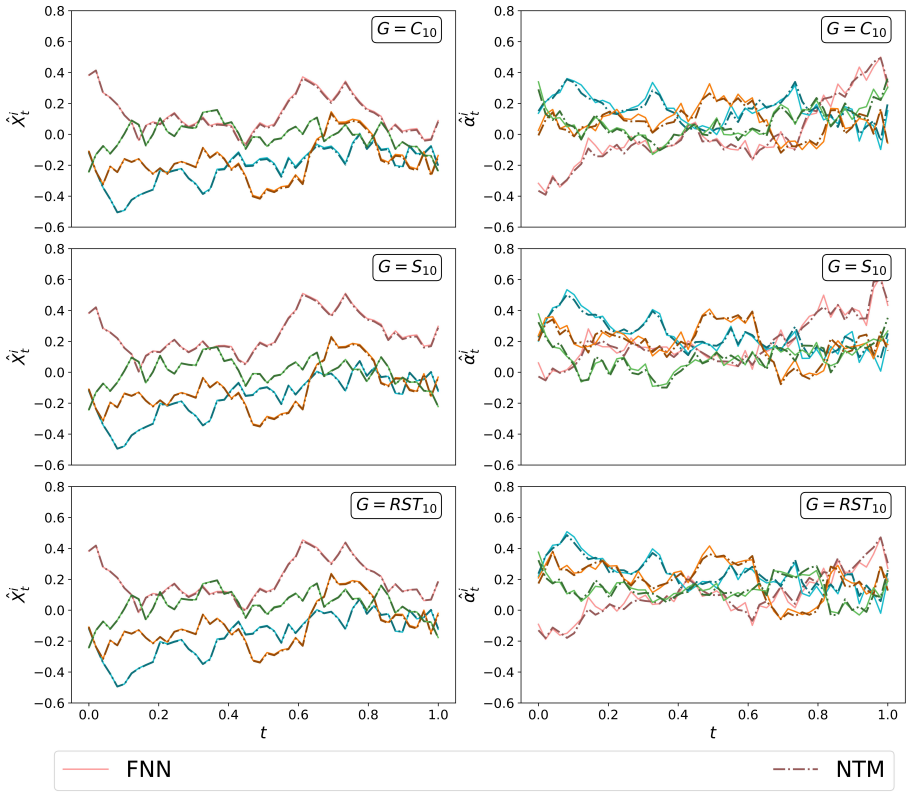
Ali Al-Aradi, Adolfo Correia, DdF Naiff, Gabriel Jardim, and Yuri Saporito. Applications of the deep Galerkin method to solving partial integro-differential and Hamilton-Jacobi-Bellman equations.arXiv preprint arXiv:1912.01455, 2019. 21 Figure 4: Comparisons of equilibrium state (left panels) and strategy (right panels) trajectories for N= 10 players in t...
arXiv 1912
-
[2]
Diffusion-convolutional neural networks.Advances in neural information processing systems, 29, 2016
James Atwood and Don Towsley. Diffusion-convolutional neural networks.Advances in neural information processing systems, 29, 2016
2016
-
[3]
Deep neural networks al- gorithms for stochastic control problems on finite horizon: numerical applications.Methodology and Computing in Applied Probability, 24(1):143–178, 2022
Achref Bachouch, Cˆ ome Hur´ e, Nicolas Langren´ e, and Huyˆ en Pham. Deep neural networks al- gorithms for stochastic control problems on finite horizon: numerical applications.Methodology and Computing in Applied Probability, 24(1):143–178, 2022
2022
-
[4]
Netgan: Generating graphs via random walks
Aleksandar Bojchevski, Oleksandr Shchur, Daniel Z¨ ugner, and Stephan G¨ unnemann. Netgan: Generating graphs via random walks. InInternational conference on machine learning, pages 610–619. PMLR, 2018. 22
2018
-
[5]
Translating embeddings for modeling multi-relational data.Advances in neu- ral information processing systems, 26, 2013
Antoine Bordes, Nicolas Usunier, Alberto Garcia-Duran, Jason Weston, and Oksana Yakhnenko. Translating embeddings for modeling multi-relational data.Advances in neu- ral information processing systems, 26, 2013
2013
-
[6]
Some notes on computation of games solutions
George W Brown. Some notes on computation of games solutions. Technical report, RAND Corporation, 1949
1949
-
[7]
Iterative solution of games by fictitious play.Activity Analysis of Production and Allocation, 13(1):374–376, 1951
George W Brown. Iterative solution of games by fictitious play.Activity Analysis of Production and Allocation, 13(1):374–376, 1951
1951
-
[8]
Princeton University Press, 2009
Francesco Bullo, Jorge Cort´ es, and Sonia Martinez.Distributed control of robotic networks: a mathematical approach to motion coordination algorithms. Princeton University Press, 2009
2009
Show all 50 references
-
[9]
Springer, 2018
Ren´ e Carmona and Fran¸ cois Delarue.Probabilistic Theory of Mean Field Games with Appli- cations I-II. Springer, 2018
2018
-
[10]
Mean field games and systemic risk
Ren´ e Carmona, Jean-Pierre Fouque, and Li-Hsien Sun. Mean field games and systemic risk. Communications in Mathematical Sciences, 13(4):911–933, 2015
2015
-
[11]
American Mathematical Soc., 1997
Fan RK Chung.Spectral Graph Theory, volume 92. American Mathematical Soc., 1997
1997
-
[12]
Approximation by superpositions of a sigmoidal function.Mathematics of control, signals and systems, 2(4):303–314, 1989
George Cybenko. Approximation by superpositions of a sigmoidal function.Mathematics of control, signals and systems, 2(4):303–314, 1989
1989
-
[13]
The complexity of computing a nash equilibrium.Communications of the ACM, 52(2):89–97, 2009
Constantinos Daskalakis, Paul W Goldberg, and Christos H Papadimitriou. The complexity of computing a nash equilibrium.Communications of the ACM, 52(2):89–97, 2009
2009
-
[14]
Convolutional neural networks on graphs with fast localized spectral filtering.Advances in neural information processing systems, 29, 2016
Micha¨ el Defferrard, Xavier Bresson, and Pierre Vandergheynst. Convolutional neural networks on graphs with fast localized spectral filtering.Advances in neural information processing systems, 29, 2016
2016
-
[15]
Learning from one graph: transductive learning guarantees via the geometry of small random worlds.arXiv preprint arXiv:2509.06894, 2025
Nils Detering, Luca Galimberti, Anastasis Kratsios, Giulia Livieri, and A Martina Neuman. Learning from one graph: transductive learning guarantees via the geometry of small random worlds.arXiv preprint arXiv:2509.06894, 2025
2025 arXiv
-
[16]
Convolutional networks on graphs for learning molecular fingerprints.Advances in neural information processing systems, 28, 2015
David K Duvenaud, Dougal Maclaurin, Jorge Iparraguirre, Rafael Bombarell, Timothy Hirzel, Al´ an Aspuru-Guzik, and Ryan P Adams. Convolutional networks on graphs for learning molecular fingerprints.Advances in neural information processing systems, 28, 2015
2015
-
[17]
Weinan E, Jiequn Han, and Arnulf Jentzen. Deep learning-based numerical methods for high-dimensional parabolic partial differential equations and backward stochastic differential equations.Communications in Mathematics and Statistics, 5(4):349–380, 2017
2017
-
[18]
Financial networks and contagion
Matthew Elliott, Benjamin Golub, and Matthew O Jackson. Financial networks and contagion. American Economic Review, 104(10):3115–3153, 2014
2014
-
[19]
Protein interface prediction using graph convolutional networks.Advances in neural information processing systems, 30, 2017
Alex Fout, Jonathon Byrd, Basir Shariat, and Asa Ben-Hur. Protein interface prediction using graph convolutional networks.Advances in neural information processing systems, 30, 2017
2017
-
[20]
The development of social network analysis.A Study in the Sociology of Science, 1(687):159–167, 2004
Linton Freeman et al. The development of social network analysis.A Study in the Sociology of Science, 1(687):159–167, 2004. 23
2004
-
[21]
Consensus-based optimal operation of multi-agent renewable energy hubs considering various graph topologies
Seyyed Aliasghar Ghappani, Abbas Khanahmadi, and Reza Ghaffarpour. Consensus-based optimal operation of multi-agent renewable energy hubs considering various graph topologies. Renewable Energy, page 123331, 2025
2025
-
[22]
Deep learning approximation for stochastic control problems.Deep Reinforcement Learning Workshop, NIPS, 2016
Jiequn Han and Weinan E. Deep learning approximation for stochastic control problems.Deep Reinforcement Learning Workshop, NIPS, 2016
2016
-
[23]
Deep fictitious play for finding Markovian Nash equilibrium in multi-agent games
Jiequn Han and Ruimeng Hu. Deep fictitious play for finding Markovian Nash equilibrium in multi-agent games. InMathematical and scientific machine learning, pages 221–245. PMLR, 2020
2020
-
[24]
Convergence of deep fictitious play for stochastic differential games.Frontiers of Mathematical Finance, 1(2), 2022
Jiequn Han, Ruimeng Hu, and Jihao Long. Convergence of deep fictitious play for stochastic differential games.Frontiers of Mathematical Finance, 1(2), 2022
2022
-
[25]
A brief review of the deep bsde method for solving high-dimensional partial differential equations.arXiv preprint arXiv:2505.17032, 2025
Jiequn Han, Arnulf Jentzen, and Weinan E. A brief review of the deep bsde method for solving high-dimensional partial differential equations.arXiv preprint arXiv:2505.17032, 2025
2025 arXiv
-
[26]
Deep residual learning for image recognition
Kaiming He, Xiangyu Zhang, Shaoqing Ren, and Jian Sun. Deep residual learning for image recognition. InProceedings of the IEEE conference on computer vision and pattern recognition, pages 770–778, 2016
2016
-
[27]
Universal approximation of an un- known mapping and its derivatives using multilayer feedforward networks.Neural networks, 3(5):551–560, 1990
Kurt Hornik, Maxwell Stinchcombe, and Halbert White. Universal approximation of an un- known mapping and its derivatives using multilayer feedforward networks.Neural networks, 3(5):551–560, 1990
1990
-
[28]
Deep fictitious play for stochastic differential games.Communications in Math- ematical Sciences, 19(2):325–353, 2021
Ruimeng Hu. Deep fictitious play for stochastic differential games.Communications in Math- ematical Sciences, 19(2):325–353, 2021
2021
-
[29]
Recent developments in machine learning methods for stochastic control and games.arXiv preprint arXiv:2303.10257, 2023
Ruimeng Hu and Mathieu Lauriere. Recent developments in machine learning methods for stochastic control and games.arXiv preprint arXiv:2303.10257, 2023
2023 arXiv
-
[30]
Finite-agent stochastic differential games on large graphs: I
Ruimeng Hu, Jihao Long, and Haosheng Zhou. Finite-agent stochastic differential games on large graphs: I. the linear-quadratic case.Applied Mathematics & Optimization, 92(2):1–50, 2025
2025
-
[31]
A short tutorial on the Weisfeiler-Lehman test and its variants
Ningyuan Teresa Huang and Soledad Villar. A short tutorial on the Weisfeiler-Lehman test and its variants. InICASSP 2021-2021 IEEE International Conference on Acoustics, Speech and Signal Processing (ICASSP), pages 8533–8537. IEEE, 2021
2021
-
[32]
Deep backward schemes for high-dimensional nonlinear PDEs.Mathematics of Computation, 89(324):1547–1579, 2020
Cˆ ome Hur´ e, Huyˆ en Pham, and Xavier Warin. Deep backward schemes for high-dimensional nonlinear PDEs.Mathematics of Computation, 89(324):1547–1579, 2020
2020
-
[33]
Systemic risk in financial networks: A survey
Matthew O Jackson and Agathe Pernoud. Systemic risk in financial networks: A survey. Annual Review of Economics, 13(1):171–202, 2021
2021
-
[34]
Distributed robotic sensor networks: An information-theoretic approach.The International Journal of Robotics Research, 31(10):1134–1154, 2012
Brian J Julian, Michael Angermann, Mac Schwager, and Daniela Rus. Distributed robotic sensor networks: An information-theoretic approach.The International Journal of Robotics Research, 31(10):1134–1154, 2012
2012
-
[35]
Kipf and Max Welling
Thomas N. Kipf and Max Welling. Semi-supervised classification with graph convolutional networks. InProceedings of the 5th International Conference on Learning Representations (ICLR), 2017. 24
2017
-
[36]
Multilayer feedforward networks with a nonpolynomial activation function can approximate any function.Neural networks, 6(6):861–867, 1993
Moshe Leshno, Vladimir Ya Lin, Allan Pinkus, and Shimon Schocken. Multilayer feedforward networks with a nonpolynomial activation function can approximate any function.Neural networks, 6(6):861–867, 1993
1993
-
[37]
A survey of sparse-learning methods for deep neural networks
Rongrong Ma and Lingfeng Niu. A survey of sparse-learning methods for deep neural networks. In2018 IEEE/WIC/ACM International Conference on Web Intelligence (WI), pages 647–650. IEEE, 2018
2018
-
[38]
A comparison of three methods for selecting values of input variables in the analysis of output from a computer code
Michael D McKay, Richard J Beckman, and William J Conover. A comparison of three methods for selecting values of input variables in the analysis of output from a computer code. Technometrics, 42(1):55–61, 2000
2000
-
[39]
Sparse- prop: Efficient sparse backpropagation for faster training of neural networks.arXiv preprint arXiv:2302.04852, 2023
Mahdi Nikdan, Tommaso Pegolotti, Eugenia Iofinova, Eldar Kurtic, and Dan Alistarh. Sparse- prop: Efficient sparse backpropagation for faster training of neural networks.arXiv preprint arXiv:2302.04852, 2023
2023 arXiv
-
[40]
Backward stochastic differential equations and quasilin- ear parabolic partial differential equations
Etienne Pardoux and Shige Peng. Backward stochastic differential equations and quasilin- ear parabolic partial differential equations. InStochastic Partial Differential Equations and Their Applications: Proceedings of IFIP WG 7/1 International Conference University of North Ca...
1991
-
[41]
Forward-backward stochastic differential equations and quasilinear parabolic pdes.Probability theory and related fields, 114:123–150, 1999
Etienne Pardoux and Shanjian Tang. Forward-backward stochastic differential equations and quasilinear parabolic pdes.Probability theory and related fields, 114:123–150, 1999
1999
-
[42]
Pegah Rokhforoz, Mina Montazeri, and Olga Fink. Multi-agent reinforcement learning with graph convolutional neural networks for optimal bidding strategies of generation units in elec- tricity markets.Expert Systems with Applications, 225:120010, 2023
2023
-
[43]
Dgm: A deep learning algorithm for solving partial differential equations.Journal of computational physics, 375:1339–1364, 2018
Justin Sirignano and Konstantinos Spiliopoulos. Dgm: A deep learning algorithm for solving partial differential equations.Journal of computational physics, 375:1339–1364, 2018
2018
-
[44]
Social network anal- ysis: An overview.Wiley Interdisciplinary Reviews: Data Mining and Knowledge Discovery, 8(5):e1256, 2018
Shazia Tabassum, Fabiola SF Pereira, Sofia Fernandes, and Jo˜ ao Gama. Social network anal- ysis: An overview.Wiley Interdisciplinary Reviews: Data Mining and Knowledge Discovery, 8(5):e1256, 2018
2018
-
[45]
Networks, dynamics, and the small-world phenomenon.American Journal of sociology, 105(2):493–527, 1999
Duncan J Watts. Networks, dynamics, and the small-world phenomenon.American Journal of sociology, 105(2):493–527, 1999
1999
-
[46]
A comprehensive survey on graph neural networks.IEEE transactions on neural networks and learning systems, 32(1):4–24, 2020
Zonghan Wu, Shirui Pan, Fengwen Chen, Guodong Long, Chengqi Zhang, and Philip S Yu. A comprehensive survey on graph neural networks.IEEE transactions on neural networks and learning systems, 32(1):4–24, 2020
2020
-
[47]
How powerful are graph neural networks? InInternational Conference on Learning Representations (ICLR), 2019
Keyulu Xu, Weihua Hu, Jure Leskovec, and Stefanie Jegelka. How powerful are graph neural networks? InInternational Conference on Learning Representations (ICLR), 2019
2019
-
[48]
Graph convolutional networks: a comprehensive review.Computational Social Networks, 6(1):1–23, 2019
Si Zhang, Hanghang Tong, Jiejun Xu, and Ross Maciejewski. Graph convolutional networks: a comprehensive review.Computational Social Networks, 6(1):1–23, 2019
2019
-
[49]
Yizhou Zhang, Guannan Qu, Pan Xu, Yiheng Lin, Zaiwei Chen, and Adam Wierman. Global convergence of localized policy iteration in networked multi-agent reinforcement learning.Pro- ceedings of the ACM on Measurement and Analysis of Computing Systems, 7(1):1–51, 2023. 25
2023
-
[50]
crIdin 0 γ(x) pr,p 0 # , W (k) pr,q =
Jie Zhou, Ganqu Cui, Shengding Hu, Zhengyan Zhang, Cheng Yang, Zhiyuan Liu, Lifeng Wang, Changcheng Li, and Maosong Sun. Graph neural networks: A review of methods and applications.AI open, 1:57–81, 2020. Acknowledgement R.H. was partially supported by the Simons Foundation (M...
2020
Reviewed August 4, 2026 · model on record in the stance chip above.
Discussion (0). Sign in to comment.